March 2025 | Rooted in Community


Bits from Beth


Hello March!


This month serves as a time to recognize and celebrate the achievements, contributions, and resilience of women throughout history. You will find a brief description within this newsletter of just a few of the books which we have curated for your reading pleasure. There are plenty more titles throughout our store about women/by women and the essential roles they have played and continue to play in history, music, sports, science, math, philosophy, literature and more. Enjoy!


I am writing this on Friday, February 28th. In solidarity of the nationwide Economic Blackout, we have been a CASH ONLY business for the day. I thought about closing for the day; however, I believe that our store, like libraries, is an important community resource for people to gain information, share ideas, and find community. So we stayed open, offered boxes of free books, and talked about the importance of supporting small businesses with the many, many customers who came in throughout the day. It was magic.


As a small business owner, choosing to align my business practices with a national movement to raise economic awareness of the predatory nature of billionaires is just common sense. We are open one to two days each month just to pay the fees associated with the credit cards used by customers to buy books. The fancier the card, the greater the fees we pay. Bookstores across the nation are hurting because of the predatory nature of corporations like Amazon. And not just bookstores, small family-owned businesses all suffer when we choose to spend our dollars online or at huge corporate retail stores. We have to ask ourselves, “What do I want my community to look like?” and then support accordingly.


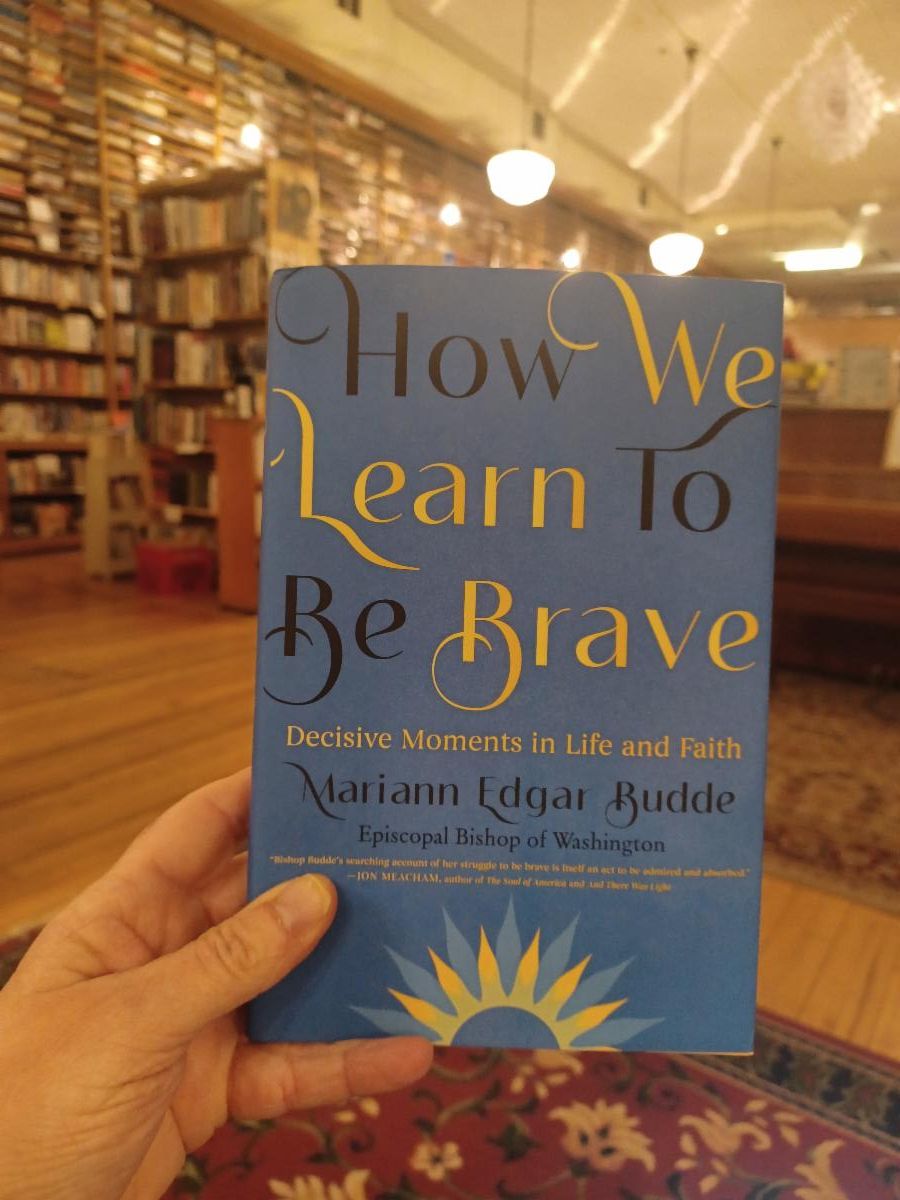
This makes me think of a book which we had been eagerly waiting to arrive - How We Learn to Be Brave: Decisive Moments in Life and Faith by Mariann Edgar Budde. I have only just started it, but it is resonating with me. I think we all believe that when that pivotal moment presents itself, of course we will have the courage to speak up and take action. I don't think it takes extraordinary courage. I think it is like a muscle and the more we use it, the stronger we will be in using our courage. I hope so. Courageous people are needed in the books we read as well as the spaces we live, work, and play. Be courageous.


Happy Reading!


Beth


Free! No tickets needed!


Each week/month, we offer a variety of events at our store or at The Root Note, one of our favorite community partners. Huge nod to Sara, our event store coordinator, for her attention to detail and amazing skills at coordinating it all. Last year she was behind over 120 events at Pearl Street Books. Every event is free. No tickets are necessary.


Have you attended any of our events recently? If so, we would appreciate hearing from you. What worked well? Anything missing? Email us at info@pearlstbooks.com


If you haven't attended any of our events, we would also like to hear from you. What prevents you from attending? Are there events you wish to see at our store? Email us at info@pearlstbooks.com


Cover to Cover (P.M. version) has been a store favorite for several years now. It is a book club which meets monthly. Everyone talks about whichever book they are currently reading (fiction or nonfiction). It is a great opportunity to learn about new to you genres and authors and talk about books you love. Last fall we implemented a morning version of it. We don't want to measure success only by numbers, but for the most part we have had only zero to 3 people attend each month. We recognize that some events are just not meant to be. However, we are going to give the morning version a bit more promotion and a bit more time before discontinuing. This month we are meeting on Wednesday, March 12 at 10:30 a.m.

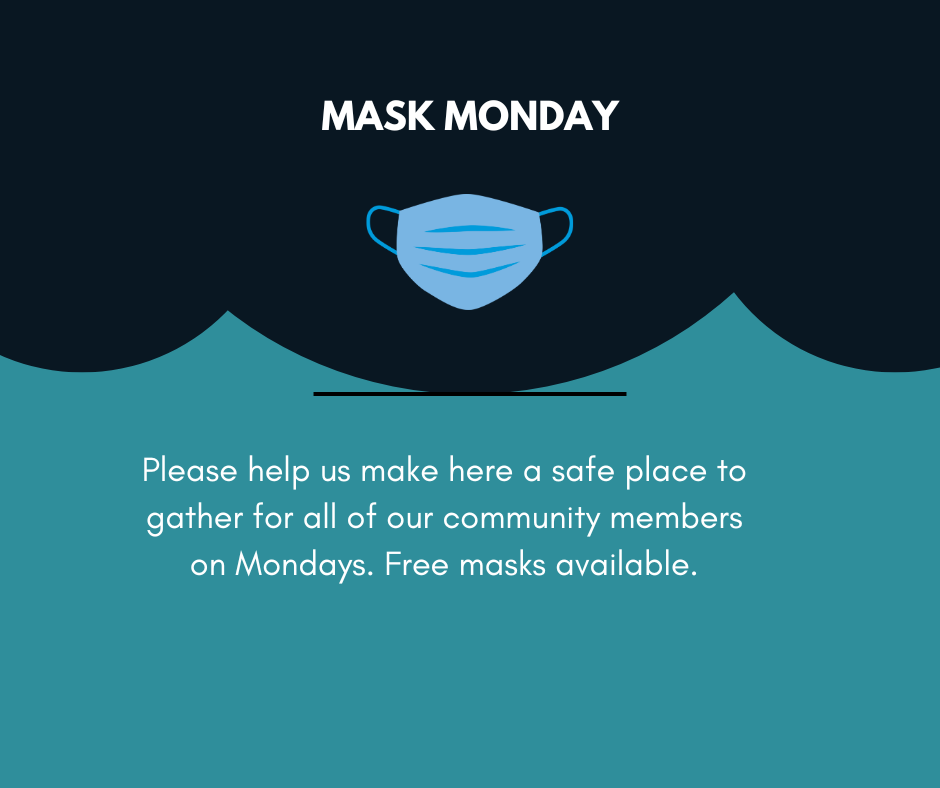
Mask Mondays


Masks reduce exposure to germs, allowing people who are immunocompromised to protect their health while fully participating in public life. We have people living in our community who are isolated because there are very few safe spaces to be where they can depend on everyone wearing a mask. To be honest, I hadn't thought of this until I read about another indie bookstore in another state which requires masks.


We want to offer a space for people who are immunocompromised as well as their friends and family. As such, beginning in March, our Mondays will be mask only shopping. We will offer free masks to anyone without one. Please help us spread the word to any neighbors, friends, or family members you know who may need a safe place to be out and about in our community.


UPCOMING EVENTS


Monday Morning Memoir

Monday, March 3, and every Monday after

10:30 to 11:30 am


Read with Therapy Dogs

Wednesday, March 5, and 19

10:30-11:30 am (Chilli & Nellie)

6:00 to 7:00 pm (Scout)


Mending Circle

Sunday, March 9

2:00 to 3:00 pm


Silent Book Club

Tuesday, March 11

7:00 to 9:00 pm

@ the Root Note


Cover to Cover: Book Club

Wednesday, March 12

10:30 to 11:30 am

6:30 to 7:30 pm


La Crescent Library

Author Event

Wednesday, March 12

Kari Lie Dorer

Muus vs. Muus: The Scandal That Shook Norwegian America

6:30 to 7:30 pm

@La Crescent Community Building


Philosophy Circle

Thursday, March 13

6:30 to 7:30 pm


Poetry Circle

Thursday, March 20

6:30 to 7:30 pm


Psychology Circle

Friday, March 21

6:30 to 7:30 pm


Music Between the Bookshelves

Hootenanny!

Saturday, March 22

6:30 to 7:30 pm


Author Talk

Thursday, March 27

Melina Packer

Feminism in the Wild

6:30 to 7:30 pm


Click here for more details about our events.


Growing Courage!

Thank you again to everyone who played our giveaway game last month. This month we're giving one free copy of Mariann Edgar Budde's How We Learn to Be Brave: Decisive Moments in Life and Faith to the first person who sends us an email mentioning this important book. Our email is info@pearlstbooks.com. Enjoy!

Image: Cover of the book, How We Learn to Be Brave.


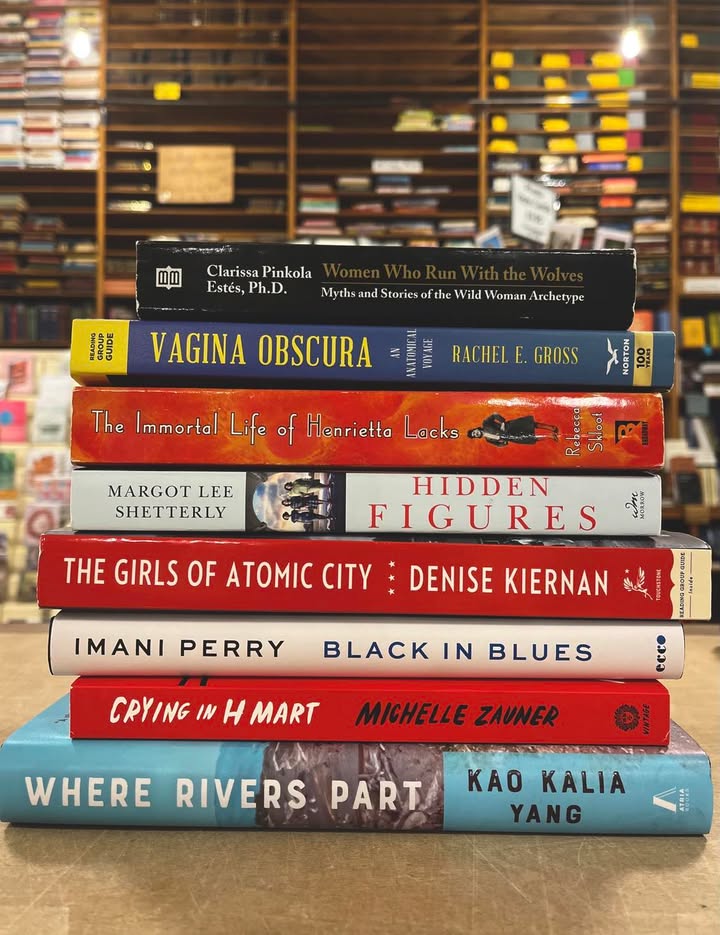
March is Women's History Month, so here's a solid list of women authors, nonfiction, fiction, and poetry, to spark your reading


Nonfiction


Women Who Run with Wolves by Clarissa Pinkola Estes 

This book, first published in 1992, could be considered dated or outdated, but I don’t think the concept of wild women ever loses style, and since it’s Women’s History Month, it's a good concept to lead with. Women Who Run with Wolves examines the mythology of the wild woman from around the world, examining her in light of more modern psychologies, presenting a clash of cultural mores, of what is expected and what is felt. If you give it a chance, I think you’ll find at least one story that resonates with your deep dark wild side.


Vagina Obscura by Rachel E. Gross 

According to this book’s intro, it wasn’t until 1993 that a federal mandate required women and minorities to be included in clinical research (and who knows how that mandate will weather this particular political moment), so all the more reason to read this book about one of the great mysteries of the human body–the vagina! The book is well-researched and accessibly, compellingly written, so without a doubt, you'll find some fascinating enlightenment within these pages.


The Immortal Life of Henrietta Lacks by Rebecca Skloot

Henrietta Lacks, a Black American woman, died of cervical cancer in 1951, but her cancer cells continued on, reproducing a new generation every 24 hours, ad infinitum. Doctors kept her cells, studying and using them (also ad infinitum) ever since, without her consent or the consent of her family. Skloot heard about Lacks's cells when taking a high school science class, and eventually her curiosity led her to seek out Lacks's family, particularly Deborah Lacks, Henrietta's daughter. This book is the result of that connection, offering searing insights on race, class, gender, and medicine.


Hidden Figures by Margot Lee Shetterly

Like Skloot's book, this is another story (and there are so many) of the repression of Black women in the face of modern science. This one is set against space instead of medicine and was made into a film, so maybe you've heard of it. If not, the story centers on four Black women, "human computers," who worked (while still segregated) at the Langley Memorial Aeronautical Laboratory during the Cold War space race with the Soviet Union. Books like this one, along with Skloot's, are so vital in shifting our collective understanding of our own pasts.


The Girls of Atomic City by Denise Kiernan

Here's another one, out from behind the curtains of history. In 1942, the federal government purchased 60,000 acres in Tennessee in order to build a city supporting 75,000 residents--a secret city at a time of war, the city's residents not clear on the end game for their work: the atom bomb. The author, Kiernan, interviewed a number of these men and women, particularly highlighting the stories of the women and their contributions to the WWII effort.


Black in Blues by Imani Perry

This book doesn't center women, but it is authored by a woman, and it's such a cool concept, we had to highlight it (plus the cover is exquisite). The book is a history of Black people through the lens of the history of the color blue. By tracing stories of how the color blue was created and carried across the world, and also transmogrified into the Blues, Perry traces and creates connections within Black culture that also contour into her own personal history with that big, vast, endless color. Fascinating.


Crying in H Mart by Michelle Zauner and Where Rivers Part by Kao Kalia Yang

We'll wrap up this nonfiction list with two memoirs, personal stories that resonate within larger immigration stories/histories, and within larger women's roles. Zauner is Korean American and Yang is Hmong, and both books largely center on the authors' mothers' stories. I have a lot of admiration for writers that take on the complexities of a mother's love in their writing; it is no easy thing to write about love in general, but mothers are a whole deep dark wild side of women and love, and both these books navigate the terrain beautifully.


Fiction/Poetry


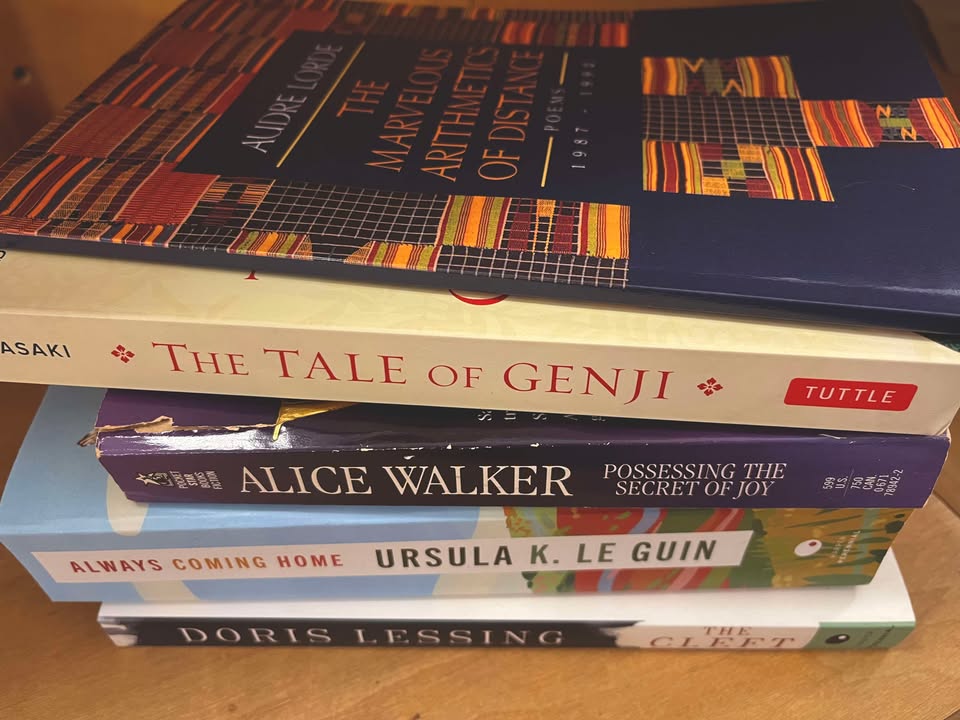
Always Coming Home by Ursula Le Guin

I can't feature women authors this month and not mention Le Guin; she's a personal favorite. Both Le Guin's parents were anthropologists, and while much of her writing slants under that influence, this novel does particularly, as it's written as an ethnography of an invented people: the Kesh. The Kesh live far into the future in a post-apocalyptic California, and the book features mythologies, songs, poetry, and beliefs of the Kesh. It's such an ambitious, fascinating work, further demonstrating Le Guin's sharp intelligence and command of craft.


The Marvelous Arithmetics of Distance by Audre Lorde

The title of this book feels apt in the context of women's history--an elusive and fantastic measurement that has so, so far to go. Lorde's poetry feels both timeless and deeply embedded in singular moments, her words smooth and hard as stones. Mentioning this book is also a subtle wave at Maya who used to work in the bookstore. She mentioned Lorde when I said I was writing about women's books this month, so if you're reading this, wave at Maya over the oceans, and then tuck into this excellent collection of poems.


The Cleft by Doris Lessing

Lessing (who won the Nobel Prize for Literature in 2007) always comes to mind when I think of personal classics of feminist literature, and this book fits the month's theme pretty perfect, as it's a retelling of the history of human creation, in a community of women who live and reproduce entirely without men. That is, until one of the women births a boy, changing everything. This is such a strange, imaginative, mythic novel, putting Lessing's unique spin on the whole of human history.


Possessing the Secret of Joy by Alice Walker

Walker never ceases to amaze me; she can take a whole enormous, difficult topic and distill it into a one-liner that sums that topic up perfectly, with her shrewd and wry humor. That and her novels are so good at navigating deep, heavy emotion without dipping into sentimentality or pity. Again, this novel is a great one for women's history, as it's an examination of female genital mutilation, the trauma, taboo, and tradition, and also a powerful story of resilience, art, and love.


The Tale of Genji by Lady Murasaki Shikibu

This book, written before 1021, is considered the world's first novel, written by a woman. The novel exemplifies courtly life during the height of the Heian period in Japan, and follows Prince Genji through his loves and exploits as a courtier. The novel has had generations of influence and continues to influence Japanese culture. Plus the whole concept of a novel originating with a woman--that's a nice walk on the deep dark wild side.

--reviews by RM

Image below: stack of novels by women authors

Ope! A word from your local indie press


Greetings! Last month I talked of firing up the Bourg, our old school Belgium perfect binding machine, which we did, and Bourg worked for about an hour before inexplicably freezing mid-zine, ending our work and leaving us in limbo. This is not the first time we’ve been confounded by this machine, so this seems a good moment to say a bit about our life with Bourg.


For the first three years of Ope!’s existence, Roxanne and I hand-stitched the majority of our zines: we’d put on a show or movie, and with needle and thread, we’d bind our zines, often late into the night, until our fingers went numb. We called them our stitch and bitch sessions; not a unique concept, but definitely a unique aspect of Ope!’s origins. Stitching even a hundred zines takes hours, and the length of each zine was limited to what we could push a needle through. Obviously, both these factors limited what we could produce. 


And then, lo and behold, Roxanne found and purchased the Bourg. 


Here's the gist of how Bourg binds a book: you, the human, lay the cover face-down flat on the right hand side of the machine, orienting it to meet the book’s stack of pages as you, the human, toggle the pages until they are smushed tight together inside a mechanical carriage that slides over from the left side of the machine. With this motion, the mechanical carriage runs the stack of pages over a set of blades, prepping them for glue application before meeting the cover, which then folds up and around the gluey spine like a taco. This is known as the perfect bind, how most books are bound (although most are on higher-tech, more modern machines than our Bourg).


When Bourg is working well, the process is pure joy, because we're creating books (they're zines, but they're also books)--the most beloved, magical object I've ever known. When Bourg doesn't work, or stops working and we don't know why, it is in direct opposition to pure joy. It is hell. And with Bourg, you just never know what you're gonna get. The machine rules us.


Next month, I'll introduce a hero and conclude this story. As we have learned with Bourg--sometimes you just have to wait. Until next time!

What's Staff Reading?


From Sophie:


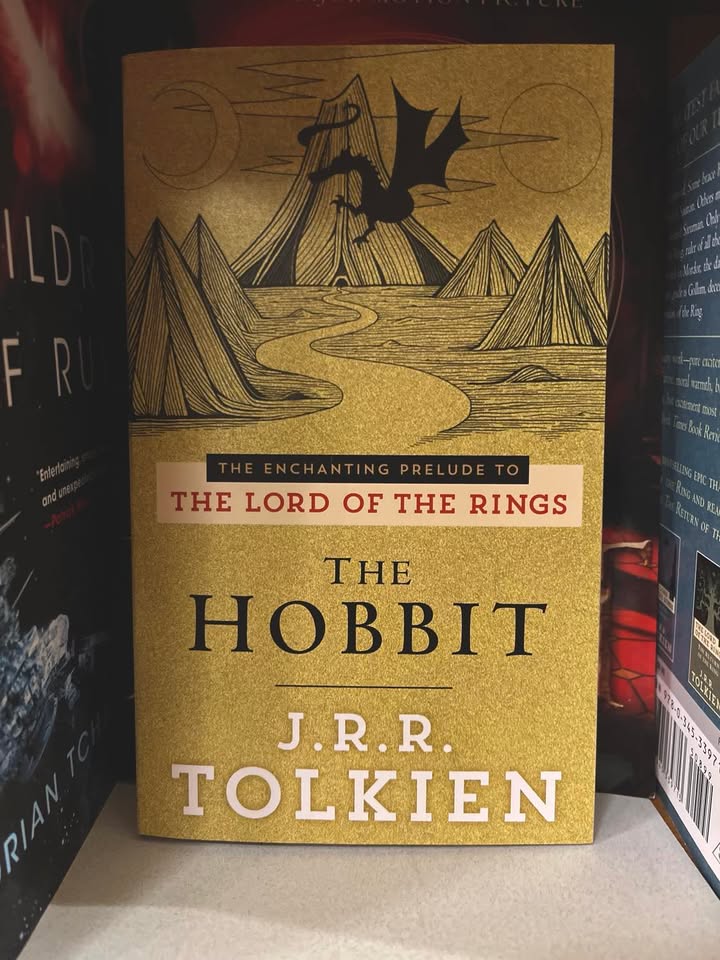
Currently I am reading The Hobbit by JRR Tolkien. It is a prequel to the Lord of the Ring Series, but is an excellent stand-alone novel. I chose to read this book because it is a comfort book and perfect fantasy story. The Hobbit follows an initially reluctant Bilbo Baggins out of his cozy hobbit hole and off onto an adventure full of unexpected dangers and excitement. Bilbo changes and grows as a character from a very respectable hobbit to a true adventurer over the course of his journey. The novel is very sweet and also has its funny moments. There are songs and poems, tales, and many mystical characters. There is just something so special and nostalgic to me about the book. The writing is very descriptive and puts you straight into the moment on the page. It is the perfect before-bed read.


Image below: Paperback copy of The Hobbit.


Happy Reading!

Keep in Touch!

Facebook  Instagram