|
Monday Report March 18th, 2024
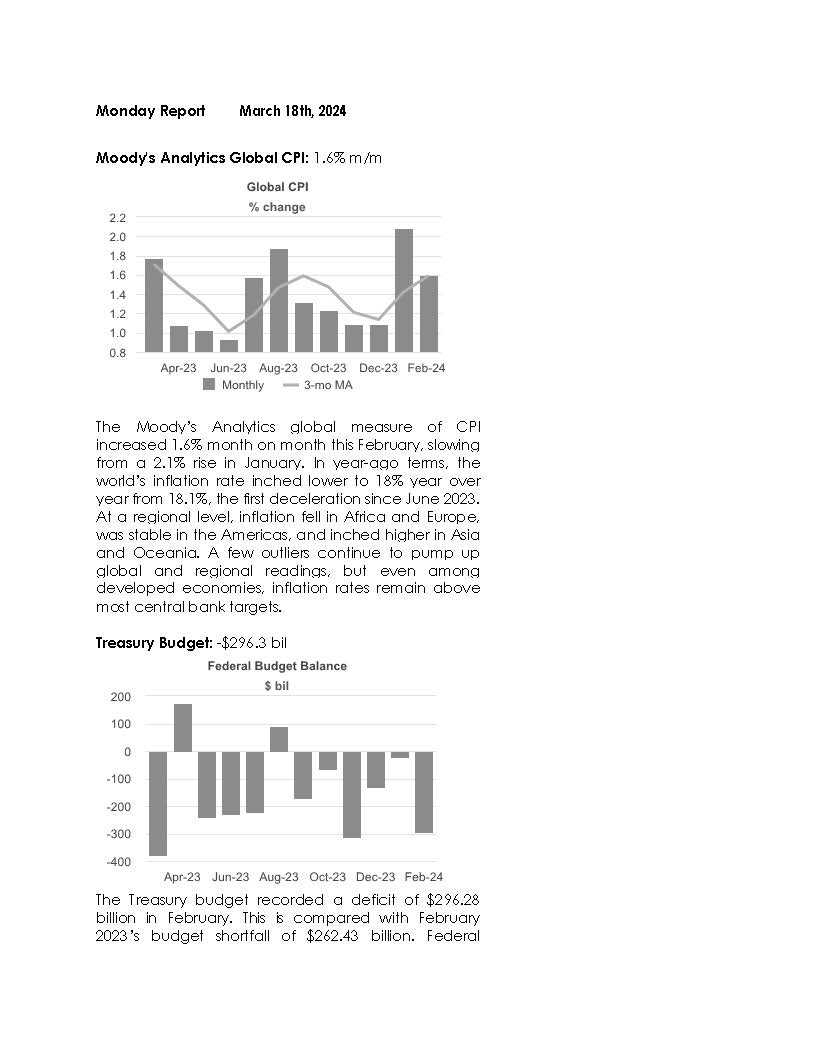
Moody's Analytics Global CPI: 1.6% m/m
The Moody’s Analytics global measure of CPI increased 1.6% month on month this February, slowing from a 2.1% rise in January. In year-ago terms, the world’s inflation rate inched lower to 18% year over year from 18.1%, the first deceleration since June 2023. At a regional level, inflation fell in Africa and Europe, was stable in the Americas, and inched higher in Asia and Oceania. A few outliers continue to pump up global and regional readings, but even among developed economies, inflation rates remain above most central bank targets.
Treasury Budget: -$296.3 bil
The Treasury budget recorded a deficit of $296.28 billion in February. This is compared with February 2023’s budget shortfall of $262.43 billion. Federal receipts rose 3.4% on a year-ago basis to $271.13 billion, while outlays increased 8.2% year over year to $567.4 billion. The federal government has approved an approximately $460 billion bill to fund about half of nondefense discretionary federal government operations. A recently passed continuing resolution extended funding for defense and the other half of the nondefense budget to March 22. Risk of a partial government shutdown has been significantly reduced in recent weeks but nonetheless remains.
Moody's Analytics Survey of Business Confidence: 10.7
Global business sentiment has stabilized in recent weeks, although it has meaningfully improved since late last year. While it remains premature to conclude that this is the beginning of a sustained improvement in sentiment, it is encouraging. More than one-fourth of responses to the nine questions posed in the global business survey are positive, less than one-fifth are negative, and the remaining responses are neutral. The survey results are consistent with a global economy that is growing close to its potential.
Consumer Price Index: 0.4% m/m
February’s consumer price index came in on the high side. The 0.4% increase in the headline CPI from January to February is above our forecast of a 0.3% gain. Relative to a year ago, the CPI rose from 3.1% to 3.2%. Core CPI, which excludes food and energy prices, rose 0.4% as well. The increase was above ours and consensus expectations of a 0.3% rise, though the annual core CPI rate ticked down from 3.9% to 3.8%. Following consecutive monthly declines, energy prices rose 2.3% in February. The CPI for shelter decelerated modestly. After a 0.6% increase in January, shelter prices rose 0.4% in February. This marks two hotter-than-expected inflation reports to start 2024, strengthening the case for those urging patience as the Federal Reserve decides when to start easing policy.
Quarterly Services Survey: 1.9% q/q
After slowing through midyear, revenue growth in the service sector picked up again to close out 2023. From the third quarter to the fourth, revenue expanded by a downwardly revised 1.9% (previously 2%) on a seasonally adjusted basis, up from a 0.7% gain in the third quarter. Though U.S. consumers have continued to spend on services, some of the recent gains can also be attributed to inflation, which is still a primary concern of the Federal Reserve because declining purchasing power will remain a primary threat to households and businesses.
Regional and State Employment:
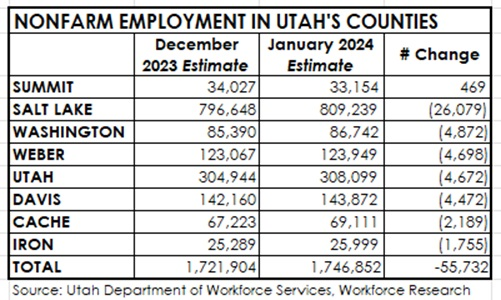
State and regional employment growth picked up in January, while the unemployment rate either held steady or rose modestly across the nation. Payrolls expanded at a statistically significant clip in eight states, with New York and Vermont leading the way in percentage terms and New York also adding the most jobs in total, while no economy experienced a meaningful decline. The unemployment rate increased significantly in four states, declined in two, and did not experience a material change across the rest of the U.S.
Employment Situation: 275,000 m/m, +22,000
The labor market keeps rolling on. Payroll employment rose by 275,000 in February, once again besting expectations. Growth was strongest in healthcare, leisure/hospitality, and the public sector, which accounted for more than two-thirds of total gains. Unlike January's report, the impact of revisions on prior months was significant and negative as gains in December and January were revised lower by a combined 167,000. The average gain over the last three months is now 265,000, compared with 289,000 last month—prior to revisions. The household survey was far less optimistic as the unemployment rate rose to 3.9%—highest since January 2022—and employment fell for the fourth time in the last five months.
NFIB Small Business Survey: 89.4
The NFIB Small Business Optimism Index fell for the second month in a row in February. The headline index fell from 89.9 to 89.4 in February, bucking our expectation for a mild increase. February’s reading is the lowest since May 2023. Weakness was broad-based, with the seven of the 10 components backtracking on the month. Small businesses remain pessimistic about the current and future state of the economy, and the index has therefore clocked in below the 49-year average of 98 for 26 consecutive months.
MBA Mortgage Applications Survey: 7.1%
Mortgage activity jumped in the week ended March 8, marking the second straight week of significant increases. The MBA’s market composite index increased 7.1% on the previous week, which followed a 9.7% increase the week before. Both indexes showed improvement, though the refinance index performed better, climbing 12.2% compared with the purchase index’s 4.7% increase. Mortgage rates were behind the refinance index’s stark improvement, showing large decreases across almost all products. The 30-year fixed mortgage rate declined 18 basis points, coming in at 6.84%.
Oil Inventories: 447.0 mil barrels.
Oil prices could see some upward movement after crude oil inventories unexpectedly fell by 1.5 million barrels in the week ended March 8. Meanwhile, the consensus was predicting a build of about 2.8 million barrels. Gasoline inventories fell by 5.7 million barrels, a larger draw than the 1.8 million barrels analysts projected. Distillate inventories rose by 900,000 barrels, besting consensus expectations of a 1.4-million-barrel draw. During the last four weeks, total U.S. demand was up 1% compared with a year earlier.
Source: Economy.com, Bonneville Research
|