|
Greetings from PCAP!
PCAP is organizing a number of events this month that you may be interested in participating.
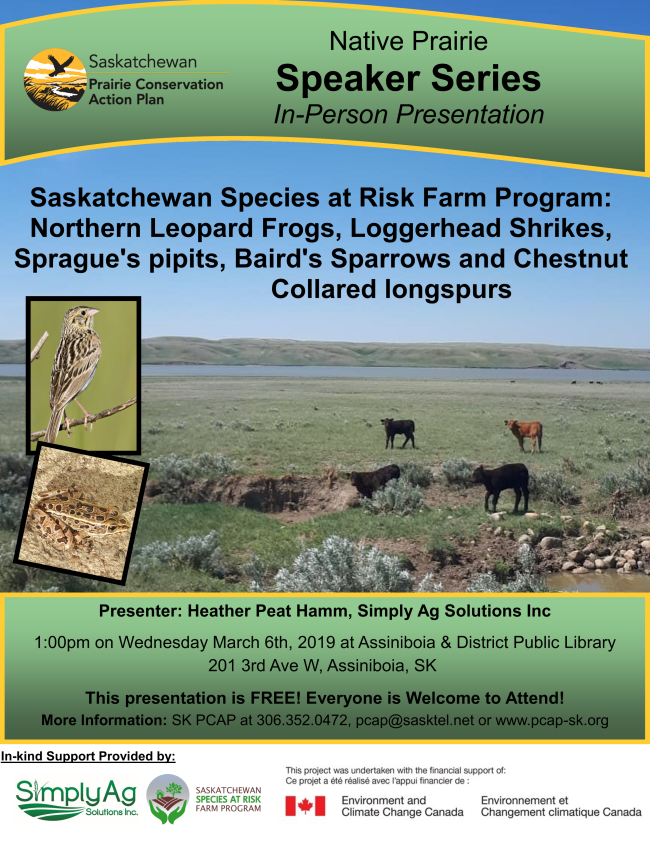
As anticipated in our last newsletter, tomorrow Wednesday March 6th, Heather Peat Hamm
from Simply Ag Solutions Inc., will be presenting in Assiniboia (at 1 pm) and Weyburn (7 pm), the
Saskatchewan Species at Risk Farm Program for Northern Leopard Frogs, Loggerhead Shrikes, Sprague's pipits, Baird's Sparrows and Chestnut Collared longspurs.
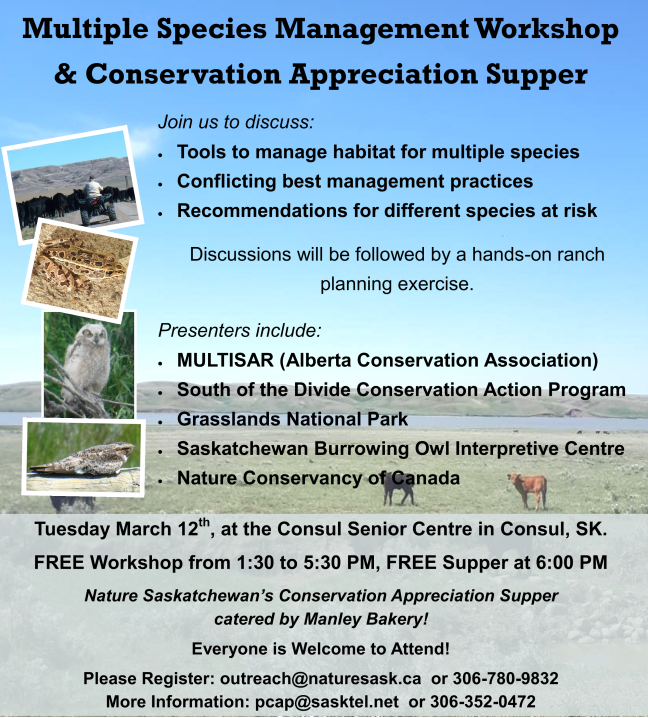
Next Tuesday March 12th, we are carrying out an interesting Workshop on
Multiple Species Management,
which will take place in Consul, SK. This half-day workshop, co-organized with SODCAP Inc and Nature Saskatchewan, will be followed by the Nature Saskatchewan's Conservation Appreciation Supper. During the workshop, representatives of SODCAP Inc., Grassland National Park, the Alberta Conservation Association and invited landowners and managers will be presenting their experiences on implementing multi-species management programs and plans. The event will also include a hands-on ranch planning activity. The Workshop and Appreciation Supper are free and everyone is welcome to attend!
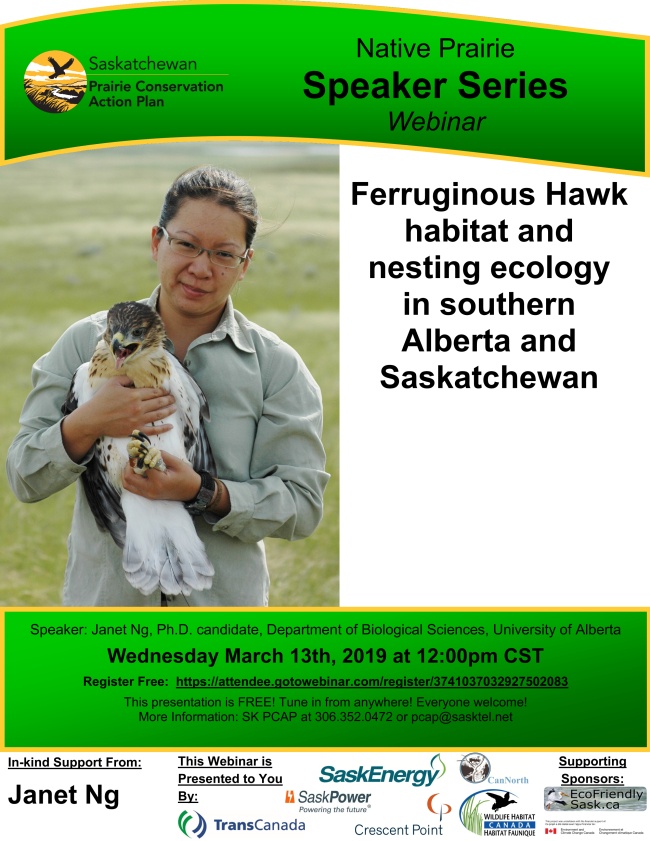
On Wednesday March 13th, Janet Ng, PhD candidate from the University of Alberta will be presenting on "
Ferruginous Hawks habitat and nesting ecology in southern Alberta and Saskatchewan"
. Please register for free here.
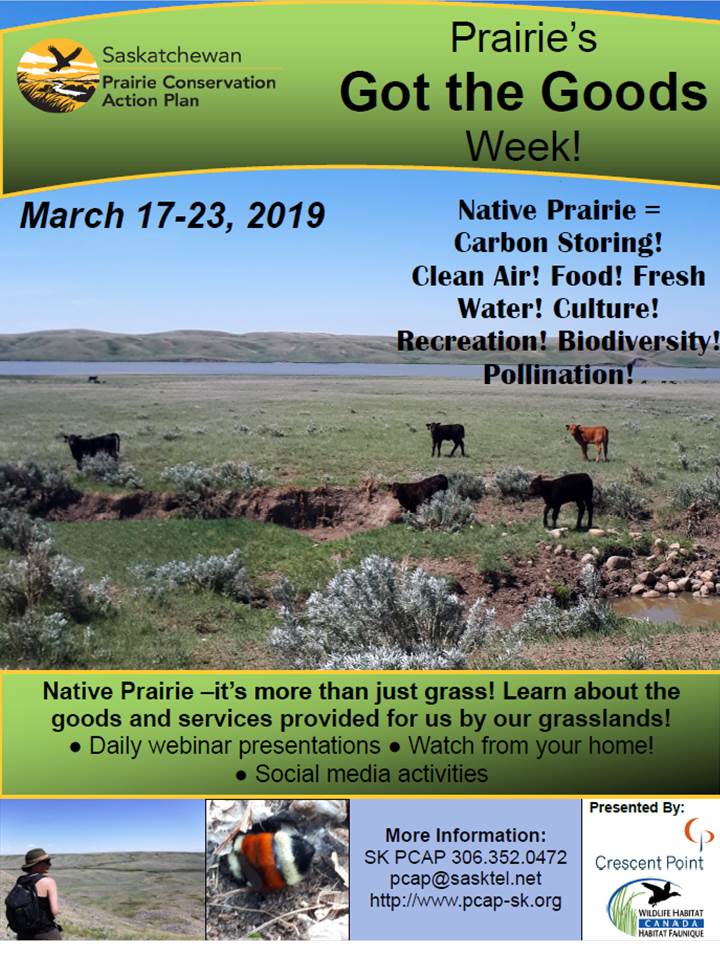
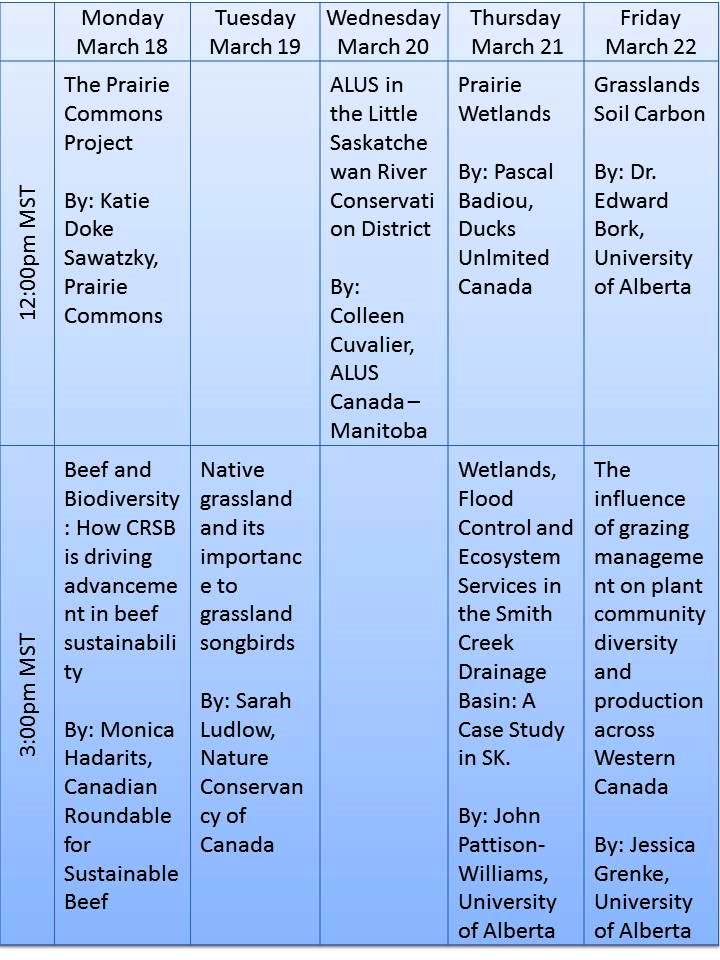
We are also very proud to celebrate the "Prairie's Got the Goods Week" on March 18th - 22nd, a week-long series of eight webinars about the ecological goods and services provided by Native Prairies! The webinars during that particular week include presentations on: 1. "Prairie Commons Project" by Katie Doke Sawatzky (U of Regina), 2. "Beef and Biodiversity: How Canadian Roundable for Sustainable Beef is driving advancement in beef sustainability", by Monica Hadarits (CRSB), 3. "Native grassland and its importance to grassland songbirds", by Sarah Ludlow (NCC), 4. "ALUS in the Little Saskatchewan River Conservation District", by Colleen Cuvalier (ALUS Canada, MB), 5. "Prairie Wetlands" by Pascal Badiou (Ducks), 6. "Wetlands, Flood Control and Ecosystem Services in the Smith Creek Drainage Basin: A Case Study in Saskatchewan", by John Pattison-Williams (U of Alberta), 7. "Grasslands Soil Carbon", by Edward Bork (U of Alberta), and 8. "The influence of grazing management on plant community diversity and production across Western Canada", by Jessica Grenke (U of Alberta). For more information on the presentations and free registrations, please visit our website.
We want to take this opportunity to thank the generous support from our sponsors: Crescent Point Energy, SaskEnergy, TransCanada, CanNorth, Wildlife Habitat Canada, EcoFriendly Sask, Environment and Climate Change Canada, as well as the continuous support of the PCAP's Partners.
Finally, we want to congratulate Emily Putz (Nature Saskatchewan) and Tom Harrison (SODCAP Inc.) for receiving recognition at the 12th Prairie Conservation and Endangered Species Conference in Winnipeg on February 19-21, 2019. Emily was awarded with the "Young Professional Stewardship Grant" that promotes future work in prairie conservation and endangered species management, and Tom was awarded with the "Prairie Conservation Award" for his significant long-term contributions to native habitat or species at risk conservation.
Please feel free to contact us at any time; we are pleased to receive your questions, comments or ideas.
Sincerely,
Diego Steinaker, SK PCAP Manager
Caitlin Mroz,
SK PCAP Stewardship Coordinator
Julie-Anne Howe,
SK PCAP Education Coordinator
Ph. 306 352 0472
pcap@sasktel.net
|
TUESDAY MARCH 12th, 2019
1:30 PM to 5:30 PM: Workshop
6:00 PM:
Conservation Appreciation Supper
Consul Senior Centre, Consul, SK.
|
"Prairie's Got the Goods Week"
|
|
Managing habitat for single species, multiple species, communities, or ecosystem?
by Diego Steinaker, SK PCAP
Managers have a continuum of options for managing habitats and resources, from one species or a few species to the management of the entire communities, landscapes or ecosystem. Each approach has pros and cons, and managers must decide which approach meets their objectives.
Single to Multiple Species Management
Habitat management for target species generally relies on the principle that, by managing for one or a few species, it would provide a suitable habitat for numerous other species as well. This assumption is particularly valid for a group of species that utilize similar resources. However, an ecosystem generally encompasses a large number of species and each species exploits a unique ecological niche (e.g., food and shelter needs). Many of the species' niches overlap to some extent, but many other species may have completely different ecological niches. Therefore, managing for one or few species may reduce habitat quality and quantity for species with different ecological requirements.
For example, managing grassland habitats for Sprague's Pipit that requires continued grass vegetation (not too tall and dense or short and spare) with light to moderate grazing and periodic prescribed fires will reduce habitat availability for species that require isolated tall shrubs and variable height grass vegetation such as Loggerhead Shrikes. Thus, management plans that aim to reach species-specific habitat targets may conflict with habitat requirements of other species. In other words, best management practices (BMPs) for one given species may be not the best practices for another species. The main challenge for land managers here is managing habitat for multiple species, dealing with conflicting BMPs for species that share the same landscape and time but have different ecological requirements. An advantage of multiple-species approaches is that managers can account for numerous species through management activities at a cost that is equal to or even less than that incurred for single species.
However, we should not rule out specific-species approaches for management and conservation. Ultimately, the managers' chosen approach will depend on their specific objectives. If the main objective is to recover a particular threatened or endangered species with relevant ecological, economic or social importance, then a single-species management approach will be more convenient for faster and more effective results. In addition, federal and provincial funding for research and conservation mainly supports habitat management projects for species listed as threatened by the Canadian Species at Risk Act, encouraging species-based approaches over conservation to higher levels of organization (community, landscape, and ecosystem).
Some authors maintain that there is not much difference between approaches (i.e., species, community, landscape, and ecosystem): If you want to manage for a species you need to look at community, landscape and ecosystem. In addition, it is valid and even desirable to use the ability of iconic or emblematic species to capture the public's attention and, thereby, funding support for conservation. If Greater Sage-grouse, for example, is an emblematic species on native prairies that mobilize people, a single-species management approach may be more appropriate. Managing for that particular species will finally contribute to preserving the entire ecosystem for all the other species that share its habitat.
However, as Ken Thompson, the author of Do We Need Pandas?, asserts, this "iconic species" approach may lead to the wrong idea that there is a "Greater Sage-grouse problem" when in fact the decline in Sage-grouse - and all other species at risk - populations is the result of the same mix of problems: habitat conversion, habitat degradation, climate change, invasive species, disturbances, among others. Much as we like Sage-grouse, it would be more convenient to raise awareness and educate people to understand about the real problems and causes.
Ecosystem Management Approach
Species are just one component of the whole ecosystem. Conservation plans should be more effective if we shift from species-based approaches to more comprehensive and holistic ecosystem approaches, i.e., management plans that provide diverse environmental conditions to meet the needs of multiple species. Such management plans cannot be focused in particular species-specific habitat requirements, but must strive to maintain the functionality of the ecosystem, that is, the biological, biogeochemical and physical processes and components within the ecosystem.
Managing habitat to maintain ecosystem functions will finally provide adequate conditions for all component systems, including species populations. In turn, the monitoring of the performance of species populations may be used by land managers as reliable indicators of the effectiveness of ecosystem management. We should also mention that managing for ecosystem is also important for maintaining the capacity of the ecosystem to supply other goods and services including mitigation of floods and droughts, generation of soil, carbon sequestration and nutrient cycling, pollination, and stabilization of climate.
Habitat Loss: The Greatest Threat
There are many threats for species at risk in Canadian native prairies, such as climate change, invasive species, over-hunting or trapping, changes in the frequency and intensity of disturbances, use of pesticides, change in land use, habitat degradation and habitat loss, among others. Canada has made significant progress in reducing some of these threats and in helping some species to recover. Thus, the importance of these threats has varied through time. For example, trapping and hunting are generally well regulated today and are not a significant threat to endangered species in Canada as they were at the beginning of the last century. Of all the threats to native prairie species and of all the factors endangering wildlife, the challenge for our generation is stopping habitat loss (even over climate change). To save and recover species at risk we need to save habitat.
Dan Kraus
from Nature Conservancy Canada stated that, now, you might have thought climate change is our biggest challenge, but to save species, to prevent the further loss of Canada's wildlife, we need to save habitat. There is no opportunity for species recovery if their habitat is lost. Changes in hunting regulations couldn't have saved pronghorns if there wasn't any habitat left. And solving climate change won't protect species if, in our race to reduce carbon emissions, their habitat disappears.
The leading cause of this loss is the conversion of grasslands to cropland. The conversion of intact grasslands represents a significant ecological loss that cannot easily be recovered. Agriculture and Agri-Food Canada inventory indicates that an average of 2.4 million acres of grasslands were converted to cropland between 1990 to 2010 in the Prairie provinces. An analysis by University of Regina professor Joe Piwowar shows a decline of 3.3 million acres over the last 25 years. The last World Wildlife Fund's Plowprint Report, which uses AAFC data maps in its measurement of grassland conversion to cropland, confirmed the trend by stating that the highest rates of grassland conversion in the Northern Great Plains were in Saskatchewan and Alberta.
At present, less than 8.2 million acres of grassland remain in Saskatchewan. This means that, out of the historical 60 million acres the Prairie ecozone once encompassed in the province, only 13.7% remains. Stopping habitat loss is the key to saving native prairie endangered species.
|
|
| |
|
|
|
Upcoming Events!
by Heather Peat Hamm
Wednesday March 6th
1:00 PM, Assiniboia, SK
7:00 PM, Weyburn, SK
Multiple Species Management Workshop
i
n conjunction with the
"
Nature Saskatchewan's Conservation Awareness Day Supper"
Tuesday March 12, from 1:30 pm
Consul, SK
by Janet Ng
March 13th (12:00 PM CST)
SK-PCAP multiple Webinars
March 18-22, 2019
7. "
Grasslands Soil Carbon
", by Edward Bork (U of Alberta), and
Back to the Field Workshop
SRM - Prairie Parkland Chapter
May 28-29 -
Val Marie, Sk
by Julie Landry-Deboer
April 15th (12:00 PM CST)
---------------------------
Conferences and webinar presentations online:
or
|
Native Prairie Speaker Series
by Heather Peat Hamm, Simply Ag Solutions Inc.
Wednesday March 6th at 1:00pm
Assiniboia, SK
Wednesday March 6
th at 7:00pm
Weyburn, SK
|
Native Prairie Speaker Series
Ferruginous Hawks
by Janet Ng (University of Alberta)
March 13th at 12:00pm CST
|
Native Prairie Speaker Series
Predictive Models for Grassland Songbird Species
by Julie Landry-Deboer, Alberta Conservation Association
Monday April 15th at 12:00pm CST
|
|
The Saskatchewan Co-operative Wildlife Management Survey
The Saskatchewan Co-operative Wildlife Management Survey, formerly the Co-operative Deer Management Survey, is a long-standing, volunteer-based survey that provides the ministry with valuable productivity and herd structure information. Participants have the opportunity to conveniently record observations using the new mobile SK CWMS application, that is compatible with both Apple and Android smart phones.
Although the SK CWMS application will allow participants to record observations at any time of year, there are key periods where it is particularly important to record your observations for each species:
- White-tailed deer and mule deer: Sept 1 to Nov 30
- Moose: Sept 1 to Dec31
- Elk: Sept 1 to Feb 28
- Sharp-tailed Grouse: March 1-July 15
- Wild Turkey: Dec 1 to March 1
|
|
Diego Steinaker, Editor, Saskatchewan Prairie Conservation Action Plan Newsletter
306-352-0472 |
|
|
SK PCAP gratefully acknowledges financial support in 2018-2019 from:
Ducks Unlimited Canada, Canada North Environmental Services, EcoFriendlySask.ca, Information Services Canada, Parks Canada - Grasslands National Park of Canada, Rancher's Stewardship Alliance Inc., Saskatchewan Cattlemen's Association,
Saskatchewan Ministry of Agriculture, Saskatchewan Ministry of Environment - Fish and Wildlife Development Fund,
SaskEnergy,
SaskPower, SaskTel, University of Saskatchewan - College of Agriculture and Bioresources, Water Security Agency.
SK PCAP gratefully acknowledges in-kind support for 2018-19 from:
Agriculture and Agri-Food Canada - Science and Technology Branch, Canadian Parks and Wilderness Association, Canadian Western Agribition, Environment Canada - Canadian Wildlife Service, Friends of Wascana Marsh, Meewasin Valley Authority, Native Plant Society of Saskatchewan, Nature Conservancy Canada, Nature Saskatchewan, Parks Canada - Grasslands National Park, Prairie Wind & Silver Sage, Ranchers Stewardship Alliance Inc., Redberry Lake Biosphere Reserve, Saskatchewan Association of Rural Municipalities, Saskatchewan Association of Watersheds, Saskatchewan Cattlemen's Association, Saskatchewan Environmental Society, Saskatchewan Forage Council, Saskatchewan Forage Industry Network, Saskatchewan Ministry of Agriculture, Saskatchewan Ministry of Environment, Saskatchewan Ministry of Economy, Saskatchewan Ministry of Education, Saskatchewan Ministry of Tourism, Parks, Culture and Sport - Royal Saskatchewan Museum and Friends of the Royal Saskatchewan Museum, Saskatchewan Research Council, Saskatchewan Stock Growers Association, Saskatchewan Wildlife Federation, Saskatoon Nature Society, SaskEnergy, SaskOutdoors, SaskPower, Society for Range Management - Prairie Parkland Chapter, South of the Divide Conservation Action Program Inc., University of Regina - Prairie Adaptation Research Collaborative, University of Saskatchewan - College of Agriculture and Bioresources, Wild About Saskatoon-Nature City Festival.
|
|
|
|