SMART POLICING INITIATIVE UPDATES - March 2024

Recent Updates

Dear SPI Community,


Please check out recent updates from the Smart Policing Initiative (SPI):

  1. Welcome to the recently awarded SPI sites. 
  2. The International Association of Directors of Law Enforcement (IADLEST) is developing cutting-edge legal training resources designed to support constitutional decision-making for law enforcement professionals. 
  3. Newly featured resource on advancing policing, implementing change in law enforcement, Public Safety Officer's Educational Assistance, considerations for specialized units, and the active shooter at Robb Elementary.
Visit our Website

WELCOME: Recently Awarded SPI Sites

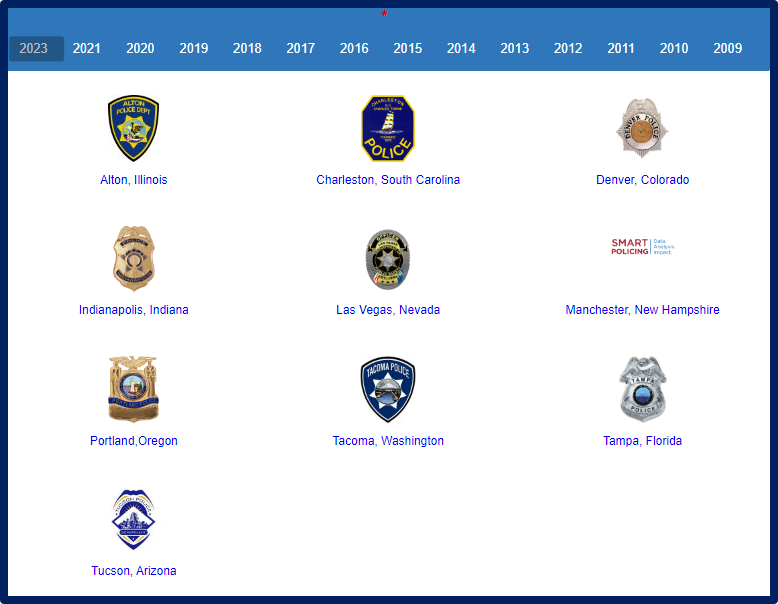
The Bureau of Justice Assistance's (BJA) Smart Policing Initiative (SPI) wants to welcome our new SPI Sites and invites you to visit their site profiles for insight on their upcoming evidence-based efforts to improve safety in their communities.


The SPI will be supporting these sites over the next 3 years as they work to develop and implement their SPI initiatives.


  • Category 1 Awardees: Smart Policing Innovation
  • Charleston, SC
  • Denver, CO
  • Las Vegas, NV
  • Portland,
  • Category 2 Awardees: Smart Policing Approaches to Community Violence Intervention and Prevention
  • Alton, IL
  • Manchester, NH
  • Category 3 Awardees: Smart Policing Technology Development and Implementation
  • Indianapolis, IN
  • Tacoma, WA
  • Tampa, FL
  • Tucson, AZ


The new site profiles can be viewed here.

Constitutional Decision-Making for Law Enforcement: Protecting Civil Rights While Pursuing Justice        

The International Association of Directors of Law Enforcement (IADLEST) is developing cutting-edge legal training resources designed to support constitutional decision-making for law enforcement professionals. The training resources will be free, available to any officer, and ideal for basic academy settings, field training, in-service, or roll call.


Constitutional Policing is defined as policing conducted within the parameters of the U.S. Constitution and informed by state constitution(s) and federal and state court decisions, which together define roles and responsibilities of law enforcement agencies and personnel in terms of everyday practices.


IADLEST seeks examples from the field to help build the project team’s understanding of what resources are currently being used to train officers in constitutional authority. U.S.-based law enforcement agencies and trainers are invited to contact the project team if they have resources that they are willing to share. We are specifically seeking examples of lessons, practical exercises, scenarios, job aids, videos, and other training tools focused on understanding constitutional authority, parameters, and responsibilities.


About the Project


In 2022 IADLEST received funding from the U.S. Department of Justice’s Bureau of Justice Assistance to provide training support to the nation’s law enforcement agencies on topics related to constitutional policing.


The project goal is to provide free training resources that increase the competence and confidence of officers related to their constitutional authority, parameters, and responsibilities. This includes strengthening officer understanding about the constitutionality of daily decisions they make.


The project team invites people who are interested in learning more about this project, sharing constitutional policing resources, or discussing what types of training resources would be most beneficial to the field to contact the Project Manager Dianne Beer-Maxwell at Dianne@iadlest.org

New Resources


Bureau of Justice Assistance Smart Policing Initiative
GET CONNECTED
Twitter  Youtube  
This project was supported by Grant No. 2019-WY-BX-K001, awarded by the Bureau of Justice Assistance. The Bureau of Justice Assistance is a component of the Department of Justice's Office of Justice Programs, which also includes the Bureau of Justice Statistics, the National Institute of Justice, the Office of Juvenile Justice and Delinquency Prevention, the Office for Victims of Crime, and the Office of Sex Offender Sentencing, Monitoring, Apprehending, Registering, and Tracking. Points of view or opinions in this document are those of the author and do not necessarily represent the official position or policies of the U.S. Department of Justice.