|
Dear Muskoka ECE Community,
Recently, I spent a day with community partners from across Muskoka looking at our region's most recent Early Development Instrument (EDI) data together. You can read the EDI Over Time Report here or explore more through our EDI Dashboard if you’re curious about the numbers.
The EDI captures a snapshot of how children are doing across five developmental domains when they enter kindergarten. It's a population-level tool, like a community health scan. It reflects what kindergarten teachers and DECEs observe in school settings. While it can’t capture everything children know and can do, particularly competencies that show up at home, in community, or in cultural contexts the tool wasn't designed to measure, the EDI offers valuable information about how our children are doing overall as a kind of indicator of our community's wellness and how broader conditions are affecting our youngest citizens.
The data shows us something you've been living: our community systems aren't keeping pace with the increased complexity children and families are navigating. Fewer children in Muskoka are arriving at kindergarten with the developmental readiness typically expected. Overall, 38% of children now enter kindergarten scoring in the lowest ranges in at least one domain.
You already know this. You see it every day. The data just names what you've been holding.
AND the important thing is this: we know how to improve outcomes when we work together intentionally as a community: the gains we've seen in literacy show us that change is possible.
What's equally true: the work you're already doing - the daily, relational, intentional work - matters profoundly. And children's development doesn't happen in isolation. It's shaped by housing stability, food security, access to healthcare, family mental health support, safe outdoor spaces, and so much more - all the systems around families.
| | |
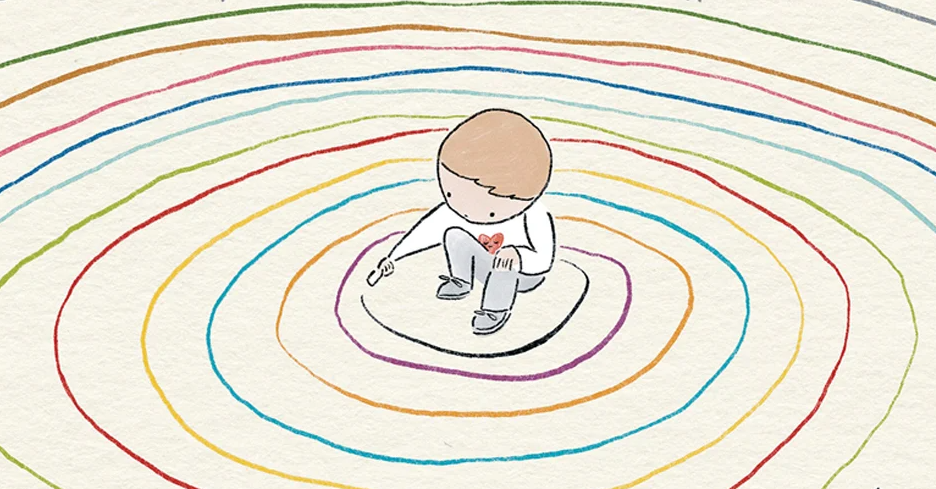
There's a moment in Brad Montague's picture book The Circles All Around Us when a child realizes we're all part of many circles that can overlap, protect, and hold each other. That's what the System Planning Day was about: recognizing that we're all part of interconnected circles around Muskoka's children and families, and that when we strengthen those connections, we strengthen everything.
The day, and the data we looked at, wasn't about trying to "fix" kindergarten readiness. It was about community partners asking: what do children and families need from us in those earliest years? Where are the systemic gaps? What's working well that we need to protect and expand? How do we address root causes?
| | |
You know, perhaps better than most, that what happens between birth and six shapes everything that follows. Your daily work matters, and so does the work of strengthening those upstream systems that shape children's lives long before they reach your programs. That's where the planning conversations are and will continue to be focused.
While the data carries weight, it also helps us tell the story of why our collective work matters, deeply. I encourage you to talk to your neighbours and other folks who might not 'get it' the way that you do, about why early childhood matters. These babies grow up to be our neighbours, our co-workers, our caregivers. What's best for kids now is best for Muskoka long-term.
Thank you for continuing to do the beautiful, hard, messy, and ESSENTIAL work of meeting children exactly where they are, and helping them become who they're meant to be.
With deep gratitude,
Vanessa
| |
|
🔎 Want to shape what shows up in your inbox?
I'd love to hear from you - and I'll enter you in a draw for a $50 resource of your choice for your program (books, loose parts, art supplies, whatever your space needs).
Just reply to this email with ONE of these:
- One thing from this newsletter that resonated with you
- One topic you'd love to see covered in future newsletters
- One practice or moment from your program you'd be willing to share (even just a sentence!)
Draw date: April 1st.
Submit your thoughts here: vanessa.fraser@muskoka.on.ca
🎉Congrats to Krista Yearly at Huntsville Co-Op Nursery School & Day Care Centre for winning last month’s prize!
| | | | |
What "Ready" Actually Looks Like
Every spring, a version of the same question starts circulating. Sometimes it comes from families, sometimes from community members, sometimes from within our own systems: Is this child ready for kindergarten?
And it almost always comes attached to a checklist. Letters. Numbers. Colours. Shapes.
Here's what the science tells us: by the time a child walks through a kindergarten door, the most significant preparation has already been happening — for years. And it looked nothing like a checklist.
The First 2000 Days
From conception to age five (approximately 2000 days), the brain is developing at a pace that will never be matched again. Research from the Centre on the Developing Child at Harvard University tells us that in the earliest years, a child's brain is building more than one million new neural connections per second. This is when the architecture of learning, behaviour, and health is literally being constructed.
And what drives that construction? Not worksheets, not circle time, not flashcards. It's Relationships, Movement, Curiosity, and Play.
| | The experiences children have in those first 2000 days shape the brain structures that underpin everything we associate with school readiness: the capacity to focus attention, regulate emotions, persist through challenges, and connect with others. These capacities don't emerge from drilling letters. They emerge from thousands of small, rich, embodied experiences, and from the presence of caring adults who make those experiences feel safe enough to try. | |
| |
Every child arrives at kindergarten having had 2000 days of brain-building. The question was never whether they were building, it's what their environment gave them to build with.
Play Is Not the Opposite of Learning
When children play, they are doing some of the most cognitively demanding work of their lives.
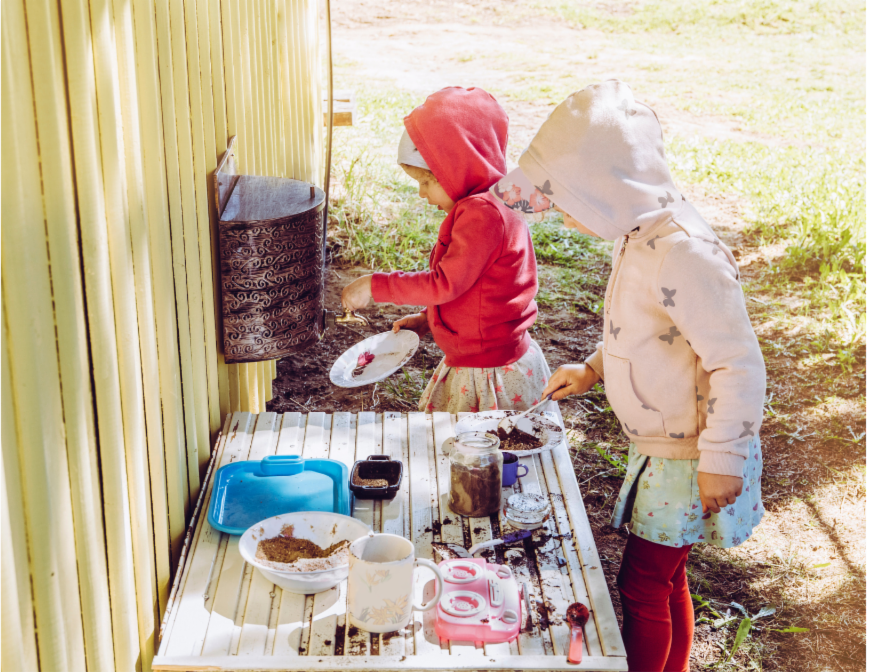
It's worth being specific about what we mean, though, because not all play is created equal. The research points most strongly to play that is open-ended (there's no single right answer or outcome), child-directed (children are making meaningful choices about what happens), and socially embedded (children are negotiating, communicating, and co-creating with others). This is the child crouched over a mud puddle, genuinely investigating. The group of three-year-olds arguing about the rules of an imaginary restaurant. The child who has been building the same block tower - and watching it fall - for twenty minutes. It is not an app with a reward sound. It is not a worksheet dressed up with stickers. It is not always tidy or quiet or easily observable as "learning," but it is exactly where the most important developmental work is happening.
Dramatic play requires children to hold a role in mind, regulate their behaviour to stay in that role, negotiate complex social rules with peers, and shift flexibly when the story changes. These are all hallmarks of executive function, the cluster of skills most strongly linked to long-term academic and life outcomes. Research points to children who engage in fantasy-oriented and sociodramatic play showing measurable improvements in working memory and inhibitory control: the very skills that allow them to sit with a complex problem, listen to instructions, and manage the frustrations of learning something new. Block play builds spatial reasoning, planning, and persistence through failure. Sensory and outdoor play builds body awareness, risk tolerance, and the kind of grounded calm that makes sustained attention possible.
Play is the vehicle for readiness, not a detour from it. Research consistently associates stronger self-regulation and executive function skills - not stronger letter recognition - with better outcomes across every domain, including, eventually, literacy and numeracy. Working memory at age five has been found to be a stronger predictor of academic outcomes six years later than IQ. The letters and numbers will come. The foundational capacities are what make them possible.
A Spectrum, Not a Threshold
Every child who enters kindergarten is ready for something. Ready to be curious. Ready to connect. Ready to move and explore and make meaning. Readiness isn't a line children either clear or don't. It's a continuum, shaped by everything that has come before, and enormously responsive to what comes next.
When we look at the EDI data, at the increases in vulnerability we're seeing across Muskoka, we're not seeing children who failed to prepare. We're seeing the cumulative footprint of what was available to them during those first 2000 days, and the weight of what the last few years have asked of families and communities. We're seeing systems data. And we're seeing exactly why the environments you create, the relationships you offer, and the play you make possible matter so profoundly.
| | Curious about what this looks like in practice? We're working together with TLDSB to plan a workshop this spring to dig into kindergarten readiness together — more details coming soon. | | |
| |
✨Where in your daily schedule does deep, uninterrupted play have room to breathe? What tends to crowd it out?
✨Think about a child in your program who is often described as "not ready" or "behind." What is that child ready for? What do they bring? What does your relationship with them make possible?
✨Think about the children who will be transitioning out of your care this spring. What do you hope the next educator in their life could understand about who they are — not what they can or can't do yet, but who they are as a learner, a friend, a person?
| | | |
If play is the vehicle for readiness, then the environment is the road. And like any road, small changes to its design can completely change where children are able to go.
Take a slow walk through your space this week - not as an educator with a to-do list, but as a child with two hours and nothing scheduled. Ask yourself:
Where can a child make a real choice? Not "red cup or blue cup," but a genuine, open-ended choice about what to explore, create, or investigate. Where do you already see that invitation living in your space — and where might there be room to deepen it?
Where can a child get deeply absorbed? Extended, uninterrupted play is where the richest executive function development happens. Are there moments in your day that protect that depth and allow it to unfold fully?
Where can children be in relationship with each other? Not side by side, but genuinely together — negotiating, problem-solving, co-creating. What does your space make possible for children who are ready to do that work?
How is children's learning made visible? When families walk in, what do they understand about what their child has been doing and why it matters? What story is your environment telling about the children who live and learn there?
You don't need a renovation. You need a curious eye and a willingness to follow what you notice.
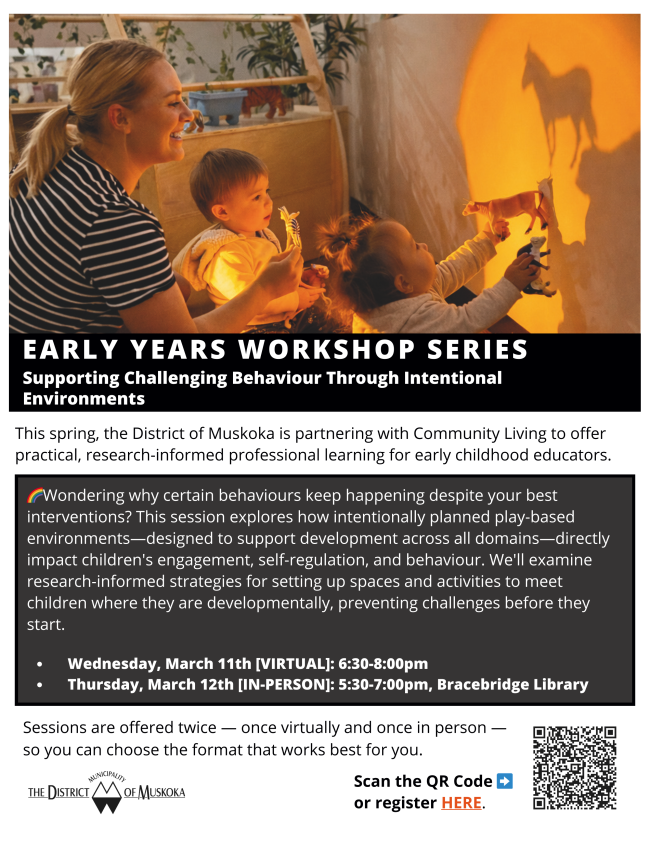
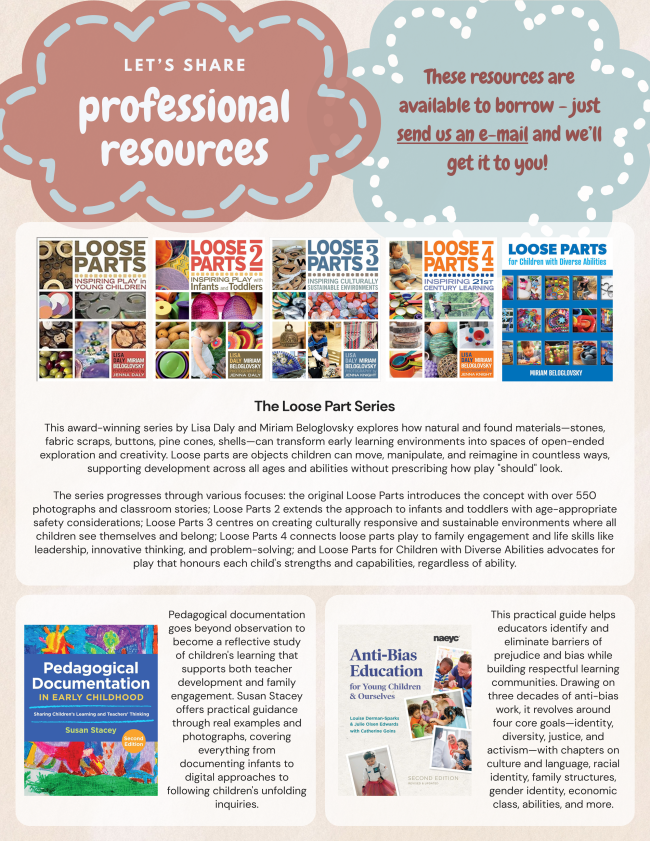
| Speaking of which, we're planning an upcoming workshop entirely dedicated to your environment. Details below! 💛 |
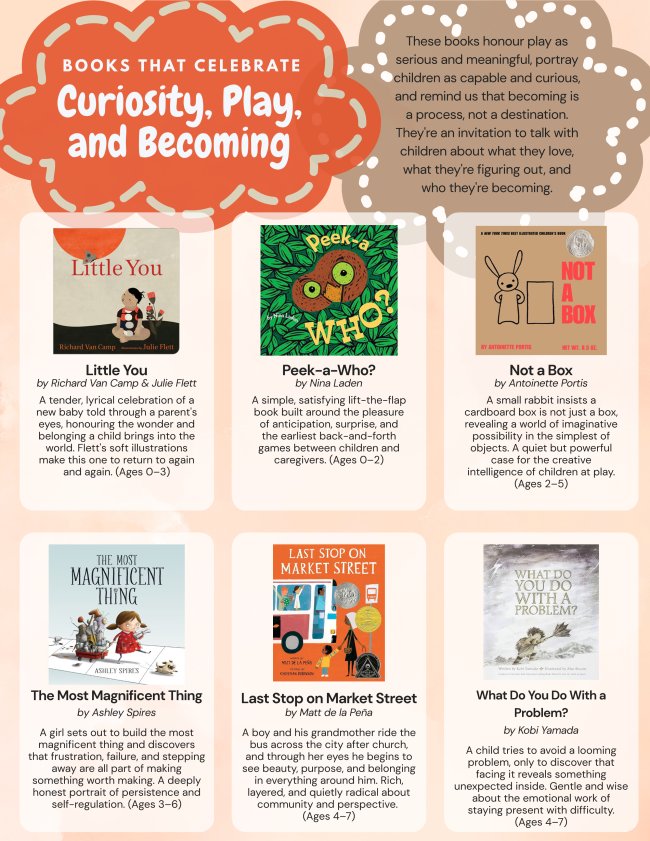
| Books That Celebrate Curiosity, Play, and Becoming! | | The best "kindergarten readiness" books don't mention kindergarten at all. They celebrate children who wonder, persist, imagine, and connect — children who are already fully engaged in the work of learning. These books honour play as serious and meaningful, portray children as capable and curious, and remind us that becoming is a process, not a destination. They're an invitation to talk with children about what they love, what they're figuring out, and who they're becoming — not what they need to know before September. (Click the image for a printable PDF) | | 🎧Tune in and Learn on the GO! | | |
More of a listener than a reader? These episodes dig into what early childhood is really about — the science behind it, the stakes, and the profound expertise that goes into doing this work well.
A Better Together Podcast Series: Bright Beginnings -
“Unlocking Potential: The Benefits of Early Childhood Education” [31 mins]
Why does investing in ECE matter? In this episode, child psychiatrist Dr. Jean Clinton, a parent, and an economist explore the crucial role ECE plays in the development of our youngest citizens, the journey of families, and the future of our broader society.
Spotify | Spreaker
A Better Together Podcast Series: Bright Beginnings -
“Expert Hands, Bright Futures – The Specialized Knowledge of Early Childhood Educators” [31 mins]
This episode explores the specialized expertise of early childhood educators in shaping young minds — and makes a compelling case for why this work deserves to be seen as the skilled, complex profession it is.
Spotify | Spreaker
Speaking of Psychology —
"Why We Learn Best Through Play" with Dr. Kathy Hirsh-Pasek [39 mins]
One of the world's leading researchers on play and learning makes the case that play isn't a break from learning. It is the learning. Dr. Hirsh-Pasek talks about what playful learning actually looks like, why children need unstructured time, and what we lose when we replace it with screens and drills. A satisfying listen for anyone who has ever had to defend play to a skeptic.
Apple Podcasts | Spotify | Pocket Casts
| | 📍More (mostly) FREE Upcoming Webinars & Courses: | | Opportunities from our wider community to connect, learn, and be inspired. This month, we’re including a few low-cost PL opportunities as well as the usual freebies. | | |
What resonated with you this month?
What are you wondering about?
We'd love to hear from you.
| | |
➕Did someone forward this newsletter to you, but you want to be added to our distribution list? Want to make sure you hear about workshops? Sign up here - Newsletter and Workshops.
| |
|
🔎Looking for past newsletters? Dig into our archive.
The Archive
| |
| |
| How did you like this months Newsletter? | | | | Please note that the information contained in this newsletter is intended to encourage conversation and self-reflection and is not to be considered as advice. | | | | |