CABE Conference hosted by the
Monterey County Office of Education
Equipping Leaders to Strengthen Community Schools
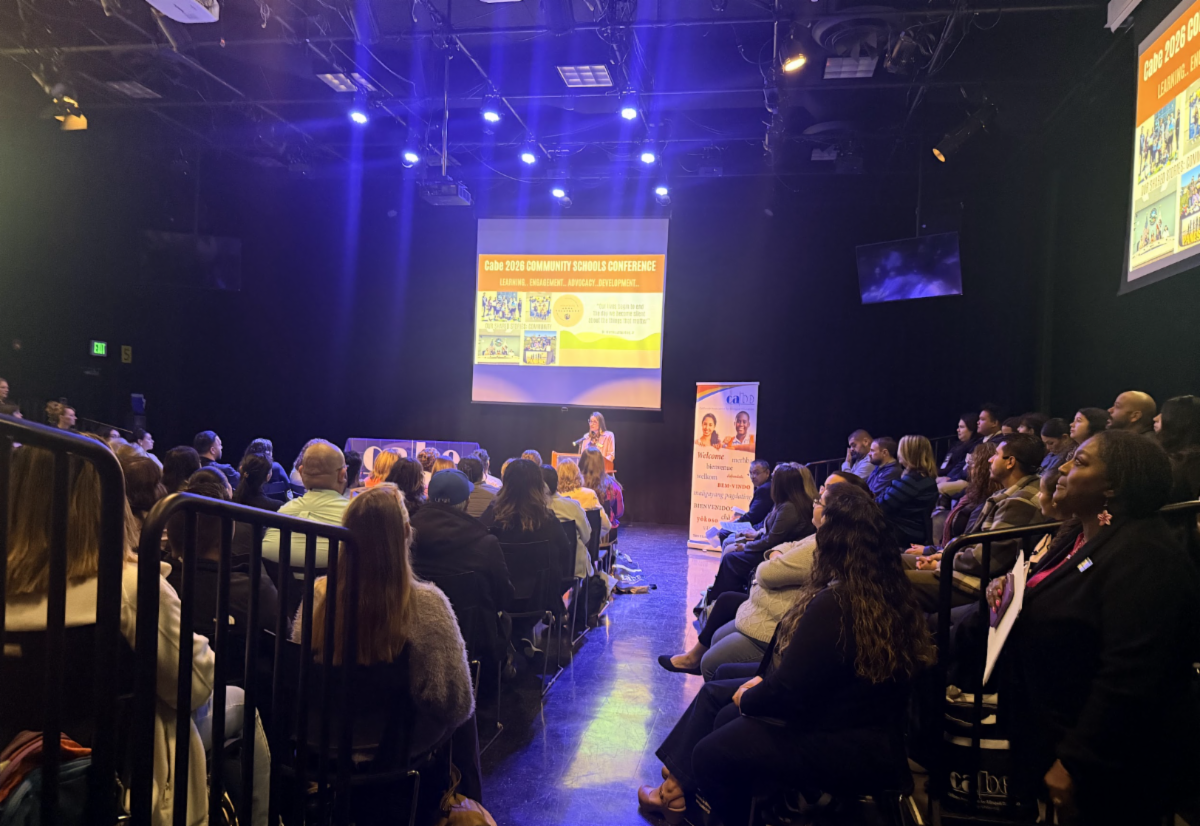
| | Caption: A CABE team member welcomes all attendees at the general session. | | |
On Monday, February 2, 2026, the Monterey County Office of Education proudly hosted the CABE Community Schools One-Day Regional Conference — a dynamic and collaborative professional learning experience designed to support district and site leaders in advancing the Community Schools model across our region. The event welcomed participants from Monterey, Santa Barbara, Lassen County, and beyond, reflecting a growing statewide commitment to whole-child, community-driven school transformation.
This action-oriented convening brought together Community School coordinators, administrators, educators, and support staff to engage in meaningful dialogue and skill-building centered on cultivating thriving Community Schools grounded in equity, shared leadership, and authentic community voice. Attendees explored practical tools, innovative strategies, and partnership approaches that strengthen implementation and deepen impact at the site and district levels.
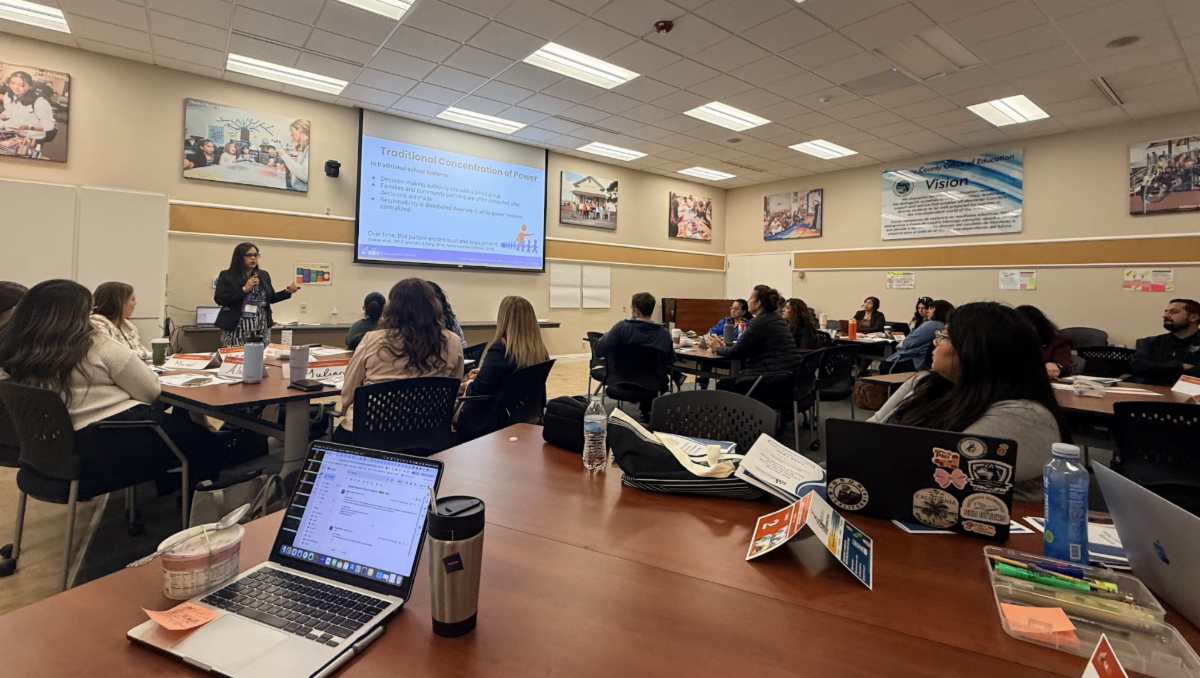
The conference featured a full day of engaging programming, including inspiring opening remarks, interactive workshop sessions, dedicated exhibitor time, and opportunities for reflection and networking. Session topics focused on building rooted and sustainable partnerships, designing inclusive shared decision-making structures, fostering psychological safety and trust within teams, and moving beyond transactional engagement toward true co-creation with families and community partners.
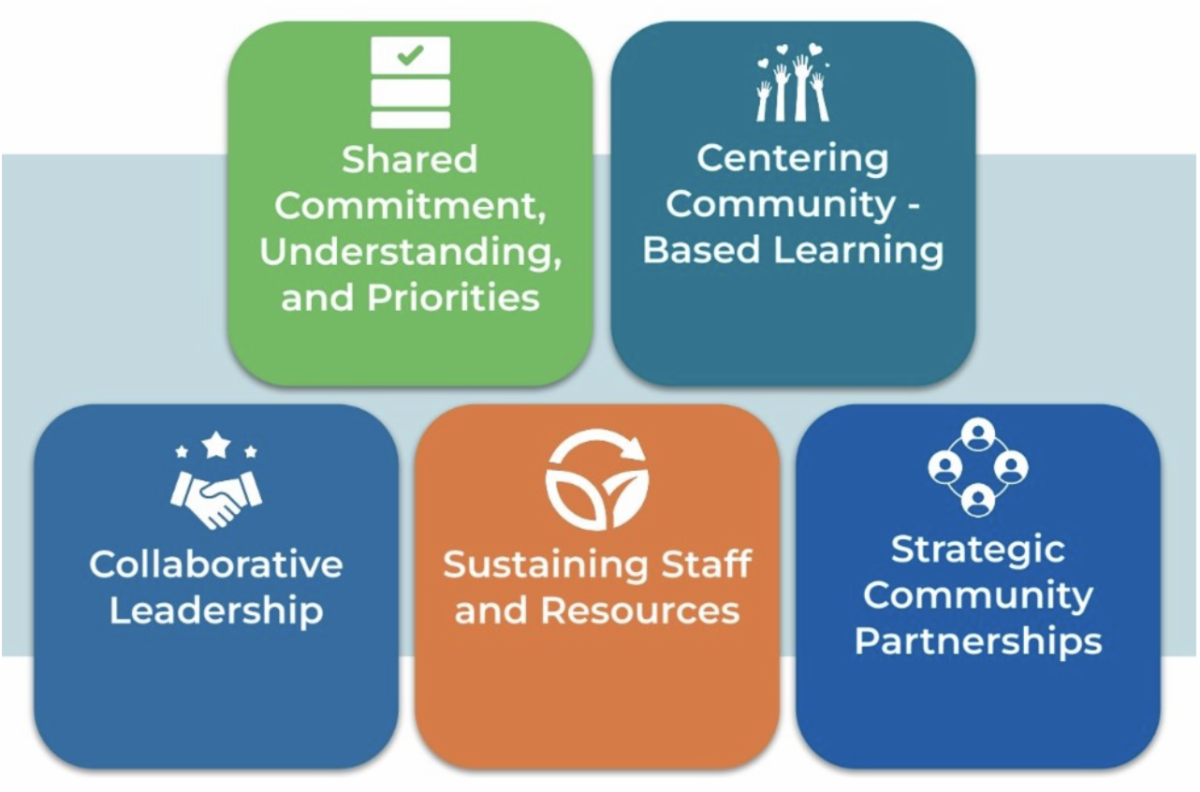
A central theme throughout the day was reinforcing the four pillars of the California Community Schools Framework — integrated student supports, expanded and enriched learning opportunities, active family and community engagement, and collaborative leadership and practices. These pillars serve as the foundation for supporting the whole child and creating the conditions necessary for academic success, belonging, and long-term well-being.
By convening leaders and practitioners to share promising practices and actionable strategies, the Monterey Regional Conference strengthened regional collaboration and built collective capacity to design schools where students, families, educators, and community partners share ownership of outcomes.
Participants left energized with new insights, strengthened networks, and clear next steps to enhance Community Schools implementation in their local contexts — advancing equity, sustainability, and opportunity for every student and family served.
| | |
Caption: CABE conference participants at one of the sessions offered.
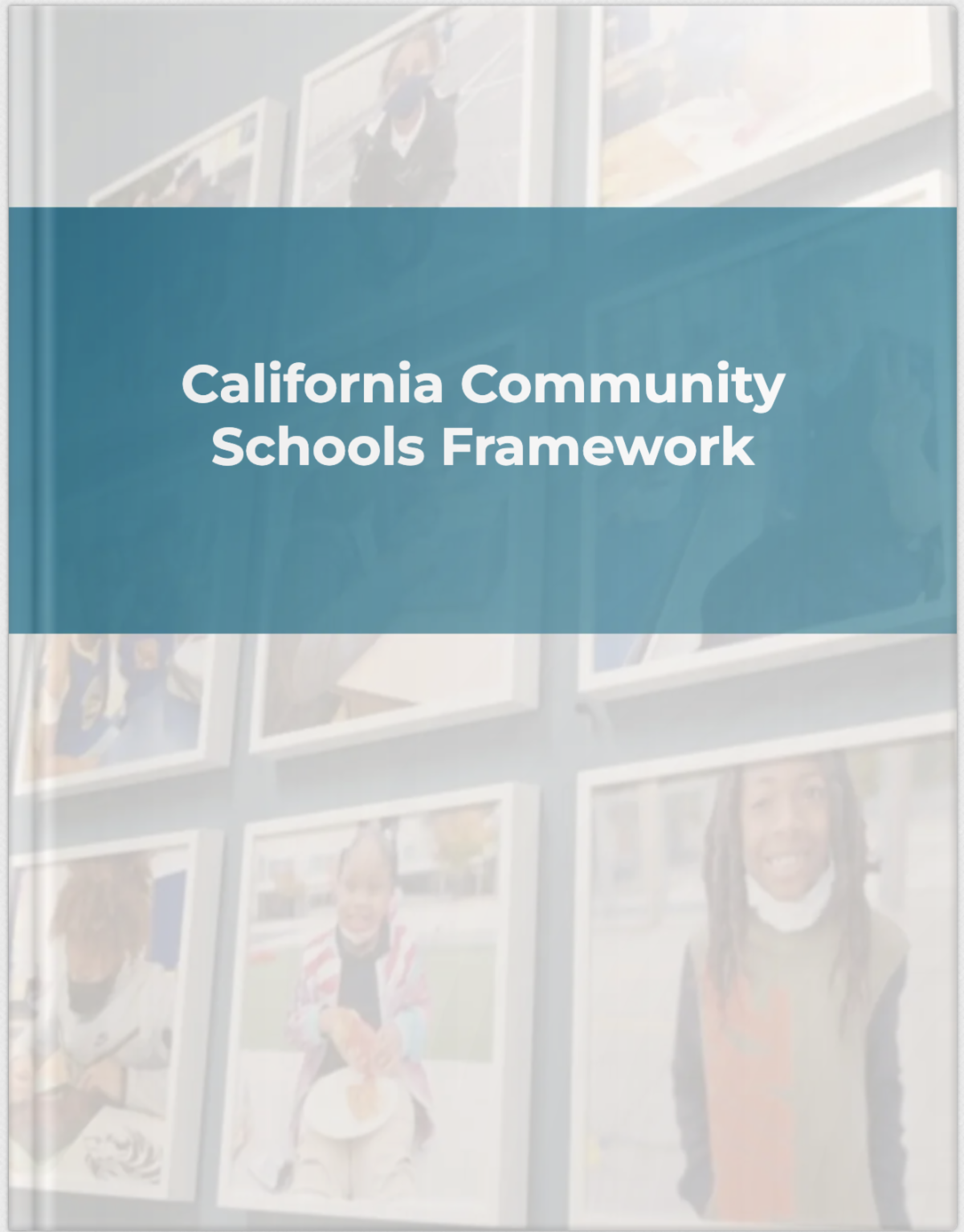
| | CCSPP Framework (17 pgs) The California Community Schools Partnership Program (CCSPP) Framework is a guiding document created by the California Department of Education (CDE) and the State Board of Education (SBE). It was adopted in July 2022 to help schools, districts, and counties design, implement, and sustain high-quality Community Schools across California. | |  | CCSPP Capacity Building Strategies (25 pgs). This resource will support Community School Coordinator/Leads' understanding of the Capacity Building strategies to support APR conversations with Advisory Council members and other stakeholders/educational partners. | | |
CISC Symposium attendees visit two
MPUSD Community Schools
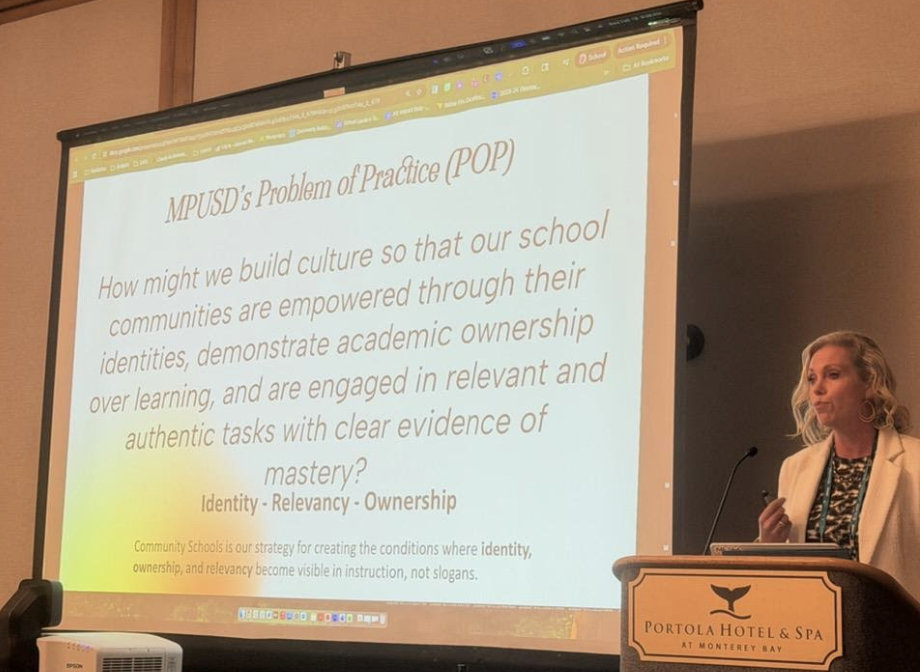
| | Caption: Associate Superintendent, Cresta McIntosh, shares the MPUSD Problem of Practice with CISC participants. | | The Curricular and Improvement Support Committee (CISC), a committee of the California County Superintendents, plays a vital role in advancing collaborative leadership, strengthening curriculum and instructional coherence, and driving systemwide improvement efforts across California. CISC supports county offices of education in aligning initiatives, sharing promising practices, and building capacity to improve student outcomes. | | | |
By partnering with county offices of education, the California Department of Education, and other educational stakeholders, CISC works to strengthen programs and practices that support success for all students — a mission that closely aligns with the Community Schools vision of shared leadership, integrated supports, and equitable outcomes. Each year, the CISC Leadership Symposium convenes more than 1,000 educational leaders from across California to network and learning about innovative models and effective system-level strategies.
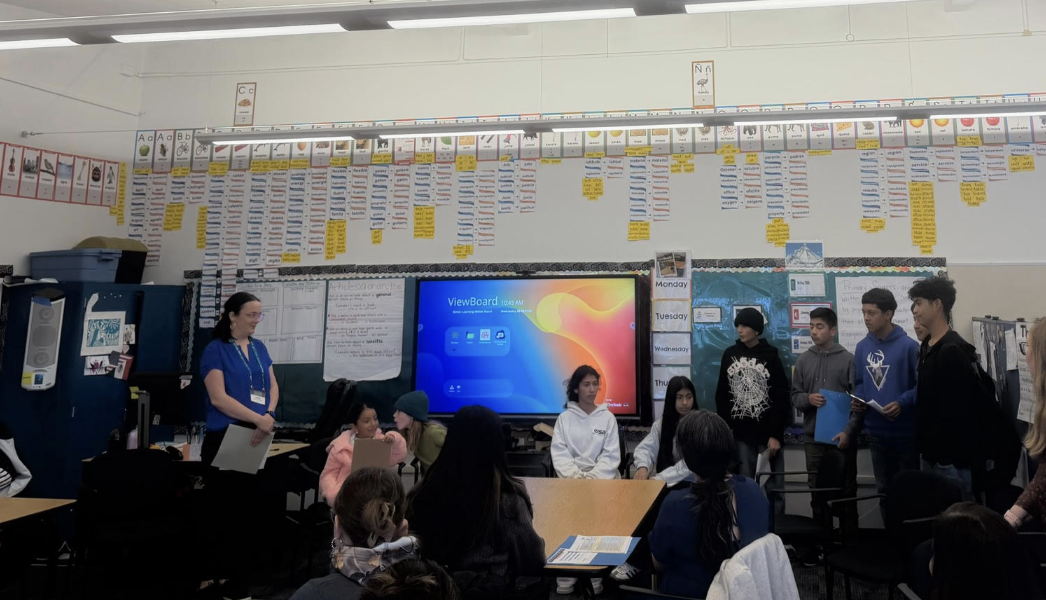
As part of this year’s CISC Leadership Symposium, the Monterey Community Coordination Grant team and the Monterey Peninsula Unified School District (MPUSD) Community Schools team partnered with the Curricular and Improvement Support Committee (CISC) to host visiting educational leaders at the Dual Language Academy of Monterey Peninsula and Seaside Middle School. The site visits were designed to provide an in-depth look at how the Community Schools strategy is being implemented across Monterey County, offering a tangible example of how integrated supports, shared leadership, and equity-centered practices come together to strengthen student outcomes. By opening their campuses to leaders from across California, MPUSD contributed to a broader statewide conversation about systems change, continuous improvement, and the power of cross-county collaboration.
MPUSD site teams thoughtfully curated an experience that moved beyond observation to active learning and reflection. The visits began with contextual framing that outlined the district’s vision, implementation journey, and alignment to the California Community Schools Framework. From there, participants engaged with structured agendas that highlighted core elements of the model in action — including collaborative leadership teams, integrated student supports, expanded learning opportunities, and authentic family and community engagement. Opportunities for dialogue allowed visiting leaders to ask questions, explore implementation challenges, and consider how similar strategies might translate to their own local contexts. The intentional design of the experience underscored that Community Schools work is not a single initiative, but a comprehensive approach to transforming school culture, partnerships, and systems of support.
| | Caption: Dual Language Academy of the Monterey Peninsula students speak to CISC conference participants. | | | | |
Reflections from participants were overwhelmingly positive and deeply affirming. Many shared appreciation for the transparency with which district and site teams discussed both successes and lessons learned, noting that the openness fostered trust and meaningful professional exchange. Visitors highlighted the value of seeing alignment between vision, planning, and practice, and left with concrete strategies to strengthen implementation in their own counties and districts. The professionalism, preparation, and hospitality demonstrated throughout the visits left a strong and lasting impression, reinforcing Monterey County’s role as a leader in advancing Community Schools as a sustainable, equity-driven strategy for student and community success.
| |
Launching the Inflexion Navigation Dashboard Tool at the
25–26 2.0 Capacity Building Finale
North and South Regions
| | |
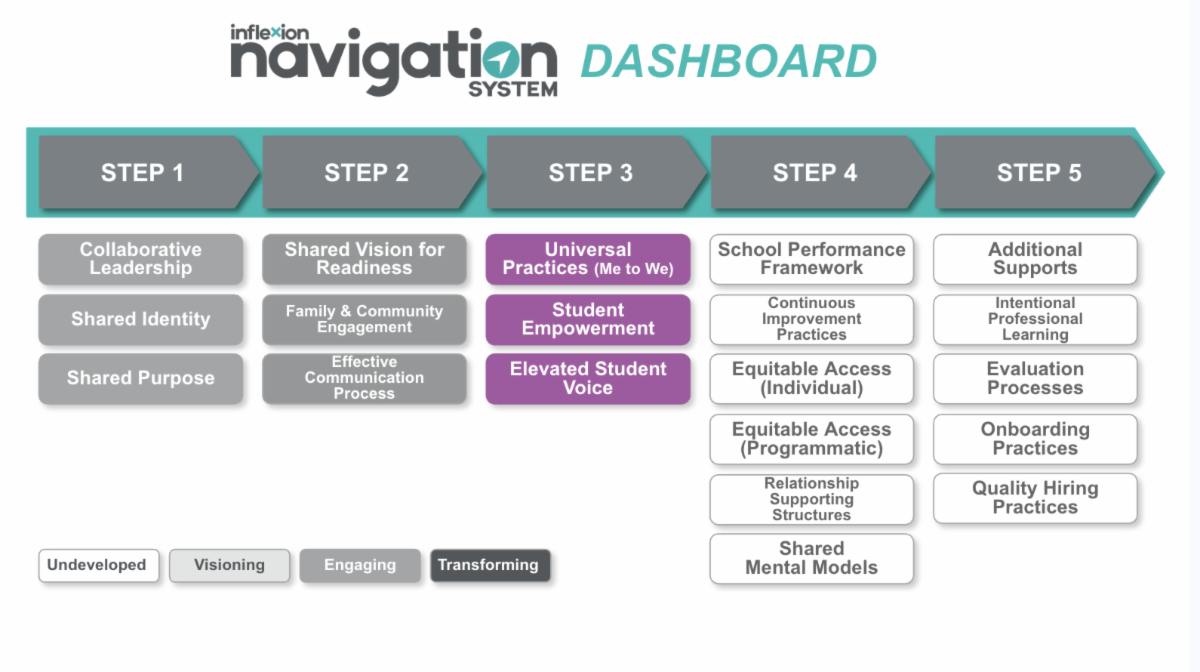
The Inflexion Navigation Dashboard Tool is designed to serve as a practical, research-based roadmap for bringing the Community School vision to life through intentional and aligned action. Grounded in implementation science, the dashboard recognizes that sustainable transformation happens through clear stages of development, continuous reflection, and evidence-based next steps.
The five steps move teams from foundational elements—Collaborative Leadership, Shared Identity, and Shared Purpose—to deeper systems work, including Universal Practices, Student Empowerment, Equitable Access, Continuous Improvement, and Sustainability. Each step is built around clearly defined Statements of the Ideal, which articulate what strong implementation looks like in practice. These Statements of the Ideal were developed with the support and insight of educators across the state, ensuring that the framework reflects real-world expertise and shared professional wisdom.
Rather than functioning as a checklist, the dashboard allows schools to assess their current stage—Undeveloped, Visioning, Engaging, or Transforming—identify evidence, clarify a game plan, and outline actionable next steps. In doing so, it reinforces a key message repeated at every capacity-building session: strong student supports cannot compensate for weak core instruction; both must be strengthened together to create lasting impact.
At its core, the Navigation Dashboard is anchored in shared values and clearly defined ideals. The Statements of the Ideal describe what it means to foster universal practices that build belonging and connection for every student, to elevate student voice so that learners shape the decisions that affect their education, and to cultivate shared mental models grounded in equity, culturally relevant learning, restorative practices, and social justice. These ideals align intentionally with the California Community Schools Partnership Program (CCSPP) Framework, the English Learner Roadmap, and MTSS, ensuring coherence across statewide initiatives and reinforcing a comprehensive approach to readiness and opportunity.
| | |
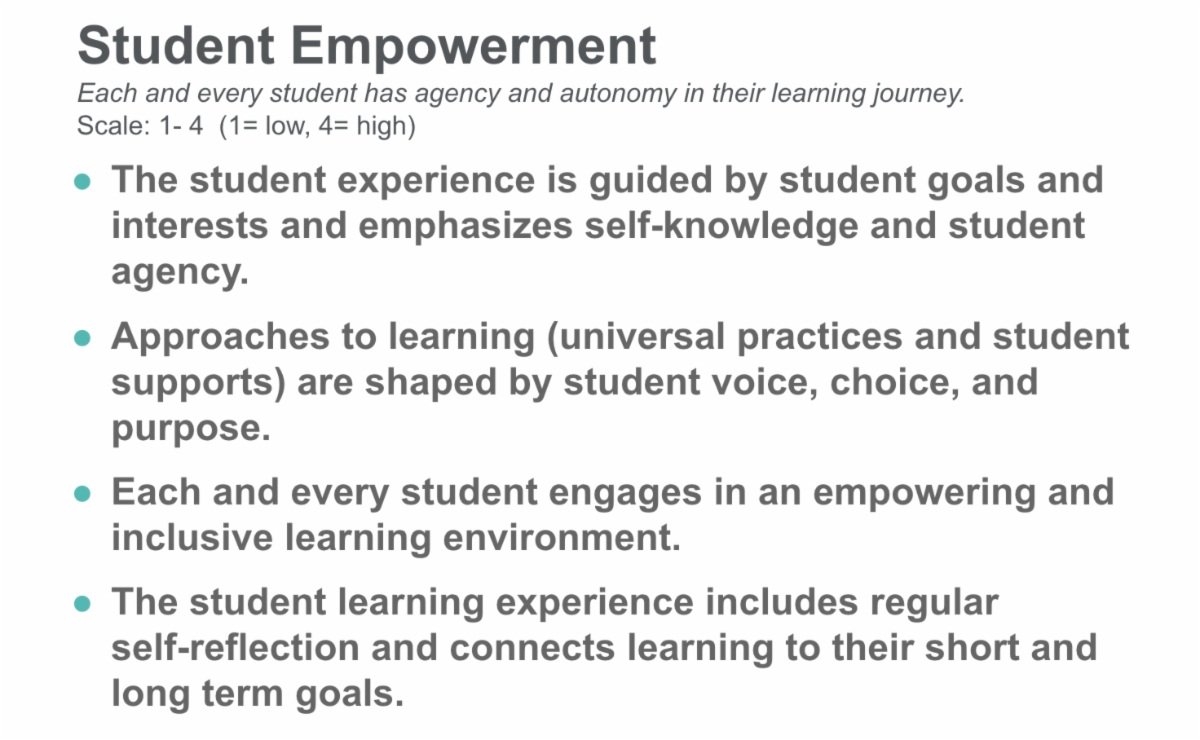
Caption: Above is one the Navigation Dashboard topics related to Student Empowerment: each and every student has agency and autonomy in their learning journey. Site teams reviewed the Statement of the Ideal, reached consensus on their current level of implementation (rated 1–4), and then documented supporting evidence and identified next steps directly within the tool.
| | | |
By centering equity, collaboration, and continuous improvement, the dashboard supports schools in aligning systems, structures, and partnerships to the lived experience of students and families. Ultimately, it helps move community school implementation from vision to reality—ensuring that every student experiences a learning environment where they belong, are empowered, and are fully prepared for success.
RTAC and Inflexion strongly encourage Central Coast Community Schools 2.0 participants to actively use the dashboard as a reflective tool to track growth, monitor implementation progress, and identify areas for continuous improvement. The dashboard is intended to support ongoing data-informed decision-making rather than serve as a compliance exercise.
In addition, the data captured through the dashboard can directly inform each site’s CCSPP Annual Progress Report and Updated Site Implementation Plan, helping ensure that reporting and planning are grounded in measurable outcomes, documented progress, and clearly identified next steps.
Additional Information: RTAC team: Benefits of the Inflexion Navigation Dashboard Tool (1 pg.)
| | |
Caption: The Inflexion Approach Navigation Tool is a practical, research-based tool designed to help school leaders guide meaningful, system-level change by grounding improvement in a shared identity and vision for readiness. It breaks school transformation into five clear steps — from establishing foundational purpose and shared goals to focusing on student-centered learning, transforming systems, and sustaining progress — so leaders can build coherent structures and aligned practices that support equitable outcomes for all students.
| | |
Resources of the Month:
Annual Progress Report
| | |
Grantees are encouraged to reach out to their County Office of Education (COE) and District CCSPP Lead, as appropriate, for guidance and support throughout the Annual Progress Report (APR) process. These teams can assist with clarifying reporting requirements, reviewing responses, ensuring alignment with CCSPP implementation strategies, and helping compile the necessary information and documentation.
Collaborating with your COE and District CCSPP Lead can help ensure that submissions are accurate, complete, and reflective of the progress and impact of community school efforts.
The RTAC team would like to share two resources with CCSPP grantees to support their ongoing implementation and reporting efforts. These resources are intended to provide additional guidance, clarify key expectations, and help grantees navigate important components of the CCSPP process.
County Office of Education (COE) and District CCSPP Leads with questions related to the CCSPP APR are encouraged to reach out to their RTAC Program Coordinator for guidance and support.
| | |
Annual Progress Report 2025–26:
Key Updates & Highlights from STAC
| | The California Community Schools Partnership Program (CCSPP) 2025–2026 Annual Progress Report (APR), released March 2, 2026. The APR is designed to support reflection and continuous improvement — not compliance; it is “not a hammer, but a flashlight.” Rather than serving as a tool for judgment, the APR is intended to illuminate what’s working, surface areas for growth, and guide thoughtful adjustments in implementation. It encourages Sites and LEAs to pause, examine their data and practices, and engage partners in meaningful dialogue about impact. | | | |
By prioritizing learning over compliance, the APR supports teams in refining and strengthening their community school strategies in ways that are responsive, sustainable, and grounded in student and family needs. It serves as a structured reflection tool for sites and LEAs to examine their implementation of the five Capacity-Building Strategies, the expansion of whole child and family supports, meaningful engagement of educational partners, and progress on key outcomes aligned with the California School Dashboard.
The APR process is designed to be collaborative, encouraging input from staff, families, students, and community partners. It draws on core planning documents — including implementation plans, needs and assets assessments, and self-assessments — to support thoughtful analysis, celebrate progress, and identify clear next steps for continuous improvement.
This year’s APR includes updates such as adjustments to engagement reporting (returning to estimated percentages and adding chronically absent students), refinements to the Whole Child & Family Supports Inventory with a stronger focus on sustainability and funding sources, and new reflection questions at both the Site and LEA levels.
APR drafts should be developed collaboratively in a shared document before being submitted in Qualtrics by June 30 (sites) and July 31 (LEAs). Support is available through RTAC and STAC office hours, the AI chatbot “APRil,” and the APR tracker to monitor submissions. APR data will also inform technical assistance, policy conversations, and a public-facing dashboard highlighting implementation progress across the state.
STAC will be providing three virtual APR Office Hour sessions to support grantees. If you are a CCSPP LEA Lead and did not receive the STAC email with additional info and how to register, please reach out to your CCSPP RTAC Program Coordinator.
How is APR data shared publicly?
Data is shared via the UCLA/STAC APR Visualization Tool. Data from CCSPP APR Year 1 to Year 3 is displayed as of Feb 2026.
| |
More inspiring Community Schools work happening in the
Central Coast region!
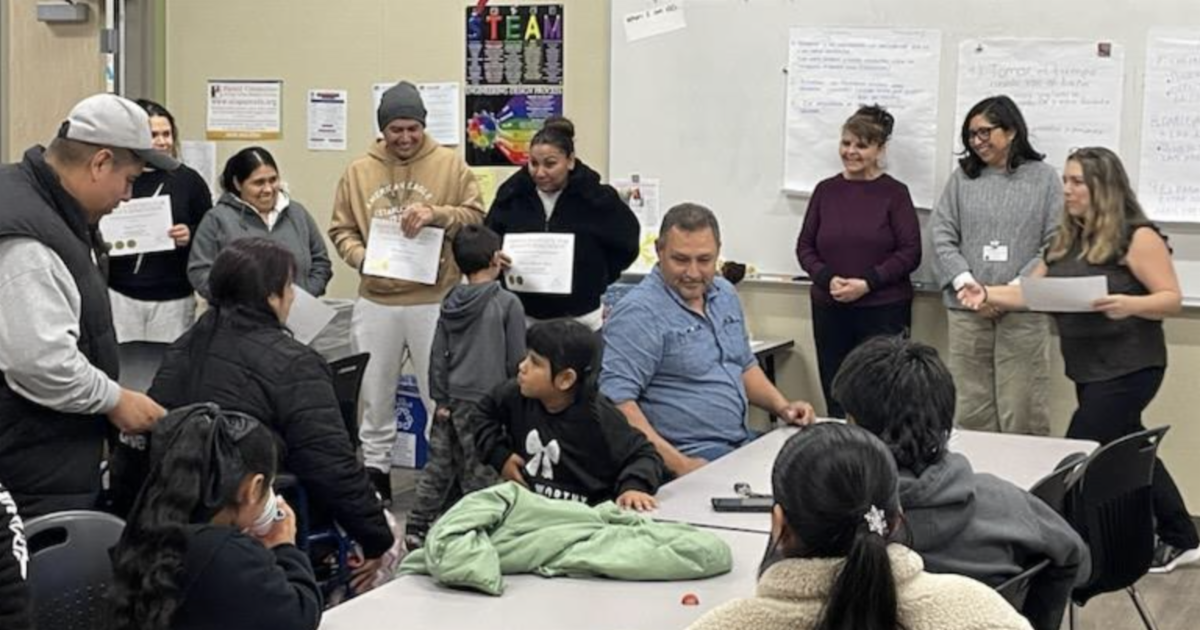
| | Caption: Several PIQUE graduates from the Glen Speck Elementary School community. | |
San Luis Obispo County - The Parent Institute for Quality Education (PIQE) program is designed to empower families with the knowledge, tools, and confidence to support their children’s academic success and actively engage in their school communities. Through a series of workshops, parents learn about the education system, strategies to support learning at home, and ways to advocate for their children’s educational pathways from elementary school through college.
Recently, 36 parents from the Glen Speck Elementary School community celebrated graduating from the PIQE program. Their graduation represents more than the completion of a workshop series—it reflects the growing leadership and voice of families who are committed to partnering with the school to support student success and strengthen the school community.
This work closely aligns with the goals of the California Community Schools Partnership Program (CCSPP) grant, which emphasizes strong family and community partnerships as a core pillar of the community schools strategy. By supporting programs like PIQE, Glen Speck Elementary is helping create meaningful opportunities for families to build relationships with school staff, participate in decision-making spaces, and contribute to a more supportive and collaborative school environment. The participation and leadership of PIQE graduates help advance the vision of the community school strategy at Glen Speck Elementary—where families, educators, and community partners work together to ensure every student has the support they need to thrive.
| | | |
Monterey County - Digital Stories - It’s Happening in Soledad: Discovering the Power of Our Stories. Hear firsthand about the experience of participating in the Digital Stories component of the Central Coast Deep Dive opportunity. Maricela, Community Schools Coordinator, Soledad High School, Monterey County:
Participating in the Storyteller Cohort for Soledad has been a truly unique opportunity—not only to learn new skills, but also to highlight the beauty and strength of our community. “It’s Happening in Soledad” is more than just a phrase; it reflects the pride, resilience, and stories that make our city special.
As a first-time storyteller, I’ll admit I felt puzzled when I was asked to create a two-minute story centered around an object. It took time to gather my thoughts and decide what I wanted my story to represent. What could possibly capture the heart of Soledad in just two minutes? As the course progresses, I find myself increasingly inspired and curious to learn more about our community and what the Soledad Unified School District represents to me and to the families we serve.
This experience has encouraged me to reflect more deeply on the impact of our work and the stories that often go untold. Without sharing too much about my final piece, I will say this: I once read a note from someone who said, “That’s why I’m bringing back a resource that went away.” When asked, “What resource?” the individual simply responded, “Me.” That message stayed with me. Sometimes the most powerful resource in any community is the people within it—those willing to show up, speak up, and give back. And that’s exactly what storytelling in Soledad is about.
| | | |
Monterey County - Teacher Fellows -
Deep Dive Districts Strengthen Community-Based Learning on the Central Coast. In the Central Coast region, Soledad Unified School District and Salinas Union High School District were selected to participate in the Teacher Fellows learning opportunity.
As part of the process, each district identified teachers to reflect on how their current instructional practices align with Community-Based Learning. To support this work, educators from both districts participate in a Teacher Fellows cohort made up of classroom teachers, site leaders, Regional Technical Assistance Center (RTAC), and State Technical Assistance Center (STAC) staff. Through regular cross-district convenings, participants collaborate, build capacity, and exchange ideas about how to more intentionally connect classroom learning with students’ communities and lived experiences.
Teacher Fellows are implementing community-based, project-based learning experiences that encourage students to explore local issues, identify community assets, and consider how they can contribute to positive change in their schools and neighborhoods. Grounded in students’ cultural knowledge and lived experiences, these projects help create responsive learning environments where academic content becomes meaningful, relevant, and connected to real-world contexts.
The work will culminate in student project showcases during the Deep Dive visit events in April, where participating schools will highlight the lessons and projects developed through this initiative. These showcases will demonstrate how community-based learning can elevate student voice, strengthen connections between schools and their communities, and support deeper engagement in learning.
Through this collaborative effort, participating districts are strengthening implementation of the Community Schools strategy, expanding educator capacity, and creating meaningful opportunities for students to engage in authentic learning that reflects the strengths, needs, and aspirations of their communities.
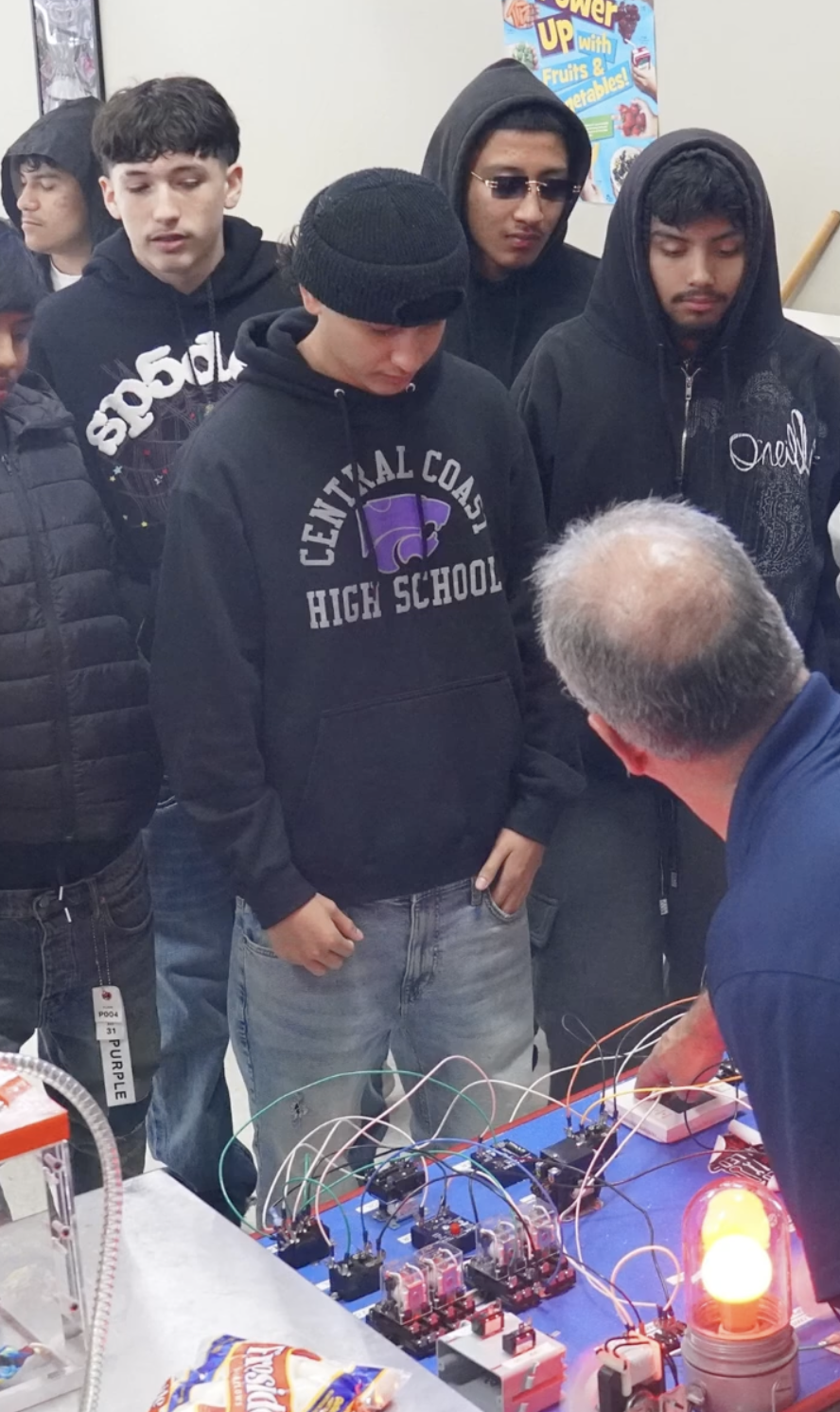
| | | Caption: CCHS Students observing a demonstration related to their HVAC learning. Picture courtesy of CCHS social media. | |
Monterey County - Through a strong community partnership, Heating, Ventilation, and Air Conditioning (HVAC) classes are now being offered to students at Central Coast High School, creating new opportunities for hands-on learning and career exploration. This collaboration brings industry-relevant training directly to students, allowing them to build practical skills while learning about pathways in the heating, ventilation, and air conditioning field—an industry with strong workforce demand in the region.
This opportunity reflects the goals of the California Community Schools Partnership Program (CCSPP) by strengthening partnerships between schools and community organizations to expand learning opportunities for students. By connecting classroom learning with real-world career pathways, the program supports CCSPP’s focus on expanded and enriched learning opportunities and college and career readiness. Through initiatives like this, Central Coast High School is helping ensure students have access to meaningful, career-connected experiences while building stronger ties between the school, local partners, and the broader community.
Check out this 33-second video, courtesy of CCHS social media, for a student's perspective.
| | |
Central Coast RTAC Partners
| | | | |
Inflexion is committed to ensuring EVERY
student receives what they need to succeed, recognizing that the playing field remains inherently unequal. An equitable education system respects students as individuals, plays to students’ strengths, values students’ unique cultures and perspectives, and allows for the individual ownership of learning along a path driven by students’ interests and aspirations.
-
Inflexion Materials/Workshop resource room (1.0 sessions)
- Inflexion Materials/Workshop resource room (2.0 sessions) (forthcoming)
Lead Facilitator: Manuel Colón
Manuel Colon: teacher, mentor, coach, administrator. AUHSD - future talks featuring Manuel Colón (27 min.)
| | | | | |
At the foundation of the Scholar System program is an educational approach focused on fostering deep learning, critical thinking, and a love for knowledge.
Programs aim to cultivate scholars who are not just knowledgeable but also possess the skills and mindset to become lifelong learners, engaged citizens, and future leaders.
Lead Facilitator: Dr. Victor Rios
Dr. Victor Rios: professor, author, speaker, mentor, and founder of the Scholar System. A teacher that tapped into his soul (video, 2 min)
| | | | | |
A most up -to-date copy of the RTAC events calendar
can be found here (Sheet)
| | | |
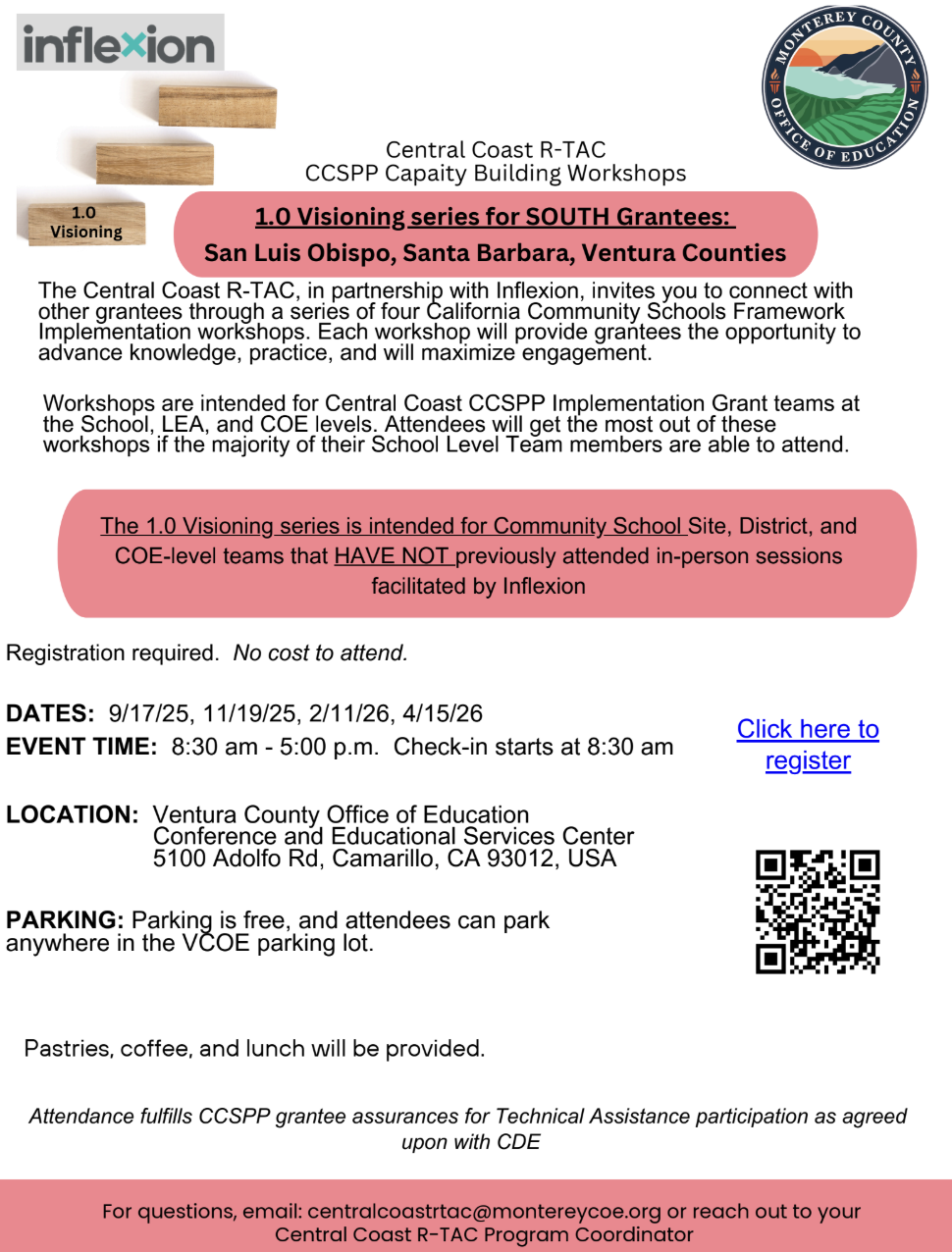
Inflexion 1.0 NORTH 25-26
(In-person) Attending EITHER the 1.0 OR 2.0 series of workshops fulfills CCSPP assurances for Technical Assistance participation as agreed upon with CDE.
| | |
Inflexion 1.0 SOUTH 25-26
(In-person) Attending EITHER the 1.0 OR 2.0 series of workshops fulfills CCSPP assurances for Technical Assistance participation as agreed upon with CDE.
| | |
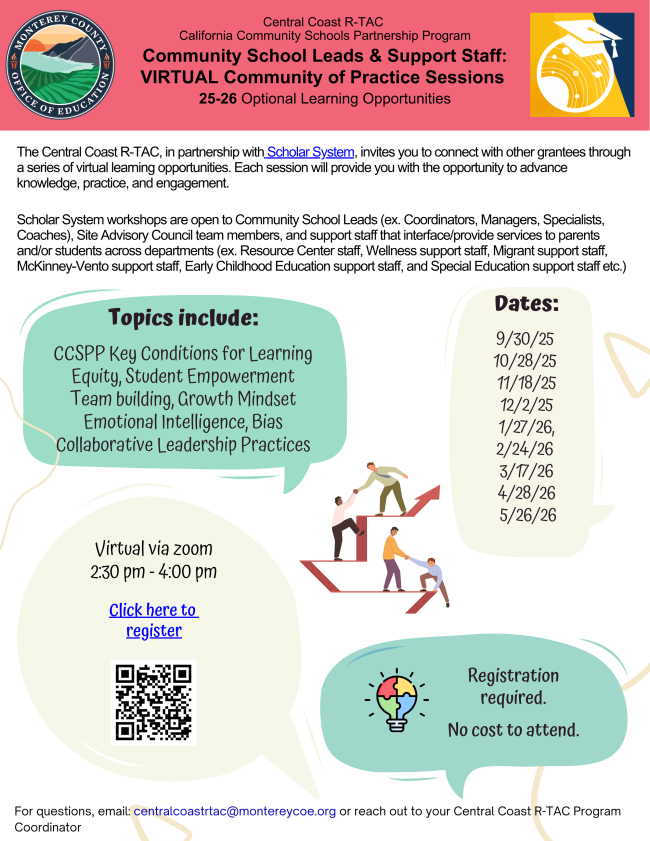
Scholar System 25-26
((Virtual/Optional-Highly recommended)
| | |
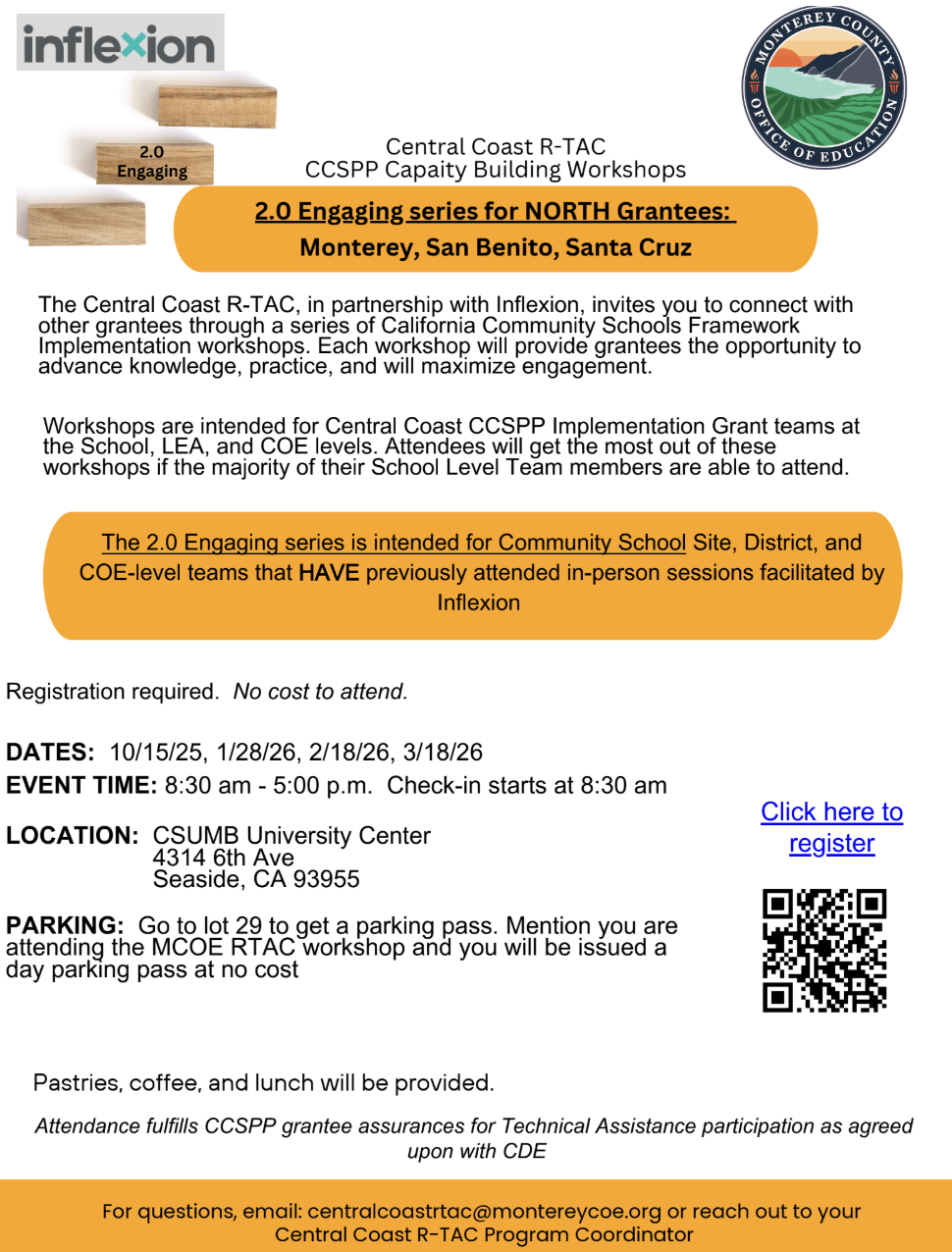
Inflexion 2.0 NORTH 25-26
(In-person) Attending EITHER the 1.0 OR 2.0 series of workshops fulfills CCSPP assurances for Technical Assistance participation as agreed upon with CDE.
| | |
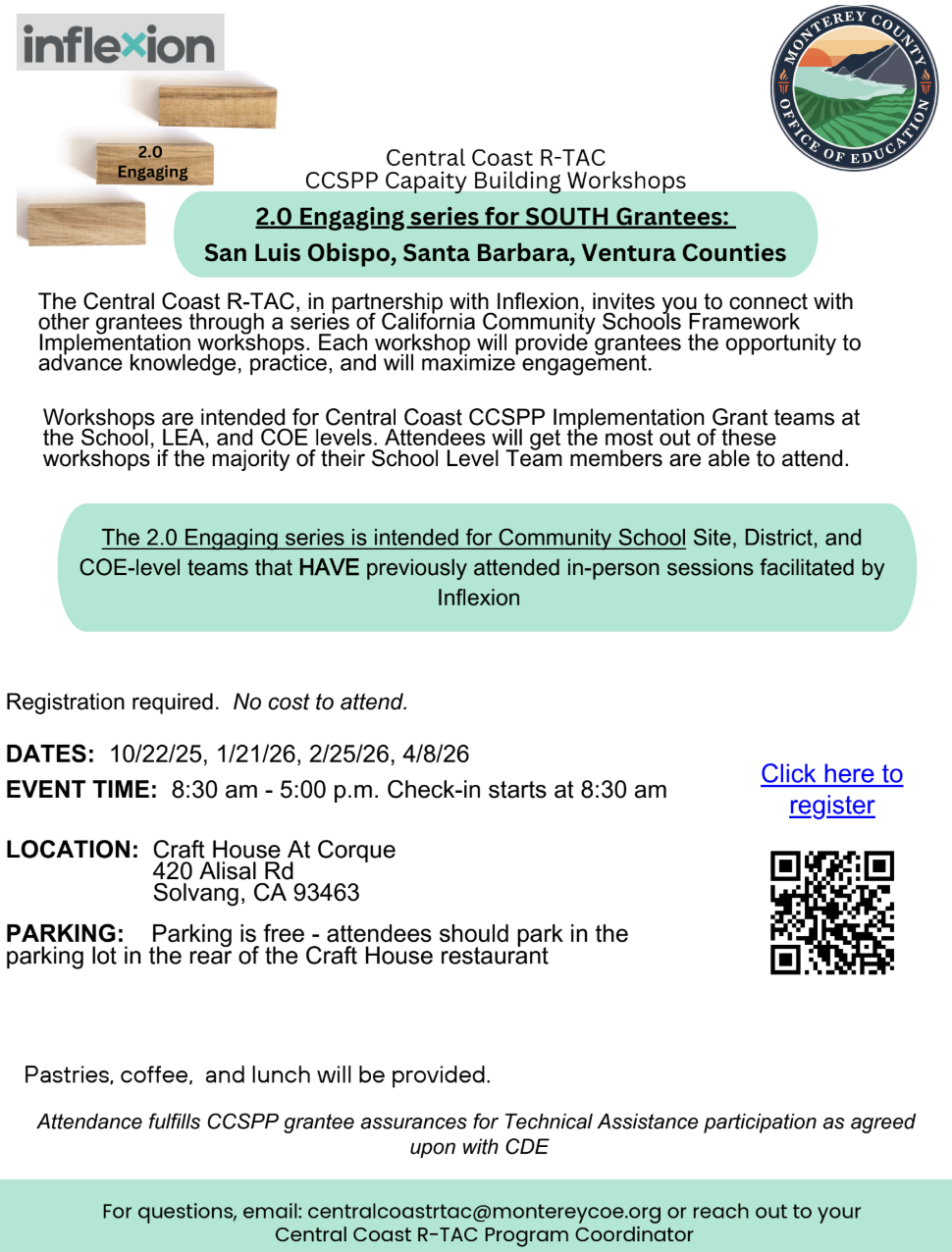
Inflexion 2.0 SOUTH 25-26
(In-person) Attending EITHER the 1.0 OR 2.0 series of workshops fulfills CCSPP assurances for Technical Assistance participation as agreed upon with CDE.
| | | |
State Technical Assistance Center team (STAC)
Updates
| | |
CDE - California Department of Education (CDE) State Superintendent Tony Thurmond celebrated the release of a new study highlighting the positive impact of California’s Community School Initiative. The study demonstrates that schools implementing the initiative are seeing measurable improvements in student attendance, stronger school culture, and enhanced engagement among students, families, and staff. Superintendent Thurmond emphasized that these results reflect the power of community schools to provide holistic support, foster equity, and create safe, inclusive learning environments where every student can thrive. The findings underscore the importance of continued investment in and expansion of the Community School Initiative across the state. The brief released by the Learning Policy Institute (LPI) can be found here: “Community Schools Impact on Student Outcomes: Evidence From California.”
| | |
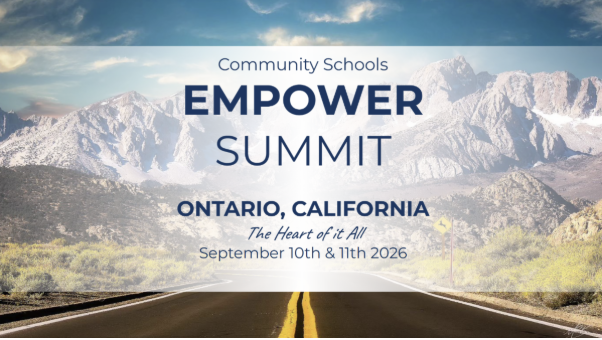
STAC - SAVE THE DATE (applies to the 26/27 School year) - September 10-11, 2026 in Ontario, CA.
The Community Schools EMPOWER Summit, hosted by the STAC team, will take place over two days in September. This statewide gathering brings together a diverse ecosystem of stakeholders—CCSPP grantees, RTACs, educators, students, families, and community partners—united by a shared commitment to advancing the community schools movement.
| | | |
The Summit is designed to reimagine and strengthen community schools by showcasing how collective efforts can support the whole child through collaboration, aligned resources, shared leadership, and innovation. More than a showcase, the Summit serves as a space for sharing lessons learned, engaging in collaborative learning, and identifying strategies to scale and sustain effective practices across California. Additional details and registration information will be shared in early 2026.
Interested in presenting at the 2026 Community Schools EMPOWER Summit?
The official Request for Proposal (RFP) for the upcoming 2026 Community Schools EMPOWER Summit is now live! The STAC team is looking for partners who are creative, organized, and deeply aligned with our mission of educational equity and excellence.
| | |
Optional Learning Opportunities
Student and Community Voice AI Summit. Explore AI through the lens of the 4 pillars. The guiding vision for the 2026 Student and Community Voice AI Summit is that humans are irreplaceable in schools and communities. AI has a place, but it must be used wisely and purposefully. Only then can it help amplify human talent and capacity and strengthen our communities. This Summit will focus on what’s really happening on the ground in schools and communities. We will also explore questions about how AI is impacting our society and workforce today, as well as how schools can develop students’ durable skills to succeed in the Age of AI.
Agenda at a glance
Anaheim, Ca. March 19 is the PreSummit. Summit is March 20-21, 2026
For more information and the cost to attend this event, click here
Interested in presenting at this Summit? Call for presenters - Due December 1st.
Click here for more details
High Tech High (K-12): Developed by a coalition of San Diego civic leaders and educators, High Tech High opened in September 2000 as a small public charter school with plans to serve approximately 450 students. HTH has evolved into an integrated network of sixteen charter schools serving approximately 6,350 students in grades K-12 across four campuses. The HTH organization also includes a comprehensive adult learning environment, including a Teacher Credentialing Program and the High Tech High Graduate School of Education, offering professional development opportunities serving national and international educators.
For more information on a visit: https://hthgse.edu/products/curated-visits/
Ontario Montclair School District (PK-8). Community School Tours. This San Bernardino County grantee is hosting site tours that highlight best practices in their work with the community school strategy. There is a registration fee to attend.
For more information:
Check out their flyer.
Informational video (3 min).
Anaheim Union High School District (7th-12th grade). This Orange County grantee is hosting site tours that highlight best practices in their work with the community schools strategy. AUHSD has built a new educational model incorporating “reverse-engineered” career pathways in partnership with higher education, private, and non-profit sectors, which have extended and transformed educational opportunities for all students.
There is a registration fee to attend.
For more information:
Click here
AUHSD Community Schools (video, 5 min)
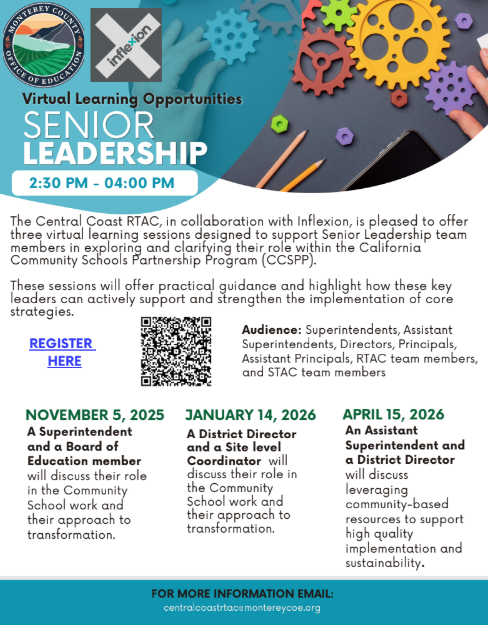
Sacramento COE and CDE - The California Community Schools Partnership Program (CCSPP) California Department of Education (CDE) team and the State Transformational Assistance Center (S-TAC) will host a series of six virtual webinars during the 2025-26 academic year focused on coherence to support the long-term sustainability of the CCSPP. These webinars will be open to all, and the registration information is included in the flyer. We hope you can join us!
National Education Association (NEA) - The NEA organization is offering CCSPP grantee teams the opportunity to participate in their benchmark academy series. The goal of the academies is to build the capacity of LEA and School site teams new to implementation. Participation in these academies is entirely optional and may be particularly beneficial if you’ve identified gaps in implementation support that they could help address. There are three benchmark academies that focus on A.) Evidence-Based Practices, Mapping and Deep Engagement B.) Determining Priorities and Developing Transformational Systems C.) Problem-Solving Cycles for Transformation. NEA academies bring site-level CCSPP teams together that include educators (including classified staff), community school coordinators, administrators, family and community members, and others. Academy participation requires a school Principal's commitment. If a CCSPP school is interested in more information about the academy series, please have a district representative contact centralcoastrtac@montereycoe.org
| | |
State Technical Assistance Center team (STAC)
Members
| | |
CDE - The California Community Schools Partnership Program (CCSPP) California Department of Education (CDE) team supports the community school, “whole-child” school improvement strategy, where the district and school work closely with teachers, students, families, and partners.
To subscribe to the CCSPP-Info listserv, send a "blank" message to: join-CCSPP-Info@mlist.cde.ca.gov
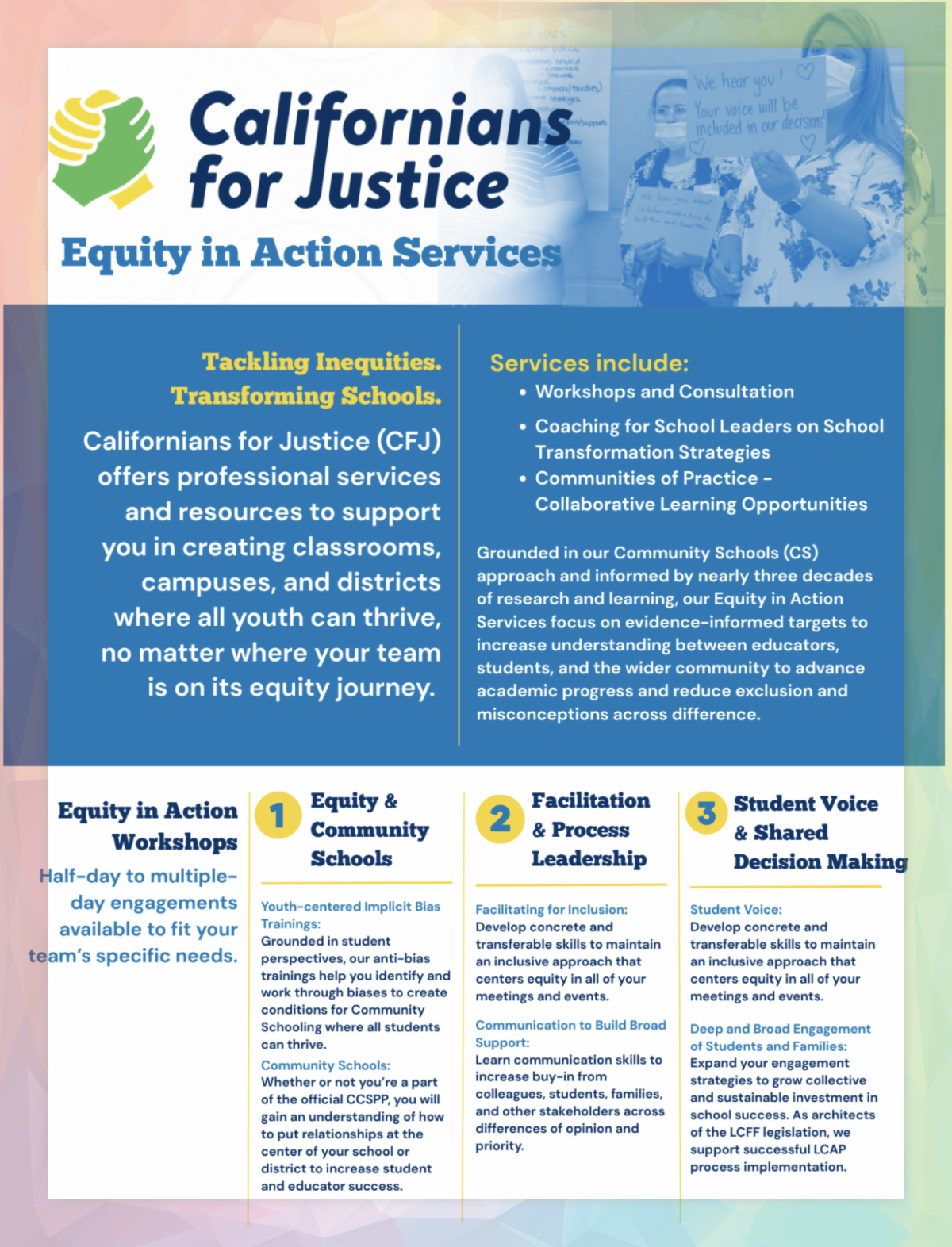
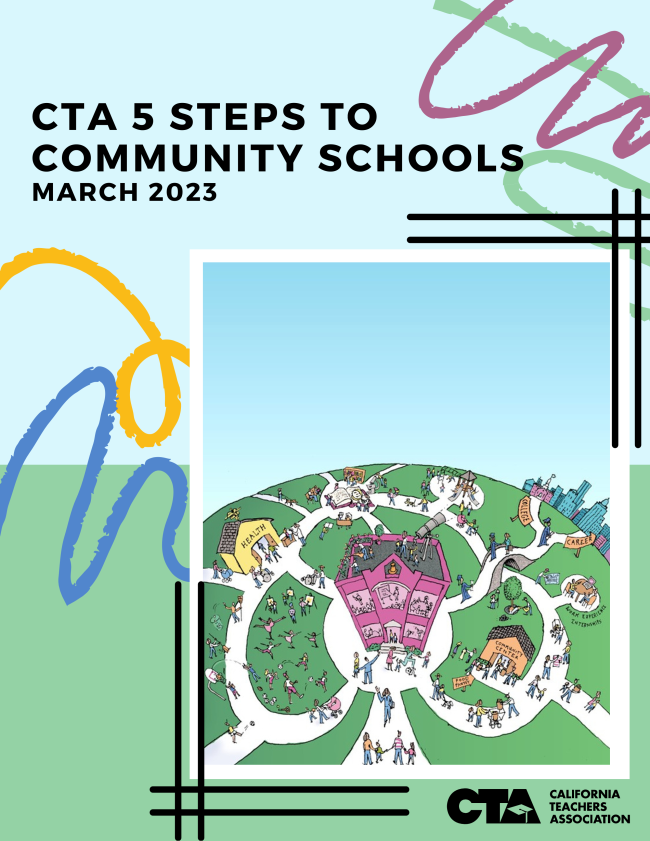
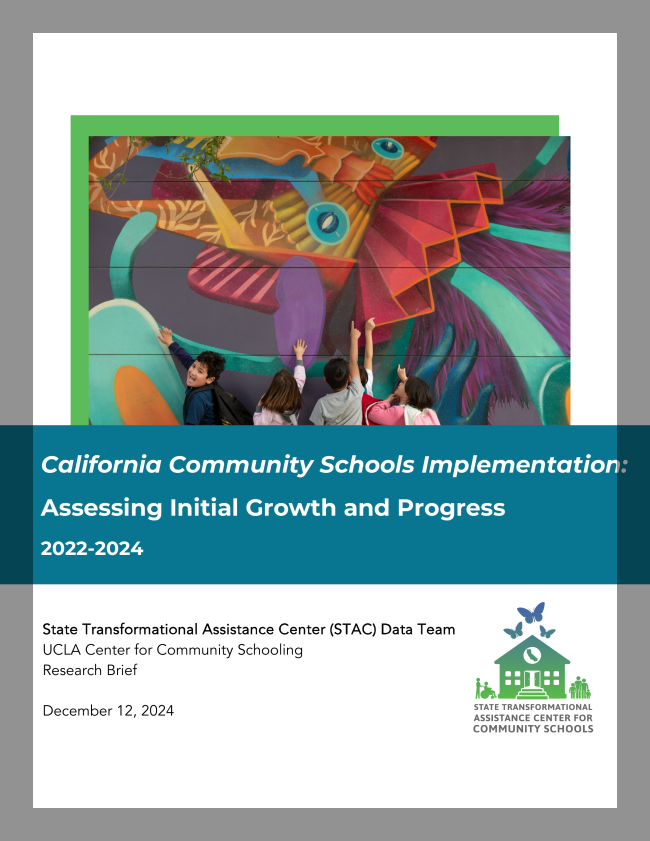
The Sacramento County Office of Education (SCOE) is the County representative on the State Transformational Assistance Center (STAC) team for the California Community Schools Partnership Program (CCSPP). This means SCOE, in partnership with Californians for Justice, the National Education Association, and the UCLA Center for Community Schooling, works closely with the California Department of Education to build content and an overarching methodology for CCSPP technical assistance.
Focus:
- Implementation rubric development
- Community of practice facilitation
- Coherence and sustainability
- Coach and advise regional technical assistance center teams (RTACs)
| | | | |
Californians for Justice.
The mailing list option is at the bottom of their website.
Focus:
- Student Engagement
- Relationship Centered Schools
- Equity
- PDF
| | |
National Education Association
The mailing list option is at the bottom of their website.
Focus:
- Professional Learning
- Leadership Development
- Just and Equitable Schools
- PDF
| | |
UCLA Center for Community Schooling.
The mailing list option is at the bottom of their website.
Focus:
- University Assisted Community Schools
- Research and Data
- Equity
- PDF
| | |
Monterey County Office of Education
901 Blanco Cir, Salinas, CA 93901
Central Coast RTAC | Website
Sign up for the RTAC newsletter, link here
email: centralcoastrtac@montereycoe.org
| | | | |