|
|
|
"Speak, Lord, We Are Listening"
NEWS & NOTES
From The Bishop's Office Of The Episcopal Diocese Of Spokane
| |
STRENGTHENING YOUR
RELATIONSHIP WITH GOD
| |
|
Sometimes I wonder if my relationship with God is a bit like how my cat relates to me. My cat comes to me when she wants to. She expects me to feed her and give her fresh water, and scolds me when I am slow about that. She doesn’t want me to pet her unless she initiates that. There are some chairs where she won’t sit with me and she will just sit and stare until I move to her preferred spot. She clearly thinks she is in charge and in control of our relationship. I would like her to be a bit more responsive and loving, but I accept her for what she is and am happy when she is willing to be with me. I sometimes wonder if God thinks the same about me. Perhaps some of you can relate. It is easy to have a casual relationship with God on our own terms, show up when we feel like it, expect God to take care of our needs and be demanding when we think God is slow about it. We can think that there are some places we will join God and some we will keep private for ourselves. But we are not cats, and our relationship with God is not called to be as standoffish as my cat is with me.
We are fully into Lent, a good time to take a look at our relationship with God and ask if it is what we desire, or perhaps what God might desire. Do we treat God as a casual relationship, one we can engage or not as we feel like it? Or do we view our relationship with God as the foundation of all other relationships, the basis of our very life? How do we nurture and develop and grow in our relationship with God? Do we take time to pray, read scripture, spend intentional time with God? What spiritual practices do we engage in that help us in our spiritual growth? Lent is a good time to ask these important questions, and then engage in the practices of relationship building. As you continue to engage in Lent, I invite you to ask yourself if what you are practicing this Lent is about strengthening your relationship with God, and if it is not, perhaps to consider how you could engage in building that deeper relationship.
+ Gretchen
|
|
|
We have some exciting news to share about changes within our Diocesan Staff. Last month we posted the Bishop's Assistant and Communications Officer opening and we are happy to announce that Tiffany Bade has accecpted that position and has already started in this role. She will serve as direct support to the Bishop and the Canon to the Ordinary, assisting in calendaring visitations and meetings, maintaining records and files, and managing the administrative planning, as well as, organize all internal and external communications. She can be reached at tiffanyb@spokanediocese.org.
Tiffany enjoys many hobbies. She is a musican, a trained pilates instructor, and a mom to a very active 7 year old.
|
|
|
We would also love to welcome Alex Flannagan as our new Canon for Camp, Youth and Family Ministries.
Alex was the assistant director at Camp Huston and the youth ministry coordinator for the Diocese of Olympia. He is looking forward to utilizing his experience from both roles at Camp Cross and the Episcopal Diocese of Spokane. He is proud of his work with the Circles of Color, a program for multicultural ministry in the Diocese of Olympia. He's been at his local church St. Christopher's, Steamboat Island for four years, where he joined the youth ministry team and the music team.
Alex first came to the States from England in 2008 to be a camp counselor. He enjoys playing guitar and hiking and has a mini horse named Mr. Chip.
|
|
SAVE-THE-DATE FOR REGIONAL GATHERING DAY | |
|
Our Spring Regional Gathering Day will be held on April 13, 2024 from 9:30-3:30pm.
Hosts by region:
SW Region: All Saints', Richland, WA
SE Region: Nativity, Lewiston, ID
NW Region: St. Luke's, Wenatchee, WA
NE Region: St. Andrew's, Spokane, WA
Invite all of your members, carpool, bring teams and enjoy the time to learn, network and develop lasting relationships with your neighbors.
READ THE INVITATION FROM THE BISHOP
| |
CAMP CROSS STAFF APPLICATIONS - OPEN NOW | |
Do you know someone or are you someone who enjoys working with youth and the great outdoors? A person looking for a special community that forms, nurtures and develops disciples of Jesus Christ in strong communities of faith for the transformation of ourselves, our communities and the world and knows how best to roast a s'more?
CAMP CROSS, our very own sleep-away summer camp on Lake Coeur d'Alene is seeking Summer staff for 2024. Come live on the lake for a summer and experience a transformative and special place.
APPLY HERE
STAFF DESCRIPTIONS CAN BE FOUND HERE
| |
EVOLUTION AND CONGREGATIONAL DEVELOPEMENT | |
|
I just returned from a once-in-a-lifetime trip to Ecuador, a significant portion of which was spent in the Galapagos Islands. The Galapagos are famous as a place that informed Charles Darwin’s theory of evolution. Although I am quite adept at leaving work behind when I go on vacation, during my travels back to Spokane, I spent some time reflecting on a parallel that I see between evolution of the species in the Galapagos and the development of congregations. This parallel is imperfect, but I hope you will find something of value in the following reflection.
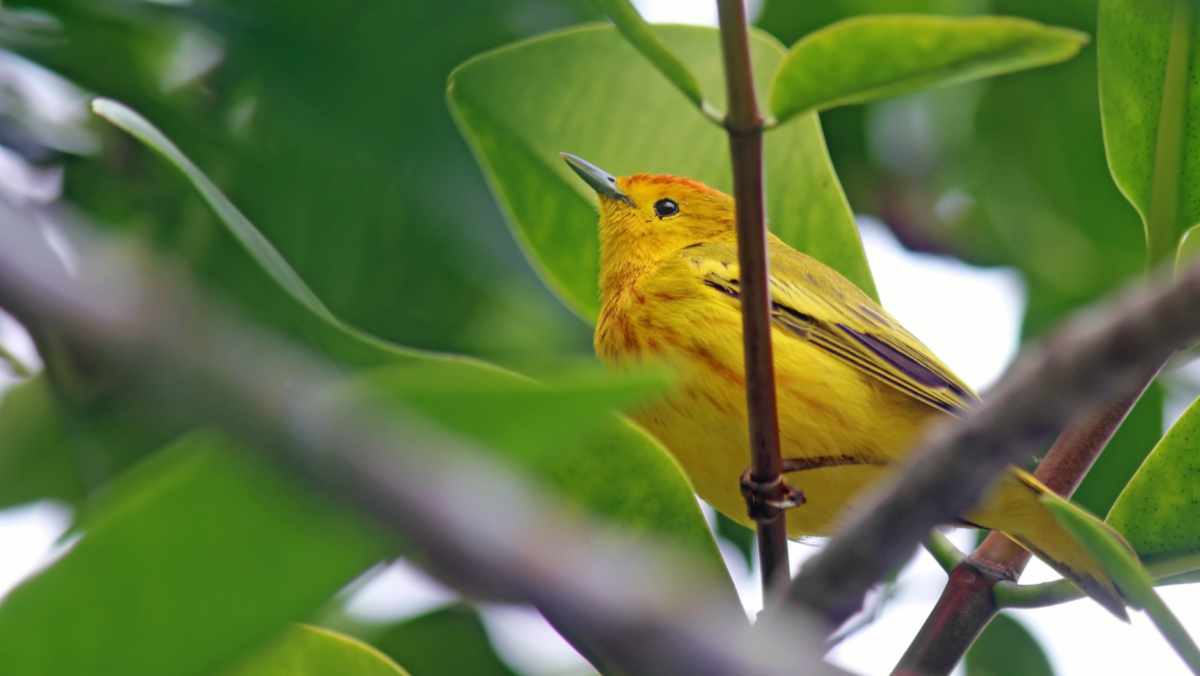
One of the common ways people summarize the evolutionary process is with the phrase “the survival of the fittest.” “Fittest” can be misinterpreted to mean the largest or fastest or strongest. What Darwin noticed in the Galapagos was that species adapt in order to thrive in the environment around them. So, I would argue that the phrase should be “the survival of the best-adapted.” For example, there are 17 species of birds in the Galapagos that are commonly called ‘Darwin’s finches.’ Each of these species evolved from a common species, believed to have originated on mainland South America. Once on the Galapagos, those original birds found, and then adapted or evolved in order to thrive in, different environments. Over time, this diversification and adaptation let to them becoming multiple species, differentiated by their shape, diet, and beak size. The changes that lead to species differentiation were specific to the diversity of habitats and food sources found on the islands.
This is where I see a parallel to congregational development. Each congregation in our diocese exists in a specific environment (we typically call this your neighborhood or context). Congregational development involves adaptation in congregational shape, size, and practices such that the congregation can thrive (increase its health, faithfulness and effectiveness) in its specific context. One significant distinction between the evolution of Darwin’s finches and congregational development is that congregational development is an intentional effort focused on adaptation. It may seem to take a long time, but in the context of evolution, it can happen very quickly indeed!
To successfully evolve, a species first has to engage with the environment. This is also true in congregational development – we can’t intentionally adapt to an environment without learning about and engaging in it. Whether offered through our diocesan Gathering Days, the College for Congregational Development, Building Bridges; Healing Divides, or individual congregational efforts, the knowledge, skills and practices for congregational development must be used in ways that support effective adaptation to the current context. Without curiosity about, awareness of, and a willingness to change in response to its context, a congregation is not likely to remain vital over time.
Please reach out if this reflection sparks questions or additional insights for you! I would love to hear and learn from your thoughts.
Cn. Caroline McCall
| |
|
BUILDING BRIDGES; HEALING DIVIDES
Applications Are Still Open
| |
|
Find the application and more information on our website here
Applications are open for Building Bridges; Healing Divides! I hope you were able to attend one of the information sessions we offered in January and that you have begun conversations in your congregation regarding whether this is the right time for you to participate in our new Thriving Congregations program, funded by the Lilly Endowment. If you were unable to attend either information session and want to know more about the program, you will find a recording of one of the sessions here. If this is not the right time for your congregation, applications for a second program cohort will open in early 2026.
If you are ready to complete an application for your congregation to be part of the first program cohort, you will find the application form here. Applications will remain open until March 15th.
The schedule for the Building Bridges; Healing Divides gatherings for cohort one can be found here.
As part of the application, you will need to provide the following information:
-
Name, email, and phone number for all people on proposed core team. You must have a minimum of three people on the team and you may have a maximum of 5 people.
-
When and how you communicated with your congregation about Building Bridges; Healing Divides and their level of expressed interest in being part of the program.
- When your vestry or bishop’s committee discussed Building Bridges; Healing Divides and the results of a vote to support this application.
-
A commitment on the part of members of your team to fully participate in Building Bridges; Healing Divides gatherings and to provide leadership for practical applications in your congregation.
-
A brief description of how you see your congregation benefiting from being part of Building Bridges; Healing Divides, including at least one area or topic where you see an opportunity to build bridges and/or heal divides in your congregation.
If you have any questions about your application or the Building Bridges; Healing Divides program expectations, please contact Cn. Caroline McCall, Bishop Gretchen, or Mallory Davis.
| |
|
We are well into our way into Lent, traversing with Jesus once more toward Jerusalem with the suffering, death, and resurrection of Jesus in our near future. And we are making this journey with the book of Mark, who is directing us toward the ultimate revelation of Jesus as the Messiah, proclaimed by the most unlikely of people. It is the Roman Centurion in charge of the crucifixion who looks upon the just-dead body of Jesus and exclaims, “Surely, this man was the Son of God!”
Jesus is revealed as who he truly is, the Messiah, the Son of God, in his suffering, death, and resurrection.
When I sit with this and spend time with it, it surprises me. I don’t tend to look at the suffering and death of Jesus to see him most clearly. His resurrection, yes; his teaching and healing and ministry, yes. But his suffering and death? I find myself grateful each Lent to be reminded of Jesus being revealed in not only his resurrection, but also in his darkest nights.
This Lent is coinciding with a time of brokenness and sadness for me. I have been attempting to sit with the brokenness and sadness, not shying away or trying to lacquer over it. It has been a deepening and challenging experience so far, and even as it is so incredibly hard, I believe I will step out of it knowing better who I am.
It is a hard thing to engage suffering and death, brokenness and sadness. And yet, as we experience this time, I wonder how we might see Jesus more clearly in the midst of it. I wonder how we might see ourselves more clearly in light of our seasons and experiences of suffering and brokenness. How might Jesus reveal himself more clearly during this next month? How might our own brokenness, held tenderly in the solidarity and love of Jesus, reveal who we are more clearly?
With you, as we journey with Jesus,
Cn. Andrea Farley
| |
Here you will find monthly ideas for approaching your annual giving campaign throughout the entire year. Looking for the full year guide, find it here: Stewardship Annual Giving Guide. | |
|
|
|
In March, it’s a great time to plan out the annual giving calendar for the remainder of the year and think through what considerations and work this involves. Consider the following:
- Open staff and lay leadership input and creative conversation on theme, content, and schedule of the annual giving plan.
- Design the calendar, goals, and materials that will be needed throughout the year.
- Send thank yous to congregants who have made annual pledges.
| |
In April, continue the annual giving calendar planning you began in March. Consider the following:
- Finalize your theme, content, and schedule of the annual giving plan that you began discussing in March.
- Design the calendar, goals, and materials that will be needed throughout the year.
- Review campaign prospect lists to determine special asks for major gifts.
| | | |
|
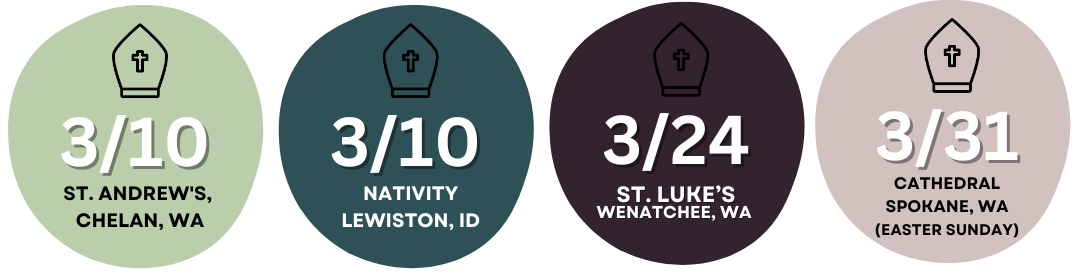
Upcoming Bishop's Visitations for 2024
March
03 - All Saints', Richland, WA
10 - St. Andrew's, Chelan, WA
17 - Nativity, Lewiston, ID
24 - St Luke’s, Wenatchee, WA
31 - Cathedral, Spokane, WA (Easter Sunday)
April
14 - St. Mary's, Bonners Ferry, ID
21 - St. James, Pullman, WA
| | | | |