Henderson Receives Funding to Develop Stormwater and Wastewater Resilience Plan
| | |
The City of Henderson has received funding to develop an integrated Stormwater and Wastewater Resilience Plan, an important investment in the community’s future. For a city of about 1,000 residents, safe and reliable water systems are essential to everyday life. This project will help lay the groundwork to ensure clean drinking water, dependable sewer service, and long-term stability for residents and businesses.
Henderson built much of its underground water and sewer system decades ago. Over time, aging pipes and heavier rain events have put added strain on the system. Groundwater can seep into sewer lines, and large storms can overwhelm equipment. These issues increase costs and raise the risk of backups or overflows.
Strong infrastructure is also important as Henderson looks to welcome new residents. When families or businesses consider moving to a community, they want to know basic services are dependable. This funding will help Henderson remain a safe and attractive place to live.
| | |
Tourism is another key part of Henderson’s economy. Visitors are drawn to the city’s historic downtown, local shops, and its location on the river. Outdoor recreation is especially popular, including the nearby Minnesota Valley State Trail, which brings cyclists and nature lovers to the area. Community events such as Sauerkraut Days also attract large crowds each year. Maintaining high water quality helps ensure that visitors feel comfortable spending time in Henderson.
Water quality doesn’t just affect Henderson. The city sits along the Minnesota River, which connects many communities. When local systems work well, it helps protect the river for everyone downstream.
RNDC has been involved in this initiative since the beginning. Planners helped secure funding for the Resilience Plan by assisting the city in the grant writing process. RNDC will also serve as the project manager, coordinating technical experts, organizing data, helping with public outreach, and identifying funding options for future improvements. The project will review water's entry into the sewer system, map existing pipes, and identify areas requiring the most repair. The plan will also look at ways to better manage rainwater, such as using landscaping features that help soak water into the ground before it reaches the sewer system. Clear priorities and cost estimates will guide future work.
Community input will also play a role. Residents will have opportunities to learn about the project and share feedback. This helps ensure that improvements reflect local needs and concerns. By completing the planning work now, Henderson will be ready to move forward more quickly.
At its core, this project is about protecting public health, supporting local businesses, and preparing for the future. Clean, reliable water service is something every community depends on. With this funding award and strong local partnerships, Henderson is taking practical steps to keep its water systems safe and dependable for years to come.
If you are looking for grant writing help, contact RNDC to see how we can help bring funding to your community!
| | |
HVAC professionals, contractors, or anyone interested in learning more about energy alternatives are invited to join RNDC and the Air Source Heat Pump Collaborative for two free, hands-on training courses led by experts from the Center for Energy and Environment at the South Central Service Cooperative in North Mankato.
The ASHP Comfort Advisor Training (March 11, 8–11 AM in North Mankato) aims to help sales staff and owners strengthen their ability to discuss and implement heat pump solutions.
Register for the Advisor Training HERE or by clicking the button below.
The Quality Heat Pump Installations and Commissioning Training (March 11–12 in Mankato) is ideal for EPA 608-certified installers and technicians ready to advance their skills.
- Learn the 6-step heat pump replacement process to perform a quality install and commissioning, including simplified wiring schematics, best practices for leak-free line sets, state-of-the-art diagnostics and commissioning, and much more
- Get hands-on with real equipment and scenarios designed by experienced installers
- Earn NATE continuing education requirements and Energy Skilled Recognition for Heat Pump Installation to boost your business’ profile and visibility on Google
Register for the Installations and Commissioning Training HERE or by clicking the button below.
Attendees will also become eligible for the Collaborative’s preferred contractor list and gain the tools needed to help customers access state rebates through the HOMEs and HEAR programs. Meals will be provided.
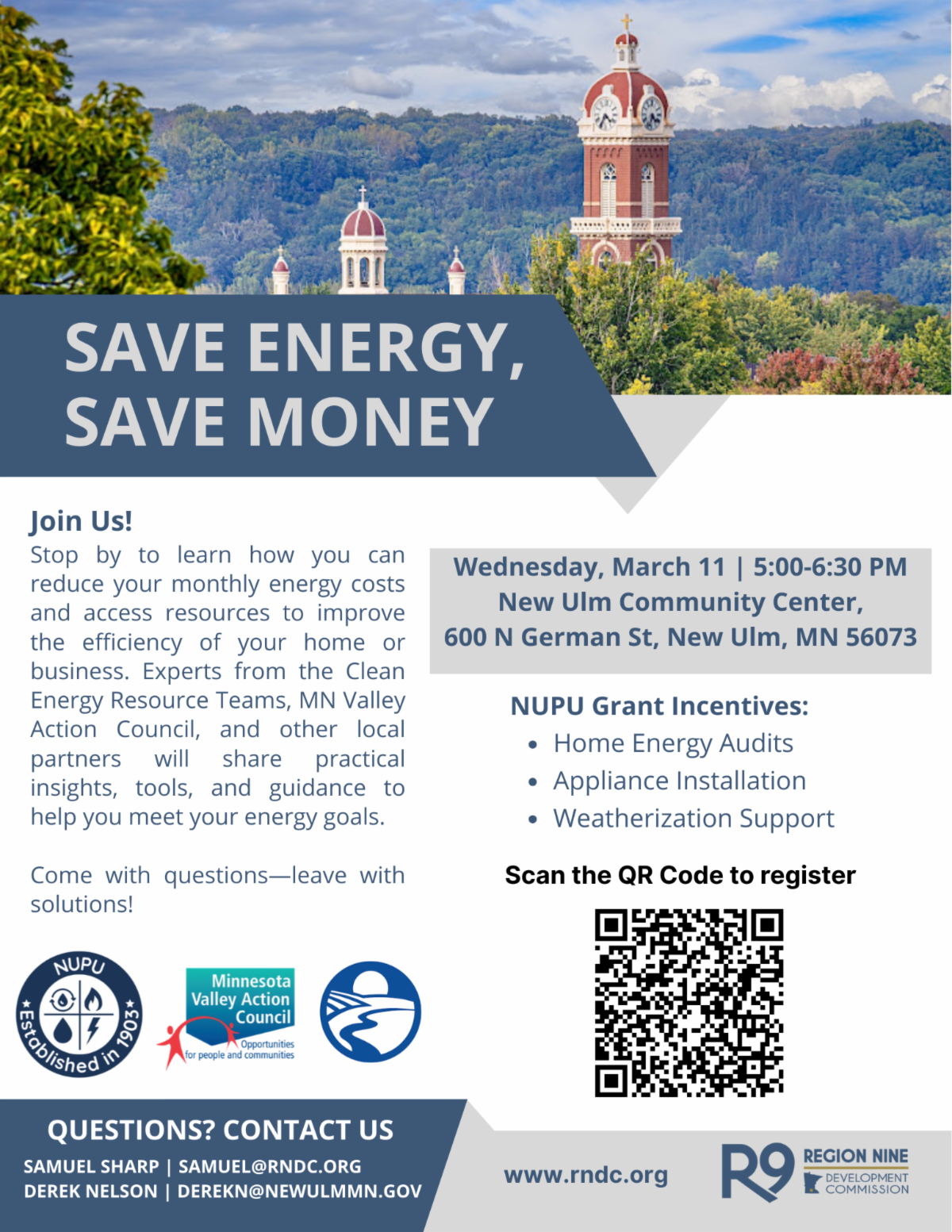
| | Join the New Ulm Public Utilities Energy Forum | | |
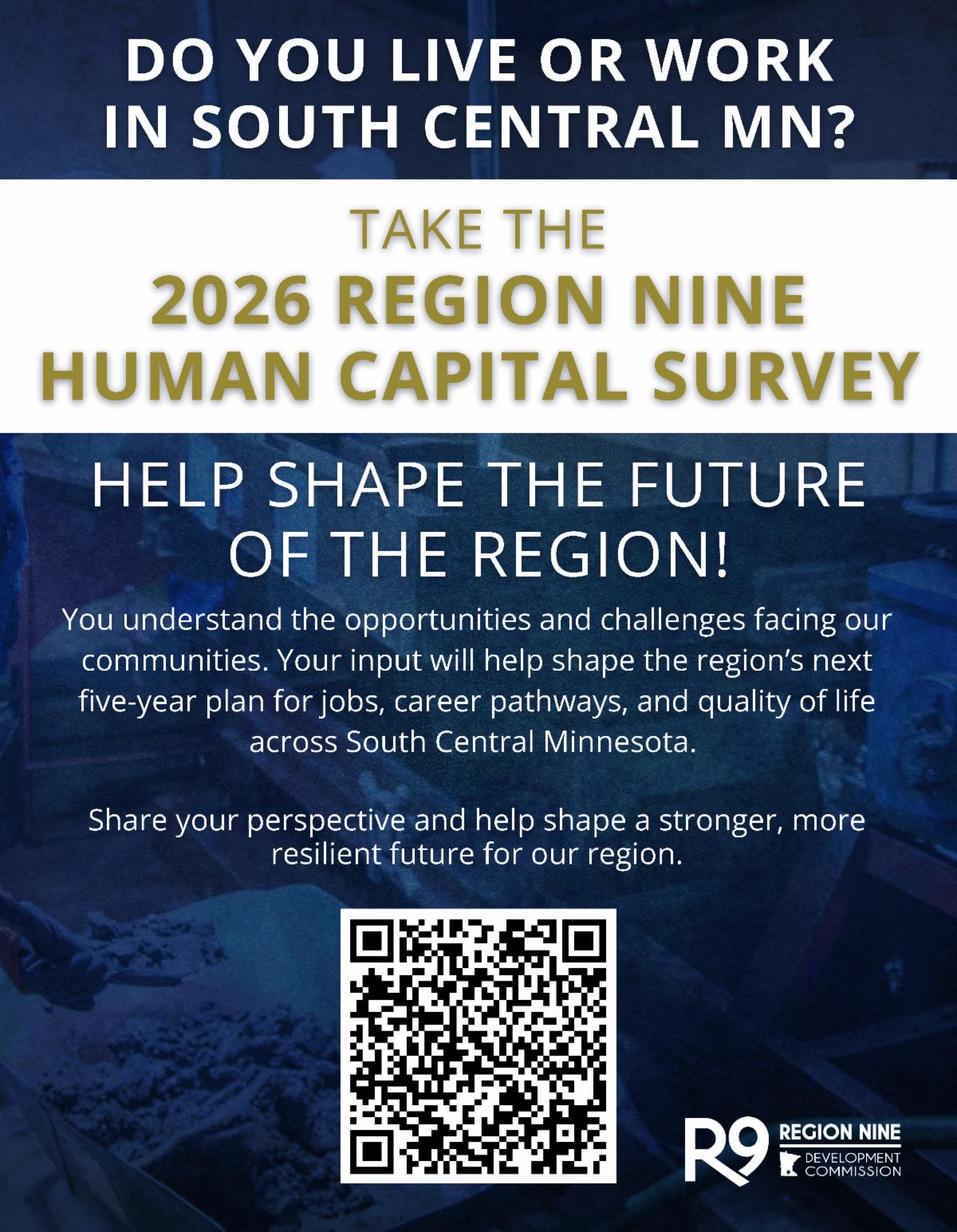
RNDC is continuing the 5‑year update of the Comprehensive Economic Development Strategy (CEDS). This regional plan sets priorities that guide investments in jobs, education, infrastructure, housing, childcare, broadband, and quality of life across our nine counties. To share take the Human Capital survey, scan the QR Code above, click the image, or use the links below.
We are currently looking for input for the following sectors:
Human Capital Survey (for anyone living or working in the region):
https://www.surveymonkey.com/r/humancapital2026 - English
https://es.surveymonkey.com/r/trabajores2026 - Spanish
Education Survey (for teachers, counselors, workforce development, and edu staff):
https://www.surveymonkey.com/r/mneducation2026 - English
https://www.surveymonkey.com/r/educadores2026 - Spanish
Student Survey (for all local students):
https://www.surveymonkey.com/r/mnstudent2026 - English
https://es.surveymonkey.com/r/estudiantes2026 - Spanish
| | |
All responses are anonymous, unless you choose to share contact info. The surveys will be also be made available in Spanish.
What’s next?
- Spring/Summer: Topic forums on housing and childcare, plus local sessions across the region.
- Fall: Create the initial draft of the CEDS.
- Winter: Final draft shared for public review and feedback.
- All year: We’ll keep the CEDS web page updated with new surveys, events, and materials.
Questions or ideas?
Contact Alejandra Bejarano at alejandra@rndc.org
| | The Cream of the Crop Awards are now open for 2026 | | |
The Minnesota Department of Agriculture through the Minnesota Grown program, is seeking nominations for outstanding K–12 school districts, early care centers, and family day care providers that connect youth to Minnesota-grown foods through Farm to School and Early Care (Farm to Kids) initiatives.
Three statewide winners will be recognized: School District of the Year, Early Care Center of the Year, and Family Day Care of the Year. Additional applicants may receive Outstanding in the Field Honors at the Golden Drumstick, Silver Squash, or Bronze Berry levels. New this year, applicants can also nominate a Minnesota Grown producer who has been an exceptional Farm to Kids partner.
First-time and returning applicants are encouraged to apply. Applications are due March 20, 2026.
Learn more and apply here, https://minnesotagrown.com/cream-of-the-crop-awards/ or clicking the button below.
| | Correction: FY 2025 EDA Disaster Supplemental Funding Deadlines | | |
A correction to the February RNDC newsletter regarding the FY 2025 Disaster Supplemental funding opportunity from the U.S. Economic Development Administration (EDA):
The Readiness and Implementation Paths applications will continue to be accepted on a rolling basis until funds are exhausted or the Notice of Funding Opportunity is canceled.
This program makes approximately $1.45 billion available to communities impacted by federally declared disasters in 2023 and 2024, with a focus on long-term economic recovery, resilience, and transformation.
Additional details and application information are available at https://www.eda.gov/strategic-initiatives/disaster-recovery/supplemental/2025 or by clicking the button below.
| | |
Farm to Food Security Grants Open
The Minnesota Department of Agriculture (MDA) is now accepting applications for the Farm to Food Security Grant program. Established by the Minnesota Legislature in 2025, the program is modeled after the former federal Local Food Purchase Assistance Program and supports local farmers and producers by funding projects that purchase local food and distribute it to Minnesotans experiencing food insecurity.
Individuals, nonprofit organizations, for-profit businesses, Tribal governments, government entities, agricultural cooperatives, economic development organizations, and educational institutions are eligible to apply. The program supports purchases of Minnesota-grown and -raised foods including produce, meats, and other whole, minimally processed, and processed foods with at least one primary ingredient that is 80% grown or raised in Minnesota. Grant funds may only be used for food distributions that take place in Minnesota.
The MDA may award up to $1.3 million in total funding for this program through a competitive review process. Applicants may request between $20,000 and $100,000, with a dollar-for-dollar match required on all funds over $50,000. This is a reimbursement grant, meaning awardees will need to pay for the project costs first, then submit receipts after the contract is signed in order to receive reimbursement.
Full grant eligibility requirements and application details are available on the MDA’s Farm to Food Security webpage. Applications are due by 4 p.m. on Tuesday, March 31, 2026.
Deadline: March. 31, 2026
| |
Minnesota Dual Training Grant
Application Now Open
The Dual Training Grant supports the implementation of Minnesota Dual-Training Pipeline programs by pairing on-the-job training with related instruction to generate a comprehensive platform for learning.
The funding generates collaborative and strategic educational solutions between employers and related instruction training providers across Minnesota. Employers or organizations of employers may apply for grants to reimburse expenses related to instruction toward attaining an industry-recognized degree, certificate or credential for their employees.
A grantee can receive up to $150,000 for related instruction costs, of which a single dual trainee can benefit from $6,000. In addition, a grantee can receive up to $15,000 for trainee support costs. Grantees receive funds through a reimbursement process.
Details and application materials are available on the Minnesota Office of Higher Education (OHE) website
Timeline and workshops
- April 2, 2026: Grants management system user registration due.
- April 8, 2026: Proposals due no later than 4 p.m.
If you have questions about the program or application, email gwi.ohe@state.mn.us
Deadline: April 8, 2026
| |
Region Nine Development Commission takes great pride in working with and on behalf of counties, cities, townships, and schools throughout South Central Minnesota. Since 1972, being a partner for progress has led to the development of programs and identification of solutions in the areas of economic development, business development, healthy communities, transportation, community development, and leveraging regional resources. To learn more about our work and mission, visit www.rndc.org.
| | | Follow RNDC on social media to stay up-to-date on events, news, and more! | | | | |