|
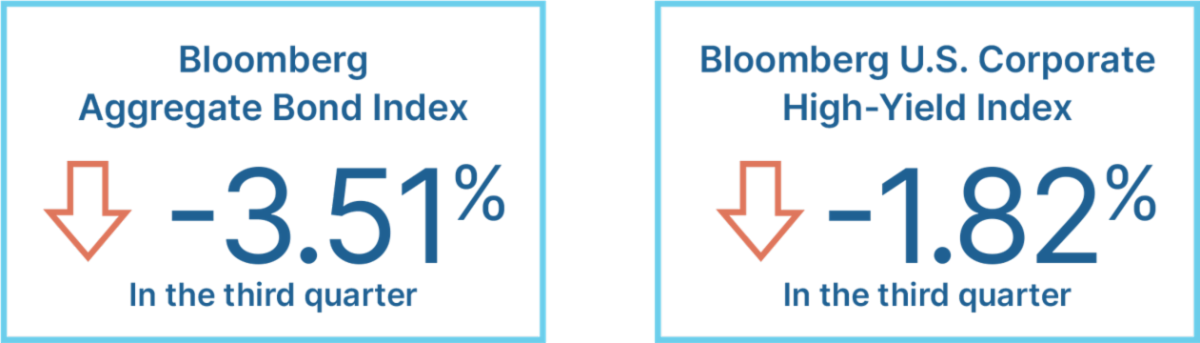
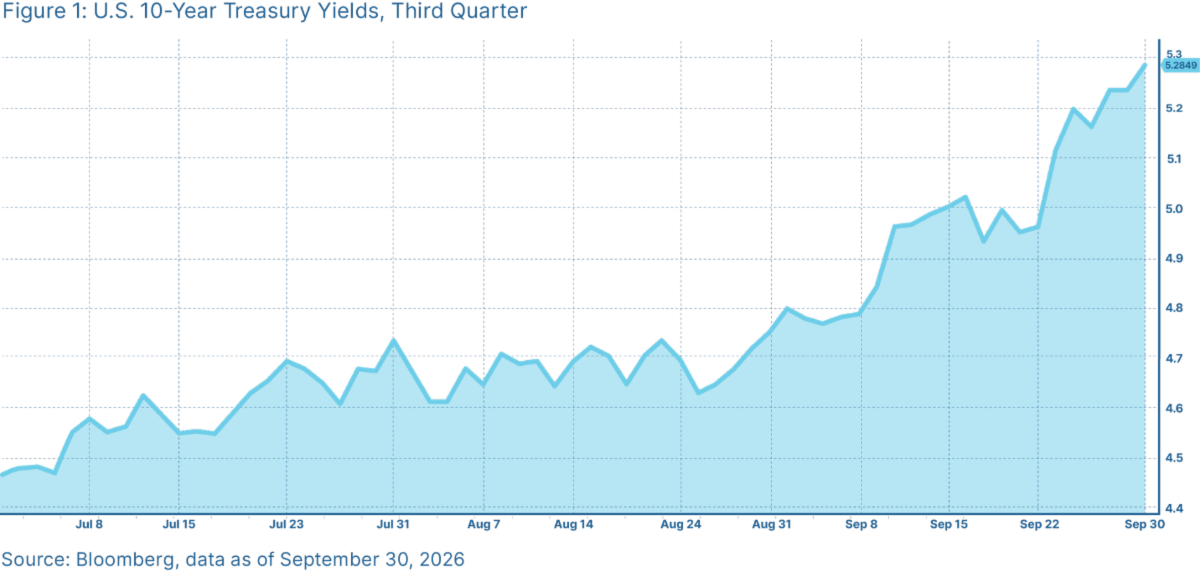
Other factors are certainly weighing on fixed income investors, such as U.S. government debt crossing the $40 trillion level and artificial intelligence infrastructure spending leading to a stronger-than-expected economy. All combined, the bond market seems to be sending a message to the Fed that it needs to raise rates more aggressively to prevent the economy from overheating and inflation from moving higher.
The Takeaway
- A deteriorating situation in the Middle East is leading to higher oil prices and higher inflation.
- The Fed raised rates at its September meeting, and the bond market expects it to do more.
Looking Ahead: Fundamentals Remain Key
As we turn our attention to the fourth quarter, there are three important topics worth watching:
- The Middle East conflict and its impact on oil prices and inflation will continue to drive market movements and Fed policy.
- Headlines about the coming election are prevalent and likely to continue through Election Day. This could lead to short-term movements in markets.
- Earnings season will begin soon, and analysts expect third-quarter earnings will increase more than 29 percent. If this were to hold, it would mark the third straight quarter of earnings growth of more than 25 percent.
Fundamentals drive markets over the long term, and they remain relatively solid for now. Solid jobs growth, continued consumer spending, and strong earnings growth, we believe, should lead to economic growth and further market appreciation.
Risks continue to exist and need to be monitored. As a result, short-term market volatility is possible. However, a diversified portfolio that matches long-term goals and risk tolerance remains the best path forward. If concerns remain, however, speak to your financial advisor to go over your financial plans.
Sincerely,
The IEM Investment Committee
*************************
Disclosure: This material is intended for informational/educational purposes only and should not be construed as investment advice, a solicitation, or a recommendation to buy or sell any security or investment product. Please contact your financial professional for more information specific to your situation.
Certain sections of this commentary contain forward-looking statements based on our reasonable expectations, estimates, projections, and assumptions. Forward-looking statements are not guarantees of future performance and involve certain risks and uncertainties, which are difficult to predict. Past performance is not indicative of future results. Diversification does not assure a profit or protect against loss in declining markets. All indices are unmanaged and investors cannot invest directly into an index. The Dow Jones Industrial Average is a price-weighted average of 30 actively traded blue-chip stocks. The S&P 500 Index is a broad-based measurement of changes in stock market conditions based on the average performance of 500 widely held common stocks. The Nasdaq Composite Index measures the performance of all issues listed in the Nasdaq Stock Market, except for rights, warrants, units, and convertible debentures. The MSCI EAFE Index is a float-adjusted market capitalization index designed to measure developed market equity performance, excluding the U.S. and Canada. The MSCI Emerging Markets Index is a market capitalization-weighted index composed of companies representative of the market structure of 26 emerging market countries in Europe, Latin America, and the Pacific Basin. It excludes closed markets and those shares in otherwise free markets that are not purchasable by foreigners. The Bloomberg Aggregate Bond Index is an unmanaged market value-weighted index representing securities that are SEC-registered, taxable, and dollar-denominated. It covers the U.S. investment-grade fixed-rate bond market, with index components for a combination of the Bloomberg government and corporate securities, mortgage-backed pass-through securities, and asset-backed securities. The Bloomberg U.S. Corporate High Yield Index covers the USD-denominated, non-investment-grade, fixed-rate, taxable corporate bond market. Securities are classified as high-yield if the middle rating of Moody’s, Fitch, and S&P is Ba1/BB+/BB+ or below. One basis point (bp) is equal to 1/100th of 1 percent, or 0.01 percent.
|