|
March home sales were lukewarm for East Tennessee after rapid growth in December, January and February. Looking ahead, pending sales for April are more promising, up 10% over last year.
Even a well-versed reader could be forgiven for confusion over the mixed signals and headlines in recent months - sales up, inventory sluggish, prices flat, population continuing to grow. The market is rounding the finish of a multi-year reset, and we're encouraging members and customers alike to stay steady.
The market is beginning to perform more predictably according to historic norms. East Tennessee hasn't seen those patterns in so long that it feels slow, but digging into the data reveals healthier trends emerging.
Pricing strategy will be increasingly important over the spring. It still isn't a "buyer's market," with inventory tight especially for the smallest and most affordable listings.
Flattening price growth and a lower sale-to-list ratio for three months in a row are sending a clear signal, especially for existing-home sales: Homebuyers are looking for value and affordability in comparison to new construction, and sellers are beginning to offer more concessions and incentives.
| | |
Home Sales Report
MARCH 2026
-
East Tennessee home sales were down 4.5% from March 2025, but cumulatively Q1 2026 sales showed an increase of 5.3% over 2025.
-
The median sale price was $364,450 — down 3% from the previous year.
-
Total housing inventory has increased 10% from the previous year.
-
Half of the homes sold were under contract in 40 days or less, up from 33 days a year ago.
-
40.7% of homes sold for the asking price or above, with 18.4% selling for more than the asking price. 6.8% sold for at least $10,000 over asking and 2.4% sold for at least $25,000 over asking price.
-
The sale-to-list price ratio fell slightly to 98.6% compared to 98.9% a year ago.
-
New construction was 13.9% of total home sales, down from 16.2% in 2025.
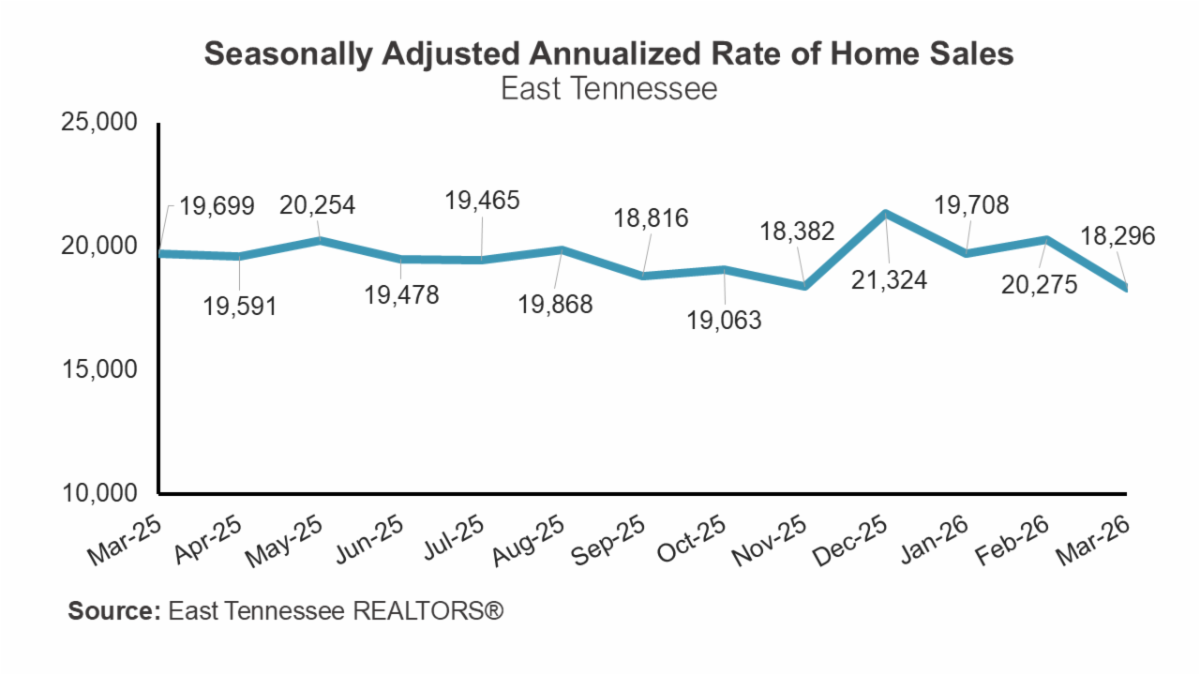
| | East Tennessee REALTORS® reports home sales data using a seasonally adjusted annualized rate (SAAR). This method takes into account seasonal fluctuations in the real estate market, such as increased home sales during the spring and summer, by adjusting the data to provide an annualized rate representing the projected number of homes that would be sold over a year if the current sales pace were to continue. | | |
What's the outlook?
After unseasonably high sales in December, January and February, March was an effective pause for the East Tennessee home sales market. Taken as a whole, however, the first three months of the year outperformed Q1 2025 by 5.3%.
In years past, typical seasonality would be flat in January and February before March kicked off the spring busy season. This year, eager buyers jumped on favorable mortgage rates and effectively snapped up the most attractive and affordable inventory before the season began. Rates then bounced up over 6.4% several times in March, curbing buyer enthusiasm.
There is good news on the consumer side; attitudes have shifted toward the positive after slightly improved national job reports, with the consumer sentiment index unexpectedly rising in April.
Whether consumers have just become used to economic and geopolitical volatility remains to be seen, but either way the reactions of the mortgage market and larger bonds market to headlines have calmed considerably and lending rates ended the month below 6.4%.
Despite market normalization, our limited inventory continues to hold back East Tennessee home sales.
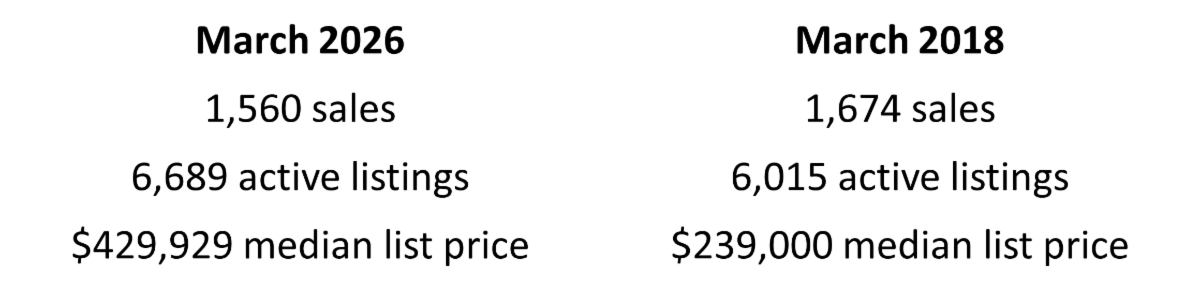
While the market is consistently improving and growing compared to the last few years, the actual numbers are still hovering around 2018 levels.
| | |
Considering that our region added nearly 100,000 people in that same 8-year period, a large portion of the potential market remains unserved. We still have an urgent need to increase inventory volume, diversity and affordability.
| | |
Inventory by county
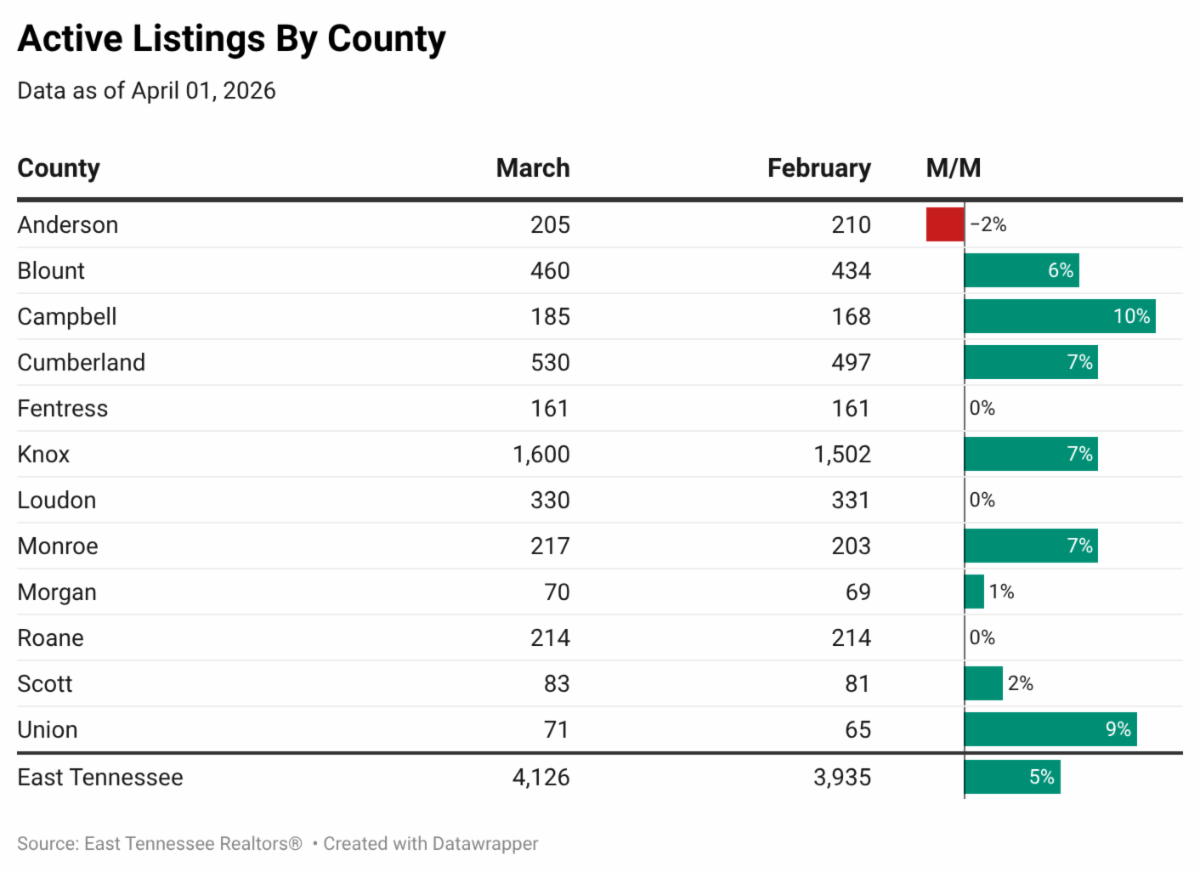
Out of the 12 counties in the East Tennessee REALTORS® footprint, 8 marked measurable increases in active listings month-over-month. Overall, regional inventory increased month-over-month by 5%.
| | |
City of Knoxville kicks off comprehensive plan process
The long-awaited comprehensive plan process for the City of Knoxville began this week with public listening sessions. Branded "What's Next Knoxville," the new planning effort is intended to guide the city's growth and vision for the next 10-20 years.
The comprehensive plan is intended to be a high-level guide for community needs, investment and big ideas around land use, transportation and infrastructure. "Recode Knoxville" updated city codes in 2019, and it is likely that another code update would follow the comprehensive plan to align with the new vision.
If this process sounds familiar, it should be: Knox County's comprehensive plan is in the final stages of a multiyear effort, culminating in the Unified Development Ordinance. While the city and county's land use policies do not overlap other than at the boundary, the general intent for the health of the region should be to view growth as a holistic vision that broadly addresses the needs of its current and future residents.
We hope to see the new City of Knoxville comprehensive plan align with the Advance Knox county plan in a few key ways that will directly affect quality of life:
- Align on priority areas of investment, driven by community input
- Position growth areas geographically in a way that can meaningfully increase diversity and quantity of housing
- Allow and incentivize mixed-use development to intentionally make space for amenities, jobs, childcare and other necessities closer to residential areas
- Broaden access to these necessities through improved transportation and walkability
The plan is an opportunity to think bigger. What should the city be known for in two decades? Are we striking the right balance of investment in green space versus living space? Do we need another highly recognizable, defining place or two?
| | |
It is also an opportunity to heal community divides and ensure that everyone in the city has the ability to guide its future.
The project team is soliciting public input and vision now on the plan website, and no technical knowledge is required to participate. Submit your thoughts at the button below.
| | |
New NAR analysis shows growing housing supply and affordability gap
The latest estimates from the National Association of REALTORS® (NAR) show that East Tennessee would need to add thousands of homes for sale at a price point of less than $550,000 to achieve a balanced market.
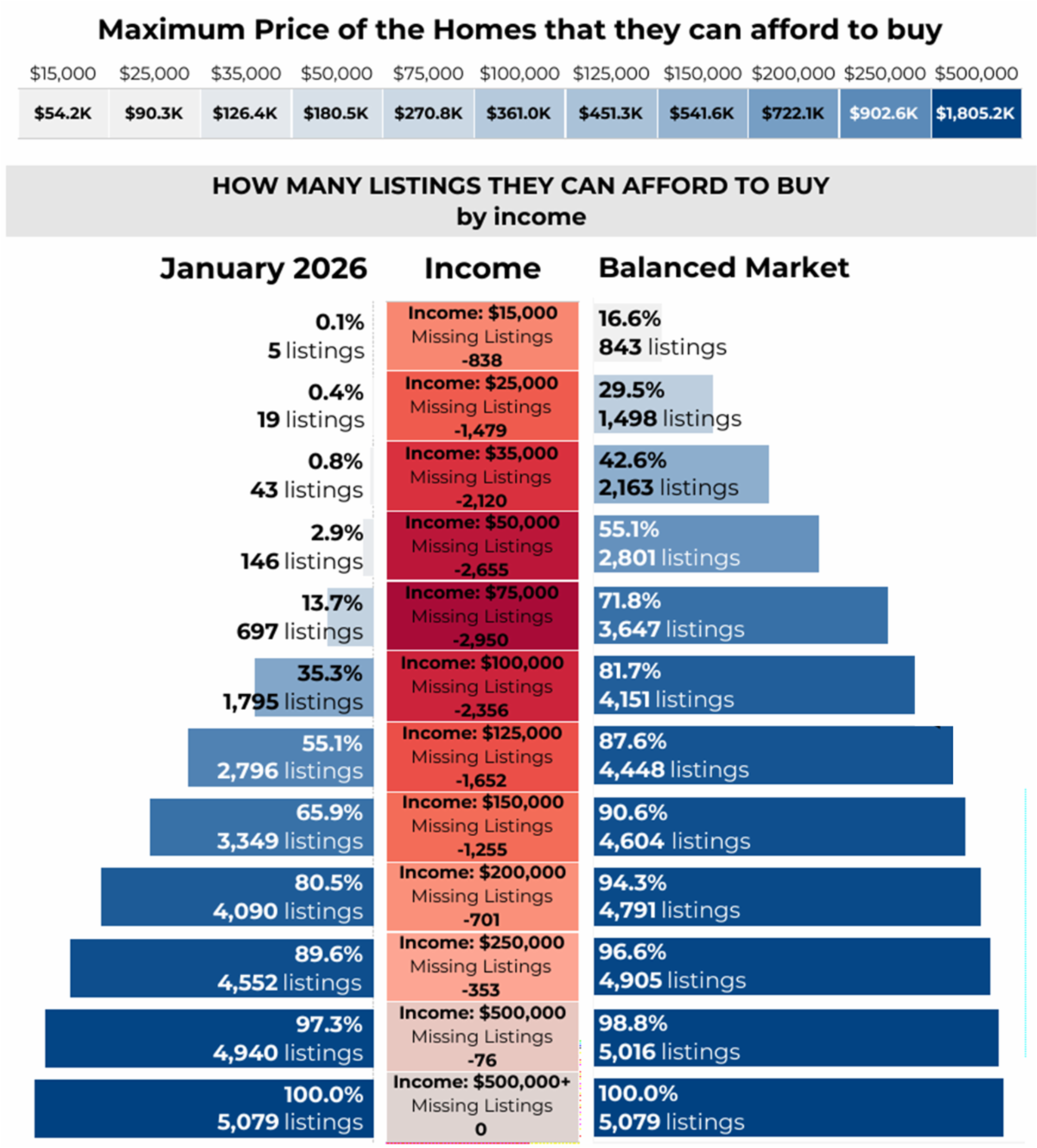
Based on January home prices, available inventory and estimated household incomes in the 9-county Knoxville metropolitan statistical area, the study showed that our market has almost no listings that are truly attainable for households making the area median annual income.
NAR's visualization uses the inventory count in January across those 9 counties, then estimates how many of those listings should be available at each income level. The right side of the visual shows the ideal number of listings that would be available in a balanced market, where there would be enough homes to create mobility for all income levels.
Using the traditional calculation that a household should not spend more than 1/3 of its gross monthly income on housing costs, and factoring in current mortgage rates, this shows that a family making $75,000 per year would be able to afford a home priced at or below $270,800. As of the beginning of the year, there were only 697 of those listings available across the entire region.
| | |
Source: National Association of REALTORS® analysis
Cumulatively, the data also shows that single-family housing starts in the Knoxville MSA are still falling short each year by at least 1,500 homes. This is purely based on a historically healthy rate of building in relation to population growth, and does not account for the existing deficit of an estimated 10,500 homes from underbuilding since 2007.
Home price growth has calmed slightly over the last 2-3 years, but in our healthy and growing economic market, prices will not drop far enough to measurably close the gap without a supply intervention. So where does that leave us?
It is crucial to add new types of supply that can enter the market now at a more affordable price point, such as middle housing that includes townhomes, duplexes, triplexes and quadplexes, condominiums, and smaller single-family homes. Simultaneously, we must continue to increase rental capacity to create mobility for households who do not yet have access to the market.
The place to start is now; As we adjust our land planning to identify where and how future growth will expand, we must urgently create areas of investment that will add meaningful inventory volume and significant density near existing infrastructure.
| |
Pending sales are up, but existing homes are slow to return to market
National pending home sales inched up 1.5% month-over-month in March, following a 2.5% increase in February. The increase was largely driven by new home sales, as existing homes have been slower to return to market. This could be due to homeowners' reluctance to sell if it means they will end up with a higher mortgage rate.
“The inventory-to-sales ratio, or supply-to-demand ratio, is below historical norms. Bringing 300,000 to 500,000 more homes on to the market would help bring the market closer to normal conditions."
- Dr. Lawrence Yun, Chief Economist for the National Association of REALTORS®
Read the full analysis here.
| | |
Mortgage Rate Update
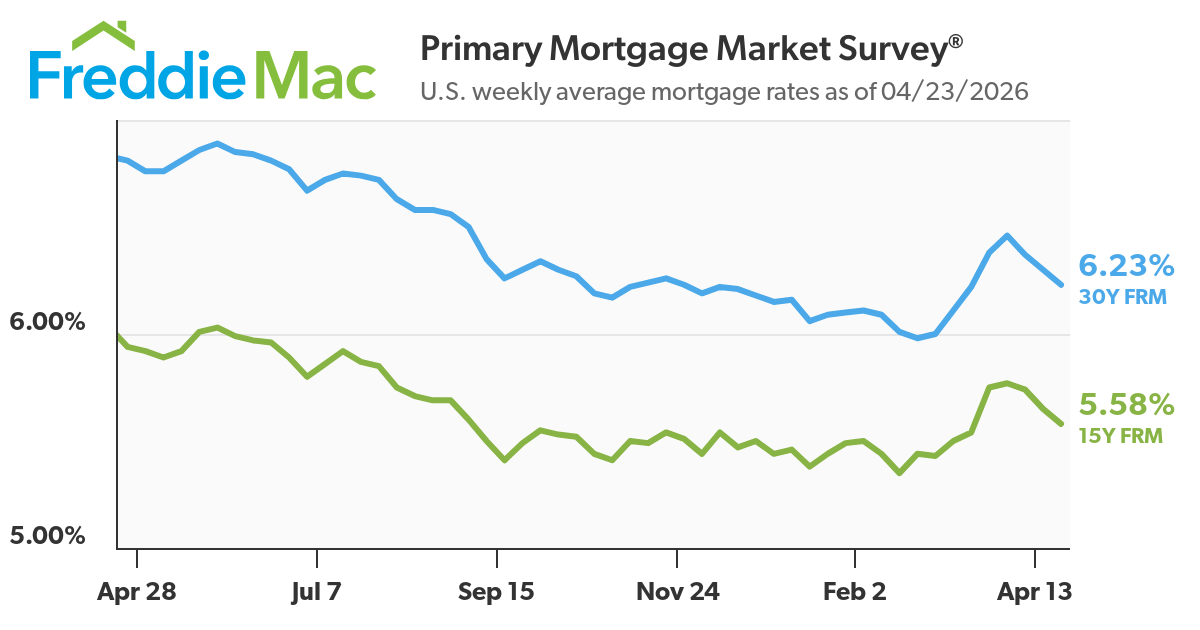
The 30-year fixed mortgage rate (30Y FRM) has been relatively stable within the range of 6.2-6.4% in April, ending the month at 6.23%.
| | |
Despite international geopolitical turbulence, conflicting reports on jobs and inflation, and the ongoing war, mortgage rates have held steady in March and April. The market seems to view current events as mostly temporary, meaning that long-term impacts have not been baked into the cost of lending.
The focus on the Federal Reserve has also died down, with experts predicting that rate cuts are no longer on the horizon. The Fed held rates at the April 29th meeting and has effectively been sidelined for the moment, due in part to the political environment amidst the expected transition from Chair Jerome Powell to Kevin Warsh, and in part to the competing mandates of labor and price stability.
| | Stay up to date with the most recent information about East Tennessee's housing and real estate market. Here's the latest from local media: | | Market Pulse is a monthly research newsletter providing a rundown of the latest housing and economic research and analysis across East Tennessee. | | Was this email forwarded to you? Subscribe here. | | | | |