|
At the halfway mark, 2026 appears to be the year East Tennessee's housing market finally recovers from post-pandemic swings.
Consumers have returned, driven to buy or sell by life changes that just can't be put off anymore. Despite mortgage rates so far in 2026 being slightly higher than last year, activity has soared. Price appreciation has slowed, and inventory is coming back.
The biggest influence on 2026 home sales is pent-up demand.
East Tennessee REALTORS® has released the 2026 edition of the State of Housing Report, an annual analysis of housing, economic data and trends to help REALTORS®, industry stakeholders, and policymakers understand and navigate the evolving market. We review the highlights below.
| | |
Home Sales Report
JUNE 2026
-
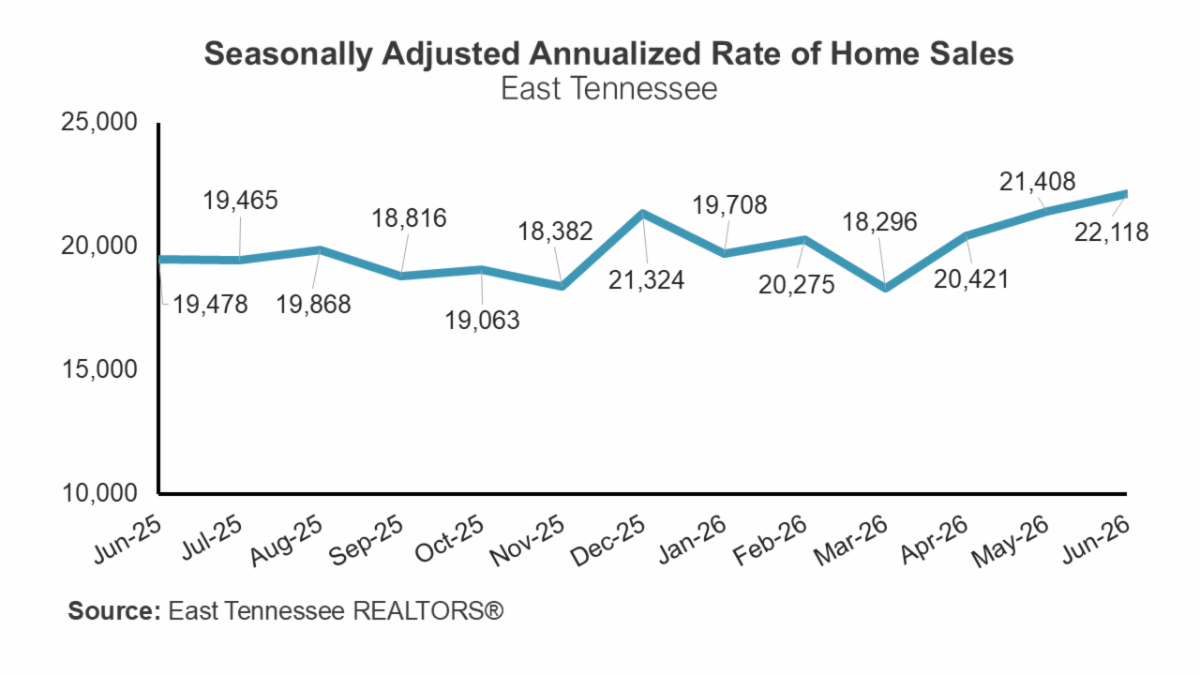
East Tennessee home sales increased 14.1% in June from 2025.
-
The median sale price was $390,000 — up 3.3% from the previous year.
-
Total housing inventory is up 6.5% from June 2025.
-
Half of the homes sold were under contract in 20 days or less, exactly the same as one year ago.
-
43% of homes sold for the asking price or above, with 18.7% selling for more than the asking price. 7.8% sold for at least $10,000 over asking and 2.5% sold for at least $25,000 over asking price.
-
The sale-to-list price ratio held steady at 98.9% compared to 99% a year ago.
-
New construction was 11% of total home sales, up from 13.4% in 2025.
| | East Tennessee REALTORS® reports home sales data using a seasonally adjusted annualized rate (SAAR). This method takes into account seasonal fluctuations in the real estate market, such as increased home sales during the spring and summer, by adjusting the data to provide an annualized rate representing the projected number of homes that would be sold over a year if the current sales pace were to continue. | | |
What's the outlook?
Enthusiastic home buyers continued to emerge in June, with single-family sales up 14% over June of 2025. To date 2026 sales are up 9% over the same 6 months last year, on track to significantly outperform 2025.
Early and sustained sales have absorbed inventory at a rapid pace starting in December of 2025, compared to the usual spring season. We see a subtle tightening in the market; for instance, despite monthly new listings and completions increasing over the previous 12 months, the median days on market is exactly the same - 20 days. For the first half of the year until now, homes were sitting on the market 5-10 days longer than in 2025; that trend has now reversed.
Price has also indicated subtle tightness in the market. After several months of flat growth, prices ticked up about 4% in one month.
All indicators point to a healthy rest of 2026 for home sales. While we often revise our projections, we have not this year and still anticipate 6.1% sales growth for the year.
| | |
Inventory by county
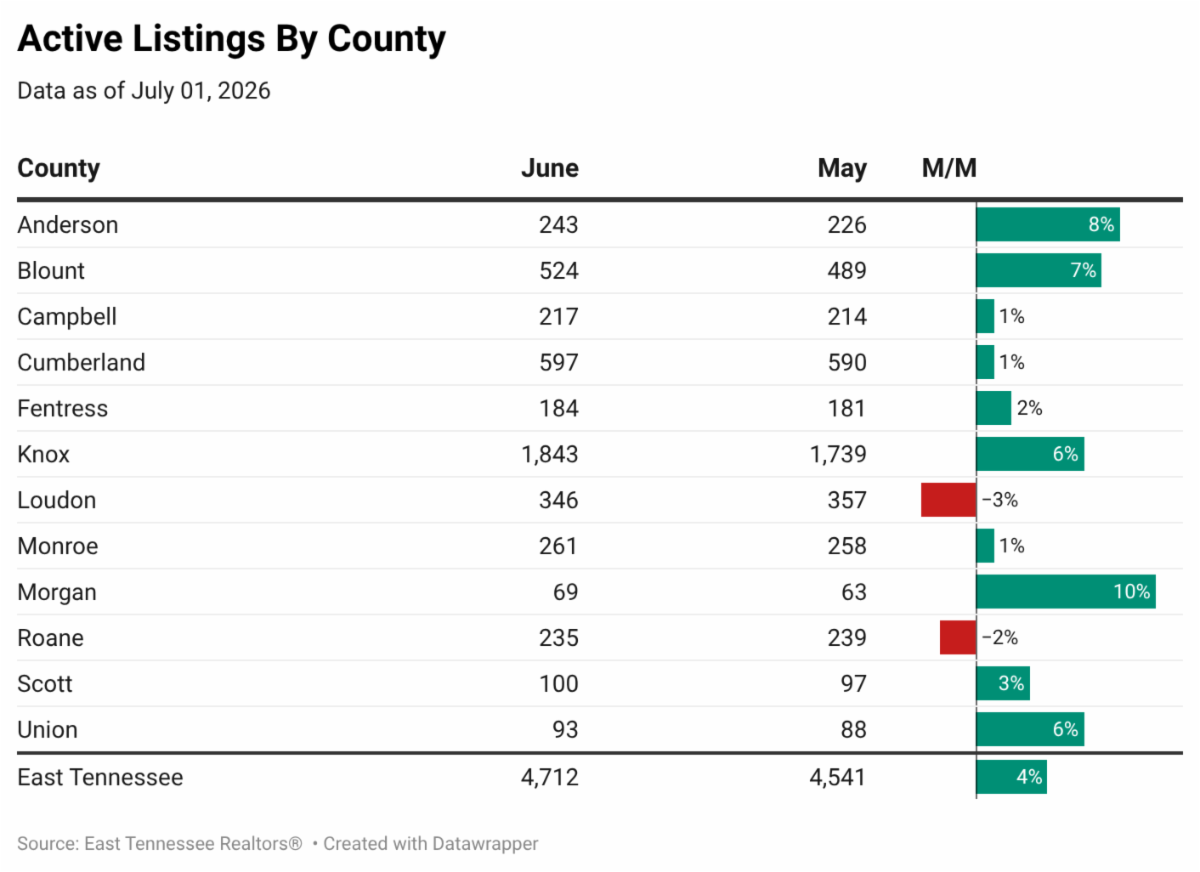
Out of the 12 counties in the East Tennessee REALTORS® footprint, 10 marked measurable increases in active listings month-over-month. Overall, regional inventory increased month-over-month by 4%.
| | East Tennessee REALTORS® 2026 State of Housing report highlights | |
Throughout the 2026 State of Housing report, market indicators return to a new "normal" pattern as homebuying essentially resets to 2018, with a few adjustments.
A coordinated effort from policy makers, elected officials, advocacy groups, builders, REALTORS®, lenders and more has resulted in a noticeable increase in supply. Price gains have slowed, and inventory is slowly coming back.
It is clear that while these efforts have had measurable outcomes, bolder reforms are needed to solve the problem. We have reached the limit of the progress that can be made in today's regulatory environment that still encourages building on large lots with higher-priced homes.
In Knox County, for example, the average new lot created in 2025 was a whopping half-acre, and the sprawling development pattern continues to burden the already-strained county budget while worsening traffic and quality of life for residents.
The next step that must occur to make any meaningful inroads for affordability is to make space in the market for a new segment of homes that can be created at a price attainable to the average household, whether that means smaller footprints, more vertical density, innovating on building and financing techniques, or other solutions.
The big population boom is over. The next phase should be one of improving services to catch up to our new residents, and planning for the future.
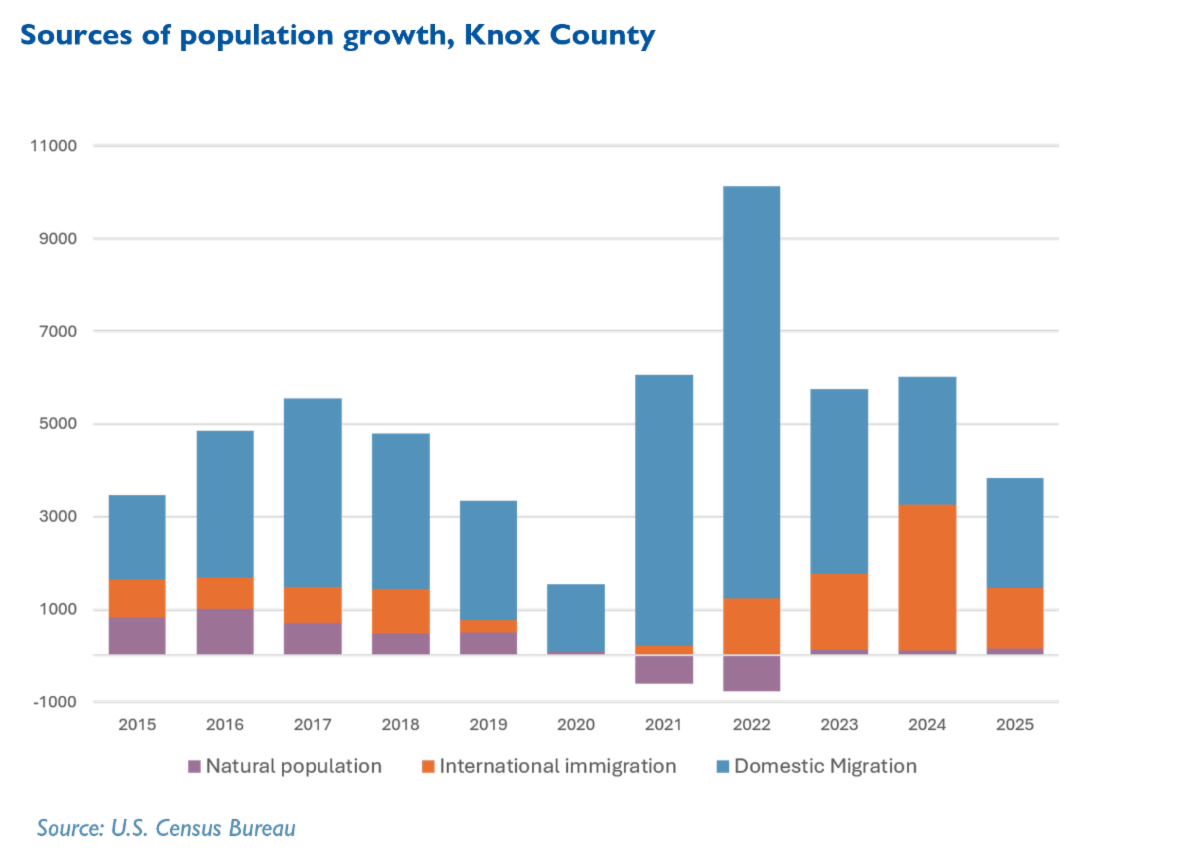
Net migration remains positive at approximately 10,300 residents in 2025, but has slowed from 19,600 in 2022 and 15,500 in 2023. The region continues to attract residents, but the pandemic-era surge has normalized.
Our 2025 rate of population growth is lower than it has been since 2016. This is likely not due to any local factor, but more that the 5-year national population shift kicked off by the pandemic has ended.
In fact, the region's natural birth rate is so low that our local economy relies entirely on migration. It will be crucial to continue attracting new residents at the current normalized rate of growth of around 1.1-1.3% over the next few years.
| |
We've mentioned pent-up demand for 2-3 years. In late 2025 and 2026, it has finally begun to arrive, and purchases are up double digits year over year.
Traditional rules of consumer behavior no longer apply; higher mortgage rates might not foretell slower purchases, for instance. When it comes to purchasing a home, consumers also seem to have opted out of the media rollercoaster. While the disruption of the global oil supply has certainly affected inflation, headline-induced caution can no longer compete with that additional bedroom a family urgently needs for a new baby.
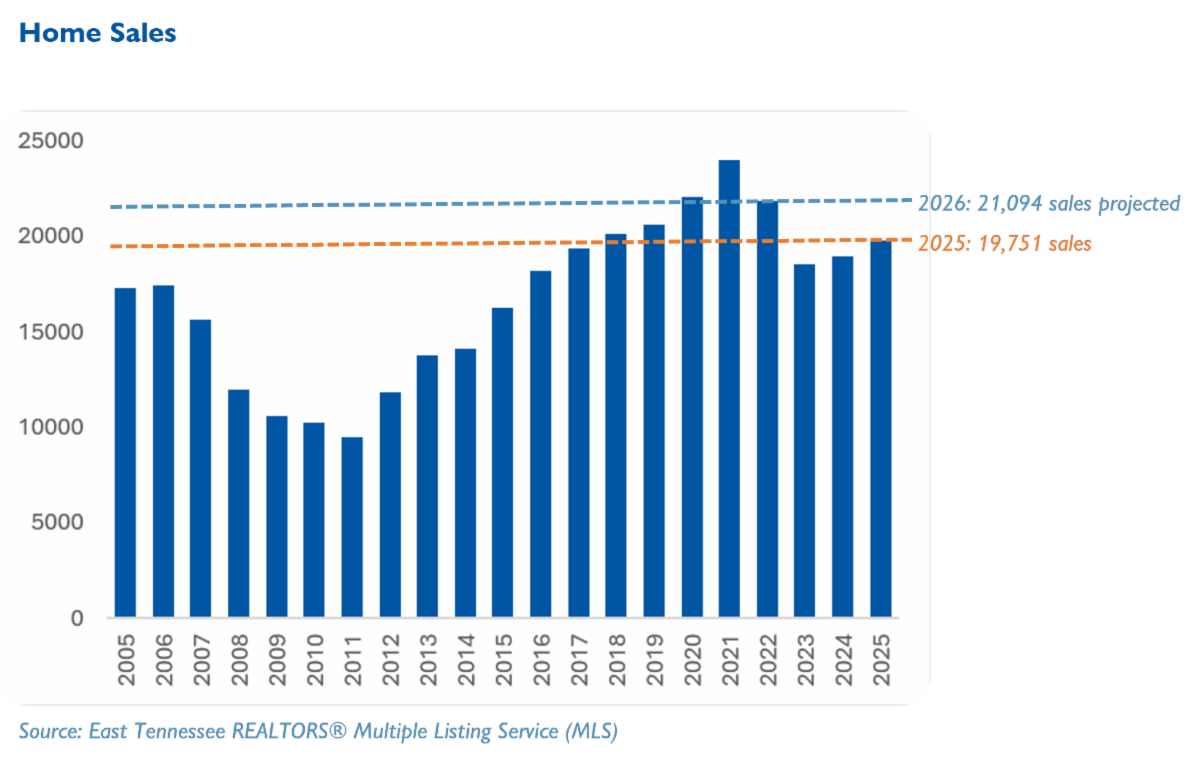
Home sales in the East Tennessee REALTORS® Multiple Listing Service (MLS) climbed to 19,751 in 2025 from 18,942 in 2024, a gain of approximately 4.3%. Sales remain well below the 2021 peak of 24,009, indicating that activity is recovering gradually rather than returning to the pandemic-era pace.
In context with historical data, however, the pace of sales is on par with 2017 sales of 19,340, not quite catching up to the 2018 level of 20,579.
2026 is projected to improve significantly over 2025.
| |
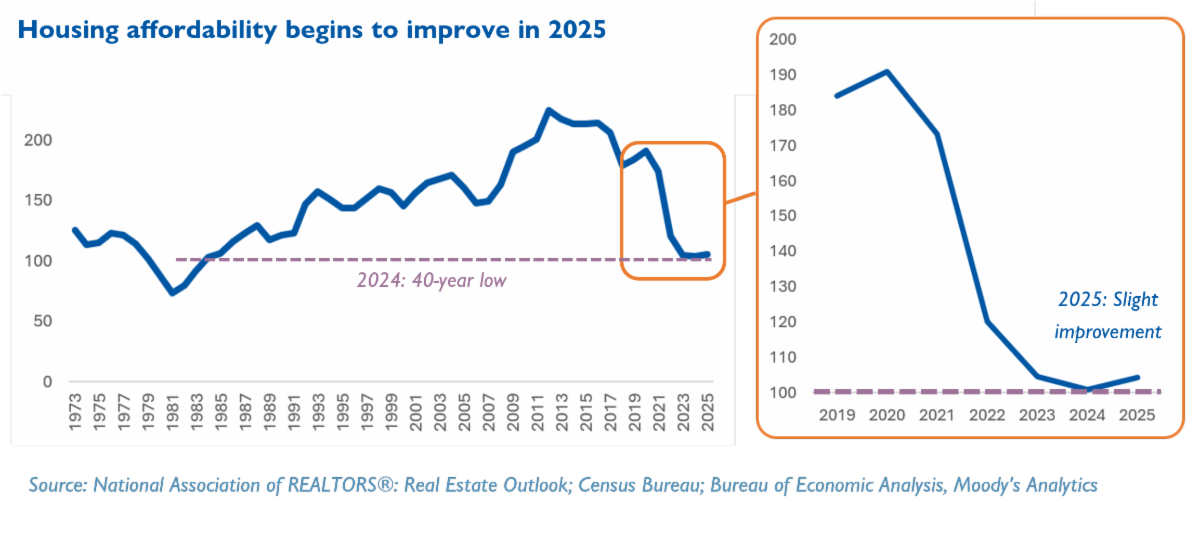
Affordability has improved slowly.
Looking at affordability, gains in 2025 were largely based on mortgage rates. The region has amped up the pace of permitting and building over the last few years, but that increase in supply is just barely being reflected in inventory and slightly slowing price growth.
The Housing Affordability Index recovered from a 40-year low of 101.0 in 2024 to 104.3 in 2025 and is projected to reach 110.8 in 2026.
Despite this small improvement in overall affordability, mostly thanks to mortgage rate changes, the home price-to-income ratio continued to worsen in 2025. Home prices will need to remain flat for several years to allow incomes to catch up with the cumulative increase in home values, because of the steep jump in prices from 2021-2024.
| | Our collective progress is worth celebrating, and we look forward to continuing to work together to ensure all East Tennessee residents can call our community home. | | |
National survey reveals unmet needs in rental housing
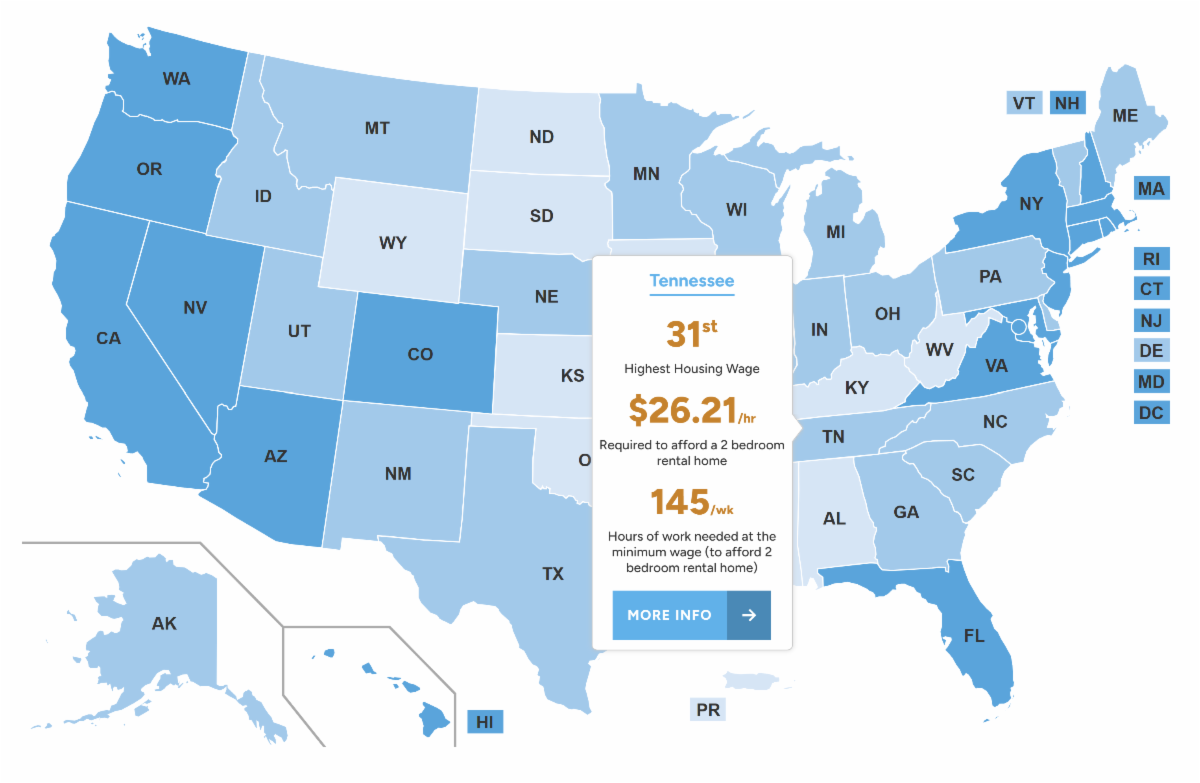
The National Low Income Housing Coalition recently released its annual Out of Reach publication, highlighting the relationship between wages and housing costs for renters across the country.
Each market varies broadly; in some, significant gains have been made. In others, disparities in access to attainable housing have broadened and wages have not kept pace with costs.
Tennessee falls into the middle; not making significant gains for rental affordability, but also not worsening. At a state average, a household would need to earn $26.21 per hour to afford the typical 2-bedroom apartment.
| | |
The report shows how the East Tennessee region stacks up to the state of the nation, and the visual dashboard allows readers to explore the data by zip code.
In West Knoxville, a renter would need to earn more than $40 per hour to afford the typical two-bedroom unit in the area.
In Maryville, the wage needed ranges from $28-32 per hour.
In Oak Ridge, the wage needed varies broadly from $21-42 per hour depending on neighborhood.
The NLIHC report's simplified method of viewing and comparing regions is a solid and accessible tool to help decisionmakers quickly see where price growth has outpaced wages as they look at areas that might be in need of affordable housing.
In the Knoxville, TN metropolitan statistical area (Knox and 8 surrounding counties), rent was down 3% over last year as of Q4 2025. This must still be kept in perspective; the average renter in our region is paying $1,600 per month, has seen a $675 per month rent increase since 2020, and a 3% reduction would amount to less than $50 for that renter.
| |
International buyer activity in U.S. slows down this year
International buyers purchased 67,100 existing homes across the nation between April 2025 and March 2026, a 14% decline from the previous year, while the dollar volume of those purchases fell nearly 20% to $45.3 billion.
Higher home prices, limited inventory, economic uncertainty, and changing immigration policies contributed to the slowdown.
Despite these headwinds, buyers from Canada, China, and Mexico remained active, reflecting the continued appeal of U.S. real estate among key international markets.
– Dr. Lawrence Yun, Chief Economist for the National Association of REALTORS®
Read the full analysis here.
| | |
Mortgage Rate Update
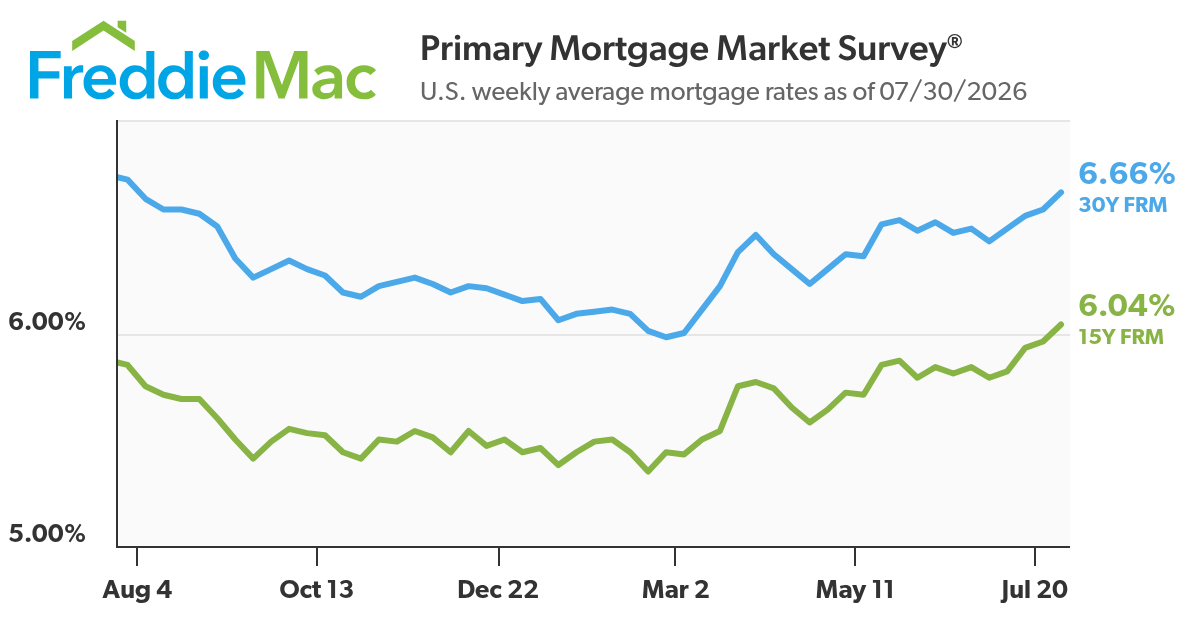
The average 30-year fixed mortgage rate (30Y FRM) ticked up slightly over the past several weeks, ending the week of July 30, 2026 at 6.66%.
| | |
Rates have been primarily affected by the ongoing conflict in Iran, and expectations on the future of global oil access through the Strait of Hormuz. Alongside headlines, rates have fluctuated as negotiations continue.
During the Federal Reserve's July meeting, the board of governors voted not to change the bank rate now. A handful of members have begun to advocate for rate hikes sooner than the end of the year to help control inflation, but the majority voted to keep the status quo.
| | Stay up to date with the most recent information about East Tennessee's housing and real estate market. Here's the latest from local media: | | |
Brookings Institute | July 17, 2026
| | |
National Association of Home Builders | July 16, 2026
| | Market Pulse is a monthly research newsletter providing a rundown of the latest housing and economic research and analysis across East Tennessee. | | Was this email forwarded to you? Subscribe here. | | | | |