- Apartment rent growth continued to moderate in February, with rents across the Knoxville metro area only increasing 2.1% from the previous year. By comparison, rents were up 0.19% nationally during the same period.
-
Home prices in the Knoxville metro area increased 11.7% from the previous year in the fourth quarter of 2023, which places the region at No. 8 in the U.S. for price growth, according to the FHFA House Price Index.
-
The National Association of REALTORS® this month announced a proposed settlement agreement that would end litigation of claims brought on behalf of home sellers related to broker commissions. Access essential tools and stay informed about the settlement by visiting etnrealtors.com/settlement.
- It's March already?! Take a breather and see if you can guess the winds of public opinion through American history in a new game, called Campaign Weathervane, courtesy of the Roper Center for Public Opinion Research.
| |
|
Home Sales Report
February 2024
-
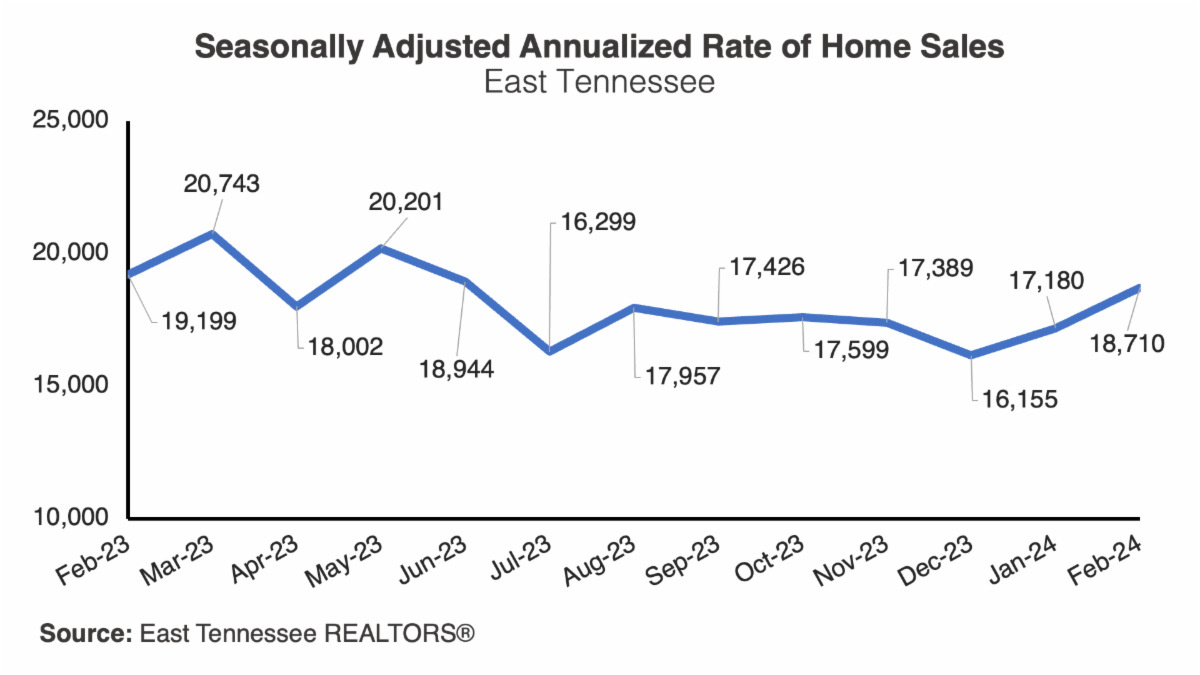
East Tennessee home sales increased 8.9% from the previous month, but were down 1.4% from a year ago.
-
The median sale price was $354,000 — up 10.3% from the previous year.
-
Total housing inventory increased from the previous year – up 24.0% from a year ago.
-
Half of the homes sold were under contract in 28 days or less, up from 25 days a year ago.
-
45% of homes sold for the asking price or above, with 21% selling for more than the asking price. 8% sold for at least $10,000 over asking and 2.6% sold for at least $25,000 over asking.
-
The sale-to-list price ratio increased to 97.8% – up from 97.6% last month.
-
New construction represented 16.5% of total home sales.
East Tennessee REALTORS® reports home sales data using a seasonally adjusted annualized rate (SAAR), a statistical measure of home sales that takes into account typical seasonal fluctuations in the real estate market, such as increased home sales during the spring and summer months, by adjusting the data to provide an annualized rate. This rate represents the projected number of homes that would be sold over a year if the current sales pace were to continue.
| |
What's the Outlook? February was a clear turning point for East Tennessee's housing market. Pending listings were up more than 16% from the previous year across the region – an uncharacteristically large jump for this time of year – as higher inventory levels and a stable mortgage rate environment has created more certainty for buyers and sellers alike. Housing market activity was especially strong in Knox County, where home sales in February increased 9.9% from the previous year. | |
National Association of REALTORS® Reaches Agreement to Resolve Nationwide Claims Brought by Home Sellers | |
|
The National Association of REALTORS® announced a proposed agreement that would end litigation of claims brought on behalf of home sellers related to broker commissions.
In our commitment to maintaining the transparency and trust that you've come to expect from East Tennessee REALTORS®, we have launched a new landing page: etnrealtors.com/settlement. This centralized hub is dedicated to keeping REALTORS®, industry stakeholders, and the public informed with the latest and most significant developments regarding the proposed settlement.
| |
Commentary: Will the NAR settlement lower home prices? | |
|
Hancen Sale
Government Affairs and Policy Director
| |  |
|
Some analysts have claimed the proposed settlement and resulting rule changes will lower housing costs, but we are unlikely to experience a broad decline in home prices for myriad reasons.
As noted in a recent report by the Urban Institute, "home prices and rents are primarily determined by the supply and demand for housing units and by changes to that supply and demand," which is a simple yet important point. These changes are driven by macro-level factors such as interest rates, migration trends, and household formation. By comparison, commission rates have little, if any, direct effect on housing supply and demand.
Even if the terms of the NAR settlement ultimately bid down commission rates – which isn't a forgone conclusion given commissions are already negotiable – it is still unclear whether it would be buyers or sellers who stand to benefit. In theory, the seller could share a portion of their savings with the buyer (e.g., by reducing their asking price to account for the lower commission fees). But this is an unlikely scenario in practice, especially in a seller's market. Instead, most of the benefit of lower commission rates would likely be realized by sellers in the form of higher profit margins. After all, this is a class action lawsuit on behalf of home sellers.
Nevertheless, it is important to place the blame for high home prices where it belongs. Real estate agent commissions have little, if anything, to do with the current housing affordability woes. It is the massive supply shortage that's driving up the cost of housing.
| |
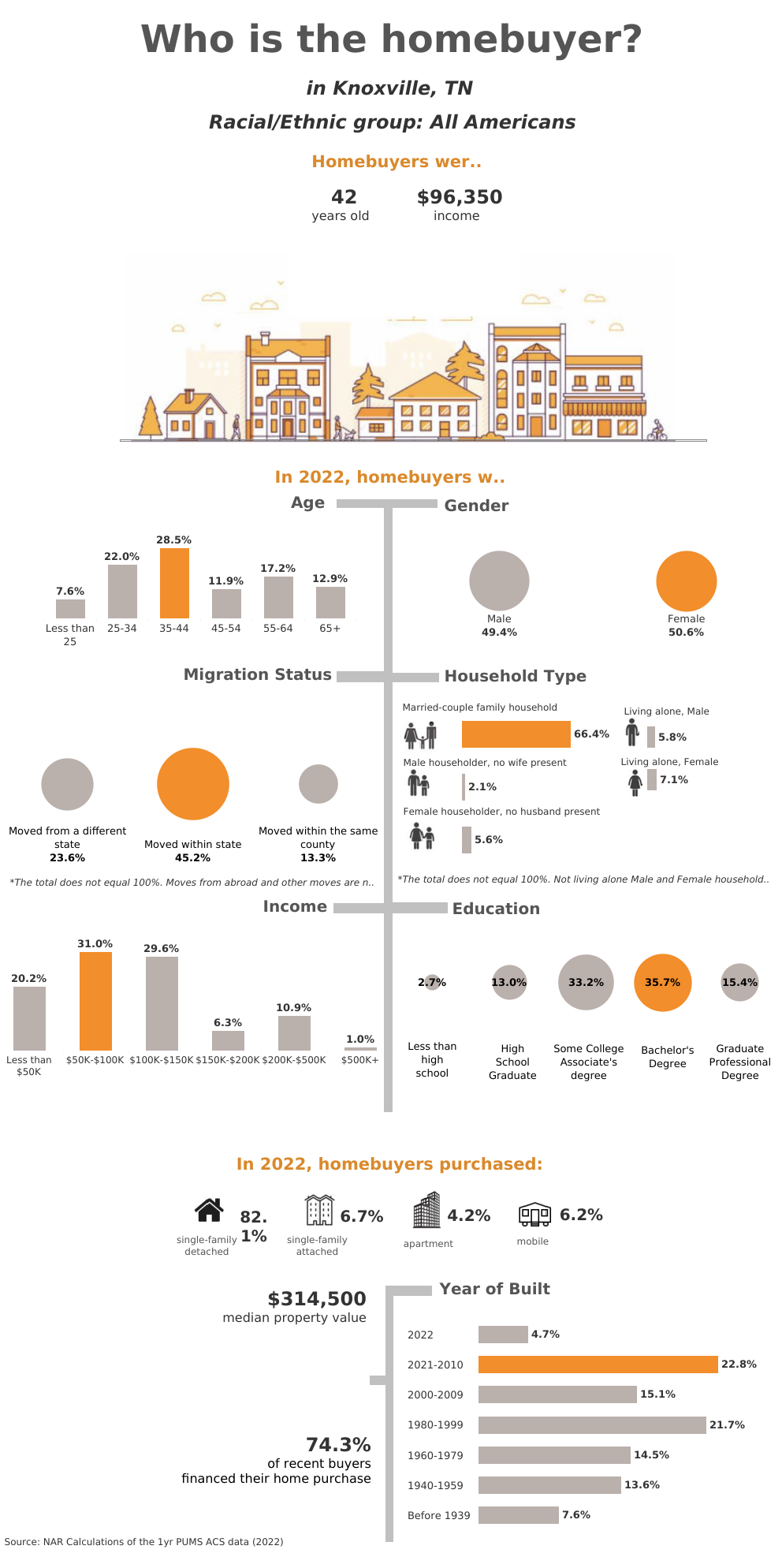
According to NAR's research, millennials accounted for 49.3% of all homebuyers across the Knoxville metro area in 2022 despite representing a much smaller portion of the overall population. Knoxville's share of millennial homebuyers was lower than many competitor cities like Nashville (50.7%), Greenville, SC (50.5%), Raleigh, NC (54.8%), and Huntsville, AL (58.7%), but higher than in-state neighbor Chattanooga (43.5%). Millennial buyers in Knoxville were slightly more affluent than the typical homebuyer, with a median household income of $98,280 (vs. $96,350 for all buyers) and median purchase price of $318,020 (vs. $314,500 for all buyers). | |
|
Addressing America's Housing Shortage:
2024 REALTOR® Legislative Prioritiees
| |
REALTORS® strive to ensure all Americans have the opportunity to achieve homeownership, which is the centerpiece of the American Dream and the pathway to economic well-being and intergenerational wealth-building. However, a historic 50-year record shortage of affordable homes available for purchase has severely limited access to the residential real estate market. Even relatively modest steps taken now to expand homeownership will unleash tremendous economic activity. | |
| NAR is asking legislators to: | - Cosponsor the More Homes on the Market Act (H.R. 1321), which incentivizes more long-term owners to sell their homes by increasing the maximum amount of capital gains a homeowner can exclude on the sale of a principal residence and annually adjusting it for inflation.
| - Cosponsor the Neighborhood Homes Investment Act (S. 657/H.R. 3940), which attracts private investment for building and rehabilitating owner-occupied homes.
| - Cosponsor the Choice in Affordable Housing Act (S. 32/H.R. 4606), which creates incentives for housing provider participation in the Department of Housing and Urban Development’s (HUD) Housing Choice Voucher (HCV) program.
| - Cosponsor the Credit Access and Inclusion Act (S. 1654/ H.R. 3418), which expands credit reporting for Americans with limited credit histories by encouraging the inclusion of common bills like rent or utility payments.
| - Cosponsor the Yes in My Backyard (YIMBY) Act (S. 1688/H.R. 3507), which encourages communities to build affordable housing through the Community Development Block Grant (CDBG) program.
| - Cosponsor the Fair and Equal Housing Act (H.R. 4439), which would add sexual orientation and gender identity as protected classes under the Fair Housing Act.
| | |
In this episode of Altos Research's Top of Mind Podcast, Mike Simonsen sits down with Ed Pinto, senior fellow and co-director of the AEI Housing Center at the American Enterprise Institute (AEI), for a fascinating look at how housing policy shapes the market and the world we live in. Tapping into his decades of experience in the housing and mortgage markets, Ed shares lessons from the 2008 bubble we can apply to today, uses data to examine the relative merits of different housing policies over the years, and gives his take on how to tackle affordability and homelessness. He also talks about why he’s optimistic about the housing market in the years to come. | |
|
Market Pulse Survey:
Q4 2023 Results
Results from the latest iteration of East Tennessee REALTORS® Market Pulse Survey indicate East Tennessee's housing market remained suppressed in the fourth quarter of 2023, although a growing share of REALTORS® expect market conditions to improve moving into the new year.
| |
- Buyer traffic remained suppressed in the forth quarter of 2023. Only 10% of respondents reported seeing more buyer traffic than this time last year, compared to 9% the previous quarter. Similarly, seller traffic declined with only 14% of respondents reporting more seller traffic than this time last year.
- Over the next three months, REALTORS® expect buyer traffic to pick up with 37% of respondents expecting more buyer traffic than last year.
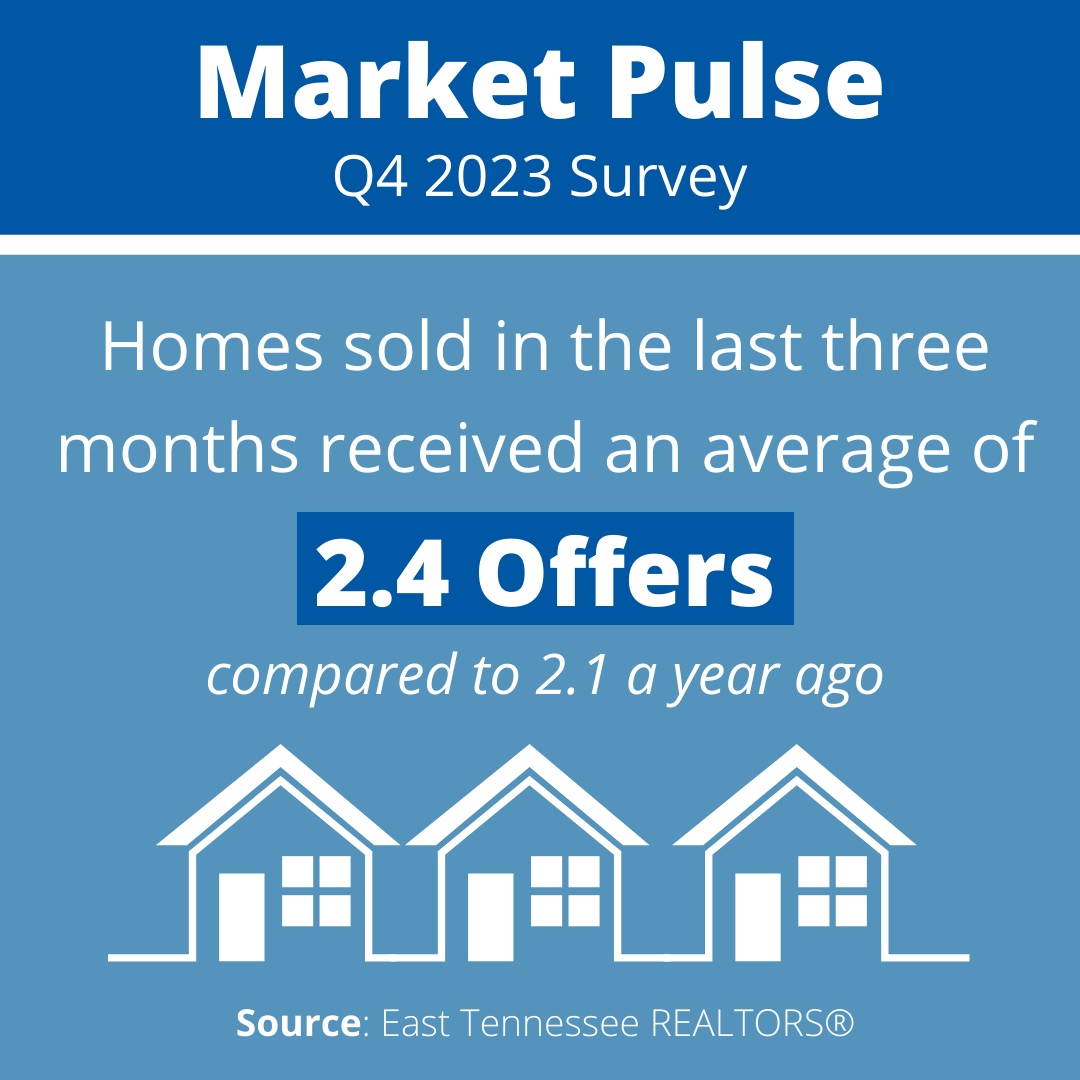
- Respondents reported receiving an average of 2.4 offers on homes sold in Q4 2023, up from 2.1 offers the previous quarter.
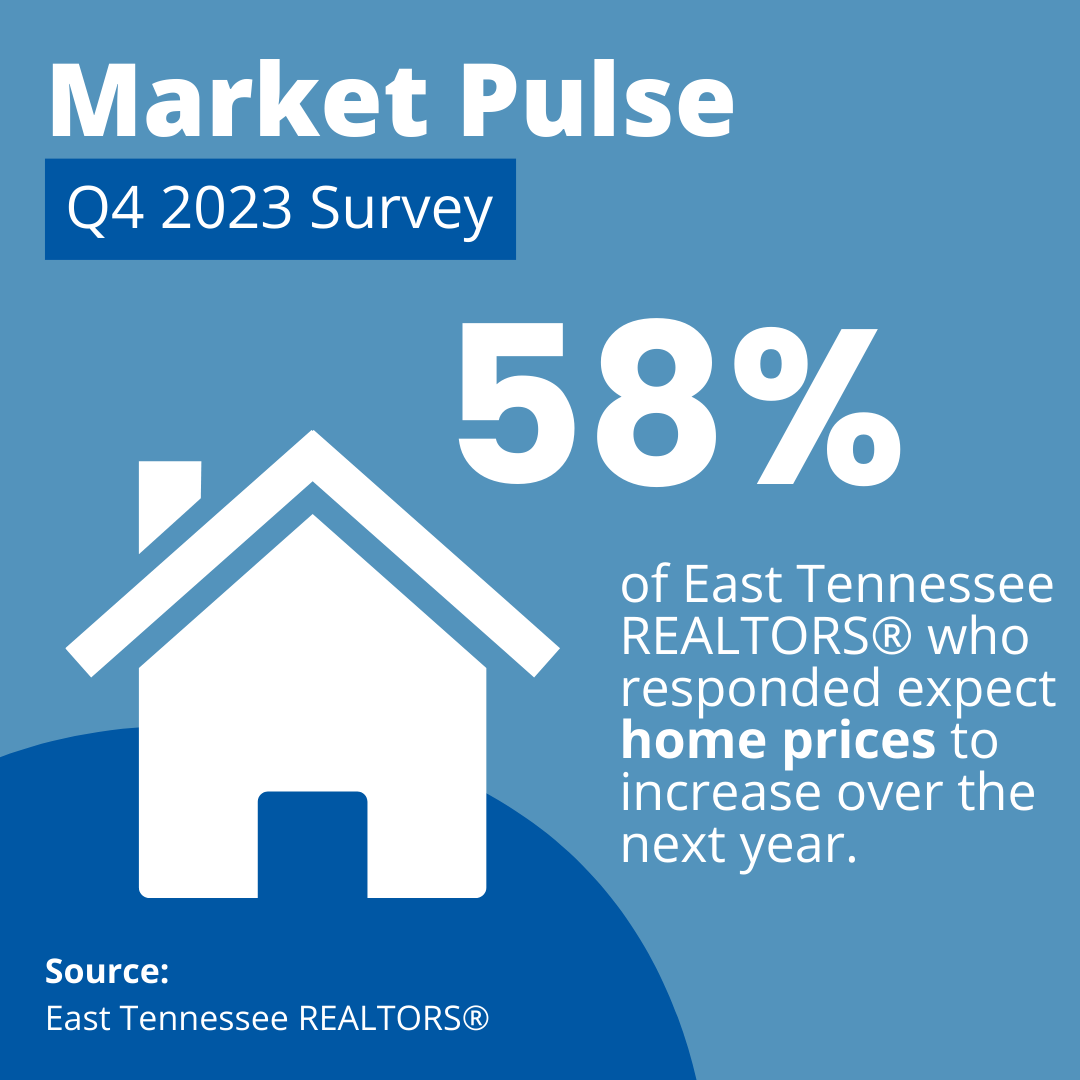
- Industry expectations regarding home prices remain relatively strong. 75% of respondents said they expect home prices will either stay the same or increase over the next year, with 58% saying they expect prices to increase.
- All-cash sales represented 31% of all home sales in Q4 2023, up from 30% the previous quarter and 29% a year ago.
- 63% of buyers in the past three months waived at least one contingency in their purchase contract, up from 55% a year ago.
| |
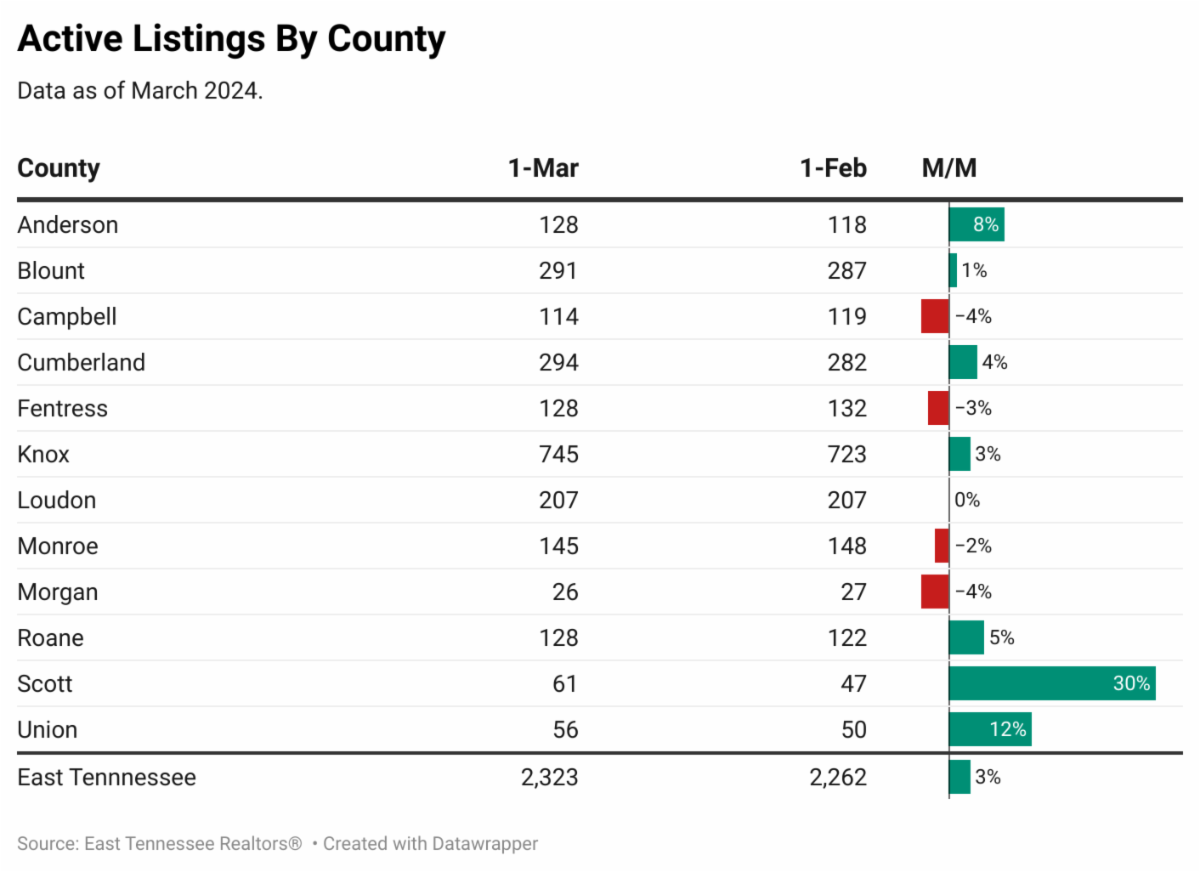
Housing inventory increased by 3% from February to March across the entire East Tennessee REALTORS® footprint over the past month, although four counties saw inventory decline. Morgan and Campell Counties experienced the largest declines, with active listings down 4% from February to March, while Scott and Union Counties experienced the largest monthly increase at 30% and 12%, respectively. | | |
|
|
"Additional housing supply is helping to satisfy market demand. Housing demand has been on a steady rise due to population and job growth, though the actual timing of purchases will be determined by prevailing mortgage rates and wider inventory choices."
– Lawrence Yun, Chief Economist at NAR
| |
|
What Makes the U.S. Mortgage Market Different
In the wake of the pandemic-induced housing market frenzy, changing economic conditions and higher mortgage rates have led some prognosticators to raise concerns about the potential for a housing market crash. Despite these concerns, several factors – such as higher lending standards and a lack of housing supply – make such a scenario unlikely.
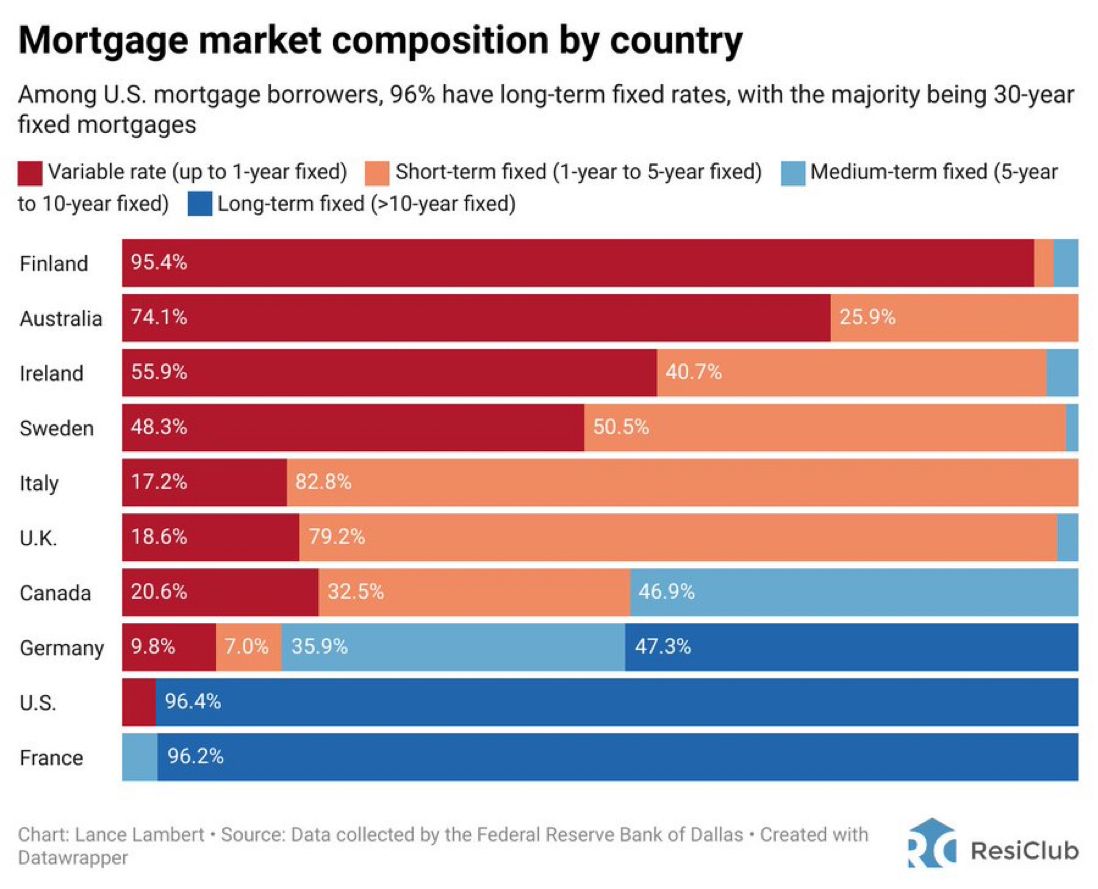
Another factor protecting against a widespread drop in home prices is the structure of the U.S. mortgage market. Unlike most other major developed economies around the world, roughly 96% of outstanding mortgage debt in the U.S is in the form of long-term fixed rate mortgages as opposed to variable rate debt.
| |
The prominence of fixed-rate mortgages in the U.S. means very few homeowners have seen their monthly mortgage payments rise in the higher interest rate environment promulgated by central bank efforts to slow inflation. As a result, the U.S. housing market has fared much better than many of its international counterparts, with very few homeowners being priced out of their home in real-time. | |
Stay up-to-date with the most recent information about East Tennessee's housing market. Here's the latest from local media: | |
|
Mortgage Rates Edge Closer To Seven Percent
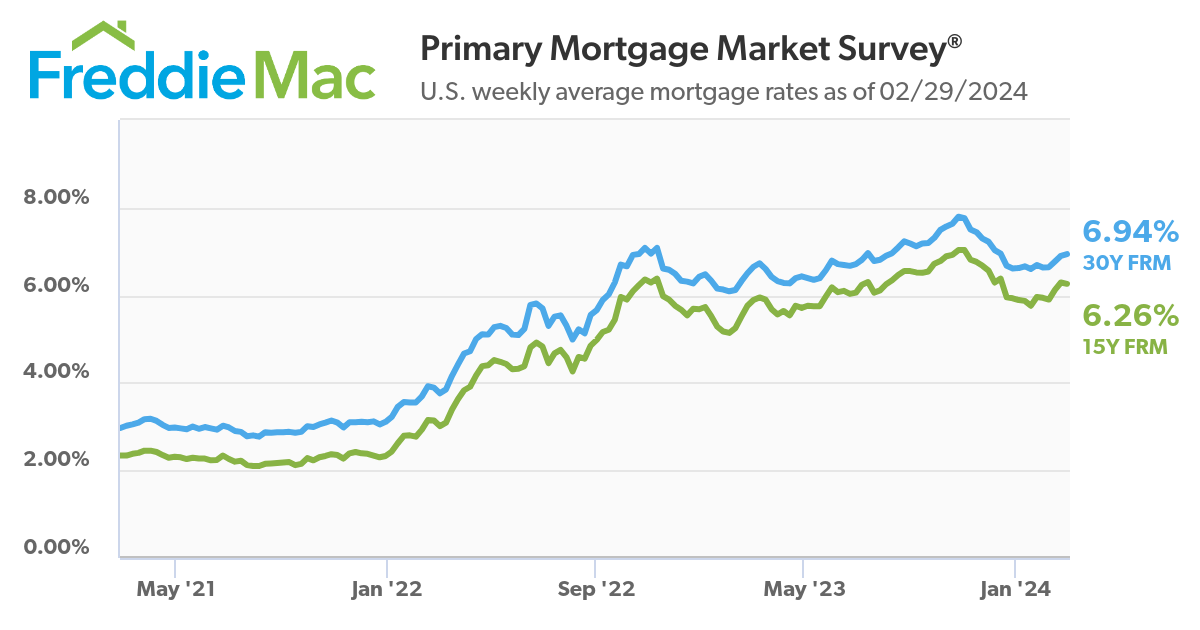
Mortgage rates in March continued to hover just under 7% in the wake of strong economic and inflation data. According to Freddie Mac's Primary Mortgage Market Survey, the 30-year fixed mortgage rate (30Y FRM) averaged 6.87% for the week ending March 21, 2024, compared to an average of 6.4% this time last year.
| |
|
Market Pulse is a monthly research newsletter providing a rundown of the latest housing
and economic research and analysis across East Tennessee.
| |
Was this email forwarded to you? Subscribe here. | | | | |