September 8, 2025

big_family_again.jpg

Wise Social Security Planning Seminar


Join us to enhance your understanding of Social Security and build your confidence on potential income strategies.


What you'll learn:

  • Changes happening to SS with the new One Big Beautiful Bill
  • File correctly the first time: "The 12 month window" ruling
  • Navigating strategies to help you capture more income
  • And more!


Dates are Tuesday, October 7th or Wednesday, October 8th at 6:00. We will be meeting in the Eclipse Training Center on the 2nd floor. You can RSVP by clicking on the link below, email pam.huston@avior.com or call (763) 542-8884.


RSVP - Website

The Markets

Was the jobs report good news or bad news for the stock market?


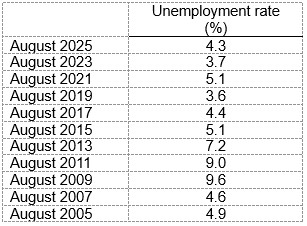
In financial markets, sometimes bad news is good. It looked like that might be the case last week. On Friday, the Employment Situation Summary was released. It showed U.S. businesses added just 22,000 jobs in August – well below expectations. Economists polled by Reuters had predicted 75,000 new jobs would be added. The unemployment rate ticked higher, moving from 4.2 percent to 4.3 percent.


That was not good news for American workers. “The [employment data] will likely heighten concerns about the durability of the labor market…Accounting for the revisions in this report, employment growth in the last three months has averaged just 29,000. Payrolls have come in under 100,000 for four straight months, extending the weakest stretch of job growth since the pandemic,” reported Molly Smith of Bloomberg.


At first, investors celebrated, and U.S. stocks moved higher. The bad news was good news because it increased the likelihood the Federal Reserve (Fed) would lower the federal funds rate at its next meeting. When the Fed lowers the federal funds rate, rates on credit cards, home equity loans, and other types of loans typically move lower, too. Low rates inspire more spending and make it cheaper to borrow, which can stimulate economic growth and lift stock prices.


As investors considered what a less robust job market might mean for economic growth, sentiment shifted. “Strong evidence the U.S. labor market is slowing rippled through Wall Street, driving stocks lower and bonds higher on concern the Federal Reserve will now have to rush to prevent further weakness. The sharp cooling triggered fears about a more pronounced jobs slowdown, sparking a flight to Treasuries, with two-year yields hitting the lowest level since 2022,” explained Rita Nazareth of Bloomberg.


Investors may have recalled a late-August speech in which Fed Chair Jerome Powell noted the U.S. labor market was in a “curious kind of balance” due to “a marked slowing in both the supply of and demand for workers. This unusual situation suggests that downside risks to employment are rising. And if those risks materialize, they can do so quickly in the form of sharply higher layoffs and rising unemployment.”


The Standard & Poor’s 500 and Nasdaq Composite Indexes gained over the week, despite dipping lower on Friday. The Dow Jones Industrial Average finished the week lower. Treasury yields fell across all maturities.

How Many New Jobs Does The U.S. Need To Keep Unemployment Low?


Over the past two decades, the unemployment rate in the United States has varied greatly. It spiked following the 2008 financial crisis (rising to 10 percent in October 2009) and again during the Covid-19 pandemic (rising to 14.8 percent in April 2020).

Since late 2021, though, the unemployment rate has remained relatively low – hovering around four percent. From an economic perspective, that puts the U.S. at or near maximum employment. In general, the maximum employment rate for the U.S. is estimated to be 3.5 percent to 4.5 percent, according to Marios Karabarbounis of the Federal Reserve Bank of Richmond.


The number of new jobs needed to keep employment steady is called the “breakeven employment growth rate”. In January, Victoria Gregory and Alexander Bick of the Federal Reserve Bank of St. Louis estimated that about 150,000 new jobs were needed each month to maintain a stable employment rate.


Since the start of this year, immigration has fallen dramatically – and so has the estimate of the number of new jobs needed to keep the employment rate steady. That’s because “…the biggest swing factor in the breakeven growth rate is the population growth rate.” With population numbers falling, just 32,000 to 82,000 jobs are needed each month to keep employment at the current level.

thinking_girl_idea.jpg

Weekly Focus - Think About It


“Far and away the best prize that life offers is the chance to work hard at work worth doing.”

– Theodore Roosevelt, Former U.S. President 

Bruce Kuehl | 763.542.8884 | bruce.kuehl@avior.com

Investment management and financial planning services offered through Avior Wealth Management, LLC a registered investment advisor. Investments involve varying degrees of risk and there can be no assurance that the future performance of any investment or investment strategy will be profitable or equal past performance results. All investments subject to loss including the loss of principle. Nothing contained herein should be construed as tax advice. Specific, individual tax questions should be asked of your CPA or accountant.


Please remember to contact Avior, In writing, if there are any changes in your personal/financial situation or investment objectives for the purpose of reviewing/evaluating/revising our previous recommendations and/or services, or if you want to impose, add, or modify any reasonable restrictions to our investment advisory services. Unless, and until, you notify us, in writing, to the contrary, we shall continue to provide services as we do currently. Please advise us if you have not been receiving account statements (at least quarterly) from the account custodian. A copy of our current written disclosure Brochure and Form CRS (Customer Relationship Summary) discussing our advisory services and fees continues to remain available upon request or at www.aviorwealthmn.com.