|
In This Issue:
- Market Update: Major Reduction in 2026 Long Grain Acres Expected
- Washington, D.C. Update: USDA Announces FBA Payments for Eligible Commodities
- Register Now for the 29th Annual Cotton & Rice Conference
- Southeast Texas Rice Symposium: January 22
- RMTC Exhibitor Highlights: SRJ & Lambton
- RMTC Early Bird Pricing Extended
- Photo from Rice Country
| |
| Major Reduction in 2026 Long Grain Acres Expected | | |
The market is shaking off its holiday slumber with both good and bad news.
The good news — exceptional, really — is the announcement of the Rice Farmer Bridge Payment rate at $132.89 per acre. While this payment will not solve the financial challenges rice farmers are facing, it is on the higher end of expectations. The payment will be made on 2025 certified acres and is scheduled to be distributed prior to February 28, 2026, with a payment cap of $155,000 per farmer. We recommend confirming individual eligibility and details directly with your local FSA office.
It is estimated that rice farmers lost in excess of $350 per acre in 2025. While this FBA payment is not a complete solution, it does help reduce the current debt burden and is intended to provide lenders some breathing room as they finance the 2026 crop.
On the negative side, the rice industry, and the nation as a whole, lost a true friend and ally with the unexpected passing of Congressman Doug LaMalfa of California. Doug was a fourth-generation rice farmer and a board member in the early days of USRPA. His friendly presence on Capitol Hill will be deeply missed, as will his steady and consistent advocacy for rural America and rice farmers.
Market dynamics remain highly fluid. While the 2025 crop is settling into a known position, the primary concern is generating sufficient demand to liquidate inventories. Iraq has provided a meaningful outlet, as has Haiti, and there are high hopes for a large Colombian tender later this month, in excess of 100,000 metric tons. However, Colombia is blending 100 percent of U.S. rice purchases with domestic rice due to grain quality concerns. Similar complaints are being reported by other Central and South American buyers, creating ongoing challenges around disappearance.
These issues, combined with poor economics, are weighing heavily on 2026 planting decisions. Traditionally, February soybean prices play a major role in determining rice acreage, but this year there are additional variables at play. Current expectations suggest planted acres could decline by more than 30 percent. One potential benefit of this reduction is improved quality: a smaller crop with fewer seed varieties could result in a more homogenous product, particularly if fewer varieties move through individual dryers.
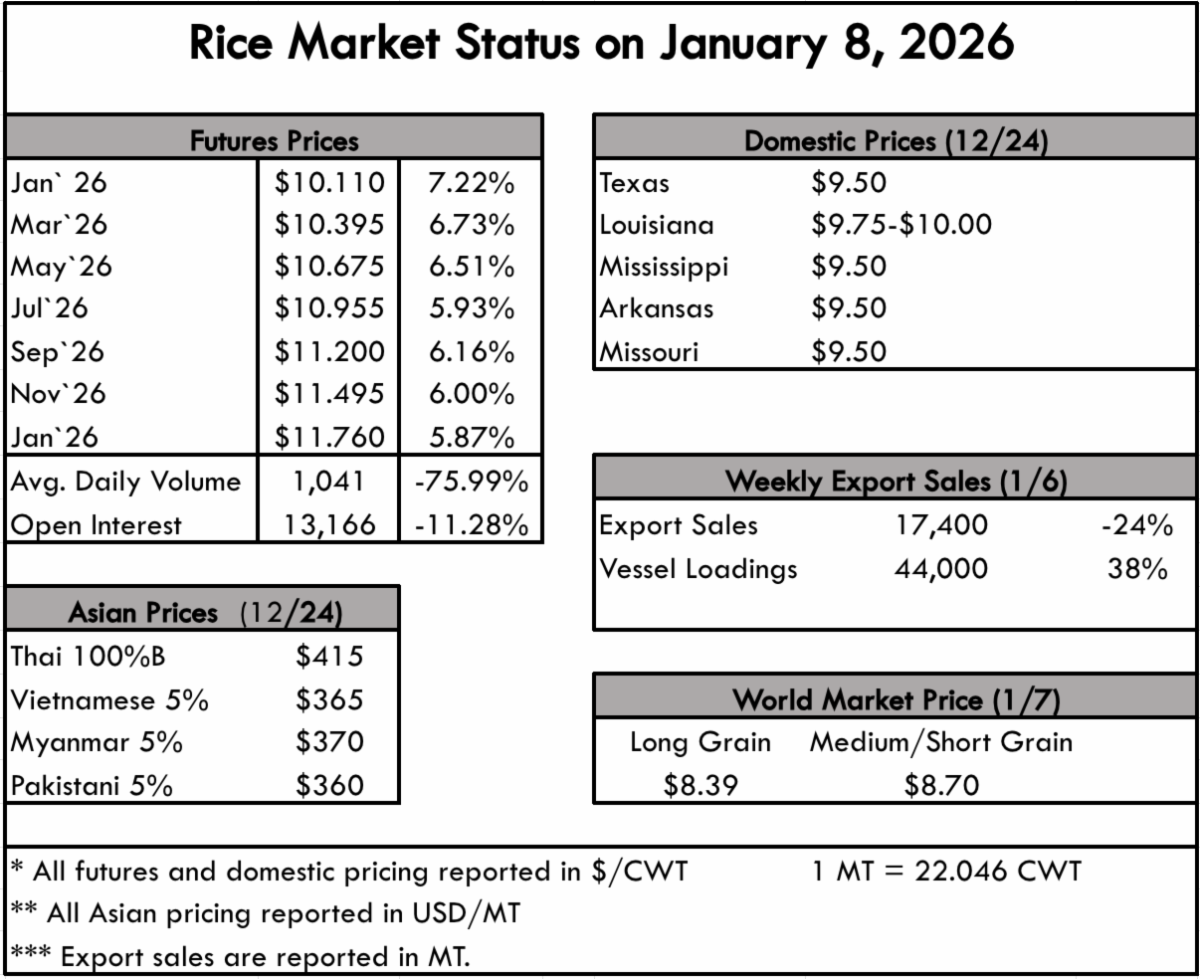
Internationally, prices in Asia remain well below $400 per metric ton, with no meaningful movement during the holiday period. The same is true in South America. Domestic pricing remains challenging as January begins, with bids reported at $9.50 per cwt in Texas, Mississippi, Arkansas, and Missouri, while Louisiana is holding at $9.75 to $10.00 per cwt. Louisiana has carved out a niche by tightly managing product quality and consistently meeting customer preferences, allowing it to capture a price premium.
| | The US Rice Producers Association Board of Directors and staff were saddened to hear of the passing of Congressman Doug LaMalfa earlier this week. A rice producer and former USRPA board member, Congressman LaMalfa was a longtime supporter of our industry. We extend our deepest condolences to the LaMalfa family. | | |
USDA announces FBA payment rates for eligible commodities
On December 31, USDA Secretary Brooke Rollins announced the payment rates for all eligible commodities under the current Farmer Bridge Assistance (FBA) Program, including rice. Of the total $12 billion allocated towards the FBA program, $11 billion is designated for one-time payments to traditional row crop producers and the remaining $1 billion will be reserved for uncovered commodities. FBA payments for currently eligible producers are expected to be delivered to producers by February 28, 2026. Timelines for payments for producers that fall under the uncovered commodities category are still under development and require additional understanding of market impacts and economic needs.
Rice received the highest payment rate among eligible commodities at $132.89 per acre. FBA payments will be based on 2025 planted acres, Economic Research Service (ERS) cost of production, and the World Agriculture Supply and Demand Estimate (WASDE) Report. Double crop acres, including all initial and subsequently planted crops, are eligible, whereas prevented planting acres are not eligible under FBA. It is also worth noting that FBA eligibility is not dependent on crop insurance linkage. For the full list of commodity payment rates and additional information regarding the program, you can visit the online FBA landing page here or contact your local Farm Service Agency (FSA) office.
USDA announces Dr. Justin Benavidez as Chief Economist
On Tuesday, January 6, USDA officially announced Dr. Justin Benavidez as the new Chief Economist. He succeeds Dr. Seth Meyer who had previously served in that role since 2021 and recently stepped down in December to lead the Food and Agricultural Policy Research Institute at the University of Missouri. Benavidez steps in the role having most recently served as Chief Economist for the House Agriculture Committee Majority Staff under Chairman Glenn “GT” Thompson (R-PA). Prior to that, he worked as an agricultural extension economist with Texas A&M AgriLife Extension, focusing on farm and ranch management, production economics, and policy analysis. He holds bachelor’s, master’s, and doctoral degrees in agricultural economics from Texas A&M University.
HHS, USDA releases updated set of Dietary Guidelines for Americans
On Wednesday, January 7, Health and Human Services (HHS) Secretary Robert F. Kennedy Jr. and U.S. Department of Agriculture (USDA) Secretary Brooke Rollins unveiled the 2025-2030 Dietary Guidelines for Americans (DGAs). Every five years, HHS and USDA jointly publish a new set of DGAs that informs a broad range of federal nutrition policies and programs using recommendations provided by the Dietary Guidelines Advisory Committee. The new guidance emphasizes reducing highly processed foods and added sugars while encouraging higher protein intake and reintroducing foods previously discouraged—such as whole milk, butter, and red meat—into recommended diets. Artificial sweeteners are downplayed, and traditional fats like beef tallow receive a nod. The changes, championed by Health Secretary RFK Jr., represent a “reset” toward what officials call “real food” and aim to move away from decades of low-fat, high-carb advice. Another key takeaway from the new DGAs was an updated dietary visual, which replaces the MyPlate framework with an inverted food pyramid. Administration officials state that the revised visual is intended to emphasize whole foods and dietary patterns designed to improve population health while supporting American farmers, ranchers, and food producers. You can find more information at realfood.gov.
| | Register Now for the 29th Annual Cotton & Rice Conference in Jonesboro | | RMTC Exhibitor Highlight: SRJ | | RMTC Exhibitor Highlight: Lambton | | |
The South Louisiana Rail Facility (SLRF) loaded 21,700 tons of long-grain rough rice bound for Mexico. This marks SLRF’s largest high-milling rice shipment of the crop year and represents the third vessel handled so far, with a fourth arriving today destined for Honduras. A fifth vessel is scheduled for February.
The group’s proactive “truck-to-ship” loading efforts are already positioning them ahead of the new rice export terminal the port plans to construct later this year.
As always, you can send us your rice country photos by email, or via Facebook or Instagram!
| |
| | |  |
Food & Agriculture
Regulatory & Policy Roundup
| | | World Agricultural Production | | | Grain: World Markets and Trade | | | |
January 21, 2026
Western Rice Belt Conference
El Campo, TX
More Information
| |
January 22, 2026
Southeast Texas Rice Symposium
Winnie, TX
More Information
| |
February 5 - 6, 2026
29th Annual National Conservation Systems Cotton & Rice Conference
Jonesboro, AR
More Information
| |
February 11, 2026
Arkansas State University Agribusiness Conference
Jonesboro, AR
More details to come
| |
February 19, 2026
Missouri Rice Council Annual Meeting
Gobler, MO
More Information
| |
February 24, 2026
University of Missouri Extension Rice Meeting
Dexter, MO
More details to come
| | |
May 26 - 28, 2026
Rice Market & Technology Convention
Cartagena, Colombia
More Information
| | |
USRPA does not discriminate in its programs on the basis of race, color, national origin, gender identity, sexual orientation, religion, age, disability, political beliefs, or marital/family status. Persons who require alternative means for communication of information (such as Braille, large print, sign language interpreter or translation) should contact USRPA at 713-974-7423. |
| | | |