|
In This Issue:
- Market Update: Strong Interest in 2026 U.S. Long Grain Rice Acres
-
Washington, D.C. Update: House Ag Advances 2026 Farm Bill Out of Committee with Bipartisan Support
-
RMTC Speaker: Jeison Santaniello
- RMTC Exhibitor Highlights: Zaccaria, Induhorst, & Satake
- Photo from Rice Country
| |
| Strong Interest in 2026 U.S. Long Grain Rice Acres | | |
Planting intentions are coming in to focus, as price action continues to move at a snail’s pace. In light of the recent strikes on Iran, the grains complex, and more specifically U.S. long grain prices, have not moved much—yet. It is still very early for there to be direct impacts from the war, but there are more subtle elements at work. First, in wartime, it is typical for the U.S. Dollar to increase in value against other global currencies as it is deemed safer than alternative global currencies. This, naturally, has a negative impact on exports. Secondly, and conversely, Iraq is one of the most strategic partners for milled U.S. long grain rice, and it’s typical for countries in conflict to stockpile basic food staples, of which rice is paramount. While there are only rumors of Iraq entering the conflict, it is something to watch. And third, what is making the news and directly impacting commodity and goods flow, is freight rates and the risk of shipping channels in the Middle East. This will have the most outsized impact short-term, but expect the first two factors to work their way into the matrix in the coming weeks if and when the war matures.
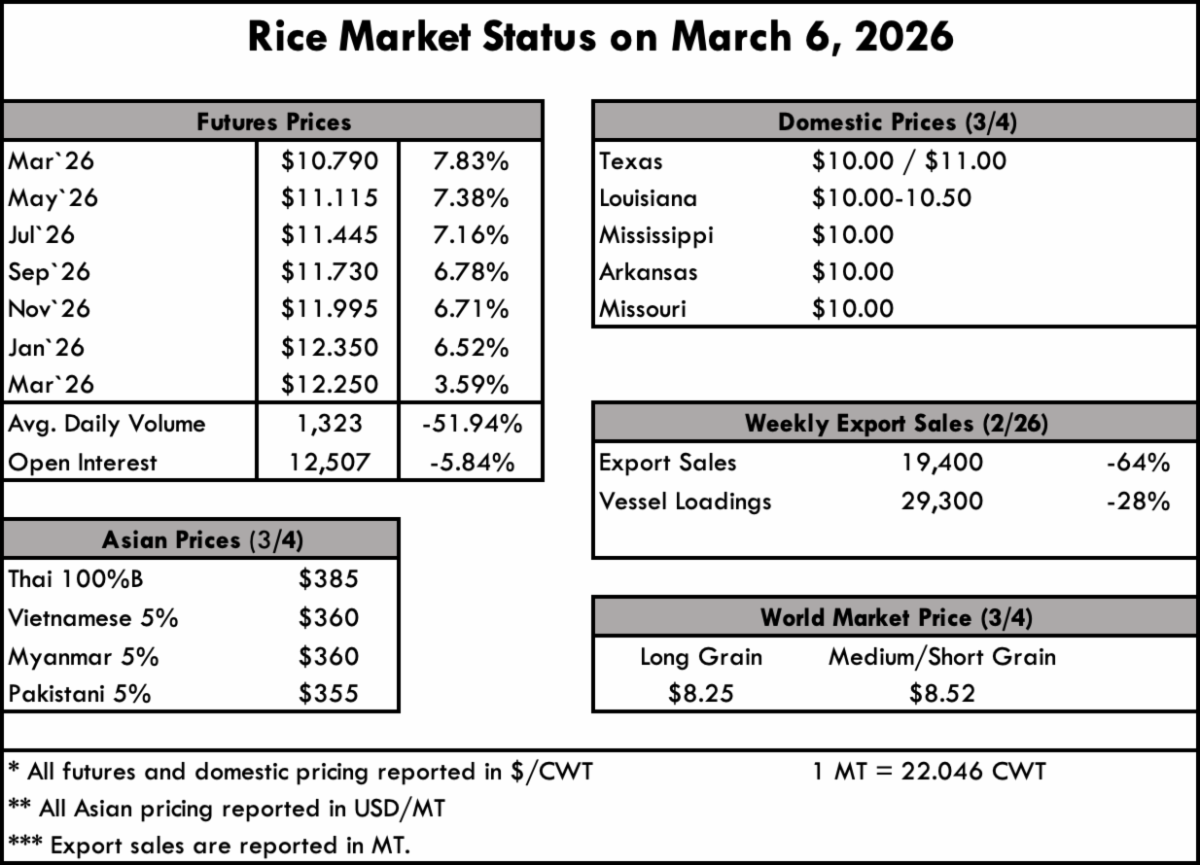
In Asia, there are reports of trade disruptions and payment issues, specifically between India and Iran. This is inevitable given the circumstances and will continue to multiply in the coming weeks. As of writing, it is difficult to analyze any direct impact pricing of the raw product of rice, but freight and logistics is certainly being impacted. Therefore, we will report rice prices as sideways out of Asia, with Thailand being $380 pmt, Vietnam at $360 pmt, and India at $350 pmt.
In South America, Brazil will play the decisive role in shaping regional rice trade over the next several weeks, as its import demand and buying patterns largely determine how rice moves within the MERCOSUR market. Brazil continues to be an outsized player in export channels in recent years, with exports reaching roughly 1.5 million tons in 2025. Paraguay remains the most vulnerable country in the region, carrying sizable old-crop inventories and relying heavily on Brazilian demand to clear stocks, which makes its market outlook closely tied to Brazil’s purchasing decisions. Argentina is transitioning steadily into harvest, with domestic consumption providing an important buffer that helps absorb early supplies and prevent immediate harvest pressure from weighing heavily on prices. Uruguay, by contrast, enters the new marketing year in the strongest structural position among the major exporters, supported by relatively low carryover stocks and disciplined forward sales coverage that reduces exposure to short-term market volatility. A new Brazilian paddy rice export subsidy for farmers is expected to be published in the Brazilian federal register today. The current Mercosur harvest is in full swing, and reports of an overall decline are mentioned to be somewhere between 8-15%. Mercosur exporters continue to be active throughout the Western Hemisphere.
The weekly USDA Export Sales report shows net sales of 19,400 MT, down 64% from the previous week and 74% from the prior 4-week average. Exports of 29,300 MT were down 29% from the previous week and from the prior 4-week average.
| | |
House Ag advances 2026 Farm Bill out of Committee with bipartisan support: Kicking off on Tuesday, March 3, and lasting until the early hours of Thursday, March 5, the House Committee on Agriculture held a Full Committee markup of H.R. 7567 —The Farm, Food, and National Security Act of 2026. The text similarly resembled that of the 2024 version of the farm bill that was marked up and passed out of Committee in the last Congress. Republicans voiced strong support for bill and toted the package as bipartisan, budget-neutral legislation that continues to build upon the improvements made by the One Big Beautiful Bill Act (P.L. 119-21) as well as the need to reauthorize a new five-year farm bill to provide certainty for farmers and rancher across the country.
Democrats expressed frustration over the lack of bipartisan dialogue prior to the release of the base text and largely criticized changes made to the Supplemental Nutrition Assistance Program (SNAP) through the reconciliation process last summer, the Trump Administration’s trade policies, and the U.S. Department of Agriculture (USDA) proposed reorganization. Other topics frequently discussed included specialty crop producers, disaster assistance, agricultural research, pesticides, conservation management, animal welfare, land-grant institutions, and rural community development.
After a collective 22-hour markup, the bill was ultimately approved by the Committee as amended and favorably reported to the House floor along a 34-17 vote with bipartisan support. Chairman Glenn “GT” Thompson (R-PA) and his Republican colleagues were joined by seven Democratic Committee members in voting in favor of the bill. Those Democratic members included Rep. Jim Costa (D-CA), Sharice Davids (D-KS), Don Davis (D-NC), Gabe Vasquez (D-NM), Adam Gray (D-CA), Kristen McDonald Rivet (D-MI), and Josh Riley (D-NY). The rest of the Democrats on the Committee, including Ranking Member Angie Craig (D-MN), voted against the bill’s passage. Now, Chairman Thompson looks towards House Republican leadership to trip and secure floor time in hopes of advancing the bill to the Senate in a timely manner. You can watch the full markup here.
“The House Agriculture Committee taking this step on the Farm Bill is welcome news, and USRPA commends the committee for its steadfast work,” said Mollie Buckler, President and CEO of USRPA. “A strong farm bill is essential to providing certainty for producers and maintaining the global competitiveness of U.S. rice.”
USDA Trade Under Secretary testifies before House Appropriations Ag Subcommittee: On Wednesday, March 4, the House Appropriations Subcommittee on Agriculture, Rural Development, Food and Drug Administration, and Related Agencies called U.S. Department of Agriculture (USDA) Trade and Foreign Agricultural Affairs Under Secretary Luke Lindberg to testify for an oversight hearing. Republicans and Democrats offered broad support for reducing U.S. reliance on foreign markets and agreed on the importance of increasing U.S. agricultural exports. Republicans focused on reducing the agricultural trade deficit, promoting America First trade policies, and exploring the benefits of a buy American approach. Democrats emphasized concerns about the transition of the Food for Peace program, the impact of the dismantling of the U.S. Agency for International Development (USAID), USDA staff reductions, and the need for lawful administration of food aid funds. Members of both parties raised questions concerning specialty crops and how USDA plans to protect farmers from non-tariff barriers. Other topics discussed included the farm bill, the United States-Mexico-Canada Agreement (USMCA) and foreign dumping practices. You can watch the full hearing here.
| | RMTC Speaker: Jeison Santaniello | |
| |
Welcome Jeison Santaniello as a speaker at RMTC 2026!
We’re pleased to have Jeison join us to discuss "Rice 5.0: Innovative Technologies for the Protection and Transformation of Rice."
The rice industry faces critical challenges today: increasing food safety requirements, pressure to reduce chemical use, demands for greater operational efficiency, and the need to deliver higher value-added products. In this context, technology becomes the primary enabler of competitiveness.
First, a clean gas technology that enables effective insect control during storage, without generating chemical residues. This same technology is applied to neutralize the organic compounds responsible for odor, reduces microbial load, and improves visual brightness through gentle surface oxygenation — enhancing product conditions, eliminating risks of commercial rejection, and contributing to food safety.
Second, advanced paddy rice steaming process that transform conventional grain into a product of higher industrial and nutritional quality, optimizing yield, stability, and market value.
Through case studies, technical foundations, and operational results, this conference will demonstrate how these solutions enable a shift from a reactive model to a preventive and strategic one — where efficiency, sustainability, and profitability move forward together.
| | RMTC Exhibitor: Induhorst | |
| |
FAO Rice Price
Update
| |  |
Food & Agriculture
Regulatory & Policy Roundup
| | | | | | Grain: World Markets and Trade | | | | | | Inter-Rice World Rice Market Report | | | |
May 26 - 28, 2026
Rice Market & Technology Convention
Cartagena, Colombia
More Information
| | |
June 6, 2026
LSU AgCenter South Farm Rice Field Day
Crowley, LA
More Information
| | |
USRPA does not discriminate in its programs on the basis of race, color, national origin, gender identity, sexual orientation, religion, age, disability, political beliefs, or marital/family status. Persons who require alternative means for communication of information (such as Braille, large print, sign language interpreter or translation) should contact USRPA at 713-974-7423. |
| | | |