Greetings!

Recent developments involving Iran have understandably generated significant media attention and raised questions about the potential impact on global markets and the economy. While market movements so far remain within the range of what we often see during geopolitical events, we felt it would be helpful to reach out now to provide perspective before uncertainty and headlines begin to drive unnecessary concern.


We are actively monitoring developments and evaluating potential implications for portfolios, but at this time we do not believe the current situation warrants any immediate changes to long-term investment strategies.


Key Takeaways:


  • Geopolitical conflicts often create short-term market volatility but historically have had limited long-term impact on markets.


  • The primary economic risk from the current situation relates to energy markets, though the United States is significantly more energy independent today than during past oil crises.


  • Your portfolio has been meticulously constructed with high-quality investments and meaningful diversification to navigate periods of uncertainty.


  • Market volatility can also create opportunities to rebalance portfolios and maintain long-term discipline.


  • Our team is monitoring developments closely and is always available to discuss any concerns you may have.


Geopolitical Events


Geopolitical events naturally create uncertainty, and markets tend to react quickly—particularly when events involve the Middle East and global energy supplies. As a result, we have seen increased volatility and rising oil prices as investors assess the potential economic impact.


While situations like this deserve our attention, history also provides helpful context. Conflicts and geopolitical shocks have occurred throughout modern market history—from the Cuban Missile Crisis to the Gulf War, 9/11, and the war in Ukraine. Markets often react sharply at first as uncertainty peaks, but they tend to stabilize once investors gain greater clarity about the scope and duration of events.


Over time, investor attention typically shifts back to underlying economic and corporate fundamentals. Unless a conflict materially alters the earnings outlook of the companies in which we invest, markets often begin to normalize as uncertainty subsides.


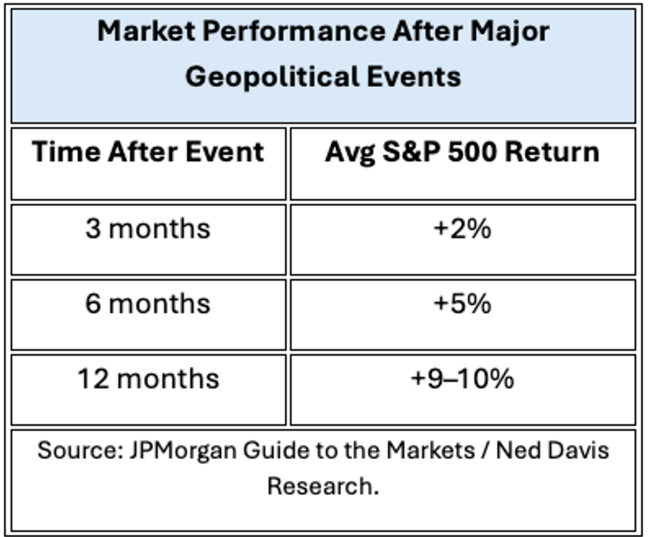
Research on past geopolitical events suggests that while markets can react sharply in the short term, they often recover more quickly than many investors expect.


Since World War II, geopolitical shocks have generally created short-term volatility but limited long-term damage to markets. Many of the most significant market declines have historically been driven by economic or financial system disruptions rather than wars themselves.¹

Energy Markets


The most immediate economic risk relates to energy markets. The Middle East remains a critical source of global oil supply, and disruptions to production or shipping routes can push energy prices higher. Sustained increases in oil prices could place upward pressure on inflation and potentially influence the path of interest rates.


Domestic Energy Production


It is worth noting that the United States is in a much different position today than during many past Middle East–related oil shocks. Over the past two decades, domestic energy production has increased significantly due to advancements in shale and other technologies. As a result, the United States is now one of the world’s largest producers of oil and natural gas and has become far less dependent on foreign energy imports than in previous decades.


While global oil markets remain interconnected and price volatility can still occur, the increased level of domestic production has helped strengthen the resilience of the U.S. economy compared with earlier periods such as the oil crises of the 1970s.²


Renewable Energy Sources


In addition, the continued growth of renewable energy sources such as wind and solar has gradually diversified our nation’s energy mix. While oil and natural gas remain critical components of the global energy system, expanding renewable energy production and improvements in energy efficiency have also contributed to reducing the United States’ reliance on imported energy over time. 


Together, these developments have helped make the U.S. economy less vulnerable to the type of energy-driven disruptions experienced in earlier decades.³


The Global Economy, Financial Markets and Your Investment Strategy


It is important to remember that the global economy and financial markets have navigated many challenges in recent years—including a global pandemic, major inflation spikes, aggressive interest rate increases, geopolitical conflicts, and other periods of economic uncertainty. Periods of volatility are uncomfortable, but they are also a normal and unavoidable part of long-term investing.


Your investment strategy was designed with this reality in mind.


Your portfolio has been carefully and meticulously designed with high-quality investments and a high level of diversification intended to help weather periods of volatility while remaining focused on your long-term financial goals.


Making emotional decisions based on breaking news or short-term market movements can often create more risk than the events themselves.


Periods of market volatility can also create opportunities to rebalance portfolios—bringing allocations back in line with long-term targets and, in some cases, selectively adding to investments that have temporarily declined in value. While these moments can feel uncomfortable, they are often a natural part of maintaining a disciplined long-term investment strategy.


Please know that we are monitoring developments closely and evaluating the situation as it evolves. If conditions warrant adjustments to portfolios or strategies, we will work with you to make those decisions thoughtfully and carefully—not in reaction to headlines or short-term market moves.


In Closing


Financial markets and the global economy have endured wars, recessions, pandemics, inflation spikes, and political turmoil throughout modern history. Through each of these periods, disciplined investors who remained focused on their long-term strategy have historically been rewarded.


If current events are causing stress, anxiety, or simply raising questions about your portfolio or financial plan, please do not hesitate to reach out. Conversations like these are an important part of our relationship, and we are always available to talk things through and provide perspective. 


Helping you stay focused on what matters most—and supporting you in living your BEST Life—remains our highest priority.


Warm regards,

Rick W. Campbell

MBA, ChFC®, BFA™, AIF®

No matter where you are on your life journey.
Let us help guide you along the way.
 
Financial Independence
931 Jefferson Blvd
Suite 2005
Warwick, RI 02886

¹ Sources: J.P. Morgan Asset Management – Guide to the Markets; J.P. Morgan “How Do Geopolitical Shocks Impact Markets?”; Ned Davis Research; LPL Financial Research.

² U.S. Energy Information Administration (EIA); International Energy Agency; Federal Reserve Economic Data (FRED).

³ U.S. Energy Information Administration (EIA); International Energy Agency (IEA); U.S. Department of Energy.

Financial Independence, LLC is a Registered Investment Advisor firm and only transacts business in states where it

is properly registered, or is excluded or exempted from registration requirements. Registration as an investment

advisor is not an endorsement of the firm by securities regulators and does not mean that the advisor has attained a

particular level of skill or ability. All investment strategies have the potential for profit and loss. Past performance does not guarantee future investment success. Always consult an attorney or tax professional regarding your specific legal or tax situation. Copyright 2021.