|
Last week’s report highlighted the prospective plantings for the U.S. rice states, and producers are actively underway in making those prospects a reality. Outside of any weather delays, the only hiccup we have to report on is a shortage of hybrid seed in some regions which has forced producers to look at either medium grain rice or perhaps beans. We don’t expect this to make a material difference in the market, but it keeps everyone on their toes. As of writing, Arkansas is 13% planted, Louisiana 66%, Texas 50%, while Mississippi and Missouri both register at 15%. In regards to emergence, Louisiana is at 50% and Texas at 27%.
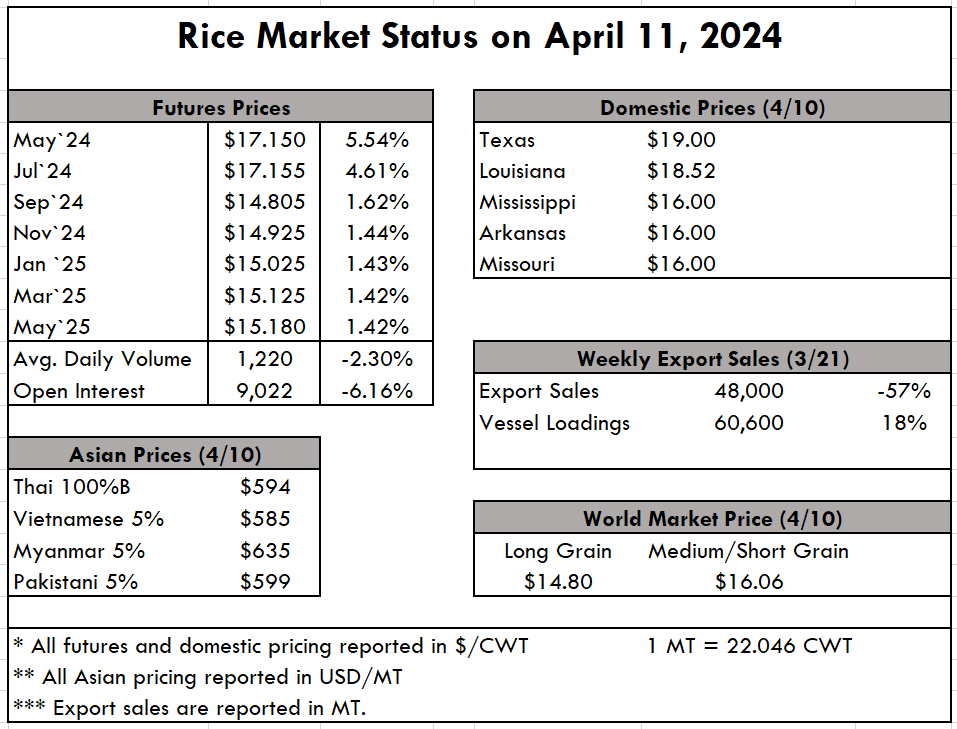
The long grain market remains bullish as mills continue to churn through paddy to fulfill domestic and export markets. The “less than ideal” quality that has defined this year is looking to have a bullish impact on the market, as the WASDE report reflects projected ending stocks to be down by an additional 1 million cwt. This can simply be attributed to the fact that the mills have to churn through more paddy to produce the same amount of milled product. This is keeping supply tight in the window before the new crop is planted and arrives. The long grain price was raised another $.10/cwt to $16.10, the Other States medium/short-grain price was raised $.50 per cwt to $18.00, and the California medium/short-grain price was raised $2.00 per cwt to $32.00. We will delve into the Grains report in next week’s Rice Advocate.
The most recent FAO Rice Price Update shows a Rice Price Index average of 138.1 points for March, down 1.7% from February. This sets a low point for the last eight months but remains 14% above this time last year. The price for Indica long grain varieties has been quite resilient in the face of macroeconomic challenges in both the Eastern and Western Hemispheres. However, as we mentioned in the last FAO report, it will be medium grain japonica prices that will pull the index down. This report certainly proves that point, with Japonica values dropping 28.3% lower than this time last year. Simply put for the japonica varieties: what goes up, must come down.
When looking at the Western Hemisphere, the prices might just be starting to trend down for the major South American exporters. With harvest in Argentina over 65% complete, Uruguay more than halfway, Paraguay nearly complete, and heavyweight Brazil closing in on completion, U.S. long grain is officially more expensive than these southern counterparts. Despite this, the market is still firm and looks positive. However, unconfirmed field reports from the last few days out of Brazil indicate 2024 harvest is smaller by the day in the key state of Rio Grande do Sul, all blamed on the weather. Rumors of FOB prices in the $460-$470 range for Brazilian paddy, if or when confirmed will send another shock wave throughout. Another case of expecting the unexpected as Mother Nature has taught us in all the markets in recent years.
Costa Rica is reporting the government has installed a new 35% tariff on all imported rice outside of CAFTA. The announcement has caused an enormous debate among farmers, mills, and the federal government, but it is our understanding at the time of this writing that this new regulation is in place despite a reported appeal process. This decision would favor U.S. origin. Stay tuned to The Rice Advocate as this situation evolves.
In Asia, Indonesia is keeping the market alive. Even during their insatiable demand, Thai and Viet prices are both below the $600 pmt point, sitting at $580pmt and 585pmt respectively. Harvest in Vietnam is in full swing, and both countries expect to exceed their original export predictions, largely a result of India’s export ban.
The weekly Export Sales report shows net sales of 48,000 MT this week, down 57% from the previous week and 47% from the prior 4-week average. Exports registered at 60,600 MT, up 18% from the previous week, but down 37% from the prior 4-week average.
|