|
In This Issue:
- Market Update: China-U.S. Trade Agreement Welcome News
- Washington, D.C. Update: Government Shutdown Continues
- USRPA Participates in USDA Trade Mission to Mexico
- Ray Stoesser Memorial Scholarship: Just One Month Left to Apply
- RMTC 2026: All Booths in Exhibit Hall - SOLD OUT!
- Photo from Rice Country
| |
| China-U.S. Trade Agreement Welcome News | | |
President Trump’s recent trade agreement with China represents a major rebalancing of agricultural trade that will ripple across U.S. farm economics. Summarizing the announcement from The White House Fact Sheet on Economic and Trade Talks with China, the country has suspended its retaliatory tariffs for the first time since 2018 and pledged to purchase more than 25 million metric tons of U.S. soybeans annually through 2028. China is also reopening its market to sorghum, beef, pork, and other American farm products. These commitments restore access to a market that had largely been shut off for years, removing trade barriers that punished U.S. producers and distorted global commodity flows. By easing retaliatory duties and non-tariff restrictions, this deal immediately strengthens demand for U.S. soybeans—helping rebalance global feed and oilseed markets and restoring confidence in American agricultural exports.
For U.S. rice farmers, the direct benefit may not come from increased rice sales to China, but from the indirect tightening of U.S. acreage and supply. As soybean prices rise with renewed Chinese demand, many Delta and Mid-South growers are likely to shift acreage back toward soybeans, which reduces total U.S. long-grain rice plantings in future crop years. With fewer acres in production, the rice balance sheet will tighten, easing the current oversupply that’s driving prices down. In effect, this trade shift could do what domestic policy hasn’t: raise rice prices by shrinking available supply. Even if soybeans capture the immediate spotlight, the downstream impact is a healthier long-grain market for those who stay in rice — higher prices, better basis, and more breathing room for U.S. producers to recover profitability.
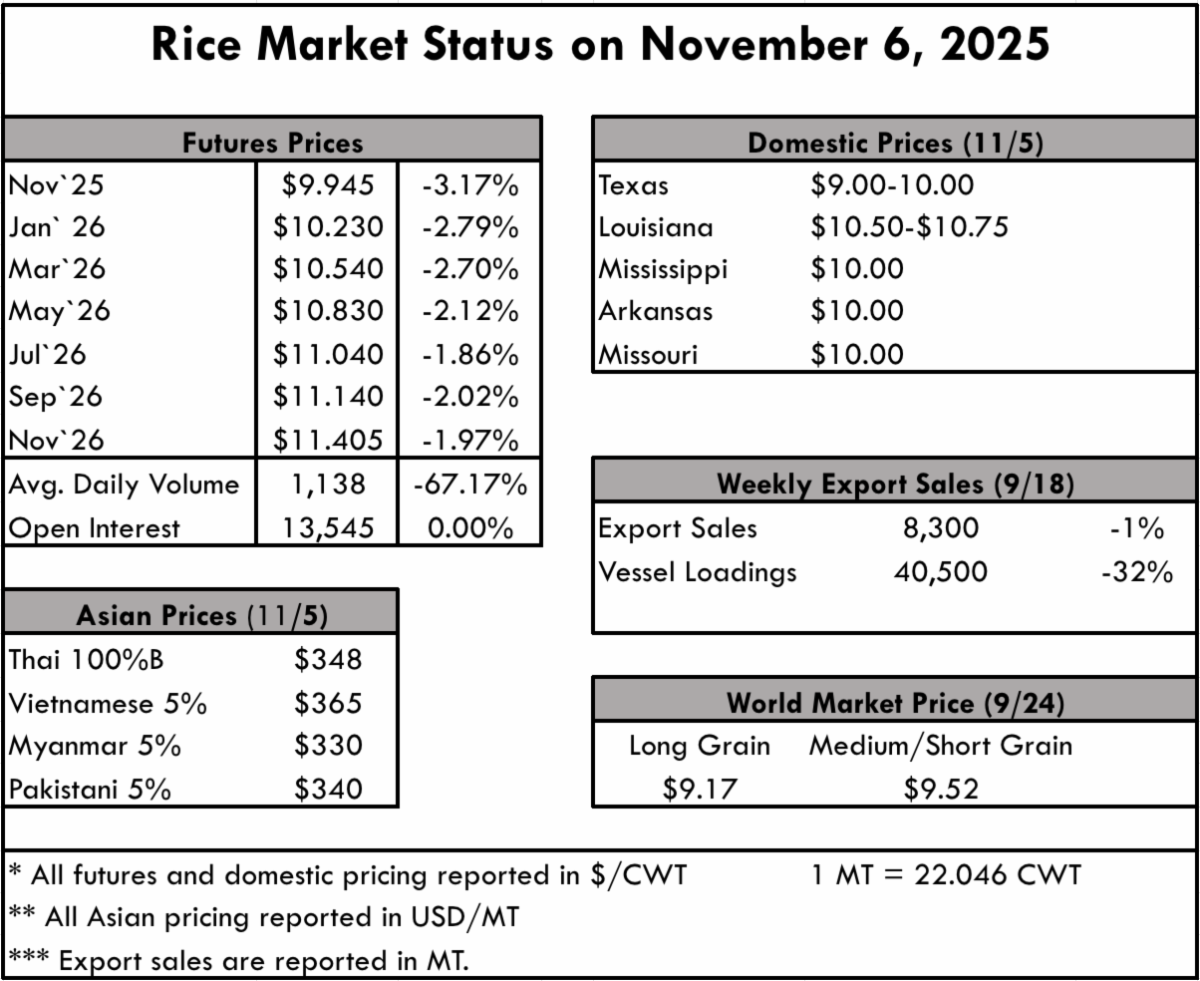
With no government sales information to report on account of the shutdown, we can’t provide empirical data to inform our export sales numbers. We are therefore intimating details from anecdotal conversations among industry members. Even those aren’t positive, as Iraq business has yet to ramp up until an MOU is signed, most likely in the first part of 2026. Exports to Haiti are consistent but remain in jeopardy because of a quality Pakistani crop. Paddy sales are also slow as the MERCOSUR has gobbled up much of our historical demand. Later this month we will have a good indication of the on-going Mercosur spring planting and carry-over stock situation, therefore the first real outlook for 2026 for these four rice-exporting countries.
As mills get deeper into the crop, it’s becoming clear that milling yields are at least 5% off, but likely not 10%. This means that the byproduct supply will increase and put even more pressure on overall returns back to the farmer, thus making ARC/PLC payments all but guaranteed for the coming crop cycle. The tough part is, without further government funding in the form of emergency payments, there is simply no way for rice to pencil in the current environment.
To exacerbate the problem, India is reporting another bumper crop, that will continue to put pressure on the Asian price matrix. This in turn will put downward pressure on prices in the Western Hemisphere. To look at how the spread has been squeezed in the last year alone, the average of Asian rice (Thai/Viet/Indian) is 45% cheaper than Western rice (USA/Brazil/Uruguay), whereas it was only 38% cheaper a year ago. All of this spells more need for the government to ensure its policies regarding national security includes food security, of which rice is paramount.
| | |
Longest government shutdown in history continues
As of today, November 7, the federal government shutdown has lasted 38 days and now holds the record for the longest shutdown in U.S. history. The House of Representatives continues to be out of session and has been since September 19, while the Senate has been in session every week since the start of the shutdown. At this point in time, Senate Republicans have attempted and failed to advance the House-passed continuing resolution (CR) 14 different times now, with another vote on the CR scheduled for some time later today. Nevertheless, Congress will likely have to reintroduce an updated CR that extends beyond the initial November 21 deadline outlined in the Housed-passed CR, which the Senate continues to vote on.
As November Supplemental Nutrition Assistance Program (SNAP) benefits lapsed over the weekend, a federal judge in Rhode Island instructed the Trump Administration use emergency funding for November food aid assistance for the millions of Americans dependent on SNAP. In response, President Trump reiterated his Administration’s position on the shutdown in a statement on Truth Social confirming that even partial benefits will be delayed, even with the recent court rulings on SNAP.
On Wednesday, Transportation Secretary Sean Duffy announced that the Federation Aviation Administration (FAA) will reduce flight schedules by 10% at 40 different airports across the country as Air Traffic Controllers and Transportation Security Administration (TSA) screeners continue to work without pay. This change will roughly impact 3,500 to 4,000 flights daily and likely disrupt millions of Americans traveling, placing increased pressure on lawmakers to come to a swift solution to reopen the government.
While there still seems to be no meaningful progress towards a compromise between parties to reopen and fund the federal government, there does appear to be a different willingness from Democrats to come to the table after Tuesday’s election night results that ruled in their party’s favor.
DOL brings back visa-processing staff
On Friday, October 31, the Department of Labor (DOL) announced it will call back 200 furloughed employees to resume visa processing and immigration-related operations. This decision is important for many farm operators and agricultural employers who worry that processing delays will prevent hiring workers for time-sensitive roles. Funding lapses are still expected to increase delays in hiring foreign workers, especially under the H2A and H2B Visa programs. More information on this announcement can be found here.
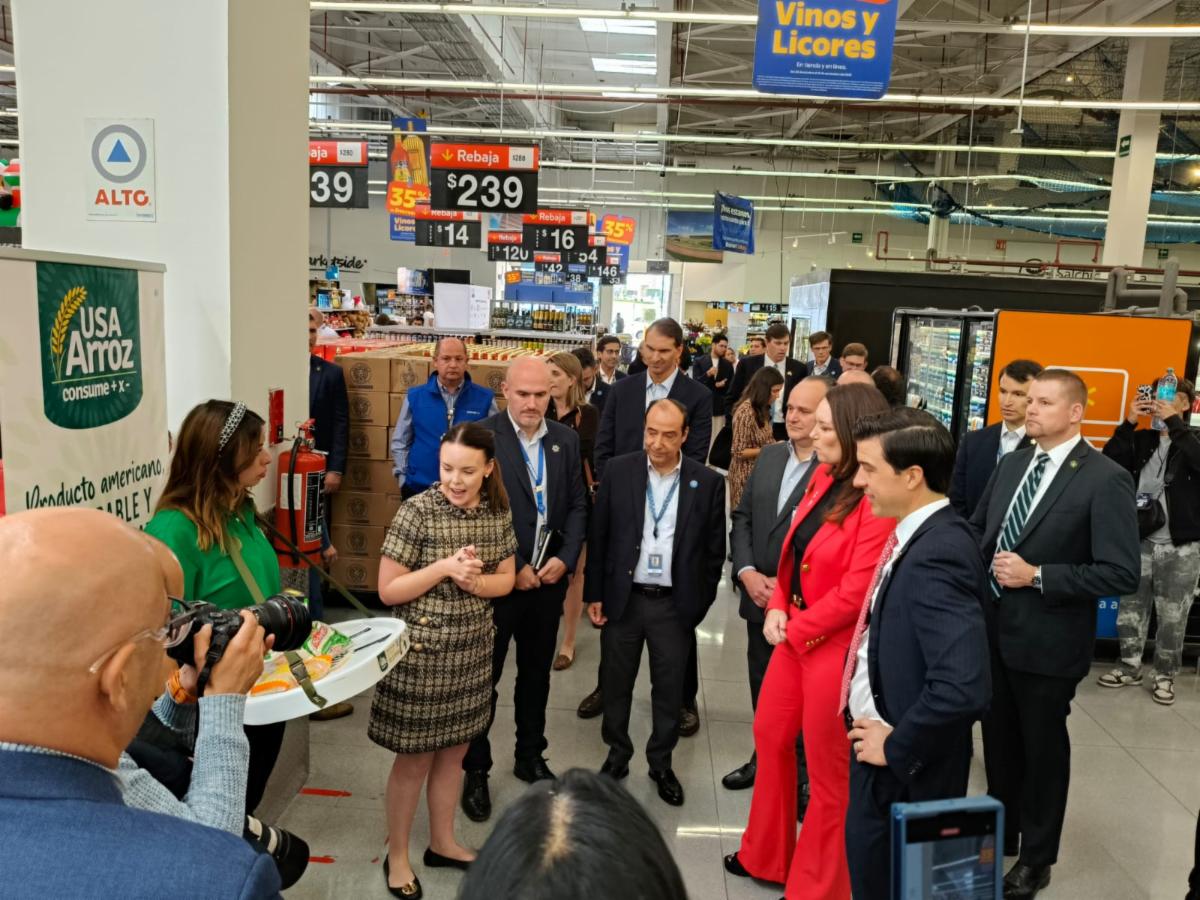
| | USRPA Participates in USDA Trade Mission to Mexico | | USRPA President & CEO Mollie Buckler highlights USRPA's activities in Mexico for Secretary of Agriculture Brooke Rollins and Undersecretary for Trade & Agricultural Affairs Luke Lindberg, along with USDA FAS staff and Walmart officials | |
This week, the US Rice Producers Association participated in USDA’s Agribusiness Trade Mission to Mexico City, USDA’s largest event of its kind to date.
The mission began Monday morning with a dynamic plenary session, including a market presentation by USRPA’s Mexican representative, Imalinx CEO Marco Albarran. In the afternoon, the delegation visited several retail locations. As part of the USDA Trade Mission activities, the USRPA had the opportunity to showcase one of its ongoing in-store promotional programs in Mexico, which encourages consumers to incorporate more rice into their daily meals. Trade mission participants, including Secretary of Agriculture Brooke Rollins, Undersecretary for Trade Luke Lindberg, and USDA-FAS staff, visited Walmart Toreo to observe first-hand the consumer engagement efforts taking place at the point of sale, such as cooking demonstrations, sampling, and promotional displays featuring U.S. rice.
“USDA trade missions play a vital role in connecting U.S. producers and exporters with international partners,” Mollie Buckler, USRPA President and CEO, said. “USRPA appreciates USDA’s partnership in helping expand market opportunities and strengthen relationships that support the growth of American agriculture worldwide, especially in Mexico, one of the most promising markets for increased rice consumption and trade collaboration.”
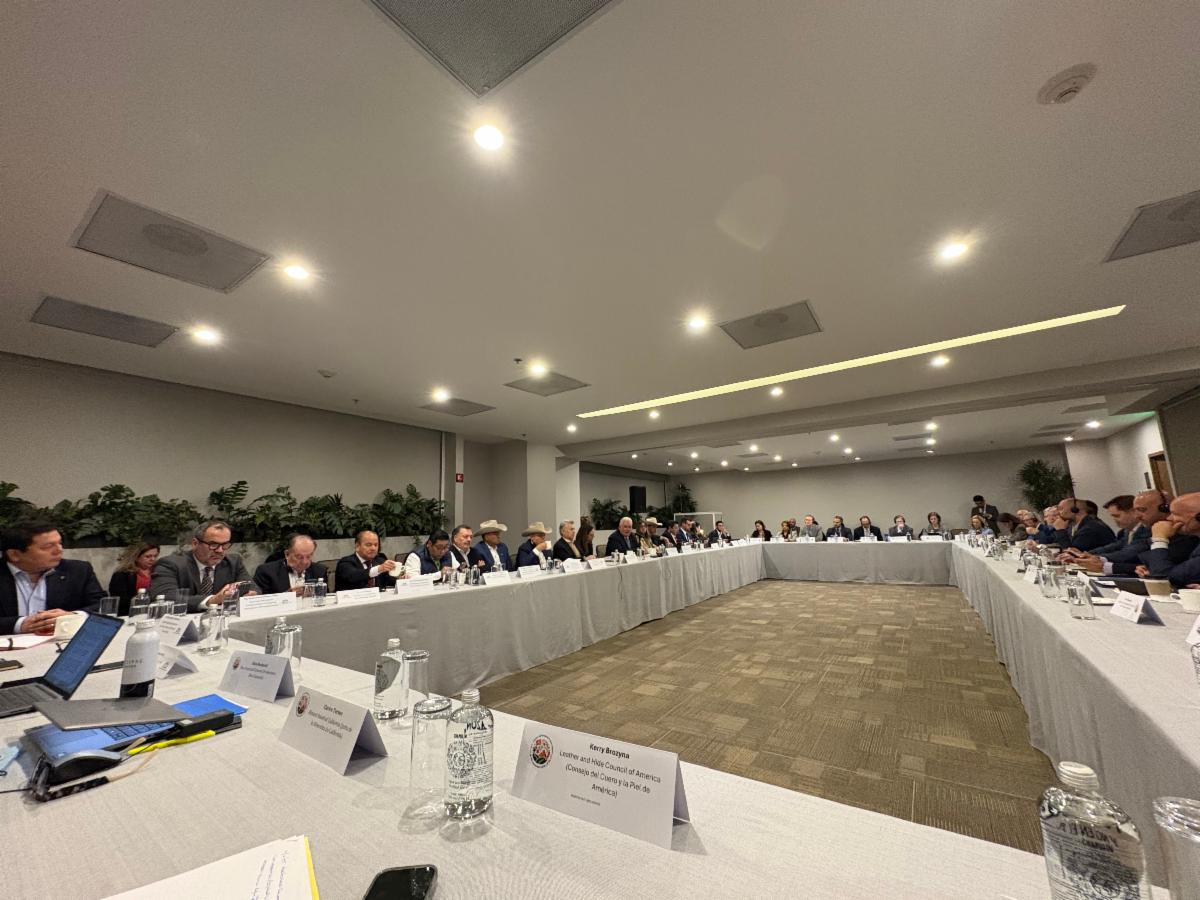
Throughout the week, Buckler represented USRPA in two roundtable discussions, one with Mexican agribusiness leaders and another at the American Chamber of Commerce focused on the upcoming USMCA review. She also met with potential buyers and toured a variety of grocery stores and supermarkets.
The timing of this mission was especially important as discussions surrounding the upcoming USMCA review continue to gain momentum. Strengthening relationships and reinforcing the value of open, rules-based trade between the U.S. and Mexico are key to ensuring long-term market stability and opportunity for U.S. rice producers.
| | USRPA's promotion at Walmart Toreo included a delicious rice pudding sample | | The visit included multiple opportunities to connect with Mexico ag and food industry leaders, including a roundtable with Mexican agribusiness leaders on Tuesday | | Ray Stoesser Memorial Scholarship: One Month Left to Apply! | | |
Throwing it back to last year's Cotton & Rice Conference! USRPA is a proud leading sponsor of this great annual event. Registration is now open for the 2026 Cotton & Rice Conference in Jonesboro, AR, February 5-6, 2026. Register today!
Send us your Rice Country photos or videos on Facebook, Instagram, or via email!
| |
| | |  |
Food & Agriculture
Regulatory & Policy Roundup
| | | |
January 21, 2026
Western Rice Belt Conference
More details to come
| |
February 5 - 6, 2026
29th Annual National Conservation Systems Cotton & Rice Conference
Jonesboro, AR
More Information
| |
February 19, 2026
Missouri Rice Council Annual Meeting
Gobler, MO
More Information
| |
|
May 26 - 28, 2026
Rice Market & Technology Convention
Cartagena, Colombia
More Information
| | |
USRPA does not discriminate in its programs on the basis of race, color, national origin, gender identity, sexual orientation, religion, age, disability, political beliefs, or marital/family status. Persons who require alternative means for communication of information (such as Braille, large print, sign language interpreter or translation) should contact USRPA at 713-974-7423. |
| | | |