|
The true nature of long grain plantings continue to be debated in the U.S., with the USDA showing flat to last year, and the industry being confident of a 10-15% cut. Time will tell, but futures prices are showing a suspected cut in acreage, and paddy prices would support the same. Uncertainty of both the market and weather continue to hover over farmers. Meterorologists at Colorado State University are predicting an “above average” 2022 hurricane season that begins June 1. Nineteen storms are forecast for the Atlantic basin. Above-average sea surface temperatures and the lack of El Nino developing that would suppress hurricane activity by increasing vertical wind shear is the contributing factor.
Prices for long grain milled are priced at or just above $650 pmt, whereas prices in South America are at least $100 pmt below that. South America is in the peak of their harvest season, with several questions swirling around the drought situation in Brazil. We know that Uruguay has crested the high point, and is on the downhill slope of the last 20% of their crop. Argentina is just ahead of them. Brazil and Paraguay are the big swings that will be coming to light in the next few weeks.
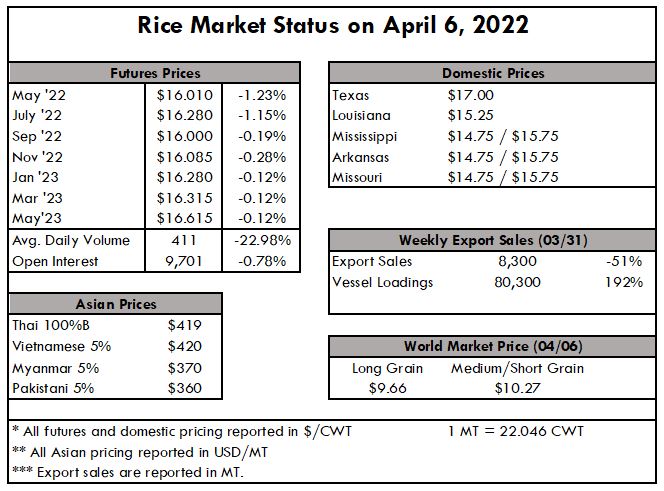
In Asia, prices have held steady despite the inflationary rise that so many other commodities have seen. For more than a quarter now, prices in Thailand and Vietnam have oscillated around $400 pmt, while India and Pakistan have been around $360 pmt. This can in large part be attributed to India, who hasn’t slowed exports over the COVID-19 pandemic, and has been responsible for its third record crop in as many years.
India’s farm subsidies, which many speculate have led to their record crop, has blunted the inflationary impacts of rice world-wide. With rice being the most basic food calorie for human consumption that prevents hunger for the poorest nations, this can be viewed as a positive in the global environment. However, India’s rice subsidy violations have put a burden on many rice producers around the globe; these violations were front-and-center this week with the World Trade Organization (WTO). India has been called out by the U.S. rice industry and others to stop creating an unfair playing field with their rice subsidy program. It is making rice from the United States and other origins uncompetitive on a global scale, and can have severe detrimental impacts on food security world-wide in the future.
Prices on the ground show Texas in the lead at $17/cwt. Louisiana is strong at $15.25/cwt, while prices in Mississippi, Arkansas, and Missouri are fluctuation between $14.75-$15.75 based on variety and qualities.
The weekly USDA Export Sales report shows net sales of 8,300 MT this week, a marketing-year low, down 51% from the previous week and 81% from the prior 4-week average. Increases primarily for Mexico (13,700 MT), Haiti (7,300 MT), Jordan (4,000 MT), the Dominican Republic (2,000 MT), and Honduras (1,500 MT), were offset by reductions primarily for Colombia (22,000 MT). Exports of 80,300 MT were up noticeably from the previous week and up 98% from the prior 4-week average. The destinations were primarily to Mexico (32,700 MT), Colombia (22,300 MT), Haiti (15,300 MT), El Salvador (4,100 MT), and Canada (2,000 MT).
In the futures market, May 22 prices are down just over 1% this week to $16.010. May 23 contracts are about flat from last week, now at $16.615. Average Daily Volume registers at 411, down 23% from last week, while open interest is flat at 9,701.
|