|
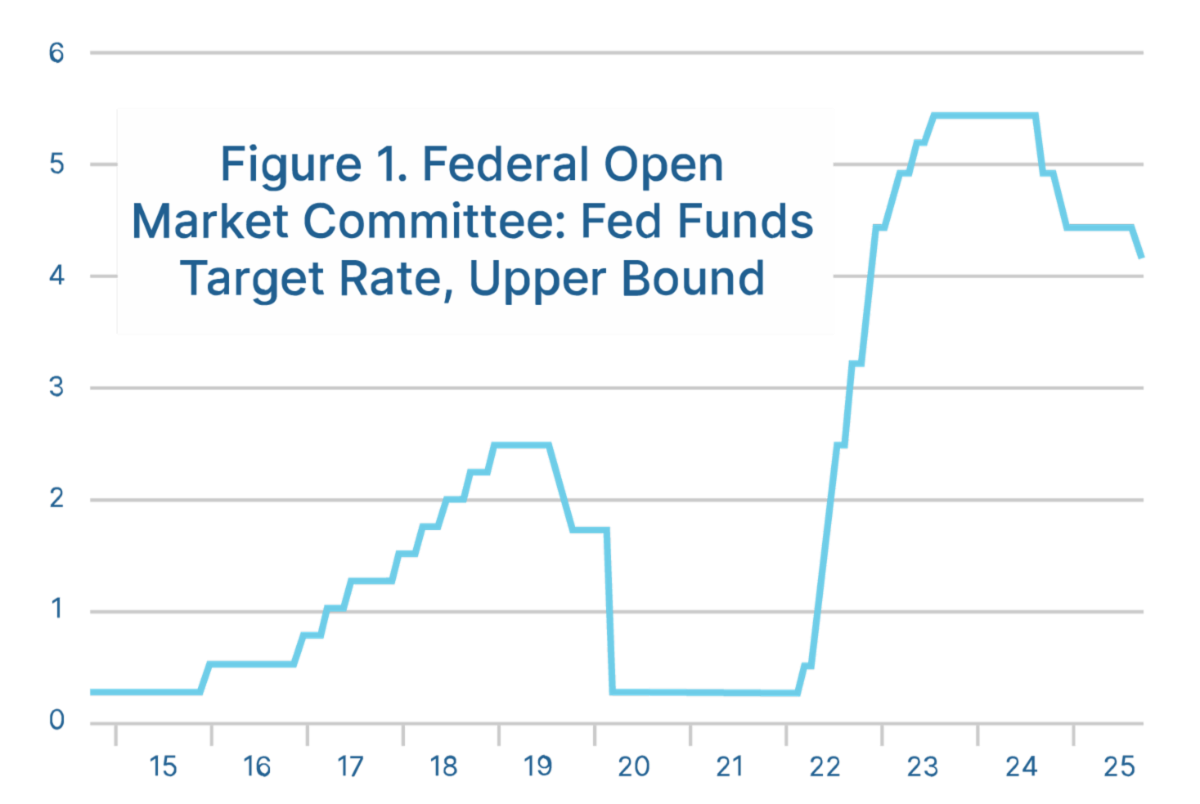
Going forward, markets expect to see one or two more rate cuts by the end of the year. In general, falling interest rates tend to support stock and bond prices, so any further cuts would likely be celebrated by investors.
Report Releases: GDP Revised Higher; Job Growth Slows Sharply
The economic updates released during the month were also broadly positive, with some caveats. Second-quarter GDP growth was revised up from earlier estimates of 3.3 percent to 3.8 percent, driven by increased personal consumption growth. Consumer spending drives the bulk of economic activity in the country, so this upward revision was a good sign for the state of the overall economy. We also saw positive reports for retail sales as well as personal income and spending growth during the month.
With that being said, there are some areas of the economy that warrant further attention. First and foremost is the labor market, as we’ve seen a notable slowdown in hiring over the past few months. The August job report showed that just 22,000 jobs were added during the month, and downward revisions to prior months further lowered overall employment levels. While still low on a historical basis, the unemployment rate in August ticked up to its highest level since late 2021.
We’ve also seen signs that inflation may be set to pick up further, as consumer inflation came in hot in August. While still well below levels seen in 2021 and 2022, inflation remains above the Fed’s 2 percent target and is trending in the wrong direction. This will be another important area to keep an eye on going forward.
Looking Ahead: Political Gridlock and Global Tensions Could Test Market Resilience
Aside from the weakening job market and concerns surrounding inflation, there are other risks that investors should keep in mind. Domestically, political uncertainty has risen recently due to the impasse in Congress over spending negotiations. While a resolution to the current stalemate is expected, the timing is still up for debate, which could lead to further policy uncertainty from Washington. Foreign geopolitical risks remain as well, as seen by the ongoing conflicts in Ukraine and the Middle East.
On the whole, we remain in a pretty good place as we head into the fourth quarter. Market fundamentals and performance have remained healthy throughout the year despite high levels of uncertainty and shifting risks. While there are some areas to monitor, especially on the jobs and inflation fronts, the economic backdrop largely remains supportive, and the most likely path forward is for continued economic growth and market appreciation.
As always, a well-diversified portfolio remains the best path forward for most investors. If concerns remain, however, please call us to go over your financial plans.
Disclosure: This material is intended for informational/educational purposes only and should not be construed as investment advice, a solicitation, or a recommendation to buy or sell any security or investment product. Please contact your financial professional for more information specific to your situation.
Certain sections of this commentary contain forward-looking statements based on our reasonable expectations, estimates, projections, and assumptions. Forward-looking statements are not guarantees of future performance and involve certain risks and uncertainties, which are difficult to predict. Past performance is not indicative of future results. Diversification does not assure a profit or protect against loss in declining markets. All indices are unmanaged and investors cannot invest directly into an index. The Dow Jones Industrial Average is a price-weighted average of 30 actively traded blue-chip stocks. The S&P 500 Index is a broad-based measurement of changes in stock market conditions based on the average performance of 500 widely held common stocks. The Nasdaq Composite Index measures the performance of all issues listed in the Nasdaq Stock Market, except for rights, warrants, units, and convertible debentures. The MSCI EAFE Index is a float-adjusted market capitalization index designed to measure developed market equity performance, excluding the U.S. and Canada. The MSCI Emerging Markets Index is a market capitalization-weighted index composed of companies representative of the market structure of 26 emerging market countries in Europe, Latin America, and the Pacific Basin. It excludes closed markets and those shares in otherwise free markets that are not purchasable by foreigners. The Bloomberg Aggregate Bond Index is an unmanaged market value-weighted index representing securities that are SEC-registered, taxable, and dollar-denominated. It covers the U.S. investment-grade fixed-rate bond market, with index components for a combination of the Bloomberg government and corporate securities, mortgage-backed pass-through securities, and asset-backed securities. The Bloomberg U.S. Corporate High Yield Index covers the USD-denominated, non-investment-grade, fixed-rate, taxable corporate bond market. Securities are classified as high-yield if the middle rating of Moody’s, Fitch, and S&P is Ba1/BB+/BB+ or below. One basis point (bp) is equal to 1/100th of 1 percent, or 0.01 percent.
Nancy Curtin is a Senior Wealth Advisor practicing at KBK Wealth Management. She offers securities and advisory services as an investment adviser representative of Commonwealth Financial Network®, a member firm of FINRA/SIPC, and a Registered Investment Adviser. She can be reached by phone at 561-526-4061 or by email at njcurtin@kbkwealth.com
© 2025 Commonwealth Financial Network®
|