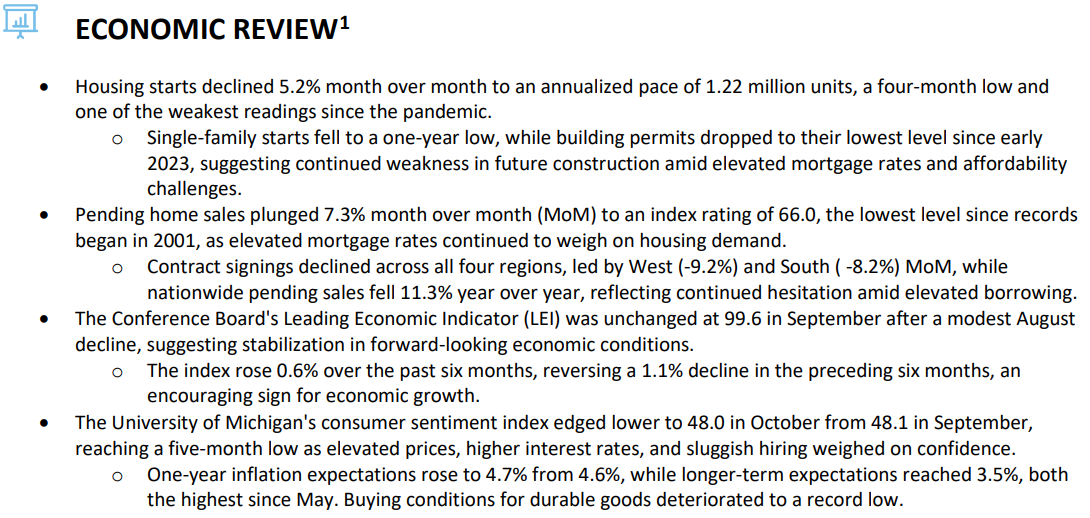
How does the most recent economic data impact you?


  • Housing remains a weak spot in the economy, although the stabilization in LEI suggests housing challenges may be isolated and not indicative of broader economic weakness.
  • Rising consumer inflation expectations remain a concern, however softer housing activity could provide some relief to inflationary pressures over time.
  • Mixed economic signals reinforce the importance of incoming data for the Federal Reserve (Fed), as persistent inflation concerns may limit the potential for near-term interest rate relief.


A LOOK FORWARD1


  • This week investors will focus on the Fed’s interest rate decision, third-quarter Gross Domestic Product (GDP), Personal Consumption Expenditures (PCE) inflation, durable goods orders, consumer confidence and the Employment Cost Index (ECI).


How does this week’s slate of economic data impact you?


  • Third-quarter GDP is expected to show continued economic resilience, while durable goods orders and consumer confidence will provide insight into business investment and household sentiment.
  • September's PCE and the third-quarter ECI will offer insights into underlying price and wage pressures, helping assess whether inflation is moving sustainably towards the Fed's 2% target.
  • The Fed is widely expected to hold rates steady, with investors focused on its outlook for future policy decisions. Inflation could reinforce expectations for higher interest rates, affecting Treasury yields and equity valuations.


BY THE NUMBERS


Grand Theft Auto VI: The $1 Billion Sick Day: The highly anticipated release of Grand Theft Auto VI on November 19, 2026, could cost the US economy an estimated $1 billion in lost productivity. About 1.5 million American workers are expected to skip work, potentially reducing national productivity by an estimated 2% that day. The estimate assumes an average annual economic output of approximately $70,000 per worker, with employees aged 18 to 30 expected to account for most absences. Technology companies could face the greatest disruption, as some businesses already prepare for employee absences and operational delays. Meanwhile, publisher Take-Two Interactive anticipates more than $1 billion in operating cash flow this fiscal year, highlighting the game's economic significance. Ease in as it launches threatens to temporarily disrupt workplace productivity.3


College Tuition: Fewer Students, Bigger Discounts: The University of Vermont (UVM) and Middlebury College are expanding tuition discounts as universities compete for students amid demographic challenges. UVM reported a 14.5% decline in firstyear enrollment, contributing to an initially projected $12 million budget shortfall that the university later closed through cost reductions. To attract students, UVM will offer tuition discounts exceeding 35%, saving eligible out-of-state students more than $18,000 annually on its typical $46,600 tuition. Middlebury, where annual tuition is about $72,900, is expanding free tuition eligibility to families earning up to $175,000, up from $65,000. While Middlebury's enrollment has remained stable, both institutions are responding to increased competition for students, suggesting the cost of higher education may become more negotiable.4

    Matthew J. Lawler, Financial Advisor

matt.lawler@osaicwealth.com  402-412-5008


Securities offered through Osaic Wealth, Inc. Member FINRA/SIPC Advisory Services offered through Osaic Wealth, Inc. Matthew J. Lawler Representative  F&M Wealth Management and F&M Bank are not affiliated with Osaic Wealth, Inc.

 May Lose Value - Not FDIC-Insured - No Bank Guarantee - Not a Deposit - Not Insured by any Government Agency

Economic Definitions


Building Permits: This concept tracks the number of permits that have been issued for new construction, additions to pre-existing structures or major renovations. These statistics are based on the number of construction permits approved.

Conference Board Consumer Confidence Index: The Consumer Confidence Survey® reflects prevailing business conditions and likely developments for the months ahead. This monthly report details consumer attitudes, buying intentions, vacation plans, and consumer expectations for inflation, stock prices, and interest rates. The Present Situation index is a sub-index that gauges consumer sentiment about current business and labor market conditions. The Expectations index is a sub-index that assesses consumers' 6- month outlook on business, employment, and income.

Conference Board Leading Economic Index: Leading indicators include economic variables that tend to move before changes in the overall economy. These indicators give a sense of the future state of an economy.

Durable Goods Orders: This concept tracks the value of new orders received during the reference period. Orders are typically based on a legal agreement between two parties in which the producer will deliver goods or services to the purchaser at a future date.

Employment Cost Index (ECI): The Employment Cost Index measures changes in employers' labor costs, including wages, salaries, and benefits, while accounting for shifts in employment across occupations and industries to provide a consistent measure of compensation pressures over time.

Federal Reserve (Fed): The Federal Reserve System is the central banking system of the United States of America.

GDP: Gross domestic product (GDP) measures the final market value of all goods and services produced within a country. It is the most frequently used indicator of economic activity. The GDP by expenditure approach measures total final expenditures (at purchasers' prices), including exports less imports. This concept is adjusted for inflation.

Housing Starts: Housing (or building) starts track the number of new housing units (or buildings) that have been started during the reference period.

PCE (headline and core): PCE deflators (or personal consumption expenditure deflators) track overall price changes for goods and services purchased by consumers. Deflators are calculated by dividing the appropriate nominal series by the corresponding real series and multiplying by 100.

University of Michigan Consumer Sentiment Index: Consumer confidence tracks sentiment among households or consumers. The results are based on surveys conducted among a random sample of households. Target Audience: representative sample of US households (excluding Alaska and Hawaii). Surveys of Consumers collects data on consumer attitudes and expectations summarized in the Consumer Sentiment, in order to determine the changes in consumers' willingness to buy and to predict their subsequent discretionary expenditures. This Index is comprised of measures of attitudes toward personal finances, general business conditions, and market conditions or prices. Components of the Index of Consumer Sentiment are included in the Leading Indicator Composite Index. Unit: Index (Q1 1966=100).


Index Definitions


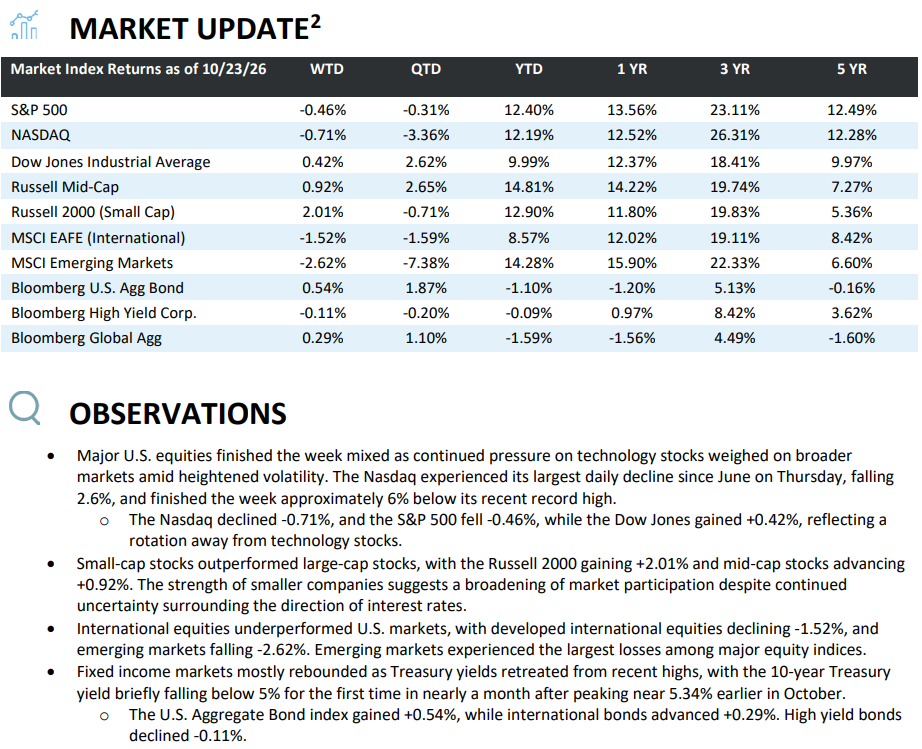
S&P 500: The S&P 500® is widely regarded as the best single gauge of large-cap U.S. equities and serves as the foundation for a wide range of investment products. The index includes 500 leading companies and captures approximately 80% coverage of available market capitalization.

NASDAQ: The NASDAQ Composite Index is a broad-based capitalization-weighted index of stocks in all three NASDAQ tiers: Global Select, Global Market and Capital Market. The index was developed with a base level of 100 as of February 5, 1971.

Dow Jones Industrial Average: The Dow Jones Industrial Average is a price-weighted average of 30 blue-chip stocks that are generally the leaders in their industry. It has been a widely followed indicator of the stock market since October 1, 1928.

Russell Mid-Cap: Russell Midcap Index measures the performance of the 800 smallest companies in the Russell 1000 Index, which represent approximately 25% of the total market capitalization of the Russell 1000 Index.

Russell 2000: The Russell 2000 Index is comprised of the smallest 2000 companies in the Russell 3000 Index, representing approximately 8% of the Russell 3000 total market capitalization. The real-time value is calculated with a base value of 135.00 as of December 31, 1986. The end-of-day value is calculated with a base value of 100.00 as of December 29, 1978.

MSCI EAFE: The MSCI EAFE Index is a free-float weighted equity index. The index was developed with a base value of 100 as of December 31, 1969. The MSCI EAFE region covers DM countries in Europe, Australasia, Israel, and the Far East.

MSCI EM: The MSCI EM (Emerging Markets) Index is a free-float weighted equity index that captures large and mid-cap representation across Emerging Markets (EM) countries. The index covers approximately 85% of the free float-adjusted market capitalization in each country.

Bloomberg Barclays US Agg Bond: The Bloomberg Barclays US Aggregate Bond Index is a broad-based flagship benchmark that measures the investment grade, US dollar-denominated, fixed-rate taxable bond market. The index includes Treasuries, government-related and corporate securities, MBS (agency fixed-rate pass-throughs), ABS and CMBS (agency and non-agency).

Bloomberg Barclays High Yield Corp: The Bloomberg Barclays US Corporate High Yield Bond Index measures the USD-denominated, high yield, fixed-rate corporate bond market. Securities are classified as high yield if the middle rating of Moody's, Fitch and S&P is Ba1/BB+/BB+ or below. Bonds from issuers with an emerging markets country of risk, based on Barclays EM country definition, are excluded.

Moody's, Fitch and S&P is Ba1/BB+/BB+ or below. Bonds from issuers with an emerging markets country of risk, based on Barclays EM country definition,

are excluded.

Bloomberg Barclays Global Agg: The Bloomberg Barclays Global Aggregate Index is a flagship measure of global investment grade debt from twenty-four local currency markets. This multi-currency benchmark includes treasury, government-related, corporate and securitized fixed-rate bonds from both developed and emerging markets issuers.

Bloomberg Barclays Municipal Bond Index: The Bloomberg Barclays U.S. Municipal Index covers the USD-denominated long-term tax-exempt bond market. The index has four main sectors: state and local general obligation bonds, revenue bonds, insured bonds and prerefunded bonds.

Disclosures


The statements provided herein are based solely on the opinions of the Osaic Research Team and are being provided for general information purposes only. Neither the information nor any opinion expressed constitutes an offer or a solicitation to buy or sell any securities or other financial instruments. Any opinions provided herein should not be relied upon for investment decisions and may differ from those of other departments or divisions of Osaic Wealth, Inc. (“Osaic”) or its affiliates.


Certain information may be based on information received from sources the Osaic Research Team considers reliable; however, the accuracy and completeness of such information cannot be guaranteed. Certain statements contained herein may constitute “projections,” “forecasts” and other “forward-looking statements” which do not reflect actual results and are based primarily upon applying retroactively a hypothetical set of assumptions to certain historical financial information. Any opinions, projections, forecasts and forward-looking statements presented herein reflect the judgment of the Osaic Research Team only as of the date of this document and are subject to change without notice. Osaic has no obligation to provide updates or changes to these opinions, projections, forecasts and forward-looking statements. Osaic is not soliciting or recommending any action based on any information in this document.


Investing involves risk, including the potential loss of principal. No investment strategy can guarantee a profit or protect against loss. In general, the bond market is volatile; bond prices rise when interest rates fall and vice versa. This effect is usually pronounced for longer-term securities. Any fixed-income security sold or redeemed prior to maturity may be subject to a substantial gain or loss. Vehicles that invest in lower-rated debt securities (commonly referred to as junk bonds or high-yield bonds) involve additional risks because of the lower credit quality of the securities in the portfolio. International investing involves special risks not present with U.S. investments due to factors such as increased volatility, currency fluctuation, and differences in auditing and other financial standards. These risks can be accentuated in emerging markets.


Index performance does not reflect the deduction of any fees and expenses, and if deducted, performance would be reduced. Indexes are unmanaged and investors are not able to invest directly into any index. Past performance cannot guarantee future results.


Securities and investment advisory services are offered through the firms: Osaic Wealth, Inc. and Osaic Institutions, Inc., brokerdealers, registered investment advisers, and members of FINRA and SIPC. Securities are offered through Osaic Services, Inc. and Ladenburg Thalmann & Co., broker-dealers and members of FINRA and SIPC. Advisory services are offered through Ladenburg Thalmann Asset Management, Inc., Osaic Advisory Services, LLC. and CW Advisors, LLC., registered investment advisers. Advisory programs offered by Osaic Wealth, Inc. are sponsored by VISION2020 Wealth Management Corp., an affiliated registered investment adviser. 9198815

1 Data Obtained from Bloomberg as of 10/23/26.

2 Data Obtained from Morningstar as of 10/23/26

3 Grand Theft Auto IV: The $1 Billion Sick Day | audacy.com

4 College Tuition: Fewer Students, Bigger Discounts | vtdigger.org