|
Daily Transportation News
August 6, 2026
| | | |
IATR 39th Annual Conference Early Bird Pricing Until Aug 15!
AV City: Autonomous Mobility
Las Vegas, Nevada | September 14–17, 2026
Vdara Hotel at ARIA | 2600 W Harmon Ave, Las Vegas, NV
Early-bird pricing extended until August 15
Hotel room block available through August 14 – availability limited
Sponsorship opportunities available until August 14
| | Massachusetts Incentives Give Electric Ride-Hailing a Boost | |
|
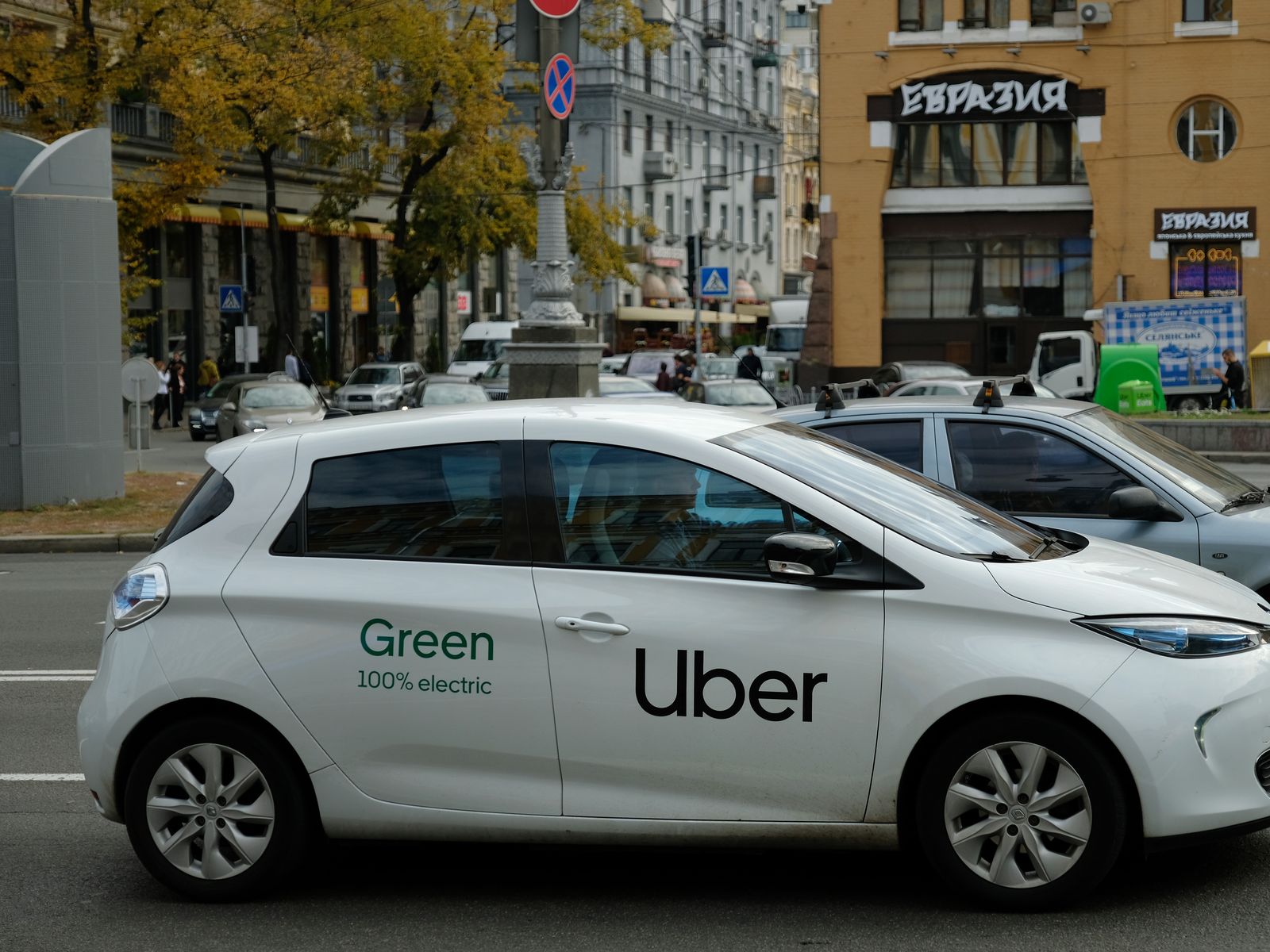
Your next Uber could be electric. Ride-hail and taxi drivers are transitioning to electric vehicles (EVs), inspired by their more cost-effective operations and the increasing availability of incentives.
In Massachusetts, ride-hailing drivers on platforms such as Uber and Lyft can get up to $14,000 toward a new EV, or $6,500 for a used EV, Grecia Mayya, program manager for the Massachusetts Clean Energy Center, said. The center oversees the Ride Clean Mass program, which provides rebates to transportation network company (TNC) drivers to purchase a new or used EV.
“We really wanted to focus on TNC drivers, because they’re more likely to be low to moderate income ... and they drive more miles than the average driver,” Mayya said during a recent webinar hosted by the Zero Emission Transportation Association (ZETA) Education Fund.
For regions wanting to transition vehicle miles traveled (VMT) — a key metric for evaluating traffic congestion and intensity — to zero-emission vehicles (ZEV), electrified ride-hailing is a natural area to focus, advocates and experts said. These vehicles tend to log more miles than personally-owned vehicles.
“Electrifying even just one ride-share vehicle can bring about much bigger emissions reductions than electrifying a personal vehicle,” Mayya said.
The incentives in Massachusetts are not just for ride-hailing. Drivers serving the taxi and livery sector are eligible for up to $17,500 to be applied to a new EV, or $12,500 for a used EV. Drivers who want to enter into EV rental agreements can apply for $200 per week rebates for up to eight weeks. Incentive recipients must use the vehicle for ride-hailing for 12 months following the award.
Source: GovTech Magazine
Click Here to Read More
| | Rideshare Unions Are Spreading Fast: What the Growing Uber and Lyft Driver Movement Means for Riders | |
|
A wave of state laws allowing Uber and Lyft drivers to unionize is spreading across the country, marking one of the most significant shifts in labor rights for gig workers since ride-hailing apps first launched more than a decade ago.
Massachusetts became the first state to open the door to rideshare unionization in 2024, when voters approved a ballot measure creating a framework that lets drivers organize and bargain collectively while remaining classified as independent contractors rather than employees. California followed in January, giving an estimated 800,000 rideshare drivers in the state the right to form a union. Illinois became the third state to pass such legislation on June 1, extending similar rights to the state's roughly 100,000 Uber and Lyft drivers.
The movement reached a major milestone this spring when Massachusetts drivers organized what labor advocates are calling one of the most significant labor wins for independent workers in decades. The certification, made possible under the state's 2024 framework, could ultimately represent nearly 70,000 drivers statewide through the newly formed App Drivers Union.
For drivers who backed the effort, the moment carried deep personal significance. Jean Fredo, who has driven for Uber for more than seven years, said he hopes the union will bring better pay, stronger protections against sudden deactivations and greater overall stability for drivers. "With the union, it will not feel like we're working for nothing," Fredo said, speaking through a translator.
Fellow driver Alfred Potter, who took part in organizing efforts, described the years-long push toward unionization as "still no more than a dream" for much of the process, reflecting how long the effort took to reach certification after the 2024 ballot measure passed.
In California, the nation's second state to grant rideshare drivers union rights, organizing is still in its early stages, with the earliest possible vote on unionization set for May. Sangar Khan, who drives for Uber and Lyft out of the Bay Area, said he believes unionization could benefit drivers financially. "I think the union is good for drivers, and maybe they pay more," Khan said, describing frustration with what he sees as a large gap between what riders pay for trips and what drivers ultimately take home.
Source: International Business Times
Click Here to Read More
| | |
US Plans New Air Taxi Infrastructure across Four States As Joby Nears Launch
Atoms, an industrial AI and infrastructure company, and Joby Aviation have formed a strategic partnership to acquire and develop vertiports across the United States. The companies will initially target Florida, New York, Texas, and California as Joby prepares to introduce early electric air taxi operations. Announced as Joby approaches commercial readiness, the plan is intended to provide aircraft with strategically located places to land, recharge, receive servicing, and connect passengers with ground transportation.
Click Here to Read More
U.S. Tourists Concerned over Ongoing Cancun International Airport Taxi Scams: Traveler Flags 5-Minute, $6,000 Ride
Another visitor was scammed into paying an outrageous fee during a five-minute ride between terminals at Cancun International Airport. Despite union proposals for new taxi fare payment structures, issues persist, with Americans and Canadians still reporting transportation problems when visiting Cancun and other parts of Mexico. Another recent incident emerged where a traveler was forced to pay $6,000, which they did not know about until checking a statement later. The unnamed traveler posted the incident online as a warning to others. The taxi scam generated hundreds of comments. After a five-minute taxi ride, the visitor quickly realized he had likely been scammed. The exchange took a turn after the driver declined his card twice.
Click Here to Read More
The Gig-Economy Crash Problem: Rideshare and Delivery Accidents in San Marcos, Texas
Few Texas cities run on app-based driving the way San Marcos does. With roughly 40,000 Texas State University students — many without cars — layered onto one of the fastest-growing corridors in the country, the city’s streets carry a constant rotation of Uber and Lyft runs to and from the Square, DoorDash and Favor deliveries to student housing, and Amazon and gig couriers threading through neighborhoods built decades before delivery apps existed.
Click Here to Read More
| |
RCMP Recover Nearly 400 Vehicles in ‘Coordinated’ Anti-Fraud Pilot Program
The RCMP say it’s recovered nearly 400 vehicles from Canadian ports during the first year of a pilot project targeting the export of vehicles obtained by fraudulent means. The pilot, called Project NoCargo, targets transnational organized crime networks using fake or stolen credentials to purchase vehicles and obtain insurance policies with the intent of committing fraud, a news release states.
Click Here to Read More
We Drove across Canada Barely Touching the Wheel. Here’s What It Felt Like.
What does it look like when you drive across Canada with your hands on the wheel, only when they have to be? The route across Canada sees mountain passes through the Rockies, open prairie sky on the Yellowhead Highway, the Cabot Trail winding along the Nova Scotia, and Cape Spear, Newfoundland, the easternmost point in North America. This summer GM Canada took in these stunning vistas. Almost entirely hands free.
Click Here to Read More
Volta Energy Gets $70M from Canadian Government, As Work on Quebec EV Materials Plant Nears Completion
The Canadian government said Aug. 4 that it will invest $70 million in Volta Energy Solutions Canada’s copper foil plant in Quebec, keeping a piece of the country’s electric-vehicle battery supply chain in place, despite industry and trade headwinds.
Click Here to Read More
| |
'Decades' before EVs Dominate Irish Roads
For the first time, fully electric vehicles have become the most popular choice for new car buyers, but they are still far from dominating the Irish roads. Battery electric vehicles overtook hybrids in July and now account for 26% of new car registrations, which is a proxy for sales, according to the Society of the Irish Motor Industry. In its own analysis, online marketplace DoneDeal Cars looked at how Ireland's EV adoption compares to other European nations.
Click Here to Read More
Private Hire Driving Heads to Consoles As Saber Interactive Unveils New Rideshare Simulation Game
Saber Interactive has announced a new driving simulation title that places players behind the wheel of their own rideshare business, with the game set to launch later this year on PC, PlayStation 5 and Xbox Series X|S. The new title, Rideshare “Stimulator”, is being developed by UNIGINE and continues Saber Interactive’s expansion within the vehicle simulation genre following releases including SnowRunner, RoadCraft and Bus Bound. The game focuses on operating a rideshare service in a busy urban environment while balancing customer satisfaction, vehicle maintenance and business growth.
Click Here to Read More
Aix-En-Provence Creates France’s First Parking Spaces for Small, No-Licence Cars
Cars measuring under three metres in length can now park in dedicated orange spaces in Aix-en-Provence. The spaces were inaugurated for the first time in France on June 17, on level minus two of the Rotonde car park in the centre of Aix-en-Provence, which is used by more than four million visitors each year. Identifiable by their bright orange colour, the spaces are exclusively for Pichautòs – a nod to the Provençal language, meaning small cars.
Click Here to Read More
| |
Pakistan Electric Vehicle Boom Fueled By Rising Chinese Imports
Chinese EV and plug-in hybrid imports surge in the first half of 2026 as consumer demand, government policies, and affordable technology drive Pakistan’s transition to electric mobility. Pakistan’s transition toward electric mobility is gaining remarkable momentum, with imports of Chinese electric vehicles (EVs) and plug-in hybrid electric vehicles (PHEVs) recording unprecedented growth during the first half of 2026. Latest customs data highlights a sharp rise in demand as consumers increasingly shift toward cleaner and more fuel-efficient transportation options.
Click Here to Read More
What South Africans Overlook When Buying a New Car – And Why Insurers Pay Attention
Close to 70% of vehicles sold in South Africa are imported, driven largely by affordable options from India and the growing market share of Chinese manufacturers. However, according to Tandiwe Cimela, Executive of Elite Risk, a leading high-net-worth insurer and part of Old Mutual Insure, while affordability is often the deciding factor when buying a vehicle, motorists should also consider other aspects that impact risk. "While price, styling and features typically drive buying decisions, elements such as vehicle safety and payload capacity can have a significant impact on both road safety and insurance risk," says Cimela.
Click Here to Read More
Singapore’s Private Car Ownership Levels Drop, Lowest Recorded
Private car ownership in Singapore has dropped to its lowest level since 2019 while rental cars have increased. According to data from the LTA, there were 516,237 private cars registered in June 2026. Rental cars, on the other hand, amounted to 97,567 units this year. The percentage of private cars have dropped to 79 per cent from 82.5 per cent in 2021. Rental cars have increased from 10.5 per cent of the national fleet to 14.9 per cent. This is the highest percentage of rental cars recorded so far.
Click Here to Read More
| | David Do Presents Green Rides and Congestion Mitigation Case Study at NCSTS | |
David Do, former Commissioner and Chair of the New York City Taxi and Limousine Commission | |
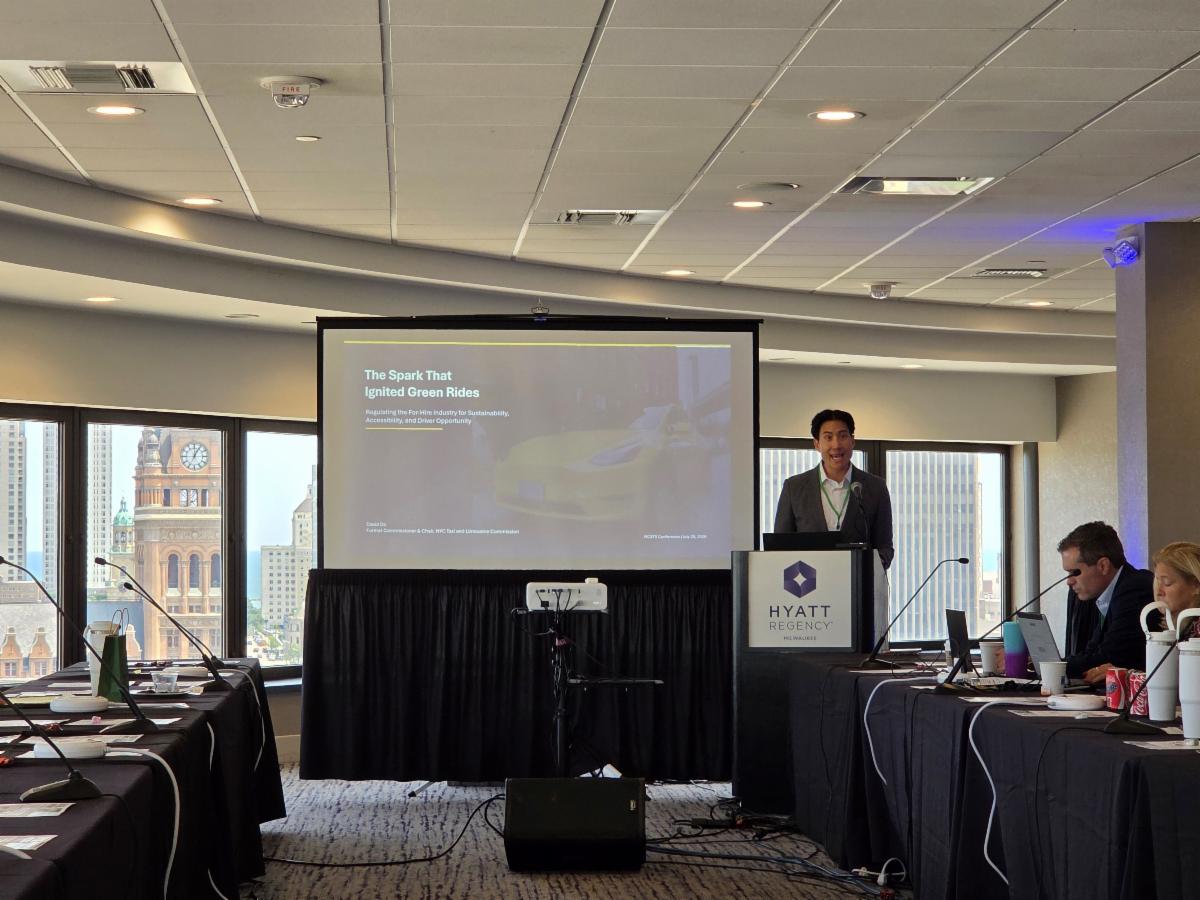
David Do, former Commissioner and Chair of the New York City Taxi and Limousine Commission, addressed the National Conference of State Transportation Specialists (NCSTS) Annual Conference on July 28 in Milwaukee, Wisconsin, presenting a session titled "Green Rides: The Spark That Ignited Regulation." David's talk walked regulators through the design and early results of New York City's high-volume-for-hire-vehicle electrification mandate, the Green Rides Initiative, framing it as a case study in converting a market signal into an enforceable public-interest rule.
NCSTS, founded in 1959, is a state-based organization focused on transportation regulation. The organization serves an operational role in federal hazardous materials and carrier registration programs: it is affiliated with the Alliance for Uniform Hazmat Transportation Procedures, and under the Unified Carrier Registration Act of 2005, NCSTS recommends five of the fifteen members of the Unified Carrier Registration Plan Board of Directors. This year's conference, held at the Hyatt Regency Milwaukee, drew state regulators and industry sponsors including GenLogs, Evans Transportation, and Tyler Technologies, and covered topics ranging from household goods tariffs to cargo theft and rail safety alongside David's session on TNC electrification.
David traced New York's rule from a modest EV share of high-volume trips in 2023 to a phased compliance ratio climbing to 100 percent by 2030, structured around reporting, fines, and corrective-action plans rather than a blunt cap. He credited the design with measurable results: zero-emission trips rose from 157,000 in January 2023 to 1.08 million in January 2024, EV trips reached 2.46 million monthly by July 2025, and the city saw a corresponding buildout of fast-charging infrastructure, from Port Authority airport investments to new capacity from Revel, Gravity, and Tesla-affiliated networks. The rule protected accessibility and driver economics alongside emissions goals, with over 8,000 wheelchair-accessible for-hire vehicles and 90 percent of WAV riders waiting ten minutes or less.
David positioned the New York experience as a direct application of IATR's Guiding Principles for Mobility Policy & Congestion Mitigation. The IATR’s 2023 framework is built from workshops, member surveys, and a review of U.S. and international practice. It identifies vehicle growth from TNCs and e-commerce, private car dependence, and post-pandemic modal shift from transit as root causes of urban congestion, and lays out solution-focused principles including fair road pricing, expansion of EV infrastructure, maximizing vehicle utilization, and promoting equity and accessibility – paired with explicit cautions against blunt tools such as blanket vehicle caps or unstructured congestion fees. David's session showed those principles operating in practice: a phased, measurable target tied to accountability and infrastructure investment, rather than a cap or an unstructured mandate.
David tied the New York experience back to the broader regulatory community, noting that the case illustrates IATR's core position that regulators can shape markets toward public outcomes before those markets harden in the wrong direction.
| |
|
Message from IATR President Matthew W. Daus
At the International Association of Transportation Regulators (IATR), our regulators are at the forefront of addressing both the challenges and opportunities facing the mobility paradigm. Our IATR members, partner organizations, and regulated industries will continue on our shared quest to fulfill the mission of our non-profit educational organization - to bring about Multi-Modal Mobility Innovation for All! This mission can best be accomplished through information sharing, collaboration, identifying and promoting best practices, and educating our membership. These educational updates and electronic media clips are affectionately known as “IATR snips” and endeavor to cover all aspects of mobility around the globe - especially news and developments involving safety, technology innovation, multi-modal integration, automation, sustainability, electrification, accessibility, regulatory modernization, and equity.
If you would like more information about the IATR, you can visit our website at www.iatr.global. Current members can renew their memberships when you log in to your IATR portal on the top right-hand side of our website, or click here. If you forgot your membership password, please email our Membership Director, Eric Richardson, at erichardson@iatr.global.
| | | | | |
|
RENEW YOUR MEMBERSHIP FOR 2026:
Weekly news snippets
Access to the membership database
Videos and files from recent conferences
Discounted rates for future conferences, and more!
Renew your membership at http://www.iatr.global or email info@iatr.global for any questions!
| | | | |