February 2026 Canine Newsletter | |
Hi Everyone,
The weather these last few weeks of January has been brutal, and not just here in Iowa. A big chunk of the country has been getting walloped. I’m definitely ready to turn the page to February: warmer days, longer light… and yes, Valentine’s Day!
Jim and I sat down with our calendars yesterday to compare notes. Much to my dismay, Jim will be gone over Valentine’s Day. 😩
I know Valentine’s Day can feel like a big ol’ marketing ploy for flowers and fancy dinners, but I have to admit, I still enjoy it.
So instead of pouting (too much), I’ve decided to create my own Valentine’s Day with my pooches. I did a little internet digging and found some great ideas that I think I will put into practice February 14th:
- Share the love with shelter dogs through donations, gifts, or support that makes a real difference. (Yep, I support our local rescue, so it's a good reminder to donate)
- Plan a day that builds your bond; a scenic park walk, soaking in nature, maybe even a playdate with a few furry friends. Of course, depending on the weather! (Yep, planning it! Our favorite walking path is a quick drive from home)
- Make it an adventure — stage your own little photoshoot, then head out to try a pet-friendly café you’ve never been to before. (Darn, not in Iowa, but if you have one near you - this might be fun!)
Because really, these kinds of experiences are what Valentine’s Day is supposed to be about anyway: love, connection, and spending time with the ones who make your life better (and fuzzier).
| |
A couple of quick tips for this newsletter…
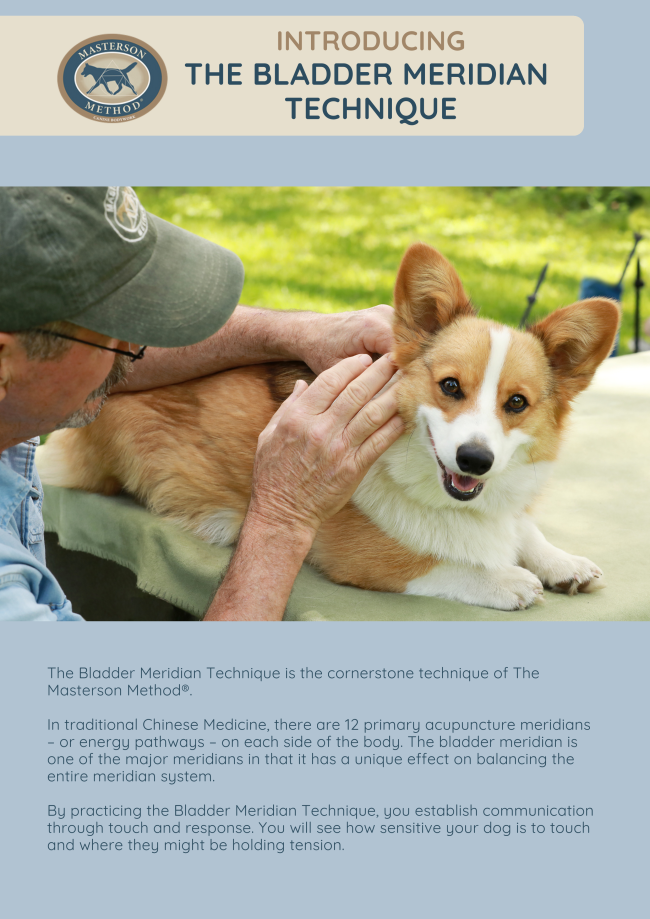
First up: we’ve included a printable PDF of the first technique in the book, The Bladder Meridian Technique. Download it, print it, and use it! (And hey… maybe print two copies: one for you, and one for your friend’s dog.)
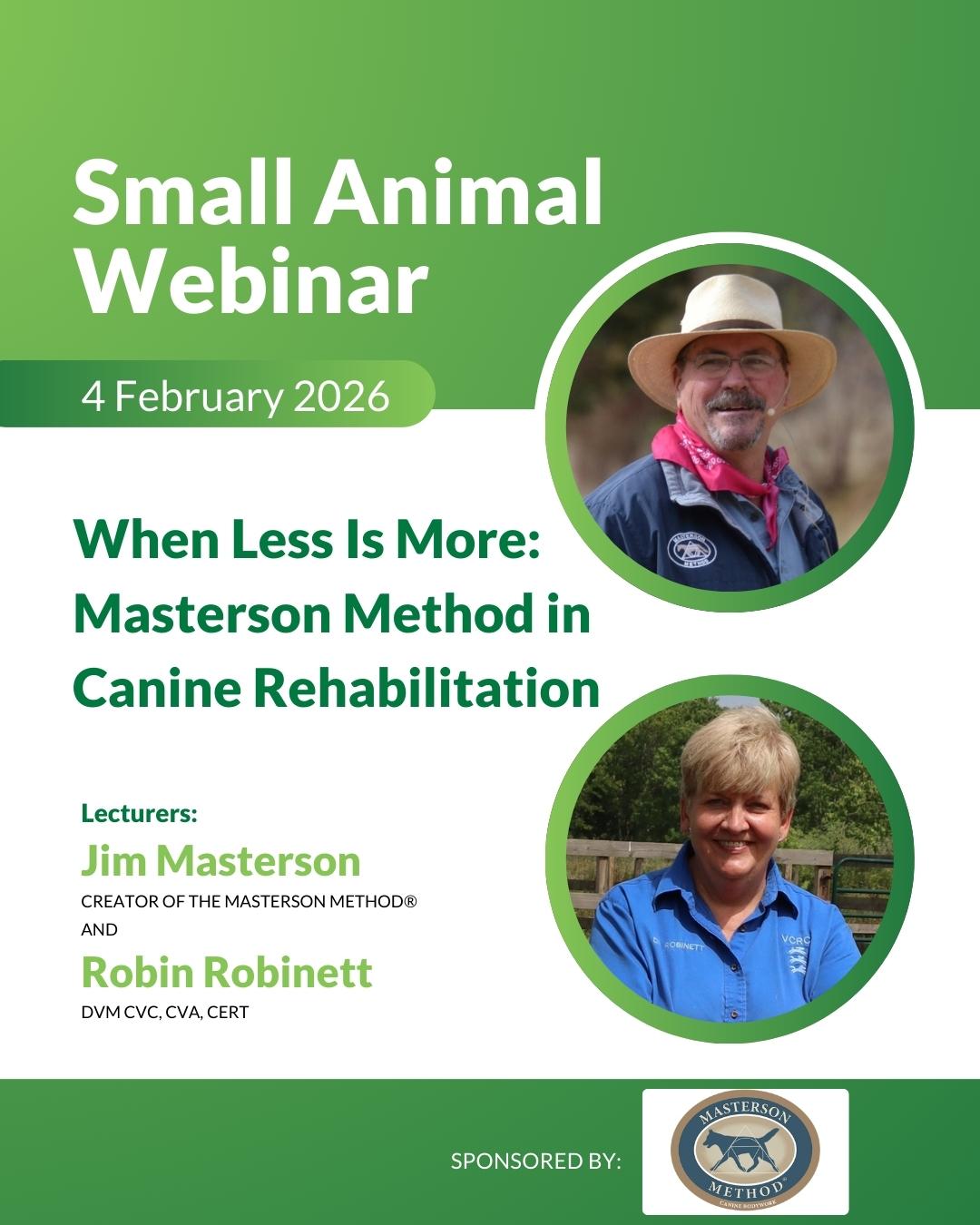
Good news: Jim and Dr. Robinett, DVM (co-creator of the Beyond Dog Massage book) will be offering a FREE webinar on Canine Rehabilitation on February 4th through Onlinepethealth, using the Masterson Method.
This webinar is normally part of their $57 membership, but we’ve included a button below so you can watch for free. Registration opens February 4th (same day as the webinar).
Also included: Leslie Kennedy, one of our wonderful Canine Instructors, has shared one of her blog posts with us. It includes a helpful checklist for Agility competitors, plus her favorite technique to support those athletic dogs.
And lastly: starting this month, we’ll be highlighting two Canine Certified Practitioners in every newsletter. We’re kicking things off with Lori Thompson (Arkansas) and Anja Jungkamp (Germany). Take a look and get to know them!
Finally, from Jim and me — have a wonderful Valentine’s Day and a great start to February!
| | |
Masterson Method®
PDF that explains the Bladder Meridian Technique
| | |
We’ve created a convenient, downloadable PDF with everything you need to practice the Bladder Meridian Technique with your dog.
Inside you’ll find:
- Clear instructions on locating the Bladder Meridian on your dog.
- Step-by-step guidance to master the technique.
- Insights into its amazing benefits.
- QR codes linking to videos of Jim demonstrating the technique.
Already familiar with the Bladder Meridian Technique? Share this PDF with a friend and let their dog experience the benefits, too!
| | A Special Gift to our Canine Community | | |
This February, we’ve partnered with Onlinepethealth to celebrate their birthday - and as part of that celebration, we’re offering a FREE educational webinar featuring Jim and Dr. Robin Robinett, DVM, CVC, CVA, CERT!
When Less Is More: Masterson Method in Canine Rehabilitation
This webinar explores how Masterson Method principles can be thoughtfully applied in canine rehabilitation, focusing on awareness, response, and gentle, effective intervention.
Registration for the webinar opens on February 4th via the button below. PLUS, keep an eye on our social media to find out about a Facebook Live event where Dr. Robinett will answer any questions you might have.
As a thank you for joining the webinar, everyone who registers will be entered into a prize draw to win a place on our Read and Release Course for you and your canine (Value: $195) or an Onlinepethealth Membership (Value: $77).
We’re so pleased to be partnering with Onlinepethealth in their birthday celebration and for helping make these educational opportunities freely available!
Registration opens Feb 4th. And if you’re part of our equine community, you’ll also be able to register for a second free webinar with Jim, where MMCP Equine Vanessa Helvey and Jim discuss Gelding Scars.
| |
Pre-Competition Check List
from Canine Instructor, Leslie Kennedy
| | |
From Leslie Kennedy's Canine Blog: Agility dogs twist, jump and turn at speed, therefore are at great risk of injury while on course, or even during training.
As a Canine Osteopath and Masterson Method® Certified Practitioner Canine and Instructor here are a few tips I recommend helping keep your performance dog healthy:
- Check your dog’s feet and toes, they are under tremendous repetitive stress.
- Keep all joints mobilized to help prevent injury to tendons, ligaments and muscles. It is imperative to keep joints mobilized to optimize Range of Motion (ROM).
- If muscles, tendons and ligaments are tight, joints will have decreased ROM thus increasing the probability of hindering performance and increasing opportunity for injury.
- Observe dog’s posture while sitting and moving. Do they sit with the hind legs squarely under themselves, or do they sit crookedly, do they track straight when travelling, or do the hind quarters track to one side, do they move forward on a STRAIGHT LINE, or do they appear to be moving on two tracks?
- Recognize your dog’s normal Range of Motion in all gaits and turns, if something doesn’t seem right, it probably isn’t.
- Identify asymmetrical patterns in the body during performance (ie which way do they turn more easily, which lead do they prefer while galloping, drifting to one side or the other).
- Address muscle tension and restrictions BEFORE they become a problem.
- Keep your dog’s mind healthy. Mentally, the dog’s mind needs to be alert, but focused. Excessive tension in the mind and body can lead to distractions, behaviour and performance challenges. Give the following Masterson Method technique a try to help release tension in your dog’s back.
The back is the bridge that connects the dog from back to front, therefore keeping it supple and tension free will go a long way in keeping your dog’s muscles and joints healthy. Constant flexion and contraction of the back muscles can cause muscle tension to accumulate over time, potentially leading to issues far from the original source, the back. In the case of competition or sports dogs' tightness, this can eventually lead to one sidedness and decreased performance. With agility dogs it is often evident through weave poles.
The following Masterson Method technique is one my favourite starting points for dogs that are constantly jumping, turning and twisting as well as working dogs; simple, yet highly effective. It is a technique tremendously helpful for senior dogs too.
It is one that I use on a regular basis before adding in the more advanced movement techniques. I find this technique easiest when the dog is sitting or standing, however it can be done when they are laying down.
Search for tension in your dog’s back by slowly and gently placing your fingers SOFTLY on the spine. You can start between shoulder blades, the lumbar or anywhere in-between.
| | |
Here, I am on the lumbar area. I find it the best starting point for my dog. I have found that not only does this area need a lot of attention with sports dogs, but it is also a common area of restriction in older dogs too.
1. Search: Slowly and softly search along the back. The softer,
lighter touch is more effective than actually using pressure on
your dog’s back. Barely touch. Your dog will tell you when you
have found areas needing attention.
2. Watch for a Response from your dog. It may be as subtle as
blinking or deeper breathing.
3. Once you have a response, Stay lightly on that spot, don’t rush and keep your touch light, go even lighter, barely touching the hair or simply pause above, a technique known as Air Gap.
4. Now for the fun part, the Release. Your dog will start licking, chewing, yawning or even get up and walk away. If he does, it is not that the dog didn’t like it, he just needs a few minutes to process what he felt. He will be back for more!
(Editors note: Leslie is teaching a Read and Release course in June! Scroll down and sign up!)
| | Canine Zoom Courses for 2026 | | |
Read and Release Courses
(First in the Series)
Read and Release is the first course to start your journey with The Masterson Method Canine Bodywork. Enjoy learning from the comfort of your home.
Students will learn to recognize and use their dog’s visual responses to find and release tension. These visual responses give you insights into your dog’s physical and emotional needs. In this course, you and your canine companion will build connection, enhance movement, and improve comfort.
Saturdays at 11:00 am CT, February 28, March 7, 14, 2026 with Kalin Finsand
Saturdays at 9:00 am CT, June 6, 13, 20, 2026 with Leslie Kennedy
| | |
Introducing Movement Courses
(Second in the Series)
Introducing Movement is your next step after completing the Read and Release Course.
Adding to the foundation of using touch effectively and understanding what your dog is communicating, you are ready to start applying Masterson Method Movement Techniques. In this course, you will learn all movement techniques from the Beyond Dog Massage book and help your dog with easier and more natural movement.
Saturdays at 11:00 am CT, February 7, 14, 21, 2026, with Kalin Finsand
Sundays at 11:00 am CT, April 12, 19, 26, 2026, with Stef Watts
| |
Newly Certified Practitioners - Canine
Need Help For Your Dog?
| | |
Find a Masterson Method Certified Practitioner (MMCP) Canine near you. Our Certified Practitioners are dedicated professionals who have acquired highly attuned skills in partnering with the dog to release tension and increase range of motion, thereby restoring healthy posture and performance. Add an MMCP Canine to your dog’s wellness team by visiting the Masterson Method Website (top right corner of home page) and look for the link to find a Certified Practitioner Canine near you.
We will be highlighting new Certified Practitioners so you can get to know them!
| | |
Lori Thompson
Hot Springs, AR
Lori has a passion for helping dogs live happier, pain-free lives. Her journey began with her motivation to help dogs release tension and stiffness they were unable to release on their own. She found that applying The Masterson Method techniques on dogs from different breeds, ages, and activities had something in common – they all benefited physically and anxiety was improved over time.
As Lori completed each course in The Masterson Method canine certification program, she learned how these techniques can enhance mobility, reduce discomfort, and strengthen the bond between dogs and their owners.
She believes every dog owner can learn how to interpret the subtle body shifts, sighs, and responses from their dog, what those responses indicate about their dog’s well-being, and The Masterson Method techniques their dog can most benefit from. When owners participate in the Read and Release course and the Introducing Movement course, they learn the tools to help their dog move more easily, reduce stiffness, and prevent pain. These skills are especially valuable for aging dogs, active breeds, or those recovering from injury.
Learning The Masterson Method is enlightening for the owner and beneficial for the dog. There is no greater satisfaction than helping dogs live a healthier and more fulfilling life!
| |  | |
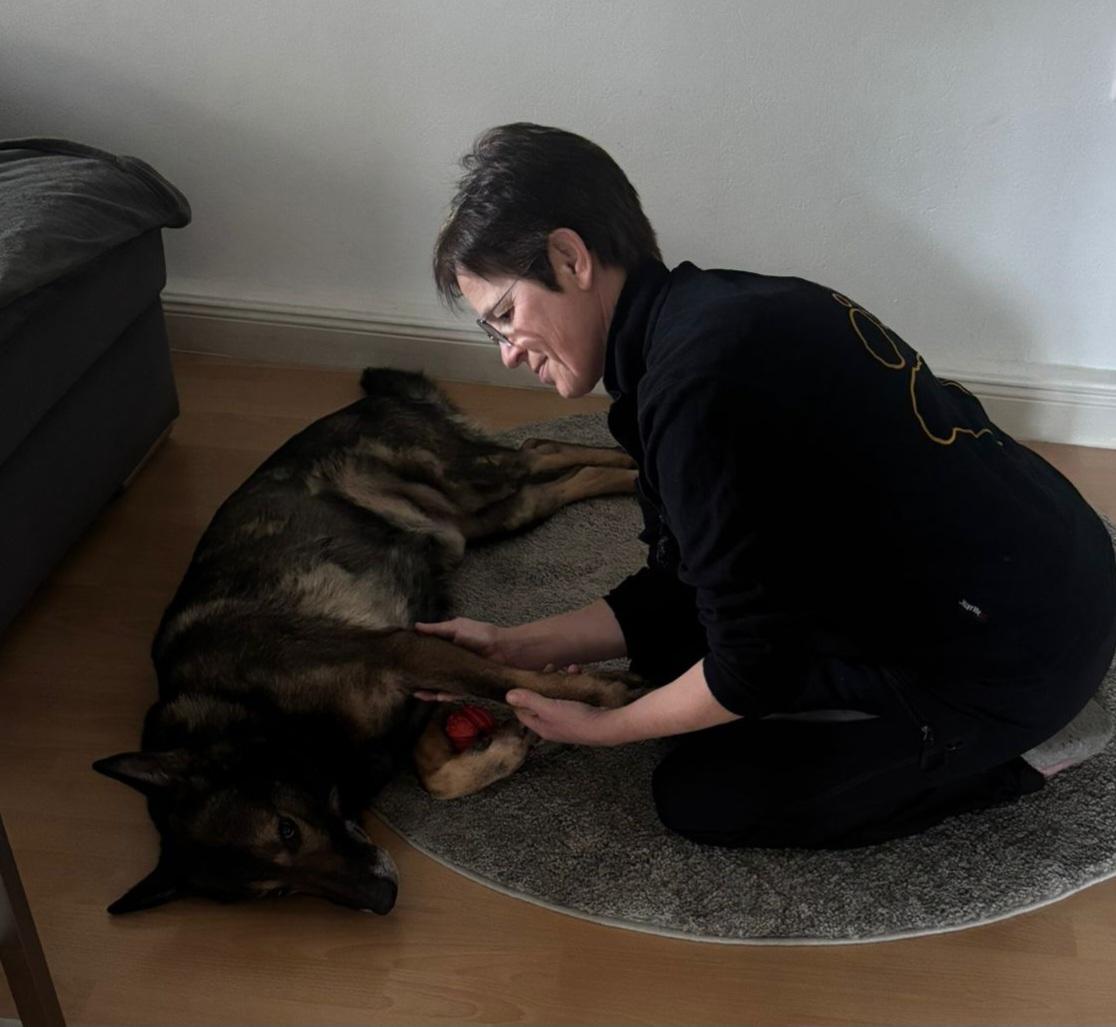
Anja Jungkamp
Rhede, North Rhine-Westphalia, Germany
I work with a gentle form of bodywork for dogs called the Masterson Method.
It is not a strong massage and it does not force anything. Instead, it uses light touch and careful observation of the dog's responses.
I first discovered the Masterson Method through my training as a Masterson Method Equine Practitioner. During that time, I experienced how powerful quiet, respectful touch can be in helping animals release tension.
Wanting to offer this work to dogs as well, I continued my education in the Masterson Method for Canines. The canine program is very new, especially in Germany.
Dogs often respond very quickly, both physically and emotionally. This requires me to stay present, flexible and responsive to every small change in the dog's body and behavior. Each session is individual and guided by the dog.
My goal is to create a safe, calm space where dogs can relax, feel supported and become more comfortable in their own bodies.
| | |
Library Journal - A Review of
Beyond Dog Massage book
| | |
Masterson (Beyond Horse Massage) created his trademark Masterson Method for horses. Although the species differ, Masterson recognized that both animals ignore or suppress physical tension and pain. He collaborated with veterinarian Robin Robinett for this book, which introduces using Masterson techniques on canines.
The authors discuss factors that can produce tension or discomfort in dogs. They introduce (and frequently emphasize) the various practices used in this method, including “Search, Response, Stay, Release,” movement techniques, and “Hold, Wait, and Melt.” Anyone employing these methods should move slowly, use gentle hands, and follow a dog’s responses. The book explores various areas of a dog’s body that might benefit from this approach, including the head-neck, neck-trunk, hind end, and midsection.
Readers can scan QR codes to view short videos with helpful explanations and techniques in action. Photos and diagrams help outline various aspects of a canine’s complex anatomy that would benefit from this method. This title also addresses how the Masterson Method can improve particular mobility/performance issues faced by many dogs and includes recommended readings for further research.
VERDICT Written in a user-friendly style, this book would assist dog owners in improving their pet’s physical and mental well-being. ~Erica Swenson Danowitz
| | | | |