May 2026 Canine Newsletter | | |
Hi Everyone,
Spring has finally arrived, and everything is starting to come alive again.
I’ll keep this short as I’m heading east (without the dogs) to visit family. Before leaving, I took some videos of Nellie and Jupiter on our favorite one-mile walk along the groomed trail at Lake Darling. Then I realized I had done the same thing last fall, so I’ve included that video too.
In this issue, you’ll find a piece from Jim on “feel and timing.” It’s a big part of what makes this work so effective. If you want to go deeper, the step-by-step photos and explanation start on page 16 of the Beyond Dog Massage book, but this will give you a good introduction.
I’ve also included part of a New York Times article on canine intelligence, as well as our “Woof and Answer” from the Masterson Method Canine Facebook page that looks at working on dogs while they’re standing or sitting. That doesn’t quite apply to Nellie, who tends to drop and roll over to avoid the work. With her, you really have to stay soft and under the radar if you want her to remain standing.
As always, we’re featuring more Masterson Method Certified Practitioners Canine and sharing upcoming classes. The calendar on our website is always the most up to date, but we’ve listed them here for convenience as well.
I’d love to stay and chat longer, but it’s time to get back on the road.
Like me, love on your dogs,
Conley, Nellie and Jupiter
| | Same one mile loop, but in the Fall: | | From Jim: The Importance of Feel and Timing | |
I found this out early on working with horses, and it carried right over to dogs. I’d reach out to touch a horse, and before my hand even made contact, I was already watching—how he shifted, how he braced, or didn’t. Pretty soon, I couldn’t NOT see it. The same thing started happening with dogs. I’d pet a dog and immediately notice the small changes—the softening, the holding, the trying. That’s your feel. Then you wait for it, instead of pushing past it. That’s your timing. And once you get that, you realize the dog has been part of the conversation all along.
Counterintuitive Way of Working
Our natural reaction when a dog resists is to meet that resistance—to hold, brace, or push back. This method asks you to do the opposite. Instead of pushing through, you soften and yield.
When you acknowledge even the smallest response and allow the dog to come out of that resistance on his own, something shifts. The dog begins to trust the interaction, and the tension starts to release.
It may feel backward at first, but once you get it, you’ll find yourself communicating with your dog in a completely different way—one that carries over into everything else you do together.
Feel and Timing
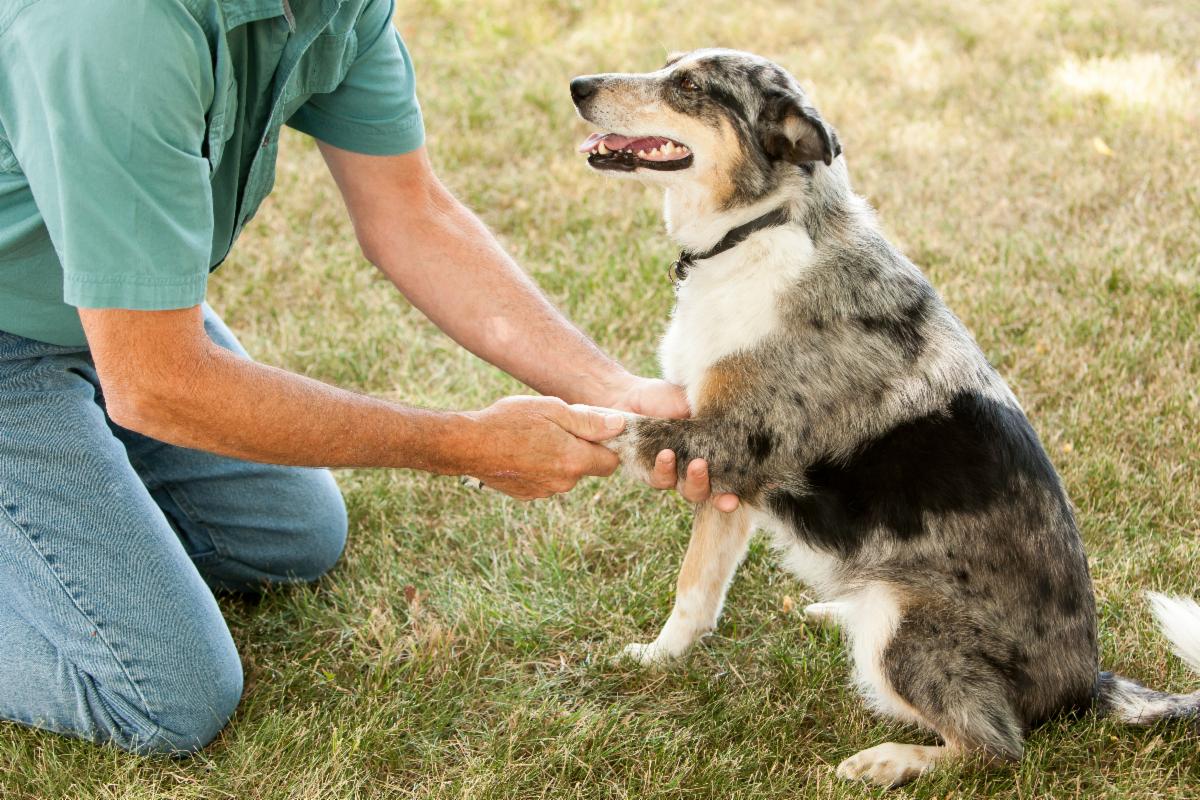
A simple way to understand feel and timing is this: gently wrap your hand around your dog’s paw and begin to bring the leg toward you. As you do, notice the exact moment he starts to resist. Don’t push past it. Instead, soften your hand right there. When you soften, he softens—and then you continue.
That point, right at the first hint of resistance, is what you’re feeling for. The timing is in responding to it in that moment—not before, not after.
That’s the essence of it: feel the change, yield to it, and let the dog guide the process.
The “No Thumbs” Rule
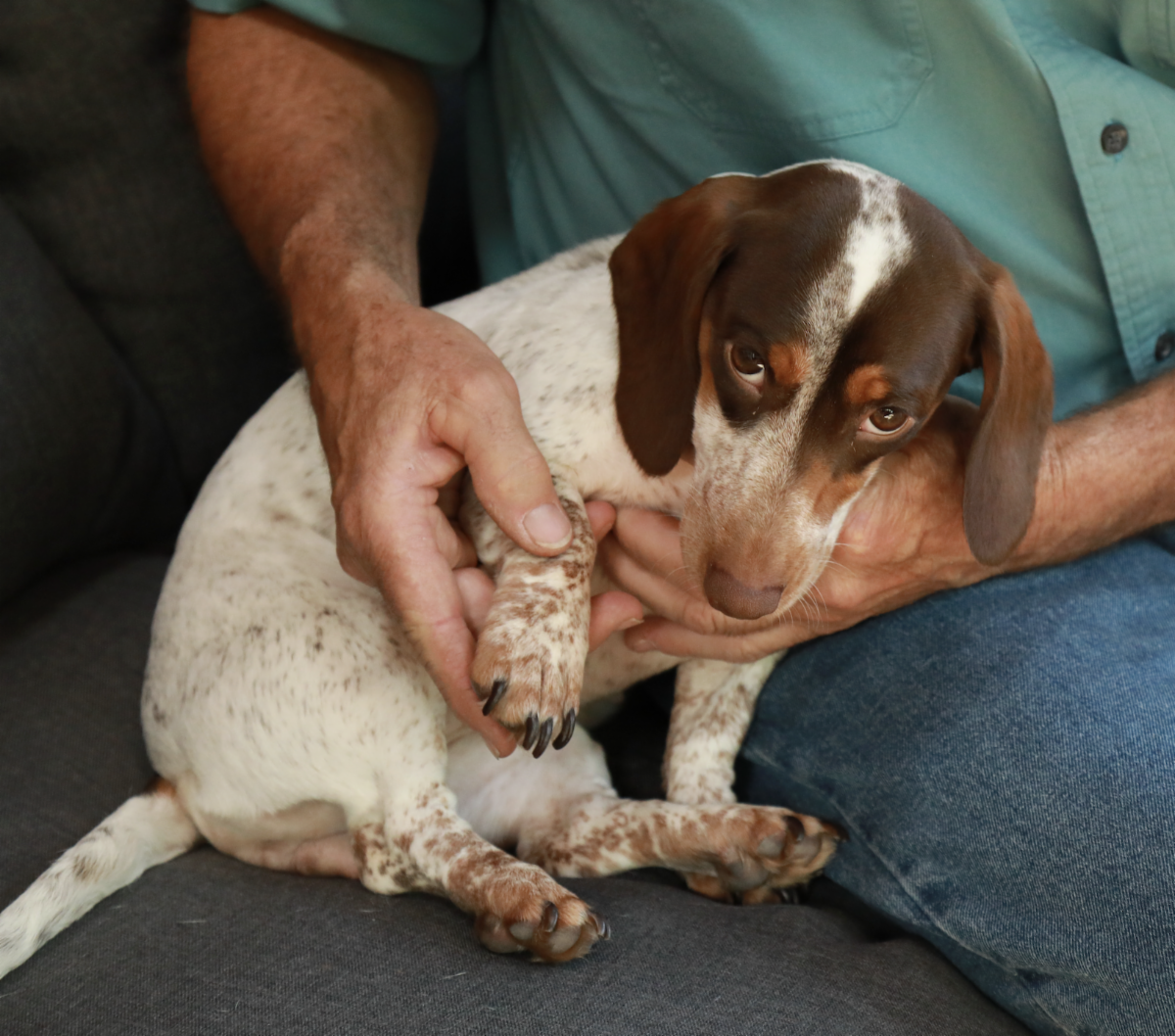
Any time your thumb is wrapped around a leg, you run the risk of breaking the rule: when your thumb is wrapped around a leg and the dog pulls away, your reaction is to clamp and pull back.
The more you are able to handle the legs without using your thumbs, the less likely you are to do this when the dog tenses or resists. You’ll also find the dog feels less tense to begin with when you don’t rely on your thumbs.
See Page 15 of the Beyond Dog Massage book: Try This Exercise (The Principal of Non-Resistance). Photos begin on page 16. Along with a QR code you can scan and watch Jim demonstrate.
| |
How Smart Do You Think Your Dog Is?
~excerpt from the New York Times
| | |
Research now reveals that dogs are capable of all kinds of sophisticated cognitive feats. They excel at reading human social cues like pointing gestures and gaze direction, for example, and can make logical inferences about the world. They seem to have a basic grasp on object permanence, or the understanding that items don’t disappear when they are out of sight. They may also possess a rudimentary theory of mind: the awareness that other individuals might have perspectives and knowledge that differ from their own.
Although it’s impossible to make direct comparisons between the overall intelligence of dogs and children (toddlers can do lots of things that dogs cannot, and vice versa), scientists have noted that some canine cognitive skills put dogs roughly on par with children between 1 and 3 years old. That message has gotten
out—and taken on a life of its own.
In a 2013 study, for instance, nearly half of dog owners ranked the mental capacities of dogs as equivalent to those of 3- to 5-year-old children. More than 20 percent of respondents rated dogs even higher; more than 5 percent reported that dogs had mental abilities on par with those of someone who was at least 16 years old. Intriguingly, the researchers found people who felt more emotionally close to their own dogs tended to give higher ratings to the cognitive abilities of all dogs.
A handful of small studies also indicate that people tend to rate their own dogs more favorably than the “average” dog on a variety of positive traits, such as loyalty, friendliness and intelligence. In a 2025 YouGov survey, two-thirds of dog owners said that their animals were smarter than the average dog. Just 6 percent rated their dogs as possessing below-average intelligence.
~ excerpt from the New York Times
| | |
"Woof and Answer" from our
MM Canine Facebook Page
| | |
Question: How is it best to practice The Masterson Method with my dog; standing or lying down?
Answer: One of the most important things to remember when practicing The Masterson Method with your dog is that there is no single “correct” position. The best position is simply the one where both you and your dog are comfortable and relaxed.
You can work with your dog standing, sitting, lying down, or even curled up in your lap. You might be kneeling, sitting on the floor, or seated in a chair. What matters most is not the position itself, but your ability to stay calm, breathe, and remain present with your dog. Before you begin, take a moment to ground yourself. Relax your body, slow your breathing, and let go of any expectation about how the session should look. When you gently hold a leg or another body part, keep your thumbs out of the way and simply wait. Allow your dog to release their weight into your hand.
Follow their movement: when they lift, go with them; when they drop, go with them again. By meeting your dog where they are physically and emotionally, you create a safe space for relaxation and release. Comfort, patience, and responsiveness are far more important than whether your dog is standing or lying down.
| | Canine Zoom Courses for 2026 | | |
Read and Release Courses
(First in the Series)
Read and Release is the first course to start your journey with The Masterson Method Canine Bodywork. Enjoy learning from the comfort of your home.
Students will learn to recognize and use their dog’s visual responses to find and release tension. These visual responses give you insights into your dog’s physical and emotional needs. In this course, you and your canine companion will build connection, enhance movement, and improve comfort.
Saturdays at 9:00 am CT June 6, 13, 20, 2026 with Leslie Kennedy
Fridays at 10:00 am CT, July 31, August 7, 14, 2026 with Amelia Nalli
| | |
Introducing Movement Courses
(Second in the Series)
Introducing Movement is your next step after completing the Read and Release Course.
Adding to the foundation of using touch effectively and understanding what your dog is communicating, you are ready to start applying Masterson Method Movement Techniques. In this course, you will learn all movement techniques from the Beyond Dog Massage book and help your dog with easier and more natural movement.
Tuesdays at 11:00 am CT, June 2, 9, 16, 2026 with Kalin Finsand
Wednesdays at 11:00 am CT, September 13, 23, 30, 2026 with Kalin Finsand
| |
Read and Release Testimonial from
Owner, Rich Cassens
| | |
“There is more of an overall connection with Banner, with him understanding that I can help him relax more. A lot of what we do is bite-work, obedience, agility, building muscle and tone.
Now there is a different side that I can help him calm down and relax. It is another aspect of where we have improved our relationship overall. Just understanding each other a little better. The Read and Release was great course and I look forward to using the Masterson Method with the dogs I have in for training.”
~Rich Cassens
| |
Newly Certified Practitioners - Canine
Need Help For Your Dog?
| | |
Find a Masterson Method Certified Practitioner (MMCP) Canine near you. Our Certified Practitioners are dedicated professionals who have acquired highly attuned skills in partnering with the dog to release tension and increase range of motion, thereby restoring healthy posture and performance. Add an MMCP Canine to your dog’s wellness team by visiting the Masterson Method Website (top right corner of home page) and look for the link to find a Certified Practitioner Canine near you.
We will be highlighting new Certified Practitioners so you can get to know them!
| |
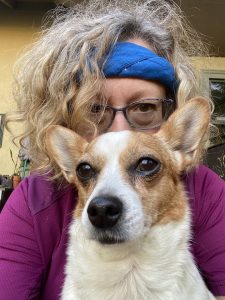
Becky Mertens
Richmond, CA
I learned about The Masterson Method Canine after becoming a Certified Practitioner for equines six years ago. I’ve always been a dog person and grew up with dogs. I’ve spent years dogsitting for my friends and they always remarked on my connection with the dogs and their response to me.
Giving back to dogs by working with them in this gentle and effective technique is important to me. I am continually stumbling on ways to use MM to help them. Recently I was staying with my friends rescue dog Percy. He suffers from PTSD after years on the streets in Oakland. There was some construction going on in his house and as soon as the workers began hammering he began to tremble all over his body. I decided to try the Bladder Meridian on him and after a few minutes he calmed even though the noise continued! He laid there in a more peaceful state.
I particularly like working with older dogs. When I first took the canine courses I had to “borrow” a dog so I used Rudy, a senior border collie with hip and leg issues. As I learned the hind end techniques and applied them with Rudy, he began to move better. It took a couple of sessions but eventually his owners told me he was climbing the stairs like he used to! He loved the work and each week when I got there he was eager to go to the room where we practiced.
I think dogs are a heavenly gift to us humans so being able to give them comfort and help them move better using The Masterson Method® is a great way to repay them.
| |  |
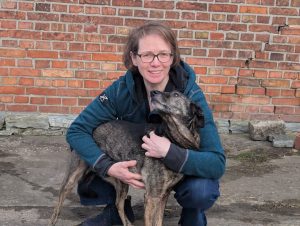
Meike Aulich
Rheda-Wiedenbrück, North Rhine-Westphalia, Germany
Dogs have been part of my life since childhood. Their gentle closeness, their exuberant joy, their willingness to stick with their humans through thick and thin—I don’t think any other animal lives as closely with its human as a dog does. And it is precisely this togetherness that is the starting point for my work.
Starting out as an MMCP for horses, I was curious and tried out what I had learned on my own dogs. Their clear, subtle reactions quickly convinced me that the unique Masterson Method© can help any animal to release tension and feel more comfortable in their body again. Training to become a Masterson therapist for dogs was the logical next step.
As a therapist, it is my heartfelt desire to help dogs regain more ease, joy of movement, and well-being— whether after intense stress, in everyday life, in sports, or simply as they grow older. It is important to me to see each dog in its individuality: with respect, patience, and subtle communication, so that together we can achieve the best possible result—at a pace that is right for the dog.
I live in North Rhine-Westphalia in the south of the district of Gütersloh and treat horses and dogs according to the Masterson Method© in my own district and the neighboring districts of Soest, Warendorf, Paderborn and in Hamm and Bielefeld. However, you are also welcome to contact me if you live further away.
I am happy to get to know you and your dog!
Meike Aulich
MMCP Canine and MMCP Equine
| | | | | |