June 2026

Massachusetts Office of Campaign and Political Finance

PUBLIC DISCLOSURE IN ELECTIONS

Statewide party candidates may receive public funds for campaigns


Matching Funds System


Two of the state’s 12 party- affiliated statewide candidates have agreed to limit spending in the primary and general elections, and in turn are eligible to participate in the state’s program for public financing of campaigns.


Candidates Who Agreed to Spending Limits


Anne Manning Martin of Peabody, Republican for lieutenant governor.

Michael Walsh of Lynnfield, Republican for attorney general.


All party-affiliated statewide candidates filed declarations, due June 2, to indicate whether they would or would not limit spending. The declarations are required in order for a candidate to appear on a ballot.


Unenrolled candidates must file their statements by Aug. 25, which is their deadline to file nomination papers with the Secretary of the Commonwealth.


The state’s system for public financing offers matching public funds, depending on availability, to statewide candidates in return for their agreeing to spending limits, which vary according to the office sought. Gubernatorial candidates are funded first, and then other statewide offices, if funds are available.


OCPF estimates the amount of available funds at approximately $1.4 million in 2026, to be divided evenly between the primary and general election campaigns.


The money provided to these candidates comes from the State Election Campaign Fund (SECF), funded by an optional $1 tax check-off on individual state income tax returns. According to recent data, less than 4 percent of eligible taxpayers check the box. The balance of the SECF consists of funds collected since the last statewide election and those remaining from prior election cycles.


To become eligible to receive matching public funds, candidates submit reports with OCPF listing contributions received. Qualifying contributions include only the first $250 of individual contributions received in 2025 and 2026.


News Bullets


ON BALLOT 2026: OCPF maintains a page displaying all 2026 House and Senate candidates, sorted by district. Click here to see each legislative race with the campaign finance totals for candidates.


___


Local party committees that have had financial activity greater than $100 during a reporting period are required to file periodic campaign finance reports. Assuming the committee has reached the $100 level of activity during a reporting period, reports must be filed on three occasions in 2026, a state election year. 

  • Pre-Primary Report: Due Aug. 24.
  • Pre-Election Report: Due Oct. 26.
  • Year-End Report: Due Jan. 20.

OCPF recommends filing all three reports for 2026 if a committee has any activity or a balance, even if the $100 threshold is not exceeded.


___


All candidates and committees should be aware of the subvendor reporting requirement this state election year.


The subvendor reporting statute requires committees to file a report when they pay $5,000 or more to a vendor, and the vendor spends $500 or more for goods or services for the candidate or committee. The video posted here demonstrates how to file a subvendor report in the depository system of reporting (all candidates and PACs filing with OCPF are in the depository system).

HOT TOPICS

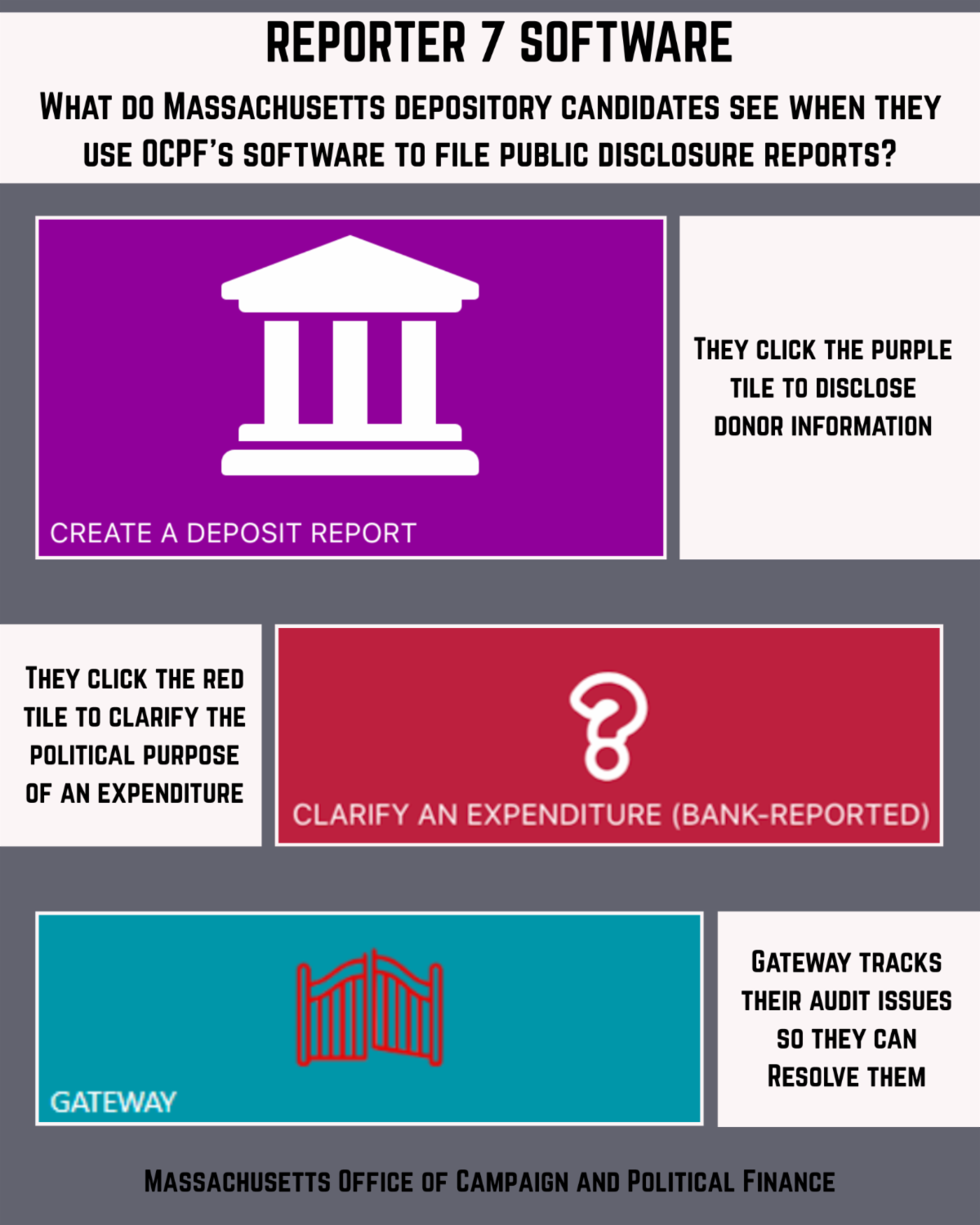
REPORTER 7 SOFTWARE HELP


Campaigns that use Reporter 7 e-filing software for the first time may have some knowledge gaps at the start.


We're here to help.


For Reporter 7 software assistance, check with us at OCPF@mass.gov or our "help videos" page here. You can also call 617-979-8300 during regular business hours.


We provide software guidance to candidates, PACs, IEPACs, parties and ballot question committees.

CAN PUBLIC EMPLOYEES GET INVOLVED IN POLITICS?


Appointed public employees, such as school teachers, firefighters, correctional officers and state college administrators, can get involved in elections. They can:

  • Hold signs on their own time.
  • Make non-fundraising political posts on their personal social media pages.
  • Donate to candidates, PACs and ballot question committees.
  • Attend political events.

Some restrictions on public employees include that they may not solicit or receive funds for any political purpose anywhere, at any time, and may not conduct political activity while working.

WHEN WILL YOU SEE STATEWIDE BALLOT QUESTION REPORTS?


Statewide ballot question committees will file their first 2026 campaign finance reports starting in September:


Sept. 4: 1st 2026 report due

Sept. 21: 2nd report due

Oct. 5: 3rd report due

Oct. 20: 4th report due

Election Nov. 3

Nov. 5: 5th report due

Nov. 20: 6th report due

FUNDRAISING ON PUBLIC PROPERTY


Fundraising is not permitted within buildings used for governmental purposes, such as senior centers and libraries. However, fundraising may occur outside on public property, such as parks, parking lots and sports fields. OCPF recommends contacting a property administrator in these situations to determine their equal access policies. 

Example: A candidate runs into a friend in the city's high school parking lot, which is public property. The friend hands the candidate a check for the campaign. This is not prohibited by the campaign finance law. 

Expenditure Totals:

Statewide Candidates in 2026

Includes only party-affiliated candidates who submitted public financing spending declarations with OCPF to appear on the ballot. Unenrolled candidates submit their spending declarations Aug. 25.

Candidate

Office

Expenditures (1/1/26 - 5/31/26)

Balance as of

May 31

Michael Minogue - R

Governor

$3,928,228

$9,535,653

Brian Shortsleeve - R

Governor

$950,886

$985,546

*Maura Healey - D

Governor

$748,296

$6,045,436

*Andrea Joy Campbell - D

Attorney General

$401,596

$811,361

*Kimberley Driscoll - D

Lieutenant Governor

$137,177

$2,314,551

Shawn Oliver - R

Lieutenant Governor

$89,711

$17,500

Elizabeth Dionne - R

Treasurer

$86,651

$113,132

Anne Manning Martin - R

Lieutenant Governor

$53,954

$2,025

*Deborah Goldberg - D

Treasurer

$51,324

$416,634

*William Galvin - D

Secretary

$49,942

$2,017,562

Michael Walsh - R

Attorney General

$48,684

$656

*Diana DiZoglio - D

Auditor

$10,189

$218,609

*Incumbent

Agency Actions

Public Resolution Letters

A public resolution letter may be issued in instances where the office found "no reason to believe" a violation occurred; where "no further action" or investigation is warranted; or where a subject "did not comply" with the law but, in OCPF's view, the case is able to be settled in an informal fashion with an educational letter or a requirement that some corrective action be taken. A public resolution letter does not necessarily imply wrongdoing on the part of a subject.


Jonathan Lima, Fall River: Did not comply. Expenditures made outside the depository system checking account. 5/6/2025.


Jillian Duclos, Northampton: Did not comply. Excess treasurer's check. 5/6/2026.


Brookline Public Schools: Did not comply. The use of public resources to influence a ballot question election. 5/14/2026.


OCPF Online Training Classes


June 15, Monday: Depository system training class (includes a demonstration of Reporter 7 filing software)


June 22, Monday: Municipal clerk micro-training to discuss independent spending on the municipal level


June 24, Wednesday: Public employee training class


July 30, Thursday: Local party committee training class: Demonstration of filing requirements in a state election year


All classes start at noon.


Click here to register for the Zoom-based training

www.ocpf.us

617-979-8300

OCPF@mass.gov

Facebook  Instagram  X  YouTube