THE NATIONAL MUSEUM OF WORLD WAR II AVIATION
* * *
COLORADO SPRINGS, COLORADO
| | Museum Breaks Ground on 40,000-Square-Foot Addition | | |
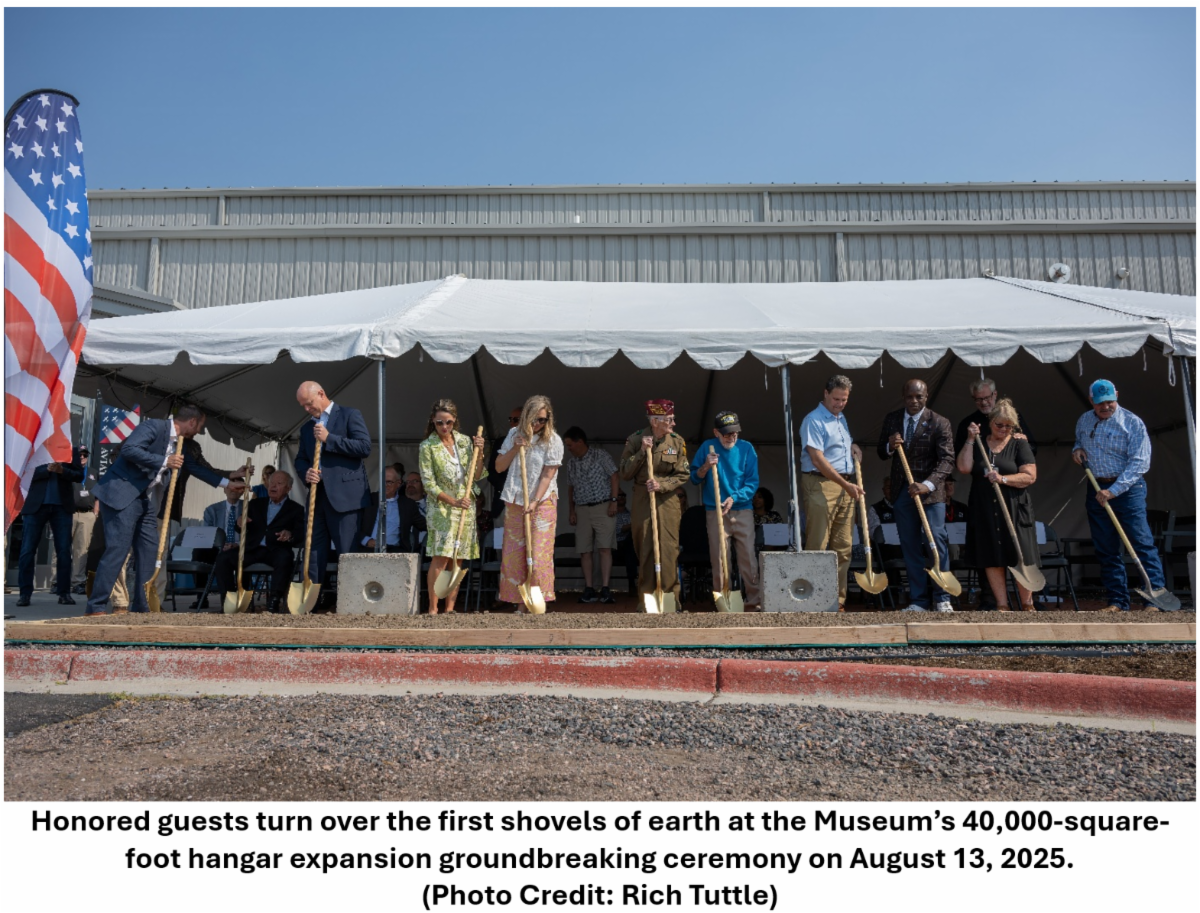
Groundbreaking for a $9 million, 40,000-square-foot hangar will bring the total floor space of the National Museum of World War II Aviation at Colorado Springs Airport to over 200,000 square feet when the building is completed next year, museum President and CEO Bill Klaers said August 13 at a ceremony marking the event.
Klaers said the new structure will help complete the story of American aviation in World War II by telling how its technologies and innovations, and the cultural changes wrought by the war, helped shape the post-war world.
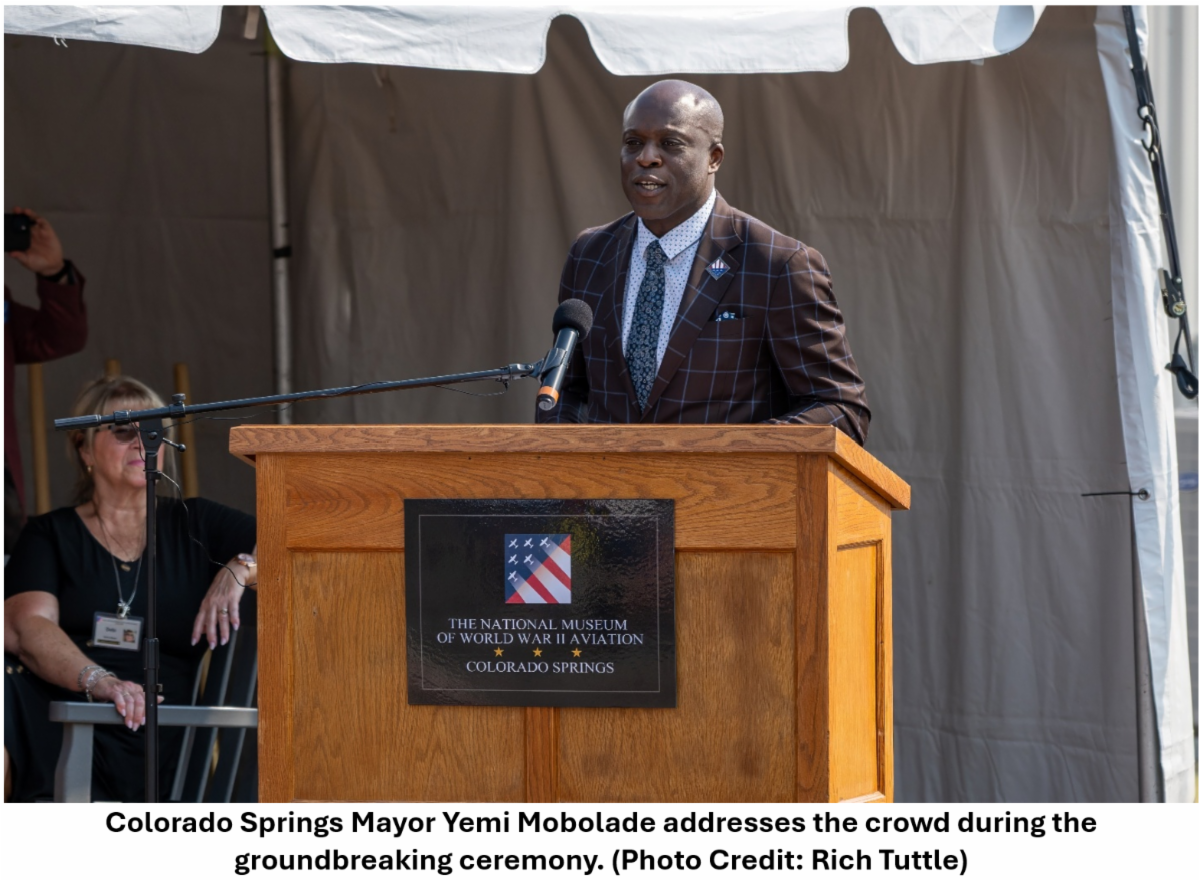
Speakers at the event, held just outside the current 40,000 square foot Kaija Raven Shook Aeronautical Pavilion, the groundbreaking of which took place in 2018, included Colorado Springs Mayor Yemi Mobolade.
Mayor Mobolade said the groundbreaking "is more than a building expansion." It's "an expansion of memory, an expansion of honor, and an expansion of the way we tell our story." The museum, he said, "preserves one of the most defining chapters in our nation's history.... Behind every plane is a pilot with a story, behind every mission is a family who prayed, and behind every victory is a generation who believed in something greater than themselves.
| | |
"The expansion we celebrate today," he continued, "will open the door for more people to hear these stories, to stand beside these remarkable aircraft, and to understand that innovation and sacrifice that won the war and secured our future. And it will inspire the next generation of leaders to dream, to serve and to innovate."
Congressman Jeff Crank, representing Colorado's Fifth Congressional District in the U.S. House of Representatives, said the museum has put itself on the map "as a location for the preservation of military history, the painstaking process of restoring aircraft, and the passing to the next generation of the lessons learned in that war. It's a continuation of the proud military history of the Pikes Peak region."
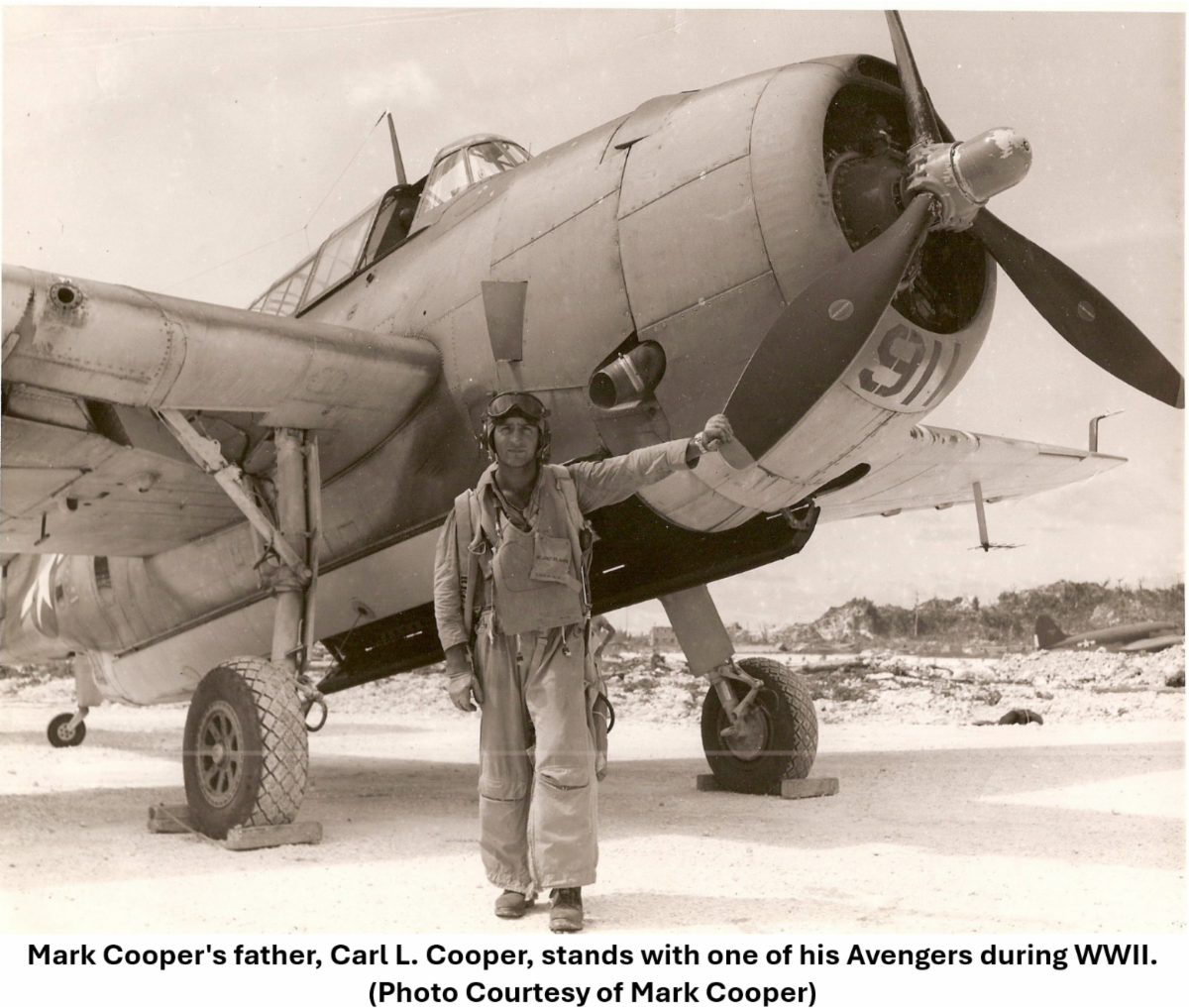
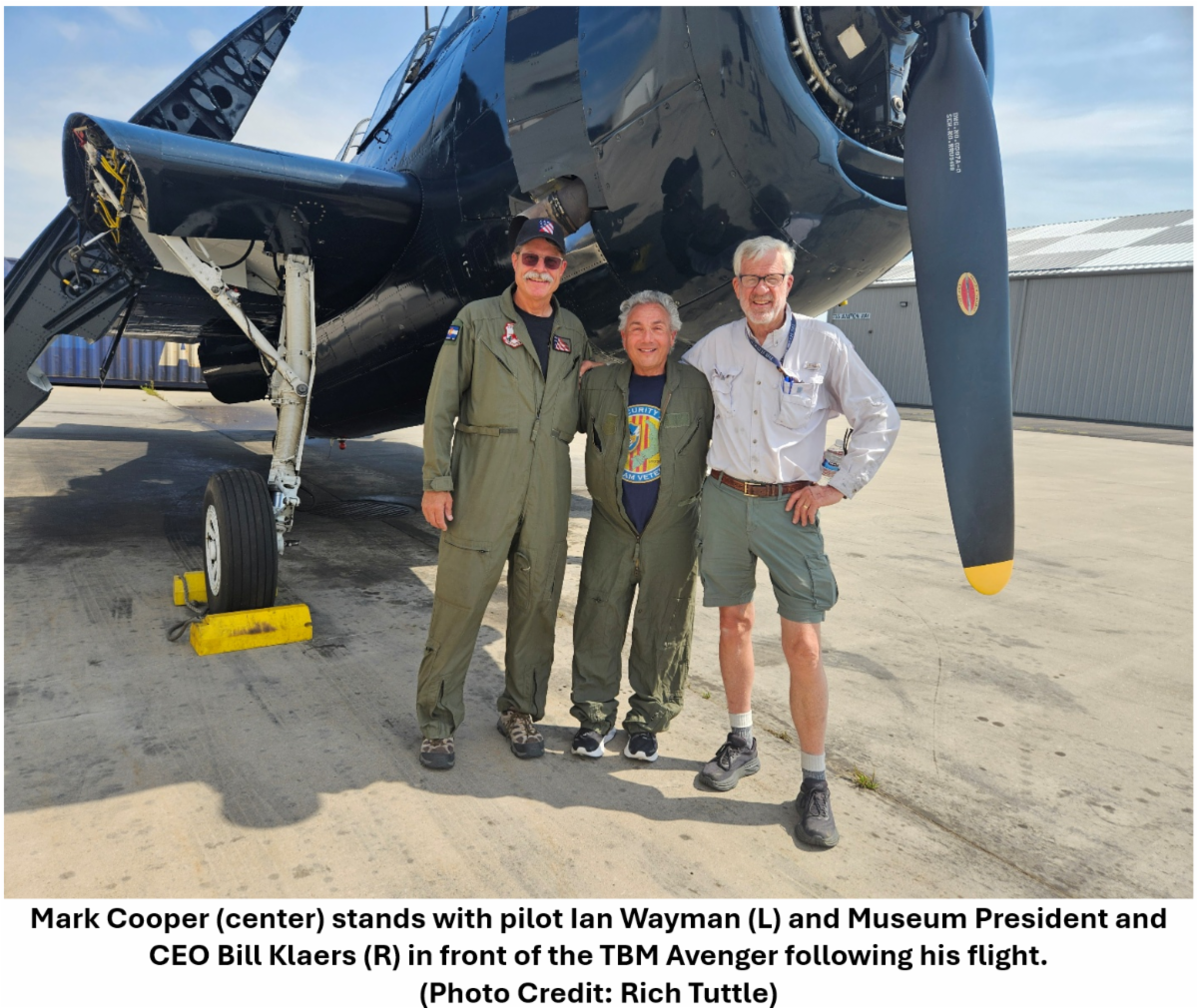
He pointed to the museum's mission of providing "unique educational experiences that promote a deeper understanding of the historical importance of American aviation in World War Two and its role in shaping the world that we live in today. "Colorado Springs resident Mark Cooper, whose father was a member of the first operational U.S. Marine Corps TBF Avenger unit in WWII, donated $150,000 to the museum in his father’s memory just before the ceremony.
Klaers said the museum was honored to take Mark for a flight the week before in one of the museum's two TBM Avenger torpedo bombers.
| | |
Ashby Taylor, museum docent, said, as Klaers has said, that without its 400+ volunteers, the museum "just simply would not exist. They open and close the museum every day. They build our displays. They build artifacts for the gift shop. They reconfigure the museum to conduct various events for our patrons. They clear snow from the ramp. They run our research library, catalogue our collections, and do anything else necessary [to] keep the museum in good operating order."
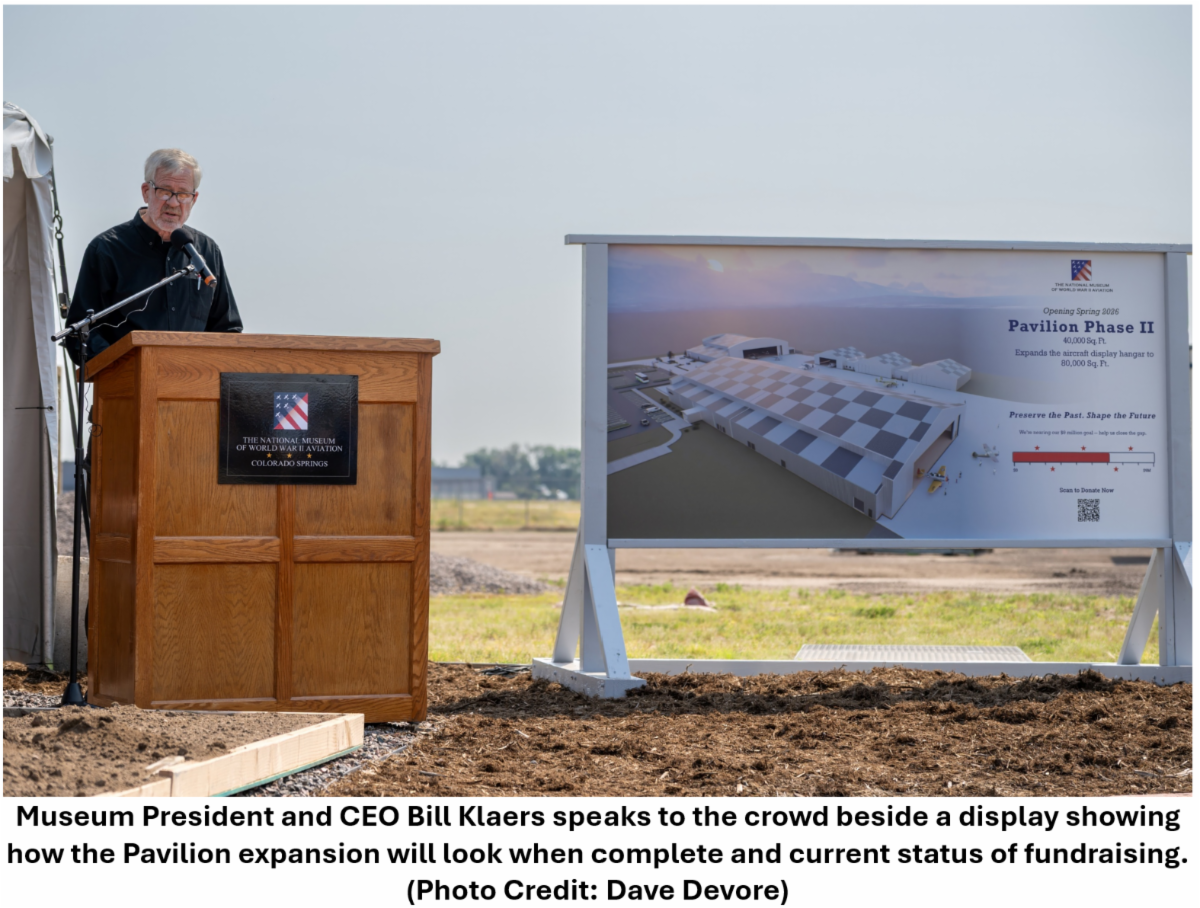
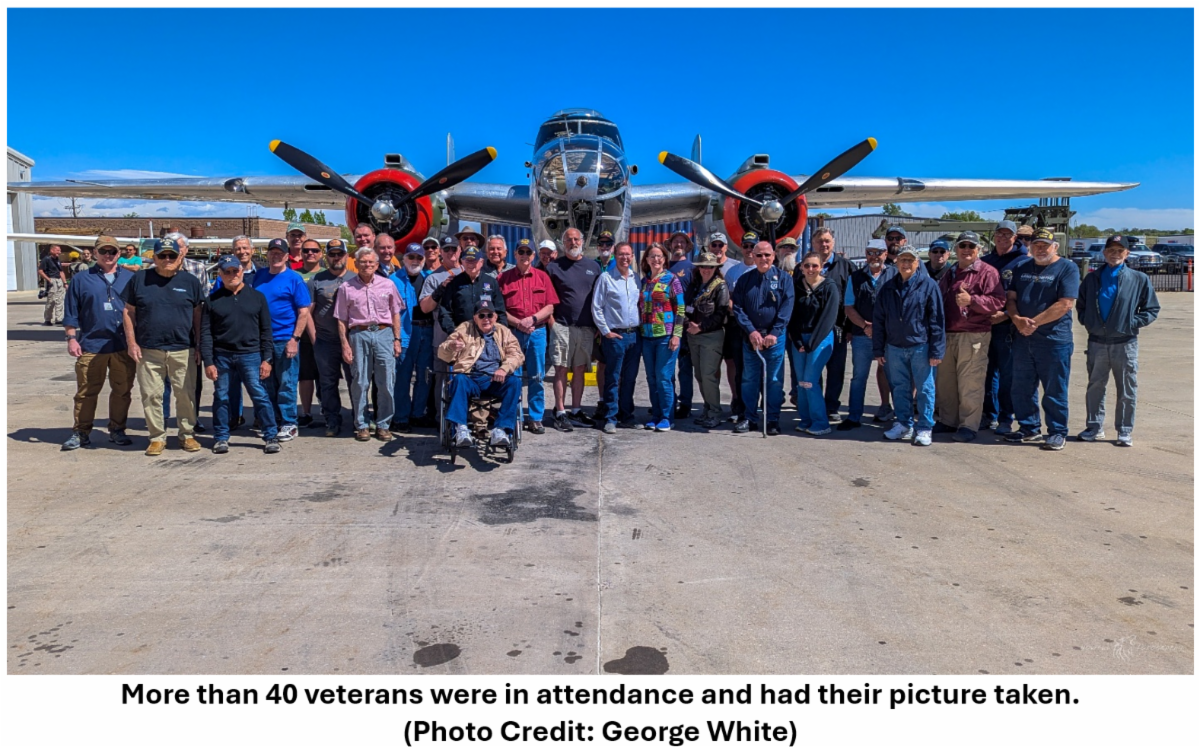
Klaers said, "The biggest thing to me is what happens in this next phase" of the museum. He said it will complete the story of American aviation's role in the war years. The next phase, exemplified by the new hangar, will complete the story, he said. It will tell "a lot more about the home front," already a focus of the museum, which opened in 2012. It will also tell what happened to veterans like 101-year-old former infantryman Ed Beck, who fought in the Battle of the Bulge and was in attendance at the ceremony. "What did he do? How did he fit back into society? Did he go on with his career? How did that proceed?" The new facility will help answer such questions.
Klaers highlighted a donation of $100,000 by long time museum member Tad Goodenbour towards the expansion project, noting that the red progress bar on the Pavilion Phase II display will move another notch to the right towards reaching the $9 million dollar fundraising goal.
| | |
And, Klaers said, it will help introduce some of the "over 400 military people that are displaced out of the military every month in Colorado Springs" to potential employment in civilian aviation. Many may want to continue to work on aircraft, and the new facility will include an airframe and powerplant school to accommodate them.
It also will allow the museum to house a number of aircraft in addition to the 29 operational planes it already has. “We have a lot of aircraft. Everybody’s always asking, “When are you going to get a B-17 (Flying Fortress)?”, Klaers said. “We are in works right now to take a look at getting one. That’s a possibility. We can’t take on one unless we can house it, because of the hail and all the other damage that occurs to your cars. So that’s on its way.”
Story Credit: Rich Tuttle
| | Springs Resident Donates $150,000 in Pilot Father’s Memory | | |
Colorado Springs resident Mark Cooper, whose father, Carl L. Cooper, was a member of the first operational U.S. Marine Corps Avenger torpedo-bomber unit in WWII, donated $150,000 to the museum in his father’s memory just before the August 13 groundbreaking ceremony marking the beginning of the second phase of the Kaija Raven Shook Aeronautical Pavilion. The new 40,000 square foot facility will double the size of the pavilion.
"Growing up the son of a Marine Corps aviator, I had the opportunity to learn about World War II, Korea, and his early years of Vietnam," Mark said of his father in an email. "He flew everything from biplanes all the way to A-4D Skyhawks."
Mark himself, who served 36 years with a government agency in a counter-terrorism role, said that "to keep my father's memory, the memory of all the pilots here that flew, to keep their memories alive and to honor them, [this is] my way of giving back. It was the greatest generation of warriors, World War II, and what they did for us, to keep us safe and to push on to the next generation of warriors. This is my way of honoring them. I have a life-ending illness. I'm not going to be able to enjoy retirement, but what I can enjoy is supporting Bill [Klaers, museum CEO and President] and all the volunteers and keeping [the generation's] memory alive."
Mark said in the email that his father was a torpedo bomber and fighter pilot who served with the Marines for 32 years. In addition to fighting in WWII, he served in Korea and then in Vietnam in 1962 and 1963, where he was an advisor.
In WWII, Mark said, his father flew Avenger torpedo bombers in the battles of Guadalcanal, the Philippine Sea, Peleliu, Iwo Jima, and Okinawa. "I have his logbook that shows hundreds of missions with anti-sub patrol strikes on Japanese boats and so on," Mark said.
| | |
Returning from the Pacific, Mark said his father trained in the F4U Corsair, flying that type as an air gunnery training school commander and instructor. He then went to Korea, flying ground support and air-to-air missions. He moved from Corsairs to F9F Panther jet fighters during the Korean War. In the late 1950s, Mark's father began training in the A-4 Skyhawk, flying that type through 1969. He then retired.
Carl L. Cooper was born in Syracuse New York, and retired in Van Nuys, California, passing away in 1996.
Klaers said the museum was honored to take Mark for a flight August 9 in one of the museum's two TBM Avengers.
Story Credit: Rich Tuttle
| | |
Curtiss Helldiver Historical Presentation and
First Official Public Flight
| | |
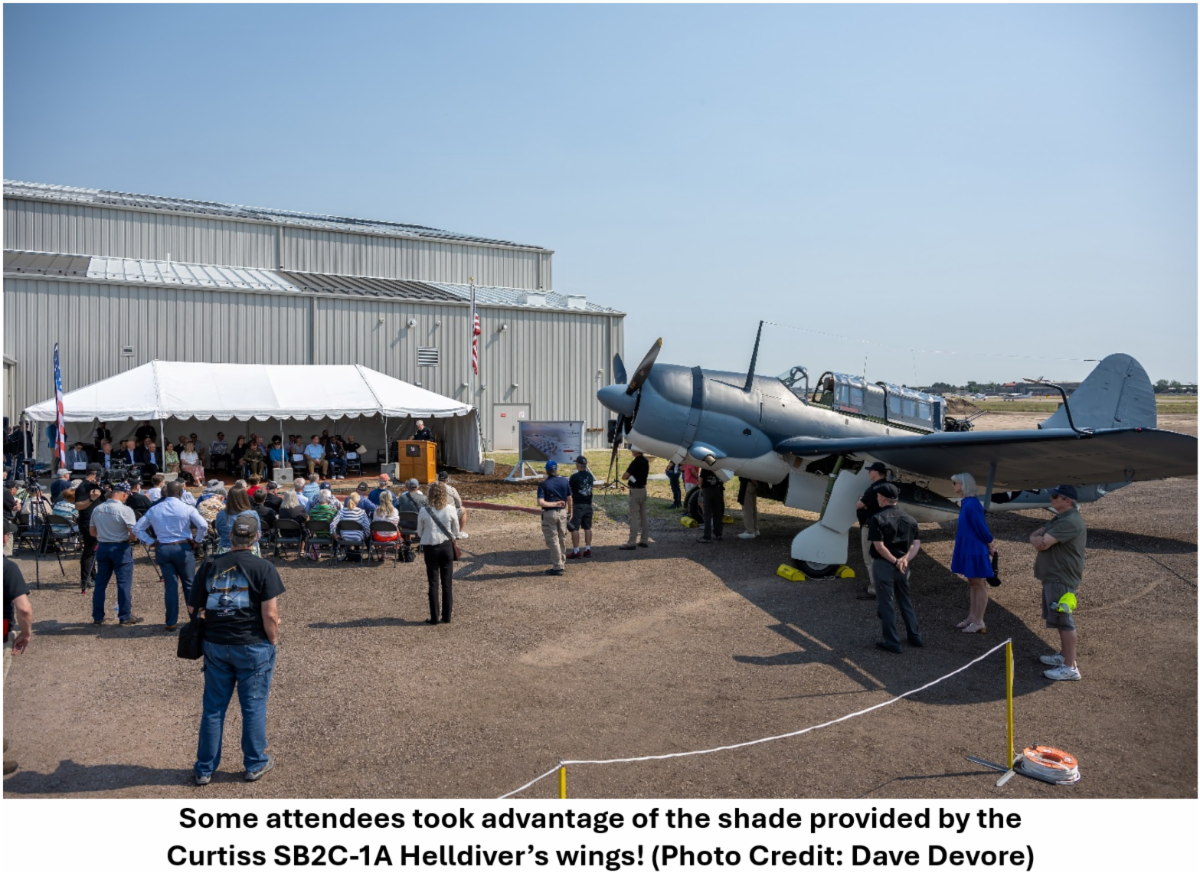
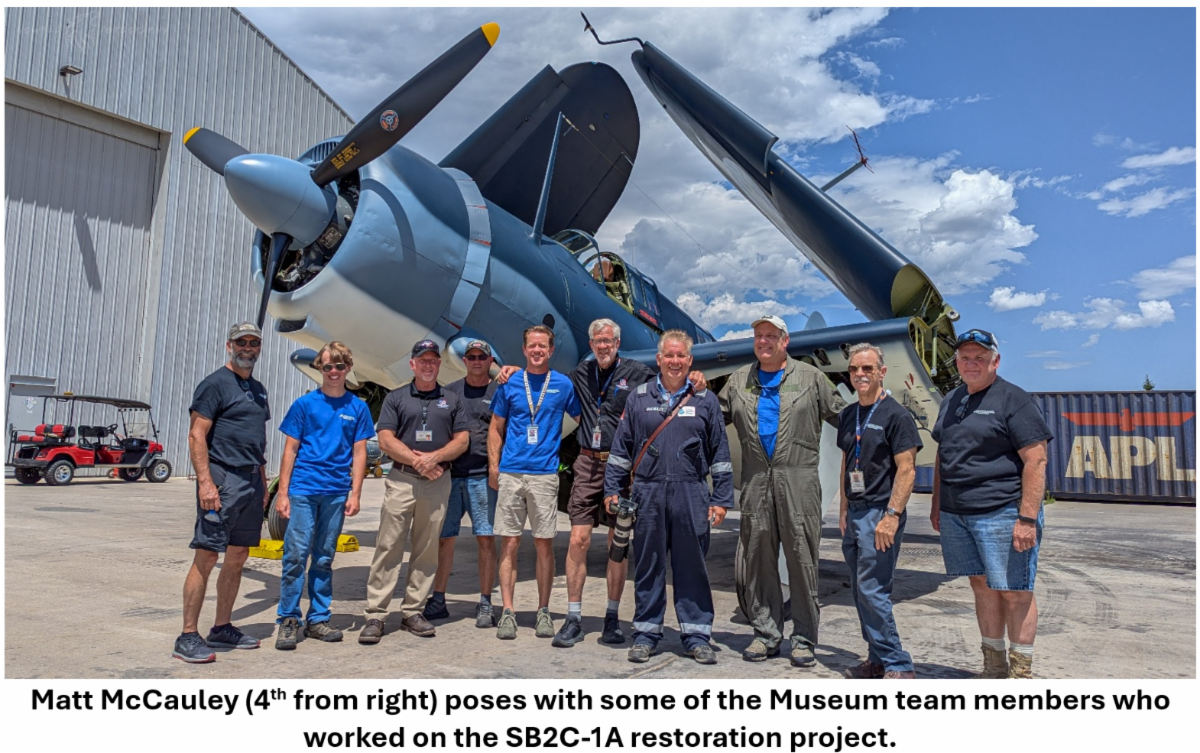
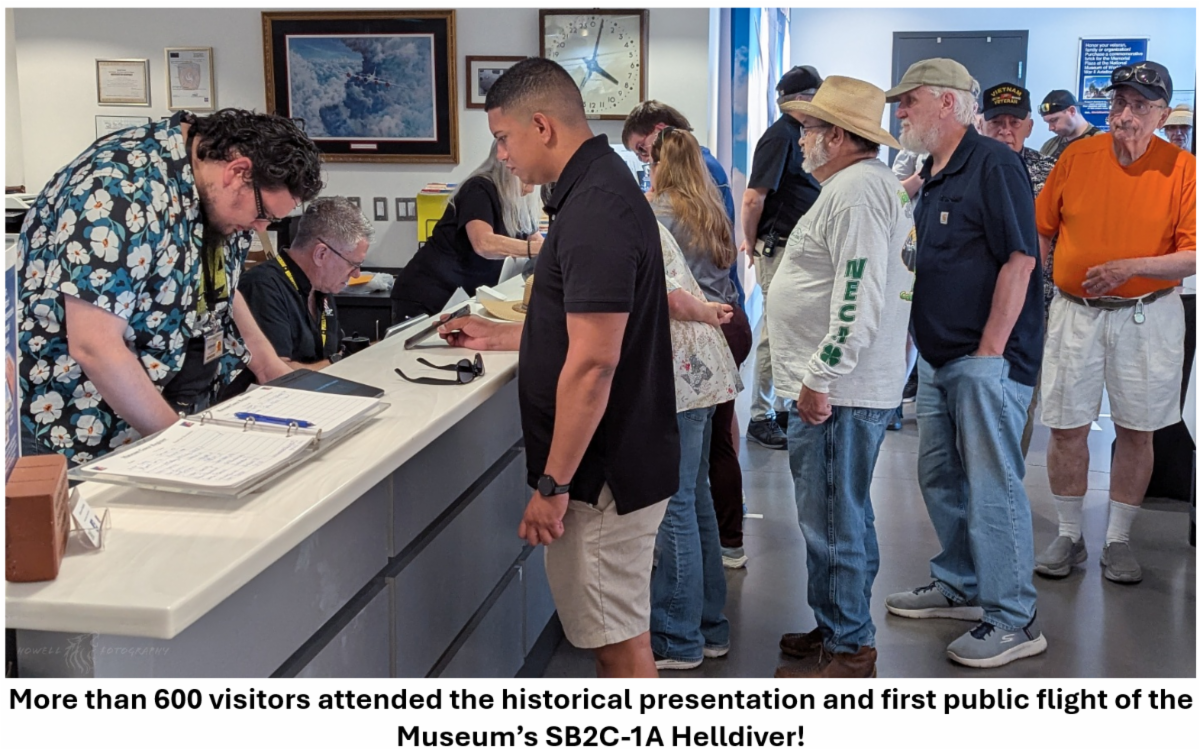
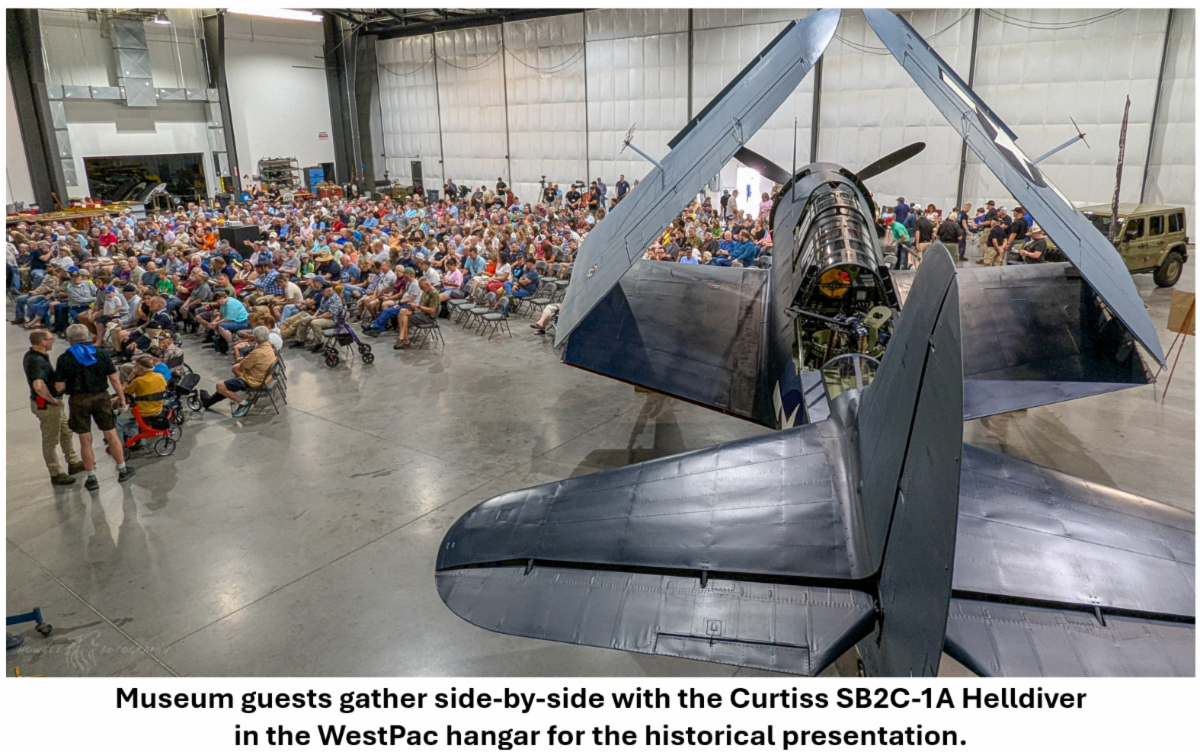
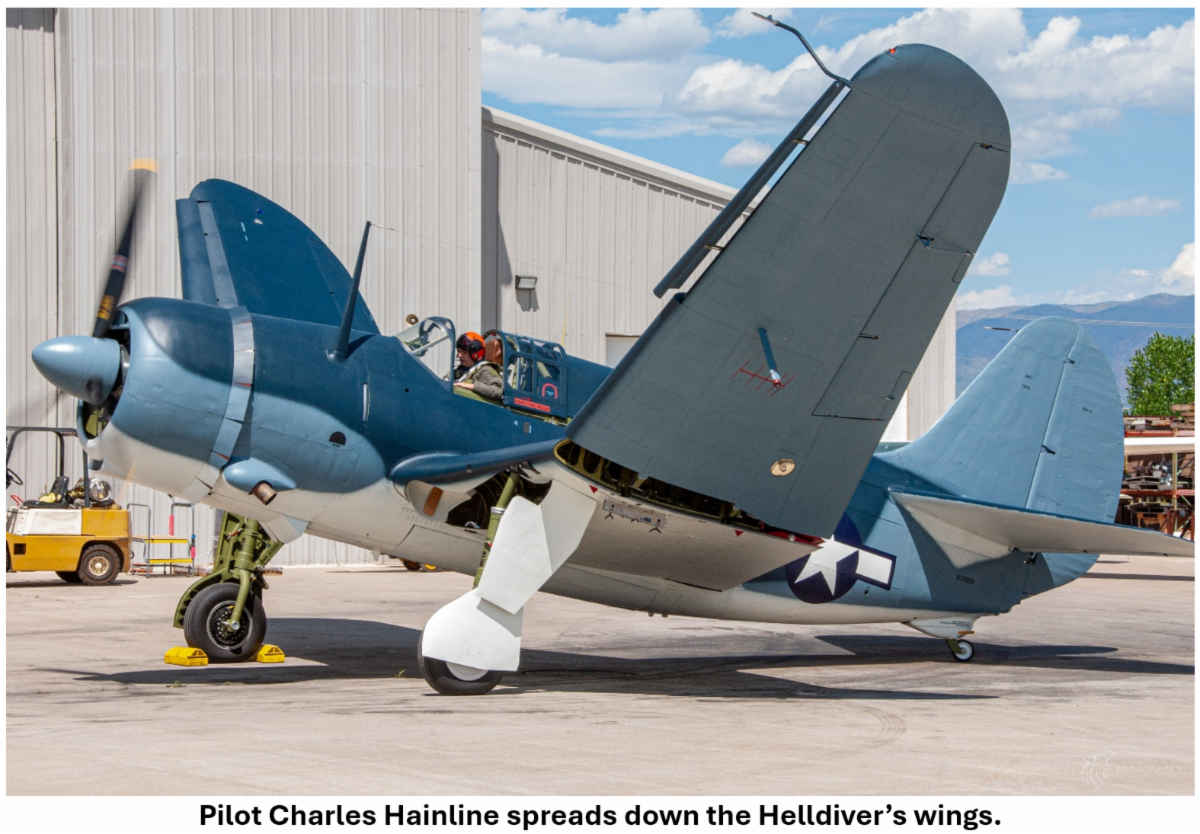
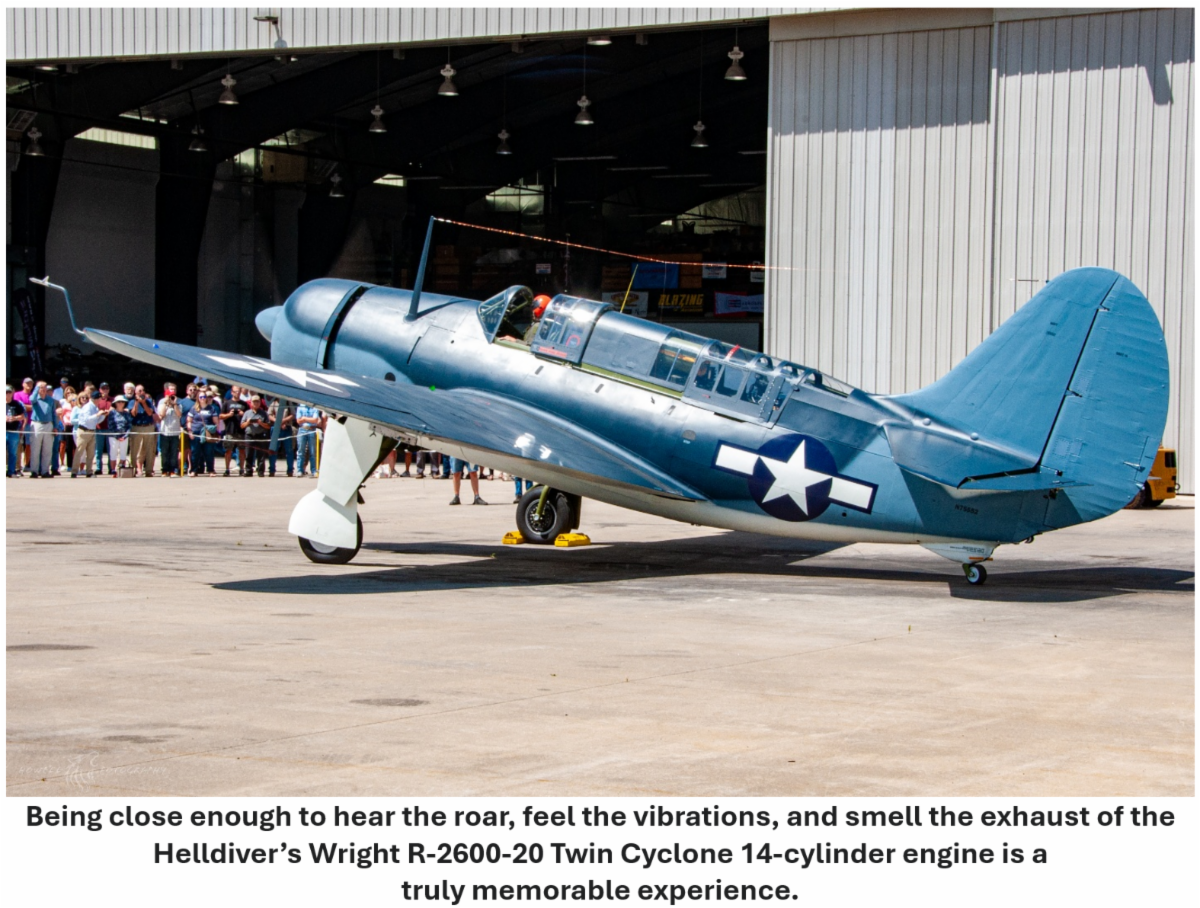
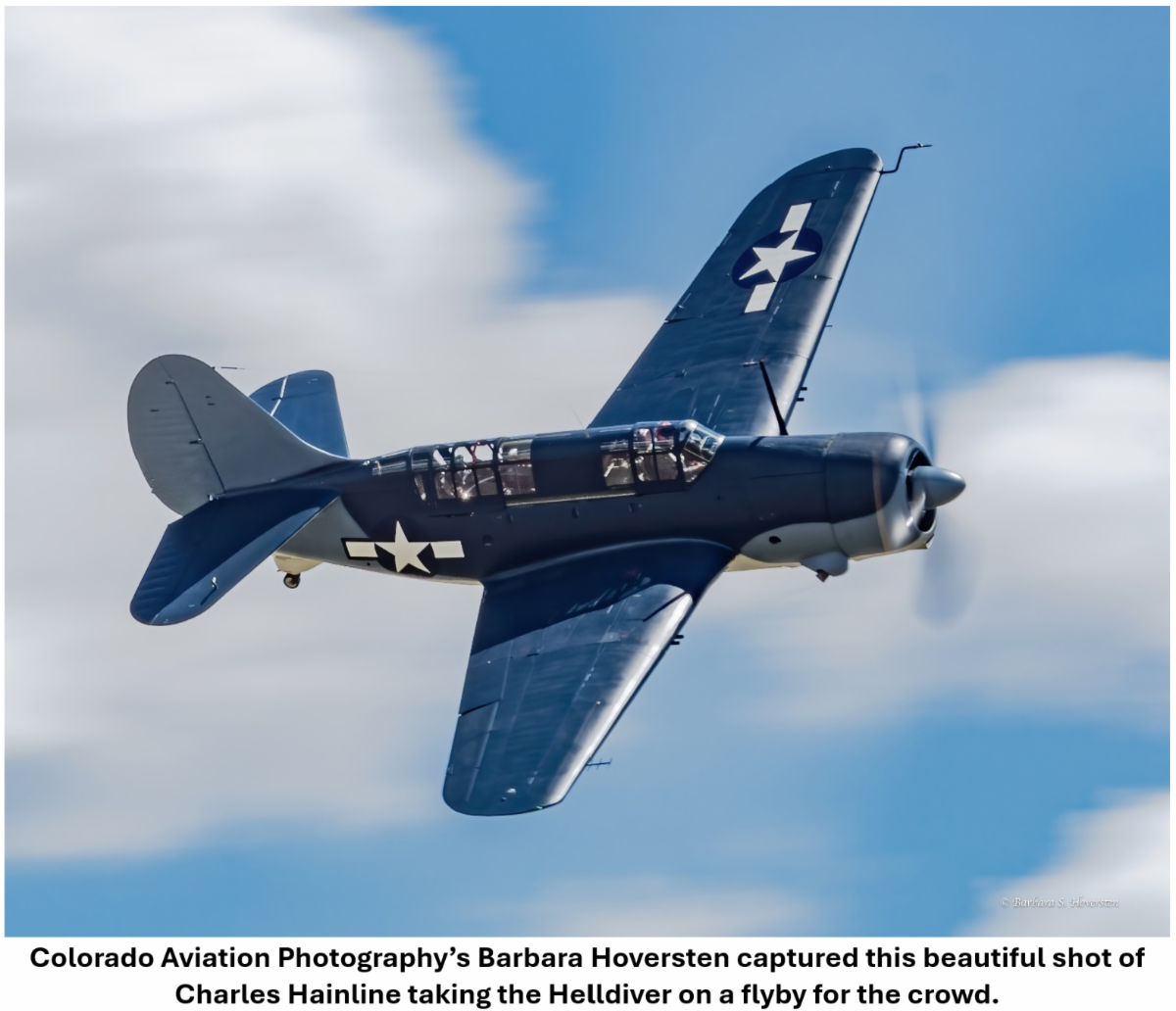
On Saturday, July 19, Lead Docent Don Johnson presented the full story of the Curtiss SB2C Helldiver to a crowd of 600+ visitors. That was immediately followed by a special presentation on the museum’s own SB2C-1A, featuring Matt McCauley--who was instrumental in recovering the aircraft from Lake Washington before eventually being restored to flying condition at WestPac here in Colorado Springs--and then the Helldiver’s first official public flight.
Late in WWII the Curtiss SB2C Helldiver dive bomber sent Japanese warships to the bottom of the ocean. It pulverized fortifications on Japan’s home islands. Yet, the Helldiver carries the reputation as a flawed latecomer to the war, a less than stellar performer built by an aircraft company that would soon fail. The Helldiver was to replace the venerable but dated SBD Dauntless that was instrumental in the U.S. Navy victories early in the war.
| | |
From the start, the SB2C garnered a reputation for poor stability, structural flaws, and poor handling. Many of the problems resulted from the Navy’s overly tight size and performance specifications, but Curtiss’ design decisions and poor quality-control contributed to many problems.
Nevertheless, the type was faster than the Dauntless and carried a heavier bomb load. By the end of the Pacific War, the Helldiver had become the main dive bomber on Navy carriers.
The first version, the SB2C-1A, was kept stateside by the U.S. Navy for training, its various development problems leading to only 200 being built. Beginning in 1944, however, introduction of the SB2C-3 and SB2C-4 models brought solutions to the Helldiver's problems.
| |
The Helldivers would participate in battles over the Marianas, the Philippines, Taiwan, Iwo Jima, and Okinawa. They were also used in the 1945 attacks on the Japanese home islands. Military records show Helldivers flew 18,808 missions in the South Pacific, where they sank 301 ships and shot down 41 aircraft. For the allies, 271 Helldivers were shot down by anti-aircraft fire and 18 to enemy aircraft. The advent of air-to-ground rockets and fighter bombers ensured that the SB2C was the last purpose-built dive bomber produced. The SB2C remained in U.S. postwar service until 1950. Industry turned out 7,141 Helldivers.
The story of the Museum’s SB2C-1A, U.S. Navy Bureau of Aeronautics BuNo 75552, began in 1944. Helldiver 75552 was assigned in June of that year to Naval Air Station (NAS) Alameda, California. In October 1944 it was transferred to NAS Seattle at Sand Point, Washington. On January 31, 1945, following a ground accident in Seattle, it was stricken from government records and discarded in nearby Lake Washington, joining a number of other aircraft no longer needed by the Navy which had met similar fates over the previous decades.
| |
Fast-forward to 1984.
When Jeff Hummel was a child, his father, who had been in the Navy in World War II, told him about planes at the bottom of Lake Washington, mentioning that one was a Martin PBM Mariner amphibious patrol bomber.
Jeff and his friend Matt McCauley, both certified scuba divers and avid aviation enthusiasts, spent their spare time scuba diving in Lake Washington, searching for lost aircraft. They accumulated a small amount of capital to salvage and restore a 16-foot boat and acquire a side-scan sonar. In 1983, they found the PBM Mariner that Jeff’s dad had told him about. In late 1983, they also found a Lockheed PV-2 Harpoon and a Consolidated PB4Y Privateer.
In early 1984, they found a Helldiver.
Jeff and Matt wrote letters to the Pentagon asking about salvaging the plane, but the responses were unclear. The two high schoolers even formed a salvage company.
Matt made the first descent on the Helldiver. The first two attempts to salvage it were unsuccessful, but the third worked and they moved the aircraft to a point near the shore in about 20 feet of water.
| |
They didn't want to haul it all the way out because it had not yet been sold. Eventually, they found a potential buyer and began 75552’s recovery. The plane was first stored temporarily at Renton Airport in Washington on a large flat-bed truck, and was later moved to the driveway of Matt's house.
The Naval Investigative Service then became involved, saying the airplane was U.S. government property. Secretary of the Navy John Lehman was personally involved. The Navy wanted the plane moved from Matt's driveway, and it was transported to a hangar at Sand Point. A two-year federal court battle ensued in which the two men received pro-bono legal assistance from a group of former and retired Navy veterans in the area.
The final decision on the case was that the Navy had abandoned the aircraft, and that Jeff and Matt now had free and clear title. A deciding factor was a Navy Bureau of Aeronautics card for the Helldiver; it plainly stated that 75552 had been stricken from government service in 1944.
| | |
The plane was then sold to aircraft restoration enthusiasts and eventually made its way to Jim Slattery. Over the past several years it has been painstakingly restored for Jim at WestPac on our Museum campus, where it is now the world’s only airworthy example of an SB2C-1A!
SB2C General Characteristics (varies by model)
· Crew: 2
· Length: 36 ft 8 in
· Wingspan: 49 ft 9 in
· Height: 13 ft 8 in
· Wing area: 422 sq ft
· Empty weight: 10,500 lb
· Max weight: 16,750 lb
· Powerplant: 1 × Wright R-2600-20 Twin Cyclone 14-cylinder air-cooled radial piston engine, 1,900 hp (1,418 kW)
Performance
· Maximum speed: 293 mph at 16,700 ft
· Cruise speed: 158 mph
· Combat range: 1,200 mi with 1,000 lb bombload
· Service ceiling: 26,700 ft
· Rate of climb: 1,800 ft/min
Armament
· Guns:
2 × 20 mm (0.787 in) AN/M2 cannon in the wings
2 × 0.30 in (7.6 mm) M1919 Browning machine guns in the rear cockpit
· Rockets: 8 × 5 in (127 mm) High Velocity Aircraft Rockets
· Bombs:
2 x 500 lb in internal bay
2 x 250 lb underwing
Story Credit: Rich Tuttle & George White
Photo Credit: George White & Barbara Hoversten
| | |
Donald McPherson, America's Last Surviving
WWII Ace, Passes Away at 103 Years Old
| | |
Editor's Note: Many thanks to Don McPherson's son Dean for his wonderful contributions to this story, and to Mark Herber for his outstanding documentation of Carrier Air Group 83 (CVG-83).
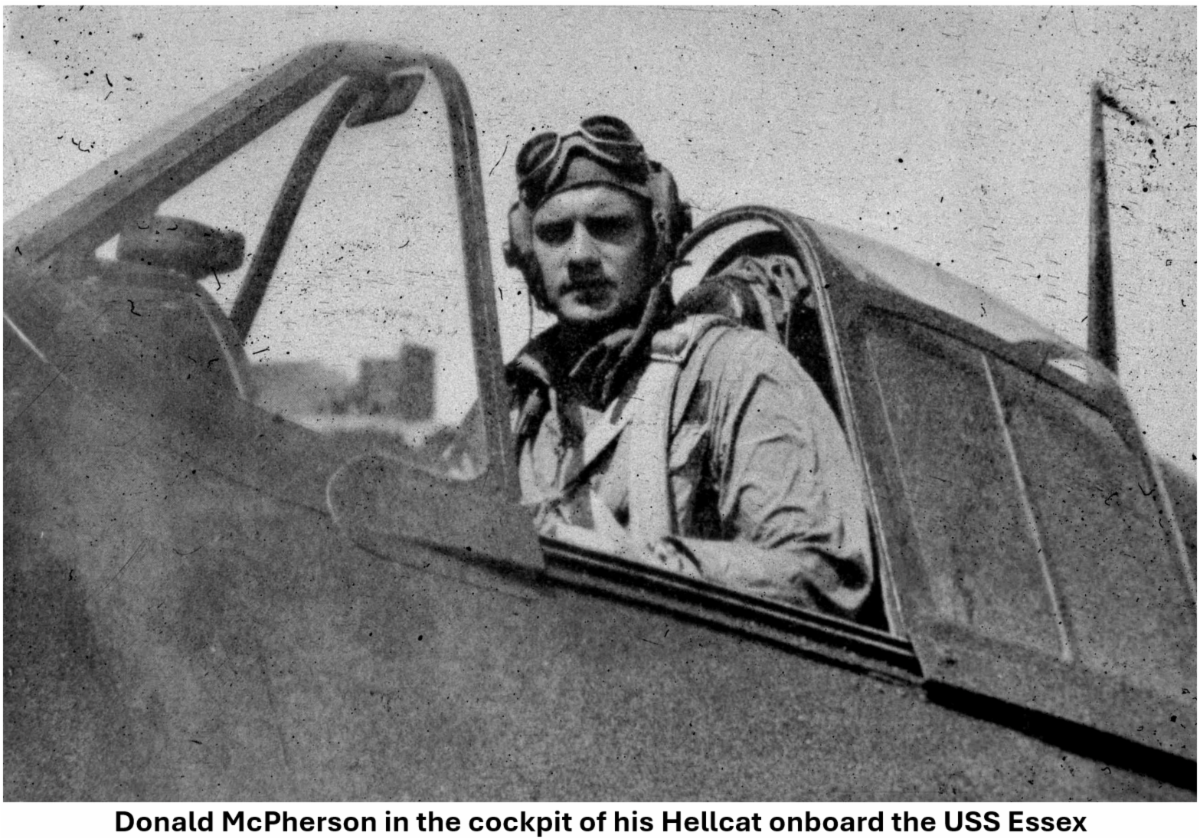
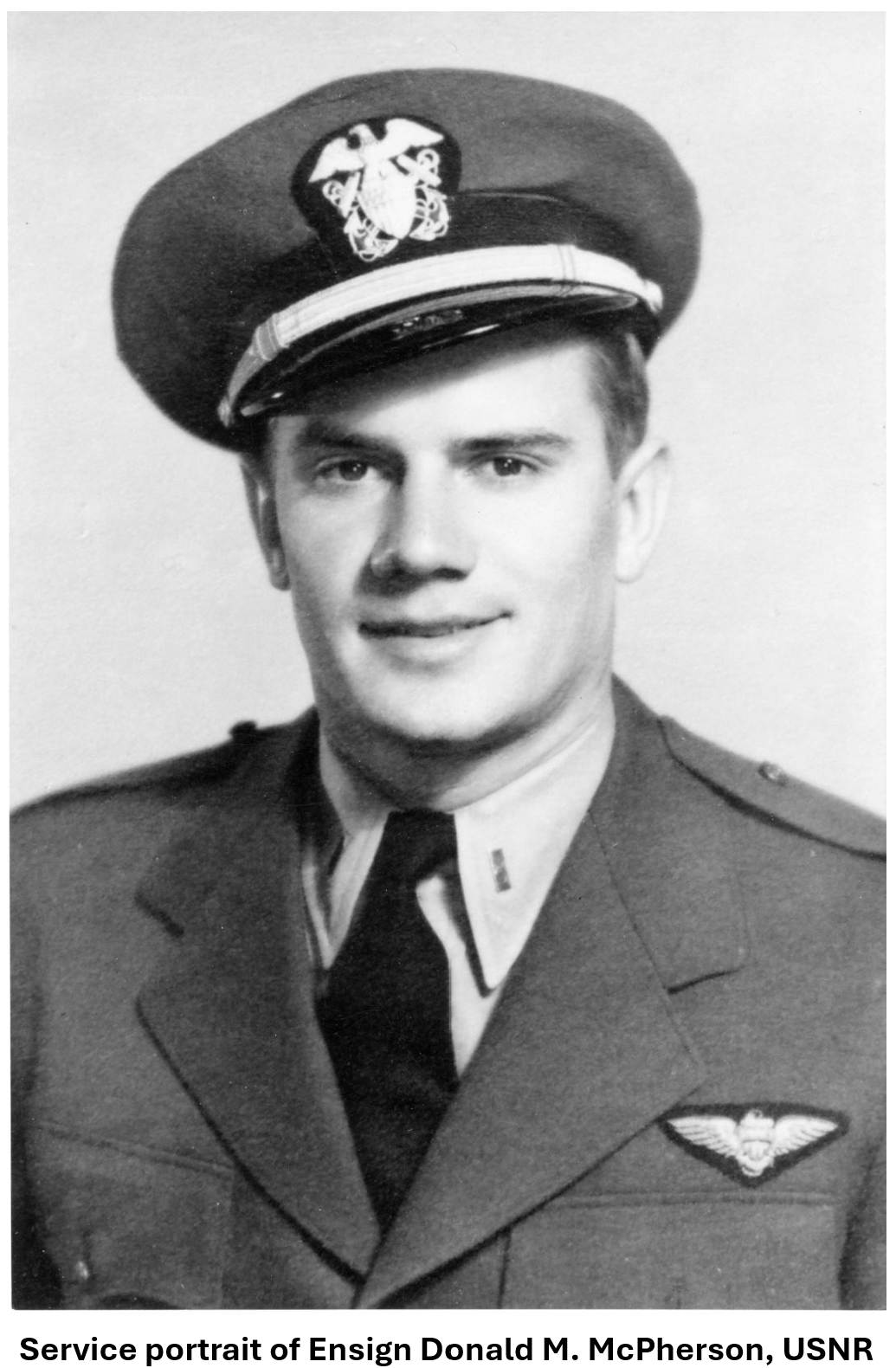
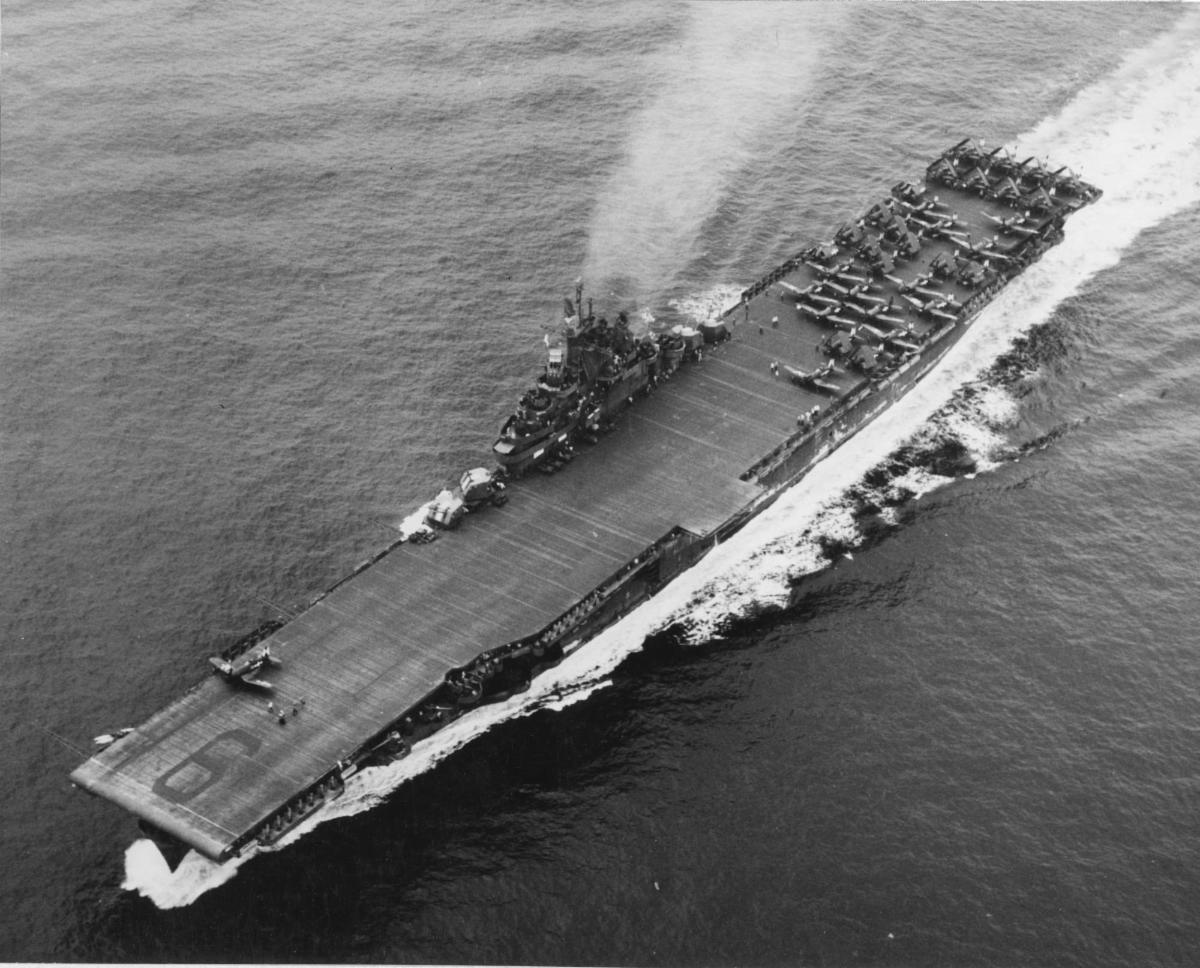
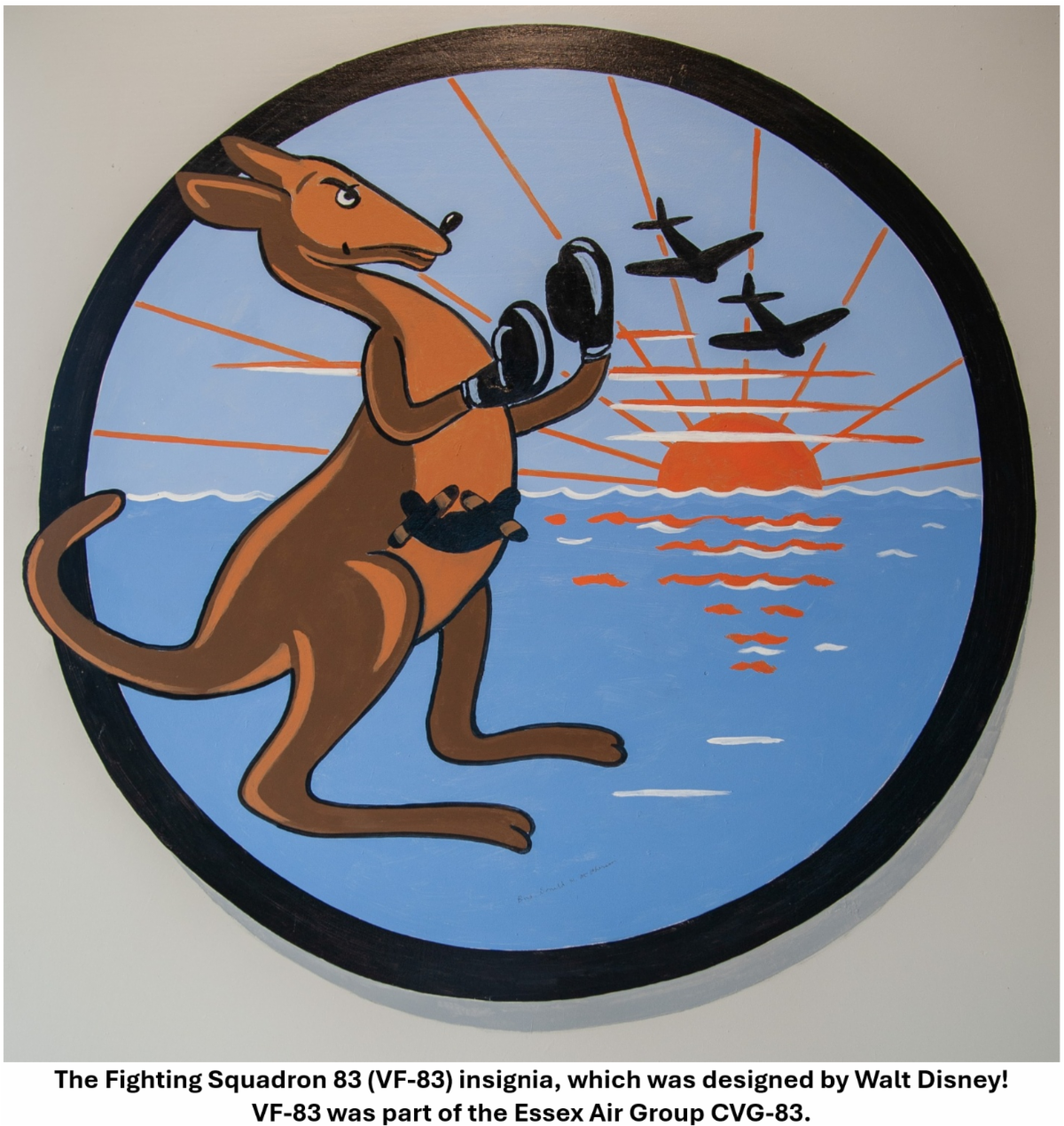
Donald M. McPherson, the last surviving American ace of World War II, passed away August 14, 2025, at the age of 103 in his hometown of Adams, Nebraska. He served in the U.S. Navy, flying Hellcat fighters with squadron VF-83 (“Fighting Squadron Eighty Three” per the cruise book) from the carrier USS Essex (CV-9) in the Pacific. The American Fighter Aces Association had recognized McPherson as the final living U.S. ace from the conflict.
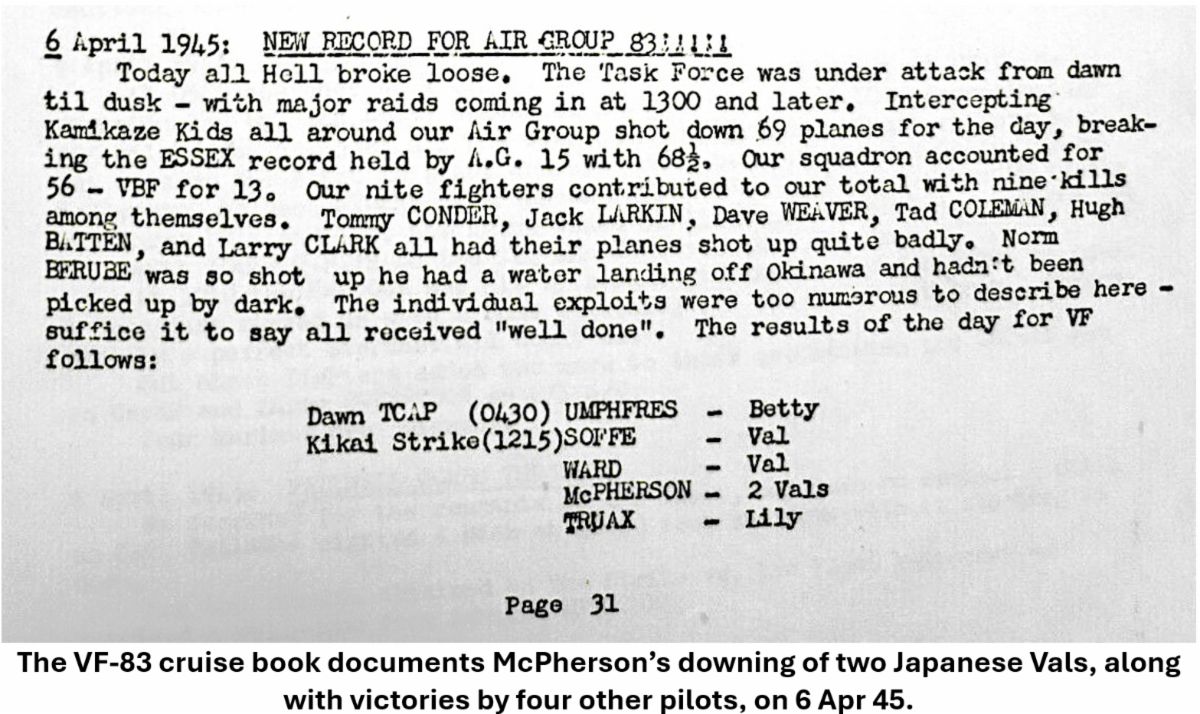
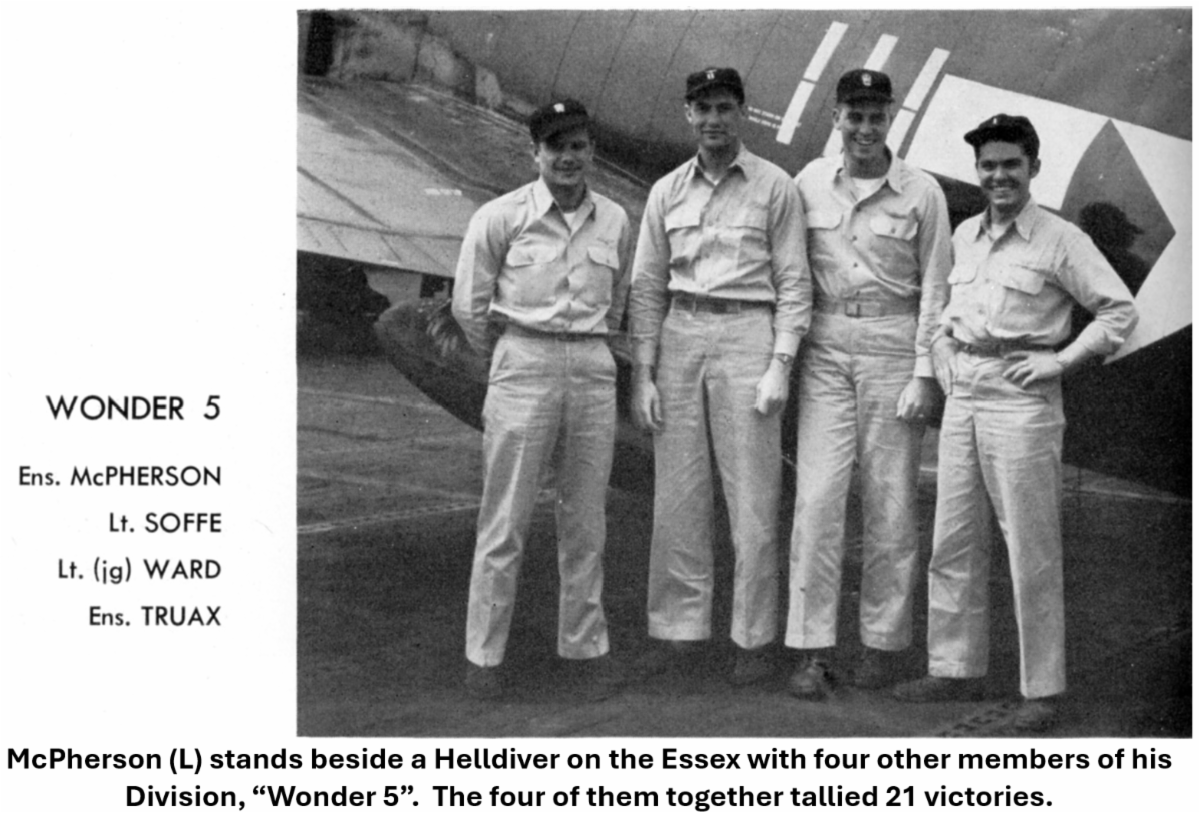
On April 6, 1945, when returning to the Essex from a strafing mission near Okinawa, McPherson was credited with shooting down two Japanese Aichi D3A “Val” dive bombers. The incident is recorded on page 31 of the VF-83 cruise book, along with victories by four other pilots (two additional Vals, a Mitsubishi G4M “Betty”, and a Kawasaki Ki-48 Lily).
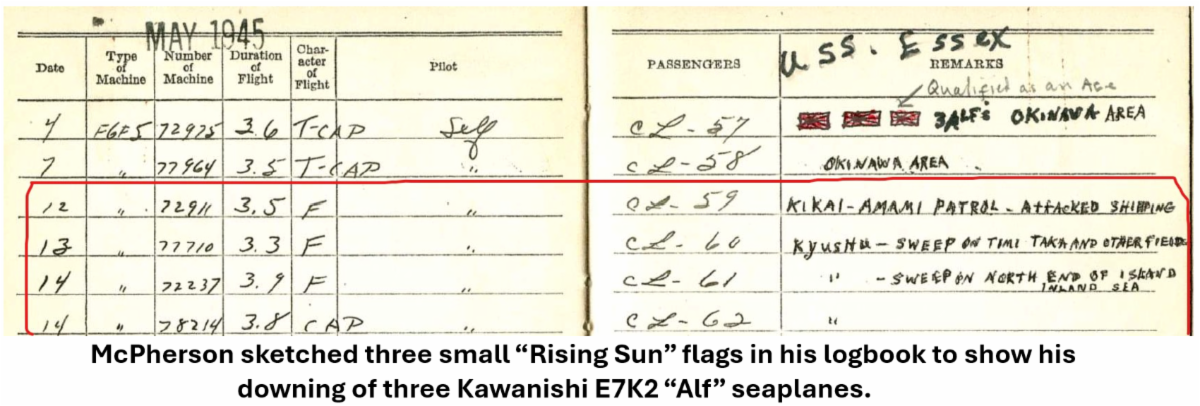
| On May 4, 1945, McPherson was tasked to fly a Tactical Combat Air Patrol (T-CAP) mission. As annotated in his personal flight log, he was assigned to an F6F-5 (Hellcat), BuNo 72975. The mission was 3.6 hours in duration and flew from the Essex to the area of Okinawa. It was there, on that mission, that McPherson downed three Kawanishi E7K2 “Alf” seaplanes which had been converted to Kamikaze suicide aircraft intent on diving into Navy ships. He annotated the victories in his log with three small “rising sun” flags along with the note, “Qualified as an Ace”. In the ten days following he flew an additional five missions, to Okinawa, Kikai Island, and Kyushu where he attacked Japanese shipping and airfields. | |
A personal piece in the museum’s Wolf Collection provided by one of his squadron mates says: “During this period, fighter pilots were flying eight hours a day, often in weather that was not fit to fly in and was often a concern whether we could find the fleet on our return because of heavy cloud cover that often was low over the ocean.” This note is part of a collection of thousands of pieces of aces’ correspondence and aces’ autographs donated to the museum by Dr. Bill Wolf in 2023. The collection includes Donald McPherson’s autograph.
McPherson was the recipient of the Air Medal with three stars in lieu of the 2nd, 3rd, and fourth awards of the medal; the Distinguished Flying Cross with two stars in lieu of the 2nd and 3rd awards of the medal; and shared with the air group a Presidential Unit Citation.
The news of McPherson’s passing has been carried worldwide, appearing across numerous news outlets. This has not only honored his accomplishments but also documented a poignant reminder that those members of America’s “greatest generation” are slipping into memory. The days when it was common to have an uncle who was a GI that fought in Bastogne or a neighbor that was a Pacific fighter ace are gone, as more of those storytellers leave us with each passing year.
We were honored to interview Don’s son, retired pastor Dean McPherson, and asked him to tell us not about the fighter pilot, but about his dad and who he was.
| |
“What a man experiences in life shows up in this character”, related McPherson. “One of the things that happened is that he came back from the war and at first he wasn't talking about it. And then, when I was a kid, he had a (VF-83) cruise book that had pictures and stuff, and so I would pull out that cruise book and I crawl up in his lap and we'd look through the pages together.
“He started by explaining what the pictures were, and that led to him telling stories. And then, when I hit fifth grade, we were studying World War Two in school and I told my teacher that my dad was in World War Two, so they invited him to come and speak. That just led to more and more invitations. My sister Beth, later when her children went through the same school, every one of them sat in that fifth grade room and got to hear their grandpa tell his stories.
“On the day of dad’s funeral, we didn't go straight to the cemetery; there was a request that we drive by the school. So, we went on the way to the cemetery, and every kid in the school was standing out there on the on the curb. Most of them were waving little American flags and standing there to honor Dad.”
McPherson related stories of attending events where even many years later veterans struggled getting the words out to tell their stories.
“My dad was very quiet and very humble and proud. I know I'm biased, but he communicated his story better than many others. The thing that just made me laugh and shake my head is at 100 years old he writes a book! It’s called ‘An American Patriot”, said McPherson, “and it doesn't just tell his war experiences, but it definitely shines a light on a lot of that.”
| | |
McPherson continued, “A recommendation for all is to go and tell the story early and often. My dad's gone now, and then last night it was like, “Oh man, I wonder about this”, but of course dad's not there to ask anymore.
Speaking on his father’s beliefs, McPherson said, “He was a man of faith. One of the times in my career as a pastor that I have very fond memories of is when dad and mom would come and visit us wherever I was serving churches. Almost inevitably that would include weekends and, of course, they would go to church with us.
“If there was more than one service for more than one church, mom would usually go home with my wife and dad would go to every service. One time, I was preaching and simply laying on of the hands and blessing people, praying over them,” he told. “The pews are filled with people and mom and dad were the first ones to the altar, so I prayed over them … and then dad just kept hanging there by the altar. After a while I just motioned him forward. It’s the only time in his life that I know of that he ever did anything like this, but he started laying hands on people and praying over them with me. And then he went to the second service and did it again. That's probably one of my best memories of my years as a pastor, that moment with my dad.”
McPherson also spoke of his dad’s commitment to his local community after he returned from the Pacific.
| | |
“He came back and the impact of his experiences in war I think made him very driven in one respect and that was to serve his community and the people around him; that reflected in him leading,” said McPherson. “He and mom for many years oversaw the summer youth ball program, you know, baseball, softball. During that time, they expanded the number of teams. They also knew there was a contest that the Lincoln Journal Star did where the local communities could nominate a volunteer from their community; at the end of the contest one volunteer would receive a cash award.” He continued, “Dad was chosen and received the award, which he then gave to the community to use to build another ballfield. Of course when they got ready to dedicate it they wanted to call it Don McPherson Field, but he said (his wife) Thelma was as much a part of this as I am. You can name it McPherson Field if you want, but if it's just about me. He wanted to make sure that mom got recognized as much as him for their accomplishments.”
“He was my scout leader for a while, and he was also commander at the VFW Post in the American Legion. So he was he becoming, in his last years especially, a community treasure.”
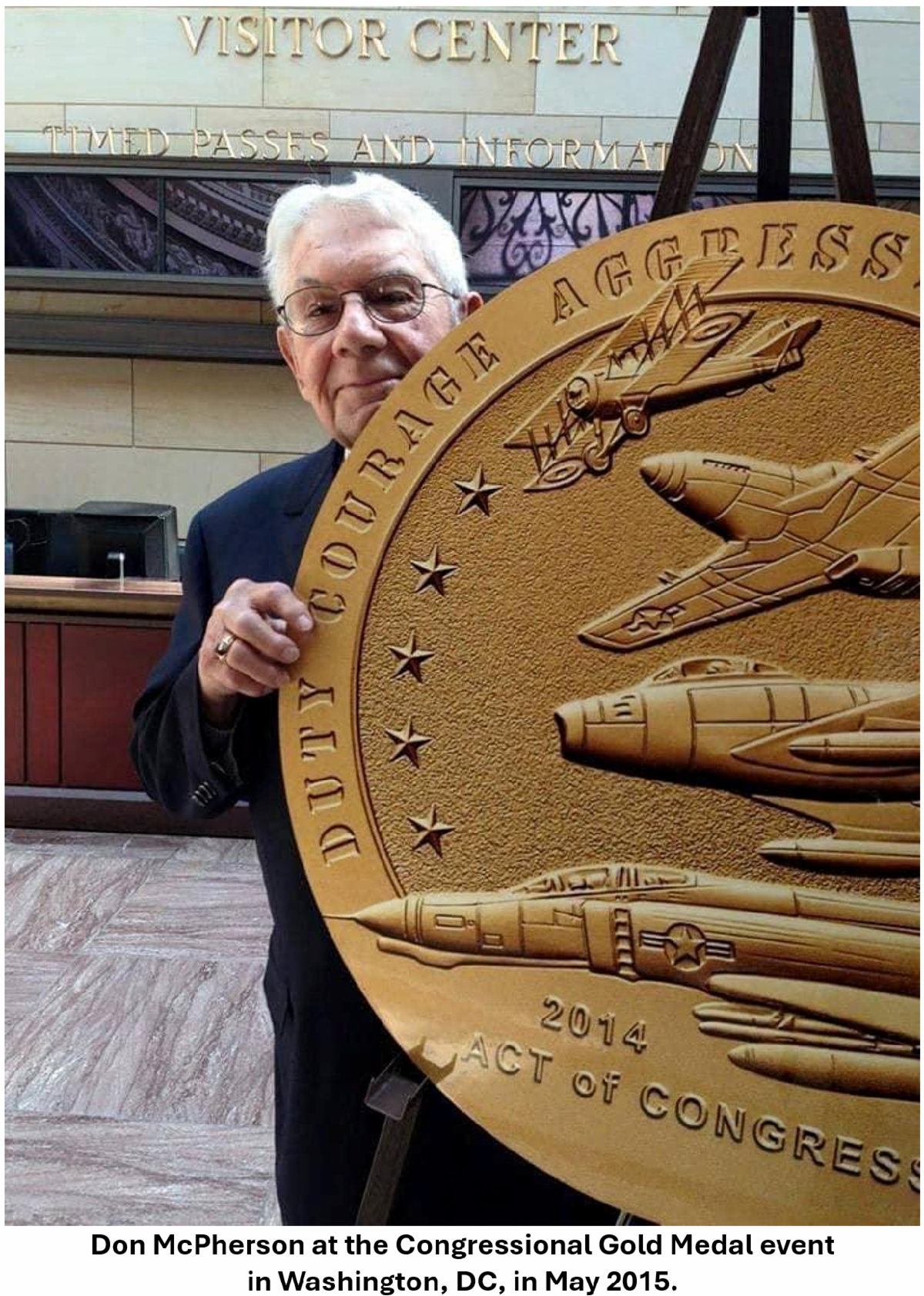
Dean told the story of when his father returned from Washington, DC, after having been one of the honorees to receive the Congressional Gold Medal for American Fighter Aces on May 15, 2015.
| |
“My whole family, we all traveled out to DC when he along with the rest of the living aces at that time were presented with the Congressional Gold medal. My son got to fly with him and with people from the Aces Association who were ferrying these aces out to the event and back.
"When they got back, my sister and her husband picked them up at the airport (and drove) him back to Adams. I remember seeing video footage; it was like an impromptu parade. Everybody was out on the streets of town waving and waiting for him to go by!”
Speaking about his dad’s first combat mission, Dean told how Don had learned a valuable lesson. In order to extend the range of the Hellcats, the aircraft were fitted with belly fuel tanks. “They told them, don’t forget before you make your strafing run that you're going to be going into a dive, so switch from your belly tank to the wing tanks because you'll pull enough G’s that you won’t be able to pull enough gas out of the belly tank. Well, he forgot.
“And so, of course, they made their run from the land side towards the sea. He's over the target and fires his guns, and then his engine conks out. So here he is, his engine’s dead, he's flying out towards the sea, and he can see the tracers converging in front of him.
“He reaches for, he called it a wobble pump, it was a hand pump in the cockpit, he starts using the wobble pump and the engine caught, and it surged forward and pulled him right into those tracers. And so he ended up with I think a 20mm hole about 6 inches wide behind his back. Of course he knew something was wrong with the plane because it handled kind of funny.
“Then smoke came into the cockpit, so he rolled the canopy open and the wind sucked off his helmet and his goggles. He lost his radio, so he couldn't talk, he had to communicate with his wingmen by hand signals. They look him over and say I think you can get back.
“He landed and then that's when the guy on the ship comes up and says, ‘It looks like you caught a little lead today’, and there was that hole behind his back. That's one of my favorite stories, because it shows the humanity of him that he got nervous on his first outing, and he just about paid for it.”
| |
Dean also related a story about his father’s response to a question that he didn’t like.
“When we were doing symposiums, they’d ask the question, “What was your favorite thing about War?” Dad didn't like the question to begin with, but his answer was always the same.
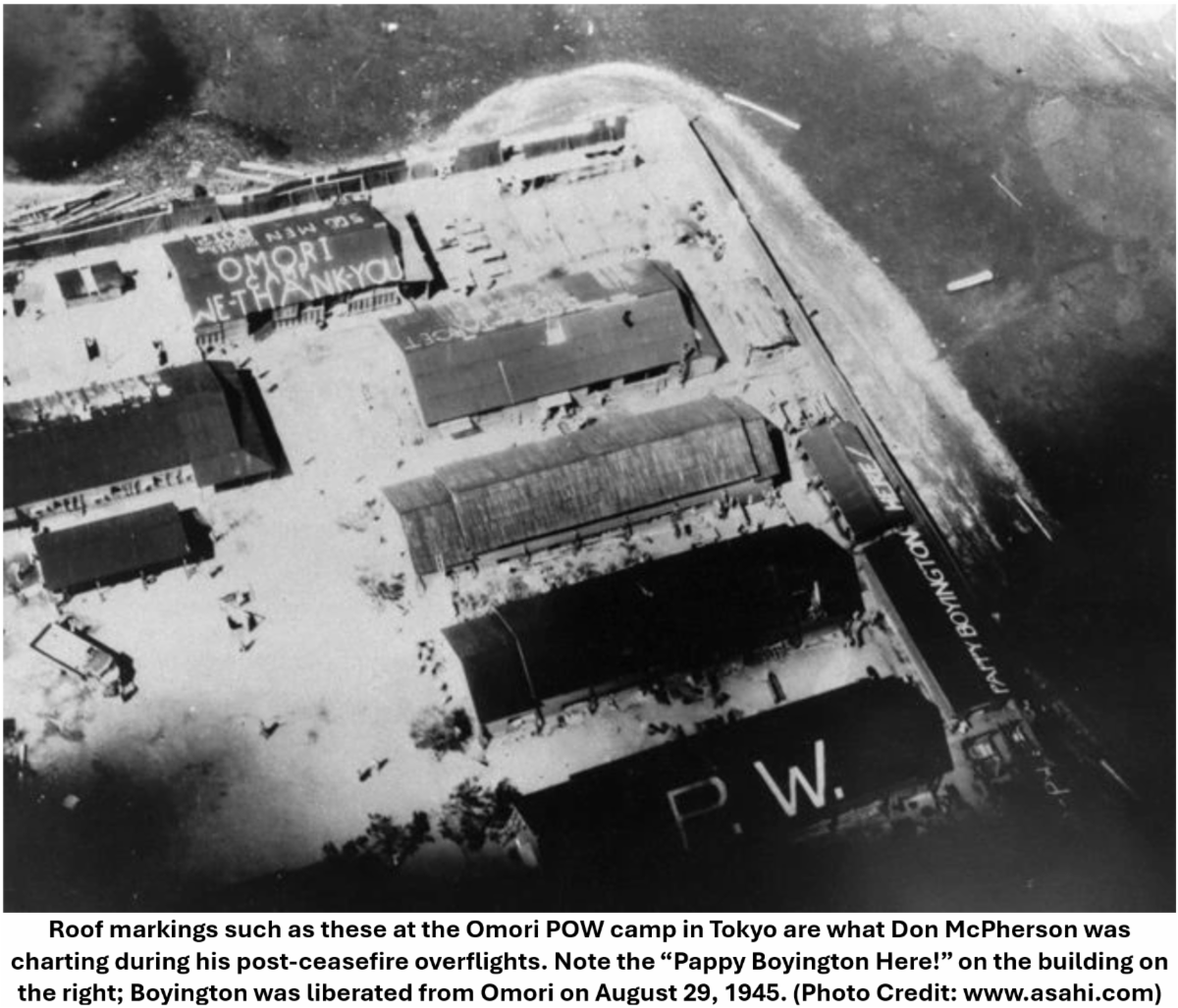
“Right after the ceasefire with Japan, they tasked him and some of the other pilots to overfly the cities, to chart where the POW camps were. The Japanese were directed to mark the roofs of all the buildings where the POWs were with the letters “PW”. He was doing an overflight of Tokyo and marking those camps and of course, when they find one, they charted them. They gave (the pilots) these small parachutes with little care package attached; candy, gum, cigarettes, that kind of stuff. The pilots would open the canopy and toss those out to the POWs.
“The next day, he was back over that same city, and he overflew one building (which he’d charted the day before), and on the roof it said, ‘Thanks VF-83; News?’. Dad came back to the ship, and he talked to the commander. He said, ‘Sir, they don't have any idea what's going on.’
| |
“And so, they fired up the printing press on board the Essex and printed leaflets that they then flew back and dropped over those camps to let them know that the war is about to be over and that they would soon be free. That was the one thing consistently that Dad said was the favorite thing he got to do during the war, was to help find our POW's and let them know that they were soon going. To be free.”
McPherson also told of how, when his dad’s book came out, that one person had come to two events. At the second, he gave them a copy of the book “Unbroken” which details American Olympic athlete and Japanese prisoner of war survivor Army Air Force Lieutenant Louis Zamperini’s story. “There's something in this book that reminded me of your dad and his stories”, which was Zamperini being in a camp and seeing those Hellcat overflights from the ground, receiving the news, and knowing the war was coming to an end.
McPherson closed with a beautiful statement:
“A lot of us have our heroes. I was raised by mine.”
Story Credit: Rich Tuttle, Gene Pfeffer, and George White
Photo Credit: Dean McPherson and Mark Herber
| | Not Everybody Gets to Fly! | | |
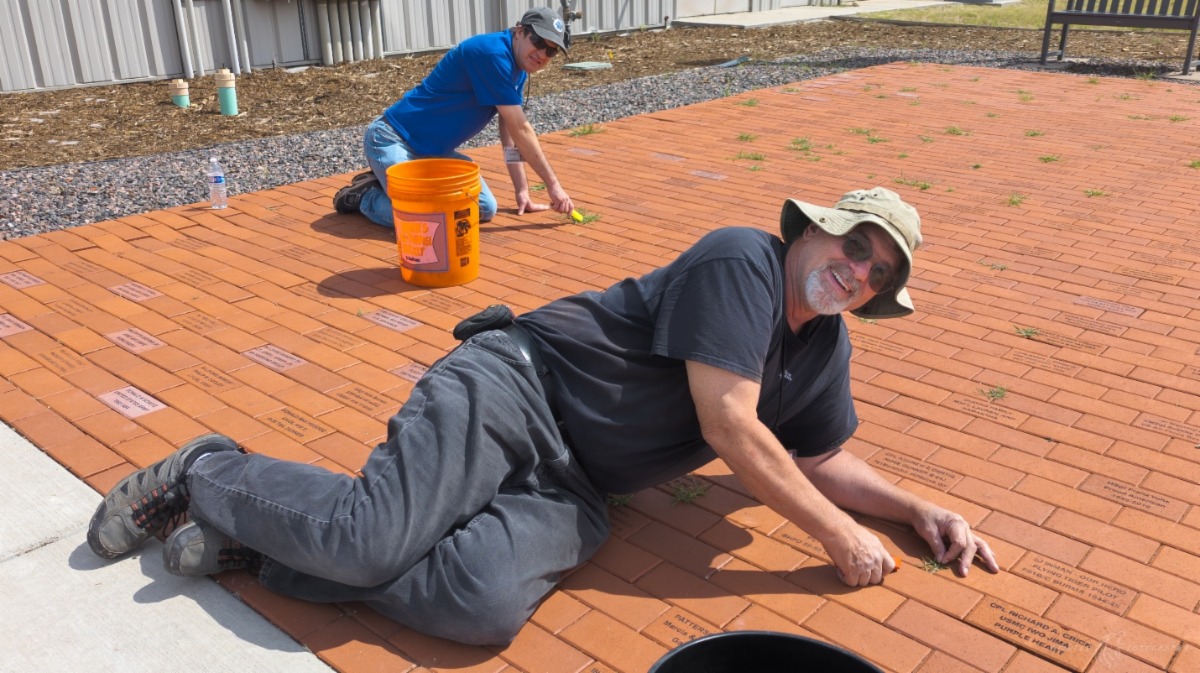
One of the many important museum volunteer groups whose work is often outside of the public eye is the Facilities and Grounds Section. These are the folks whose duties include maintaining all museum buildings and grounds, to include maintenance repair work, servicing building and support equipment, and cleaning of facilities and exhibits. And yes, that also includes picking weeds from between the memorial bricks beside the Museum entrance!
On a recent hot Saturday, that’s exactly the non-glorious duty that volunteers Andy Oertig (front) and David Kuklin (rear) performed with a smile on their faces, preparing the area for the upcoming week’s visitors.
Story and Photo Credit: George White
| | |
Pappy Gunn ‘Burned with the
Desire to Win at All Cost’
| | |
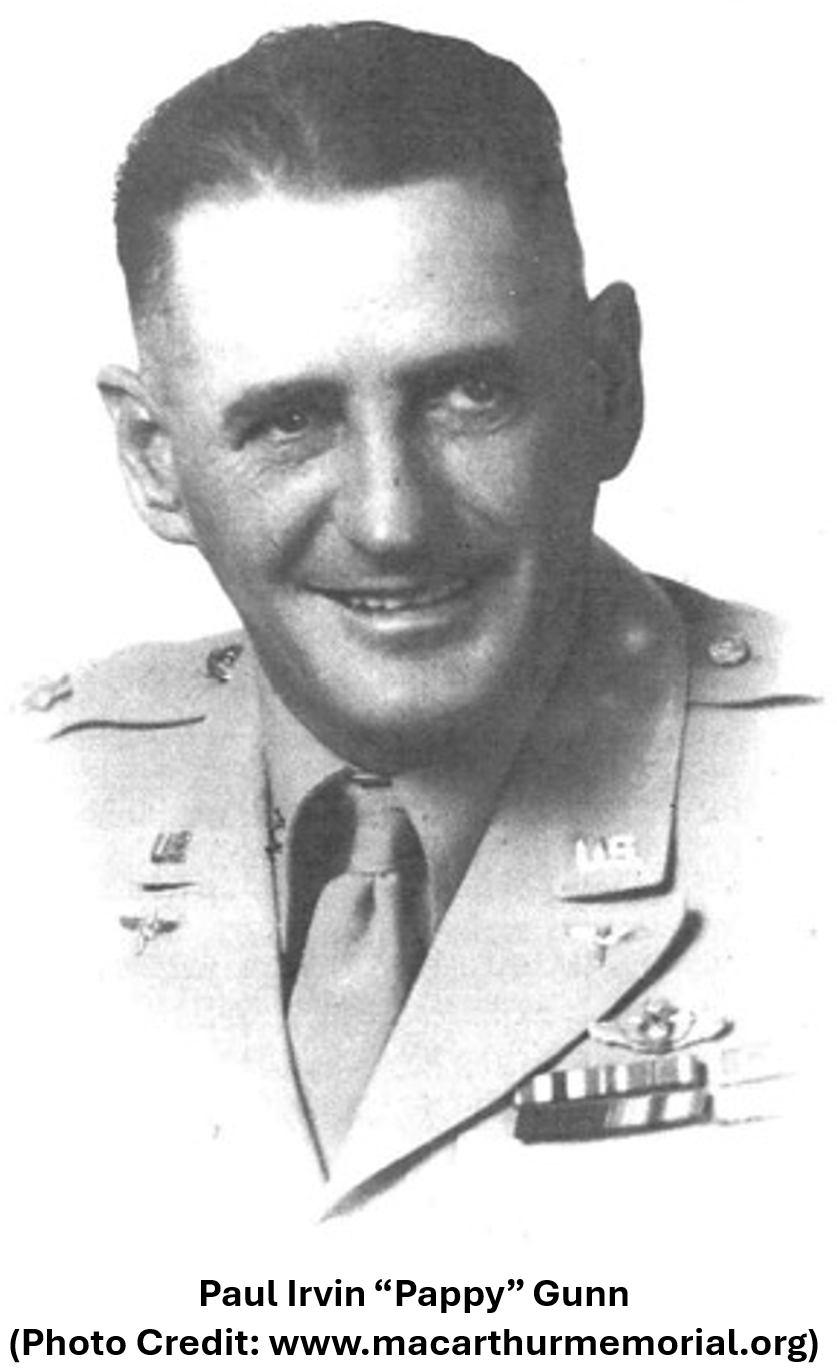
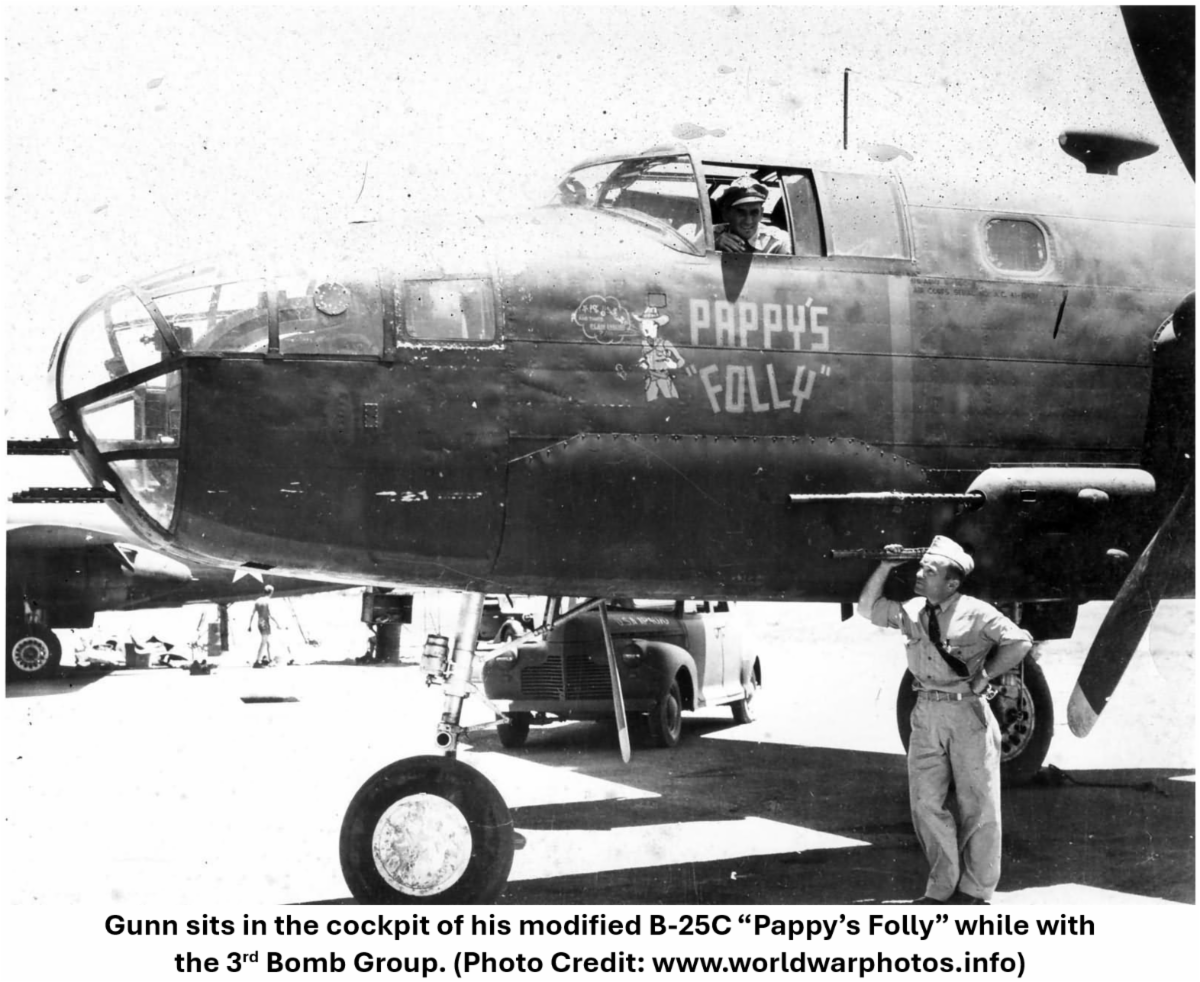
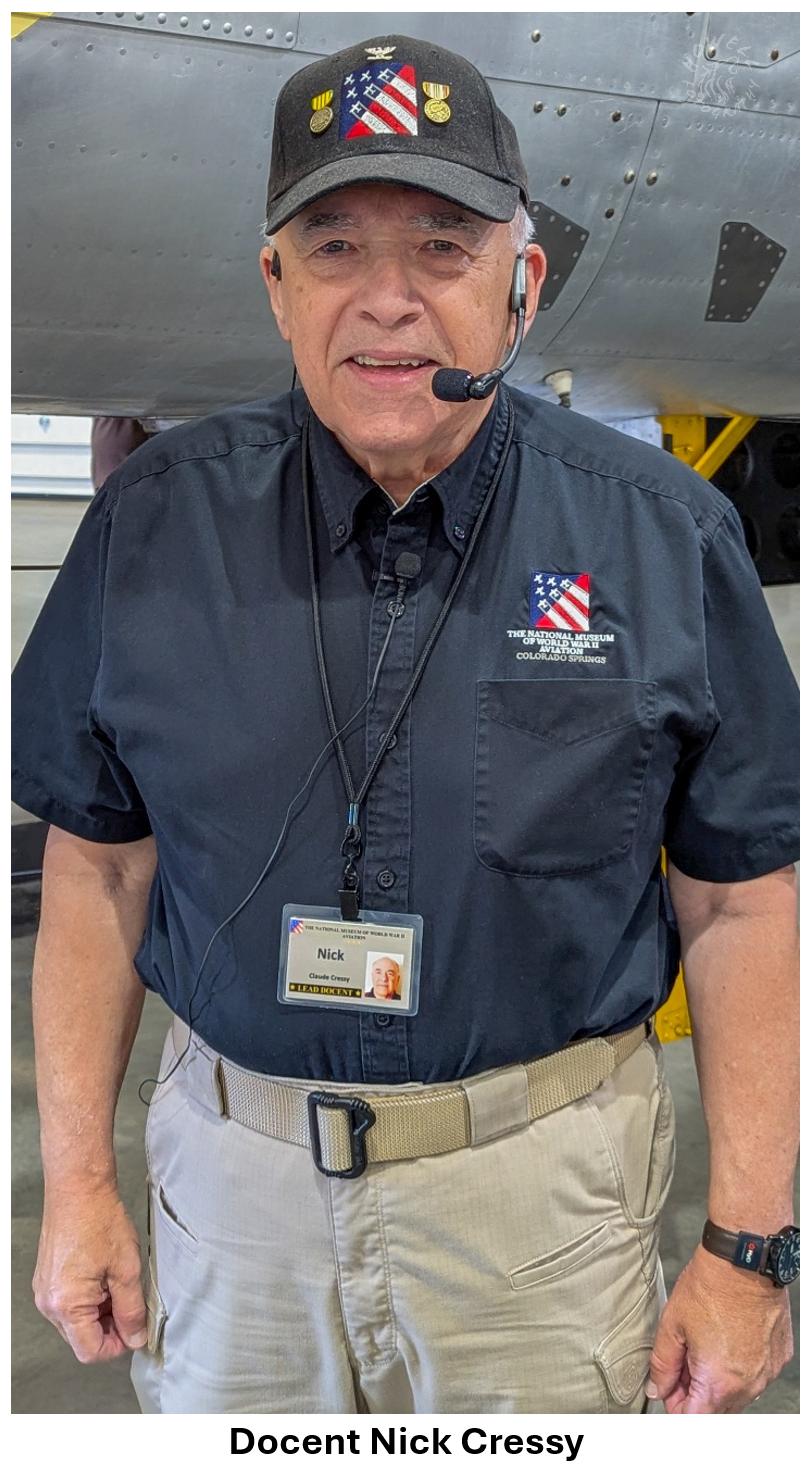
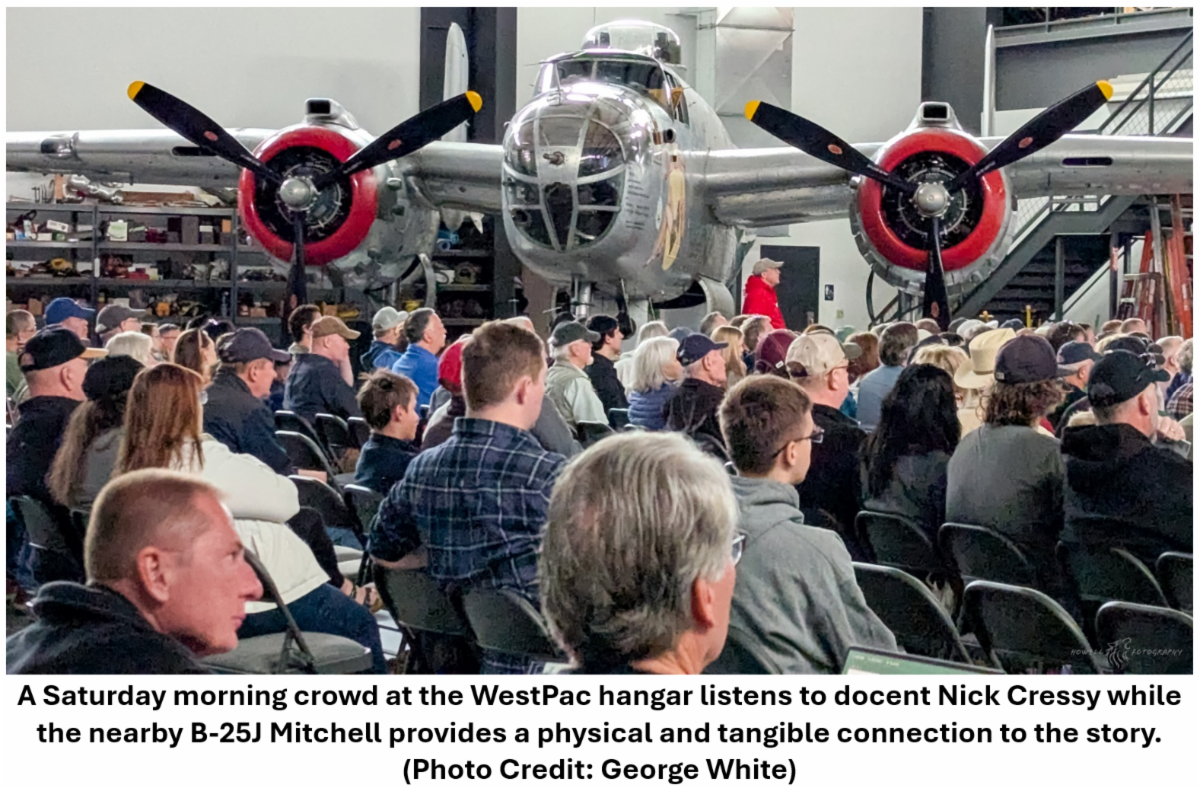
Paul Irvin "Pappy" Gunn, an unlikely hero of World War II the Southwest Pacific, was the subject of a museum presentation May 17 by docent Nick Cressy. Gunn played a key role in the success of the 5th Air Force, according to General George Kenney, General Douglas MacArthur’s air commander in the Southwest Pacific. Kenney said Gunn was "a gadgeteer par excellence.” He perhaps became best known for his ingenious modifications of B-25 and A-20 medium bombers, turning them into attack planes that proved deadly to Japanese shipping, most notably in the Battle of the Bismarck Sea.
Gunn had a long career in aviation even before WWII, Cressy said during the presentation in the WestPac facility on the campus of the museum at the Colorado Springs Airport. Born in Arkansas in 1899, Gunn enlisted in the U.S. Navy in 1918. He became one of the Navy’s few enlisted pilots, flying with two fighter squadrons -- VF-2, the "Flying Chiefs" and VF-1, the "Tophatters -- and commanding a utility squadron, VJ-7. He was called "Pappy" by younger pilots.
In 1937 Gunn participated in the search for Amelia Earhart, flying from the USS Lexington. He retired from the Navy as a Chief Petty Officer in 1939, having served for 22 years.
| As the chief pilot, Gunn helped the owner of Philippine Air Lines build the airline in 1941, flying Beech 18s between Manila and other cities in the Philippines. During the Japanese invasion of the Philippines, Gunn volunteered to fly supplies and equipment to the valiant defenders. He was subsequently commissioned as a Captain in the Army Air Forces, shuttling supplies to troops fighting on Luzon using Philippine Airlines aircraft. When the Philippines fell Gunn escaped to Australia, but his family was interned in Manila. | |
As the war in the Pacific expanded, General Kenney learned that Gunn was using 0.50 caliber machine guns from wrecked fighters to add punch to A-20s assigned to the 5th Air Force, Cressy said. He was impressed by Gunn’s innovative abilities and placed him in charge of special projects. Based on his work on the A-20, Kenney had Gunn convert a squadron of B-25s with similar armament. The effort was hugely successful and many more were converted. They were first used as strafers in late August 1942 at Lae, New Guinea. A-20s used nose guns and parachute fragmentation bombs -- invented by Kenney between WWI and WWII -- in New Guinea.
Gunn’s modified A-20s and B-25s played the key role in the Allied victory in the 1943 Battle of the Bismarck Sea. Combinations of B-24, B-26, A-20 and B-25 bombers, as well as U.S. and Australian fighters, strafed, bombed and skip-bombed Japanese ships. Japan was soundly defeated. The U.S. Strategic Bombing Survey said that "From 1 March 1943 to the end of the war, the enemy remained on the defensive, strategically and tactically, except for desperate counterattacks by separate and isolated units.”
North American Aviation ultimately incorporated variations of Gunn’s armament innovations into later models of the B-25, specifically the B-25G, H and J models. Responding to a question from a visitor regarding the added guns during the presentation, Cressy pointed out specifically on the Museum’s own J-model where a side fuselage gun pod would be mounted; this was a direct connection for the audience to the work of Pappy Gunn.
| |
Gunn participated in the little-known Royce Mission of April 11-14, 1942, a bombing operation led by Brigadier General Ralph Royce involving three B-17s and 10 B-25s flying from Australia to hit Japanese shipping, airfields and other targets in the Philippines. Pappy Gunn, providing expertise in several areas including fuel issues, piloted a B-25. It was one of the first U.S. offensive raids in the Pacific theater.
Flying 1,500 miles from Darwin, Australia, the planes arrived at Del Monte Airfield on Mindanao in the Philippines; the B-25s were then dispersed to two other fields. Both types of aircraft hit targets for two days, before returning to Darwin with evacuees. Gunn's B-25 was the last plane to leave for Darwin.
| |
The mission was successful because no American aircraft or personnel were lost, but it was overshadowed by the April 18, 1942, raid on Japan led by Colonel James "Jimmy" Doolittle.
The success of the B-25s specifically prompted the USAAF to require North American Aviation, builder of the B-25, to begin modifying B-25s to use the nose guns that were so effective in the Bismarck Sea fight, but the company said it couldn't be done. With Pappy Gunn’s consulting advice at North American, the B-25Gs and Hs were ultimately fitted with nose-mounted 75mm cannon. The Gs and Hs had two-to-four 0.50 caliber guns mounted in the nose. The Js had not continued the use of the cannon but had factory-built variations of up to 14 forward-firing 0.50 caliber guns.
Pappy himself tested the B-25G’s cannon in actual combat on July 24, 1943. He loved it. In the test flight he hit (and sank) a Japanese transport and destroyed several large targets at a Japanese airfield. The cannon was hard to operate, punished the airframe and was unpleasant to use. It popped rivets, filled the cockpit with smoke and cordite, and was very loud. But it was also very effective.
| |
Gunn was promoted to Lieutenant Colonel and appointed maintenance officer for the 5th Air Force. In February 1944, he tested the new Douglas A-26 Invader in combat but concentrated on teaching tactics and ensuring that "strafers," like the up-gunned B-25 and A-20, were combat-ready.
With the liberation of the Philippines in 1944, Gunn was given several duties including command of a Special Support Battalion. It was set up during the initial landings on October 20, 1944. After the aircraft carrier USS Princeton was sunk during the Battle of Leyte Gulf on October 24, Gunn, the former Navy pilot, helped guide the Princeton's low-on-fuel planes to safe landings at Leyte's Tacloban Airfield.
When Japanese forces hit Tacloban on October 30, 1944, Gunn was wounded an evacuated to Australia.
| | |
Manila was liberated between January and March of 1945, and General MacArthur ordered the liberation of Santo Tomas Internment Camp, where many, including Gunn's family, were being held. They were found safe on February 3, 1945, and on February 19 were flown to Brisbane, Australia, where Pappy was in a hospital recovering from wounds from bomb fragments in his left shoulder.
Gunn flew many combat missions throughout the war, reaching the grade of Colonel and earning two Distinguished Flying Crosses, the Silver Star, Legion of Merit, Air Medal, nine Purple Hearts, and the WWII Victory Medal.
Gunn retired in late 1948 on full disability after multiple surgeries, Cressy said. He re-engaged with Philippine Air Lines (PAL) but left PAL to establish Philippine Aviation Development Inc. in 1950 with his son Daniel.
| | |
On October 11, 1957, Gunn was flying a Beech 18 in the Central Philippines when a sudden downdraft forced the low-flying plane into the ground. He briefly regained flight but hit a tree and crashed. All aboard were killed.
Cressy cited this passage from "The Legend of Pappy Gunn 59 Years Later," posted on The American Warrior, October 11, 2016, by John R. Bruning:
“Pappy Gunn embodied the best of the American spirit: a refusal to quit no matter the odds, a can-do attitude, a disregard for red tape, a refusal to accept failure and defeat, and a disdain for unnecessary and hindering bureaucracy. He burned with the desire to win at all cost.”
Story Credit: Rich Tuttle
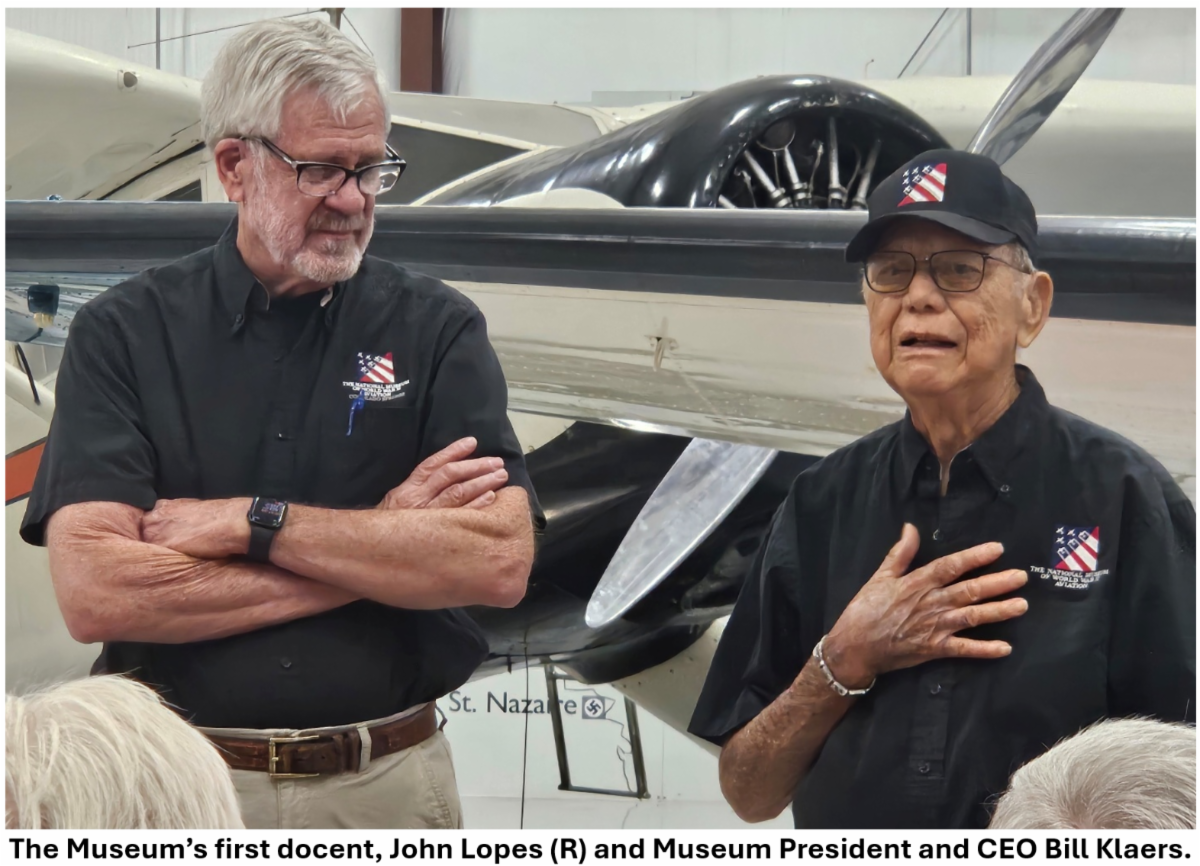
| | Long-time Employee and First Museum Docent John Lopes Retires | | |
Docent John Lopes was honored June 28 at a special luncheon in the museum's Hangar 2. The long-time employee and volunteer made the move with WestPac from Rialto, California, to Colorado Springs in 2008 and worked for the company until he became a docent in 2012. "John was the first docent before we officially opened the Museum; he did tours with visitors before we had a formal program", said Museum Proesident and CEO, Bill Klaers.
John was born in Hawaii in 1937 and was in Oahu when Pearl Harbor was attacked by Japan on December 7, 1941. He's retiring from the museum and will return to Hawaii. Bill Klaers, President and CEO of the museum, praised John for his many contributions. John said, "It's been a pleasure and it's been a labor of love, strong love."
"He's a big part of this organization and has been forever," said Bill ("Dude") Barclay. "There's a million stories and a lot of funny stories, and probably some we shouldn't share here. But...it's an honor to know you... We like to celebrate you because you deserve it."
John said he "watched the Japanese strike Pearl Harbor and it left a lasting impression on my heart and soul." He said he served with the U.S. Air Force for thirty-three-and-a-half years because “I saw 2,000 American GIs die for our freedom."
He said Bill Klaers at one point "tried to put together a flying museum at Pearl Harbor" but it didn't work out. "This man is about honoring those...GIs." But "we have [the National Museum of World War II Aviation in Colorado Springs] because we've got a guy who had a dream." He brought "us into that dream and we love him for that."
In 2016, on the 75th anniversary of Japan's attack, he told the Newsletter that on the morning of Japan's attack he was "in Honolulu having breakfast with my family." Then, spurred by radio reports that "something was going on”, the family drove to the home of one of John's aunts, who lived on the high ground of Diamond Head. From this vantage point, he said, "I could look out at Pearl Harbor and my recollection is probably the second [Japanese] raid had already terminated...but I remember [the USS] Arizona burning furiously, I remember seeing small craft moving in the harbor," probably "attempting to rescue individuals that were swimming in fire, swimming in oil...."
He told the Newsletter that he also remembered:
* Destruction in downtown Honolulu, later determined to have been caused by dud anti-aircraft shells that had apparently fallen and hit gas lines, causing explosions. "I remember going by a school, every pane of glass in the school was shattered; the fire department was out, fire hoses were laid out in the street...."
* What he thought was a battle-damaged airplane. In the afternoon, as the family was driving back to their home in Kailua, not far from Honolulu, he heard an airplane and looked up. It was a single-engine plane that "I thought was battle-damaged because I could see daylight through the wings. So, I'm thinking, 'He's going to crash,' but he kept on flying. He was about 1,000 feet overhead. He was going to Kaneohe Naval Air Station, which was real close to where we lived." Much later, John realized that he had been looking at an American SBD dive bomber. It has perforations in its flaps to allow better control while diving on a target. "When the flaps are down and in the trail position, you see daylight through the wing, and that's what I was assuming was battle damage."
* A sense, on the part of adults, that a Japanese invasion might be imminent. "Everybody expected to look out on the horizon and see Japanese ships and invasion guys landing." The entire island of Oahu "was ringed with barbed wire." John's family lived close to Kailua beach and a 105-mm howitzer was placed there "with the barrel at about ground level, sticking out to sea....The GIs let us [kids] play with this gun." He would sit in the gunner's seat, look through the sight, play with the wheels and make "the gun go up and down. As long as the battery commander wasn't around, we got away with it." He also remembers how the GIs would run down the beach with their mattress bags to fill them with air, then use them to catch waves.
* Playing with other kids under a USO pavilion on the beach in the days following the attack. "The U.S. troops would be sitting in the audience throwing money on the stage. The dancers are busy dancing, the musicians are busy playing. We were under the stage, and the money was falling through the cracks, so we were scooping up all the money. So, life goes on, even in war."
On another occasion, John said he recognized that, as a four-year-old, events around him wouldn't normally have made a lasting impression. But in this case "There was panic in the air, and when you watch the adults around you going berserk," sights and sounds are not forgotten.
At the June 28 luncheon, Bill Klaers said John is passionate about keeping the Pearl Harbor story alive. He recalled the reaction of one person who heard John tell the story to a group of visitors in the museum's early days. Bill said he and others were standing nearby, just listening, "and we were all crying." Bill said a person in Bill's group told him, "If you could bottle that, this museum will be a huge success.” He told the person, "It's Johnny and it comes from the heart.... He lives this every day.'"
"You're an anchor in this museum," Bill told John at the luncheon. "We'll be missing you."
"The greatest compliment I was ever given in my life was when [Bill] called me his oldest son. That's important for me. Thank you very much. Aloha."
Story and Photo credit: Rich Tuttle
| | Listen to the Museum's New Podcast! | |
The National Museum of World War II Aviation is proud to announce that we now have a podcast! Join us for "Winged Victory w/ Rob and Scott”, hosted by Rob Gale (museum docent) and Scott Klaers (restorer at WestPac, museum volunteer, and pilot), and produced by William Stephenson (museum volunteer for audio and visual equipment).
Winged Victory focuses on the men and women of the past and present that were and are involved with WWII aviation in any way, shape, or form. It's available on most podcast platforms such as Apple Podcasts, Amazon Music, Spotify, and Podcast Index. The video version is also available on the museum's YouTube channel @nationalwwiiaviation.
The first three podcasts include:
Episode 1: Rob sits down with the museum's chief pilot, Charles Hainline, for a discussion on what it’s like to fly the Curtiss SB2C-1A Helldiver. They also touch a bit on his combat history flying the Lockheed F-117 Nighthawk.
Episode 2: Rob and Scott sit down with docent and pilot Don Johnson and talk to Matt McCauley, who was instrumental in recovering the Curtiss SB2C-1A Helldiver out of Lake Washington in Seattle.
Episode 3: Rob and Scott sit down with museum President and CEO Bill Klaers, and board member Mark Earle, to talk about various exciting things coming to the museum in the future.
Please subscribe, like or follow the podcast; this greatly helps getting it into the world!
| | K-12 Education Program Back in Full Swing | | |
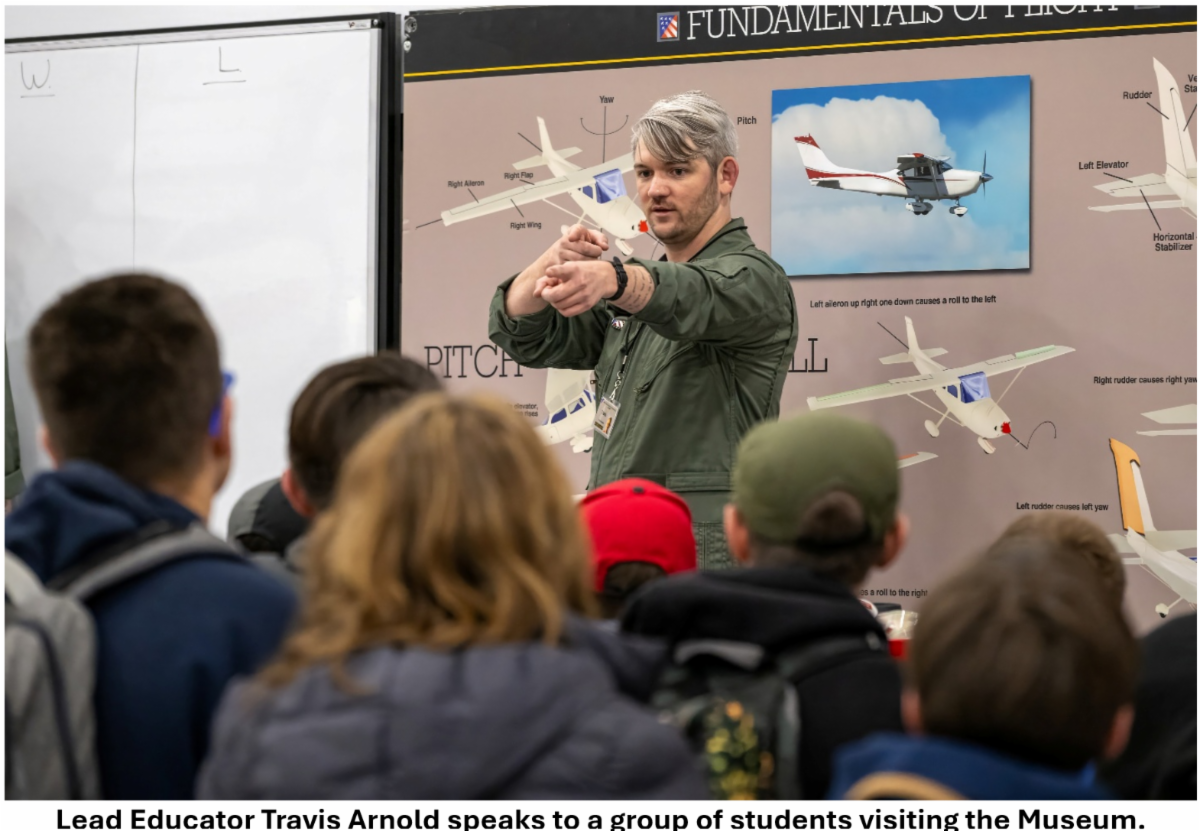
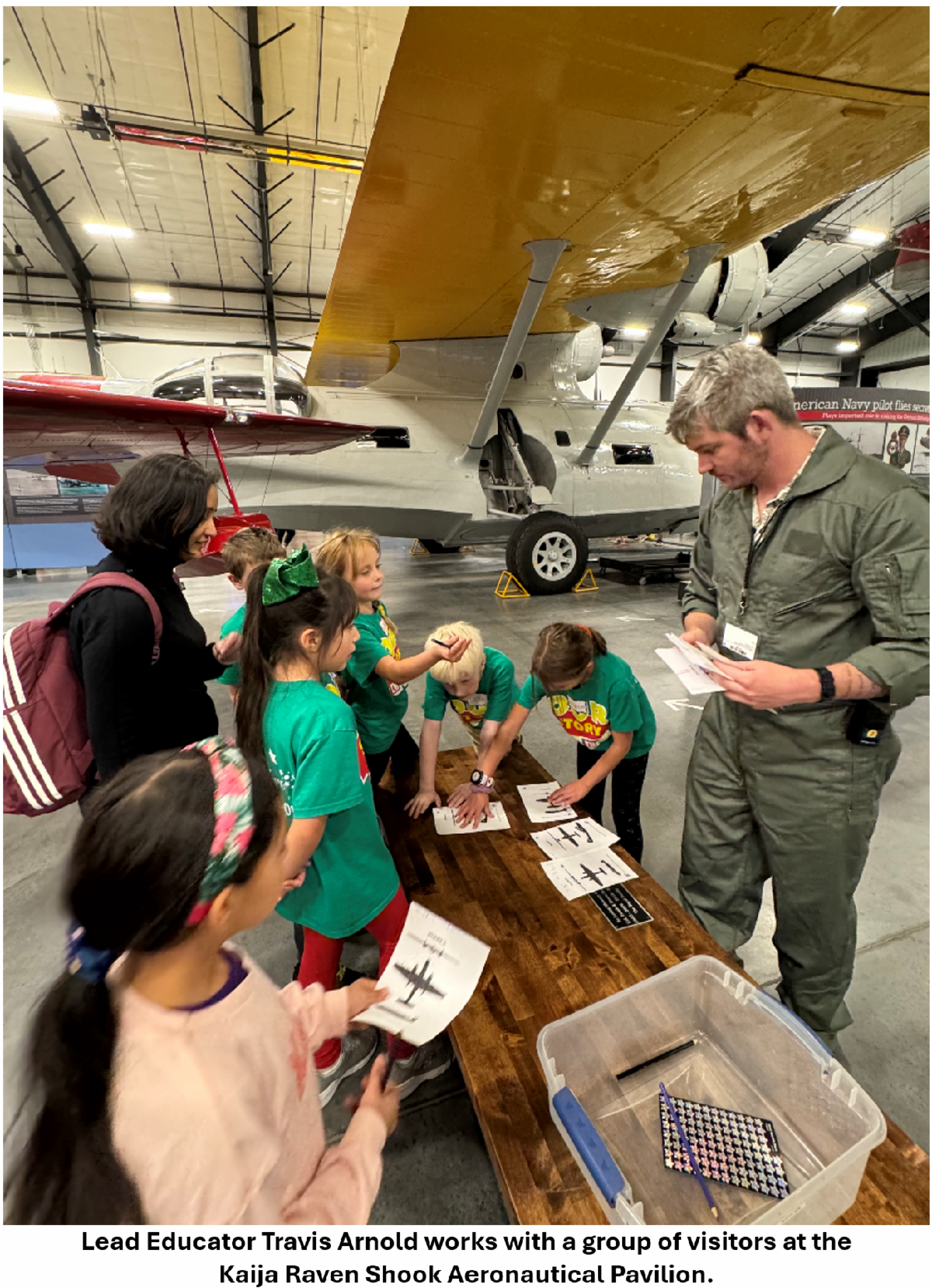
The Museum’s highly successful K-12 Education Program — which was restarted in September 2023 after being forced to suspend in early 2020 during the COVID-19 shutdown — has come back strongly. More than 25,000 students have been through the program since it was initiated in 2012.
“The Museum received a $55,000 education grant from the Colorado Division of Aeronautics to fund a portion of the program re-start. That funded approximately half of the cost of updating the program modules and operations throughout the 2023-24 school year,” said Mark Earle, Director of Education.
Travis Arnold, the program’s Lead Educator, cited several reasons for the program’s strong recovery, including his personal contact with many schools in the Colorado Springs area and positive reactions to a live broadcast from the Museum by the local Fox 21 News Channel.
The broadcast covered the Museum’s many activities, including the K-12 Education Program. Earle told Fox 21 that the K-12 Program teaches STEM and Social Studies concepts within the historical context of World War II. “The aim is to capture the imagination of students in the early years and teach them how airplanes fly. And then later, especially in high school, we start talking with the older kids about careers in aviation.”
“We take the museum experience to a whole different level. We get students very much involved with the airplanes in the Museum. If you notice, we don’t have ropes around any of these planes. We get the kids right up close where they can have the best possible learning experience”
Lead Educator Arnold says the broadcast prompted “an immediate spike” in queries about the Education Program, and the number remains high. Most of the inquiries come through our website — https://www.worldwariiaviation.org/education — which includes a description of the K-12 Program.
Many of the inquiries on the website are about the K-12 Social Studies Track, which will be available for the 2025-2026 academic year. “We have a lot of history teachers, especially, reaching out,” says Arnold, who has a master’s degree in history from the University of Colorado, Colorado Springs.
“This element of the K-12 Program explores specific aspects of World War II history and its lasting social and economic impacts on our nation and the world,” Earle says. Arnold notes that it tells the story of how the U.S. became involved in World War II, the importance of air power, and how American assembly lines produced a war-winning 300,000 planes, not just for the U.S. but for Allies as well.
“Both the STEM and Social Studies tracks are designed to convey contemporary concepts consistent with Colorado Academic Standards while immersing the students in the extraordinary history of World War II aviation,” he says.
| | |
In the STEM Track, Arnold says, there are three Modules, each of which “scaffolds” to the next.
Stem 1 (Kindergarten-3rd grade), “It’s a Bird, It’s a Plane!”
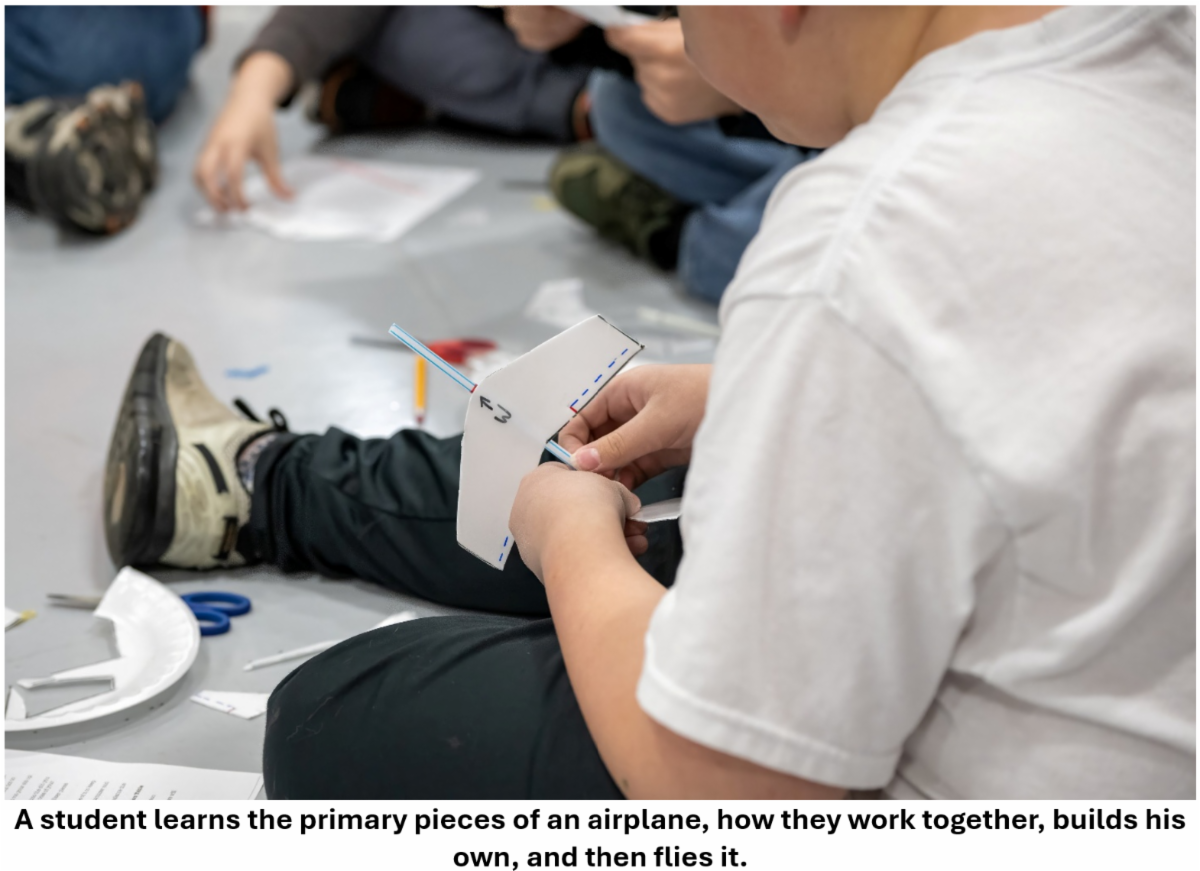
Students begin to explore how an airplane flies through lesson plans that adhere to Colorado Academic Standards for K-3rd grade. Starting with simple comparisons to birds, the STEM lessons in Module 1 examine the basics of aircraft design and explore why there are so many different sizes and shapes of airplanes. Culminating with a visit to the museum, students get up close and examine WWII aircraft in unique capstone activities that reinforce their understanding of what makes airplanes fly and how they are designed for specific missions.
Stem 2 (4th-6th grade), “Keep ‘Em Flying!”
Building on STEM Module 1, this module introduces the basic physics of flight to students. Adhering to Colorado Academic Standards for 4th-6th grades, STEM Module 2 teaches students about the physics of flight and how an airplane’s control surfaces interact with the Four Forces of Flight to lift and guide an airplane through the air. STEM Module 2 culminates in a visit to the museum where students interact with actual World War II airplanes in a unique capstone activity that reinforces their understanding of the Forces of Flight and how an airplane flies through the air.
Stem 3 (7th-9th grade), “Wings Up!”
Building on STEM Module 2, this module is a further exploration of how an airplane flies. Through lesson plans that adhere to Colorado Academic Standards for 7th-9th grades, students learn how a pilot interacts with the controls in the cockpit of an aircraft to move the control surfaces that make the aircraft climb, descend and turn. In the visit to the museum, students engage in STEM activities that reinforce their understanding of the interaction between pilots and their aircraft and get an up-close look at the control surfaces and cockpit of a Word War II aircraft.
There are also three Modules in the Social Studies track, Arnold says.
Social Studies 1 (Kindergarten – 3rd Grade), “Salvage for Victory!”
This module teaches our youngest adventurers about how American children contributed to the war effort during World War II via their “Salvage for Victory” efforts. Through lesson plans that adhere to Colorado Academic Standards for K-3rd grades, Social Studies Module 1 focuses on the “home front” experience of U.S. families during the war, with a specific emphasis on salvage drives—especially those conducted by American schoolchildren. Culminating with a visit to the museum, students get up close to WWII aircraft in a unique capstone activity that reinforces the lessons learned in the classroom and celebrates America’s accomplishments on the Homefront during World War II.
Social Studies 2 (4th – 6th grades), “We Can Do It!”
Blending civics, economics and geography, Social Studies Module 2 explores how the American public and private sectors worked in close collaboration to design and produce more than 300,000 airplanes during World War II. Students will learn how this was accomplished through extensive planning and allocation of limited material and human resources. They will explore how the U.S. produced, salvaged and rationed materials, and developed mass production processes to keep up with demand throughout the war. At the museum, students will explore further by creating their own assembly lines and examining World War II artifacts and exhibits involved in the production process.
Social Studies 3 (7th – 9th grades), “Why We Fought”
Social Studies Module 3 students explore the history of World War II aviation with an emphasis on the technological and socio-economic changes that occurred during the war. Using critical analysis, the students are challenged to question what they do and don’t know about the war, and then to build on that to develop a deeper understanding of the long-term impacts that led to America’s emergence as a superpower in the post-war years. At the museum, students will be given a special tour of the museum’s aircraft and exhibits with a focus on the historical legacy of the World War II era.
| | |
Both the Social Studies track and the STEM track culminate with Module 4 (10th-12th grade), “Soar to Success”, where students are introduced to the many areas of the working world of aviation, Arnold says.
As a follow-on to both the Social Studies and STEM curricula, students explore the emergence of aviation as a career field in the years that followed World War II and learn about modern career paths within the field of aviation. At the museum, students will have the opportunity to interact with an array of aviation professionals who will share their thoughts on a career in aviation, whether as a pilot, aircraft mechanic, air traffic controller, aerospace engineer, or any of the other exciting career choices in aviation.
“Whether it’s a career flying airplanes, designing or maintaining them, or related jobs in air traffic control, airport management, the airlines, or other aviation careers, we’re making those connections. The students leave the program with information on how to prepare for and pursue an aviation career, if that’s where their interest lies.”, says Arnold.
For more information, contact Travis.Arnold@worldwariiaviation.org.
Story Credit: Rich Tuttle and Travis Arnold
Photo Credit: Dave Devore
| |
MG Car Club - Rocky Mountain Centre Visits Museum | | |
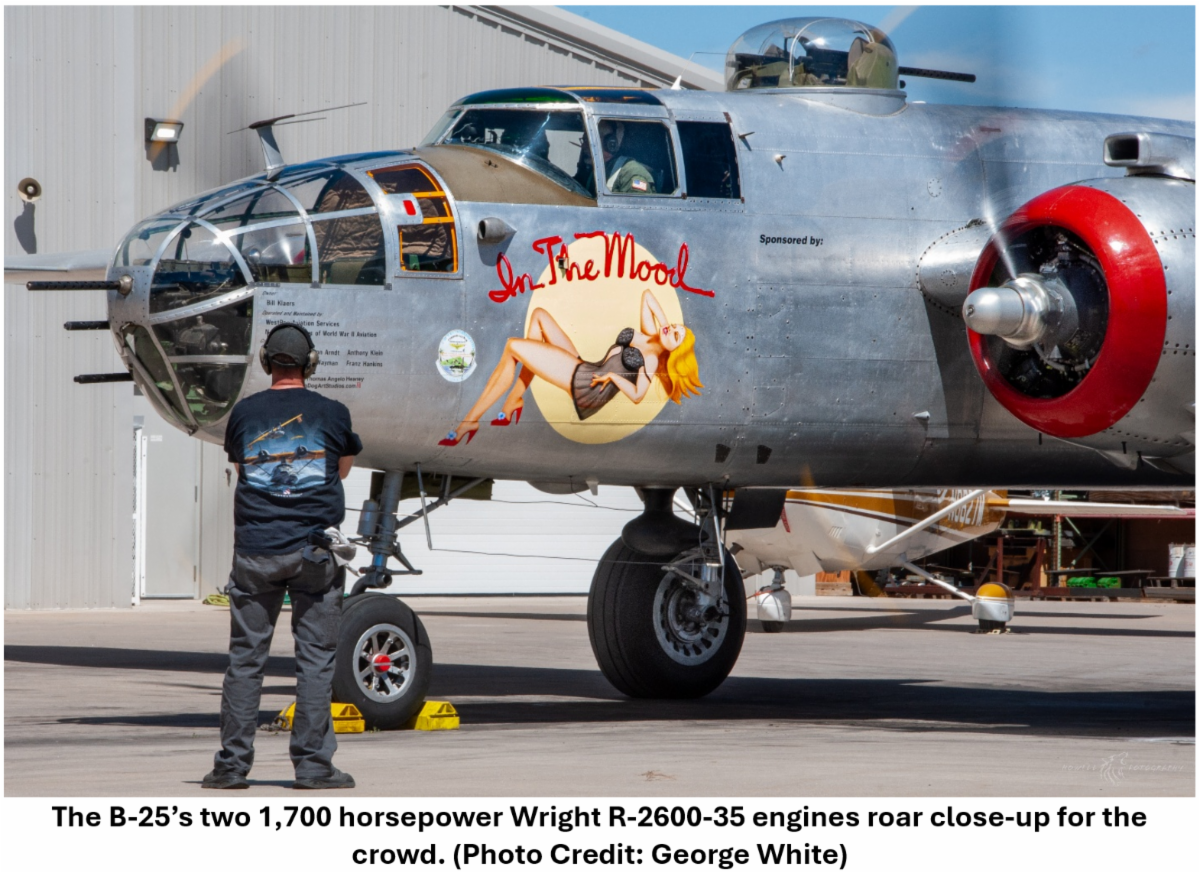
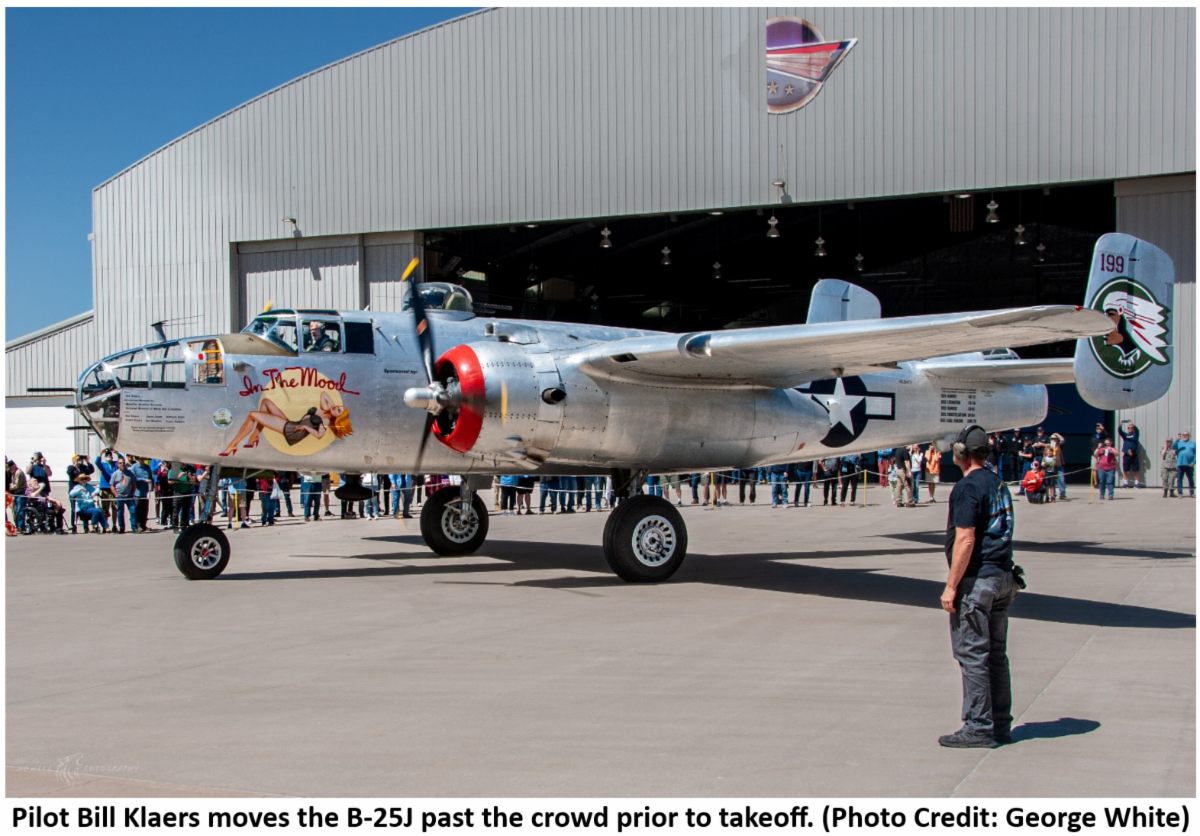
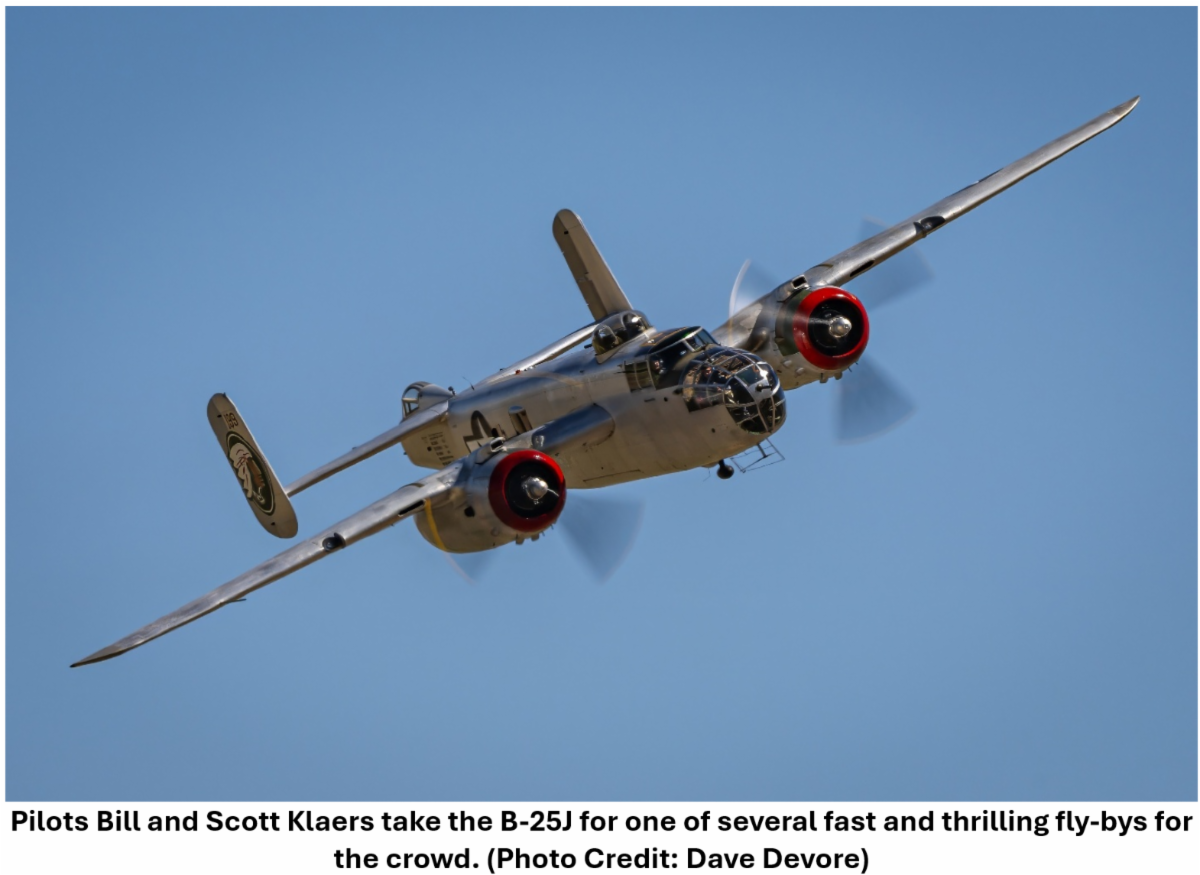
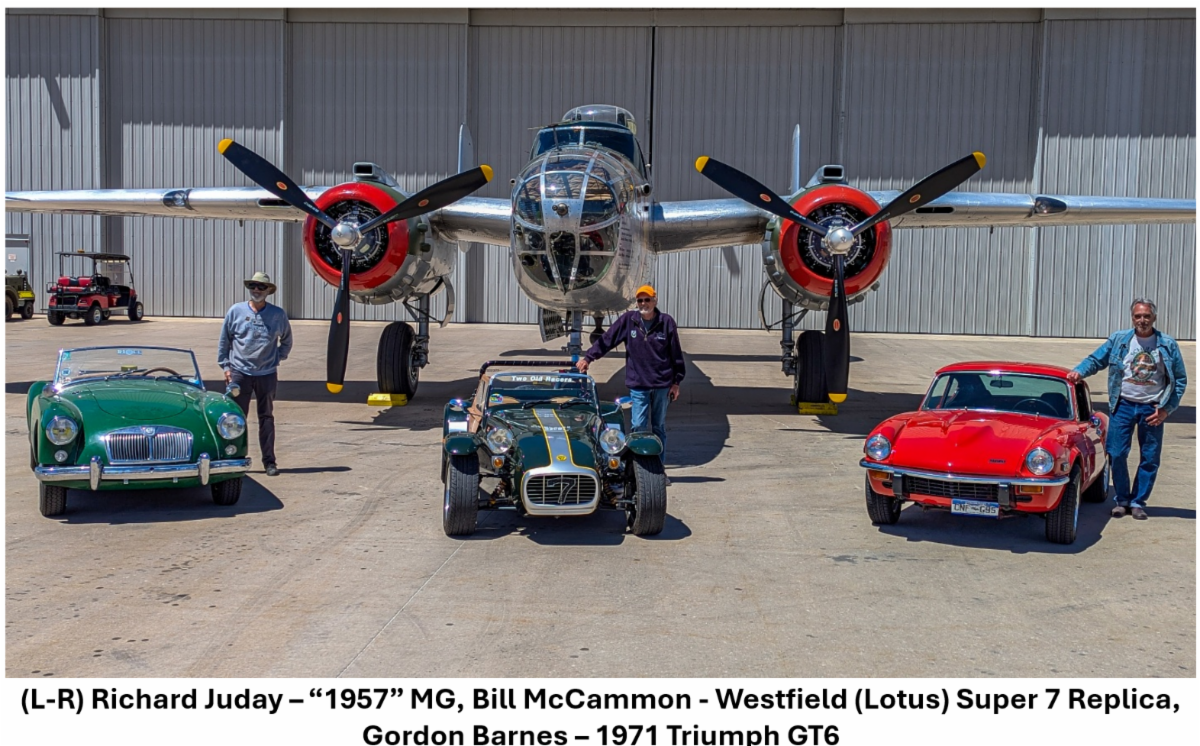
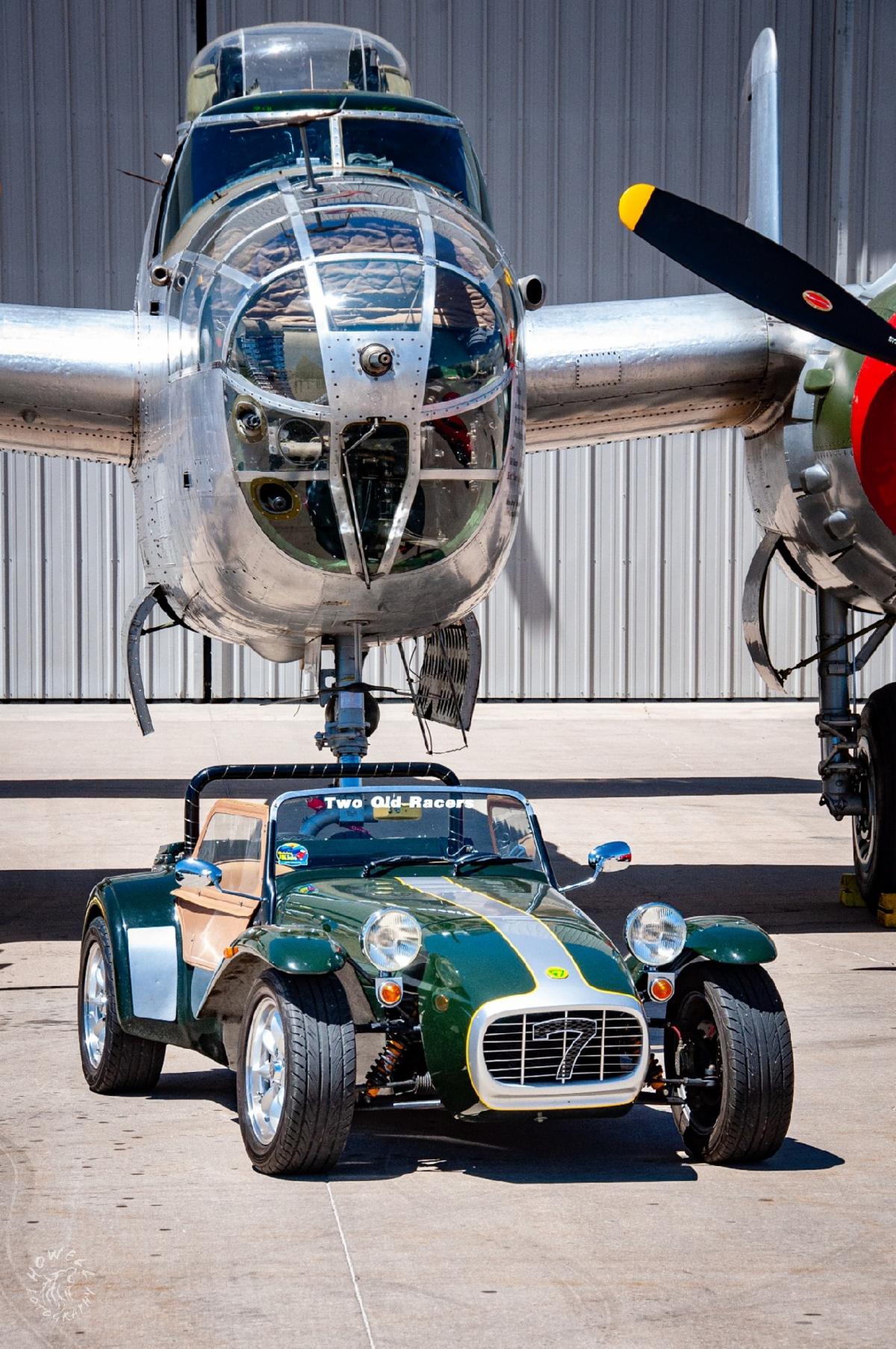
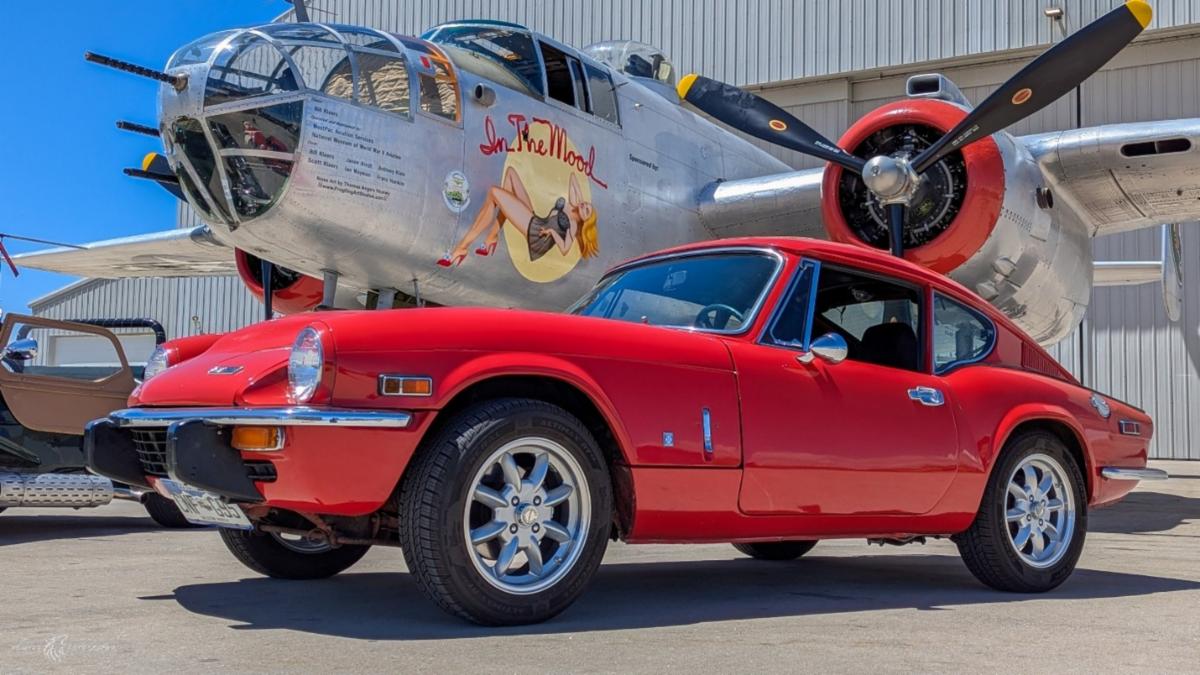
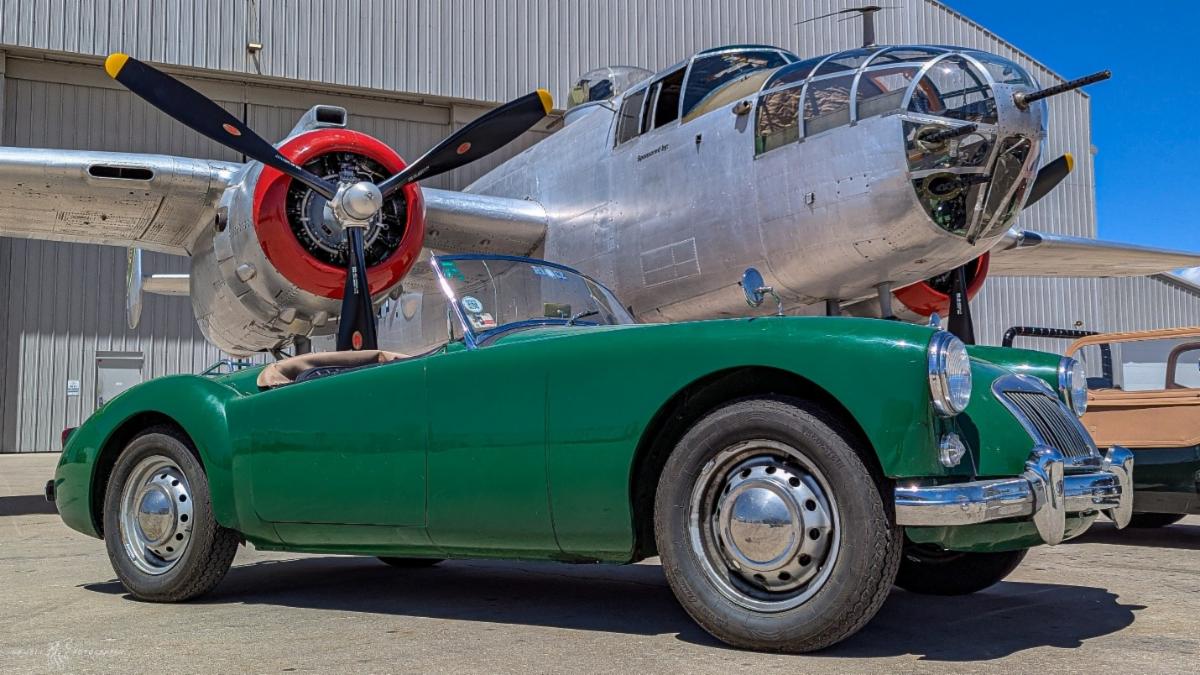
Following the "Pappy" Gunn historical presentation, members of the MG Car Club - Rocky Mountain Centre had the opportunity to pose some of their vehicles with the Museum’s B-25J Mitchell "In The Mood" for a photo shoot!
In attendance and pictured below were club members Gordon Barnes of Colorado Springs with his red 1971 Triumph GT6; Richard Juday of Longmont with his green “1957” MGA, and Bill McCammon with his Westfield (Lotus) Super 7 Replica.
| | As it turns out, restoring and driving old MGs has amazing similarities to restoring and flying old aircraft, as explained by club member Jim Goodwin. | | |
When speaking about Juday’s 1957 MGA, Goodwin said, “The 1957 date is in quotation marks because the car is a winnowed amalgam of three MGAs of differing title dates that Richard has owned. There were enough satisfactory pieces in the pile to make one good one, and in fact most of the car is from that 1957 one.
“The MGA's restoration included a body-off repainting, new wiring, radiator, brakes, hydraulics, LED headlights, alternator, electronic ignition, gas tank, and wheel bearings and -- well, you get the idea. It is brought into the modern era as well as it can be, while retaining the old British character the love of which is a semi-perverse affectation of all MG owners."
Bill McCammon often drives his Lotus and said, “I have owned it for about 8 years. I hit a deer with it about 2 years ago and had to rebuild the front end. I have rebuilt the engine and done several other upgrades to the car over the years and driven it on a 1000-mile charity run through the Colorado mountains.”
| | |
Goodwin summed up his feelings about old versus new vehicles, saying, “Modern cars are better vehicles. Arguably modern airplanes may similarly be compared with the B-25. But that roar of a radial engine being fired up -- woo!”
We couldn’t agree more, Jim ... woo!
Story and Photo Credit: George White.
| | 83rd Anniversary of Guadalcanal | | |
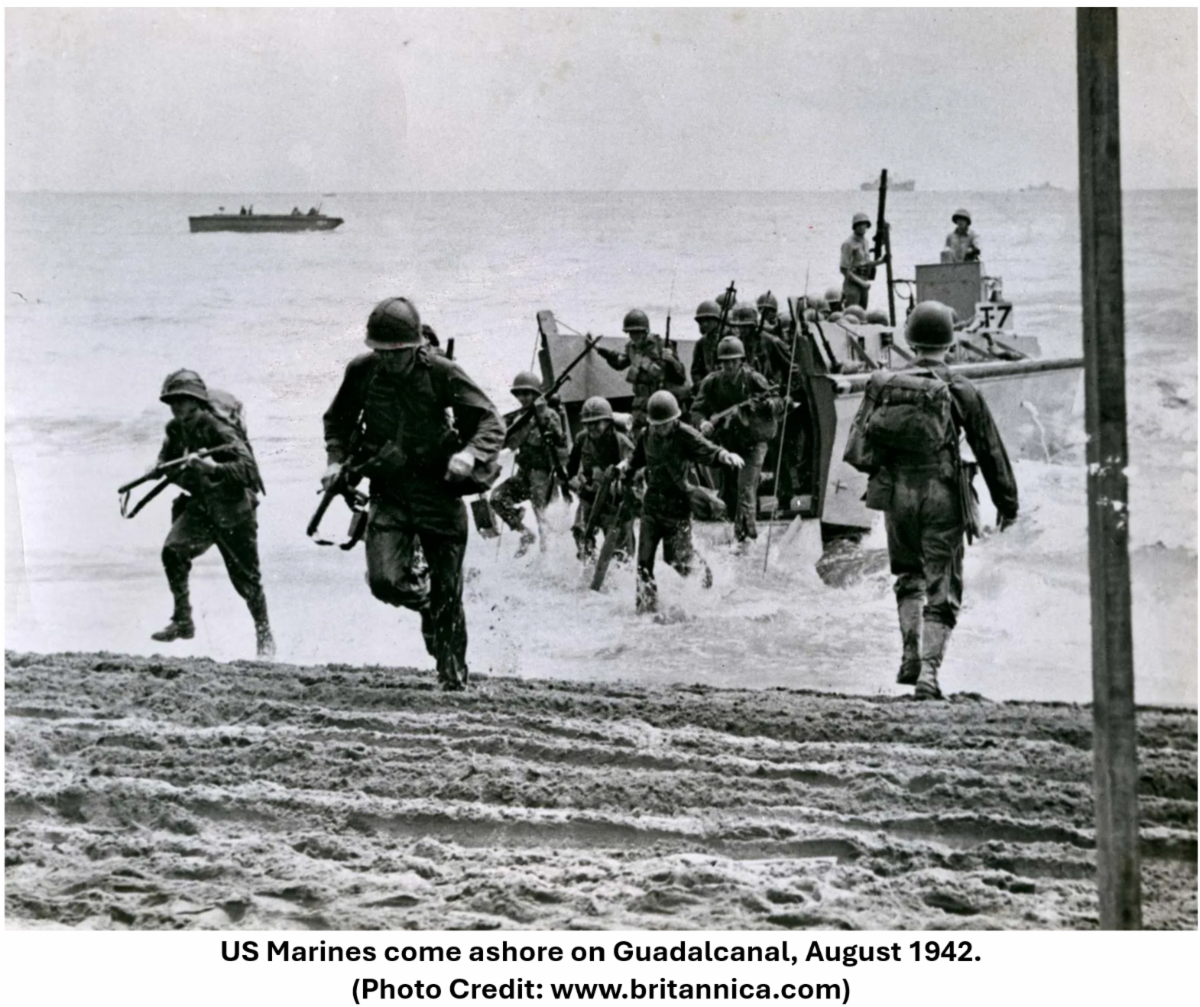
Eighty-three years ago this month, two months after the great naval victory at Midway, Marines landed on Guadalcanal on August 7, 1942, to capture and hold the airfield under construction by Japanese engineers.
The Guadalcanal campaign began with the landing of the 1st Marine Division on the Japanese-occupied island; it was the first offensive action against the Japanese in the southwest Pacific. Navy Seabees that landed with the Marines soon had the field open for operations. The captured airfield was named Henderson Field in honor of Marine Major Lofton Henderson who was killed during the Battle of Midway.
Japan wanted Guadalcanal as a base for its long-range bombers to control the sea lanes from the United States to Australia. After U.S. victories at the Coral Sea and Midway, commanders believed Guadalcanal was the place to stop the Japanese. It was a difficult campaign under extreme tropical conditions where weather and disease impacted both sides, but the eventual victory there in February 1943 began the long march to Tokyo.
| |
U.S. air power played a key role in the ultimate victory. Japanese air power attempted to drive U.S. forces from Guadalcanal, with Japanese air raids on Marine and Army positions happening continuously throughout the battle … but U.S. air power succeeded in limiting the Japan’s ability to reinforce the island. The U.S. Navy, Marine and Army pilots who defended Guadalcanal called themselves “The Cactus Air Force” as Cactus was the code name for the island.
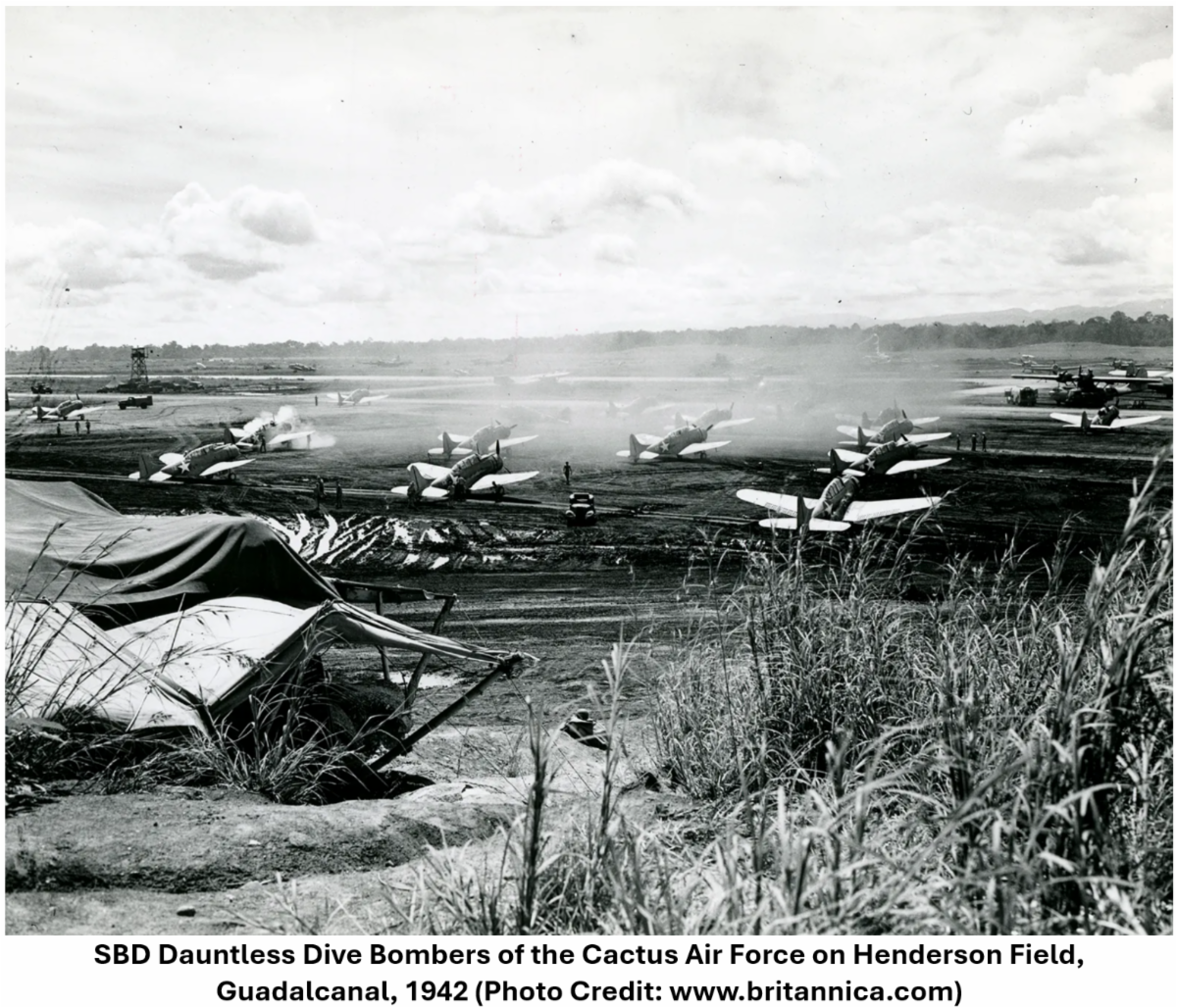
There were major air and sea battles to contest the Allied blockade of Japanese supplies and reinforcements, and there were major land battles for control of the main airfield. The Cactus Air Force of Navy and Marine F4F Wildcat fighters, SBD Dauntless dive bombers, and a few Army P-39 Airacobras defended the airfield, attacking Japanese reinforcements and supporting Marines ashore. The Guadalcanal airfields were bombed and shelled almost daily, with the Battle of Guadalcanal becoming a battle for the island’s airfields.
During the campaign, the Cactus aircraft sank 17 Japanese ships and damaged 18 more -- battleships, cruisers, destroyers & transports. U.S. fighters claimed 268 Japanese aircraft downed, which was 2.5 times the number that they lost. Japan lost 30,000 experienced troops, most to starvation and disease. After the battle, Guadalcanal became a major base for the Allied advance up the Solomons. Japan was now on the defensive.
| |
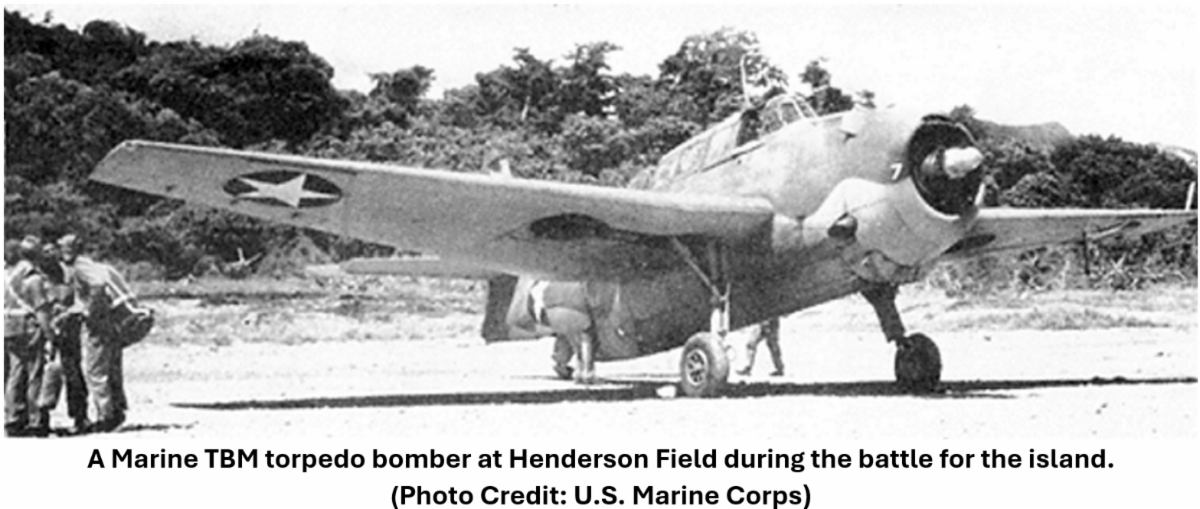
After brutal fighting on the island, and the surrounding ocean and airspace, the Japanese abandoned their efforts to retake Guadalcanal, conceding the island to the Allies and evacuating their last forces on February 7, 1943. Henderson Field was later supported by two additional airfields nearby. Henderson hosted U.S. Navy, U.S. Marine Corps, and U.S. Army Air Forces squadrons with many aircraft types including fighters, dive bombers, torpedo bombers, medium bombers, and amphibian patrol aircraft.
Guadalcanal became the jumping off point for further attacks up the Solomon Islands chain that contributed to the liberation of much of the southwest Pacific. After Guadalcanal the Japanese were clearly on the defensive in the Pacific.
Story Credit: Gene Pfeffer and Rich Tuttle
| | Welcome Kris Toy, Our New Membership Coordinator | | |
Hi, I’m Kris Toy. My husband, Dave, and I have been volunteers with the Museum for the past several years, and I’m thrilled to have recently taken on the role of Membership Coordinator.
I’m excited for the opportunity to get to know the members and learn what is important to each of you. My interest in World War II aviation is sparked by Dave’s Dad and his service as a radio operator on B-17s during the war. Dave and I have been fortunate to fly on a B-17 several times starting in 2017, and it’s hard to describe the connection I felt to my father-in-law who I never had the opportunity to meet.
We all have our stories, and I love hearing them. The next time I see you at the Museum, please tell me about yourself and tell me your story.
| | Join Kroger's Rewards Program and Support the Museum at No Additional Cost to You! | | |
Do you already have a King Sooper’s card? Support the museum through Kroger’s nonprofit rewards program; it’s the easiest way to help keep ‘em flying!
You can support the National Museum of World War II Aviation just by shopping at any Kroger store, King Soopers or City Market in Colorado, or at any other Kroger brand such as Ralphs, Fry's, Fred Meyer, Smith’s, Food 4 Less, or Harris Teeter!
To support the museum, shop online or at your local store, swipe your Loyalty Card, and funds will be donated to the museum at no added cost to you.
Sign up today to transform your everyday shopping into museum support:
1) Visit https://www.kingsoopers.com/signin or https://www.citymarket.com/signin
2) Sign in if you have an account, or click “Create an Account” and enter your name, email, and password. If you have an existing loyalty card, enter your card number or “Alt ID” (usually a phone number)
3) Once logged in, go to the user icon toward the top right corner of the window. From the drop-down menu, click “My Account”
4) Scroll the menu options and select “View Community Rewards”
5) When prompted to “Find an Organization,” use the search bar to look up "National Museum of World War II Aviation" or "BH543."
6) When the "National Museum of World War II Aviation" option appears, click “Enroll."
It's that easy!
Please do not hesitate to call Lance James at 719-637-7559 if you need any help linking your shopper's card.
Thank you for taking the time to register and supporting the museum, and for helping us to keep ‘em flying!
| | |
Special Presentation:
Cat Tales: Stories of the PBY in the Pacific
Saturday, September 13, 2025
Museum opens at 8:00 a.m.
Presentation at 9:00 a.m.
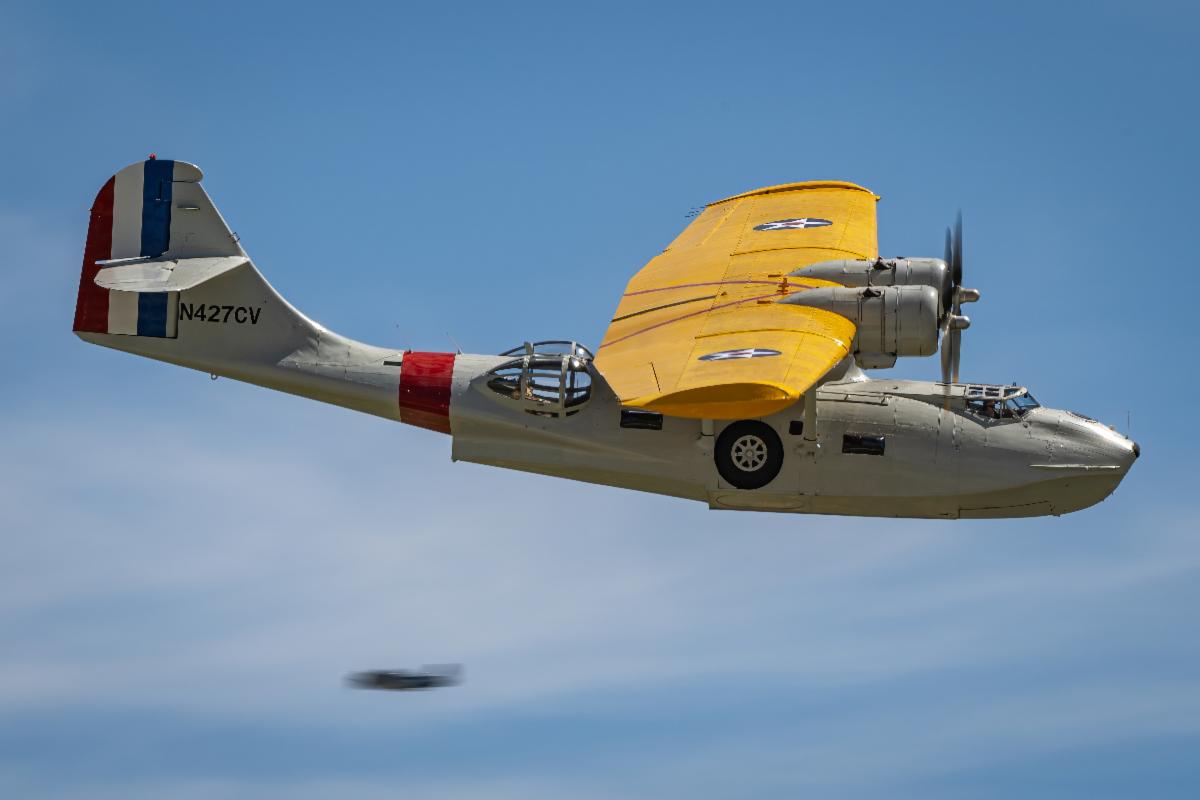
A demonstration flight of the Museum's PBY Catalina will follow the presentation (weather permitting)
The PBY Catalina was one of the most famous and most numerous of its type in WWII. PBYs were used for reconnaissance, anti-submarine warfare, bombing missions, convoy escort duties, search and rescue missions, and as a cargo transport.
There are many tales of unique missions, dangerous rescues, and night attacks associated with this great aircraft and the men who flew it. One PBY pilot was awarded the Medal of Honor; another went on to play an important role in Colorado government. In 1945, a PBY was critical in the rescue of survivors of the USS Indianapolis, whose sinking was one of the worst U.S. naval disasters of WWII.
On Saturday, September 13th at 9:00 am, museum docent and retired U.S. Air Force Flight Surgeon Colonel Dave Schall will present the multi-faceted story of several key missions involving the PBY and the riveting stories of the heroes who flew them.
Weather permitting, the presentation will be followed by a flying demonstration of the museum's PBY. Scheduled runway closures at the airport may require altering the normal demonstration flight pattern.
Standard admission prices are in effect. The purchase of advance on-line tickets is encouraged.
Advance ticket prices are:
Adult - $17
Child (4-12) - $13
Senior and Military - $15
WWII Veterans – Always FREE!
Children 3 and Under – Always FREE!
Museum Members - Included in membership; please call 719-637-7559 or stop by the front desk to make your reservations.
And of course, parking is always FREE!
Story Credit: Colonel Gene Pfeffer (USAF-retired), Museum Curator and Historian
| | Give Us Your Newsletter Feedback! | | |
Do you really love an article? Did a photograph really wow you? Have a question about a story? Want to see more of a certain topic? Did something spark a memory that you'd like to share with us?
We'd love to hear your what you have to say about the newsletter; let us know by dropping the editor a message at newsletter@worldwariiaviation.org!
| | Newsletter Staff / Contributors | |
Gene Pfeffer
Historian & Curator
| |
Rich Tuttle
Newsletter Writer, Social Media Writer, Photographer
| |
John Henry
Lead Volunteer for Communications
| |
George White
Newsletter Editor, Social Media Writer, Photographer
| | | | |