 |
Child Action, Inc.
is a private, nonprofit organization created in 1976 to provide for the education and social welfare of children and families and to advocate on their behalf. Our goal is to partner with families and assist them in the care and education of their children and to advocate beside them in support of their concerns. We want to do our part in promoting the healthy growth and development of children and families living in Sacramento County. We strive to meet the needs of our community and as those needs change, we do our best to continue to grow and develop our services to better serve parents and providers. We are proud of the diversity of our staff which is able to assist parents and providers in 23 different languages!
Click Here to learn more.
**Thank you to Elaine Arteaga, Director of Client Services, for the submission!**
|

Davis Street APP Parent success story:
About a year ago in April 2018, we enrolled a CPS 4 year old child who was abandoned by the mother, and was a in the process of being united with the father. The father who was referred to our agency for child care payment assistance had just started a job a month before, and was in desperate need of child care to continue to work and be able to be awarded the custody of the child since he had been homeless, and just moved in with a friend in order to provide a stable living situation. Our Davis Street Child Development Center had a preschool opening and the father was able to choose this child care learning environment.
The first few months on the program were challenging for both the parent and child as the child adjusted to the changes in his environment. The child was not easily adjusting to a group child care setting. The child and father were having difficulties bonding in the new home setting, but with the support of our in-house resource services, Davis Street was able to provide the father and child with behavioral health counseling, food, clothing and referrals to outside resources to assist his child's social-emotional needs at the preschool along with the social services in -home visits.
Today, both child and father are thriving at home, work and school. The father expressed his gratitude for having the support of the APP program and other Davis Street resources as his child is now ready to enter Kindergarten this Fall!
-----------------------------------------
Do you have success news to share with us?! We love to hear what our members are up to and where they're going! Submit your accomplishment(s) big OR small by emailing us!
|
|
|
CAPPA's
2018-19 Board of Directors
|
|
Rick Richardson
Child Development Associates
Karen Marlatt
Valley Oak Children's Services
Beth Chiaro
Child Care Resource Center
LaVera Smith
Supportive Services Fresno
Martin Castro
Mexican American Opportunity Foundation
Jeffrey Moreira
Crystal Stairs, Inc.
Public Policy Co-Chair
Phillip Warner
Children's Council San Francisco
Tina Barna
Choices for Children
Abby Shull
YMCA Childcare Resource Service
Leslie Reece
Family Resource & Referral of San Joaquin County
Jeanne Fridolfs
Napa County Office of Education
Mike Michelon
Siskiyou Child Care Council
Marco Jimenez
Central Valley Children's Services Network
San Mateo 4Cs
Michelle Graham
Children's Resource & Referral of Santa Barbara County
Joie Owen
Glenn County Office of Education
Denyne Micheletti Colburn
CAPPA CEO
|
|
|
ELCD/CDE, DSS & CCLD Updates
|
|
The ELCD will host a webinar on
Thursday, March 14, 2019 from 10 a.m. to 12 p.m. to provide technical assistance with the CDMIS.
January 28, 2019
January 4, 2018
The California Department of Social Services (CDSS) has amended regulations pertaining to CalWORKs, within the Eligibility and Assistance Standards Manual. The changes are detailed in
CDSS Manual Letter No. EAS-18-05
|
|
|
Is Your Organization Hiring?
Post your job announcement here for thousands to see!
There is no charge for CAPPA members.
Non-members will be charged a fee of $75.
MCT Technology
Child Care Resource Center
Community Action Partnership of San Luis Obispo County, Inc.
Pomona Unified School District- Child Development
Child Care Coordinating Council, Inc. of San Mateo County
|
The CAPPA Board has made it a priority to support our field with a coordinated calendar to note upcoming statewide conferences, federal conferences of relevance, CDE and DSS stakeholder meetings and legislative and budget deadlines and hearings.
NOTE: If you would like to share your newsletter or items of interest with our field via the Monday morning e-Newsletter, then please
email us
a link. Please make sure that you have a link included to an online version or viewing.
|
|
|
Become a Monday
Morning
Update
Partner!
|
|

Our Monday Morning Update supports our Early Learning & Child Care field with timely information about what is going on in California and nationally; as well as dates to be aware and upcoming events.
Our weekly (50 times per year) Monday morning distribution is to more than 4,000 federal and state local agencies, resource and referrals, contractors, legislators and their staffs', centers, parents, providers, state departments and advocates.
To help support the continuation of this resource and or advertise in the Monday Morning Update, click
HERE.
You can also make a donation to CAPPA and CAPPA Children's Foundation
The Children's Foundation is a non-profit organization (501(c)3), Taxpayer Identification Number is
03-0521444. Your generous donation is tax deductible.
|
|
|
|
|
Last Thursday,Governor Newsom released the
2019-20 May Revise also referenced as the "May Revision." The May Revision provides updates on the state's finances that may then be taken into account to update previous proposals or to introduce some new ones.
Overall the May Revision reflected higher revenues than previously projected by roughly $3.2 billion. To seek the links to the May Revision, the Department of Finance "one-pagers", and much more, click
CAPPA's Budget Page.
One area for celebration is the commitment to fund
SB 321 (Mitchell), Strong Start for CalWORKs Families Act co-sponsored by Parent Voices and the Child Care Law Center. SB 321 provides families who enter the CalWORKs program with quality affordable child care to bring stability to families in crisis. Stage 1 child care will be authorized for 12 months, or until transfer to Stage 2, establishing continuous affordable child care for families. This measure aligns Stage 1 child care rules to all other subsidized child care programs in California, including Stages 2 and 3. Continuous child care will minimize disruptions for children, parents, employers, and child care providers.
Other funding areas for our field to be aware are:
- $80.5 million Cannabis Fund to subsidize child care for school-age children from income-eligible families.
- $40.7 million in General Funds (GF) in 2019-20 and $54.2 million in GF ongoing to bring 12 month eligibility into the CalWORKS Stage 1 child care program. The Governor notes "this will provide CalWORKs clients consistent child care access while their work activities stabilize."
- $12.8 for emergency child care vouchers. These vouchers will allow vulnerable families to maintain work activities by providing emergency child care services through the Alternative Payment program as they pursue job stability.
- $2.2 million ongoing federal funds to improve child care quality through Quality County California.
- $38.2 million ongoing GF to supplement the Stage 2 and Stage 3 funding to account for an additional 14,000 children receiving child care services. This caseload increased resulted from the adoption of increased income eligibility and 12 month eligibility rules.
- Reduces proposed State Preschool expansion increases by $93.5 million to reflect an adjustment to the Governor's Budget proposal to provide 10,000 State Preschool slots at non-local educational agencies beginning July 1, 2019. This adjustment reflects a change to release 2,500 slots starting April 1, 2020, and 7,500 slots starting July 1, 2020.by postponing the release of the additional 10,000 preschool slots until April 1, 2020.
- Of the amount appropriated $31,400.000 is available beginning April 1, 2020 to provide 2,500 additional full-day state preschool slots to non-local educational agencies."
- COLA's adjustment for non-CalWORKs decreased from 3.46 percent to 3.26 percent
- Standard reimbursement rate shall not exceed $49.54 per day general child care/$30.87 per day part-day California state preschool programs/ $49.85 for full-day California state preschool programs
- $1.7 million increase to state child nutrition program
Click here to read
Trailer Bill Language (TBL) for some of the May Revision proposals.
Click here to view a field calendar that will include legislative and bill hearing dates. Below are scheduled budget hearings:
- May 14, 2019 ASM Sub 2 on ECE and K-12 in May Revise
- ASM Sub 2 will close out all actions the week of May 20
NOTE: Although the May Revision had much in it to help families such as a boost to $1,000 per family to the Cal-Earned Income Tax Credit, expanded Paid Family Leave, elimination of taxes on menstrual products and diapers, children from birth to three were largely forgotten. In the coming days as we gather more information, please be prepared to elevate our voices and demand more spaces for our babies. Working families need child care so that parents can secure and maintain employment in our 24 hour/7 days per week workforce. Employers need stable and reliable workers. Child care is the cornerstone of a vibrant and thriving California economy.
|
|
|
ECE Coalition Day - May 21st!!!
|
|
SAVE THE DATE - MAY 21, 2019
ECE COALITION ADVOCACY DAY
Come join us on ECE
Child Care Advocacy Day! This is a day advocates will join together, in a shared voice, to advocate for child care and early education.
The Governor's May Revise will be released mid-May. We already know that child care and early education is a priority of the governor as well as the Legislative Women's Caucus.
On this day we need to make sure that we provide the input on the best way to  maximize the dollars to make the biggest impact on supporting our earliest learners and increasing access for working families.
More details will be forthcoming. If you would like to join other advocates and groups and participate in meetings with legislators and staff, then send an email with the names of who your legislators are and/or who you would like to meet with.
|

WHAT DO WORKING FAMILIES NEED?
ACCESS!! WHEN DO THEY NEED IT? NOW!!
AB 194 (Reyes) will be heard in ASM Appropriations Suspense on May 16!
On behalf of a broad based partnership of early childhood education advocates, centers, service organizations and parents working together to secure more access to child care California's low-income and working families, we come together to ask for $1 billion over three years for the Building Equitable Futures for Families Act. This much needed funding will immediately improve access to affordable child care by increasing the number of low-income children served in Alternative Payment Programs and General Child Care.
With good, affordable child care, families can go to work with peace of mind knowing that their children are safe, nurtured and learning. However, the vast majority of families cannot afford child care because the state does not provide enough affordable spaces to support children from the beginning of their lives.
The California Center on Budget and Policy estimates that there are 1.8 million eligible children waiting for care, 86% of which are children of color. This funding will create a strong start for children and their families by funding thousands of new child care spaces. These child care spaces will have two-
generational impact, by both supporting the child's development and the family's economic success. Supporting children from the beginning of their lives lays the foundation for a brighter future for everyone: children will be ready for school, their families are able to work and provide for their needs, and our communities grow stronger.
If we want to close the opportunity gap for children of color, we must invest in a multi-year effort that allows all children to thrive. Providing $1 billion will expand access to affordable child care from birth and supports the whole family moving forward. This is particularly responsive to the needs of he many of the state's low-income families, disproportionately single mothers of color who work in jobs meeting the demands of our 24/7 economy. Child care options must meet their unique needs, which for a majority of low-income parents include non-standard and inconsistent work schedules. This funding is the key to addressing the inter-generational cycles of poverty by allowing parents to work and create opportunities for their families. This is how we promote equity from the start.
If you would like to join onto the support letter being submitted by the following noted below,
click here
to send your logo:
|
- Monday, May 13, 2019:
- SEN Appropriations (Portantino, Chair)
- Thursday, May 16, 2019:
- ASM Appropriations SUSPENSE (Gonzalez, Chair) *upon adjournment of session
- ASM Appropriations (Gonzalez, Chair) *upon adjournment of session
- SEN Appropriations SUSPENSE (Portantino, Chair) *upon adjournment of session
Click here
to see all of the legislation identified of interest to our field.
Click here to see calendar of field events/interests and legislative hearings and deadlines. If you would like something added to the field calendar, click here and submit details.
|
PROFILED BILL OF THE WEEK
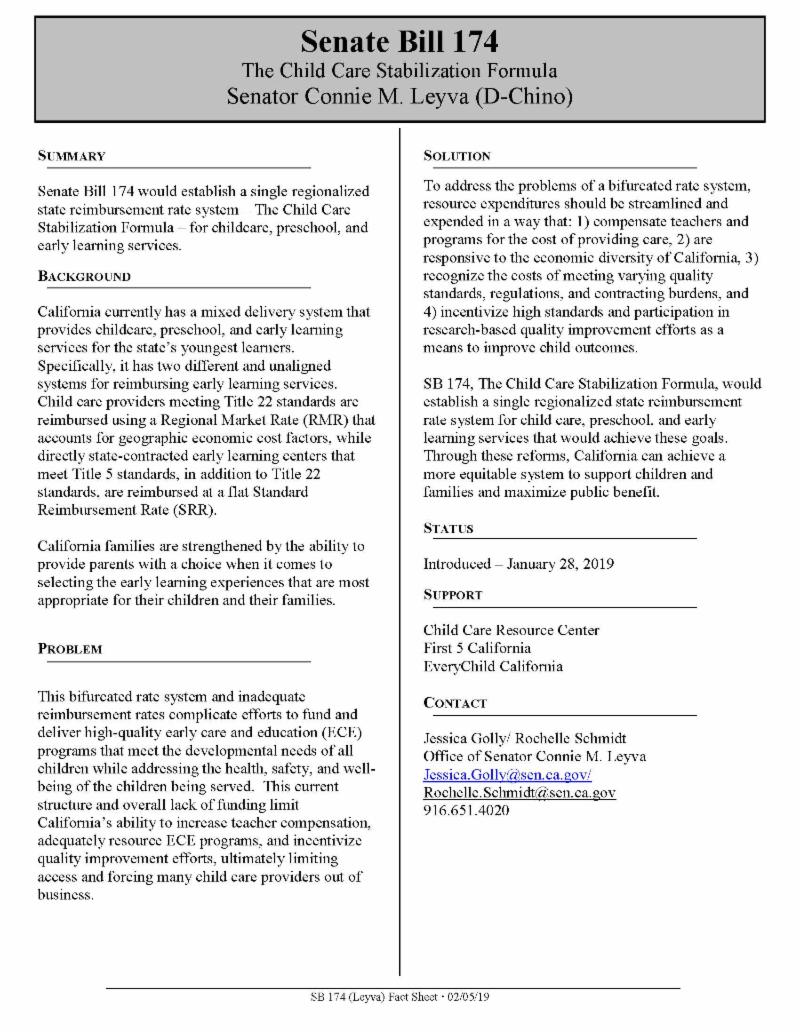
SB 174 ~ Senator Connie Leyva
The Child Care Stabilization Formula
This bill would replace the current bifurcated child care reimbursement rate system with a single, regionalized reimbursement rate in order to achieve a more equitable system to support children and families.
|

Contingency Funds Application Process
Dear Alternative Payment Program Contractors:
The purpose of this letter is to provide Alternative Payment Program (CAPP) contractors with information regarding the process to apply for contingency funds.
Pursuant to Education Code Section 8222.1, per the Budget Act of 2018, the California Department of Education (CDE) shall reallocate funds as necessary to reimburse CAPPs for actual and allowable costs incurred for additional services. A CAPP contractor may apply for reimbursement of up to three (3) percent of their contract amount, or for a greater amount subject to the discretion of the Department, based on availability of funds. Applications may be submitted as early as May 1, 2019, but no later than September 30, 2019. The CDE will approve or deny applications submitted pursuant to this section, but will not consider applications received after September 30, 2019, of the current calendar year for additional costs incurred during the 2018-19 fiscal year.
The CDE will distribute reimbursement funds for each approved application within 90 days of receipt of the application if it was filed between May 1 and July 20 inclusive of the current calendar year. Applications received after July 20 are not subject to the 90-day requirement for the distribution of funds. If requests for reimbursement pursuant to this section exceed available funds, CDE will assign priority for reimbursement according to the order in which it receives the applications.
Funds received by a CAPP contractor pursuant to this section that are not substantiated by the program's annual audit must be returned to CDE and are not subject to the appeal process.
If you have any questions regarding this process, please contact me at 916-324-6611, or email JClegg@cde.ca.gov.
Sincerely,
Jordan Clegg, Staff Services Manager I
Child Development & Nutrition Fiscal Services
Fiscal and Administrative Services Division
|
SAVE THE DATE- Early Learning and Care Division
This notice informs ELCD contractors of key SAVE THE DATE Request for Applications (RFA) events for the following RFAs:
- The California State Preschool Program (CSPP) Expansion RFA will announce score notifications to applicants by mid-March 2019, and send out Proposed Award Letters in mid-May 2019. The program start date will be June 28, 2019. Please note this date has changed from previous years' start dates.
- The General Child Care and Development (CCTR) RFA will announce score notifications to applicants by mid-March 2019, and send out Proposes Award Letters in mid-May 2019. The program start date will be June 28, 2019. Please note this date has changed from previous years' start dates.
- For all other questions regarding the CSPP RFA, please send an email to CSPPRFA@cde.ca.gov.
- For all other questions regarding the CCTR RFA, please send an email to CCTRRFA@cde.ca.gov.
|

Network and CAPPA Joint Annual Conference 2019
October 2-4, 2019
DoubleTree Hotel Sacramento
Sacramento, CA
The California Child Care Resource & Referral Network and the California Alternative Payment Program Association look forward to hosting our 7th Joint Conference together this fall.
Registration information, along with a preliminary conference program, will be released in July. At that time, online registration will be open and attendees will be able to indicate their
workshop selections when they register for the conference.
|
|
Help Increase CA's Families' Access to Childcare!
A
majority of CA families cannot afford child care because the state does not provide enough affordable spaces to support children from the beginning of their lives. Sign on to urge CA leaders to expand access to affordable.
|
The Western Center on Law and Poverty just recently released their 2018 Annual Report. Click
here
to read it!
|
|
Dollars and Democracy: A Guide to the State Budget Process
Expanding the CalEITC: A Smart Investment to Broaden Economic Security in California
The California Earned Income Tax Credit (CalEITC) is a refundable state tax credit that helps people who earn little from their jobs to pay for basic necessities. The CalEITC builds on the proven success of the federal earned income tax credit (EITC), which reduces poverty and boosts employment, and may even improve children's health and educational attainment.
A new California Budget & Policy Center guide,
Expanding the CalEITC: A Smart Investment to Broaden Economic Security in California, provides an overview of how EITCs support families, children, and communities; examines key features of the CalEITC; and shows how Governor Gavin Newsom's 2019-20 budget proposal to significantly expand the credit will impact state residents with low incomes. The guide also highlights several ways that the CalEITC could be further strengthened, including by extending the credit to working immigrants who pay taxes and to unpaid family caregivers.
|
|
Solid Evidence for Career Pathways Out of Poverty
Project QUEST in San Antonio was a pioneer in creating what is now known as an adult career pathway program. The program combines sector strategies, comprehensive support services, community-based career navigators, foundational skill building, and community college postsecondary training. Strong evaluation results prove the effectiveness of this model for increasing the earnings of low-income adults. Promisingly, career pathways are now a defined service delivery model for equity investments in communities of need in three federal education and workforce development laws: the Workforce Innovation and Opportunity Act (WIOA), the Higher Education Act (HEA), and the Strengthening Career and Technical Education for the 21
st
Century Act (Perkins V).
Click
here for full article.
|
|
Closing the Gap: How CCR&RsCan Help Communities Meet Their Child Care Supply and Demand Needs
Child Care Aware® of America recognizes that Child Care Resource and Referral (CCR&R) agencies have a strong presence in communities throughout the country and extensive knowledge of the child care landscape. Our new report, Closing the Gap: How CCR&Rs Can Help Communities Meet Their Child Care Supply and Demand Needs, highlights examples of CCR&Rs and advocacy organizations and their approaches to ensure families' and communities' needs are met. With extensive knowledge of the child care landscape and firmly positioned in communities, CCR&Rs are uniquely qualified to identify gaps in child care supply at state and local levels.
|
|
Pelosi calls for investments in
child care, early education
Speaker
Nancy Pelosi (D-Calif.) on Friday voiced support for increased federal funding of early child care and education while touring schools in Massachusetts.
Joined on the trip by several congresswomen from the state, Pelosi told reporters that her primary motivation for serving in government has been improving life for younger generations,
according to The Associated Press.
"My 'why' has always been the 1 in 5 children in the United States who live in poverty," she said, according to the news service. "Everything that we do has to be about the children and their future."
The Speaker made the remarks after touring the Eliot-Pearson Children's School at Tufts University and reportedly emphasized that education funding is a long-term economic booster.
Pelosi said she stressed the need to fund programs aimed at helping children with disabilities when she met this week with
President Trump and Senate Democratic Leader
Charles Schumer (N.Y.) to discuss infrastructure, the AP reported.
Pelosi was joined on the trip by Democratic congresswomen including Reps.
Katherine Clark and
Ayanna Pressley, two founding members of the Black Maternal Health Caucus, a congressional working group focused on efforts to reduce the racial disparity in death rates from pregnancy-related complications.
In 2017, as part of the then-minority Democrats' "Better Deal" agenda, Pelosi co-sponsored a bill that would have ensured that low-income families pay no more than 7 percent of their income on child care expenses.
The bill would have also supported universal preschool access for 3- and 4-year-olds, and improved training and pay for child care workers.
|
|
|
|