IEF Image Banner

Intertribal Education Foundation

Elevating Indigenous Knowledge. Securing Indigenous Futures.

Welcome to IEF's May 2023 Newsletter

We hope this newsletter finds you well and as always, thank you for your

constant support. Please reach out to share ideas and comments!

Visit our website to learn more!

Donate

Letter from the Executive Director

Dear Nicole,


I hope the sun is shining upon you! As the school year ends and summer starts to show itself, my mind always turns to the many ways summer break affects our students. Summer break is known to be a period of learning loss, and many teachers assign summer homework and reading to help limit the amount of learning loss students experience. In communities around the world, summer break (at any time of year) is often a time of difficulty and expense for parents. While our learners might need a break from academic rigor, concerns over childcare, enrichment, and even food security often lead to hardships for the household. Even for those who do not struggle with food security, knowing how to help others access food options during summer break is important. Here are a few tools to help you help your family and community:

  1. Find your local food bank via Feeding America.
  2. Find meals for kids via USDA’s Summer Meals for Kids site finder. 
  3. Text the word "FOOD" to 304-304 to locate nearby options via No Kid Hungry.  


(I must note my disappointment in coverage for much of Indian Country. If you know of resources in your area, please share them with us, and we will help spread the word.)


As for enrichment, I seem to read most during the summer months. I’m known to put my phone or e-reader in a waterproof bag (a couple of zip-top plastic bags will often do the trick) and read while I float in the nearest cooling body of water. Even though we stay busy during the summer months, the heat gives me a slow-down mentality, and my love of reading flourishes. Reading together is a great way to combat summer learning loss in children and build a lifelong love of reading in them. Kids love getting to choose their own books rather than reading what they have to for school, and something as simple as putting a blanket down in the yard after dinner and each person reading to themselves can strengthen bonds, reading skills, and thinking skills without feeling like homework. Keep reading this newsletter for more information on how to create your summer reading challenge and join us as #IEFreads! 


Sending you a summer slow-down mindset, 

Nicole Nash's Signature

Nicole B. Nash, Executive Director

Connect with Nicole

PS. We appreciate all you do, and we can’t do it without you! Please donate to IEF today so we can keep getting amazing programming opportunities for Indigenous students and adults. 

Program relevant topic

Join the IEF Summer Reading Challenge! Did you know Nicole, our Executive Director, used to be a literacy specialist for high-school-age learners? Here are her tips for getting readers of ANY age excited for summer reading:  


  1. Let the reader choose. As a parent, guardian, or other trusted adult, it’s important to give young readers some guidance in selecting what to read, but don’t limit them. Consider picking a theme (check out this month’s Culture Connection for reading list resources) and a selection of age-appropriate books, then let your reader (even if that is yourself!) select what they want to read. Having sovereignty over what to read builds intrinsic motivation to read.
  2. Ask questions about what they are reading every day. This can be as simple as, “How are you liking that book you picked out? What happened in it today?” This achieves two goals: 1. Sets the expectation that they will read daily without forcing it, and 2. Provides an opportunity for them to engage about their experience (this helps turn a solitary activity into a social one).  
  3. THEY DON’T HAVE TO LIKE IT! I’m using all caps here because being forced to like something you’re reading is absurd and one of the foremost problems many schoolchildren have with reading. It’s okay not to like a book! If your child doesn’t like the book after a couple of chapters, let them pick another book. But first, make them explain to you WHY they don’t like the book. “I don’t like it” isn’t critical thinking. “I don’t like it because the main character isn’t somebody I feel like I want to be friends with” IS critical thinking and opens up the moment for a deeper conversation about what kind of things your child dislikes in the character and what they do like in a friend. Have a conversation about it, then help them move on to another book that they hopefully will enjoy. 

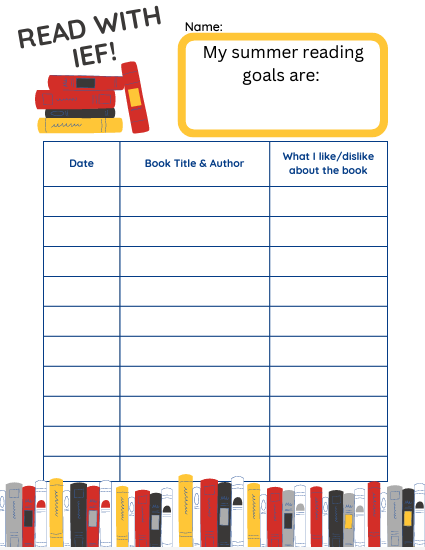
4. Track their efforts (and yours). Download and print our handy reading challenge tracker and work together to set summer reading goals. Do you each want to read five books this summer? Is there a particular topic you want to learn about? Write your goals down, and display the tracker somewhere prominent, like the fridge. When a book is begun, note the date, title, and author. When the reader is done with the book (even if they didn’t finish it because they didn’t enjoy it), write the end date and notes about what they like or didn’t like about the book. For younger readers, heaping praise when they are done with a book provides validation and builds motivation to continue. 

5. Celebrate! When somebody meets their summer reading goals, find a way to do something special to celebrate. Ideas include a special movie night, a family ice cream party, or maybe a special day trip.  


We want to know what you’re reading this summer! Tag us on social media and use the hashtag #IEFreads to share what books are on your summer reading list!

Culture Connection

We think more people should learn about the experiences and cultures of Indigenous people from Indigenous voices. Here are some helpful lists of book recommendations to help us all do just that: 

  1. Native American Children’s Literature Recommended Reading List by the First Nations Development Institute. 
  2. 20 Best Books by Native American Authors to Add to Your Bookshelf by Good Housekeeping. 
  3. Book recommendations from the staff at the First Nations Development Institute, broken down by topic. 
  4. Native American Young Adult Books You Need to Read (Native American authors and characters) by the Los Angeles Public Library. 

Use #IEFreads to let us know what you’re reading this summer! 

Facebook  Twitter  Instagram  Linkedin  

Was this email forwarded to you?

Email us or head to our website to subscribe to our monthly newsletter!