|
The Corresponder
The Newsletter of the Committees of Correspondence for Democracy and Socialism
| | |
"WE NEED TO SING AS WE GO MARCHING:”MUSIC
AND SOCIAL MOVEMENTS
Monday, May 26, 2025, 8 pm (Eastern)
Committees of Correspondence for Democracy and Socialism (CCDS)
Socialist Education Project (SEP)
4 th Monday Webinar Series,
As Patti Smith declared in an NME Song Stories segment:
“… what we wanted to do was remind the listener of their individual power but also of the
collective power of the people, how we can do anything. That’s why at the end it goes, “I believe
everything we dream can come to pass, through our union we can turn the world around, we can
turn the earth’s revolution.” We wrote it consciously together to inspire people, to inspire people to come together.
https://www.youtube.com/watch?v=y6Wz3i_BYUc
| | |
As the crisis of democracy deepens and genocidal
violence spreads around the world, social movements
continue to expand. As in the past, activism is and has
been inextricably connected to culture-song, drama,
literature, graphic arts and painting. This webinar will
assess the role of music in building and sustaining social
movements. Panelists will describe their experiences as
performers, activists, and educators in reference to music
and social movements. After brief commentary and
performances by panelists, attendees will be invited to
raise questions and share their experiences.
Panelists:
Kristin Lems is an American musician, singer-songwriter, feminist, and author/educator in the field of teaching English as a Second Language. Hers songs on “The Theocracy” and “We Will Never Give Up” are classic.
Doug Morris (Ph.D., Penn State) teaches in the world of critical pedagogy at West
Chester University. He is a former jazz guitarist, a singer, a composer, and a performer of
"people's songs." Dr. Morris has written about Woody Guthrie, Pete Seeger, Bruce
Springsteen, and others in the tradition of "people's music”.
To Register: https://us02web.zoom.us/meeting/register/U8YmtQ4QQa6WDFojq17JfQ
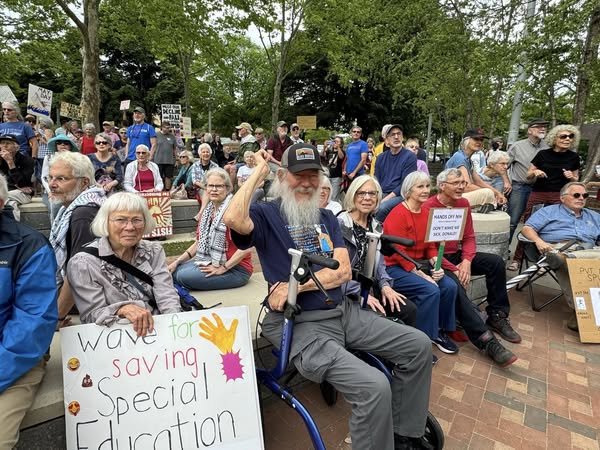
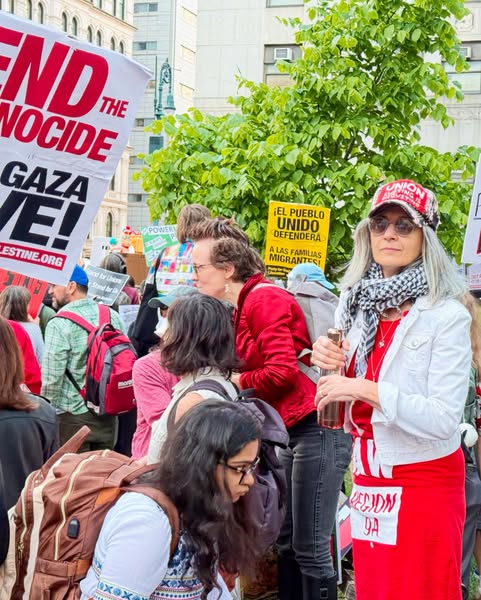
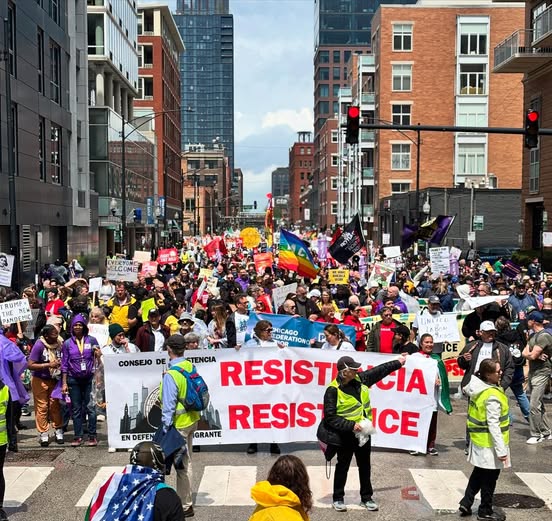
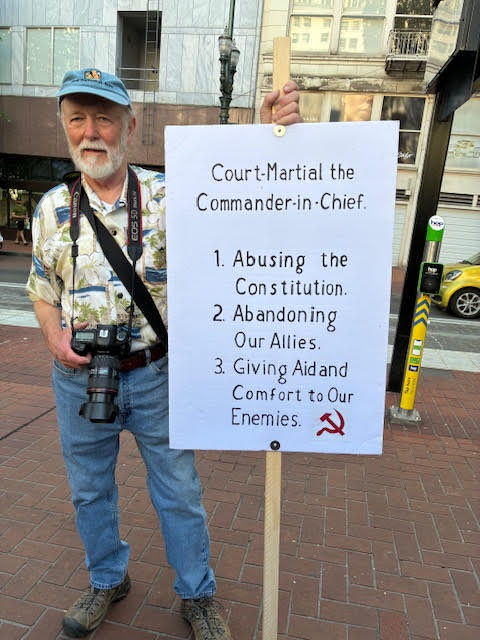
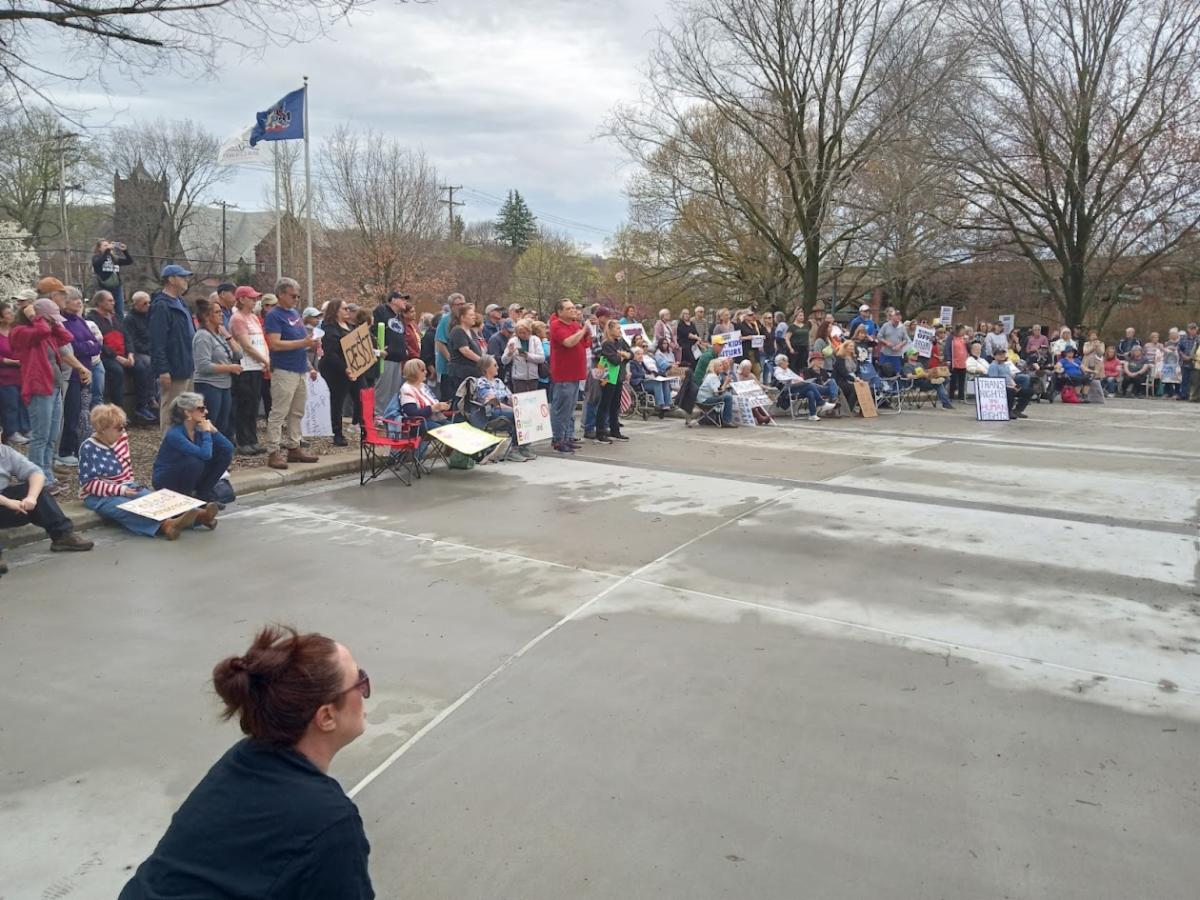
| | Miscellaneous May Day photos | |
|
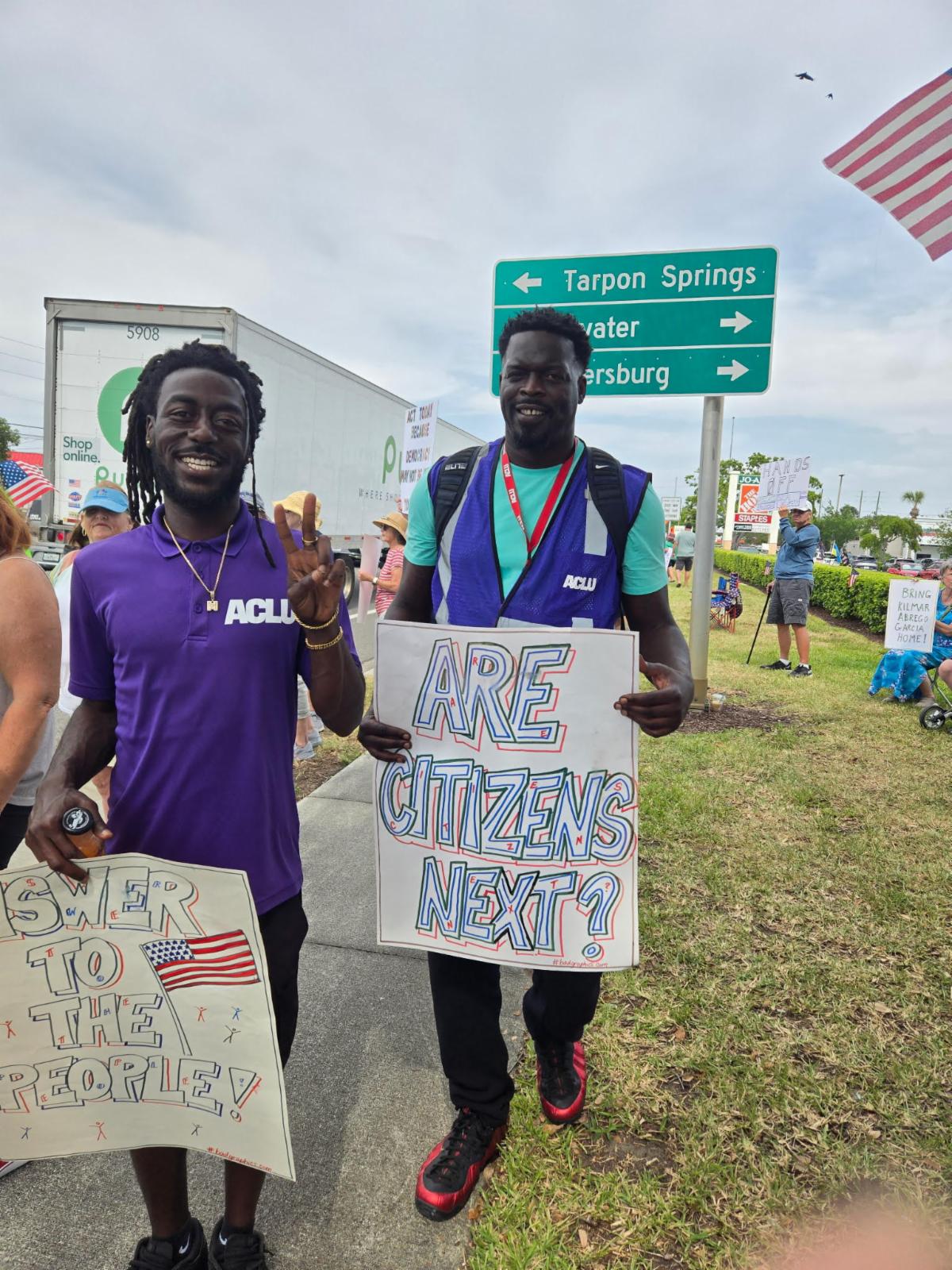
CCDS Statement on Kilmar Abrego Garcia
(National Executive Committee, April 15, 2025)
Married with parental responsibility for three disabled children, Kilmar Abrego Garcia was a 14-year Maryland resident until he was snatched off the street by ICE agents. An undocumented immigrant from El Salvador, he was first arrested and held for deportation in 2019. At that time he was granted "withhold from removal" status by a judge who specifically ruted he should not be returned to El Salvador as that was the nation from which he sought asylum for gang threats against his family and himself.
In March 2025 Abrego Garcia was placed on a plane by US immigration agents and transported to El Salvador, where shackled hand and foot, his head shaved, he was forced to march doubled over into a maximum security prison. Abrego Garcia was never indicted or convicted on any charge in either the US or El Salvador, he was never sentenced, and there is no indication if he will ever be released. US officials admit it was a "mistake" to send Abrego Garcia to prison in El Salvador but have refused to bring him back.
His attorneys convinced the US Supreme Court that the Trump government should "facilitate" his return to the US, but to-date this ruling has been shrugged off, thus provoking a Constitutional crisis. As a nation, we are now witnessing the government ignoring the rule of law, disregarding the courts, and passing into outright dictatorship.
We must vigorously protest the government's actions. We must join with others to demand Abrego Garcia be returned to the US forthwith. We must demand the enactment and enforcement of laws that prevent the rendition of anyone from the United States without due process. We must demand a law that bars the rendition of permanent US residents and citizens to countries outside the US. We must demand that the federal judiciary be assigned an enforcement arm, such as bringing the US Marshal Service under court jurisdiction, so that federal officials who defy the courts can be arrested and jailed for contempt.
We also must understand the Abrego Garcia case is another manifestation of the burgeoning profit-driven political-industrial complex in the US, which has among the highest incarceration rates in the world. The US cannot jail its way out of the multitude of problems it faces. Solutions can only be found in a just economic and democratic social system.
Reunite Abrego Garcia with his family. Free Kilmar Abrego Garcia!
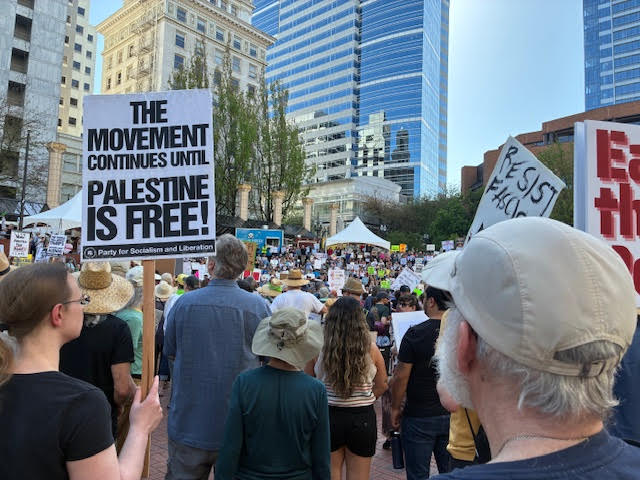
| Portland, Oregon photos from Rod Such |
Wednesday, April 30, 2025
Harry Targ
MAY DAY BRINGS THOUGHTS OF SOCIALIST ALTERNATIVES: And Thoughts about Moving Ahead
(Originally posted on May 1, 2009)
Pete Seeger - "L'Internationale"
https://www.youtube.com/watch?v=v85NWc0RIKc
Sketching Today’s Global Political Economy
During the latest phase of monopoly and finance capital (1945- to the present) enormous changes occurred in the global political economy. First, the United States emerged as a superpower and in an effort to crush the threat of socialism around the world committed itself to constructing a “permanent war economy.” This permanent war economy would create the military capacity to destroy alternatives to global capitalism, stimulate and maintain a high growth manufacturing economy, justify an anti-communist crusade to crush the left in the United States, and co-opt and/or repress working class demands for change. In addition, the permanent war economy would occasion the perpetuation of racism and patriarchy in public and private life.
As the years passed corporate rates of profit began to decline as a result of rising competition among capitalist states, over-production and under-consumption, an increasing fiscal crisis of the capitalist state, and rising prices of core natural resources (particularly oil). With a growing crisis, global corporate and finance capital shifted from investments in production of goods and services to financial speculation. Thus capitalist investment steadily shifted to financialization, or the investment in paper-stocks, bonds, private equity and hedge funds and other forms of speculative investment. Financial speculation was encouraged by state tax policies, “free trade” agreements, an expanded international system of indebtedness, and increased reliance on consumer debt.
Multinational corporations which continued to produce goods and services sought to overcome declining profit rates. This, they concluded, could only be achieved by reducing the costs of labor. To overcome the demand for higher real wages, health and other benefits, and worker rights, manufacturing facilities were moved from core capitalist states to poor countries where lower wages were paid. Thus, in wealthier countries millions of relatively high paying jobs were lost while production of goods increasingly moved to sweatshops in poor countries. Wealthy capitalist states experienced deindustrialization.
Finally, assisted by technological advances, from computers to new forms of shipping, financial speculation and deindustrialization fueled the full flowering of globalization, or the radically increased patterns of cross border interactions-economic, political, and cultural. Globalization began to transform the world into one integrated global political economy. (The current tariff war launched by President Trump does not change the core reality of global capitalism).
In short, we may speak of a four-fold set of parallel political and economic developments that have occurred since the end of World War II, in which the United States has played a leading role: creating a permanent war economy, financialization, deindustrialization, and globalization.
Should We Be Thinking About Socialism Today?
A rich and vital set of images of a socialist future comes down to us from the utopians, anarchists, and Marxists, the martyrs of the first May Day, and the variety of experiments with socialism attempted in Asia, Eastern Europe, Western Europe, Africa, and the Caribbean. Extracting from the multiple reasons why individuals and movements chose socialism one reason stands out; that is, that capitalism historically is and has been a cruel and inhumane system, a system borne and fueled by slavery, genocide, super exploitation of workers, tactics of division based on race and gender, and an almost total disregard for the natural environment that sustains life. Building a permanent war economy, financialization, deindustrialization, and globalization are merely extensions of the cruel and heartless pursuit of profit which has been the fundamental driving force of the capitalist mode of production.
Drawing on the history and the images of a better future coupled with the brutality of the capitalist era, we might conceive of a 21st century socialist future that has four main dimensions.
First, we need to create institutions that are created and staffed by the working classes and serve the interests of the working classes. While scholars and activists may disagree about what “class” means in today’s complicated world, it is clear that the vast majority of humankind do not own or control the means of production, nor do they usually have an instrumental place in political institutions. Therefore, socialism involves, in the Marxist sense, the creation of a workers’ state and since most of us are workers (more than 90 percent of the US population for example), a state must be established that represents and serves the interests of the many, not the few.
Second, our vision of socialism is a society in which the working classes fully participate in the institutions that shape their lives and in the creation of the policies that these institutions develop to serve the needs of all the people.
Third, socialism also implies the creation of public policies that sustain life. Socialism in this sense is about good jobs, incomes that provide for human needs, access to health care for all, adequate housing and transportation, a livable environment, and an end to discrimination and war.
Fourth, socialism is also about the creation of institutions and policies that maximize human potential. A socialist society provides the intellectual tools to stimulate creativity, celebrate diversity, and facilitate writing poetry, singing and dancing, basking in nature’s glow, and living, working, and loving with others in humanly sustainable communities.
Today we remain terribly far from any of these dimensions of socialism. But paradoxically, humankind at this point in time has the technological tools to build a mass movement to create a socialist future. We can communicate instantaneously with peoples all over the world. We can access information about the world that challenges the narrow ruling class media frames about the human condition. We have in the face of brutal war, environmental devastation, enduring racism, super exploitation of workers everywhere mass movements of workers, women, people of color, indigenous people, and youth who are demanding changes. Increasingly public discourse is based upon the realization that our future will bring either extinction or survival. Socialism, although it is not labeled as such, represents human survival.
Where do we who believe that socialism offers the best hope for survival stand at this critical juncture? We are weak. Many of us are older. Some of us have remained mired in old formulas about change. Nevertheless, we can make a contribution to building a socialist future. In fact we have a critical role to play.
We must articulate systematic understandings of the global political economy and where it came from: permanent war, financialization, deindustrialization, and globalization. We need to articulate what impacts these processes have had on class, race, gender, and the environment. In other words, we need to convince activists that almost all things wrong with the world are connected and are intimately tied to the development of capitalism as the dominant mode of production.
We need to take our place in political struggles that demand an expanded role for workers in political institutions. We need to insist that the working classes participate in all political decisions.
We need to work on campaigns that could sustain life: jobs, living wages, single payer health care, climate change etc. Our contribution can include making connections between the variety of single issues, insisting that participants in mass movements take cognizance of and work on the other single issues that constitute the mosaic of problems that require transformation. We must remember that in the end the basic policies that sustain life require building socialism. Most struggles, such as those to achieve living wages or a single payer health care system for example, plant the seeds for building a broader socialist society. We can incorporate our socialist vision in our debates about single issues: if we demand a living wage, why not talk about equality for example?
We need to rearticulate our belief that human beings have a vast potential for good, for creativity, and given a just society, we all could move away from classism, racism, and sexism. We could pursue our talents and interests in the context of a sharing and cooperative society.
By working for institutional incorporation (empowerment) and life-sustaining and enhancing policies we will be planting the seeds for a socialist society.
“In our hands is placed a power greater than their hoarded gold,
Greater than the might of armies, magnified a thousand-fold.
We can bring to birth a new world from the ashes of the old.
For the union makes us strong”
From “Solidarity Forever,” Ralph Chaplin lyrics, 1915.
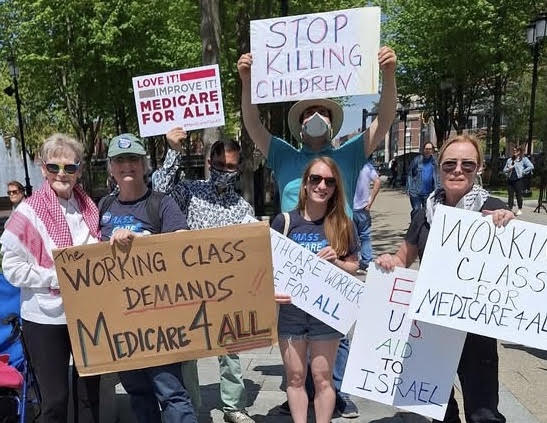
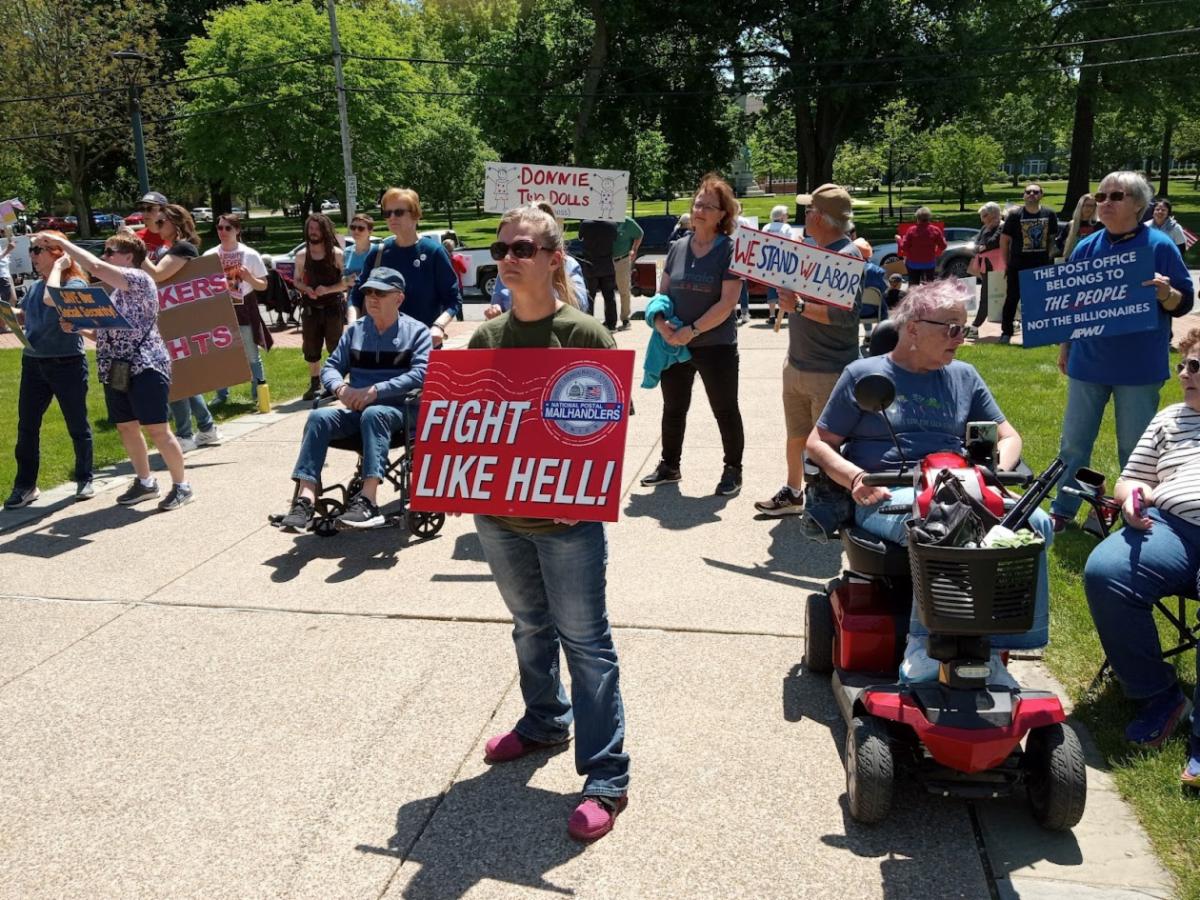
| Quincy, Mass (From May Day (Sandy Eaton) | | Photos Beaver County PA from Carl Davidson | | |
Mahmoud Khalil at the Columbia University protest encampment in New York City on April 29, 2024., AP Photo/Ted Shaffrey
| | |
Mahmoud Khalil
May 11, 2025
The Guardian
To my newborn son: I am absent not out of apathy, but conviction. Deen, the grief I feel being apart from you is one drop in a sea of sorrow Palestinian families have drowned in for generations
Yaba Deen,* it has been two weeks since you were born, and these are my first words to you.
In the early hours of 21 April, I waited on the other end of a phone as your mother labored to bring you into this world. I listened to her pained breaths and tried to speak comforting words into her ear over the crackling line. During your first moments, I buried my face in my arms and kept my voice low so that the 70 other men sleeping in this concrete room would not see my cloudy eyes or hear my voice catch. I feel suffocated by my rage and the cruelty of a system that deprived your mother and me of sharing this experience. Why do faceless politicians have the power to strip human beings of their divine moments?
Since that morning, I have come to recognize the look in the eyes of every father in this detention center. I sit here contemplating the immensity of your birth and wonder how many more firsts will be sacrificed to the whims of the US government, which denied me even the chance of furlough to attend your birth. How is it that the same politicians who preach “family values” are the ones tearing families apart?
Deen, my heart aches that I could not hold you in my arms and hear your first cry, that I could not unfurl your clenched fists or change your first diaper. I am sorry that I was not there to hold your mother’s hand or to recite the adhan, or call to prayer, in your ear. But my absence is not unique. Like other Palestinian fathers, I was separated from you by racist regimes and distant prisons. In Palestine, this pain is part of daily life. Babies are born every day without their fathers – not because their fathers chose to leave, but because they are taken by war, by bombs, by prison cells and by the cold machinery of occupation. The grief your mother and I feel is but one drop in a sea of sorrow that Palestinian families have drowned in for generations.
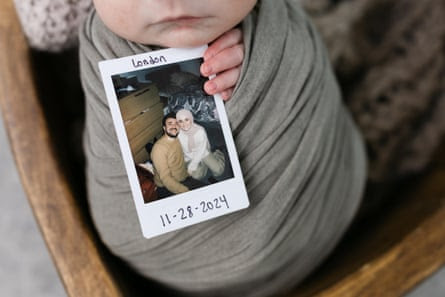
Baby Deen, in a photo provided by Dr Noor Abdalla and Mahmoud Khalil. Photograph: Rafiya Alam
Deen, it was not a gap in the law that made me a political prisoner in Louisiana. It was my firm belief that our people deserve to be free, that their lives are worth more than the televised massacre we are witnessing in Gaza, and that the displacement that began in 1948 and culminated in the current genocide must finally end. This mere belief is what made the state scramble to detain me. No matter where I am when you read this – whether I’m in this country or another – I want to impress upon you one lesson:
The struggle for Palestinian liberation is not a burden; it is a duty and an honor we carry with pride. So at every turning point in my life, you will find me choosing Palestine. Palestine over ease. Palestine over comfort. Palestine over self. This struggle is sweeter than a life without dignity. The tyrants want us to submit, to obey, to be perfect victims. But we are free, and we will remain free. I hope you feel this as deeply as I do.
Deen, as a Palestinian refugee, I inherited a kind of exile that followed me to every border, every airport, every form. Borders mean something to me that they may not mean to you. Each crossing required me to prove my docility, my identity and my very right to exist. You were born an American citizen. You may never feel that weight. You may never have to translate your humanity through paperwork, countless visa applications and interview appointments. I hope you use this not to separate yourself from others, but to uplift those who live under the same circumstances that once constrained me. But I won’t pretend this citizenship protects you. Not completely. Not when you have my name. Not when those in power still see our people as threats.
One day, you might ask why people are punished for standing up for Palestine, why truth and compassion feel dangerous to power. These are hard questions, but I hope our story shows you this: the world needs more courage, not less. It needs people who choose justice over convenience.
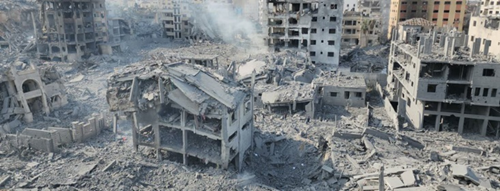
It is nothing but the dehumanization and racist disregard for Palestinians that renders their lives forgettable and that dares describe Palestinian fathers who love their sons as “terrorists”. Perhaps that is why the world so quickly forgot the killing of four-month-old Iman Hijjo in Gaza in 2001. Why did Ahmed Abu Artema’s beloved son Abdullah die hungry for bread? Who recalls the children lost in the Flour Massacre? Where is the justice for the fathers in the West Bank who carefully dress their sons for prison? Why does liberty not visit the bodies of Palestinian children whose limbs are missing, whose ribs are exposed under thin skin and who are born lovingly only to die under an Israeli bomb?
On this first Mother’s Day for Noor, I dream of a world where all families are reunited to celebrate the incredible women in their lives. Many years ago, on one of our very first dates, I had asked your mother what she would change in the world if she could. Her simple response was: “I just want people to be nicer to each other.” Deen, you were born to a mother as gentle as she is fierce. I pray that you live in a world shaped by that kindness. I hope, with all my heart, that you will not witness the oppression that I’ve known. I hope that you never need to chant for Palestine, because it has long been free with dignity and prosperity for all. Should that day come, know that it was ushered in through the courage of those who came before you. I am certain that in this new world, you and I will visit Tiberias together, drink from the river and marvel at the sea. There, in a free and just Palestine, you will see the fruits of our struggle.
Deen, my love for you is deeper than anything I have ever known. Loving you is not separate from the struggle for liberation. It is liberation itself. I fight for you, and for every Palestinian child whose life deserves safety, tenderness and freedom. I hope one day you will stand tall knowing your father was not absent out of apathy, but out of conviction. And I will spend my life making up for the moments we lost – starting with this one, writing to you with all the love in my heart.
*Yaba Deen: “Yaba” (يابا ) is an affectionate term meaning “dad” in Arabic. In Palestinian Arabic, yaba is often used self-referentially to center the father-son bond in the greeting itself. So when a father says “yaba”, he’s using a tender, fatherly voice to address his child, somewhat like saying: “From your dad, Deen” or “My son, from your yaba (dad)”
| |
IS ISRAEL COMMITTING GENOCIDE?
Amnesty International Charges Israel With Genocide
https://www.democracynow.org/2024/12/6/amnesty_genocide
Below is the language of Article 2 of the United Nations Convention on Genocide initiated in 1948. Is there any doubt that the government of Israel is engaging in genocidal policies against the Palestinian people in the Gaza strip? - Harry Targ
“In the present Convention, genocide means any of the following acts committed with intent to destroy, in whole or in part, a national, ethnical, racial or religious group, as such:
(a) Killing members of the group;
(b) Causing serious bodily or mental harm to members of the group;
(c) Deliberately inflicting on the group conditions of life calculated to bring about its physical destruction in whole or in part;
(d) Imposing measures intended to prevent births within the group;
(e) Forcibly transferring children of the group to another group.”
Both Israel and the United States are signatories to the Genocide Convention.
| |
Your copy should address 3 key questions: Who am I writing for (audience)? Why should they care (benefit)? What do I want them to do (call-to-action)?
Create a great offer by adding words like "free," "personalized," "complimentary," or "customized." A sense of urgency often helps readers take action, so consider inserting phrases like "for a limited time only" or "only 7 remaining!"
| With Respect and Honor to Pope Leo | | Pope Leo calls for a ceasefire in Gaza | | |
Rerum Novarum – 2 Minute Summary
Two minute summary of Rerum Novarum
Rerum Novarum, also known as On the Condition of Labor, is an encyclical issued by Pope Leo XIII in 1891. It is considered one of the most important papal documents on social teachings and is seen as the foundation of Catholic social teaching. The encyclical addresses the condition of the working class in the wake of the Industrial Revolution and the rise of socialism.
The encyclical begins by recognizing the changes that have occurred in society due to the industrial revolution, including the growth of cities and the rise of the working class. It acknowledges the difficulties faced by the working class, including low wages, long working hours, and poor living conditions. Pope Leo XIII states that these difficulties are the result of the capitalist system, which he believes to be unjust.
Pope Leo XIII then goes on to discuss the rights and duties of both the worker and the employer. He states that workers have the right to a fair wage and to form unions for collective bargaining, while employers have the duty to provide just wages and safe working conditions. He also emphasizes the importance of the family as the foundation of society and the importance of private property.
The encyclical also addresses the issue of socialism and its critique of the capitalist system. Pope Leo XIII acknowledges that socialism has arisen as a response to the injustices of the capitalist system, but criticizes it for its disregard for the rights of private property and the importance of the family. He argues that the solution to the problems faced by the working class is not socialism, but rather a just and equitable distribution of wealth.
Pope Leo XIII also calls for the state to play a role in addressing social and economic issues. He argues that the state has a duty to protect the rights of citizens and to promote the common good. He also calls for the state to provide for the needs of the poor and to ensure that the economy serves the needs of all citizens.
The encyclical also addresses the relationship between the Church and the state, arguing that the Church has a role to play in the social and political realm. Pope Leo XIII emphasizes the importance of the Church in promoting social justice and the common good. He also calls for the state to respect the autonomy of the Church and to promote religious freedom.
Finally, Pope Leo XIII concludes the encyclical by calling for the promotion of social harmony and the common good. He encourages all members of society to work together to address social and economic issues, and to promote the well-being of all citizens. He also calls on the faithful to work for the betterment of society and to promote the values of justice, charity, and solidarity.
In summary, Rerum Novarum is an encyclical that addresses the social and economic issues arising from the Industrial Revolution. It addresses the rights and duties of workers and employers, the role of the state, the importance of the family and private property, and the Church’s role in promoting social justice. It is considered as a foundation of Catholic social teaching, calling for the promotion of social harmony and the common good, it also remains an important document for understanding the Catholic Church’s views on social and economic issues.
Key Lessons from Rerum Novarum
The key points of Rerum Novarum include:
- The right to private property is recognized, but it is limited by the duty to use it for the common good and the right of the state to regulate it in the public interest.
- The right to form unions and strike is recognized as necessary for the protection of the rights of workers.
- The state has the duty to intervene in order to protect the rights of workers and ensure that they receive a just wage.
- The Church has the duty to help workers by providing education, spiritual guidance and support.
- The family is considered the foundation of society and is deserving of special protection and support.
- The rich have a responsibility to help the poor, and charity is an important duty of all Christians.
- The idea of subsidiarity is introduced, where the state should not interfere in matters that can be handled by individuals or local communities.
- The document advocates for the creation of a living wage, the right to form labor unions, and the responsibility of employers to provide safe working conditions.
- The document calls for the recognition of the rights of workers and the establishment of a living wage, in addition to the right to form unions and the responsibility of employers to provide safe working conditions.
Overall, Rerum Novarum emphasizes the importance of social justice and the protection of the rights of workers, while also promoting the traditional Catholic teaching on the importance of the family, the duty of charity, and the right to private property.
The lasting impact of Rerum Novarum
Rerum Novarum, which translates to “On the New Things”, is an encyclical letter written by Pope Leo XIII in 1891. It is considered one of the most important social encyclicals in the Catholic Church and had a lasting impact on the Church’s teachings on social and economic issues.
One of the main themes of Rerum Novarum is the concept of subsidiarity, which holds that social and economic issues should be addressed at the most local level possible. This principle has been influential in the Church’s teachings on issues such as poverty, worker’s rights, and the role of government in society.
Rerum Novarum also emphasized the importance of the right to private property, but it also recognized the need for the state to regulate the use of property in the interest of the common good. This teaching has been influential in the Church’s stance on issues such as economic inequality and the role of the state in promoting social justice.
The encyclical also addressed the rights and duties of workers, emphasizing the importance of fair wages, safe working conditions, and the right to form unions. This teaching has been influential in the Church’s stance on issues such as workers’ rights and the rights of labor unions.
Rerum Novarum also addressed the issue of poverty, emphasizing the importance of charity and the role of the state in addressing poverty and social inequality. This teaching has been influential in the Church’s stance on issues such as welfare and social services.
In conclusion, Rerum Novarum had a lasting impact on the Catholic Church’s teachings on social and economic issues. Its emphasis on subsidiarity, the right to private property, the rights and duties of workers, and the issue of poverty have been influential in the Church’s stance on a wide range of social and economic issues. It continues to be a reference point for the Church in addressing social and economic issues today.
| |
Saturday, May 3, 2025
Harry Targ
The Greater Lafayette area consists of two towns: Lafayette is a mixed community with some manufacturing and service as its economic base and West Lafayette, a smaller community, but a central location of Purdue University. Lafayette’s population as of 2020 was about 70, 000 and West Lafayette’s 44, 000. The metropolitan area, including several neighboring towns has a population of about 237,000, a growth of 16 percent since 2010. By far the major “industry” in the area, Purdue University, employs 17,000 workers of all kinds and the Purdue Research Park employs some 3,000 who work for 155 companies.
Although Purdue University always had strong programs and a research agenda involving engineering and agriculture, over the last thirty years the liberal arts, social sciences and humanities grew as well. Purdue employed poets and novelists of national reputation, as well as historians, political scientists and philosophers. Interdisciplinary studies programs were established in African American Studies, Women’s and Gender Studies, American Studies, and smaller programs for example concerning Human Rights, Peace Studies, Latin American Studies, Jewish Studies and others. The intellectual vitality of the university and the surrounding communities parallels such growth in many places around the country.
However, pressures from conservatives, advocates for “free enterprise,” and opponents of the flowering of higher education in all its diversity as a result of “the 60s,” grew as well. The politics of Indiana moved to the right with the electoral victories of Mitch Daniels and Mike Pence, due to the weakening of the Democratic Party and the sustained assault on organized labor. Indiana moved from a “purple” to a deep “red” state.
And thus, the pressures on higher education in keeping with the new rightwing agenda, which began before the prominence of Donald Trump, expanded. Nancy MacLean, in “Democracy in Chains,” documents the steady penetration of education, K through university, by the Koch Foundation and other conservative forces. Their programs have been recently illustrated in the document Project 2025 which recommends policies that will reverse the vitality and diversity of higher education. This historic project of dismantlement of education was accelerated by the long-term defunding of higher education by states and the national government and the covid epidemic.
These changes involved universities, like Purdue, increasingly currying financial connections with huge corporations and the military, downsizing and marginalizing the university work force, privatizing heretofore public services including food, residences, software services, transforming a public university into a series of private corporations. And these changes in the political economy of higher education have been paralleled by pressures to transform the curricula from rigorous discussion to celebration of American exceptionalism. And the transformation of higher education in the Greater Lafayette area has paralleled the transformations of the political economy of the twin cities, increasing privatization of public services, enticing outside corporate investors, increasing ties to the military and transforming communities and residences.as well.
Now, West Lafayette, in conjunction with the Purdue Research Foundation (which has been deemed “private”) is embarking on the construction of a huge South Korean chip manufacturing and packaging plant in West Lafayette. The West Lafayette City Council is scheduled on May 5 to debate changing ordinances to allow this massive factory to be housed in a residential community in the north end of West Lafayette. (The City Council has the last word even though the Area Planning Commission voted against the rezoning request.)
Indiana politicians and spokespersons have been fantasizing for many years about Central Indiana becoming “the Silicon Valley of the Midwest.” Now the pending agreement with the firm, SK hynix, it is claimed, will make Indiana a huge player in the new US/global political economy. However, those familiar with such dreams recall that SK hynix closed a large plant in another college town in Eugene, Oregon because product demand had declined. And those familiar with Wisconsin, are reminded of huge tax incentives given by the US government and the state to another high-tech company, Foxconn. In both cases, large numbers of new jobs were promised and, in both cases, smaller communities suffered critical residential dislocations. The jobs did not materialize. In the Oregon case the plant shut down. In Wisconsin the facility built turned out to be a fraction of the size of what was promised.
Critics of the rezoning request that the West Lafayette City Council is being asked to grant make the following points.
The zoning request is for Sy Hynix to use 121 acres of land which is surrounded by residential communities. The plant to be constructed would be for packaging superchips, including manufacturing processes, and to develop a research and development center. The manufacturing of semiconductors is known to risk fire, explosions, and health risks to adjacent communities and workers. And the state of Indiana has already issued orders to reduce “regulatory safeguards.” Since semiconductor manufacturing causes health and safety hazards, experts urge that factories be placed far from residential areas. In this case, SK hynix will be adjacent to and surrounded by existing residential communities and near a school, a wellness center, and a park, as well as large areas of greenery to the north.
Along with the dangers of air pollution, the projected plant will increase traffic in a heretofore residential area, put demands on the county’s water supply, and in the main radically transform a residential, and rural environment to an industrial zone that may destroy the sense of community which residents have enjoyed.
In sum, for the last decade the Greater Lafayette community and its primary “industry,” Purdue University, have embraced a single-minded economic development model that pays little attention to the quality of life of the community, health and safety inside and outside facilities, while transforming the tradition of open and vibrant education at Purdue University to the celebration of a model of unbridled growth at all costs.
If the West Lafayette City Council approves the business/university push for moving closer to a midwest “Silicon Valley,” it will substantially reduce the quality of life as well as the educational vitality of this community.
| | |
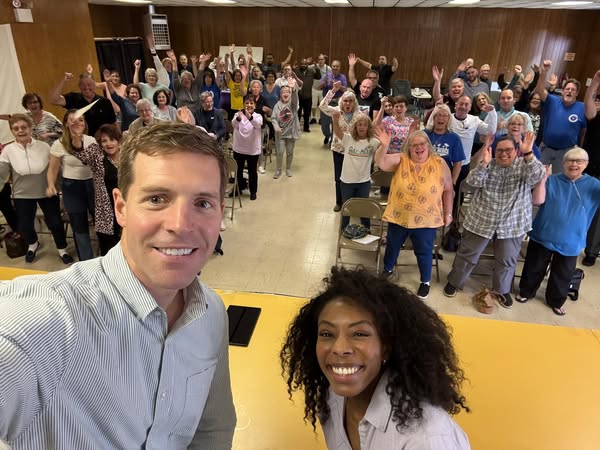
Townhall in New Castle, PA May 10th with Conor Lamb and Lindsay Powell
state rep from Pittsburgh
| | |
Beth Howard, author of Rednecks for Racial Justice and of SURJ
Presentation on March 25th 4th Monday :Women and Political Struggle
| |
Hey, friends, it's so good to be here. It's good to meet all of you. My name is Beth Howard. I live in Lexington, Kentucky, and I'm from rural eastern Kentucky. I am in a staff transition. I'm still Showing Up for Racial Justice, and I can talk a little bit about what we do. I was the Appalachia people's union director at SURJ, which is a program and an organizing group that I helped start. Now I'm just moving over the past couple of weeks to my new role, which is a cultural strategist at SURJ, and I can say a little bit about those things. So I have been doing community organizing for almost 20 years, which is hard to imagine and think about how fast time has gone.
But I grew up on a small family tobacco farm in rural eastern Kentucky. My dad was a coal miner. He worked in strip mining in the 80s, and my mom was a grocery store clerk, and also, later worked at a factory. I always start with what they did for work, because it defined everything about me and my life and how I understood the world, and it still does. And so I'm from a line of really strong Appalachian women, and I'm proud to be a part of a working-class family.
I got into organizing after attending school for English to become a writer, which I'm finally doing, which is exciting. I'm the author of a forthcoming memoir from Haymarket Books called Like Our Lives Depend On It and that will come out in the spring of 2026 It's the story of my life and how I started out. Yeah, growing up rural and a majority all white community and how I found common cause in the fight for racial and economic justice.
I work for Showing Up for Racial Justice, which is SURJ. We are the largest national organization that's bringing working-class white people into the fight for racial justice. We have a national base of people who are mobilized in various ways, including through local organizing chapters. You might have one in your city or town or close to you. But also, we've worked on national campaigns, notably, a lot of electoral campaigns in the past few years, to try to block MAGA at the polls.
We are also trying to build the multiracial working class and being the white stripe of that effort in a group of coalition organizations, so that we can get the kind of systems that we need to live in, not just the status quo or not just selecting liberal democrats, but trying to do that as a move to block MAGA, so that we can be on the offensive and try to win the things that we really need.
When I was at Kentuckians for the Commonwealth, I was doing grassroots organizing here in Lexington. There was a lot of political study and transformation that I went through that really had me looking at whiteness and race and class. The way that whiteness was constructed to keep people like me and my family siding with white people who don't have our best interests at heart, ruling class white people, instead of my multi-racial working class. I wanted to do whatever I could to interrupt the way that the far right has been able to use racism, and always has throughout history, to win working class white people to their side.
And so in 2020 I wrote an essay called Rednecks for Black Lives that ended up going viral as kind of a call to action to my people to say, let's choose the right side of this issue now, and always, and calling us back to the very radical revolutionary history that Appalachians have had. Particularly, the Battle of Blair Mountain in West Virginia in 1921 was the largest uprising in this country's history. They were a multi-racial group of 10,000 coal miners, comprising a third white, a third black, and a third immigrant. They wore red bandannas around their necks and were called Rednecks. That is radical history of 'redneck' and is challenging the way that it's been distorted by those in power almost to be synonymous with racist. We need to get back to its roots and call ourselves into our best selves.
From that, I have worked to start an organizing group. We're called Kentucky People's Union in northeastern Kentucky, near where I grew up. We're a community organizing group that is majority white, but also a multi-racial group. Our strategic focus at SURJ and also with KPU, is to be in majority white, economically struggling places in the south, and to bring people into something that is organizing for the best of all of us. Communities like mine, where I grew up, have largely abandoned progressive forces.
The Democratic Party, which used to be a stronghold in a place like Appalachia that was synonymous with my great-grandparents. They benefited from the New Deal. They were the people who had a photo of FDR right in their living room and voted for Democrats because of the United Mine Workers of America. That has changed and shifted so dramatically for so many reasons. The Democrats have largely abandoned communities like mine.
Progressives kind of just consider us a lost cause, or that we belong to MAGA. The truth is if we look at Kentucky alone, we're the fifth poorest state in the nation, and so many people are locked out of voting because the rules are so rigged. Our entire state government was authoritarian before this latest wave, similar to many state governments in the South. In the most recent presidential election, we achieved a voter turnout rate of barely over 50%. I always say we're not a red state, we are primarily an unorganized state, but we can be a powerful force. I wanted to do whatever I could to come into communities that progressive forces have abandoned and that the far right has taken claim to. Especially when we think about communications, who's talking to them, who's paying attention to them, and competing for them, to give them a better offer than white supremacy, I believe that that is multi-racial organizing. Campaigns around housing, health care, are the things that impact all of us. If we can get people together in a room to fight for a material issue, then we can all be changed and transformed, and we start to build relationships with people who are different than us.
We take a lot of inspiration from Linda Burnham, who is a brilliant black woman organizer, writer, thinker, and theorist. After the 2016 election of Trump, she said that white people are suffering, and somebody has got to speak to their suffering, like poor white people. If we don't, then we know someone else. We have seen this over and over again, so that's what I'm committed to doing: trying to organize as many white people as possible, bringing them together, and forming a fighting force for justice.
I think the last thing I'll say is that I am genuinely interested and committed to building a shared interest among working-class people, as opposed to the traditional white privilege frame that has been used. We talk a lot about how white privilege is real and it can be deadly, and it's also not a strong organizing strategy when we're talking to very poor white people, right? To talk to them about their privilege and how they need to give up things in order to be part of this beautiful multi-racial movement, right? And instead, let's talk about what we all have to gain, right? People often ask me, “Well, Beth, what did you give up to be part of this work for racial justice?” And I do think that white people will maybe lose relationships, right, or lose things in their lives. But for me, it has overwhelmingly opened my life up, and it's given me so much, and so really trying to engage poor white people around what they have to gain, as opposed to what they have to lose.
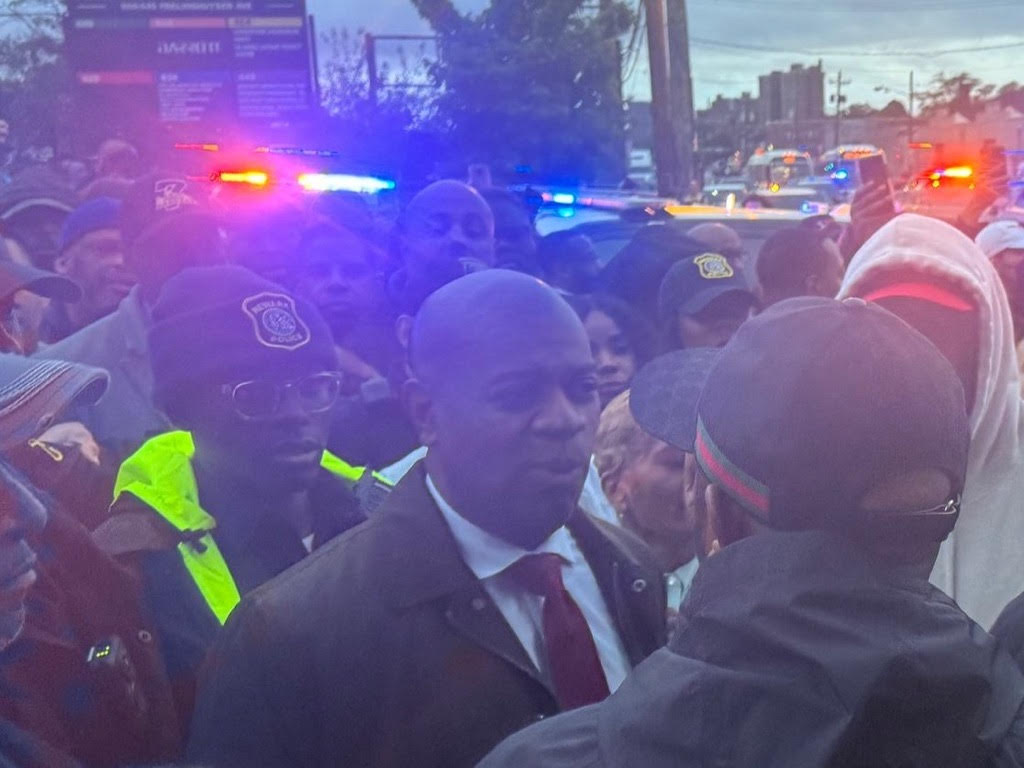
| | Newark Mayor Ras Baraka is met with hundreds of supporters after being released from ICE custody Friday night. Photos/Bob Hennelly | |
‘Gestapo Nation’ - Inside the ICE Arrest of
Newark Mayor Ras Baraka
May 11
By Bob Hennelly
from Work-Bites news
On Friday, federal immigration police seized Newark Mayor Ras Baraka off of a public street outside Delaney Hall, a controversial private prison operated by the GEO Corporation, formerly known as Wackenhut Corrections Corporation. This for-profit, publicly traded, multinational employs 18,000 people at over 50 sites here and abroad.
The chaotic scene, captured on bystander video, shows Rep. Bonnie Watson Coleman, 80, Rep. LaMonica McIver, 39 and Rep. Robert Menendez Jr., 39 encircling Mayor Baraka outside the GEO perimeter in an unsuccessful attempt to prevent his being taken inside by the armed masked agents.
That's a heroic and rational response in the age of the Trump/Musk fully functional junta that's scooping people off the streets without due process and sending them to places like the private prison in El Salvador.
It's a simple test for us all. When you see armed masked law enforcement, á la death squad, coming for someone you care about do you stand aside? Do you slink away and count on the courts to sort it out? Or do you do what you can to slow it all down?
Multiple news media organizations, including the BBC, led their accounts with quotes from acting US Attorney for New Jersey, Alina Habba, as the foundation for their reporting that offered credence to the false narrative that Mayor Baraka had "committed trespass and ignored multiple warnings" to leave Delaney Hall.
The BBC headline, "New Jersey Mayor Arrested in Protest At Migrant Centre" no doubt pleased the Trump White House as it got traction even on MSNBC—but it downplays what Mayor Baraka and the three members of Congress were actually doing there. No doubt, even in 2025, for the corporate news media, if there are a sufficient number of faces of color it has to be a protest. It couldn't be that this was a delegation of duly-elected officials doing the jobs they were elected to do.
U.S. Rep. Bonnie Watson Coleman.
"I have been in situations that have been heartbreaking personally and professionally. I have never been afraid. I have never been so disheartened and I have never felt so helpless to get the right thing done as I was today," Rep. Bonnie Watson Coleman (D-NJ) told WorkBites/WBAI. Watson insisted Baraka had done nothing wrong. "He wasn't even on their property," she added.
When asked how New Jersey's blended citizen/migrant households must feel, Watson was direct.
"I think they are scared to death and they have every right to be scared to death—I think this is almost a Gestapo nation right now—that people are going to take you out of your homes, out of your school, out of your jobs—whatever. This is not America," Rep. Watson Colman said.
Why Mayor Baraka and Members of Congress Where Really There
Believe it or not, at its core this all started out as a labor and law & order story. It became a protest story when federal immigration officers took the mayor of New Jersey's largest city into custody and manhandled three sitting members of Congress in the process. That was the headline.
This is all about a local mayor and federal elected officials attempting to fulfill their oath of office to "support and defend" the U.S. Constitution. In the case of the three members of Congress, who were at Delaney Hall to exercise their right to inspect such sites, they are also required to "defend" that Constitution "against all enemies, foreign and domestic."
Protesters gather outside the gates of the Frelinghuysen Avenue facility in Newark, NJ on Friday, May 9.
Friday's visit was only the most recent by Mayor Baraka who insists that GEO has to have a proper Certificate of Occupancy and the fire inspection that would be required of any congregant care facility that's slated to house 1,000 people. To not do so, puts the entire GEO workforce and the private prison population at risk.
GEO and ICE don't have a fire department. And as Newark tragically learned with the July 2023 maritime fire that killed Newark Firefighters Wayne Brooks and Augie Acabou, when you can't hold entities like GEO or the Port Authority of New York & New Jersey accountable to do the right thing, people die and it's the people and the City of Newark that pay the price.
“The GEO Group and ICE exhibit a nationwide pattern of discrimination, disregard for due process and attacks on the foundations of liberty, justice and democracy. Here in Newark, they also ignored court direction to apply for a Certificate of Occupancy (CO) at Delaney Hall, and other deliberate acts of non-compliance that put detainees, as well as employees, at additional, unnecessary risk," Mayor Baraka said in a statement in the days before his arrest. "As a city of immigrants known for caring for its own, this adds insult to injury. The city will continue to demand that the GEO Group provides full transparency of operations, that they submit a CO application to ensure compliance all around, and complete ongoing inspections for safety of all involved. Because in Newark, we uphold our laws and statutes with the same rigor that we uphold the rights of our people.”
GEO, a major campaign donor to President Donald Trump, started getting federal immigration detention contracts during his first term after then Attorney General Jeff Session ended an Obama-era ban on the Department of Justice contracting with for profit private prisons. GEO was subsequently awarded a $1 billion, 15-year contract to operate the 1,000 bed immigration detention facility.
The State of New Jersey is currently defending a law it passed in 2021 prohibiting companies like GEO from setting up private immigration detention centers as well as permitting local or county governments from leasing out their jail cells for that purpose. In 2023, a federal judge struck down the prohibition on private immigration lockups, according to the New Jersey Monitor.
On Friday, federal officials held the mayor for several hours at their Frelinghuysen Avenue location. The crowd of his supporters grew exponentially as twilight faded into night.
It was a surreal dystopian scene, not far from the dysfunctional air traffic control tower at Newark's Liberty International Airport. The federal government, that's having trouble with basic functions like air traffic control, is now looking to spend billions to double down on rounding up immigrants.
Historical Context
As dozens of protestors became several hundred on Friday night, the chants for Baraka's release grew louder and louder echoing throughout the industrial corridor.
Amina Baraka, 82, the mayor's mother looked on with a look of both pride and trepidation. While her biography includes being a poet, author, community organizer, and performing artist, she's also a central figure, along with her late husband the poet Amiri Baraka, in Newark's fractious and tumultuous history.
.
On July 12, 1967, Newark police pulled over John W. Smith, an African-American cab driver, for what started out as an alleged traffic violation. Police contended Smith cursed at them when they encountered him and that when the police went to take Smith into custody he assaulted them. According to the police, they got Smith into their squad car but when they got to the precinct they maintained Smith continued to resist. This time, passersby who witnessed the altercation heckled the police, demanding that they take the handcuffs off Smith.
Large crowds formed outside the precinct house where Smith was held. Community leaders demanded to see him and when they were granted access, they discovered he needed immediate medical attention. Smith was sent to the hospital for treatment for a skull injury and broken ribs. By 7 p.m. the next day, Smith was released to his lawyer but the damage was done. Word on the street was that Smith had been fatally beaten.
Over the next 24 hours, the Newark Police Department tried to keep a lid on a very dynamic situation. Cab drivers were mobilized to protest the treatment of their colleague, community members were protesting police brutality, and street conditions were deteriorating. Police were being pelted by debris and looting started to break out.
Out of the 26 fatalities during the five days of unrest, 23 (including a number of innocent bystanders) were from gunshot wounds.
The tragic details are laid out in an official account compiled by “The Governor’s Select Commission on Civil Disorder.” This document, known as the Lilley Report after its chairman, then AT&T President Robert D. Lilley, has slipped into undeserved obscurity. Over months of investigation, the panel took sworn testimony from more than 100 witnesses ranging from the Superintendent of the New Jersey State Police to Amiri Baraka, the poet and playwright, and Mayor Baraka's father, whose activism had made him a frequent target for the local police.
After speaking with scores of Newark store owners and residents, the Commission concluded that members of both the police and the National Guard, motivated by racial prejudice, had used “excessive and unjustified force” on Newark residents, and had specifically targeted African-American-owned businesses for destruction. “These raids resulted in personal suffering to innocent small businessmen and property owners who have a stake in law and order and who had not participated in any unlawful act. It embittered the Negro community as a whole when the disorders had begun to ebb,” concluded the Commission.
The Lilley report estimated that the National Guard and New Jersey State police fired some 13,000 rounds in all. No total was available for the local police, who reported killing people, seven “justifiably” and three “by accident.”
On this Spring night in 2025, the Newark Police and the massive crowd of protestors were aligned on the same side of history and the same side of the chain linked fence topped with barbed razor wire. Inside the ICE/DHS compound perimeter the Trump/Musk junta was certainly outnumbered and hunkered down with their only their weapons and masks to protect them.
Mayor Baraka, who is running for Governor in the June 10th primary, addressed the crowd after his release as night fell.
"We have a right to be here. We struggled on these streets...I never thought I would be incarcerated for something I believe is my democratic right—to speak out against what I think was happening there—a violation of city and state laws and a lack of transparency," Baraka said. "This thing that's happening in America is wrong. If you're not Blackfeet or Cherokee or Lenni Lenape, then somebody in your family was documented at some point."
Mayor Baraka referenced the idealized version of democracy "we all learn about in the fifth grade" and referenced Black Americans whose ancestors came as slaves and "were the first" wave of "undocumented".
"We put up a statue that said give me your tired, your hungry, your poor masses. We advertised it to the world. So the world has come here fleeing climate change, fleeing authoritarianism to find that democracy in this country… At some point we have to stop letting these people cause division between us."
On this night, Newark was united.
| | |
Carl Davidson
May 4
LeftLinks Weekly, May 2, 2025
Our Little Donald wants a parade on his birthday. A big one, with 6000 soldiers, tanks, cannons, and all the rest. We kid you not. Here’s the AP report:
“WASHINGTON (AP) — Detailed Army plans for a potential military parade on President Donald Trump’s birthday in June call for more than 6,600 soldiers, at least 150 vehicles, 50 helicopters, seven bands and possibly a couple thousand civilians, The Associated Press has learned.”
On our opening, we usually pay our respects to the AP Style Book, if not the current occupant of the Oval Office. On his first mention, we will cite his full name and title, as the AP does above: ‘President Donald Trump.’
But these are not usual times. So, ‘Our Little Donald’ is more appropriate for this bizarre event, which is missing one crucial element: that a good majority of our citizenry is willing to honor this oligarch in any way. At best, he has about a third of the country willing to indulge him. This means the planned event, as a spectacle, will be a farce.
As a left determined to remove him and his minions from office, we might make good use of such a farce. As with any circus parade, it will need clowns—lots of them, all along the line, for our deployment as counter-spectacle.
Consider the possibilities. Who might be our clown-in-chief? With his orange tufts of hair and honking air horns, Clarabel of the 1950s might do. But no, he’s too friendly to kids. We’ll have to look for his evil twin. For Defense Secretary Pete Hegseth, a brain-damaged Frankenstein would fit. For Press Secretary Karoline Leavitt, Snow White’s Wicked Stepmother, passing out poisoned apples to all who doubt she’s ‘the fairest of them all,’ would be perfect.
Placing current Trump officials as characters from the Wizard of Oz would be fun: the Tin Man searching for a heart, the Cowardly Lion looking for courage, the Scarecrow looking for a brain, the Wicked Witch seeking revenge. But it might be better to cast them on our side, since they all seek positive qualities as they help Dorothy in her travails with the Wizard.
We have a wealth of resources. In the inner circles of the fascist right, it’s well known that both tech billionaire Peter Thiel and his nemesis Steve Bannon use figures from J.R. Tolkien’s ‘Lord of the Rings’ series to characterize both friends and enemies. In Bannon’s eyes, Elon Musk and his crew are the evil ‘Orcs’ while he commands a white worker army of ‘Hobbits.’
Leftwing fans of Tolkien are quick to attack Bannon here, noting that in ‘The Return of the King,’ the Hobbits unite to overthrow the xenophobic thugs who built a wall around the Shire and poisoned its waters with sludge, turning it into a place ‘worse than Mordor.’ The Hobbits overcome false divisions, win over allies, and overturn Grima Wormtongue and his henchmen.
Grima Wormtongue, as Tolkien’s arch syncophant, woman lecher, and power-grabber, would do well as a stand-in for Trump in our characters for his parade. We could reasonably ask: why does Trump, a known foe of disabled veterans as ‘suckers’ and ‘losers,’ even want a military parade? The answer is likely ‘autocrat envy,’ where Trump has praised military parades, especially those organized by Vladimir Putin and Kim Jong Un.
Trump argues that this is the perfect time for a military parade in D.C. His 79th birthday, June 19, is also the 250th anniversary of the founding of the U.S. Army. The Army already plans a ‘Festival’ on the National Mall, so adding a big parade would be an enhancement. Plus, and very important, it would give Trump pictures and videos to trade with Kim Jong Un, Putin, and a few others.
Many Democrats will denounce this planned spectacle as too expensive, costing many millions of dollars, in addition to the damage tank tracks would leave on D.C. streets. All this is true, but secondary. The main point of such a parade is to put a halo of military authority around Trump's quest to be a Duce or a Fuhrer of all the Americas in the 21st Century.
There have been many military parades in D.C., all with a political point. The most recent declared a victory in the Gulf War. It’s noteworthy that no parade followed the U.S. stalemate in Korea and its defeat in Vietnam. The inaugurations of Dwight Eisenhower and John F Kennedy featured military displays as Cold War propaganda. Perhaps the most significant D.C. parade of all was the Grand Review of the Armies held on May 23 and 24, 1865. Hundreds of thousands of Union soldiers, Black and white, filled the streets for seven miles, singing ‘John Brown’s Body’ with the original radical verses, over the replacements in the Battle Hymn of the Republic. The soldiers were followed by thousands of civilians who rallied around Gen. William Tecumseh Sherman in his march through the South, then up the Carolinas into D.C. No matter who was in the White House, this event and its significance could not be held back.
Trump has no significant military victories to celebrate. He left the withdrawal from Afghanistan to President Joe Biden, and then denounced it for the casualties suffered on the way out. He might want to make a ‘victory’ out of the current genocide in Gaza, but no U.S. soldiers have yet to have their ‘boots on the ground.’ Likewise, with Ukraine, where he is giving backhanded support to Putin’s war of annexation. Today, Trump likes to name China as enemy number one. However, nearly all military experts agree that no war with China today will result in a U.S. victory. For nonmilitary events, Trump could try to commemorate a favorite of his father, Fred Trump, the 30,000-strong Ku Klux Klan parade in Washington, D.C., on Aug. 8, 2025. But it’s not likely, even if 2025 would be the centennial year.
So we are back where we started. This is a clown show, a circus designed to inflate Trump’s ego as ringmaster. There are countless ways to prick holes in that balloon. Let’s do some planning of our own.
| | Photos from Meta VasnSickle-Florida | | |
Honor Black History Month
February 24th
"Abolition Democracy" and A Third Reconstruction
and a Tribute to Mark Solomon
| | "It's one thing for a fascist clique to take office in DC and begin to wreak havoc. But we're a big country of 50 states, hundreds of large cities and 3000 counties. They will have to go through all of them to consolidate their fascist hegemony, the long march through the civil society institutions 'in reverse,' so to speak. But we can fight them every step of the way, from our localities, then networking outward and upward. Win on our local ground first. We rarely win at the top what we haven't already secured at the base." Carl Davidson | | The grass is dry in Cleveland. Be sure to click the play button. | | |
With the winning of the Trump/Vance ticket along with the far right in leadership of all 3 branches of government we need to bury our differences and build the left and the Progressive Majority, a majority that we know exists on most issues of public policy.
We need to build our organizations to defend democracy, in our communities and at the state and national levels including progressive gains won over several decades.
IN GENERAL WE NEED TO REBUILD OUR LEFT: PEACE ACTIVISTS, FEMINISTS, WORKERS, ENVIRONMENTALISTS, AND ALL HUMANISTS WHO UNDERSTAND THAT. (HOWEVER WEAK) US DEMOCRATIC INSTITUTIONS ARE UNDER ATTACK AND THE VERY PEACE AND ENVIRONMENTAL CONDITION OF THE WORLD ARE UNDER ATTACK
Harry Targ
| | "Organization is the central task; revolutionary education is the key link." Carl Davidson | | |
Carl Davidson
Mar 10
New Video Courses
How the U.S. Civil War Made Canada
New Text Courses
Alexander Dugin, the Imperialist Philosopher Who Demanded the Ukraine War
New Blog Post
Marxism is the ‘True Scripture’ of Us Communists, By Tang Aijun, Study Times, China
New in the Archives
Historical Roots of American Fascism and Antifascism: Bibliography-in-Progress, for the Marxist Education Project 2025
New in Cultural Studies
The Communist Folk singer Who Shaped Bob Dylan
To visit the OUL, go here: http://ouleft.org
| | Organization is the central task; revolutionary education is the key link. | | |
Our Amazing Resource for Radical Education
CURRENT FEATURE: In the 'Study Guides' Section
A 4-PART STUDY OF THE SHAPING OF THE
RUST BELT WORKING CLASS.
From the settlers to the present, and how its consciousness is conflicted. Prepared by Carl Davidson and Rebecca Tarlau,
with some help from the DSA Rust Belt group.
There are hundreds of video courses here, along with study guides, downloadable books and links to hundreds of other resources for study groups or individuals.
Nearly 10,000 people have signed on to the OUL for daily updates, and more than 150,000 have visited us at least once.
Karl Marx's ideas are a common touchstone for many people working for change. His historical materialism, his many contributions to political economy and class analysis, all continue to serve his core values--the self-emancipation of the working class and a vision of a classless society. There are naturally many trends in Marxism that have developed over the years, and new ones are on the rise today. All of them and others who want to see this project succeed are welcome here.
NEW UPDATES...
On our Blog Page:
How to Create a Future of Cheap Energy for All
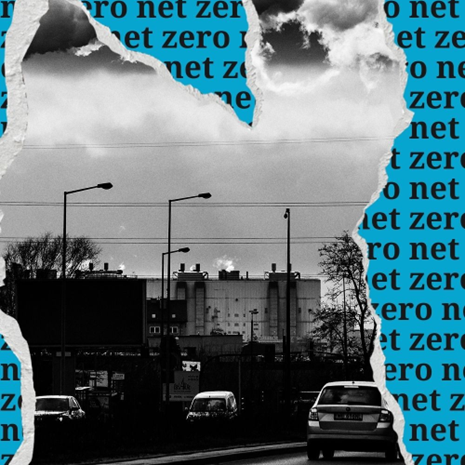
The WIRED & Octopus Energy Tech Summit in Berlin was bursting with innovative ideas for reaching net zero and on working together at an ever-greater scale.
How to Build an Underground Resistance Force in 16 Steps
Lessons from Blue Virginia, a community-based organization of women
Our Latino/a Studies Dept:
Forced Amnesia: The Hidden History Of America’s Far West
An emotional and historical journey through the American West on the tracks of the pre-1848 border, to meet families that lived there since long before the US takeover.
Our History Dept:
Marcus Rediker on the Quaker Abolitionist and Seaman Benjamin Lay – History from Below after the Transnational Turn.
This seminar subtitled “The Case of a Forgotten 18th-century Revolutionary,” was given by Marcus Rediker as part of the Development Studies Seminar Series on 24 October 2017 at SOAS University of London
To get regular updates, be sure to ‘Like’ us at http://facebook.com/ouleft.org Be sure to also, under ‘Like’, pick ‘Get Notifications.’ You can also ‘subscribe’ to our FB page and send in articles for our blog at the OUL main site, http://ouleft.org
Read more
http://ouleft.org
| | POWER TOOLS FOR UNION BUILDING | |
Timothy Sheard | 415 Argyle Rd. 6A | Brooklyn, NY 11218 US
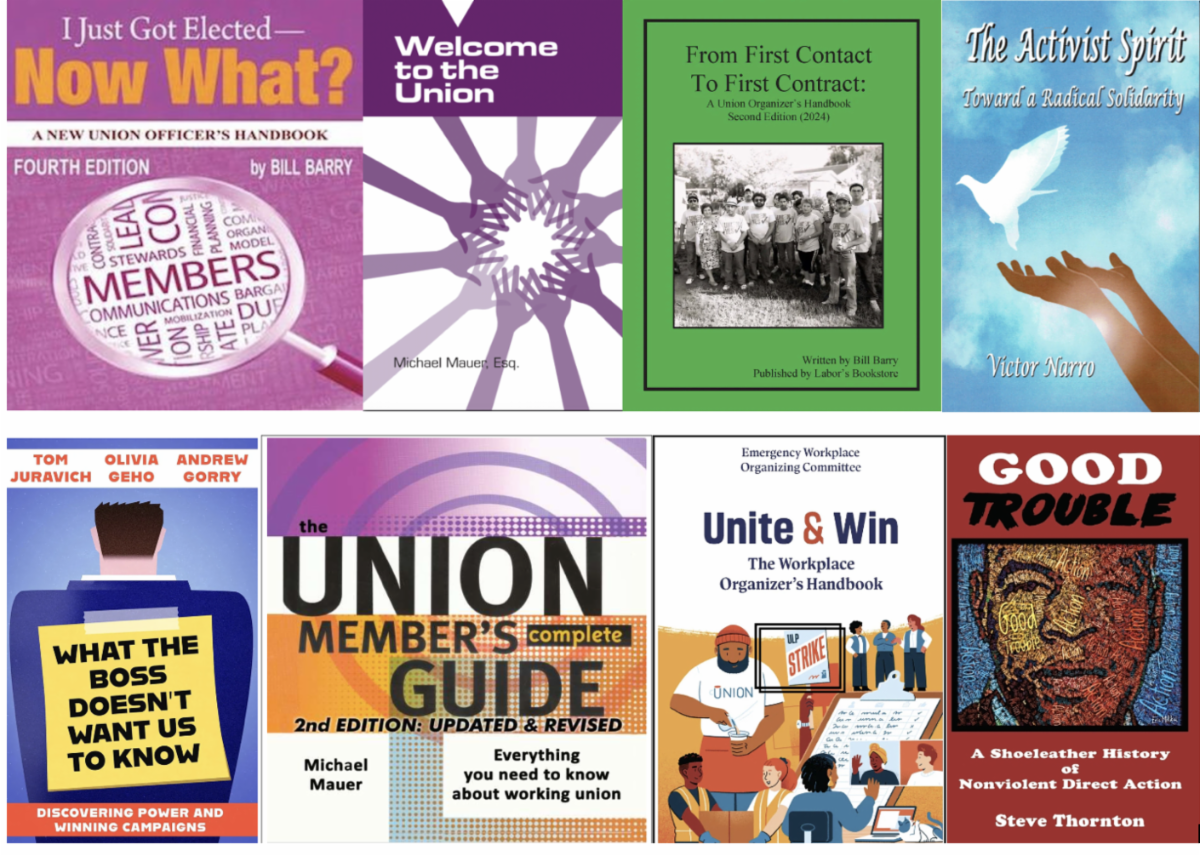
| | With grave new challenges from the current administration, Hard Ball Press is raising our game, with new books & new Staff. | | Click go to Hard Ball Press for fresh information about organizing the workplace and building union power. | | |
Hard Ball Press is thrilled to welcome Cynthia Selene Hernandez to our staff. Cynthia will take charge of new book development, design and marketing, beginning with a children's book about Women In Construction.
Cynthia began her organizing career during the Free Trade Area of the Americas protests in Miami in the early 2000s. As a student organizer in 2006, she took part in the Justice for Janitors campaign at Florida International University, which successfully advocated for improved wages and working conditions for janitorial staff.
With the support of a Pell Grant, Cynthia joined Florida International University's Labor Center (FIU), advancing from research intern to senior research associate and instructor. Her focus on wage theft led to the enactment of seven anti-wage theft county ordinances in Florida. After nearly a decade at FIU, she became the Executive Director of the South Florida AFL-CIO. She led labor and community coalitions to enhance wages and benefits for low-income families in Miami-Dade County.
In 2018, Cynthia joined Resilience Force as Florida Director, advocating for labor protections for resilience workers. As Hurricane Ian made landfall in Florida in 2022, she returned as Resilience Force National Training and Education Director.
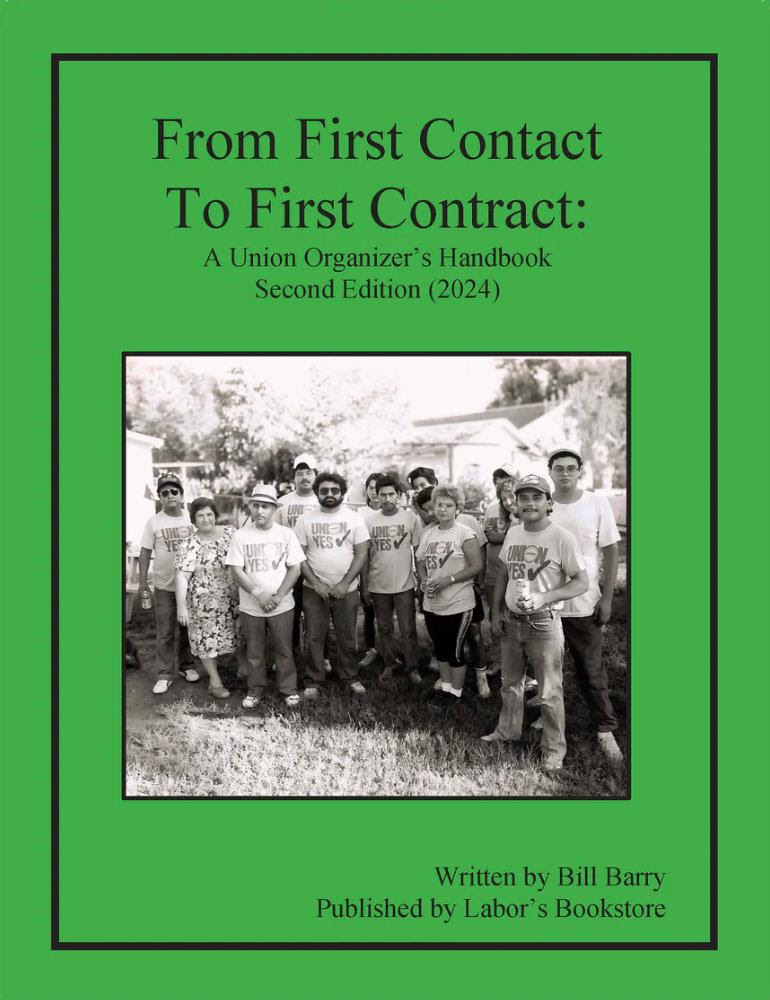
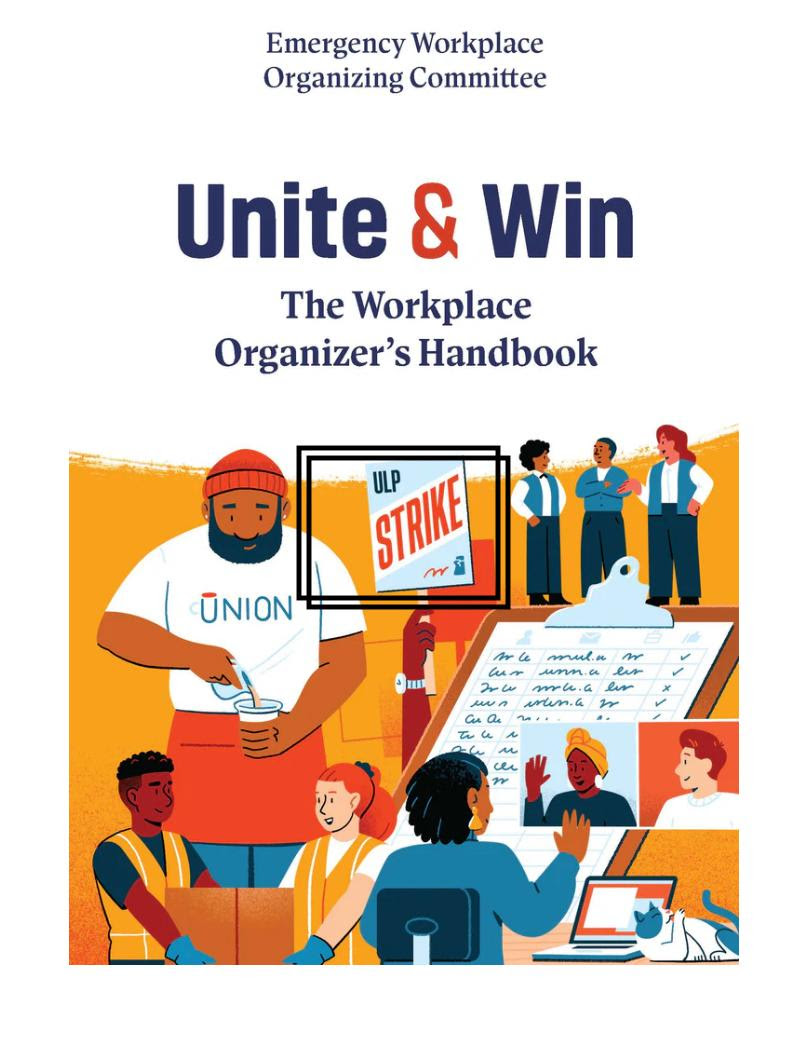
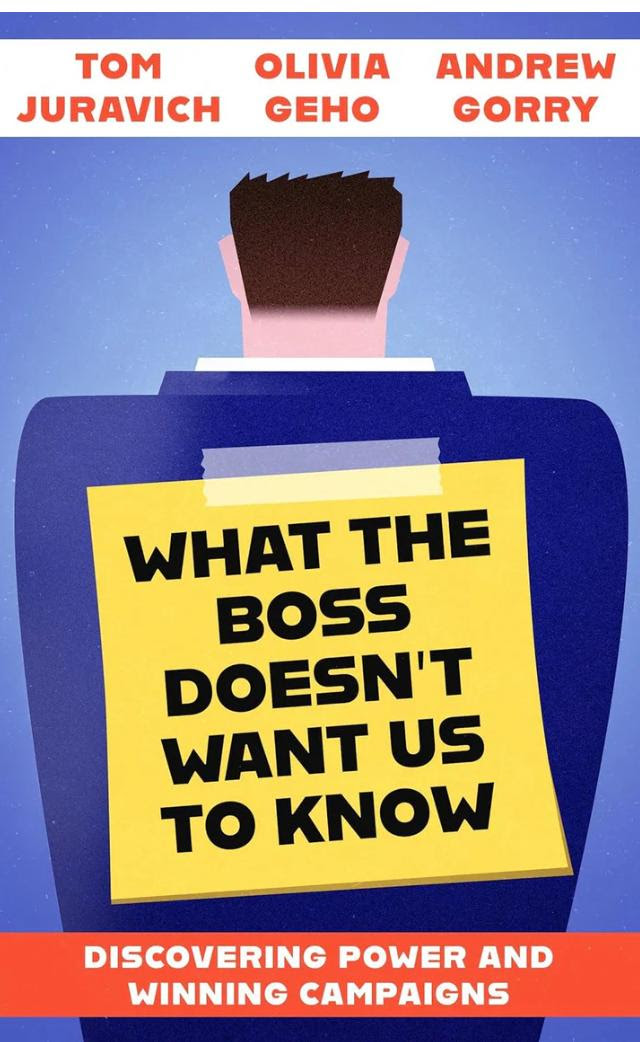
| | | | Be sure to check out the latest organizing tools from Labor's Book Store and the latest labor news from Work-BItes. | | | |  | |
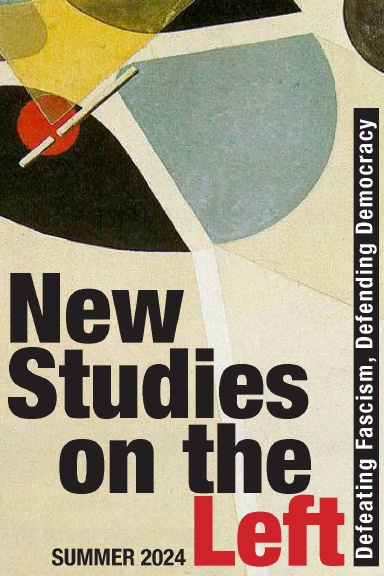
New Studies
on the Left
Paperback $19.95
...is a journal of socialist theory and practice. It is the successor to ‘Dialogue and Initiative, published as an annual journal of the Committees of Correspondence for Democracy and Socialism in book form from 2012 to 2022. It will continue the CCDS policy of left unity, including articles with a variety of left perspectives, including debates.
This issue contains over 30 articles grouped under the headings of Analysis and Global Reach, Debate and Controversy, Labor, Socialism, and Book Reviews. Some are reprinted from other sources, but many appear here for the first time.
Among the authors are David Bacon, Joan Braune, Carl Davidson, Bill Fletcher, Jr., Jerry Harris, Jay Jurie, Paul Krehbiel, Sun Liping, Adewale A. Maye, Duncan McFarland, Jasmine Payne-Patterson, Vijay Prashad, Nikhil Pal Singh, Harry Targ, and Janet Tucker.
Table of Contents
Click HERE to purchase
| | |
CHANGEMAKER PUBLICATIONS: Recent works on new paths to socialism and the solidarity economy
Remember Us for Gift Giving and Study Groups
We are a small publisher of books with big ideas. We specialize in works that show us how a better world is possible and needed. Click Gramsci below for our list.
| |
522 Valencia St.
San Francisco, CA 94110
415 863-6637
| | | | | |