|
House Passes Farm, Food, and National Security Act of 2026
The U.S. House of Representatives has passed the Farm, Food, and National Security Act of 2026 (H.R. 7567) after back-and-forth negotiations that delayed consideration.
Following disagreements and negotiations over ethanol policy (E15) and provisions regarding state regulations for pesticides and animal welfare, the House held a late-night session on April 29, followed by votes on amendments and final passage on April 30. The vote on final passage was 224-200.
A provision supported by USCA that would reinforce federal authority over pesticide labeling and prevent conflicting state requirements was stripped from the bill during floor consideration by a vote of 280-142.
The ball now moves to the Senate where the Ag Committee Chairman indicated he plans to release his proposed bill in the coming weeks. The current Farm Bill extension expires September 30, 2026.
Learn more about the Farm Bill House Agriculture Committee: https://bit.ly/4vPyzfj
| | |
Additional Economic Assistance for Agriculture Under Consideration
Members of Congress and the Administration continue to discuss the potential for additional economic assistance for farmers; however, there is still no clear view on the vehicle, the amount of assistance, or how it would be allocated.
House Agriculture Committee Chairman GT Thompson indicated in public remarks that he supports providing an additional $20 billion, with $10 billion for specialty crop producers and $10 billion for row crop producers. Senate ag leaders continue to reference a total of $17 billion with no indication of how it would be divided.
| |
House Releases FY2027 Agriculture Appropriations Bill
The House Appropriations Committee released the FY2027 Ag Appropriations Bill and accompanying report. The measure maintains funding for the Supplemental and Alternative Crops (SAC) program at $2 million. The SAC program typically supports competitive research proposals for canola.
Overall, the Ag Appropriations Bill reduces USDA discretionary spending by 1.5% ($380 million) from the current fiscal year. This differs significantly from the administration’s budget request, which called for a 19% reduction.
The bill proposes reducing Farm Service Agency (FSA) salaries and expenses to $1.1 billion, a $19.1 million cut from 2026. The reduced spending reflects the rtaff treductions hat have occurred. The bill stipulates $15 million specifically for hiring staff to fill farm loan officer positions or vacancies at FSA county offices. It would also continue a prohibition on closing county offices and bars the agency from permanently relocating county-based employees without congressional approval if doing so would leave an office with two or fewer employees.
Learn more from the House Appropriations Committee: https://bit.ly/4mXPKY8
| |
Trump Administration Released Their FY2027 Budget Proposal
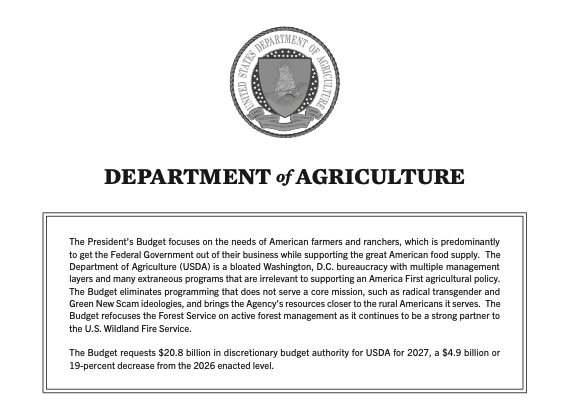
Overall, the proposal holds the line on total spending while increasing defense spending and reducing non-defense spending by 10%. The proposal reduces USDA spending by $4.9 billion, or 19%, from current funding levels. For comparison, the proposal calls for reductions to other non-defense federal agencies, including a 52% cut to the EPA, 13% cut to the Department of the Interior, and 12.5% cut to the Department of Health & Human Services. Keep in mind that budget proposals from Administrations are typically a political exercise that are largely disregarded by Congress when they develop the annual appropriations bills.
Read the Budget of the U.S. Government from the Office of Management and Budget Fiscal Year 2027:rhttps://bit.ly/3ODrfmx
| |
Legislation Introduced to Address Fertilizer Costs as Administration Discusses Options
Bipartisan groups in the US Senate and House of Representatives, led by Sen. John Thune (R-SD), Sen. Amy Klobuchar (D-MN) and Rep. Dusty Johnson (R-SD) and Angie Craig (D-MN) introduced bills to address high fertilizer costs in the wake of the war in Iran, tariff threats on fertilizer imports, and fertilizer market consolidation.
The “Fertilizer Transparency Act” would create a mandatory price reporting system to offer market participants of all sizes with comparable levels of market information on fertilizer components, while the “Homegrown Fertilizer Act” would create a grant and loan program to expand domestic fertilizer production and improve fertilizer storage capacity. Previous bills introduced by Sen. Grassley (R-IA) and Sen. Baldwin (D-WI) would require the USDA to study competition and trends in the fertilizer market and their subsequent impacts on prices.
Meanwhile, USDA Secretary Brooke Rollins has convened meetings with fertilizer companies and stakeholders to investigate options to address costs in the near-term. The Administration has taken some steps they hope will ease price pressures such as waiving domestic shipping requirements and loosening controls on Venezuelan fertilizer imports.
| | |
USDA Sends “Climate-Smart” or “Low Carbon” Biofuel Feedstock Plan to White House
In a step toward adding guidelines to the 45Z biofuels tax credit to allow farmers to improve carbon-intensity values through conservation practices, the USDA sent proposed guidelines to the White House for review in early April. This follows the proposal that was first initiated during the Biden Administration, which referred to “climate-smart” practices.
The USCA has submitted comments to USDA on the development of the guidelines and has referenced those views in comments submitted to the Treasury Department on the 45Z tax credit implementation.
| | |
Fats in the MAHA Era: Consumer Perceptions of Common Cooking Fats
According to researchers Maria Kalaitzandonakes and Jonathan Coppess of the University of Illinois and Brenna Ellison of Purdue University, consumer perceptions of cooking fats continue to evolve amid growing public debate.
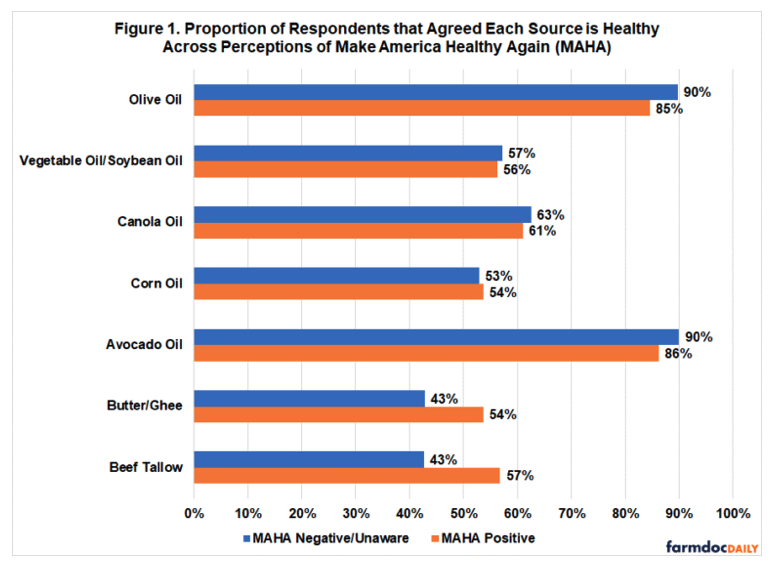
Findings from the Gardner Food and Agricultural Policy Survey show that most consumers are familiar with common fats, though their use varies widely. Olive oil, butter/ghee and vegetable oils are used most often, while beef tallow shows a large gap between awareness and actual use. In terms of health perceptions, olive oil and avocado oil rank highest, but more than half of respondents also view vegetable/soybean, canola and corn oils as healthy.
Notably, perceptions of seed oil healthfulness were consistent regardless of views on the MAHA movement, while opinions on animal fats varied more widely. Overall, most respondents agreed that following current Dietary Guidelines on fat use is important for household health, underscoring the continued influence of nutrition guidance on consumer behavior.
Read the research on farmdocDAILY: https://bit.ly/3QBLMIL
| | | | |
Seed Oils and Health: Dietitian Separates Fact from Fiction
According to registered dietitian Emily Szatrowski of Norfolk County, Ontario, current research does not support claims that seed oils are harmful to health. While concerns often focus on omega-6 fatty acids and inflammation, studies show these essential fats do not increase inflammatory markers and may even support heart and metabolic health.
The article also highlights that confusion around seed oils is often tied to their presence in ultra-processed foods—not the oils themselves. With strict regulations in Canada ensuring safety in processing, experts emphasize that seed oils can be part of a balanced diet. Overall, the guidance remains to focus on overall diet quality, variety and moderation rather than eliminating specific fats.
Read the article from Canadian Living: https://bit.ly/4tDFJBR
| | |
Seed Oils and Cancer Claims: Experts Urge Focus on Facts Over Fear
According to dietitians cited by News24, including Elske Rich of the Association for Dietetics in South Africa, there is no evidence that seed oils directly cause cancer despite growing online claims. While concerns often center on omega-6 fats and processing, experts emphasize these fats are essential and that risks are more closely tied to overall diet patterns, including high consumption of ultra-processed foods and repeated high-heat cooking.
The article highlights that seed oils can be part of a healthy diet when used appropriately, with guidance focusing on balanced eating, proper cooking methods and increasing omega-3 intake, rather than eliminating specific oils.
Read the article from News24: https://bit.ly/4cCwqwb
| | |
Lower Canola Seeding Rates May Cut Costs Without Sacrificing Yield
According to trials presented by Bourgault agronomist Curtis De Gooijer, canola growers may be able to reduce seeding rates without significantly impacting yield. Multi-year strip trials showed that plant competition and environmental conditions often played a larger role in yield outcomes than plant population alone.
While higher seeding rates increased plant density, lower populations produced larger, more branched plants that helped compensate for fewer plants. Results also showed little advantage to more precise singulation systems over conventional air drills. Ultimately, optimal seeding rates varied with weather conditions, highlighting opportunities for growers to manage costs and adapt seeding strategies based on field conditions.
Read the article from The Western Producer: https://bit.ly/4w47kxZ
| | |
UI/PNWCA Canola Tour - Camas Prairie
May 27, 2026 | 7:30 a.m. - 12:00 p.m. MST
Mark your calendars for the 3rd Annual Prairie Canola Tour! The tour will begin in Craigmont and conclude in Cottonwood, Idaho.
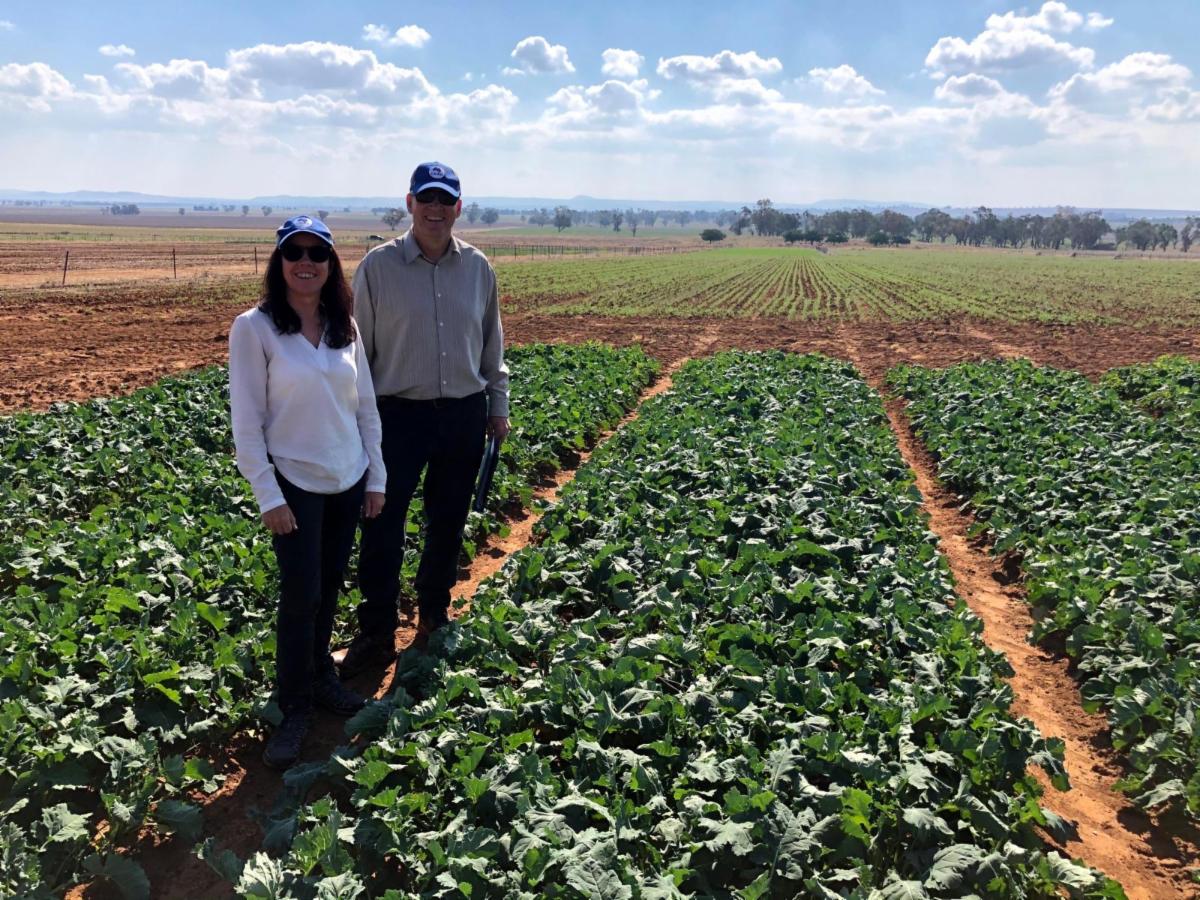
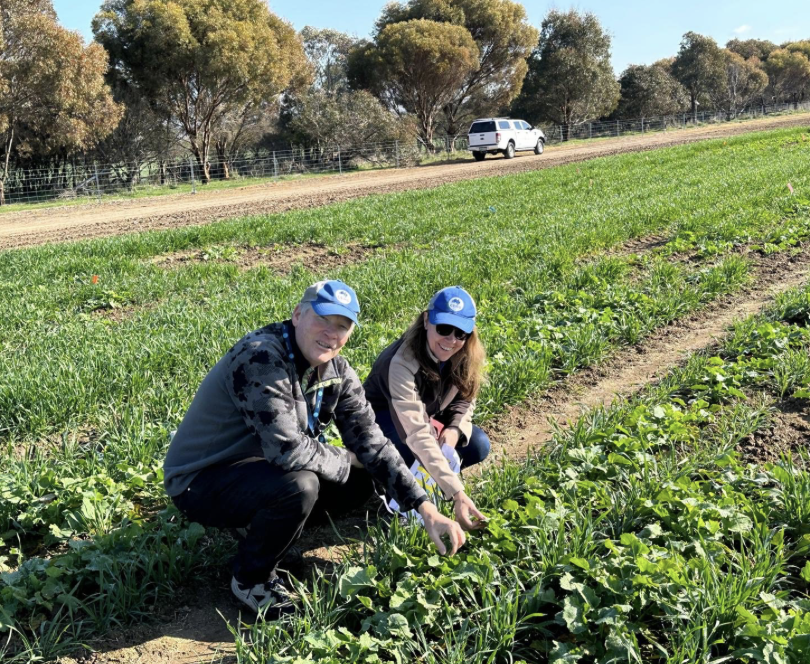
This year’s agenda features presentations from Australian canola researchers, a drone demonstration, University of Idaho research updates, market and insurance insights, and more. Bus transportation will be provided, and thanks to our sponsors, there is no cost to attend.
To register, please visit: https://bit.ly/4243UgU
| |
WSU Lind Station Meet & Greet
May 28, 2026 | 11:00 a.m. - 1:30 p.m. PST
The WSU Lind Dryland Research Station will host a special event featuring visiting scientists Drs. John and Julianne Kirkegaard from Australia. Both bring extensive experience in cropping systems research, particularly in wheat and canola.
Tentative plans include a tour of the facility, lunch, and visits to several nearby farms.
Please visit https://bit.ly/4eRcjM6 for more information, including RSVP details.
| |
Canola Tour - Wilbur, WA
May 29, 2026 | 3:00 p.m. - 7:00 p.m. PDT
Plans are underway for a late-afternoon canola tour near Wilbur, Washington, hosted by PNWCA and WSU, followed by a BBQ.
The agenda includes small-plot and large-scale variety trials, WA Oilseed Commission-funded research updates, and a market update.
Mark your calendars and stay tuned for additional details and speaker announcements!
Please visit https://bit.ly/3QEvnDk for more additional details.
| |
Cargill Opens Canadian Canola Crush Plant, Expanding Markets for Growers
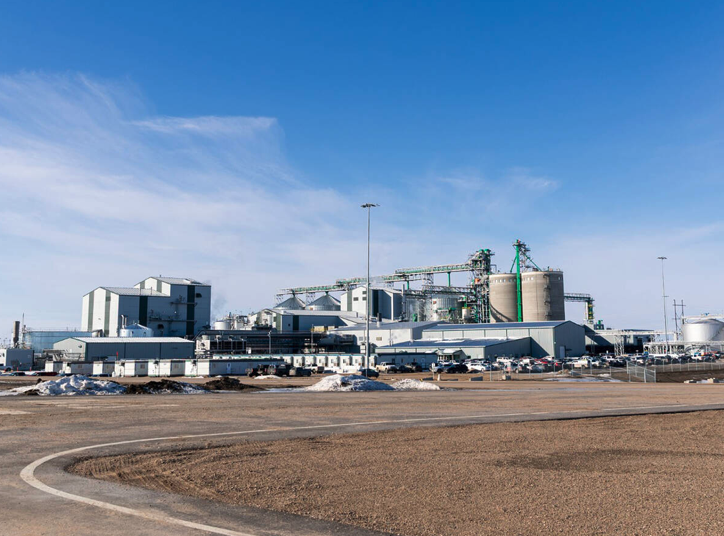
According to The Western Producer, Cargill has opened a new canola crushing facility in Regina, Saskatchewan, with the capacity to process one million tonnes of canola annually. The plant is expected to reach full capacity soon and will serve both food and growing biofuel markets.
The facility increases local demand and marketing opportunities for farmers across southern Saskatchewan and western Manitoba, offering greater price transparency and delivery flexibility. Industry leaders note the investment strengthens domestic processing capacity and supports long-term demand for canola in both food and low-carbon energy sectors.
Read the article published in The Western Producer: https://bit.ly/4eUpcoy
| |
Farm Bankruptcies Rise, but Ag Sector Shows Resilience Amid Downturn
A new report from The Feed by Farmer Mac highlights a 46% increase in Chapter 12 farm bankruptcies in 2025, signaling financial stress across parts of U.S. agriculture. However, filings remain well below levels seen in past downturns, indicating a challenging cycle—not a crisis.
The report emphasizes that Chapter 12 is primarily a restructuring tool that often allows farms to continue operating, with many cases ending in successful repayment or settlement.
Distress is concentrated in specific regions and commodities, particularly Midwest and Southeast row crops, driven by declining farm income and elevated input costs.
For agricultural lenders, the report underscores the importance of proactive engagement, strong collateral management, and long-term relationship building during this period of adjustment.
Read the article published by Farmer Mac: https://bit.ly/4ulVo8Z
| |
Final RFS Rule Expected to Boost Canola Demand and Biofuel Growth
According to Barry Coleman, executive director of the Northern Canola Growers Association, the EPA’s final Renewable Fuel Standard (RFS) volumes for 2026 and 2027 are expected to drive renewed demand for canola oil and strengthen the biofuels market. The rule sets record biomass-based diesel targets and is projected to increase use of canola and soybean oil, particularly as policy changes make imported feedstocks less competitive.
While recent data showed a temporary decline in canola oil use for biofuels, demand is expected to rebound as production ramps up to meet new requirements. Combined with steady food demand, total U.S. canola oil use is projected to grow, reinforcing canola’s role in supporting domestic energy, economic and environmental goals.
Read the article published in the Farm&Ranch Guide: https://bit.ly/4vWcADt
| |
Strong Crush Margins and Biofuel Demand Lift Outlook for Ag Processors
Reporting from Reuters and Yahoo! News shows improving conditions for major agribusinesses, as strong oilseed crush margins and rising biofuel demand boost earnings outlooks.
Bunge Global raised its 2026 earnings forecast to $9.00–$9.50 per share following better-than-expected quarterly results, while peers like Archer Daniels Midland are also expected to benefit.
Higher soybean oil prices, driven in part by crude oil volatility linked to the Iran war, and updated U.S. biofuel blending mandates have strengthened margins and reduced uncertainty. However, ongoing geopolitical tensions, elevated input costs, and near-capacity U.S. crush levels may limit expansion and continue to pose risks to supply chains and future growth.
Read the articles published from:
Reuters: https://bit.ly/4uhUmdY | Yahoo! Finance: https://bit.ly/4uogq72
| |
Rising Biofuel Demand Drives Surge in Used Cooking Oil Imports
According to Bloomberg, U.S. imports of used cooking oil (UCO) from China are increasing as higher biofuel blending requirements and rising energy prices, linked in part to the Iran war, boost demand for renewable diesel feedstocks. Recent shipments mark the largest imports of the year, with more expected as fuel producers work to meet record renewable volume obligations. While soybean oil remains the leading feedstock, its higher prices are widening the gap with lower-cost imports like UCO. Analysts note that limited domestic supply is driving imports, even as concerns persist among U.S. farmers and processors about the impact of foreign feedstocks on domestic markets.
Read the article from Bloomberg: https://bit.ly/4de4krc
| |
Northeast Arkansas Farmers Turn to Canola as Demand Grows for Renewable Jet Fuel
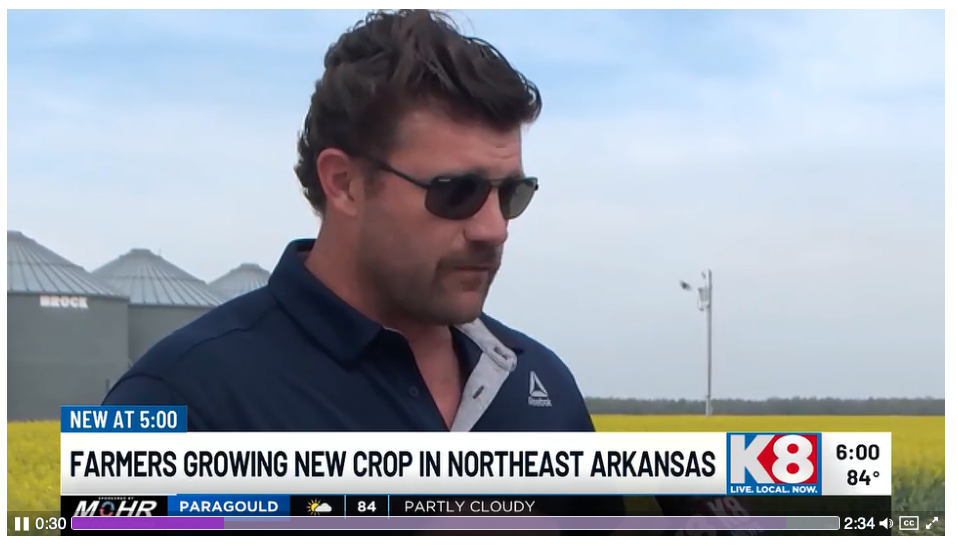
According to a K8 News report, farmers in northeast Arkansas are planting canola as part of a growing initiative to supply feedstocks for renewable jet fuel. The program, backed by industry partners, is expanding across multiple states, with plans to significantly increase acreage in the coming years.
While growers face challenges introducing a new crop, many see canola as an opportunity to diversify operations and tap into a new revenue stream amid shifting commodity markets. With strong demand projected for low-carbon fuels, farmers view canola as a promising addition that could play a key role in the future of aviation energy.
Watch the report from K8 News: https://bit.ly/4eRcrLu
| | |
USCA works to support and advance U.S. canola production, marketing, processing, and use through government and industry relations. Since its establishment in 1989, the association has helped domestic canola acreage grow from virtually zero to about 2 million. To learn more about USCA, go to: www.UScanola.com
Want to promote your products or services to canola producers and industry members? Visit our advertising pages to find specs, deadlines and rates to advertise in the Canola Quick Bytes monthly e-newsletter.
| | | | |