|
The Corresponder
The Newsletter of the Committees of Correspondence for Democracy and Socialism
| |
THE STRUGGLE AGAINST FASCISM AND WAR:
CONTINUING THE DIALOGUE ABOUT THEORY AND PRACTICE
May 25, 8 pm Eastern
| | |
Committees of Correspondence for
Democracy and Socialism (CCDS)
Socialist Education Project (SEP)
4 th Monday Webinar Series
At the April 27 webinar entitled "What's Next?" we heard longtime activist leaders Leslie Cagan, Carl Davidson, and Bill Fletcher discuss "BUILDING THE MOVEMENTS AGAINST FASCISM AND WAR: After No Kings: What's Next?"
After the short presentations attendees, mostly with long movement experience, continued the discussion. All agreed that defeating fascism and war may be the most critical project of our political lives and that discussion, reflections, and report backs from various communities was of vital importance. We agreed to reassemble and hear from participants from around the US.Below is a recording of that discussion:
https://www.dropbox.com/scl/fi/gkro2g1dpe3l2uwkel4yk/building-movements-4th-monday-april-2026.mp4?rlkey=o4ntlsp2bqnfc33uqyd3c5pa0&st=8f0v14q1&dl=0
This May 4th Monday program is for and by CCDS members and political activists everywhere. Come prepared to report on :
-the grassroot activities in your community
-has work in your community moved from mobilizing a mass movement to organizing specific ongoing campaigns?
-what issues, campaigns, strategies and tactics are working? What ones are not? What other lessons have been learned?
-what should progressives, the "left," and socialists be doing now to fight fascism and war?
-Should other issues: war, healthcare, inequality, racism, homophobia, islamophobia, environmental degradation be part of our immediate agenda?
After very short introductions to this webinar, we will solicit comment on these issues from all webinar attendees. Contrary to most webinars, this webinar will be led by registrants who are, in fact, experienced organizers for change.
Join us and share your ideas and experience at this event.
Register here:
https://us02web.zoom.us/meeting/register/UH10DBKQQNCiPp2ekurYQQ
| |
Bad Weather and Rough Roads Ahead. Study the Maps
and Get Organized for the Breakthroughs We Need
by Carl Davidson
reprinted from Leftlinks
May 8th
Here are eight of today's news headlines. Taken as a whole or in batches, they spotlight the troubles we face:
--ICE Arrests Violated Order Requiring Warrants in D.C., Judge Rules
--Iran War Live Updates: U.S. and Iran Exchange Fire Amid a Declared Truce
--Anti-Choice States Target Organizations Providing Information About Abortion
--Tennessee Approves New Map Aimed at Flipping the Last Democratic Seat
--The meeting at the Vatican followed President Trump's condemnation of Pope Leo XIV for opposing the war in Iran.
--Trump Keeps Saying He Wants to Leave NATO. Maybe He Already Has
--Trump administration now classifies Antifa and left-wing networks among 'major' terror groups
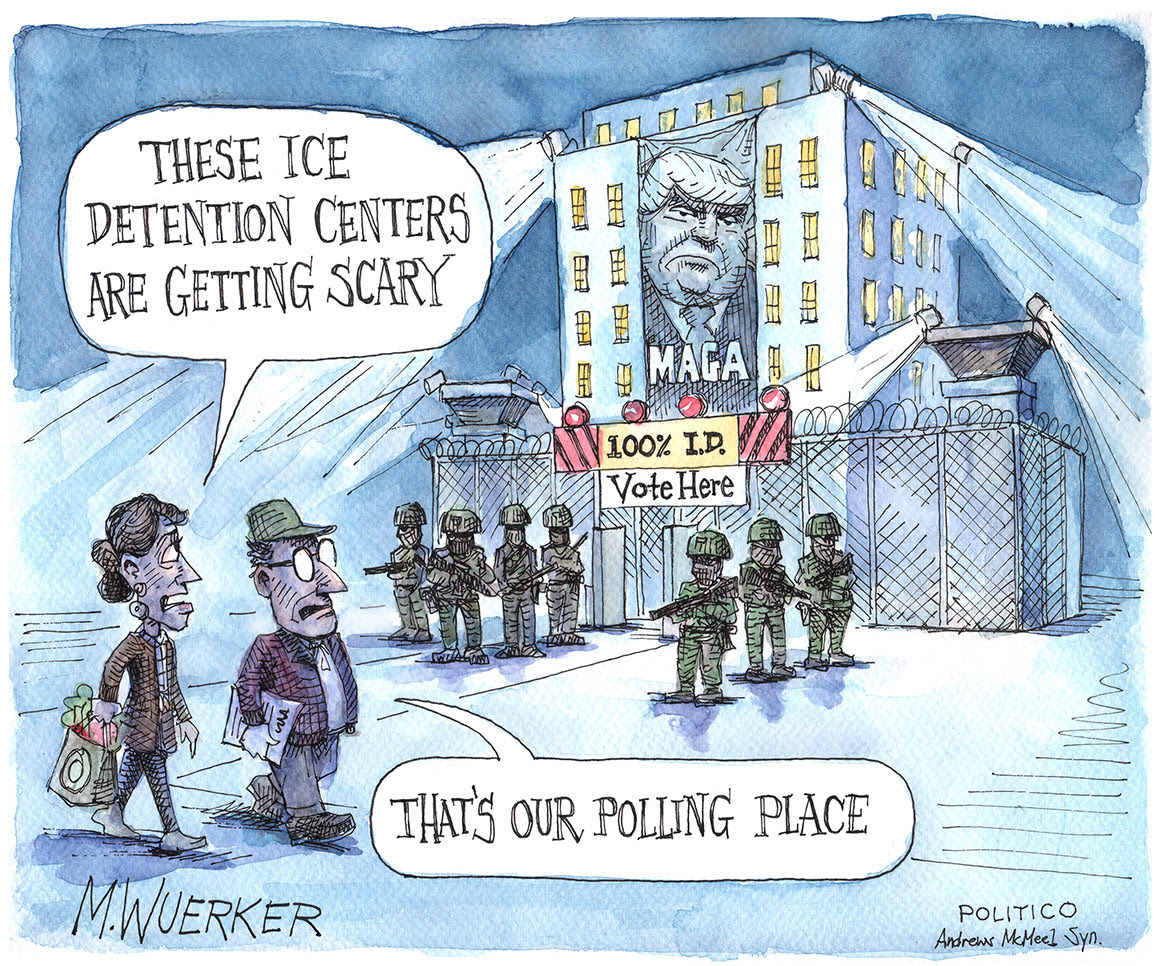
--GOP Senate candidate recruiting off-duty Detroit cops to intimidate voters
Taken one by one, the headlines of the week look like scattered crises - a legal ruling here, a foreign policy flareup there, a redistricting fight, a culture war skirmish, a new classification of "terror threats," a candidate recruiting police to hover over the ballot box.
But read together, these eight headlines form a single narrative thread. They reveal a country locked in a difficult, grinding struggle on two fronts at once: expanding wars abroad and creeping fascism at home. And they show how much harder the months ahead will be.
1. "ICE Arrests Violated Order Requiring Warrants in D.C., Judge Rules."
This story is not just about immigration enforcement. It is about the rule of law itself. When a federal judge finds that a government agency violated a court order, it signals something deeper: a willingness inside the executive branch to treat legal constraints as optional, as advice it can ignore. That is the seedbed in which authoritarianism grows - not in dramatic coups, but in the quiet normalization of ignoring the law, especially those concerning our democratic rights, when it becomes inconvenient.
2. "Iran War Live Updates: U.S. and Iran Exchange Fire Amid a Declared Truce."
The declared truce that isn't a truce is a metaphor for the entire conflicted moment. The country is told there is peace, even as missiles fly. Americans are told the conflict is contained, even as it widens. The war in Iran - and the administration's shifting explanations for it - has become a test of democratic oversight and the War Powers Act. Congress strains to reassert its constitutional role. Peace advocates, churches, veterans' groups, and foreign policy scholars raise alarms. Yet the machinery of war grinds on. This is the worldwide front of the struggle: an unjust war whose aims remain undefined, whose costs are mounting, and whose justification grows thinner by the week.
3. "Anti?Choice States Target Organizations Providing Information About Abortion."
At home, the struggle takes a different form: the policing of information itself. When states begin targeting not just abortion providers but organizations that merely inform people of their options, the issue is no longer only reproductive rights. The question becomes whether the government can criminalize knowledge to enforce patriarchy. That is the logic of male supremacist censorship regimes, not democracies.
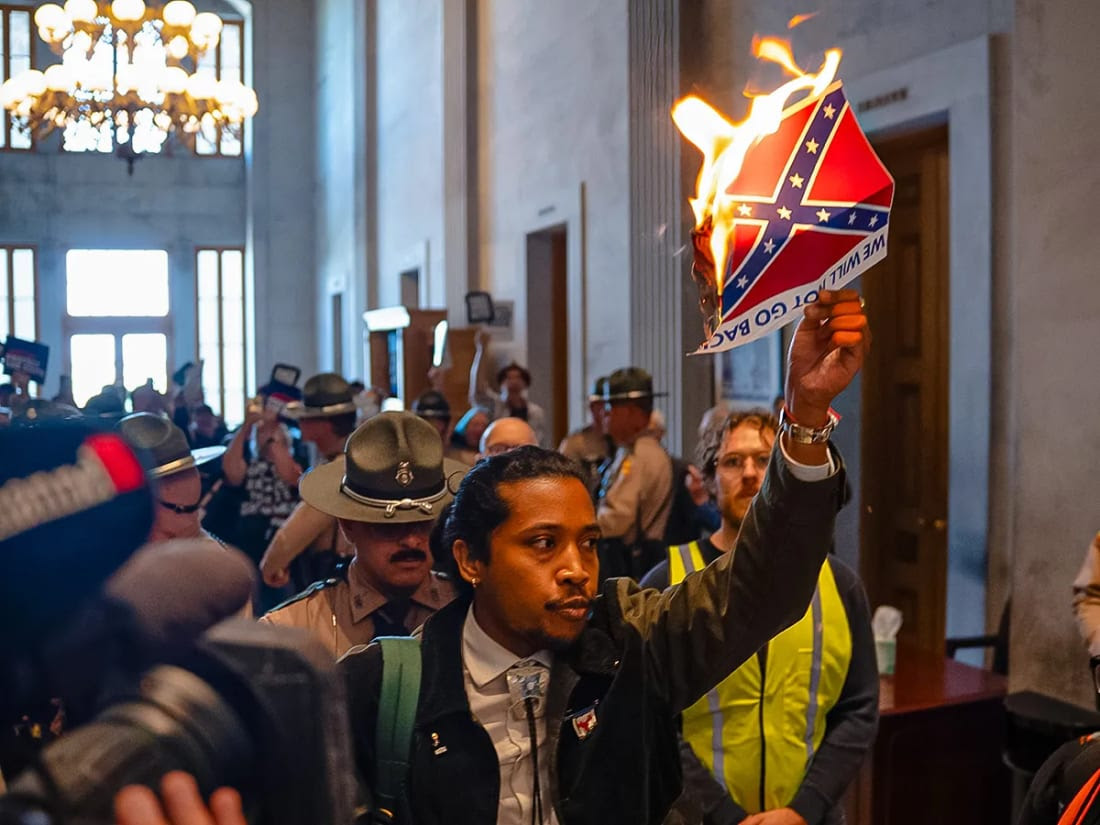
4. "Tennessee Approves New Map Aimed at Flipping the Last Democratic Seat."
Redistricting battles are officially treated as technical or partisan. But this headline points to something more fundamental: the white supremacist systematic engineering of political outcomes before a single vote is cast. When the last remaining majority Black opposition seat in a state is carved up to ensure its defeat, elections become a skewed performance rather than a democratic choice. The struggle here reveals the Neo-Confederate dimension of the MAGA bloc, not rational demographics between parties.
5. "The meeting at the Vatican followed President Trump's condemnation of Pope Leo XIV for opposing the war in Iran."
In the nest of contradictions it contains, this headline captures a moment that would have been unthinkable in earlier eras: a U.S. president publicly condemning a pope for refusing to bless a war. The Vatican meeting that followed - reportedly tense, reportedly urgent - symbolizes the moral pressure being exerted on and by institutions that have historically stood outside partisan politics. When religious leaders are told to align with state military aims, the line between church and state is not blurred; it is crossed.
6. "Trump Keeps Saying He Wants to Leave NATO. Maybe He Already Has."
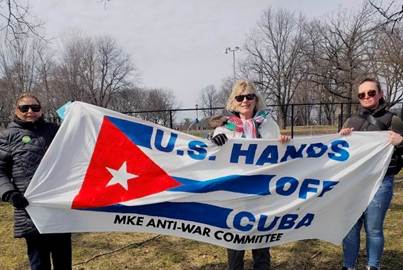
Whatever we think of NATO or whether the United States has formally withdrawn or merely ceased to function as a reliable ally, the effect is the same: the 1945 postwar security architecture is destabilized. This is not just a foreign policy headline. It is a domestic one. A country that abandons its alliances abroad often does so because it is turning inward - toward nationalism, unilateralism, and the politics of grievance. The struggle here is over America's identity: a partner in the rules-based order of the UN? Or a solitary power seeking hemispheric hegemony guided by impulse. Do we seize Greenland? Take over Cuba? Take back the Canal? All these and more are now on the table.
7. "Trump administration now classifies Antifa and left?wing networks among 'major' terror groups."
This one is aimed at us. The classification of domestic left and liberal political networks as "major terror groups" marks a profound escalation. Terror designations carry extraordinary legal powers: surveillance, asset seizure, and expanded policing authority. When applied to loosely defined ideological categories rather than specific violent actors, they risk becoming tools to suppress dissent. This is the domestic front of the struggle in its starkest form: the state deciding which political beliefs constitute a security threat.
8. "GOP Senate candidate recruiting off-duty Detroit cops to intimidate voters."
And finally, the headline that ties the entire domestic picture together. When a candidate recruits ICE agents or off-duty police officers to "monitor" voters, especially in a majority-Black city with a long history of voter suppression, the message is unmistakable. The struggle over democracy is not abstract. It is happening at the ballot box, in real time, with real consequences. We need to be ready to deploy counter-intimidation where needed.
Taken together, these eight headlines describe a country under extraordinary strain:
--A government is testing the limits of legal obedience.
--An unjust war abroad is expanding despite public unease.
--A domestic landscape where information is policed, districts are engineered, dissent is surveilled, and voters are intimidated.
Institutions - from churches to alliances - are pressured to conform.
This is not a single crisis. It is a convergence of crises.
And it reveals the central truth of the months between now and November: The struggle is not only about who wins an election. It is not only about whether the country can maintain the democratic, legal, and moral foundations that make elections meaningful in the first place. It is also whether we can win something new and better, the 'abolition democracy' rooted in a Third Reconstruction.
Headlines are often warnings. They also reveal a map. They show where the pressure points are, where the greatest erosion is happening, and where citizens - religious, secular, conservative, progressive, independent - will have to stand firm if the country is to emerge from this season with its democratic character intact and on a positive path forward.
| |
Thursday, April 9, 2026
MAY DAY BRINGS THOUGHTS OF SOCIALIST ALTERNATIVES: And about Moving Ahead
Harry Targ
Sketching Today’s Global Political Economy
During the latest phase of monopoly and finance capital (1945- to the present) enormous changes occurred in the global political economy. First, the United States emerged as a superpower and in an effort to crush the threat of socialism around the world committed itself to constructing a “permanent war economy.” This permanent war economy would create the military capacity to destroy alternatives to global capitalism, stimulate and maintain a high growth manufacturing economy, justify an anti-communist crusade to crush the left in the United States, and co-opt and/or repress working class demands for change. In addition, the permanent war economy would occasion the perpetuation of racism and patriarchy in public and private life.
As the years passed corporate rates of profit began to decline as a result of rising competition among capitalist states, over-production and under-consumption, an increasing fiscal crisis of the capitalist state, and rising prices of core natural resources (particularly oil). With a growing crisis, global corporate and finance capital shifted from investments in production of goods and services to financial speculation. Thus capitalist investment steadily shifted to financialization, or the investment in paper-stocks, bonds, private equity and hedge funds and other forms of speculative investment. Financial speculation was encouraged by state tax policies, “free trade” agreements, an expanded international system of indebtedness, and increased reliance on consumer debt.
Multinational corporations which continued to produce goods and services sought to overcome declining profit rates. This, they concluded, could only be achieved by reducing the costs of labor. To overcome the demand for higher real wages, health and other benefits, and worker rights, manufacturing facilities were moved from core capitalist states to poor countries where lower wages were paid. Thus, in wealthier countries millions of relatively high paying jobs were lost while production of goods increasingly moved to sweatshops in poor countries. Wealthy capitalist states experienced deindustrialization.
Finally, assisted by technological advances, from computers to new forms of shipping, financial speculation and deindustrialization fueled the full flowering of globalization, or the radically increased patterns of cross border interactions-economic, political, and cultural. Globalization began to transform the world into one integrated global political economy.
In short, we may speak of a four-fold set of parallel political and economic developments that have occurred since the end of World War II, in which the United States has played a leading role: creating a permanent war economy, financialization, deindustrialization, and globalization.
Should We Be Thinking About Socialism Today?
A rich and vital set of images of a socialist future comes down to us from the utopians, anarchists, and Marxists, the martyrs of the first May Day, and the variety of experiments with socialism attempted in Asia, Eastern Europe, Western Europe, Africa, and the Caribbean. Extracting from the multiple reasons why individuals and movements chose socialism one reason stands out; that is, that capitalism historically is and has been a cruel and inhumane system, a system borne and fueled by slavery, genocide, war, super exploitation of workers, tactics of division based on race and gender, and an almost total disregard for the natural environment that sustains life. Building a permanent war economy, financialization, deindustrialization, and globalization are merely extensions of the cruel and heartless pursuit of profit which has been the fundamental driving force of the capitalist mode of production.
Drawing on the history and the images of a better future coupled with the brutality of the capitalist era; we might conceive of a 21st century socialist future that has four main dimensions.
First, we need to create institutions that are created and staffed by the working classes and serve the interests of the working classes. While scholars and activists may disagree about what “class” means in today’s complicated world, it is clear that the vast majority of humankind do not own or control the means of production, nor do they usually have an instrumental place in political institutions. Therefore, socialism involves, in the Marxist sense, the creation of a workers’ state and since most of us are workers (more than 90 percent of the US population for example), a state must be established that represents and serves the interests of the many, not the few.
Second, our vision of socialism is a society in which the working classes fully participate in the institutions that shape their lives and in the creation of the policies that these institutions develop to serve the needs of all the people.
Third, socialism also implies the creation of public policies that sustain life. Socialism in this sense is about good jobs, incomes that provide for human needs, access to health care for all, adequate housing and transportation, a livable environment, and an end to discrimination and war.
Fourth, socialism is also about the creation of institutions and policies that maximize human potential. A socialist society provides the intellectual tools to stimulate creativity, celebrate diversity, and facilitate writing poetry, singing and dancing, basking in nature’s glow, and living, working, and loving with others in humanly sustainable communities.
Today we remain terribly far from any of these dimensions of socialism. But paradoxically, humankind at this point in time has the technological tools to build a mass movement to create a socialist future. We can communicate instantaneously with peoples all over the world. We can access information about the world that challenges the narrow ruling class media frames about the human condition. We have in the face of brutal war, environmental devastation, enduring racism, super exploitation of workers everywhere mass movements of workers, women, people of color, indigenous people, and youth who are demanding changes. Increasingly public discourse is based upon the realization that our future will bring either extinction or survival. Socialism, although it is not labeled as such, represents human survival.
Where do we who believe that socialism offers the best hope for survival stand at this critical juncture? We are weak. Many of us are older. Some of us have remained mired in old formulas about change. Nevertheless, we can make a contribution to building a socialist future. In fact we have a critical role to play.
We must articulate systematic understandings of the global political economy and where it came from: permanent war, financialization, deindustrialization, and globalization. We need to articulate what impacts these processes have had on class, race, gender, and the environment. In other words, we need to convince activists that almost all things wrong with the world are connected and are intimately tied to the development of capitalism as the dominant mode of production.
We need to take our place in political struggles that demand an expanded role for workers in political institutions. We need to insist that the working classes participate in all political decisions.
We need to work on campaigns that could sustain life: jobs, living wages, single payer health care, climate change etc. Our contribution can include making connections between the variety of single issues, insisting that participants in mass movements take cognizance of and work on the other single issues that constitute the mosaic of problems that require transformation. We must remember that in the end the basic policies that sustain life require building socialism. Most struggles, such as those to achieve living wages or a single payer health care system for example, plant the seeds for building a broader socialist society. We can incorporate our socialist vision in our debates about single issues: if we demand a living wage, why not talk about equality for example?
We need to rearticulate our belief that human beings have a vast potential for good, for creativity, and given a just society, we all could move away from classism, racism, and sexism. We could pursue our talents and interests in the context of a sharing and cooperative society.
By working for institutional incorporation (empowerment) and life-sustaining and enhancing policies we will be planting the seeds for a socialist society.
May Day and No Kings 2026
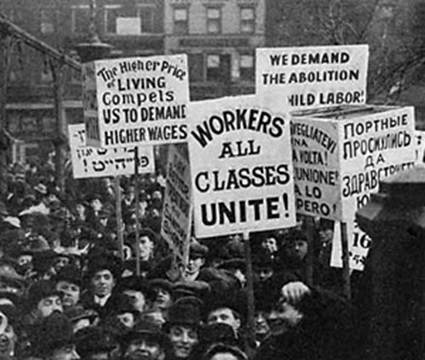
This year May Day will continue the historic mass mobilizations for social and economic justice of recent historic No Kings rallies. The original May Day was designed to remember the May 1, 1886 rally in Chicago for the 8-hour day. At that rally more than 300,000 workers from 13,000 businesses walked off their jobs to demand justice for workers.
At a subsequent rally two days later at another rally an unknown person threw a bomb, violence broke out, police and others were killed. Anarchist leaders of the rallies, the Haymarket Martyrs, were charged with the violence, which they had nothing to do with. Subsequently eight martyrs were convicted, four of whom were executed for crimes they did not commit. Three years later, a federation of socialists workers, the Second International, declared May 1 an International Workers Day to remember the Haymarket Martyrs and at the same time to continue to rally for worker rights, from social and economic justice to ending war. Almost 70 countries around the world honor May Day as an official holiday today, and workers in many more countries celebrate the day and workers’ rights even though it is not an “official” holiday.
Today working people, most of the population of the United States, still need social and economic rights, labor rights, and would benefit from dramatic cuts in military spending and increases in social spending. As a result, millions of people in the United States have marched and rallied for social and economic justice, defending democratic institutions, and against wars in recent No Kings rallies, the most recent being March 28. Given the threats of fascism at home and world war overseas, activists are asking “What do we do now?’ One answer is to step up the militancy while honoring May Day, the International Workers Day.
“Coming off the heels of the massive energy from the No Kings mobilizations, people are ready to take action and keep fighting for a democracy of, by, and for the people,” says Indivisible Co-Founder Leah Greenberg, whose organization started the No Kings protest.
On May 1, Indivisibles will be joining people across the country with a clear message: we demand a government that invests in our communities, not one that enriches billionaires, fuels endless war, or deploys masked agents to intimidate our neighbors.
”
https://paydayreport.com/no-kings-organizers-pivot-to-may-day-general-strike/
As Ralph Chapin. the lyricist of the industrial Workers of the World wrote in 1915 in the workers' anthem, “Solidarity Forever”:
“In our hands is placed a power greater than their hoarded gold,
Greater than the might of armies, magnified a thousand-fold.
We can bring to birth a new world from the ashes of the old.
For the union makes us strong”
| | |
Update on Israel’s Continuing Genocide and Apartheid in Palestine and Its Illegal Attacks on Lebanon, Amid BDS Wins
by Rod Such
Palestinian resistance and the work of international solidarity activists can take pride in recent victories against Israel’s ongoing violations of international law in the occupied Palestinian territories and Lebanon. These victories should not be overlooked despite the horrific violence Israel continues to unleash in Gaza, the West Bank, and Lebanon, especially in southern Lebanon.
In Gaza, Israel has killed more than 850 Palestinians since the October 2025 ceasefire was announced. Violations of the ceasefire include ongoing drone strikes and artillery shelling, according to the Gaza Health Ministry. Israeli military forces continue to occupy more than 50 percent of Gaza, forcing Palestinians into a narrow corridor of mostly rubble, a landscape that’s been described as leaving Gaza without any recognizable landmarks.
Most Palestinians live in tent encampments where sewage and waste foster rodent and insect infestations that make daily life unbearable, while healthcare is severely curtailed. In short, the genocide that has already taken nearly 73,000 lives continues unabated with no end in sight due to the existence of U.S. President Donald Trump’s so-called Board of Peace. Trump created the board after declaring U.S. ownership of Gaza. It notably includes no Palestinians and is demanding Hamas’s complete disarmament before reconstruction can begin.
Meanwhile, in the occupied West Bank, settlers have stepped up physical attacks on Palestinian communities, and the death toll there continues to mount. Israel’s military and its illegal settler movement have killed more than 1,000 Palestinians in the West Bank since October 2023, according to the United Nations Relief and Works Administration (UNRWA).
In just the last year, Israel has established more than 100 new illegal outposts in the West Bank, according to human rights organizations. In July 2024 the International Court of Justice issued a provisional opinion declaring the occupation of Gaza and the West Bank, including East Jerusalem, “unlawful.” Israel has unlawfully transferred more than 750,000 of its citizens to the occupied territories, a violation of the Fourth Geneva Conventions, recognized and ratified by most of the world’s nations, including the United States..
In Israel proper, where apartheid also exists and was codified with the 2018 Nation State Law that declares Israel a state for Jews alone–even though 20 percent of the population is Arab Palestinian.
The Israeli parliament, the Knesset, recently passed a death penalty law that applies to Palestinians alone, the most draconian law yet passed by the apartheid state. A Jew convicted of carrying out a terrorist attack resulting in death is not subject to the death penalty, whereas a Palestinian Arab convicted of the same crime is guaranteed the death penalty by hanging. Israel immediately began to prepare prosecutions of Palestinian political prisoners suspected of taking part in the Oct. 7, 2023 attack.
Finally, the U.S-Israeli playbook since the October 2025 ceasefire also includes an attempt to destroy the resistance put up by Hezbollah, the Islamic Shia resistance movement that in 2000 succeeded in forcing Israeli military forces to withdraw from southern Lebanon with its large Shia community.
When Hezbollah responded on March 2, 2026 to the U.S.-Israeli war on Iran that began on Feb. 28, by firing rockets into northern Israel, Israel initiated air and artillery strikes that have now killed more than 2,000 Lebanese and wounded thousands more. Those air strikes included attacks on Beirut, the Lebanese capital, and went beyond striking communities where Hezbollah enjoys popular support.
Israel attempted to incite an ethnic cleansing campaign against Shia Muslims in Lebanon by urging predominantly Christrian and Sunni Muslim communities to expel Shia or face continued Israeli bombing campaigns. Discrimination against Shia Muslims within Lebanon, along with a lack of political representation, was a major reason for the rise of Hezbollah in the first place.
When Iran threatened to revoke a ceasefire agreement reached two weeks after the war began due to Israel’s bombing of Lebanon, President Trump posted on his Truth Social account that the U.S. was prohibiting Israel from continued aerial bombardment. Israeli air strikes largely ceased except in southern Lebanon where Israel established a 10-kilometer salient and began systematically destroying entire Lebanese villages and towns within that salient. Hezbollah’s armed resistance, however, continued to fight the invasion, including with new drone technologies and also demonstrating the ability to continue firing rockets into northern Israel.
Israeli Prime Minister Benjamin Netanyahu boasted that Israel was the chief regional power in the Middle East and also a “world power.” Indeed, Israel has long played a role as a global military and intelligence ally of U.S. imperialism, including supplying armaments and nuclear assistance to apartheid South Africa and intelligence aid to the military dictatorships in Latin America propped up by the United States.
So how did the international Boycott, Divest and Sanctions (BDS) movement factor in during this period?
Perhaps the most noteworthy development came in April 2026 when 40 Democratic senators voted in support of two Senate resolutions introduced by independent Vermont Senator Bernie Sanders. One resolution called for blocking any further U.S. military aid to the Israeli government and the other called for ending scheduled U.S. shipments of bulldozers, such as Caterpillar’s, which Israel uses to demolish Palestinian homes and infrastructure. Notably those senators deemed closest to the Democratic Party establishment, such as former majority leader Chuck Schumer, voted against the resolutions.
It was the largest bloc of Democratic senators ever to vote for ending military aid to Israel. In many states, such as Illinois, Maryland, Minnesota, New Mexico, and Oregon, both U.S. senators voted for the measures, which was also unprecedented. Whether the motivation was merely performative, knowing that the resolutions had no chance of succeeding due to the Republican-controlled Senate, or whether the vote accurately reflected genuine support for the growing opposition to aid to Israel within the Democratic electorate remained to be seen.
Regardless, it was a significant sign of the growing influence of the BDS movement. The previous month, the Washington state treasurer unilaterally divested the state treasury’s investments in Caterpillar on the anniversary of the death of Palestine solidarity activist Rachel Corrie who was killed by an Israeli soldier driving a Caterpillar bulldozer as Corrie tried to block the demolition of a Palestinian home in Gaza in 2003.
During the 1980s, when the anti-Apartheid struggle in South Africa called for BDS, more than 1,200 U.S. cities and towns answered the call, either divesting from the South African gold coin, the Kruggerand, or pledging not to invest in the apartheid state.
A similar movement is now underway in the U.S. with recent successful campaigns recorded in St. Louis, Mo; Medford, Northampton, and Somerville, Mass.; Iowa City, Ia.; Portland, Me., and Alameda County, Calif.
| | |
My conversation with Tennessee Rep. Justin Jones
Robert Reich
May 12
Tennessee Rep. Justin Jones and Yours Truly
Friends,
Yesterday I spoke with Tennessee state representative Justin Jones, one of the nation’s young Black leaders who’s been a rising star in Tennessee politics, about the Supreme Court’s shameful April 29 decision in Louisiana v. Callais, gutting Section 2 of the Voting Rights Act.
Jones told me that, at Trump’s urging, Tennessee Republicans had prepared a redistricting map even before the Court announced its decision. Then, despite pleas from Black voters and voting rights advocates, the white Republican legislators moved their meeting to another room without allowing the public in to watch, passed the new map out of committee, and enacted it within 24 hours.
The new map has eliminated Tennessee’s one remaining Democratic district around Memphis, a city of about 610,000 people, about two-thirds of whom are Black — by cracking it into three majority-white district, one stretching hundreds of miles. The map has also divided Nashville, another city with a Black majority, into five white-majority districts.
Jones described Tennessee house speaker Cameron Sexton as the “grand wizard in chief,” explaining that “that’s what they want to do. They want to create a process that is unfair and unequal.”
Other Southern states have joined Tennessee’s rush to redistrict.
Louisiana’s governor has ordered that the state’s ongoing congressional election be set aside while state lawmakers redraw maps to eliminate a Democratic-majority – that is, a Black-majority – seat covering Baton Rouge.
At Trump’s request, Alabama Republicans have approved legislation directing the governor to schedule new primary elections this year under a GOP-friendly map that would end districts represented by Black lawmakers, if courts lift an injunction on its redistricting.
The Mississippi legislature will soon convene in a Confederate-era capitol building that it hasn’t used in 100 years, presumably to eliminate the Democratic majority in the one Mississippi district held by a Black representative.
South Carolina’s Republican majority in the statehouse voted Wednesday to extend its legislative calendar, allowing time to consider whether they should eliminate the state’s sole Democratic-majority, Black-majority district, held by long-serving representative James Clyburn.
Florida was already in a special redistricting session when the Supreme Court announced its decision, enacting a congressional map for its 28 districts that packs Black and brown voters into four districts on the south Florida coast and Orlando, eliminating every other Democratic majority.
“We’re going backwards at warp speed,” Jones told me. “In just over a week, we’ve gone from the 1965 Voting Rights Act back to the era of Jim Crow.”
I asked him what he and other Black political leaders in the South were planning to do.
“There’ll be a lot of litigation,” he said, “but we can’t be optimistic with this Supreme Court.”
“So, what’s the strategy?”
“We need the biggest voter turnout in history this fall. Every Black person, every Brown person, every Democrat, everyone who cares about the moral soul of this nation has to vote for equal voting rights. Take over Congress. Increase our power in state legislatures. This is the only way to respond.”
“I’m with you,” I said, “but I really wonder whether that’s possible.”
“How about a new Freedom Summer?” Jones responded, with a smile. “A multi-racial force of young people fanning out across the South, registering voters, getting them to the polls, just like they did in 1964.”
“I remember. I lost a dear friend in Mississippi Freedom Summer.”
“I have no direct memory, of course,” Jones said. “I was born in 1995, thirty-one years after Freedom Summer. But the South is almost back to where it was then. So, yes, it’s possible. It’s got to be possible.”
I told him I’d share his idea with you, and ask you for your responses.
Share
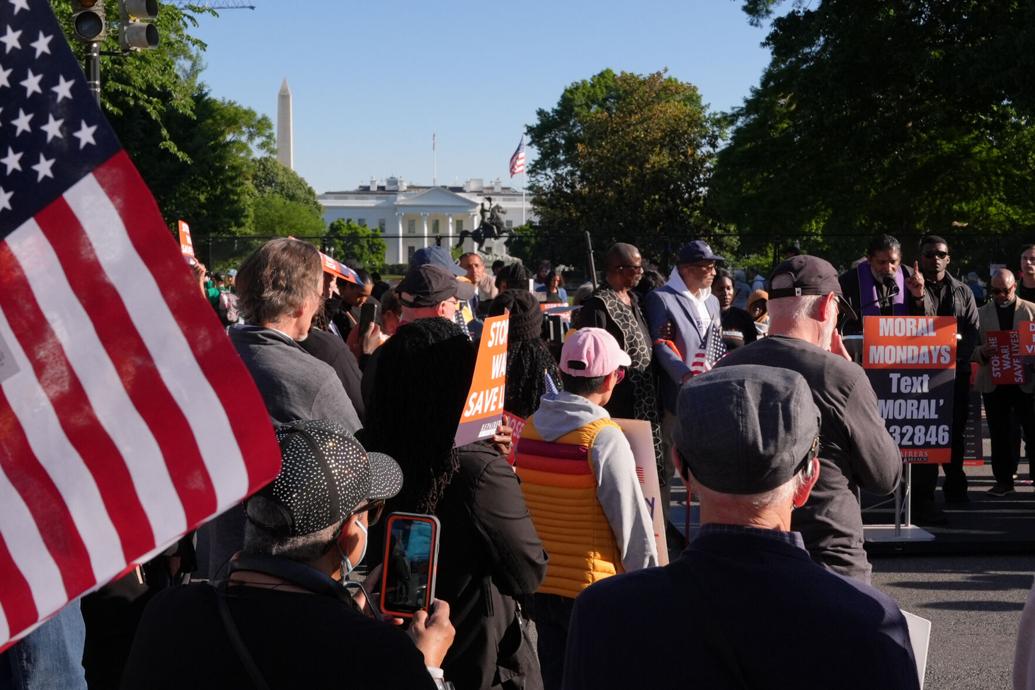
| | People listen as Rev. William Barber II speaks during a protest near the White House Monday, May 11, 2026, in Washington.| Jacquelyn Martin/AP | |
Rev. Barber: What do we do when democracy is hijacked?
WASHINGTON—In some of his sharpest language yet against the Trump regime—and its congressional and MAGA followers, too—Bishop and Rev. William Barber II is challenging the country by answering, “What do we do when democracy is hijacked?”
Joined by other ministers, victims of Trump’s policies, and Samuel Epps, President of the Metropolitan Washington Central Labor Council, Rev. Barber launched into a fiery speech just a block from the White House on May 11, before leading a group of volunteers to sit down on the sidewalk in front of the Executive Mansion to be arrested in a show of peaceful civil disobedience.
There was, as usual, no immediate reaction from Trump. D.C. police monitored the rally, but kept a low profile. And Rev. Barber vowed, “We will be back.”
Trump’s troops—National Guards from red states and ICE agents who have been dragooning, beating, arresting, and deporting people—were nowhere to be seen.
Rev. Barber answered his own question by quoting sections of the Declaration of Independence.
“We hold these truths to be self-evident that all men—it should now be ‘all people’—are endowed by their creator with certain unalienable rights, that among them are life, liberty, and the pursuit of happiness.”
“That to preserve these rights, governments are instituted among men, deriving their just powers from the consent of the governed. But whenever any form of government becomes destructive of these ends, it is the right of the people to alter or abolish it, and institute new forms of government.”
And the way to accomplish that goal is to flood the polls this fall with record numbers of voters demanding a change in government and a change in policies emanating from D.C., Rev. Barber and other speakers saiAfter all, he pointed out, in the last election, the number of registered voters who did not vote—90 million—exceeded the vote totals of both Republican nominee Donald Trump and his Democratic foe, Vice President Kamala Harris. Rev. Barber did not name either.
“It is not just my right to vote. It is my duty,” Rev. Barber declared. “Whenever there is a long train of abuses, it is time to turn this nation around.”
“Over and over, people have come to this place to change democracy. This is hard work,” he added.
Rev. Barber unveiled a list of goals the foes of authoritarians and supporters of “the tradition of non-violence, peace and justice,” should stand for.
“We say NO to denying peace, but choosing an unholy war of choice in Iran,” he declared. To “denying voting rights, denying living wages, denying health care, denying freedom from poverty, denying labor rights, denying statehood to citizens of Washington, D.C., denying rights to indigenous people, denying climate change, denying gender rights.”
The May 11 event Rev. Barber hosted was livestreamed on YouTube, and Repairers of the Breach—the parent organization of his New Poor People’s Campaign—organized similar events and had members lobby lawmakers in various states from coast to coast.
“What do we do when democracy is hijacked? This is the question we face. This is why we got to get real serious,” Rev. Barber said.
The rally and speeches were the latest Moral Monday event in D.C., and Rev. Barber promised to sponsor more every Monday until the nation wakes up and demands an end to “the U.S.-Israel illegal and immoral” Iran War abroad. “It is a war of aggression,” he said.
Rev. Barber did not let the rest of the nation off the hook by putting all the blame on Trump. He described “a social schizophrenia” in the U.S. “that has been with us since the nation was born.”
Trump, his followers, his congressional allies, and his MAGA legions are just the latest symptoms of that longtime national ailment, he said.
“But every so often it goes real crazy,” he added.
That’s manifested “in the man who occupies the White House, in a Congress that treats him as a demigod” and an Executive Branch uncontained by legal or moral guardrails.
The result is Trump and the forces behind him “think America was right to begin with” in 1776, when only propertied white men, most of them Christian Protestants, took control of the nation.
And for that caste, “everything since then has been downhill,” he said, referring to the steady expansion of voting rights, civil rights, and workers’ rights, first to landless white men, then to African-American men, then women, then workers, and then finally people 18 and over.
And much of the U.S. elite is complicit with that elite, Bishop Rev. Barber warned, especially in spending on Trump’s war on Iran. “We have paid for the genocide” Israel is perpetrating in Gaza, he said. He stated that $28 billion in U.S. military aid and weaponry accounts for 40% of Israel’s defense budget.
“Shame on us and shame on Israel for starting this war together.”
To preserve their power and their influence, the original oppressors—those white property owners, now the 1%, including Trump—are now MAGA “waging a war that is mean, a war that is angry, a war that is greedy and a war that is anti-American.”
The other speakers, most of them religious leaders, were given two minutes each and asked to speak on specific topics. They ranged from the Trump wars on Venezuela, Iran, and the Palestinians, to his ICE troops and their war on migrants.
Others targeted the Supreme Court’s eradication of the remnants of the Voting Rights Act—as did Rev. Barber—and Trump’s abolition of measures to combat climate change.
Trump’s ICE agents “are coming after people who don’t look like me,” one white pastor said in denouncing Trump’s troops in U.S. cities, notably D.C. itself.
Trump, meanwhile, mused in a White House meeting with reporters about annexing Venezuela as the 51st state, primarily for its oil reserves.
Epps, the Metro D.C. Central Labor Council president, particularly slammed Trump’s racism towards anyone who’s a person of color, especially those of Hispanic descent. Trump has withdrawn some of his vicious and violent ICE and Border Patrol agents from other cities he sent them to occupy, such as Los Angeles and Chicago.
But not D.C.
“We are talking about policy violence when the people who grow our food, who pave our roads, and who care for our children are told they are not worth a living wage,” he said. Other speakers on the repression of migrants pointed out that Trump wants to expel them all.
We say ‘no’ to an economy that acquires wealth,” that condones union-busting, and that dumps voting rights. We say ‘yes’ to an “economy where it is built from the bottom up, and where persons who make the least deserve the most.”
| |
THE CUBAN REVOLUTION LIVES
Harry Targ
March 30, 2026
After the 1898 “Spanish-American War”, the United States military, with the support of small numbers of compliant Cubans, created a government that would open the door completely for United States investments, commercial penetration, an externally-controlled tourist sector, and North American gangsters. The U.S. neo-colonial regime on the island stimulated pockets of economic development in a sea of human misery. Responding to grotesque economic suffering in the 1950s a band of revolutionaries (led by Fidel Castro, Che Guevara, Camilo Cienfuegos, Celia Sanchez, Vilma Espin, and Haydee Santamaria) defeated the U.S. backed military regime of Fulgencio Batista.
Vilma Espin, Cuban Revolutionary
The Cuban Revolution of 1959 began in the nineteenth century and was driven by 400 years of nationalism, a vision of democracy, and a passion for economic justice. This vision was articulated in Fidel Castro’s famous “History Will Absolve Me” speech given before being sentenced to prison after a failed military action against Batista in 1953. He spoke of five goals of his revolution: returning power to the people; giving land to the people who work it; providing workers a significant share of profits from corporations; granting sugar planters a quota of the value of the crop they produce; and confiscating lands acquired through fraud. Then he said, the Revolution would carry out agrarian reform, nationalize key sectors of the economy, institute educational reforms, and provide a decent livelihood for manual and intellectual labor.
The problem of the land, the problem of industrialization, the problem of housing, the problem of unemployment, the problem of education and the problem of the people’s health: these are the six problems we would take immediate steps to solve, along with restoration of civil liberties and political democracy (Fidel Castro, “ History Will Absolve Me,” Castro Internet Archive, www.marxists.org/history/cuba/archive/castro/1953).
Almost immediately the revolutionaries who had seized power in January, 1959 began to implement the program envisioned by the Castro speech. Over the next sixty years, with heated debates inside Cuba, experiments--some successful, some failed--were carried out. Despite international pressures and the changing global political economy, much of the program has been institutionalized to the benefit of most Cubans.
Education and health care became free to all Cubans. Basic, but modest, nutritional needs have been met. Cubans have participated in significant political discussion about public policy. And Cuban society has been a laboratory for experimentation.
at March 30, 2026
| | |
Monday, June 29, 2015
A TWENTY-FIRST CENTURY PEACE CHARTER
Harry Targ
The Need for a New Peace and Solidarity Vision
Peace activists have influenced the debates about foreign policies of states for centuries. Despite the fact that World War 1 which led to 20 million deaths was not averted, peace activists opposed to that war such as Jane Addams and Eugene V. Debs became models for peace advocacy for the remainder of the twentieth century.
After the next World War which added another forty million deaths to the century's devastation, peace activists restrained the worst features of state violence and educated younger generations about war, colonialism, imperialism, and the links between the drive for oil and violence. Peace activists formed organizations such as The Women's International League for Peace and Freedom, The War Resisters League, The Committee for a Sane Nuclear Policy, and Peace Action. Massive mobilizations and civil disobedience in opposition to the Vietnam War, the United States wars in Central America in the 1980s, and bombings of Serbia in the 1990s characterized protest during the last forty years of the twentieth century. During the early part of the twenty-first century movements sprung up to oppose the wars in Afghanistan, Iraq, and Syria, the spread of nuclear weapons, and the links between militarism and climate change. In addition, progressive trade unionists, feminists, communities of faith, Communists, Socialists, and some Democratic, Republican and third party activists have opposed war and the preparation for war over the years.
Given the new, more complicated international and domestic environment that has emerged since the last century, it is time to revisit the theory and practice of the peace movement. Effective approaches to peace must be adapted to new circumstances. This Peace Charter proposes three peace principles--peaceful coexistence, economic conversion, and international solidarity--which might serve as a guide to peace movement practice.
The Five Principles of Peaceful Coexistence
In 1954, the governments of China and India signed a treaty based on what became known as the Five Principles of Peaceful Coexistence. At the first meeting in 1955 of what would later become the Non-Aligned Nations, China articulated the Five Principles as a guide to their foreign policy. Although the sixty year old treaty between China and India based on the Five Principles was established in a different time and place, they still can serve as a standard by which the peace movement can evaluate the foreign policies of their country and others as well.
The Five Principles, as first articulated by the treaty signed on April 29, 1954, are:
Mutual respect for each other's territorial integrity and sovereignty.
Mutual non-aggression.
Mutual non-interference in each other's internal affairs.
Equality and cooperation for mutual benefit.
Peaceful co-existence.
The first principle suggests that a just foreign policy requires that nations respect the territory and sovereignty of each and every country. The history of empires indicates that dominant powers failed to give minimal respect to the institutions, cultures, and economic life of citizens of other countries. The United States has been shaped in its worldview and policies by claims of "exceptionalism," or its being "the last remaining super power" with particular obligations to oversee the conduct of other countries. Many influential foreign policy elites today still articulate the view that the United States is "the indispensable nation."
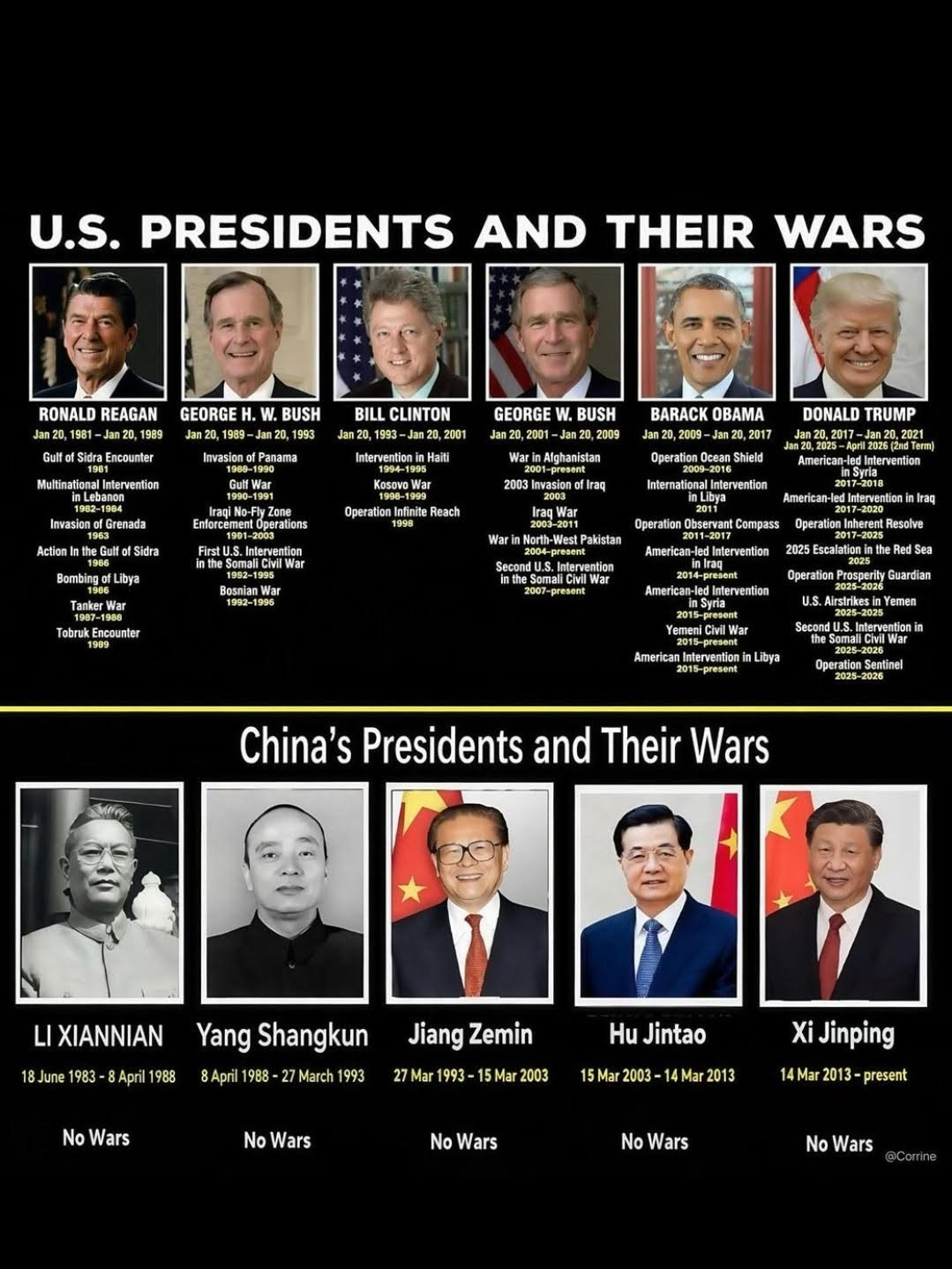
The second principle makes clear that a just nation does not engage in aggression against others; not in wars, subversion, covert military assaults, or in economic blockades that are designed to disrupt, destroy, and create havoc. To the contrary, the United States since the end of World War II, for example, has engaged in at least 75 military operations that have led to the deaths of at least ten million people and the displacement of millions more. The peace movement should demand that the United States and all the other countries abstain from aggression.
The third principle, paralleling the second, makes it clear that nations cannot interfere in the internal affairs of other countries. Interference takes many forms. Some are as suggested above. Others include the use of economic techniques, the internet, penetration and manipulation under the guise of religion, education, and various forms of non-governmental activities in targeted countries.
The fourth principle, assumes a very different lens or vision concerning the relationships between states and people. The old vision, derived from certain Western philosophical traditions, emphasizes the struggle of each against all. The world is a Social Darwinian world, this view suggests, in which only the strongest shall survive. An alternative vision, as suggested by this principle is that mutuality of cooperative relationships can create mutuality of benefits. Experience suggests that cooperation is the essence of human development. And, despite claims to the contrary, the vast majority of human interactions are cooperative, not competitive. Particularly the peace movement must challenge the assumption broadly marketed by militarists that war is perpetual.
Finally, and in conjunction with all of the principles articulated above, the goal of any nation's foreign policy ought to be peaceful coexistence. To the extent that the United States violates this principle, the peace movement should demand a new agenda.
Economic Conversion
"From Forrestal's day to the present, semi-warriors have viewed democratic politics as problematic. Debate means delay. To engage in give-and-take or compromise is to forfeit clarity and suggests a lack of conviction. The effective management of national security requires specialized knowledge, a capacity for clear-eyed analysis and above all an unflinching willingness to make decisions, whatever the cost.
With the advent of the semi-war, therefore, national security policy became the preserve of experts, few in number, almost always unelected, habitually operating in secret, persuading themselves that to exclude the public from such matters was to serve the public interest. After all, the people had no demonstrable 'need to know.' In a time of perpetual crisis, the anointed role of the citizen was to be pliant, deferential and afraid." (Andrew Bacevich, reviewing a biography of James Forrestal, the first Secretary of Defense, in The Nation, April 23, 2007).
Andrew Bacevich reminds us that a permanent war economy has been part of the political and economic landscape of the United States at least since the end of World War II.
The War Resisters League pie chart of total government spending for fiscal year 2015 indicates that 47 percent of all government spending deals with current preparation for war and past wars.
In addition, "war support" contractors, such as KBR, have made billions of dollars in the twenty-first century from military spending. Virtually every big corporation is to some degree on the Department of Defense payroll.
Because of the economic crisis which began in 2007, debate about military spending increased. In 2010 Congressmen Barney Frank and Ron Paul initiated a study addressing needed cuts. The report prepared for them in 2010, "Debt, Deficits, and Defense," called for across the board reductions in spending--procurement, research and development, personnel, operations and maintenance, and infrastructure---of $960 billion over the next decade. The report noted that over the last decade 65 percent of federal discretionary spending went to the military.
President Obama in January, 2010, proposed spending cuts of $480 billion over the next decade (reductions in projected increases, not existing funding). He coupled recommendations about future spending with a firm statement that the world must realize that the United States remains committed to maintaining its military superiority.
The President indicated that spending reductions in the future will be tied to greater use of "special operations," drones, and shifting existent forces from Europe to Asia.
The magnitude of military spending represents what Bacevich referred to as the permanent war economy articulated and defended by the "semi-warriors" dominating U.S. foreign policy in each administration since World War II.
These semi-warriors gained influence after the Truman Administration accepted recommendations in National Security Document Number 68 (1950) that defense spending should always have priority over all other government programs. NSC 5412, approved by President Eisenhower, gave legitimacy to covert operations around the world allowing any president to "plausibly deny" any connections with such operations.
Subsequently virtually each president proclaimed a doctrine justifying more and more military spending--Eisenhower for the Middle East, Carter for the Persian Gulf, Reagan to rollback "the evil empire," Clinton for "humanitarian interventions" and Bush for "pre-emptive attacks."
The Obama administration, through speeches and actions, has constructed what might be called "the Obama Doctrine."
First, as the last remaining superpower and the beacon of hope for the world, the United States once again reserves the right and responsibility to intervene militarily to enhance human rights anywhere.
Second, U.S. humanitarian military interventions will be carried out from time to time preferably with the support of our friends.
Third, new technologies such as drones will allow these interventions to occur without "boots on the ground." They will be cheaper in financial and human cost (primarily for American troops).
Finally, assassinations and covert killings have made it clear that the Obama Doctrine overrides recognized judicial proceedings and the sanctity of human life.
Since the establishment of the permanent war economy in the 1940s millions of proclaimed "enemies" have been killed and seriously injured, mostly in the Global South. Permanent physical and psychological damage has been done to U.S soldiers, predominantly poor and minorities as they too are victims of war.
In addition, military spending has distorted national priorities and invested U.S. financial resources in expenditures that do not create as many jobs as investments in construction, education, or healthcare. And the permanent war economy has created a culture that celebrates violence, objectifies killing, dehumanizes enemies, and exalts super-patriotism through television, music, video games, and educational institutions.
These issues need to be more vigorously related to those raised by the grassroots campaigns that have sprung up to defend the rights of workers, women, people of color and those experiencing discrimination for various reasons; to oppose growing income and wealth inequality; and to defend working people's homes from foreclosures.
In 1967 in reference to the massive U.S. war in Southeast Asia and desperate needs of workers at home, Dr. Martin Luther King described the fundamental connections that peace activists and all progressives must pursue: "I speak of the poor of America who are paying the double price of smashed hopes at home, and death and corruption in Vietnam."
As Michael Eisenscher, National Coordinator, U.S. Labor Against the War (USLAW) articulated in a powerful data-based essay on economic conversion:
We see this as just the beginning of a conversation. This effort takes the struggle for new priorities to a new level -- to a struggle for a demilitarized economy and foreign policy --a struggle for a new, more just, equitable and democratic economy and society. In the process, we will help to redefine the meaning of "national security" -- as determined not only by the security of our borders, the size of our military or the power of its arsenal, but also by whether people have real economic and social security--food security, health security, housing security, employment security and security in their old age - and a decent standard of living for all, not just the privileged few. ("Economic Conversion: From Military Addiction to Economic Sustainability: Charting the Course to a New Economy for All").
International Solidarity
A centerpiece of the peace movement is solidarity. Solidarity refers to giving moral, intellectual, and material support to struggles for peace and justice everywhere. During the Spanish Civil War, American progressives raised money for the defenders of democracy, pressured the Roosevelt administration to give war material to the Loyalists, and even sent men and women to fight on the side of Spanish democracy. During World War II, Americans raised money for and publicly demonstrated support for the Red Army while the Soviet Union confronted 90 percent of the German army. From the 1940s until the end of the Cold War, peace and justice activists mobilized to support the Guatemalan, Cuban, Vietnamese, Salvadoran, South African and Nicaraguan people and to oppose United States policies toward these countries.
Today, there is a major international campaign to support the Palestinian people. Initiated by many Palestinian groups, a global campaign to support boycotts, divestment, and sanctions against Israel have spread all across the globe. Vibrant BDS campaigns have a visible presence in the United States. Campaigns seek to isolate Israel because of its perpetual violence against Palestinian people in the Occupied Territories, expanding land grabs of Palestinian land in violation of international treaties and law, and discrimination against Palestinians who reside in the state of Israel.
In the end, international solidarity is based upon the assumption that violence and war somewhere is inextricably connected to violence and war elsewhere. Particularly peace activists in the United States are animated by the proposition that their own country is connected to regimes that violate human rights and participate in the economic exploitation of subject peoples. Historically peace activists have educated publics about international affairs and have advocated for changes in United States foreign policy. International solidarity advocates for and gives material support to people struggling for peace and justice wherever they are and helps build a consciousness of the unity of people across nations and cultures. As Paul Robeson suggested metaphorically, all cultures have folk music traditions using common chord structures. He was suggesting that commonalities of human experience mirror commonalities of folk traditions. Peace activists believe that the recognition of the commonalities among people can be the basis for the construction of a more peaceful world
| |
"It's one thing for a fascist clique to take office in DC and begin to wreak havoc. But we're a big country of 50 states, hundreds of large cities and 3000 counties. They will have to go through all of them to consolidate their fascist hegemony, the long march through the civil society institutions 'in reverse,' so to speak. But we can fight them every step of the way, from our localities, then networking outward and upward. Win on our local ground first. We rarely win at the top what we haven't already secured at the base." Carl Davidson | | The grass is dry in Cleveland. Be sure to click the play button. | | | |  | |
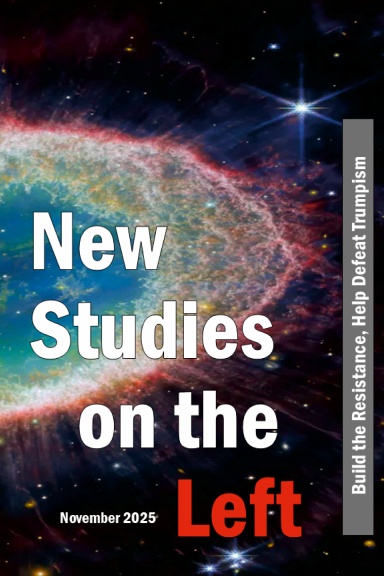
New Studies on the Left, November 2026
Paperback $14.95
...is a journal of socialist theory and practice. It is the successor to ‘Dialogue and Initiative, published as an annual journal of the Committees of Correspondence for Democracy and Socialism in book form from 2012 to 2022. It will continue the CCDS policy of left unity, including articles with a variety of left perspectives, including debates.
This issue contains a dozen articles grouped under the headings of Analysis and Global Reach, Electoral campaigns, and Book Reviews. Some are reprinted from other sources, but many appear here for the first time.
Among the authors are C.J. Atkins, Carl Davidson, Steve Early, Bill Fletcher, Jr., Suzanne Gordon, Jerry Harris, Jay Jurie, Paul Krehbiel, Matthew Scott, Rod Such, Harry Targ, and Janet Tucker and Steve Willett.
Table of Contents
Click HERE to purchase
| | | |
With the winning of the Trump/Vance ticket along with the far right in leadership of all 3 branches of government we need to bury our differences and build the left and the Progressive Majority, a majority that we know exists on most issues of public policy.
We need to build our organizations to defend democracy, in our communities and at the state and national levels including progressive gains won over several decades.
IN GENERAL WE NEED TO REBUILD OUR LEFT: PEACE ACTIVISTS, FEMINISTS, WORKERS, ENVIRONMENTALISTS, AND ALL HUMANISTS WHO UNDERSTAND THAT. (HOWEVER WEAK) US DEMOCRATIC INSTITUTIONS ARE UNDER ATTACK AND THE VERY PEACE AND ENVIRONMENTAL CONDITION OF THE WORLD ARE UNDER ATTACK
Harry Targ
| | "Organization is the central task; revolutionary education is the key link." Carl Davidson | | |
Carl Davidson
Mar 10
New Video Courses
How the U.S. Civil War Made Canada
New Text Courses
Alexander Dugin, the Imperialist Philosopher Who Demanded the Ukraine War
New Blog Post
Marxism is the ‘True Scripture’ of Us Communists, By Tang Aijun, Study Times, China
New in the Archives
Historical Roots of American Fascism and Antifascism: Bibliography-in-Progress, for the Marxist Education Project 2025
New in Cultural Studies
The Communist Folk singer Who Shaped Bob Dylan
To visit the OUL, go here: http://ouleft.org
| | Organization is the central task; revolutionary education is the key link. | | |
Our Amazing Resource for Radical Education
CURRENT FEATURE: In the 'Study Guides' Section
A 4-PART STUDY OF THE SHAPING OF THE
RUST BELT WORKING CLASS.
From the settlers to the present, and how its consciousness is conflicted. Prepared by Carl Davidson and Rebecca Tarlau,
with some help from the DSA Rust Belt group.
There are hundreds of video courses here, along with study guides, downloadable books and links to hundreds of other resources for study groups or individuals.
Nearly 10,000 people have signed on to the OUL for daily updates, and more than 150,000 have visited us at least once.
Karl Marx's ideas are a common touchstone for many people working for change. His historical materialism, his many contributions to political economy and class analysis, all continue to serve his core values--the self-emancipation of the working class and a vision of a classless society. There are naturally many trends in Marxism that have developed over the years, and new ones are on the rise today. All of them and others who want to see this project succeed are welcome here.
NEW UPDATES...
On our Blog Page:
How to Create a Future of Cheap Energy for All
The WIRED & Octopus Energy Tech Summit in Berlin was bursting with innovative ideas for reaching net zero and on working together at an ever-greater scale.
How to Build an Underground Resistance Force in 16 Steps
Lessons from Blue Virginia, a community-based organization of women
Our Latino/a Studies Dept:
Forced Amnesia: The Hidden History Of America’s Far West
An emotional and historical journey through the American West on the tracks of the pre-1848 border, to meet families that lived there since long before the US takeover.
Our History Dept:
Marcus Rediker on the Quaker Abolitionist and Seaman Benjamin Lay – History from Below after the Transnational Turn.
This seminar subtitled “The Case of a Forgotten 18th-century Revolutionary,” was given by Marcus Rediker as part of the Development Studies Seminar Series on 24 October 2017 at SOAS University of London
To get regular updates, be sure to ‘Like’ us at http://facebook.com/ouleft.org Be sure to also, under ‘Like’, pick ‘Get Notifications.’ You can also ‘subscribe’ to our FB page and send in articles for our blog at the OUL main site, http://ouleft.org
Read more
http://ouleft.org
| | | | | |
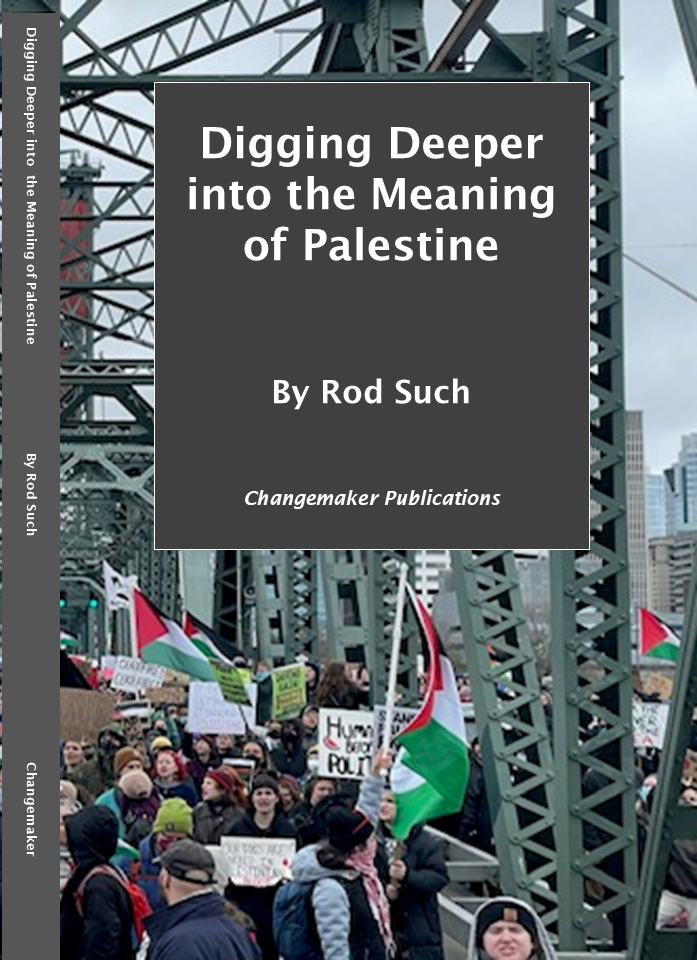
Digging Deeper into the Meaning
of Palestine
By Rod Such
Author's note: My initial decision to begin reviewing books on Palestine and the Palestinian liberation struggle was to write for political activists, rather than academics or the general public. This book, which collects dozens of reviews over a decade, might also be regarded then as a kind of wide-ranging primer or introduction to Palestine that will lead hopefully to an ongoing learning experience.
316 pages, $19.00 (discounts available for quantity), order at:
Changemaker Publications
https://www.lulu.com/spotlight/changemaker
| | | |
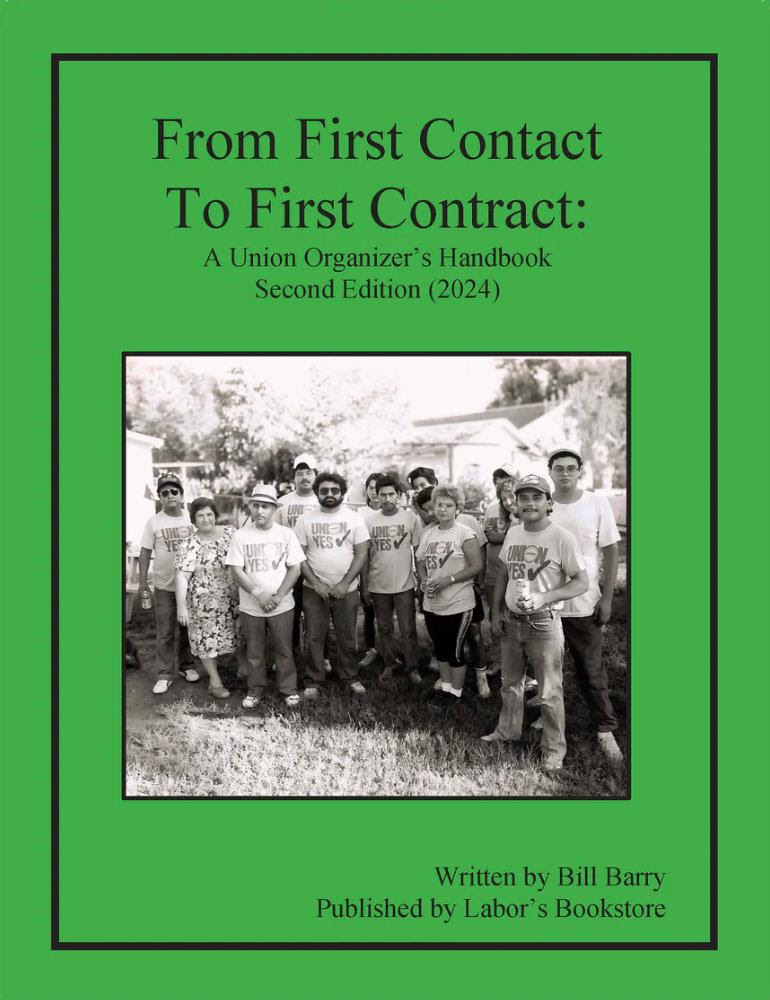
From Hard Ball Press, a leading source of working class stories.
| | | | | POWER TOOLS FOR UNION BUILDING | |
Timothy Sheard | 415 Argyle Rd. 6A | Brooklyn, NY 11218 US
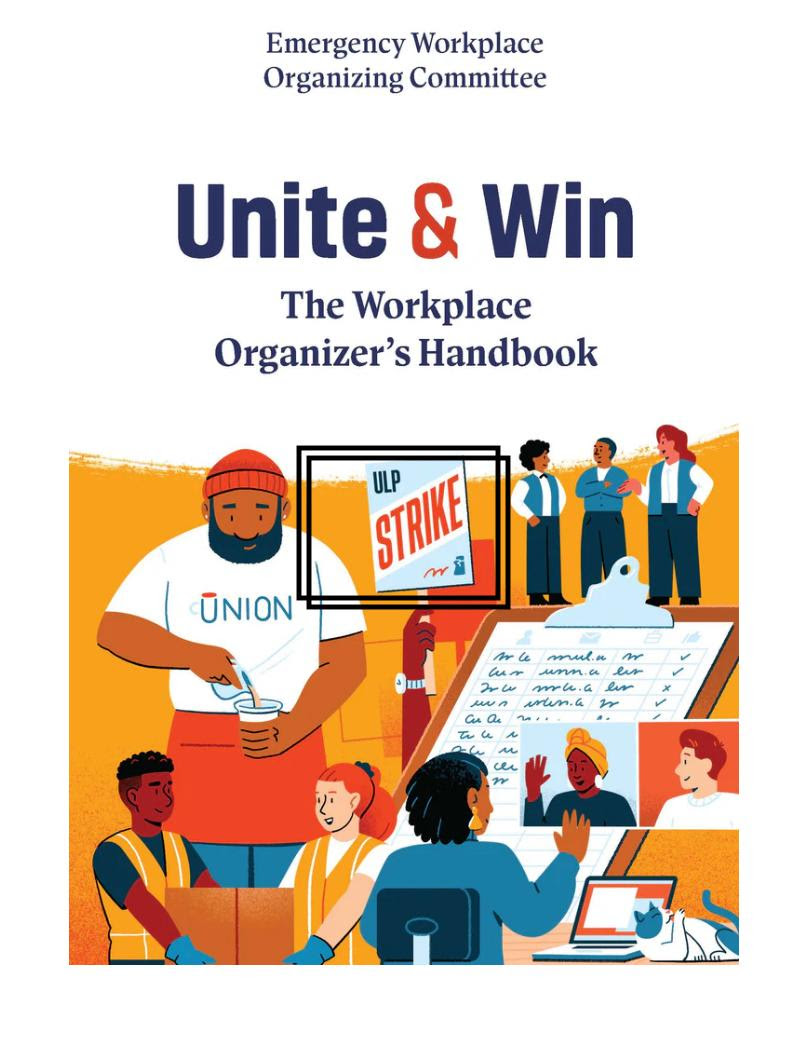
| | With grave new challenges from the current administration, Hard Ball Press is raising our game, with new books & new Staff. | | Click go to Hard Ball Press for fresh information about organizing the workplace and building union power. | | |
Hard Ball Press is thrilled to welcome Cynthia Selene Hernandez to our staff. Cynthia will take charge of new book development, design and marketing, beginning with a children's book about Women In Construction.
Cynthia began her organizing career during the Free Trade Area of the Americas protests in Miami in the early 2000s. As a student organizer in 2006, she took part in the Justice for Janitors campaign at Florida International University, which successfully advocated for improved wages and working conditions for janitorial staff.
With the support of a Pell Grant, Cynthia joined Florida International University's Labor Center (FIU), advancing from research intern to senior research associate and instructor. Her focus on wage theft led to the enactment of seven anti-wage theft county ordinances in Florida. After nearly a decade at FIU, she became the Executive Director of the South Florida AFL-CIO. She led labor and community coalitions to enhance wages and benefits for low-income families in Miami-Dade County.
In 2018, Cynthia joined Resilience Force as Florida Director, advocating for labor protections for resilience workers. As Hurricane Ian made landfall in Florida in 2022, she returned as Resilience Force National Training and Education Director.
| | | | Be sure to check out the latest organizing tools from Labor's Book Store and the latest labor news from Work-BItes. | |
CHANGEMAKER PUBLICATIONS: Recent works on new paths to socialism and the solidarity economy
Remember Us for Gift Giving and Study Groups
We are a small publisher of books with big ideas. We specialize in works that show us how a better world is possible and needed. Click Gramsci below for our list.
| |
522 Valencia St.
San Francisco, CA 94110
415 863-6637
| | | | | |