|
Dear Community:
The recently released 2026 Commonwealth Fund report, “U.S. Health Care from a Global Perspective,” offers a stark rebuke of our nation’s health system. Comparing the U.S. to 19 peer nations, the findings are alarming: despite spending nearly twice as much on healthcare, we rank near the bottom for life expectancy, affordability, and primary care physician supply. Tragically, we remain near the top for preventable deaths and maternal mortality.
This data confirms a harsh reality. Our primary care system is overwhelmed, leaving tens of millions of Americans behind. At the Center for Closing the Health Gap, we know these aren't just statistics, they are the lived realities of our marginalized neighbors facing daily, systemic inequities.
A system that leaves so many behind cannot be the one we wait on to heal us. We must champion accessible care, demand equity, and empower our neighborhoods from within. Now more than ever, We Must Save Us.
Blessings to all of you for a safe and healthy week ahead.
Renee Mahaffey Harris
President & CEO
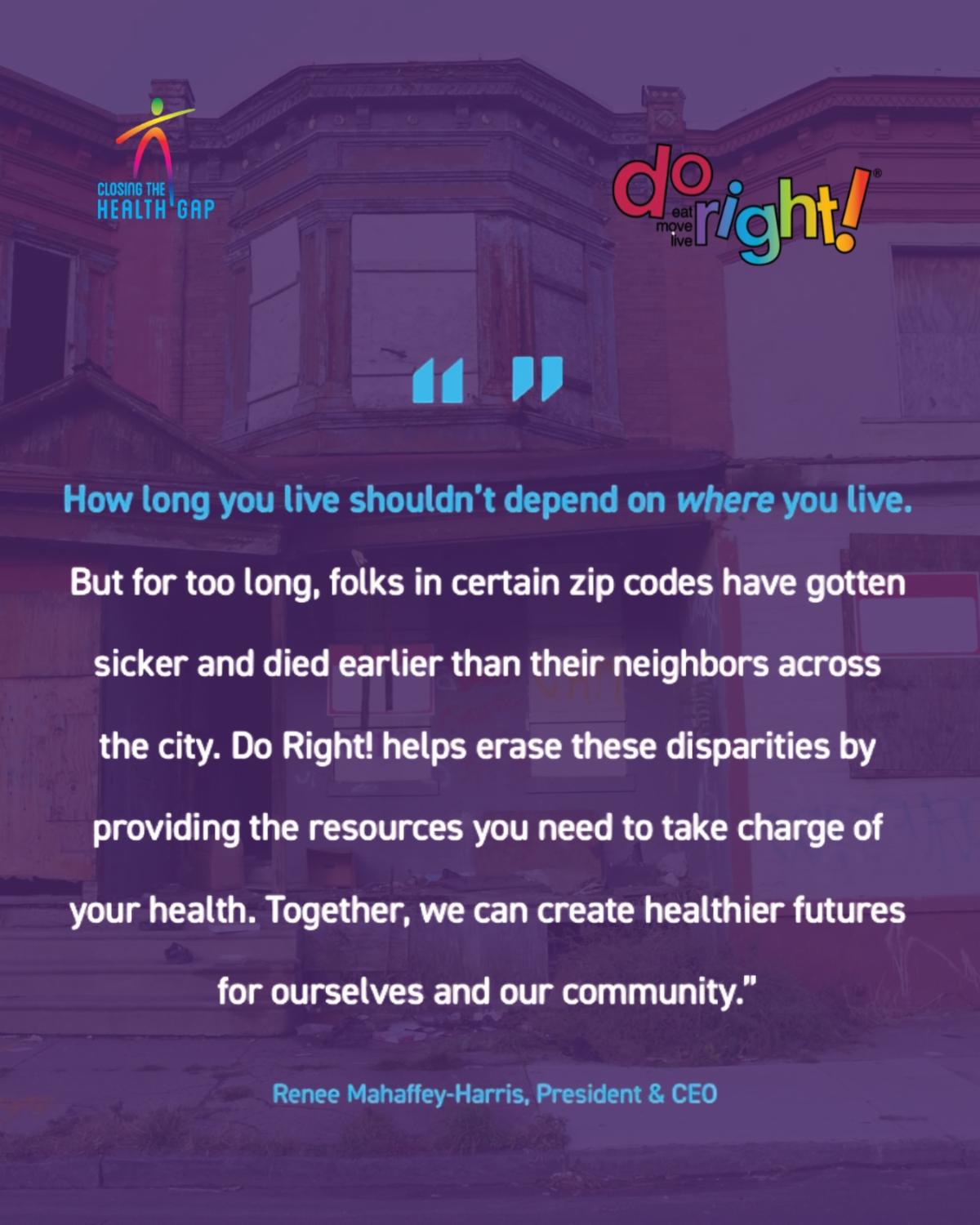
| | Our Do Right! Campaign is about helping our communities eat right, live right, and move right through small changes that lead to healthier futures. Need resources, health information, or support to get started? Visit our website to learn more and join the movement. | |
How does U.S. health care stack up globally? Not well, according to new data
Despite spending nearly twice what peer nations spend on health care, the United States ranks near the bottom on life expectancy, primary care physician supply and affordability — and at or near the top for preventable deaths and maternal mortality — according to a major new international report.
The Commonwealth Fund's “U.S. Health Care from a Global Perspective, 2026: Expanded Edition” compares the U.S. with 19 other member countries of the Organisation for Economic Co-operation and Development (OECD), a group of mostly high-income nations. The analysis draws on 2026 OECD health statistics compiled in January and February 2026 and covers four broad areas: insurance coverage and access to care, affordability, care delivery and equity of outcomes.
The findings are a stark rebuke of U.S. health system performance. It’s another confirmation that primary care physicians are in short supply and increasingly overwhelmed as they serve as the front door to a system that leaves tens of millions of Americans behind.
| |
Heart disease hits minority communities harder. Here’s why and what needs to change.
Heart disease remains the leading cause of death in the United States according to Centers for Disease Control and Prevention, but experts say not all communities are impacted equally. For many patients from minority groups, barriers such as delayed access to care, transportation issues, financial hardship, and mistrust in the healthcare system can lead to worse outcomes and earlier disease.
Safwan Gaznabi, MD, cardiologist at Loma Linda University Health, says those disparities manifest in ways long before patients arrive in the hospital. “I’ll often see patients in my office or in the hospital who have had cardiovascular symptoms or conditions for years without adequate diagnosis or treatment,” Gaznabi says. “More often than not, access to care is the biggest issue, and that leads to less favorable outcomes.”
Racial and ethnic disparities in cardiovascular disease are well documented across rates of disease, treatment patterns, hospitalizations, and mortality. According to Gaznabi, adults from Black and Hispanic communities are among those most affected.
|
Why US Life Expectancy Continues to Trail Peer Nations
Racial and geographic disparities, high out-of-pocket costs, and lack of universal health coverage are among the key reasons that the US continues to fall behind in life expectancy compared with its peer nations, despite spending the most on health care. A new report from The Commonwealth Fund also found that the US had the fewest primary care doctors per capita when compared with other nations included in this study, such as Australia, Canada, and the United Kingdom.
The U.S. Health Care from a Global Perspective 2026: Expanded Edition report used the 4 areas of insurance coverage and access to care, affordability of care, equity of outcomes, and care delivery to compare the US with 19 other countries across the world. The countries, which are part of the Organisation of Economic Co-operation and Development (OECD), are similar in economic status to that of the US. The countries included in the report were the United Kingdom, Australia, Canada, Denmark, Chile, Germany, France, Italy, Israel, Japan, Korea, the Netherlands, Mexico, Norway, New Zealand, Switzerland, Sweden, Spain, and Türkiye.
|
Vatican diplomat calls for international cooperation to address health disparities
Addressing the World Health Assembly, a Vatican diplomat called for international cooperation to address “disparities in life expectancy and health quality across and within countries.”
“Shared responsibility is a call for civil authorities to consistently uphold the God-given dignity of every human being, by promoting the right to the highest attainable standard of physical and mental health in policymaking and improving the conditions that enable people to live in good health,” said Archbishop Ettore Balestrero, apostolic nuncio and Permanent Observer to the United Nations and other international organizations in Geneva, Switzerland.
Archbishop Balestrero added that “the ethical litmus test of any reshaped global health architecture is how it treats those whose inherent dignity is most easily forgotten: the child in the womb, the elderly, persons with disabilities, the poor, the displaced.”
|
Declining trust in doctors is widening the health gap between conservative and liberal Americans
A recent study published in Nature Human Behaviour suggests that conservative Americans have experienced worse health outcomes and higher mortality rates than their liberal counterparts over the past decade. The research provides evidence that this widening health gap stems from demographic shifts within political coalitions and a growing distrust in medical professionals among right-leaning individuals. These changing attitudes toward seeking and following medical advice tend to leave conservative individuals more vulnerable to preventable health risks.
Scientists Elizabeth Elder and Neil A. O’Brian conducted the study to better understand how political beliefs might act as a social determinant of health. Past studies on this topic often relied on county-level geographic data or self-reported health surveys. These older methods often produced mixed findings because self-reported health can be subjective and county-level averages do not always reflect individual behaviors.
|
CT’s silent health disparity: Lack of adult dental coverage
Every 14 seconds, an American ends up in the emergency room for a dental problem that might have been prevented. These visits are painful for patients and costly for the healthcare system, yet they persist because routine dental care remains out of reach for millions, including many in Connecticut.
The state’s Medicaid program provides only limited dental coverage for adults, leaving low-income residents without access to basic preventive and restorative services. The result is predictable: untreated caries progress into infections, manageable conditions escalate into emergencies, and patients turn to hospital emergency departments for relief. There, they often receive only temporary solutions like antibiotics or pain medication rather than definitive care. This is not just a coverage gap. It is a system failure.
Across the United States, dental-related emergency department visits cost roughly $2.4 billion each year. These visits are far more expensive than routine dental care and do little to resolve the underlying issue. By delaying treatment until it becomes urgent, the system creates higher costs and worse outcomes, a pattern Connecticut continues to replicate.
| | | | |