|
May 2026 Adventures-in-P21 eNews Update | | Here’s your roundup of projects, tips, and more...now reaching over
6,200 world-class Prophet 21 ERP System users! | |
P21WWUG Connect 2026
We’re looking forward to being back at P21WWUG Connect 2026 in Orlando and continuing the conversation in person.
We’re also proud to support the P21 user community again as a Gold Sponsor. After nearly two decades in the ecosystem, this remains one of the few places where real-world ideas, challenges, and solutions are shared openly.
This year, our team will be presenting several sessions focused on practical, field-tested applications inside Prophet 21:
Featured Sessions
- Advanced Report Studio: Overcoming Its Shortfalls
- Beyond the Box: Building a Smarter Supply Chain on P21
- Using SQL, Business Rules and SISM for P21 Automation
- Where to Find Data in P21
- Label Printing & Customization Options
If you’re planning to attend, we’d be glad to connect and compare notes!!.
--------------------------------------------------------------
New & Upcoming Articles — IndustryWeek & ISHN
We’ve had new articles published—and more releasing next week—focused on real-world challenges we’re seeing across manufacturing and distribution environments.
Now Live — IndustryWeek
Get Your AI Terminology Straight: A Manufacturing Leader’s Guide
A practical look at how AI, machine learning, and Digital Intelligence terminology is being used—and often misused—in real operations, and how to think about where they actually fit.
Coming Next Week — IndustryWeek
How to Evaluate AI Tools Without Wasting Your Plant’s Budget
Most AI tools look impressive in demos—but that’s not where they fail.
They fail in the transition to real environments.
This piece focuses on how to evaluate AI based on operational fit—not just capability—including common red flags:
- Heavy reliance on “clean data” with no path to get there
- Vague or underspecified integration requirements
- Outputs that don’t connect to real workflows
- Results not tied to operational KPIs
- No clear ownership post-implementation
Coming Next Week — ISHN
The Next Safety Incident May Start Between Your Systems
A look at how disconnected data across systems is creating blind spots in safety and operations—preventing teams from seeing risk early enough.
| Recent Project Highlights | | |
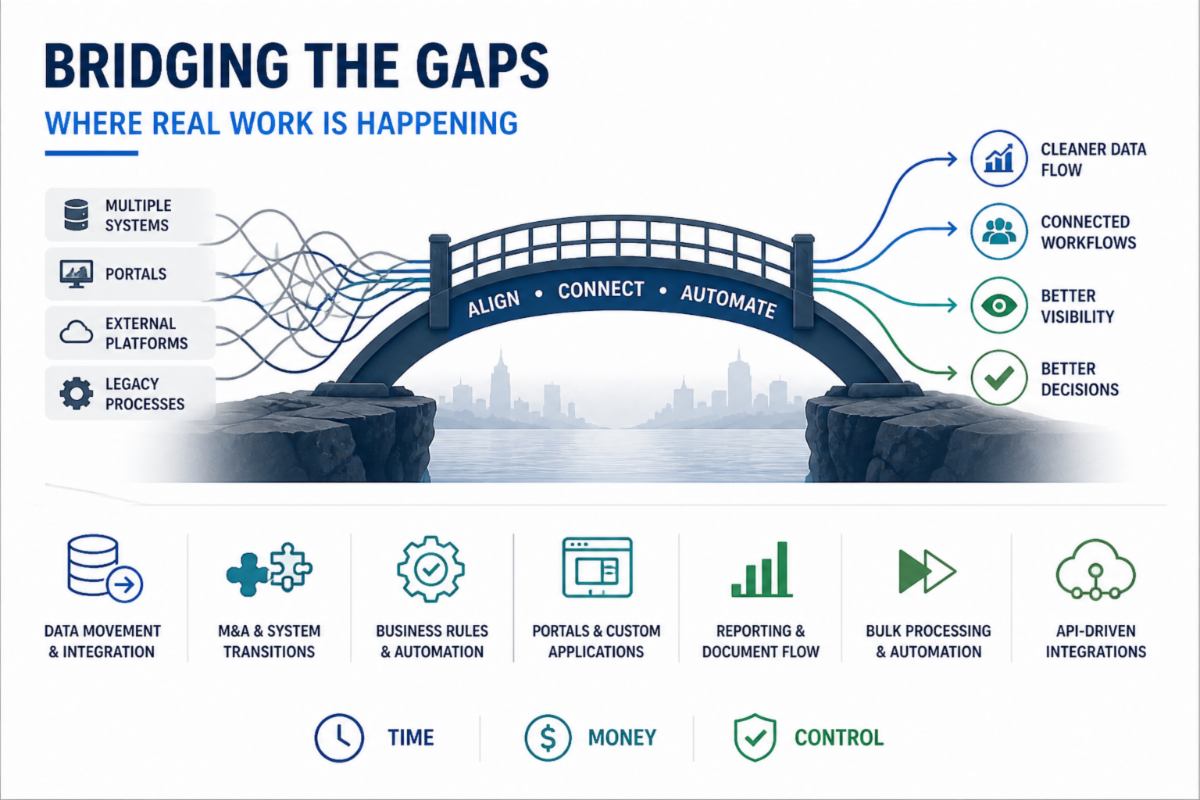
Bridging the Gaps — Where Real Work Is Happening
Across both these articles—and in day-to-day client work—we’re seeing a consistent pattern:
- Systems are working… but they’re not always aligned.
- Data lives in multiple places.
- Workflows span ERP, portals, and external platforms.
- Business logic doesn’t always translate cleanly into SaaS and API-driven environments.
The result isn’t failure—it’s friction.
Most organizations aren’t replacing systems—they’re working to connect, align, and streamline what they already have so data flows cleanly and teams can execute without delay.
…and here are some of our recent project examples:
| |
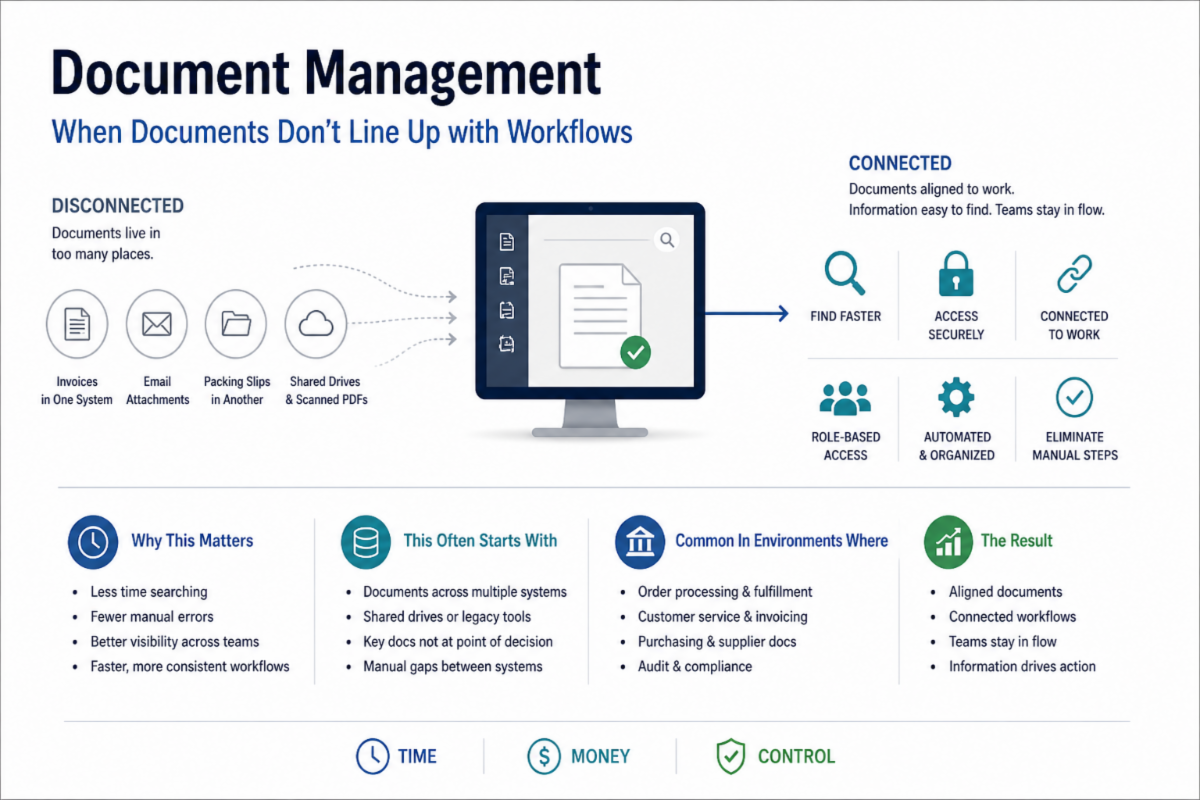
Document Management — When Documents Don’t Line Up with Workflows
Across a number of recent Prophet 21 environments, one issue keeps surfacing:
- Documents exist—but they’re not where work is happening.
- Invoices in one system.
- Packing slips in another.
-
Shared drives, email attachments, scanned PDFs—each step adding friction, delay, or manual effort.
For many teams, this isn’t a storage problem—it’s a flow problem.
- Time lost searching for documents
- Manual filing and rekeying
- Inconsistent access across teams
- Documents disconnected from orders, customers, and transactions
What We’re Seeing
As systems evolve—especially with SaaS, portals, and integrations—document challenges tend to increase, not decrease.
This often starts with:
- Documents live across multiple systems with no clear ownership
- Teams rely on shared drives or legacy DMS tools that don’t align with ERP workflows
- Key documents aren’t accessible at the point of decision
- Manual processes quietly fill the gaps between systems
How Teams Are Solving It
To address this, we’ve been building custom document management solutions that connect directly into operational workflows—rather than sitting alongside them.
Instead of treating documents as a separate system, these approaches:
- Automatically capture and organize documents as part of daily workflows
- Attach documents directly to orders, customers, and transactions
- Use OCR and metadata to make documents instantly searchable
- Eliminate manual filing and reduce user-driven errors
- Apply role-based access across departments
- Integrate with platforms like SharePoint while staying aligned with ERP data
Why This Matters
When documents move with the transaction instead of outside it:
- Teams spend less time searching and more time executing
- Errors drop as manual handling is removed
- Visibility improves across departments
- Workflows become faster and more consistent
Common In Environments Where
We’re seeing this type of project gain traction in:
- Order processing and fulfillment
- Customer service and invoice retrieval
- Purchasing and supplier documentation
- Audit and compliance environments
- SaaS transitions where legacy document tools no longer fit
If This Sounds Familiar…
- Your team spends too much time looking for documents
- Files live in multiple systems with no clear ownership
- Documents don’t align cleanly with P21 transactions
- Manual filing or scanning is still part of the process
In most cases, this can be simplified.
Let’s Take a Look
If document flow is slowing things down, we’re happy to review your current setup and share what we’re seeing across similar environments.
Once documents are aligned with workflows, the next challenge we often see is pricing and product data—where inconsistencies can have a direct impact on margin.
| | |
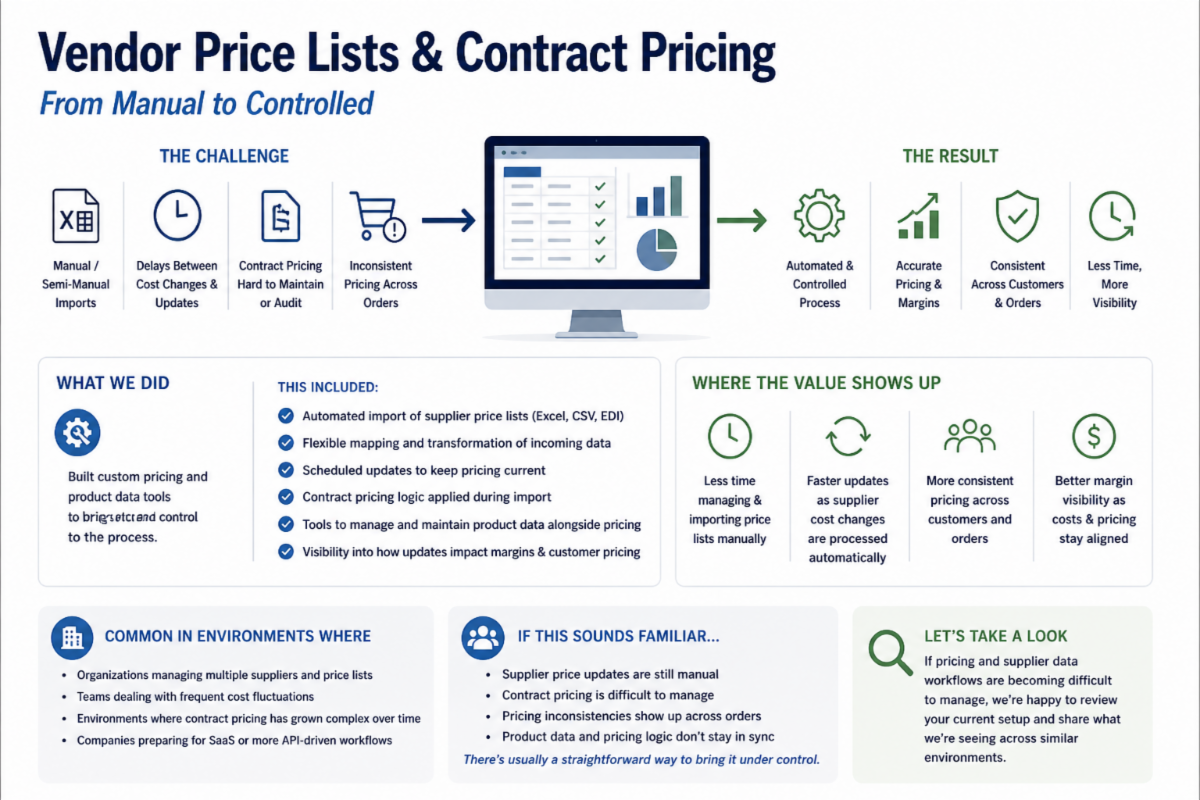
Vendor Price Lists & Contract Pricing — From Manual to Controlled
Another area we’ve been heavily engaged in recently is supplier price lists, contract pricing, and cost management inside Prophet 21.
In these environments, pricing had evolved over time—multiple suppliers, different formats, contract rules layered in, and a growing reliance on spreadsheets to manage updates.
The result:
- Price lists being imported manually or semi-manually
- Delays between supplier cost changes and system updates
- Contract pricing that was difficult to maintain or audit
- Inconsistent pricing behavior across orders
What We Did
We built a set of custom pricing and product data tools designed to bring structure and control to the process.
This included:
- Automated import of supplier price lists (Excel, CSV, EDI)
- Flexible mapping and transformation of incoming data
- Scheduled update processes to keep pricing current
- Contract pricing logic applied during import
- Tools to manage and maintain product data alongside pricing
- Visibility into how updates impact margins and customer pricing
Where the Value Shows Up
- Less time spent managing and importing price lists manually
- Faster updates as supplier cost changes are processed automatically
- More consistent pricing across customers and orders
-
Better margin visibility as costs and pricing stay aligned
Common In Environments Where
- Organizations managing multiple suppliers and price lists
- Teams dealing with frequent cost fluctuations
- Environments where contract pricing has grown complex over time
- Companies preparing for SaaS or more API-driven workflows
If This Sounds Familiar…
- Supplier price updates are still manual
- Contract pricing is difficult to manage
- Pricing inconsistencies show up across orders
- Product data and pricing logic don’t stay in sync
There’s usually a straightforward way to bring it under control.
Let’s Take a Look
If pricing and supplier data workflows are becoming difficult to manage, we’re happy to review your current setup and share what we’re seeing across similar environments.
| | |
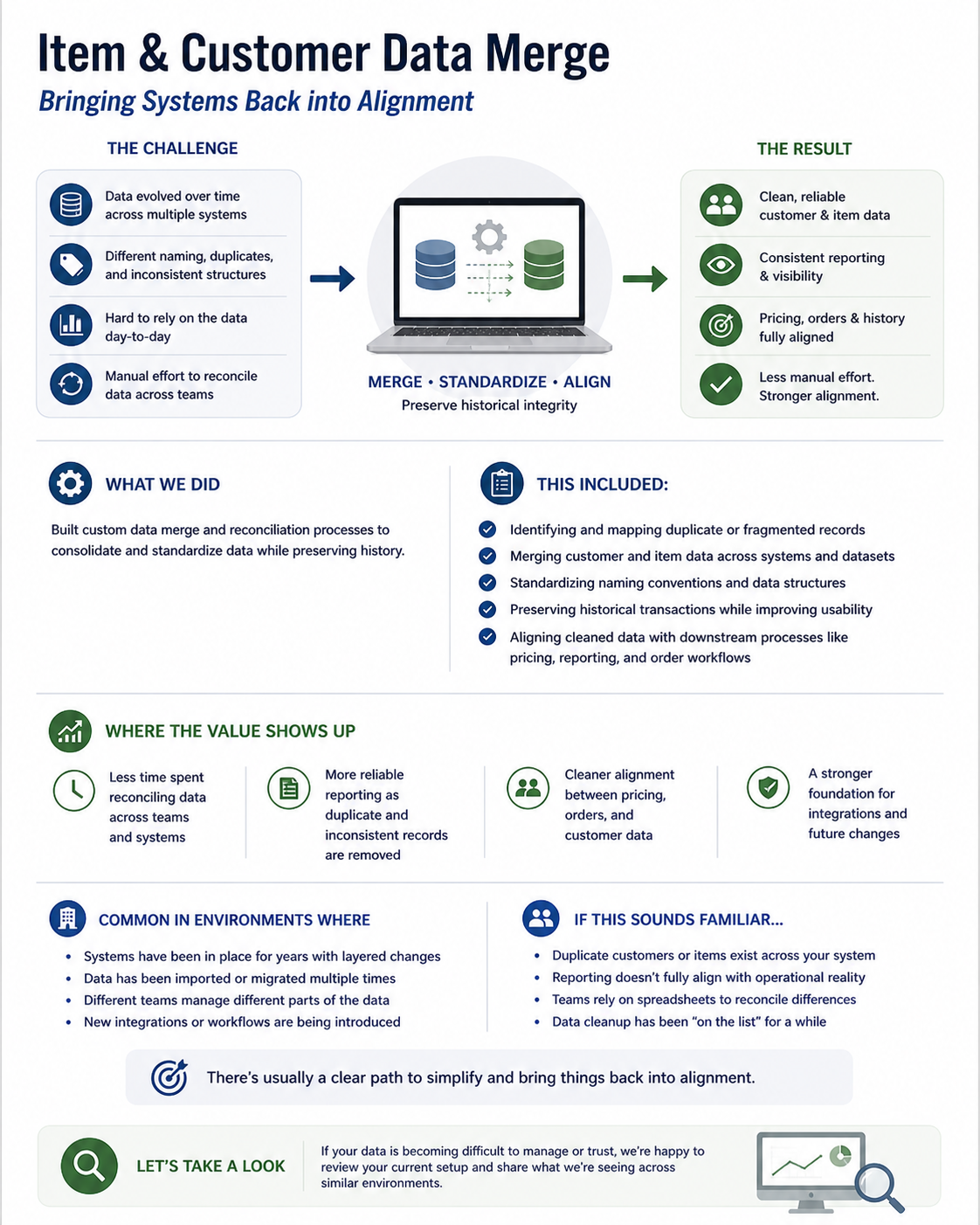
Item & Customer Data Merge — Bringing Systems Back into Alignment
Another project we’ve been working on recently involves merging and aligning item and customer data across Prophet 21 environments.
In these cases, data had evolved over time—often across multiple systems, imports, or operational changes. Different naming conventions, duplicate records, and inconsistent structures made it difficult to rely on the data day-to-day.
The result:
- Duplicate or mismatched customer and item records
- Inconsistent reporting and visibility
- Pricing, order history, and transactions not fully aligned
- Ongoing manual effort to reconcile data across teams
What We Did
We built a set of custom data merge and reconciliation processes to consolidate and standardize the data while preserving historical integrity.
This included:
- Identifying and mapping duplicate or fragmented records
- Merging customer and item data across systems and datasets
- Standardizing naming conventions and data structures
- Preserving historical transactions while improving current usability
- Aligning cleaned data with downstream processes like pricing, reporting, and order workflows
Where the Value Shows Up
- Less time spent reconciling data across teams and systems
- More reliable reporting as duplicate and inconsistent records are removed
- Cleaner alignment between pricing, orders, and customer data
- A stronger foundation for integrations and future system changes
Common In Environments Where
This typically shows up in environments where:
- Systems have been in place for years with layered changes
- Data has been imported or migrated multiple times
- Different teams manage different parts of the data
- New integrations or workflows are being introduced
If This Sounds Familiar…
- Duplicate customers or items exist across your system
- Reporting doesn’t fully align with operational reality
- Teams rely on spreadsheets to reconcile differences
- Data cleanup has been “on the list” for a while
Let’s Take a Look
If your data is becoming difficult to manage or trust, we’re happy to review your current setup and share what we’re seeing across similar environments.
| | |
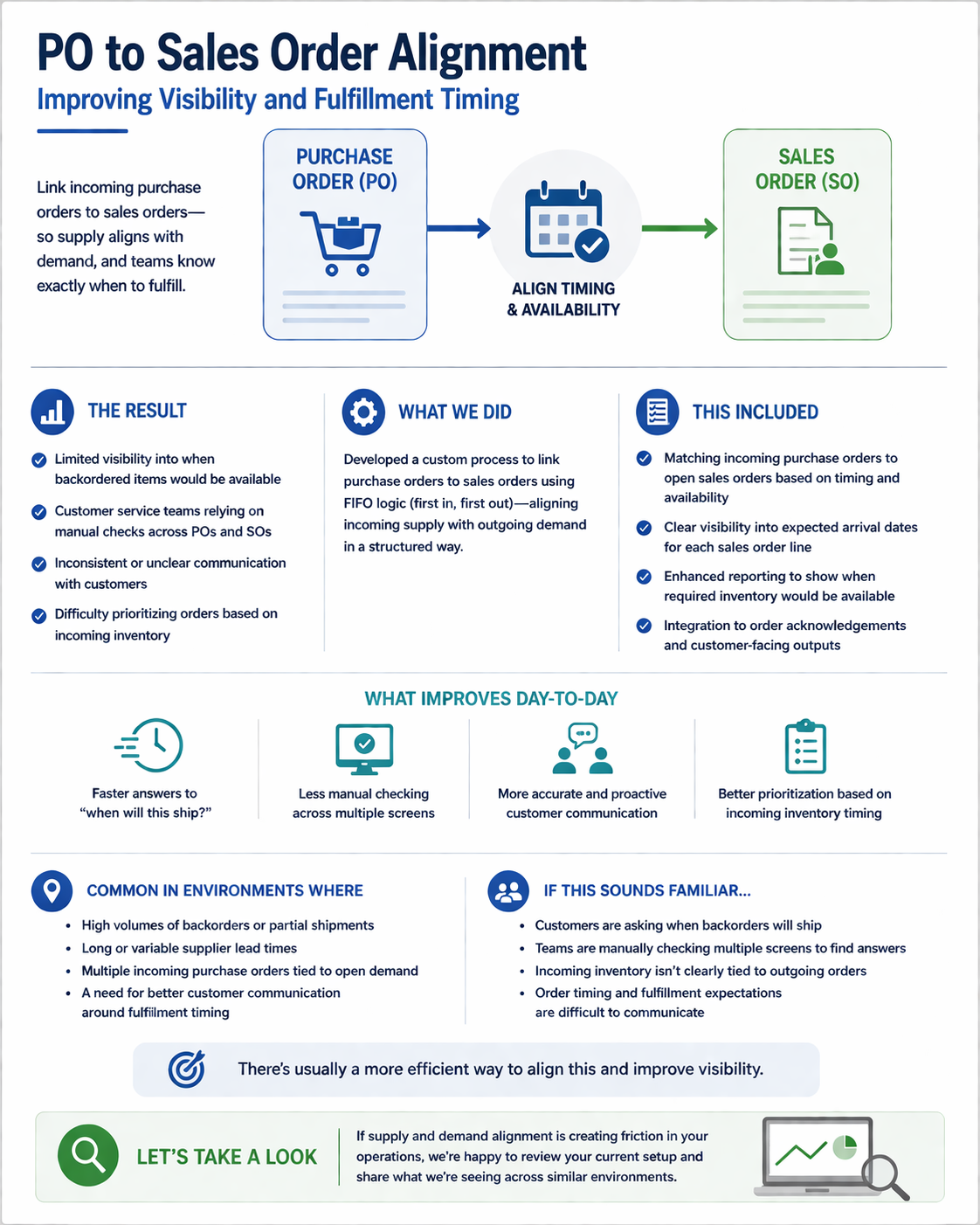
PO to Sales Order Alignment — Improving Visibility and Fulfillment Timing
Another recent project focused on improving how purchase orders and sales orders align inside Prophet 21—particularly around backorders and expected fulfillment timing.
In this environment, incoming supply and outgoing demand weren’t always clearly connected. While the data existed, it wasn’t easily visible or aligned in a way that helped teams—and customers—understand when orders would actually be fulfilled.
The result:
- Limited visibility into when backordered items would be available
- Customer service teams relying on manual checks across POs and SOs
- Inconsistent or unclear communication with customers
- Difficulty prioritizing orders based on incoming inventory
What We Did
We developed a custom process to link purchase orders to sales orders using FIFO logic (first in, first out)—aligning incoming supply with outgoing demand in a structured way.
This included:
- Matching incoming purchase orders to open sales orders based on timing and availability
- Providing clear visibility into expected arrival dates for each sales order line
- Enhancing reporting to show when required inventory would be available
- Integrating this information into order acknowledgements and customer-facing outputs
What Improves Day-to-Day
- Faster answers to “when will this ship?”
- Less manual checking across multiple screens
- More accurate and proactive customer communication
-
Better prioritization based on incoming inventory timing
Common In Environments Where
This typically shows up in environments with:
- High volumes of backorders or partial shipments
- Long or variable supplier lead times
- Multiple incoming purchase orders tied to open demand
- A need for better customer communication around fulfillment timing
If This Sounds Familiar?
- Customers are asking when backorders will ship
- Teams are manually checking multiple screens to find answers
- Incoming inventory isn’t clearly tied to outgoing orders
- Order timing and fulfillment expectations are difficult to communicate
Let’s Take a Look
If supply and demand alignment is creating friction in your operations, we’re happy to review your current setup and share what we’re seeing across similar environments.
| | |
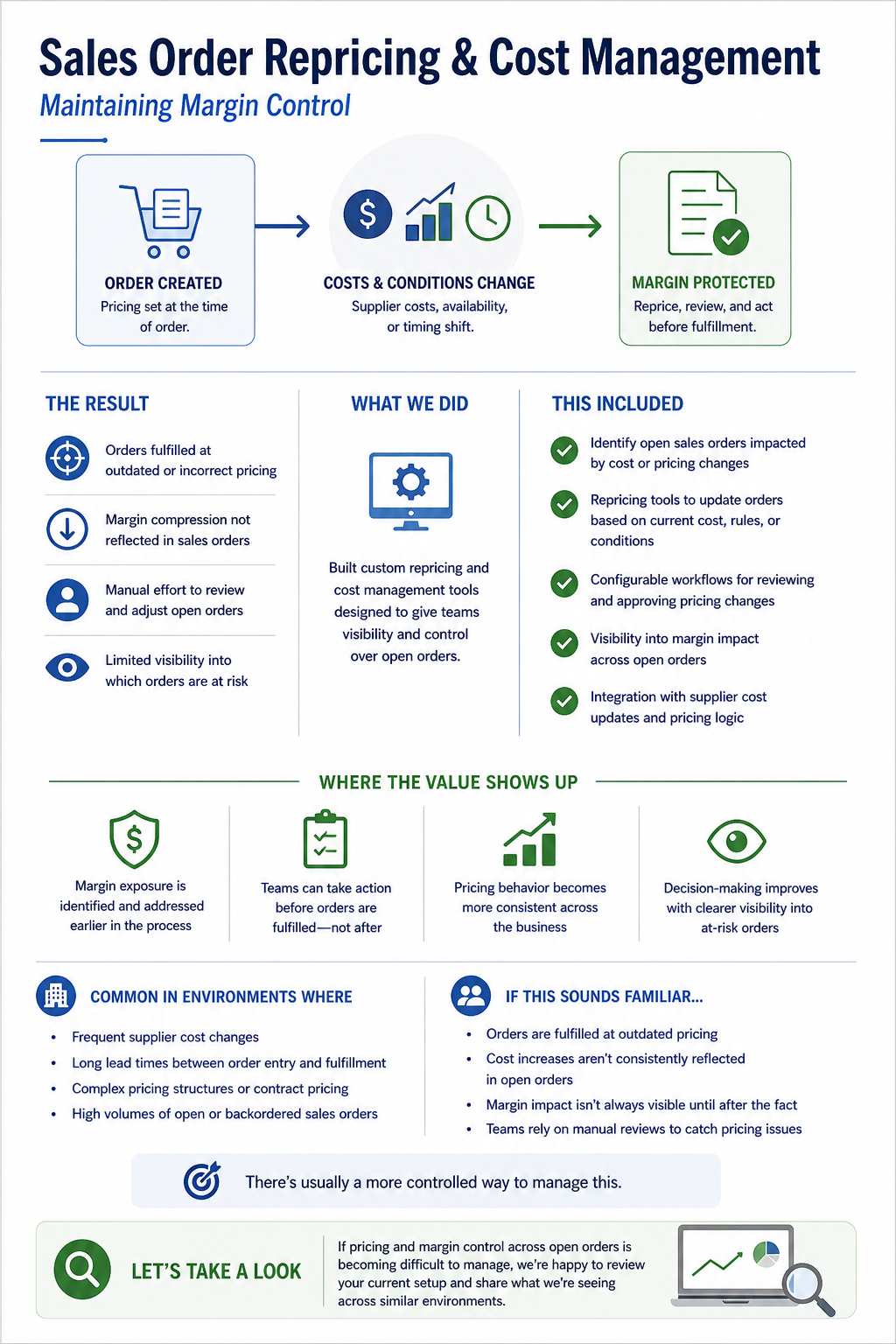
Sales Order Repricing & Cost Management — Maintaining Margin Control
Another project we’ve been working on focuses on sales order repricing and cost management inside Prophet 21—helping teams maintain margin control as costs and conditions change.
In many environments, pricing is set at the time an order is created—but supplier costs, availability, or timing can shift before the order is fulfilled. Without a clear process to review and adjust pricing, margins can erode quietly over time.
The result:
- Orders fulfilled at outdated or incorrect pricing
- Margin compression due to cost increases not reflected in sales orders
- Manual effort required to review and adjust open orders
- Limited visibility into which orders are at risk
What We Did
We built a set of custom repricing and cost management tools designed to give teams visibility and control over open orders.
This included:
- Identifying open sales orders impacted by cost or pricing changes
- Repricing tools to update orders based on current cost, rules, or conditions
- Configurable workflows for reviewing and approving pricing changes
- Visibility into margin impact across open orders
- Integration with supplier cost updates and pricing logic
Where the Value Shows Up
- Margin exposure is identified and addressed earlier in the process
- Teams can take action before orders are fulfilled—not after
- Pricing behavior becomes more consistent across the business
- Decision-making improves with clearer visibility into at-risk orders
Common In Environments Where
This is becoming more common in environments with:
- Frequent supplier cost changes
- Long lead times between order entry and fulfillment
- Complex pricing structures or contract pricing
- High volumes of open or backordered sales orders
If This Sounds Familiar…
- Orders are fulfilled at outdated pricing
- Cost increases aren’t consistently reflected in open orders
- Margin impact isn’t always visible until after the fact
- Teams rely on manual reviews to catch pricing issues
Let’s Take a Look
If pricing and margin control across open orders is becoming difficult to manage, we’re happy to review your current setup and share what we’re seeing across similar environments.
| |
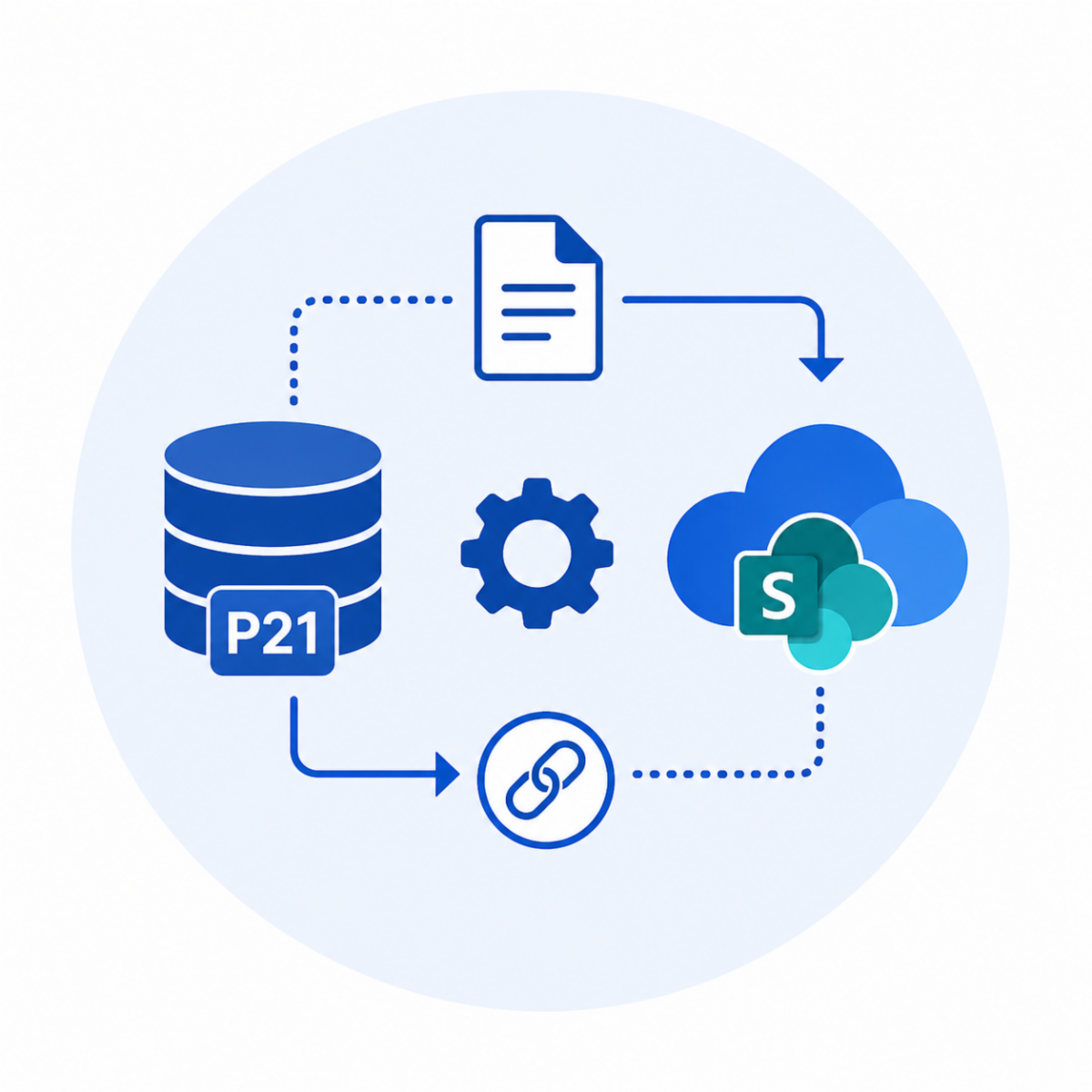
P21 + SharePoint Document Automation
P21 Document Integration with SharePoint Online
Automate document generation, storage, and access directly from within P21.
- Trigger documents (Pick Tickets, Packing Lists, Order Acknowledgements) automatically
- Store centrally in SharePoint using Microsoft Graph API
- Link documents back to Sales Orders via P21 DocLinks
- Eliminate manual handling and improve document visibility across teams
Result: Better control, centralized storage, and seamless access inside P21
|
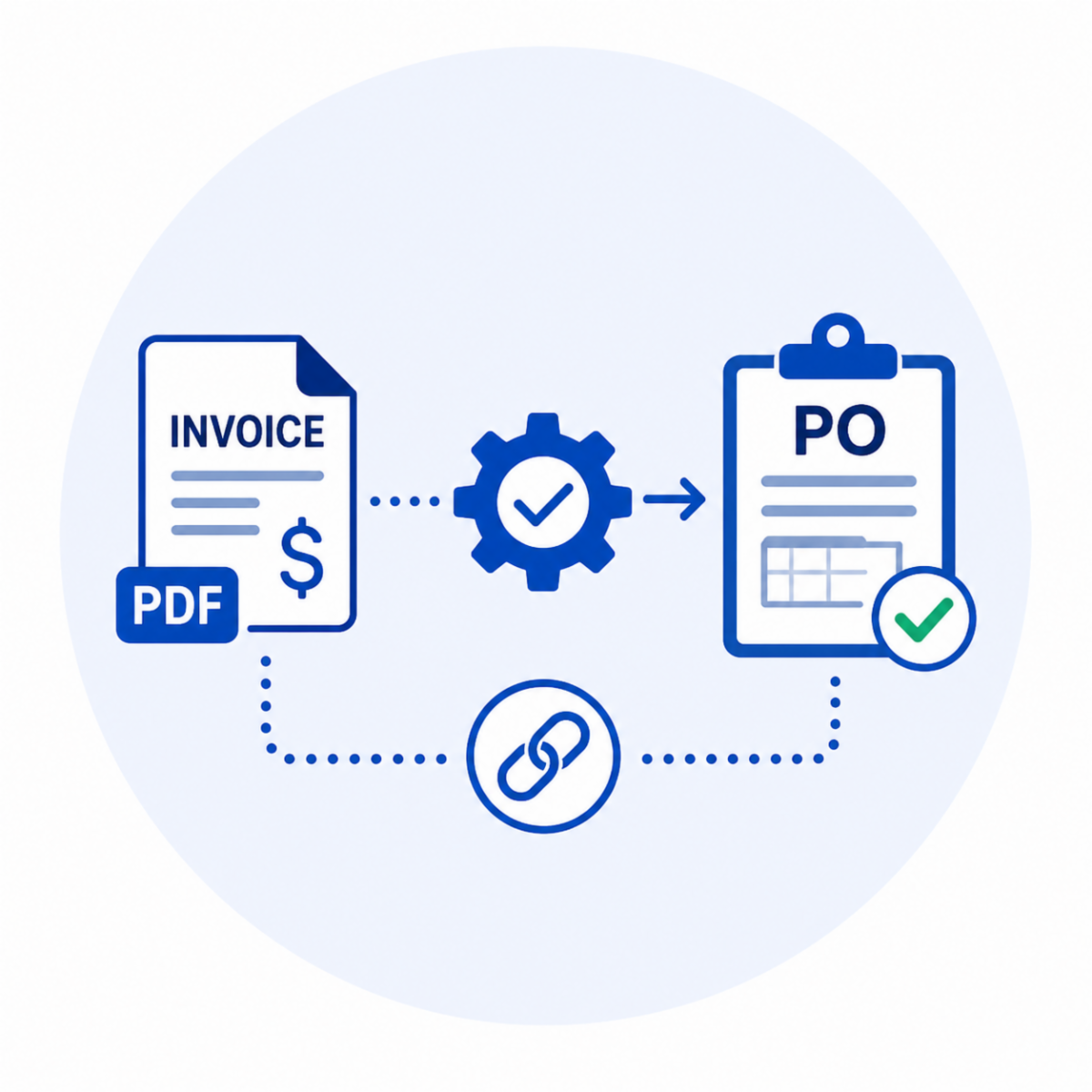
Auto PO Doc Links (AP Automation)
Automating Purchase Order Document Linking in P21
Reduce manual AP workload by automatically linking vendor invoices to Purchase Orders.
- Monitors incoming invoice PDFs
- Extracts PO + invoice data (no OCR required)
- Validates against P21
- Automatically links documents to the correct PO
Result: Faster AP processing, fewer errors, and full document visibility in P21
| |
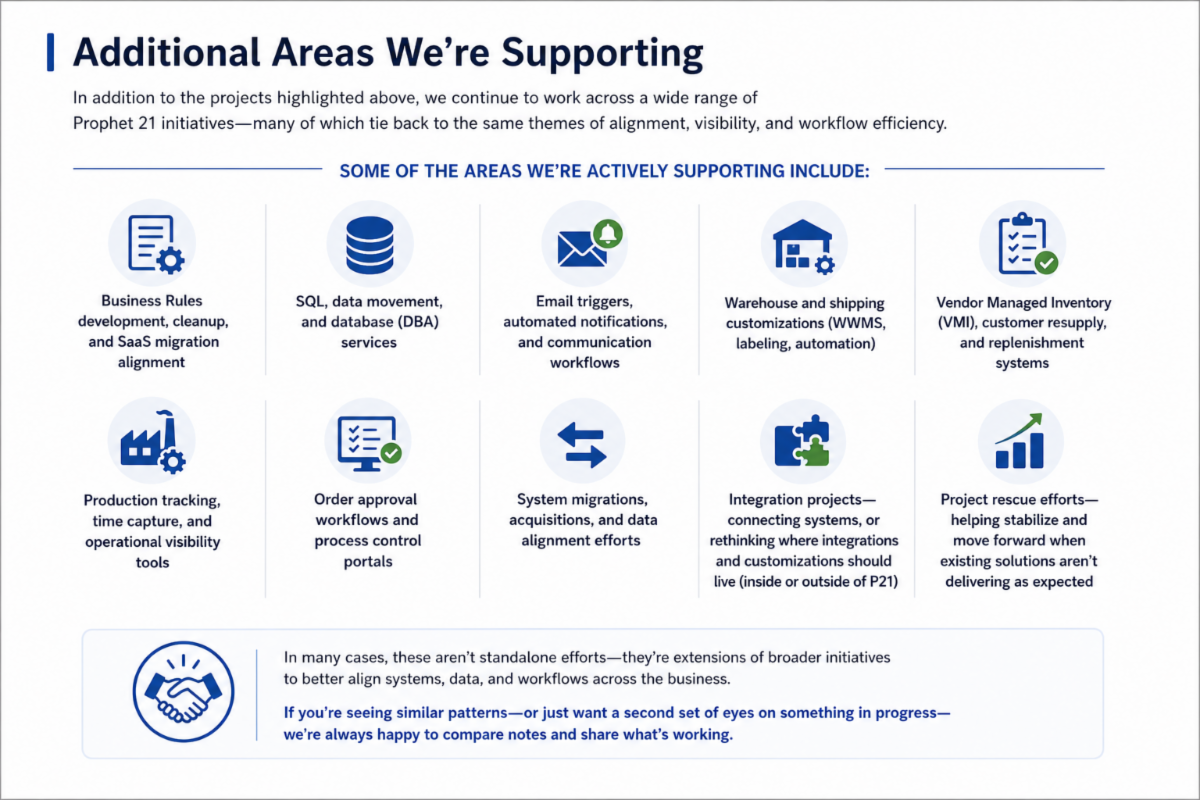
In addition to the projects highlighted above, we continue to work across a wide range of Prophet 21 initiatives—many of which tie back to the same themes of alignment, visibility, and workflow efficiency.
Some of the areas we’re actively supporting include:
- Business Rules development, cleanup, and SaaS migration alignment
- SQL, data movement, and database (DBA) services
- Email triggers, automated notifications, and communication workflows
- Warehouse and shipping customizations (WWMS, labeling, automation)
- Vendor Managed Inventory (VMI), customer resupply, and replenishment systems
- Production tracking, time capture, and operational visibility tools
- Order approval workflows and process control portals
- System migrations, acquisitions, and data alignment efforts
- Integration projects—connecting systems, or rethinking where integrations and customizations should live (inside or outside of P21)
- Project rescue efforts—helping stabilize and move forward when existing solutions aren’t delivering as expected
In many cases, these aren’t standalone efforts—they’re extensions of broader initiatives to better align systems, data, and workflows across the business.
If you’re seeing similar patterns—or just want a second set of eyes on something in progress—we’re always happy to compare notes and share what’s working.
| |
|
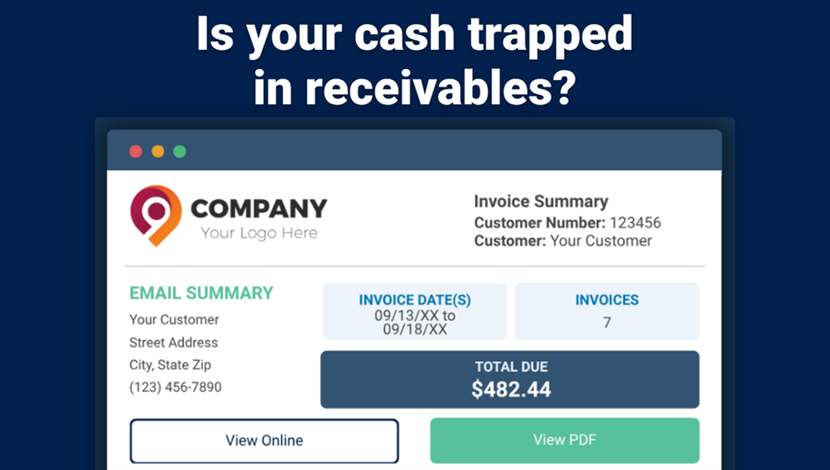
Cash trapped in receivables costs your business money because it can't be used to buy inventory, fund expansion, or weather a downturn. Unified A/R fills that gap in order-to-cash workflows and your ERP with A/R Automation technology designed specifically for Prophet 21. Modular solutions including interactive invoices with secure payment links and automated payment posting back to P21 mean less friction for your customers and faster cash for you.
Here’s why thousands of business locations trust Unified A/R
✓ DSO drops with real-time invoices with ePayment acceptance
✓ Full end-to-end A/R visibility within P21, no extra systems to manage
✓ PCI-compliant, tokenized self-serve customer payments 24/7
✓ Implemented by our team in under an hour with minimal impact to your business
✓ A/R Automation allows your business to scale
"After putting Unified A/R in place, our back office saved 30% of their time,
which we were able to transition to other duties."
-Pete Chrobak, CFO, Duncan-Parnell | Epicor P21 User
Incredible Savings and Efficiencies Begin with a Short Demo.
| |
Service Pro® by MSI Data enables field service organizations to better manage their service operations and increase profitability. With full integration capabilities to Epicor P21, you’ll seamlessly access real-time data. Our platform provides your entire team, from the back office to field technicians, with the necessary information to complete work orders correctly the first time.
Benefits to tying in tech:
- Fully integrate with Epicor Prophet 21.
- Gain visibility into the equipment data.
- Organize orders and schedules for pro-active service.
- Capture notes, photos, and signatures via true mobile app.
- Improved customer satisfaction & longevity.
Please visit: MSIData.com and/or
contact Andrew Knox for more information.
8 MSI Service Pro + P21 integrations are now live...and we've got several more of these Field Service Management Software integration projects now rolling with the wonderful team at MSI Field Service Management and our clients.
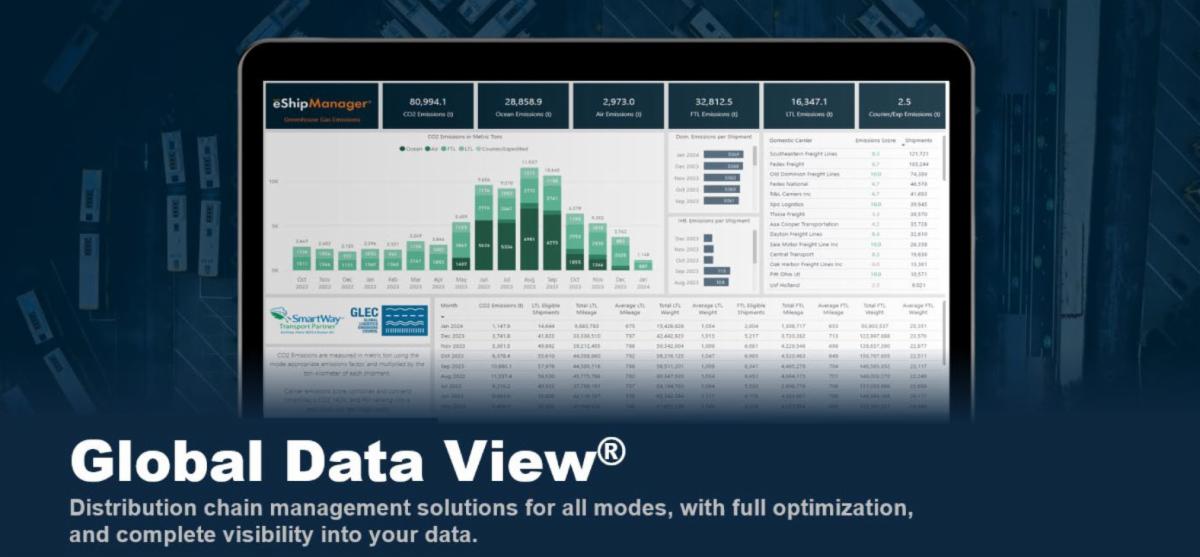
| eShipping helps P21 users turn transportation and logistics costs into full profit centers by gaining control of the supply chain, driving out cost, and increasing growth through enhanced customer experience. |
eShipping — Smarter Shipping Inside P21
eShipping is a long-time Epicor partner providing powerful, multi-carrier shipping automation tightly integrated with Prophet 21.
Together, MindHARBOR and eShipping help distributors:
- Rate shop across multiple carriers
- Automate label generation and shipment processing
- Improve shipping accuracy and speed
- Reduce freight costs and manual effort
Our work focuses on ensuring eShipping integrations align cleanly with real-world P21 workflows — from order entry through shipment confirmation and invoicing — so shipping becomes a streamlined extension of your ERP, not a separate system to manage.
Ready to see the benefits of Global Data View?
Click here to Schedule a Complimentary Demo.
About eShipping
eShipping is a transportation and logistics management company providing comprehensive solutions that span transportation, warehousing, distribution, and technology. Core services include domestic and international transportation management across less than truckload, truckload, international, and small parcel, as well as warehousing, fulfillment, and financial services.
| |
Career Connections within the P21 Community
We’re proud to serve as a connector within the P21 community—helping match talented professionals with companies in need of expertise. Over the years, we’ve facilitated countless introductions, always confidentially and without fees.
Have an opening—or exploring new opportunities?
Please reach out to Mike with the details, and we’ll share it confidentially with our P21 network. We’re always glad to help—no pressure, no fees, just connecting good people.
| Got Content, Feedback, Questions? | |
If you have articles, press releases, adventures, questions, and/or tips to share with other Prophet 21® system users in the next edition of Adventures in P21, please send them our way!
| | www.MindHARBOR.com QuickLinks & More Information: | | Thank you for reading, and for the opportunity to be your Partner-in-P21! | | |
Please spread the word by forwarding &
sharing this free eNewsletter with a fellow P21 user today!
| | |
Legal Notice: MindHARBOR, Inc. is an independent systems provider and is not affiliated with, sponsored by, or endorsed by any of the brands, companies, or products referenced in this email or on our website, including but not limited to: Epicor Software Corp., Epicor Prophet 21®, Activant®, Dynachange®, ICE®, Microsoft®, SQL Server®, Power BI®, Azure®, AutoCrib®, CribMaster®, Kardex®, Modula®, VendNovation®, SnapVend®, 1Source®, Adobe Commerce / Magento®, BigCommerce®, WooCommerce®, Shopify®, Amazon®, eBay®, OroCommerce®, ROC Commerce®, Channel Software®, Salesforce®, HubSpot®, Selltis®, Constant Contact®, SAP Concur®, Profit2®, Blue Ridge Global®, Rubber Tree Systems®, Vena®, eShipping®, DispatchTrack®, Curri®, KD Logistics®, BlueGrace®, BlueShip®, UPS®, FedEx®, ShipStation®, KDL Logistics®, Crystal Reports®, SSRS®, BarTender®, epaCUBE®, Catsy®, Akeneo®, Salsify®, and Unilog®.
MindHARBOR delivers custom C# .NET development, ERP integrations, SQL Server Reporting Services (SSRS), API solutions, and eBusiness consulting — on time, on spec, and on budget — since January 1, 2000.
| | | | |