Health News Digest, May 2026 | |
Could eating eggs help protect your brain from Alzheimer’s?
A new study followed adults aged 65 and older and found that those who ate at least one egg a day for five or more days a week were 27% less likely to be diagnosed with Alzheimer’s disease compared to those who never ate eggs. Even people who ate just 1-3 eggs each month were 17% less likely to develop Alzheimer's. The researchers believe the benefit comes from specific nutrients in eggs that are likely to support memory and brain function.
This is encouraging news at a time when more than 7 million Americans are living with Alzheimer's, and there is still no cure. The findings add to a growing body of research showing that everyday food choices can help protect our brains as we age. Eating eggs as well as a balanced diet rich in vegetables, fruits, whole grains, and healthy fats may be one of the easiest things older adults can do to support long-term brain health.
Read more about the study in The Hill.
| |
Are AI chatbots a safe place to turn for mental health support?
More and more Americans are using AI chatbots for mental health advice, and the American Medical Association (AMA) is asking Congress to step in and make them safer. In letters to lawmakers, the AMA pointed out that some chatbots have encouraged people to hurt themselves, ignored signs of a crisis, shared private health information, and even pretended to be real therapists. A recent survey found that nearly 1 in 3 Americans use AI chatbots for health information, and more than 1 in 4 use them for stress or mental health.
We agree with the AMA that chatbots should clearly tell users they are talking to a machine, not a person, and that they are not therapists. The AMA is also asking for better privacy protections, fewer ads in mental health chatbots (especially ones used by kids), and tools that can spot when someone is in danger and connect them to real help.
Children and young adults are especially likely to be harmed by Chatbots. These AI products need to be regulated because they can do more harm than good.
Read more in Fierce Healthcare.
| | |
Should a non-scientist lead the National Science Foundation?
President Trump keeps nominating people with no scientific or medical background to lead our nation's top research agencies. That's why Salon interviewed NCHR President Dr. Diana Zuckerman about Trump's pick to run the National Science Foundation (NSF).
The director of the National Science Foundation has always been a scientist or engineer. Unfortunately, Trump's nominee, Jim O'Neill, is a Silicon Valley investor with no scientific training. Past directors have expertise that enables them to understand research and the importance of solid evidence. O'Neill, by contrast, spent more than a decade running hedge funds and venture capital firms tied to billionaire Peter Thiel, and most recently served as RFK Jr.'s deputy at HHS during the worst measles outbreak in decades. Dr. Zuckerman warned that O'Neill's lack of scientific credentials is "problematic." “You can be very smart and be very good in the financial world,” she said. “But science has a different level of evidence, and it has a different interest in long-term benefits and not the sort of short-term, ‘get the price of a stock up and then sell it.'”
Read more in Salon.
|
Why did the FDA Commissioner resign, and what happens next?
On May 12, FDA Commissioner Dr. Marty Makary resigned after months of pressure from the White House, anti-abortion groups, the tobacco industry, and pharmaceutical lobbyists. The New York Times, STAT News, and The Hill all interviewed Dr. Zuckerman asking her to explain what his departure means for the future of the FDA.
FDA is responsible for determining what medical products are safe and effective. Unfortunately, Commissioner Makary could not overcome political pressure in FDA decisions such as flavored e-cigarettes, research on the abortion pill mifepristone, or unproven peptide treatments. Dr. Zuckerman told STAT News that Makary was "the worst FDA Commissioner" in the 40 years she has worked on FDA issues.
She told the New York Times that "he managed to offend almost everyone involved in FDA issues, which is not easy to do, but it would still be a disaster if he is replaced by someone who appeals primarily to tobacco companies, anti-abortion activists," and pharmaceutical lobbyists.
She told a reporter at The Hill, that we need “a more scientific-based, evidence-based FDA, and not one that has to change according to the whims of political appointees and also perhaps donors and friends of the White House."
Read more in The New York Times, STAT News, and The Hill.
| |
Why are so many patients harmed by FDA-approved medications?
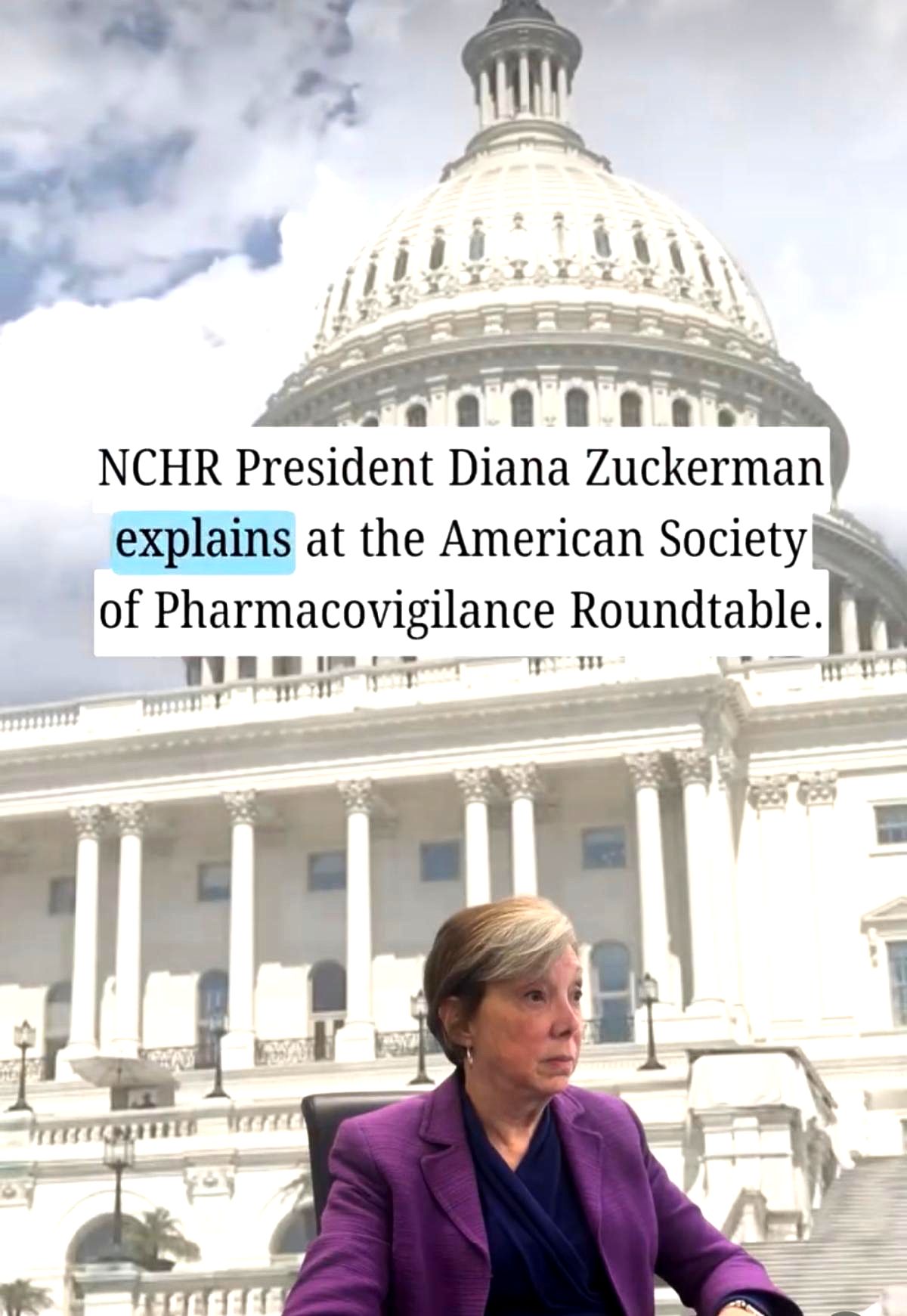
The American Society of Pharmacovigilance is very concerned about how many patients have serious side effects from their medication. At its Roundtable in Washington, DC, Dr. Diana Zuckerman explained that pharmaceutical companies want their drugs to be approved as quickly as possible, and that results in smaller, shorter-term studies that don't provide all the information about risks and benefits that patients and their physicians need.
Pharmaceutical companies have figured out that training and funding patient groups to lobby Congress and the FDA is a very effective way to get drugs and devices approved with less evidence.
One possible solution is to require that patients receive an easy-to-read patient booklet with risk information that they must sign before getting an implanted medical device. FDA has agreed it is a good idea, but has backed away from making sure that patients are not overwhelmed with patient booklets that are too long and too technical.
Watch Dr. Zuckerman's reels on these topics here and here.
| | We're Speaking Out For You |
Should the FDA approve cancer drugs that may not help patients?
The FDA traditionally holds public Advisory Committee meetings when there is controversy about whether to approve a new medical treatment. In the last year, however, the agency has held very few of these public meetings. On April 30, the FDA held two public meetings to consider two cancer treatments, one for metastatic breast cancer, and one for advanced prostate cancer.
Dr. Diana Zuckerman testified during the Public Comment part of both meetings. In both cases, the FDA‘s main concern was whether either of these treatments provided a meaningful benefit to patients. This was a particular concern for the prostate cancer drug TRUQAP, which the FDA had previously approved for a different type of prostate cancer, because several patients died as a result of taking it.
We agreed with the FDA scientists’ concerns that these treatments were unlikely to benefit patients. Advisory committee members agreed with us about the breast cancer drug, but thought that the prostate cancer drug might possibly be beneficial.
You can read our testimony here and here.
| |
Are new FDA rules for rare disease treatments putting patients first?
Patients with rare genetic conditions urgently need new treatments, and the FDA has proposed a new "Plausible Mechanism Framework" that would allow individualized therapies to be approved based on very small studies and biological theories. The FDA asked for public comments, and we responded by warning that approving treatments without solid proof of patient benefit could leave patients exposed to harm as well as enormous medical bills for therapies that may not work.
Instead of relying on small studies and biological theories that may not translate into real benefits for patients, we urged the FDA to focus on stronger evidence. We recommended requiring follow-up studies to already be underway at the time of approval, setting clear timelines and consequences when companies fail to complete those studies, and limiting approvals based on surrogate measures that do not always measure whether patients feel better or live longer. Without these safeguards, patients and doctors will not have the information they need to make these types of major medical and financial decisions.
Read our written comment here.
| | |
Check us out!
Did you know that artificial turf, rubber playground surfaces, and rubber mulch contain chemicals that can cause attention problems, obesity, early puberty, asthma, and cancer? Are your children or grandchildren getting exposed when they play? Follow us @safe.to.play
| |
| Our main Instagram account and Threads provide free information about new medical research, programs, and policies to help health experts, patients, and the public improve the health of individuals and communities. Follow us @healthresearch4u | | | Connect With Us on Our Other Social Media! | | Your Contribution Can Make a Difference! | | We do not accept any funding from drug companies, device companies, chemical companies, or other sources that could influence our work and compromise our integrity. That's why so many people turn to us when they need help. Donations are tax-deductible! Please consider giving to the National Center for Health Research online or by mail to the address below. You can also contribute to our Cancer Prevention and Treatment Fund online, by mail, or through the Combined Federal Campaign using CFC# 11967. | |
To sign up for these monthly updates, click here.
| | | | |