|
|
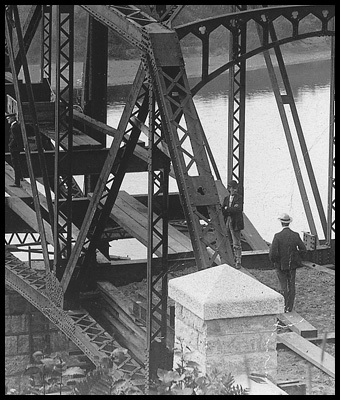
| Longleaf Hard Pine Stringers |
|
|
|
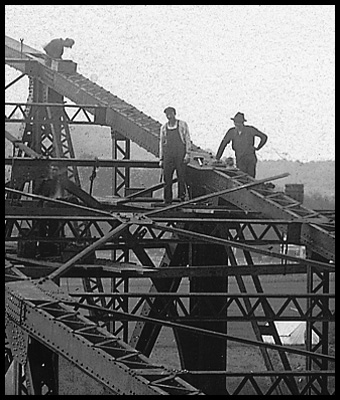
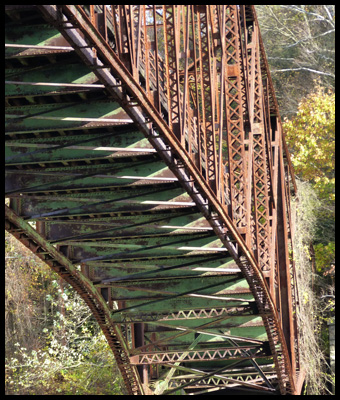
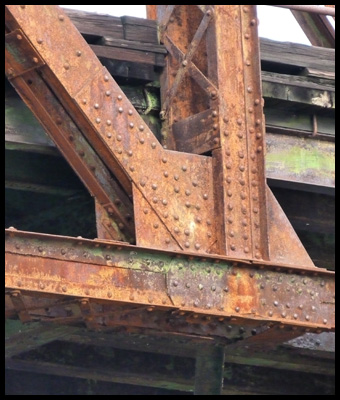
| Riveting was done by four gangs of four men each |
|
|
|
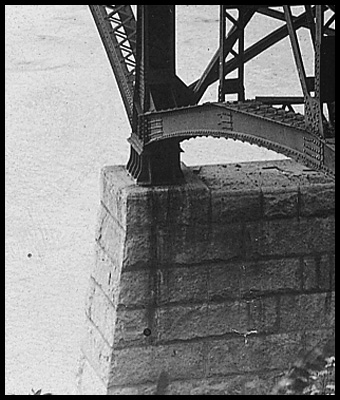
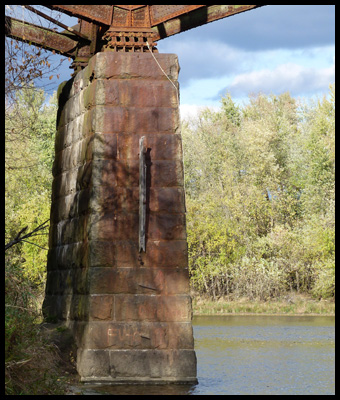
| Granite from Lebanon, New Hampshire |
|
|
|
Greetings,
-
This issue of the ISP newsletter features the Schell Memorial Bridge of Northfield, Massachusetts. In the June issue, wrought iron will be the subject. For the preservationist it is important to understand this metal's unique characteristics and methods for its preservation, a metal no longer produced in the USA. And b
e sure to check out the
Custom Welding Courses offered at Lansing Community College.
Vern Mesler
Iron & Steel Preservation Coordinator
Lansing Community College
|
| "Principles of Aesthetics" |
|
|
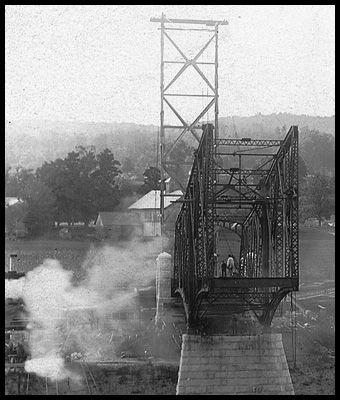
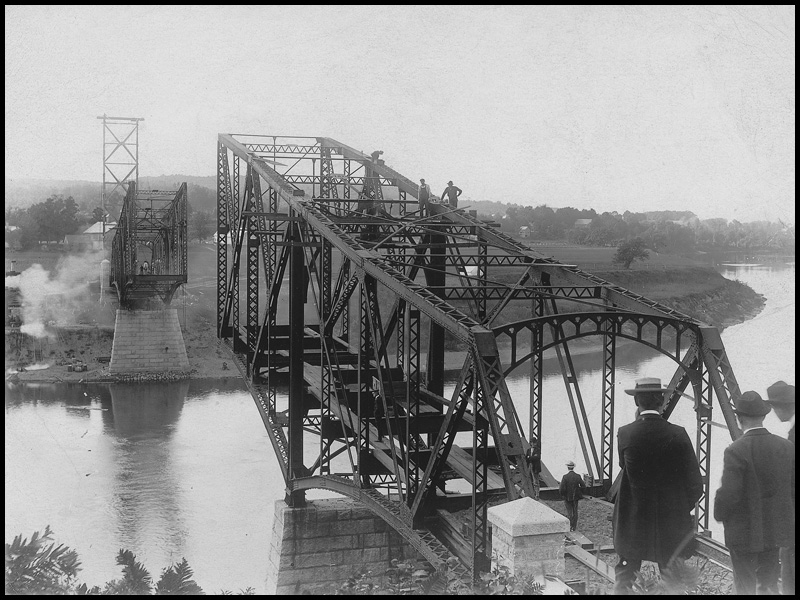
| Erection of the Schell Memorial Bridge, "Courtesy of Northfield Mount Hermon Archives." (see details in photos at left) |
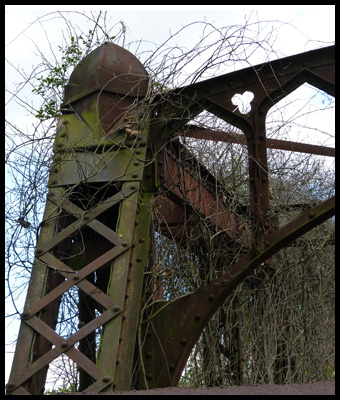
In his book De Ponitibus, the civil engineer and bridge designer J. A. L. Waddell (1854 - 1938) complained about the lack of architectural elements and ornamentation in American bridges. "That the metal bridges built in the United States ... are, with rare exceptions, anything but models of excellence in respect to the principles of aesthetics, no engineer is likely to deny." In one rare exception, in 1903, a new highway bridge being considered for spanning the Connecticut River at Northfield, Massachusetts, although first designed for utilitarian purposes only, became something more than that. Upon hearing of the proposed construction, Mr. Francis Robert Schell offered to finance the new bridge as a memorial to his mother and father. It would be known as the Schell Memorial Bridge. First designed with three simple and independent spans, it was decided that a "Baltimore" type through truss would be a more appropriate design for a memorial and would span the entire width of the Connecticut River. The new bridge would be an exception to what Waddell noted in his book: "In regard to the ornamentation of bridges by the adoption of elaborately artistic approaches ... little has yet been done in America, the reason being that any money so expended has evidently no utilitarian purpose, and consequently to the eye of the solely practical man appears to be entirely wasted." |
| We think of a memorial as ageless, constructed of the finest materials, crafted by skilled craftsmen, maintained by the benefactor of the gift for futures generations to admire and study, and for future architects, engineers and craftsmen to search for insight to create new and innovative designs. However, for the Schell Memorial Bridge, destruction of the original structure is imminent, the bridge to be replaced by a new span said to be "similar to the original truss design" to quiet those who wish to see this memorial preserved and returned to its original grandeur. One essential record from the Schell Memorial Bridge that will be lost forever is the craftsman's record, not in words but in the bridge itself: quarry-faced granite, longleaf hard pine, chestnut, railway bridge steel, cast iron posts of special design, material wrought by craftsmen and erected by a unique cableway system. |
| A written record does exist with technical information about the bridge from a series of articles titled "The Schell Memorial Bridge" published in Volume 50 (No. 25 - 27) of The Engineering Record (1904, December 17, December 24, and December 31). Thanks go to historian Elaine Davis and Michigan State University engineering librarian Tom Volkening for finding clear copies of these articles, digitized by Google from the collection of the University of Michigan. Schell Memorial Bridge - The Engineering Record These articles provide a rare insight into the design, fabrication and erection of a significant twentieth century steel bridge for a small New England town. From the design of the Schell Memorial Bridge to the final laid plank, the written descriptions can lead the reader to explore other historic and contemporary sources and lead to interesting discoveries. |
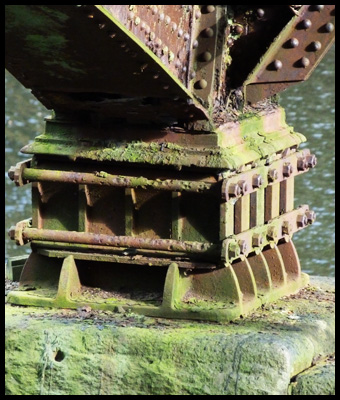
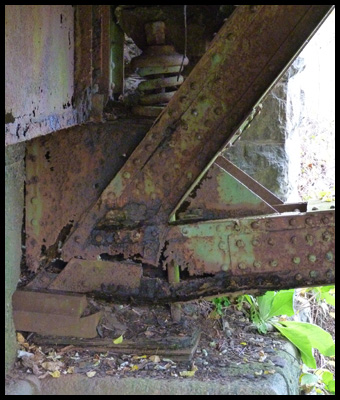
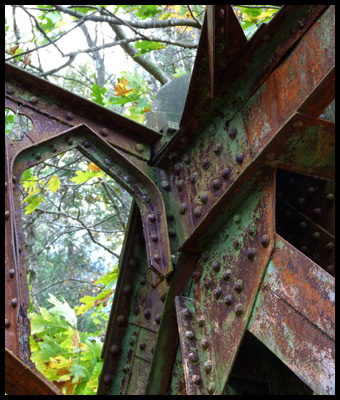
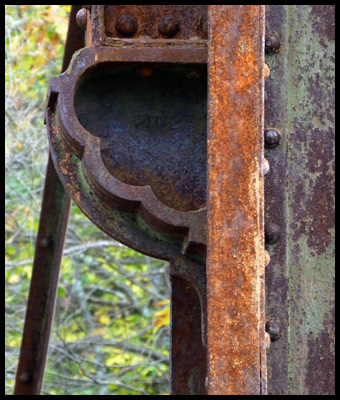
| Templets, Rivet Connections "As the bridge was designed with riveted connections throughout, special care was taken in making the templets, in order that the several parts when brought together in the field without the support of falseworks might be connected with satisfactory results." Freight-Car Springs "The upper ends of the anchor rods, already referred to, pass through the abutment bearing and ends of the trusses, on which they bear by means of cast-iron washers and spiral steel freight-car springs, through which the anchor rods pass. The bearings were adjusted so as to leave a play of 1/32 to 1/16 in. between the ends of the trusses and the bearings below, and also between the washers on top of the spring and the nuts on the anchor rods." Curbs and Wheel Guards "The steel floorbeams carry lines of longleaf hard pine stringers, spaced 2 ½ ft. apart on centers, and butted on the top flanges of the floorbeams, on which they are gained to varying depths to give a crown to the roadway." Cast-Posts of Special Design "The railings are formed of four lines of wrought-iron pipe passing through cast-posts of special design, spaced 5 ft. 4 in. on centers and secured to the broad wheel guards on which they rest by lag screw." Erecting the Schell Memorial Bridge was done by a cableway system for which "there is no published description of previous use." The authors of the article devoted a significant portion with text and diagrams of the erection apparatus. |
| In 1903 the Schell Memorial Bridge was opened to the public. On December 17 of the same year at Kitty Hawk, North Carolina, the first powered, heavier-than-air machine took flight. Aviation has advanced, where the Schell Memorial Bridge with its exceptional truss design, its artistic approach in ornamentation, unusual for the time, was closed in 1985 and left to rust. Vern Mesler |
| Past Iron & Steel Preservation Newsletters |
|
|