Letter from the Executive Director and Artist in Residence | | |
Dear Randy,
If you follow the Garden on Instagram (@thejfgarden) you may have seen posts from a trip we recently organized to Paris, Versailles, and the Touraine region of France's Loire Valley, known as 'The garden of France.' The trip was brilliantly put together by Casey O'Brien Blondes (@loirelegends) highlighting a spectrum of garden design and intention: from the gardens of the chateâux of Chambord, Chenonceau, and Chaumont, to the charming village of Chedigny – a town with more rosebushes than citizens, and the only municipality in France given the prestigious 'remarkable garden' designation. We visited a lovely private garden by Nic Tomlan (@ntomlan), a garden designer formerly at Longwood Gardens until moving to France to be the botanical director at Château de Chenonceau, where we got to see another of his projects, a walled garden inspired by the British garden designer Russell Page. We saw other gardens with the 'remarkable garden' designation - the picturesque Le Plessis Sasnière, an English-style garden in a sublimely pastoral setting, the Château de Valmer in Chançay, a 300 hectare Italian Renaissance-inspired estate founded in the 16th Century, where we were given a tour by owner, Alix Saint Venant. At Le Prieure d'Orchaise, Antoine Treuille walked us around the garden comprising 2,000 species collected by his father – engineer, world traveler, and botany enthusiast, Hubert Treuille.
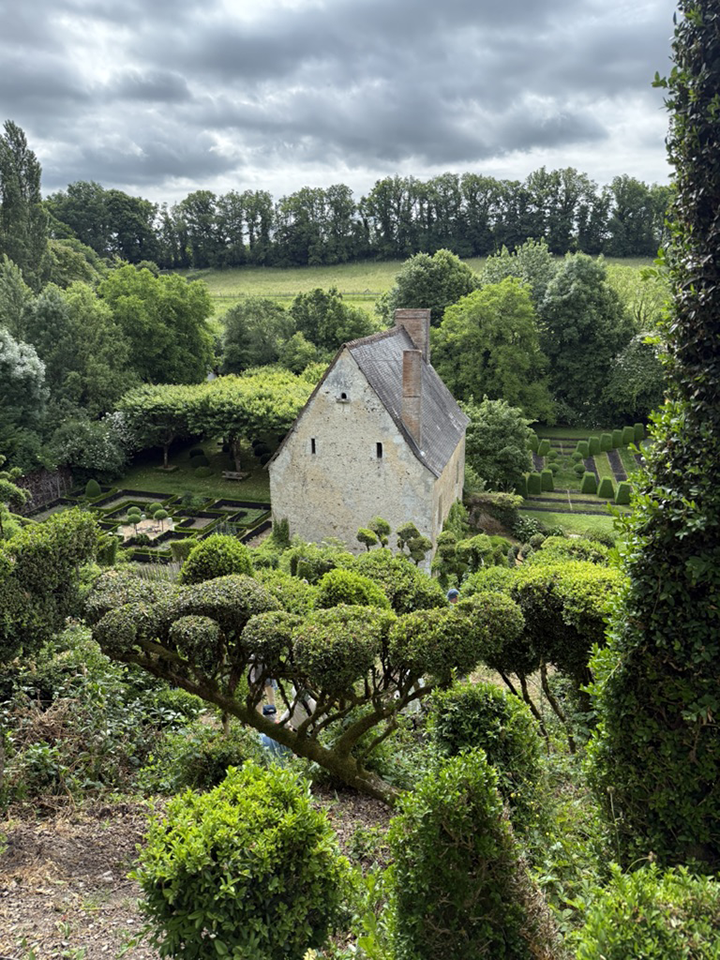
We also visited the unforgettable Le Prieuré de Vauboin, another 'remarkable garden' created by a charming man named Thierry Juge. Monsieur Juge's introduction to our garden tour began, 'Ce n’est pas un jardin botanique, c’est un jardin mystique. 'This is not a botanic garden, it's a mystic garden.'
One might think that boxwood blight would be a likely cause for despair for a gardener maintaining a highly pruned boxwood garden. Thierry the mystic, though, is an intrepid gardener, intervening with plants in ways that would make a purist blanche. How? By painting the dead inside of the hedges with waterproof black paint he sourced from Sweden. The live outside edge of his boxwood hedges are still vibrant green, creating a bright live border around the minimal, black geometry of the ravaged hedge. The result is somehow both elegiac and celebratory.
Le Prieure de Vauboin is not solely a garden of symmetrical, formal topiary. The shockingly steep terrain on its east side is mostly covered in wild boxwood. Atop very tall ladders made for such a terrain, Thierry has pruned this boxwood forest into whimsical shapes – some recognizable, some abstract. There are topiaries inspired by Brancusi and animal life, and there is one of which he is particularly proud in the form of a ballerina. Thierry told us he has loved boxwood since he was a child. 'When I am pruning,' he said, 'the boxwood tells me what to do.'
Though John Fairey's temperament may not have been so whimsical as Thierry's, I thought of John as Thierry shared thoughts about his garden. Akin to John, Thierry considers it a studio, a place to explore plants, beauty, form, ideas, and one's relationship to his environment. I can't say whether John thought of his garden in mystical terms, but I believe he and Thierry both created an environment liable to intensify one's conscious connection with the spiritual; one that, independent of style or design, provides the ecstatic experience that distinguishes the 'jardin mystique' from the 'jardin botanique.'
Warm regards,
| |
Restoring Lost Collections: The First Step
Wally Wilkins, Director of Horticulture and Living Collections
| | |
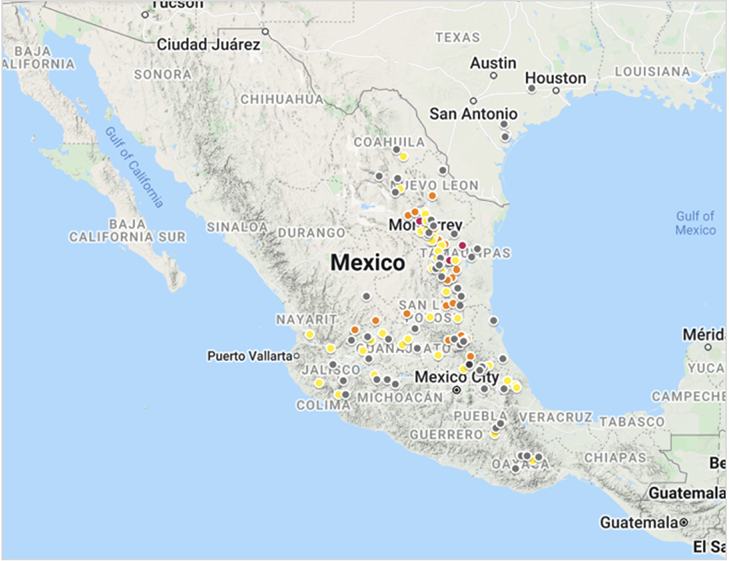
The John Fairey Garden owes much of its unique character to the bold and beautiful plants collected over the course of more than 100 expeditions into Mexico by our founder, John Fairey, and his longtime collaborator Carl Schoenfeld. Together, they ventured into the Sierra Madre Oriental, exploring cloud forests of the mountaintops, the desert canyons of the interior, and everything in between—ultimately collecting and introducing more than 1,000 different taxa to the garden.
What made these collections especially meaningful wasn’t just their rarity, but the way John ultimately integrated them into the landscape: with an artist’s eye and a plantsman’s heart. These were not simply plants to be catalogued—they were the living palette of an ever-evolving garden sculpture.
| | |
This bounty of interesting plants wasn’t restricted to use by John at the garden though. Over the years, John and Carl invited like-minded explorers to join their adventures—including individuals who founded renowned nurseries like Sean Hogan of Cistus Nursery and Tony Avent of Plant Delights. Seeds and plants from these expeditions also made their way to major botanical institutions such as UC Berkeley Botanical Garden, JC Raulston Arboretum, and UC Santa Cruz—and ultimately into the hands of the public via the Yucca Do Nursery.
But as every gardener knows, botanic collections are not permanent. Nature has her say. In our tough southeast Texas climate—with its droughts, floods, wild temperature swings, and the occasional hungry armadillo—it’s inevitable that some treasures slip away. After more than 30 years, we estimate that as much as half of the original Mexican collections have been lost or never fully established in the garden. And so, we’ve begun the process of restoration.
Following a recent inventory, we prioritized a list of target species that we believe can thrive again in our climate. Even better, we’ve tracked down places where many of these plants still live—often growing robustly in the gardens of old friends and collaborating institutions.
| | |
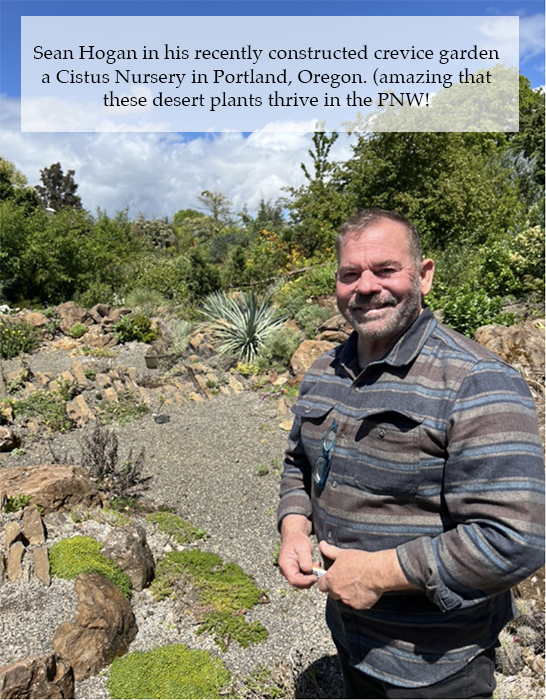
The first step in this restoration journey took me west in May, on a 4,500-mile round trip from Hempstead. The first stop: Portland, Oregon, where I spent a day with Sean Hogan at his Cistus Nursery. Amid the lush and densely packed gardens surrounding his home and nursery, we talked plants (of course), marveled at the diversity of his wild collections, and reminisced about the expeditions he once shared with John and Carl. Sean generously donated more than 50 plants to our restoration effort—several of which he and John had collected together.
| | | | | |
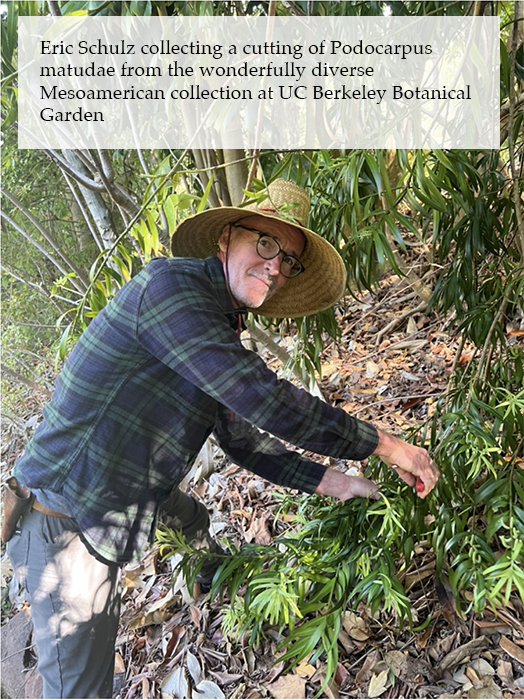
From there, I headed south to the UC Berkeley Botanical Garden, where I met Director of Collections Andrew Doran; Curator and Conservation Officer Clare Loughran; and Horticulturist Eric Schulz. We spent the day collecting cuttings from 43 different plants—each one tied back to John’s original Mexican collections. That kind of generosity is humbling, and a reminder of how strong and enduring the bonds are within the botanical world.
Finally, stops at Western Hills Garden, the Ruth Bancroft Garden, and UC Santa Cruz Arboretum opened the door to future plant exchanges and partnerships.
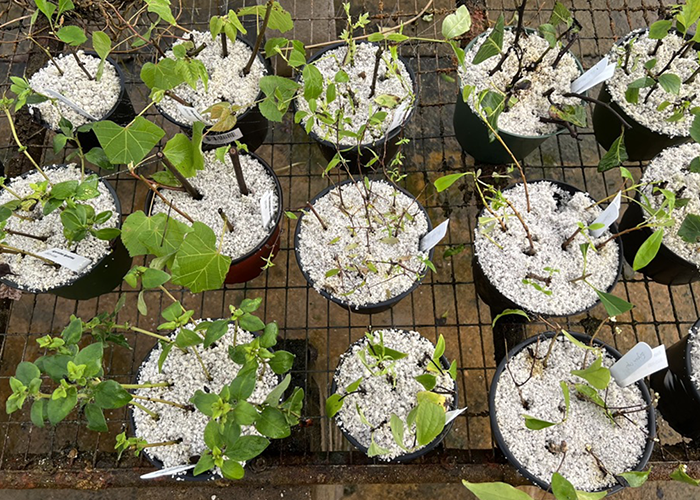
| | | | Back in Hempstead, the new arrivals are settling in. The cuttings are tucked into mist benches in our nursery, and the plants from Cistus are in the greenhouse, recuperating from the journey. While it will be a few months before we know which cuttings have rooted successfully, we’re hopeful. With luck, we’ll begin planting the first of them this fall—just after the worst of the summer heat has passed. | | |
Of course, this is only the beginning. Many more plants remain on our restoration list, and I’m already planning another trip—this time to North Carolina to visit the Juniper Level Botanic Garden, JC Raulston Arboretum, and the Bartlett Research Facility. Each of these gardens, like ours, is led by passionate plantspeople who understand the value of preserving and reviving wild-collected botanical treasures.
We’re excited to be taking the first real steps toward restoring the Mexican collections that are so central to the identity of The John Fairey Garden. And we’re deeply grateful to our friends and colleagues across the country who are helping us bring these plants—and the spirit of their original collection—back home.
| | Letter from the Nursery Manager and Horticulturist | | |
Big things are happening in the John Fairey Garden Nursery! I’ve been out in the Garden collecting as many cuttings as I can fit on our mist benches to stock up the sales nursery. I’m happy to say that we’ve got quite a selection of trees, shrubs, succulents, and herbaceous perennials in stock. You can follow our nursery Instagram page (@jfg_nursery) to find out what’s happening in the sales nursery. The garden is closed during the hot summer months but the nursery is still open, so come by and shop Tuesday-Saturday from 9-3!
If you’re already following our nursery Instagram page, then you're aware of our newest greenhouse project. In April, our Director of Horticulture and Living Collections, Wally Wilkins, made a visit to Fort Worth Botanic Garden to collect plant material from their Begonia collection. Wally brought back cuttings of 32 different species of Begonia, and I have spent the last month attempting to root them out. I initially started by testing half of the cuttings on our mist bench, and half in mini "humidity chambers" made out of Ziploc bags. Unfortunately, after about two weeks, the cuttings in the Ziplocs began to rot, so I urgently switched the remaining cuttings to the mist bench. Since then, all of the cuttings have looked healthy, and some were large enough to pot up! Even with the failure of the Ziploc experiment, I still have some remaining plant material from each one of the 32 species. We intend to plant these Begonias in the ground next spring. We don't know the cold tolerance of most of these Begonia species, so next winter will be a true test. We're cautiously optimistic they will survive our climate.
All best,
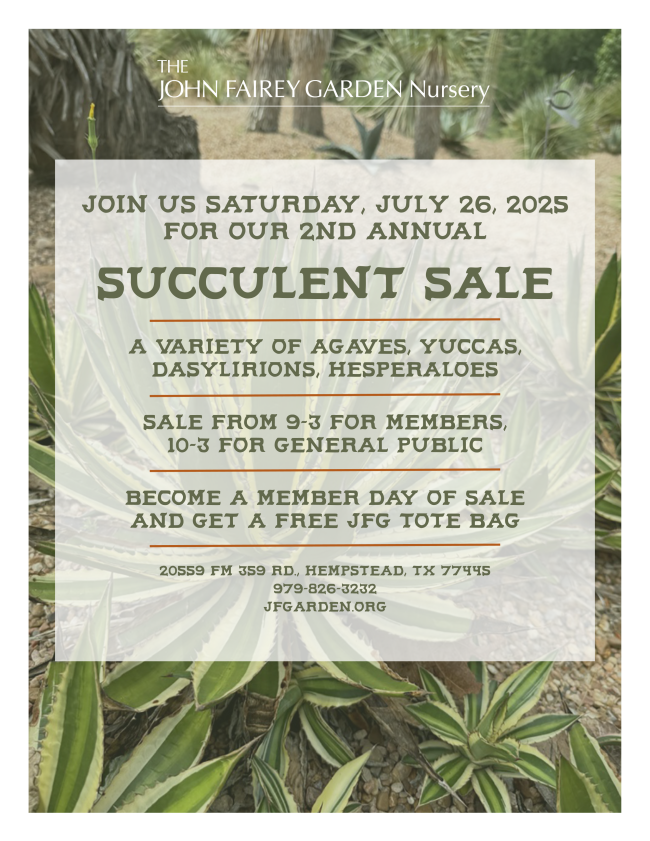
| | SECOND ANNUAL SUMMER SUCCULENT SALE | | We hope you can join us for this sale of selected succulents. As a bonus, become a member that day at the Garden and receive a free JFG tote. | | Notes from John Fairey's Mexico plant collecting journals | | |
Trip #45 - October 7, 1992 - October 14, 1992
Tuesday, October 7, 1992, John, Carl, and Brett Hall (now the California Native Plant Program Director at the UC Santa Cruz Arboretum and Botanical Garden) departed Hempstead, TX for the Sierra Madre Oriental Mountains on a week-long plant collection trip. The trio made 128 collections of seeds from a variety of species at altitudes from 1,000' to 9,400'.
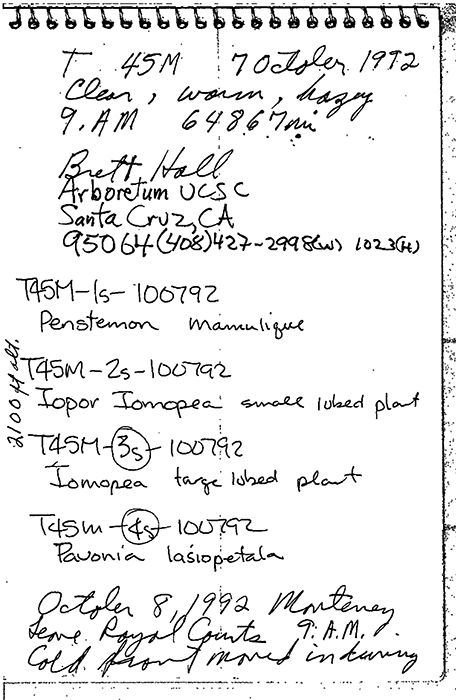
On the second day of the trip, they collected Staphylea pringlei seeds at 3,400' in the San Carlos Mountains. As you can see below, the collection was originally thought to be Litsea parvifolia pringlei. At some point, the entry was crossed out and corrected. Though the seeds were propagated and Staphylea pringlei was planted in the Garden, the plant(s) have not survived.
According to Trees and Shrubs online, a website of the International Dendrology Society, the Mexican species are little known and seldom cultivated. It goes on to say, however, that S. pringlei S. Watson is grown at the University of California Botanical Garden at Berkeley from several collections made in Tamaulipas during the 1990s.
One of those collections was made by John Fairey and Carl Schoenfeld on trip #45.
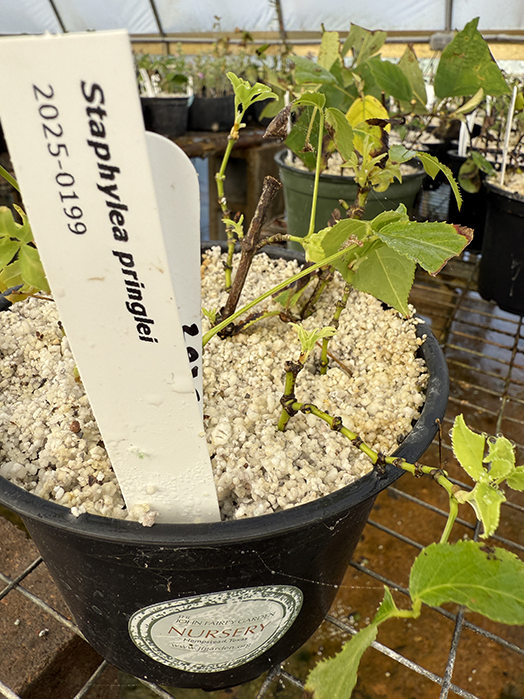
Recently, as you may have read in Wally Wilkin's article above, Wally visited the UC Botanical Garden at Berkeley and was given cuttings from those plants to bring back for propagation and re-entry into our garden, extending a reciprocal relationship that began over thirty years ago.
| | SAVE THE DATE FOR TAKING ROOT | | |
Though it's months away, please take the time to put our twelfth annual Taking Root Luncheon on your calendar for Wednesday, October 22, 2025. This year we're returning to the gorgeous, newly remodeled ballroom at The Junior League of Houston.
Our fabulous Co-Chairs, Cabrina Owsley and Allison Parsley, are already hard at work to help make this our most successful luncheon ever. We're all thrilled this year to be honoring friend of the Garden and visionary, Christopher Knapp. And in keeping with our tradition of compelling speakers, we couldn't be more excited to welcome author and New York Times columnist, Margaret Renkl as our guest speaker.
If you'd like to support the Taking Root Luncheon, you can contribute here.
| | |
The gardener digs in another time, without past or future, beginning or end. A time that does not cleave day with rush hours, lunch breaks, the last bus home. As you walk in the garden you pass into this time – the moment of entering can never be remembered. Around the landscape lies transfigured. Here is the Amen beyond the prayer.
Derek Jarman, Modern Nature
|
| | | |