LinkedIn  Facebook

Real estate investing has always rewarded patience, discipline, and the ability to adjust when the market changes. Interest rates rise. Insurance costs increase. Tenants change. Local markets cool off while others gain momentum. A property that made perfect sense ten years ago may no longer fit an investor’s goals today.


That does not always mean the investor wants out of real estate. More often, it means they want to reposition. That is where a 1031 exchange can be such a powerful planning tool. The real value is flexibility. In a changing market, that flexibility can be the difference between staying stuck in yesterday’s investment and positioning for tomorrow’s opportunity.


The Market Changes. So Should the Strategy.

Many real estate investors start with a property that fits their life and goals at the time. Maybe it is a single-family rental, a small multifamily property, a commercial building, farmland, or a vacation rental. Over time, the property may appreciate, debt may be paid down, rental income may grow, and the investor may build meaningful equity. But the investor’s needs may also change.


Some investors get tired of managing tenants, repairs, leases, and late-night maintenance calls. Others want to move from slower-growth properties into stronger markets. Some want to trade older properties with deferred maintenance for newer properties with better long-term economics. Others want to diversify their equity across several assets instead of relying on one property, one tenant, or one local economy.


A 1031 exchange gives investors a way to make those changes without having the tax consequences of a sale immediately reduce the capital available for the next investment and allowing your equity to keep working for you.

Different 1031 Exchange Structures for Different Investor Goals

Not every investment transition looks the same, and not every 1031 exchange is structured the same way. The right structure depends on the timing, the property, the financing, and the investor’s goals.


The most common structure is the straight 1031 exchange. This is the traditional exchange where the investor sells the relinquished property first and then purchases replacement property afterward. This structure is often used when the investor has a clear sale timeline and enough confidence that suitable replacement property can be found after closing.


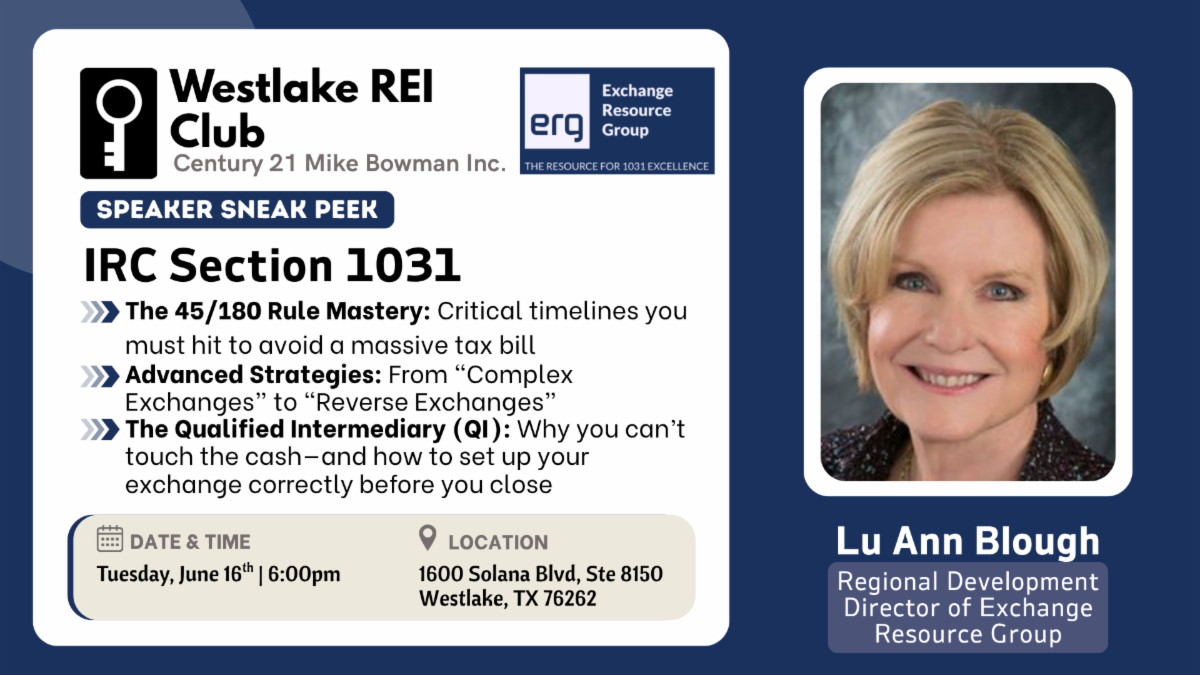
A reverse 1031 exchange is used when the investor needs or wants to acquire the replacement property before selling the old property. This can be especially valuable in competitive markets where a desirable property becomes available before the investor is ready to sell. It can also be a valuable tool when the market slows, and investors want to take their time finding the right deal. They can secure the new property and then utilize the next 180 days to sell their old property.


An improvement exchange allows an investor to use exchange funds to improve replacement property before the exchange is completed. This can be useful when the replacement property needs renovations, tenant improvements, buildout, or other upgrades in order to meet the investor’s needs.


A construction exchange is similar in concept but is often used when the investor is acquiring land or property that requires more significant construction.

One of the strengths of a 1031 exchange is that it supports most tried and true traditional real estate investing principles. In fact, it often works best when paired with the old, proven strategies that have built wealth for generations.


For example, many investors use 1031 exchanges to follow the classic “trade up” strategy. They may sell a smaller rental property and exchange into a larger multifamily property, a better-located commercial building, or a property with stronger income potential. Others use exchanges to consolidate. An investor who owns several scattered rentals may decide that the management burden is no longer worth it. Through a 1031 exchange, they may sell multiple properties and acquire one larger property that is easier to manage, professionally managed, or better aligned with their long-term goals. The opposite strategy can also work. An investor who owns one large property may use a 1031 exchange to diversify into multiple replacement properties.


1031 exchanges also fit well with long-term buy-and-hold investing. Investors who have held properties for years often have significant appreciation and depreciation recapture exposure. A taxable sale could create a large tax bill. An exchange allows them to continue their real estate investment journey while keeping more equity invested.

Adapting to Newer Real Estate Investment Models

While traditional real estate strategies remain important, the investment landscape continues to evolve. Investors today have more choices than ever, and 1031 exchanges can often be used to reposition into newer or more specialized real estate models.


Some investors are moving from hands-on rental ownership into more passive structures, such as Delaware Statutory Trusts, commonly known as DSTs. Others are looking at short-term rentals, vacation rentals, or properties in destination markets. These investments may offer a blend of rental income potential and long-term appreciation, although they require careful planning, especially where personal use is involved. A 1031 exchange can help investors move from one type of rental property into another, provided the replacement property is held for investment or business use and the exchange is structured properly.


Industrial, storage, medical office, mixed-use, build-to-rent communities, and specialized housing models have also drawn increased investor attention. As market conditions shift, some investors may want to move away from one property class and into another that better reflects current demand, demographics, or income trends.

The point is not that one strategy is right for every investor. The point is that 1031 exchanges can give investors options.

Repositioning Is About More Than Avoiding Taxes

It is easy to think of a 1031 exchange only in terms of tax deferral. That is certainly one of its major benefits. But the better way to think about it is this: a 1031 exchange can help investors preserve momentum.


Taxes can create friction. When an investor faces a large taxable gain, they may hesitate to sell, even when the property no longer fits their goals. They may hold onto an underperforming asset simply because the tax cost of selling feels too high. A 1031 exchange can reduce that friction and allow the investor to make decisions based more on investment strategy and less on tax pressure.


That can be especially important in uncertain markets. When conditions are changing, investors need the ability to adjust. They may need to move into stronger cash flow, reduce management headaches, reposition debt, change geography, or align their portfolio with a new stage of life.


Planning Is the Key

At Exchange Resource Group, we help investors think through these options and structure exchanges that fit their investment goals. Whether the goal is to trade up, diversify, consolidate, move into a passive model, improve a replacement property, or secure a new opportunity before selling the old one, the right exchange structure can make a meaningful difference.


Real estate markets will continue to change. Investor goals will continue to evolve. The good news is that a 1031 exchange can help investors move with the market instead of being trapped by it.


When used thoughtfully, a 1031 exchange is more than a tax-deferral tool. It is a way to reposition, adapt, and keep building wealth through real estate.

Exchange Resource Group, LLC

(303) 789-1031 • Info@erg1031.com

www.ERG1031.com

Contact:

Lu An Blough

Luann@erg1031.com

Exchange Resource Group | (303) 789-1031 | info@erg1031.com | erg1031.com