|
Product Stewardship Updates
May 29, 2026
| | CALRECYCLE APPROVES SB 54 REGULATIONS | | |
On May 1, 2026, California's Office of Administrative Law approved the permanent regulations for the state's packaging EPR law, SB 54, completing a three-year rulemaking process following a gubernatorial directive in early 2025 and withdrew a revised set of draft rules in January 2026 before the current regulations were approved. The final rules outline how producers must comply with SB54, including reducing single-use plastic packaging, improving recyclability and compostability, and funding recycling infrastructure statewide. By 2032, SB 54 aims to reduce covered plastic packaging by 25%, make all covered materials recyclable or compostable, and raise the recycling rate for single-use packaging and food service products to 65%.
With regulations now in effect, producers face a June 1 deadline to register with Circular Action Alliance (CAA) and submit 2023 baseline supply data, register with CalRecycle as an independent reporting entity, or apply for the small producer exemption. CalRecycle estimates the regulations will apply to more than 5,700 producers selling covered materials into California. CAA is expected to submit its California program plan in June 2026. Full program implementation is scheduled to start January 2027. Read more in the blog.
| | OREGON DEQ APPROVES RESPONSIBLE END MARKETS AMENDMENTS | The Oregon Department of Environmental Quality (DEQ) has approved a program plan amendment submitted by Circular Action Alliance (CAA) that strengthens requirements for Responsible End Markets (REM) under the state’s Recycling Modernization Act. The updated version outlines a benchmarking process for third-party end market certifications and PRO verifications, adjustments to performance criteria, and improving public understanding and participation in the program. This change reflects ongoing implementation of the state’s EPR framework for packaging and was developed through stakeholder engagement and public input. CAA is seeking to develop a harmonized, third-party verification system for REMs across multiple states with packaging EPR programs. The draft standard is open for public comment on the CAA website through July 7. | JULY 1 DEADLINE TO REGISTER WITH LANDBELL USA | |
With the passage of California’s SB 707, the textile industry is facing a significant regulatory shift as the state implements the nation’s first textile EPR program. This legislation mandates that all obligated producers, including manufacturers, importers, and retailers, register with the designated Producer Responsibility Organization (PRO), Landbell USA, by the statutory deadline of July 1, 2026. This registration is a critical requirement for maintaining compliance and avoiding fines.
To assist companies in navigating these new requirements, Landbell USA has partnered with the EPR experts at H2 Compliance to produce a Q&A interview that addresses the most pressing questions regarding the program's status. The session provides background on determining producer obligation, managing the initial $1,000 registration fee, and preparing for the upcoming 2027 Needs Assessment. This collaboration provides a clear roadmap for businesses to align their operations with California’s evolving environmental standards. Further questions can be directed to landbellusa.support@landbellgroup.com.
| PAINTCARE SHARES SUCCESS STORIES OF EXPANSION TO ILLINOIS AND MARYLAND | |
PaintCare recently introduced two new statewide paint stewardship programs-in Illinois and Maryland-that make paint recycling convenient for households and businesses. With the addition of these programs, PaintCare now offers paint recycling opportunities to about one third of the U.S. population across 13 jurisdictions.
The Illinois PaintCare program launched on December 1, 2025, and the Maryland PaintCare program launched on April 1, 2026. The implementation process includes building close relationships with state oversight agencies and local government and private sector partners to create a program plan and determine how the program will serve those in the state. PSI partnered with the American Coatings Association to advocate for passage of both laws, as well as partnering on the consensus-based process that led to the model bill on which these two laws are based.
In over 15 years of operation, PaintCare has collected an estimated 90 million gallons of leftover paint for recycling or safe disposal. Households are encouraged to use PaintCare’s network of over 3,000 drop-off sites across all program states to recycle leftover paint for free. Most drop-off sites are located within 15 miles of households, making it easier than ever to recycle. Find a drop-off site near you.
| EPA RELEASES NEW BEST PRACTICES FOR BATTERY COLLECTION AND RECYCLING PROGRAMS | | |
The U.S. EPA released new best practices guidance for battery collection and recycling programs focused on improving safety, reducing fire risks, and increasing consumer awareness. The report fulfils a congressional mandate under the 2021 Bipartisan infrastructure law (BIL), which also requires EPR framework is identified in the report as a next step, but that work is already underway.
Meanwhile, states have not waited for federal leadership on a battery EPR framework. Since 2020, legislatures in 10 states and the District of Columbiahave enacted new battery EPR laws, while California, New York, Vermont, and D.C. have expanded existing ones. This year alone, 11 more statesintroduced bills, including in states that typically take a voluntary approach to recycling, underscoring the broad and growing appeal of EPR as a solution for battery safety and recycling. The laws reach an ever-widening range of battery chemistries, sizes, and uses, with a dual focus on fire prevention and recovery of critical metals that power a high-tech economy.
Fire risk has emerged as the most significant driver of legislative momentum. The National Institute of Standards and Technology (NIST) estimates there have been approximately 198,000 lithium-ion battery fires in structures since 2011, and the resulting damage and insurance costs are increasingly hitting businesses. “Producers have a major responsibility for putting safe products on the market, but also to pay for and manage those products at the end of life,” said Scott Cassel, PSI’s CEO and founder in a recent Investigative TV video and article. Battery EPR laws require the industry — through its producer responsibility organization — The Battery Network — to fund collection infrastructure, consumer education, and recycling. That's why PSI advocates for including embedded batteries and damaged or defective batteries within the battery EPR program scope.
PSI members interested in joining PSI’s national battery policy working group should contact Hanz Atia, senior associate for policy and programs.
| |
-
Hidden Heat: Battery disposal gaps keep fueling fires as states consider who should foot the bill | Investigate TV (video and article), May 2026 – ScottCassel, PSI CEO / Founder speaks on battery EPR and the role it plays in addressing battery fires. “Some of these laws have been in place only for maybe 5 years or so, and so the data are just coming out, but I can tell you that, yes, there’s significant increases of recycling with these systems in place, and the government taxpayer savings are very large,”
-
Vermont takes the lead on first household hazardous waste EPR plan in U.S. | Waste Dive, May 2026 – Scott Casel, PSI CEO / Founder notes that many early electronics programs started without a PRO, but that as EPR trends change, producers should expect that more states will pass EPR legislation, and this is an opportunity to “get a model and develop an efficient, effective operation moving forward so it’s the least cost to the industry.”
-
Can EPR & Single-Serve Beverage Packaging Coexist? | Packaging Digest, March 2026 - Darla Arians, PSI Director of Policy and Programs, speaks to the role that EPR fees play in disincentivizing materials that are not recyclable and rewarding use of materials that have responsible recycling end markets.
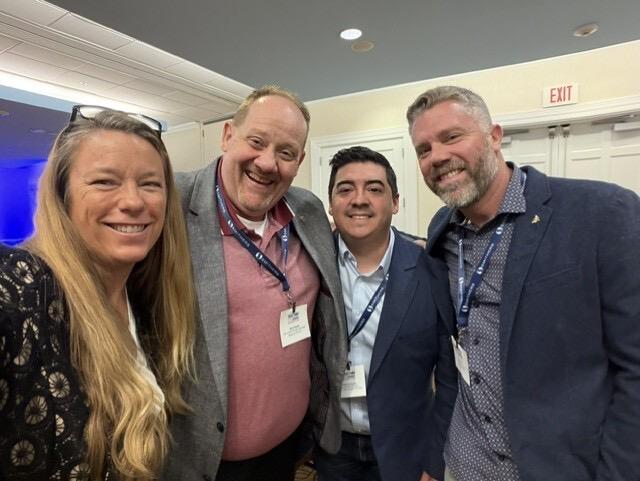
| | Pictured: Darla Arians (PSI), with Gary Ruede, Ismael Quintanilla, and Ted Reid (Discount Tire) | | Darla Arians, Director of Policy & Programs, presented at the Traction Summit in Charleston, South Carolina, the tire and rubber industry’s leading annual conference. Her presentation, "Extended Producer Responsibility for Tires," introduced EPR concepts, covering how EPR works, lessons from Europe and Canada where tire EPR programs have achieved high recovery rates, and the current U.S. tire EPR landscape. Darla shared key data that is driving interest in tire EPR, including the fact that more than 264 million tires are discarded in the U.S. each year, with a third burned as tire-derived fuel. She also discussed how producer-funded stewardship programs compare to consumer fee-based programs operating in 35 states, and shared lessons from Connecticut's 2023 tire EPR law. Growing momentum is evident: five states introduced seven tire EPR bills in the 2025–2026 legislative session. | | |
Product Stewardship Institute – Communications and Marketing Manager
The Product Stewardship Institute (PSI) seeks an experienced, ambitious, collaborative, and organized communications expert to join our dedicated team. The ideal candidate will have a well-rounded skill set and a passion for waste reduction, reuse, and recycling policy, with a talent for storytelling. This is an excellent opportunity to work in the rapidly growing field of EPR and to be part of a fast-paced organization that has been at the forefront of the U.S. EPR movement for 25 years. Learn more at https://productstewardship.us/careers/
|
| |
FREE WEBINAR: PaintCare Program Implementation: Case studies from Illinois and Maryland | Virtual
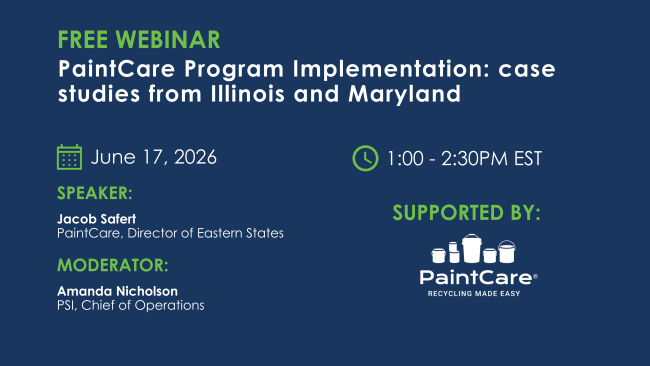
Join Jacob Saffert, PaintCare’s Director of Eastern States, on Tuesday, June 17 at 1pm ET to learn everything you always wanted to know about how PaintCare launches a program using model legislation in each new state. There will be a baseline overview of the history and structure of the PaintCare program, followed by an in-depth dive into the nuts and bolts of program development, launch, and year-1 implementation. This deep dive into the PaintCare program will feature recent case studies from the launch of the PaintCare program in Illinois in December 2025 and in Maryland in April 2026. There will be ample time for questions and discussion during this event moderated by Amanda Nicholson, PSI Chief of Operations. Register
| | |
Packaging Recycling Summit
Join Darla Arians, Director for Policy and Programs at PSI, at The Packaging Recycling Summit in Chicago this June for practical insights into packaging EPR programs. The Summit unites CPG brands, materials suppliers, reprocessors, MRFs, retailers, and policymakers to explore real-world solutions for advancing packaging recovery and circularity.
Details:
June 15-17
The Loews Chicago O’Hare
Rosemont, IL
Register
SWANA RCon 2026: Where Waste & Resource Management Professionals Go To Think | In-Person
SWANA RCon 2026 is the premier annual gathering of waste and resource management professionals where leaders come together for technical training, keynote and concurrent sessions, roundtable discussions, and networking to advance “waste as a resource.” Join PSI’s policy staff in September for sessions on batteries, vapes, and EPR.
Details:
September 29-October 2
St. Louis, MO
Register
| | (StudioThreeDots / Canva Teams) | |
-
CAA seeks to standardize responsible end market requirements. The Circular Action Alliance is developing standardized responsible end-market requirements to create more consistent and transparent material management practices across EPR programs Read more
-
Minnesota launches first boat wrap recycling program. The Commercial and Industrial Flexible Film Recycling Organization (CIFFRO) - the producer responsibility organization for Minnesota’s first-in-the-nation EPR program for boat wrap - is now recycling boat wrap with collection sites throughout the state. Read more
-
US Plastics Pact pushes for compostables in EPR laws, food waste mandates. A new report form the U.S. Plastics Pact report highlights ongoing infrastructure and labeling challenges for compostable packaging. Read more
-
NJ qualifies PureCycle PP for minimum PCR law. New Jersey regulators approved PureCycle’s recycled polypropylene resin for use in meeting the state’s post-consumer recycled content requirements, expanding compliance pathways for manufacturers. Read more
-
Electronics are the fire risk battery EPR keeps missing. Industry leaders wan that battery EPR laws continue to overlook embedded batteries in electronics despite growing fire risks. Read more
-
EPA pitches Congress on best practices for recycling batteries. U.S. EPA submitted a report to Congress offering best practices that can be implemented by state, Tribal, and local governments for safe, environmentally sound, and technically and financially feasible battery collection and recycling. Read more
-
Iowa City Landfill now offering safe vape disposal, citing dangers from improperly trashed e-cigarettes. An Iowa City landfill launches a vape disposal program to reduce fires caused by improperly discarded lithium-ion batteries. Read more
-
Houston expands multifamily recycling pilot. Houston and The Recycling Partnership launched a pilot program to expand recycling access at multifamily properties. Read more
-
Recycling access for paper cups hits 20% of U.S. Paper cup recycling access has expanded to approximately 20% of U.S. households, according to a new industry report. Read more.
-
Clean Earth e-waste processing site in Texas can now recycle solar panels. A Texas e-waste facility can now recycle solar panels, expanding end-of-life management capacity for renewable energy materials. Read more.
| | |
The Product Stewardship Institute is a policy expert and consulting nonprofit that pioneered product stewardship in the United States. Since 2000, PSI has helped enact 150 extended producer responsibility (EPR) laws across 22 product categories in 34 states and the District of Columbia — the bedrock on which the circular economy is built. We work with businesses, nonprofits, academia, and governments to ensure that products are responsibly managed from design to end of life.
Join us at www.productstewardship.us.
| | |
The Product Stewardship Institute, Inc. is an equal opportunity employer and provider. Persons with disabilities who require alternatively formatted materials to ensure effective communication should contact Amanda Nicholson at info@productstewardship.us or 617.236.4855.
| | | | |