|
Monthly newsletter from the City of Chula Vista
Sustainability Division
| | 2025 Sustainability Champion Awards Announced | | |
The City of Chula Vista’s Sustainability Commission sponsors the annual Sustainability Champion Awards, which recognize individuals and groups who are helping to achieve clean air, water and land for future generations within Chula Vista. The nomination period ran from mid-January through the end of March and the Sustainability Commission recently selected the final award recipients. These sustainability heroes will be recognized for their efforts in making Chula Vista more sustainable at the May 13 City Council meeting.
The 2025 winners include:
- Community Contributor – tie: Lesley Gallegos-Stearns AND Zero Waste San Diego
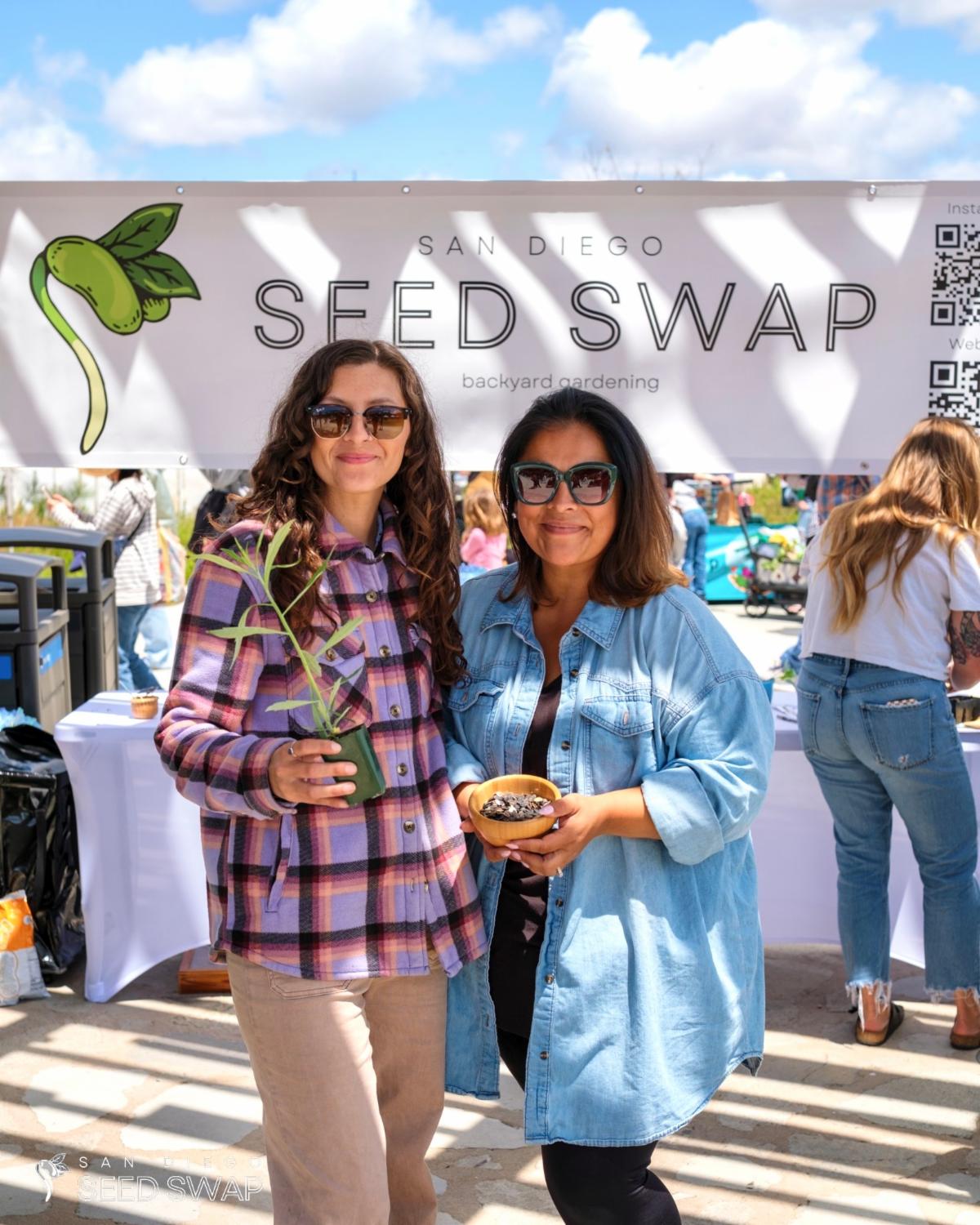
- Organization – San Diego Seed Swap
- City Employee – Lieutenant Rusty Rea, Police Department
- Resident – Nichole Torga Natividad
- Educator – Tynia Ayers
- Student – tie: Richard Manguid and Brian Manguid; AND Jocelyn Bracamontes
By celebrating local sustainability champions, the Sustainability Commission hopes to inspire others to make eco-friendly choices in their everyday actions. Congratulations champions!
| |
SANDAG Bike Anywhere Day 2025 is Thursday, May 15!
SANDAG Bike Anywhere Day is back! Join thousands and ride your bike to work, school, the beach, or anywhere in the San Diego region on Thursday, May 15. Be sure to pedal to one of the 100 pit stops between 6:30 AM and 9:30 AM.
The City of Chula Vista’s Sustainability team will be hosting a pit stop on the corner of Bay Blvd. and E St. Staff members will be present to educate cyclists on the city’s Sustainability's resources and programs. In addition to City staff, community partners including Living Coast Discovery Center, Collins Aerospace, South Bay Sustainable Communities and Circulate San Diego will join with their own tables and will provide refreshments and giveaways!
Eligible registrants will be automatically entered into the Bike Anywhere Day Sweepstakes for a chance to win one of three e-bikes. Learn more and register at SANDAG.org/bikeday. (para español, visite SANDAG.org/diadelabici).
| | International Compost Awareness Week | | |
Last month we talked about how compost is the stabilized product of an aerobic biological process and adding it to your garden will deliver a whole host of benefits.
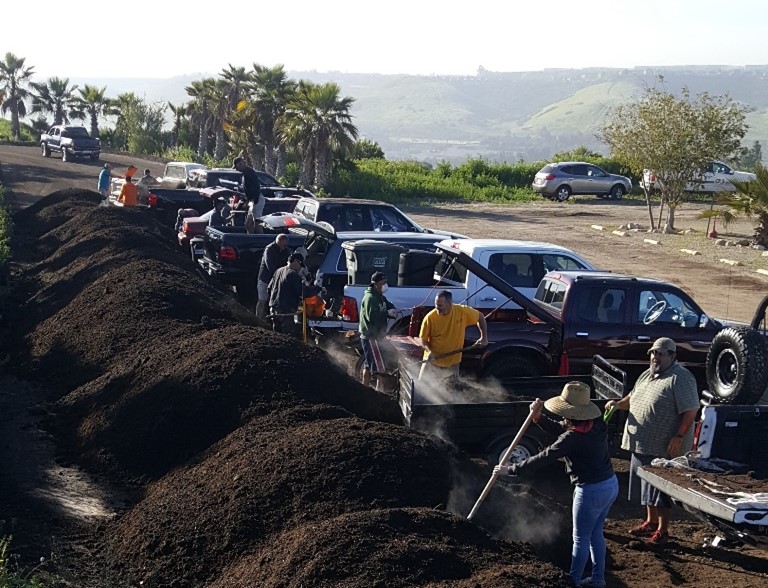
In the US and internationally, compost is celebrated the first full week of May during International Compost Awareness Week (ICAW). As the largest and most comprehensive education initiative of the compost industry, the goal of ICAW is to raise public awareness on why we all should be composting our organics and using compost to create healthier soil. Although this year’s celebration has passed, you can still add compost to your planters, grass and garden any time of the year. Our next free compost giveaway for residents is July 12 from 8 AM – 12:00 PM at the Otay Sustainability Park at 1700 Maxwell Road. Mark your calendars and remember to bring your shovels to load, containers to fill and tarps to cover your load.
Keep in mind, non-organic materials such as rocks, cigarette butts, metal, plastics and ceramics are not accepted in your food and yard waste cart! These items do not break down and therefore contaminate the compost.
Free compost events will take place rain or shine! For more information go to www.chulavistaca.gov/sustainability and click on the “Home Composting” link.
| | City Recognized by U.S. Department of Energy in Better Climate Challenge | | |
The U.S. spends more than $800 billion each year to power buildings, industrial plants and homes and on average, 20-30% of that energy is wasted. By reducing this waste, building owners can save money and reduce greenhouse gas (GHG) emissions. In 2022 the U.S. Department of Energy (DOE) created the Better Climate Challenge to accelerate investment in energy efficiency and emission reduction approaches throughout the commercial, public, industrial and residential sectors. In 2022, the City joined the DOE’s Better Climate Challenge and made a voluntary goal of reducing GHG emissions in municipal operations by 50% by 2032. Remarkably, by the end of 2022, the City surpassed this goal and reduced GHG emissions by 64% from the 2018 baseline year!
How did we do it? In support of the City Council adopted Climate Action Plan goal of procuring 100% renewable electricity by 2035, the City joined other local agencies to create San Diego Community Power (SDCP), a community choice energy program which provides electricity for its customers and allows more options in the amount of renewable energy that can be delivered. The City enrolled all municipal electricity accounts in the Power100 renewable electricity product from SDCP and the first full year of procuring this electricity was 2022. The City also saw a large reduction in fleet GHG emissions due to the switch from 20% biodiesel to 100% renewable diesel and the increase in electric fleet vehicles. The City also has solar installations at over 20 municipal locations.
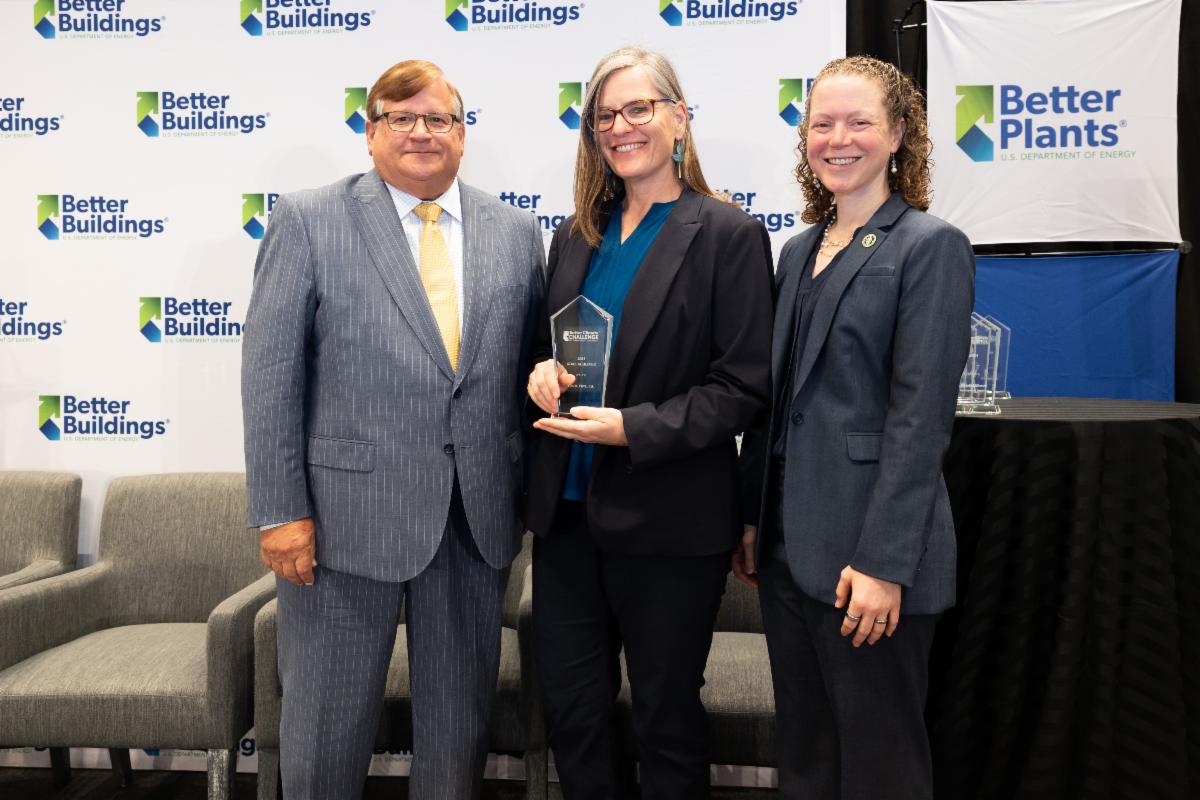
The City was recently recognized by the U.S. Department of Energy as a goal achiever in the Better Climate Challenge and received an award as the first public sector agency in the nationwide program to achieve this goal. Environmental Sustainably Manager, Coleen Wisniewski, accepted the award on behalf of the City. She was also a presenter during a session titled “Go for the Goal: Learning from the Latest Goal Achievers” alongside representatives from large manufacturing and real estate companies and moderated by Maria Vargas, Director of the Better Buildings Initiative. To learn more about the Better Climate Challenge or see other goal achievers, check out the Better Climate Challenge website.
| | |
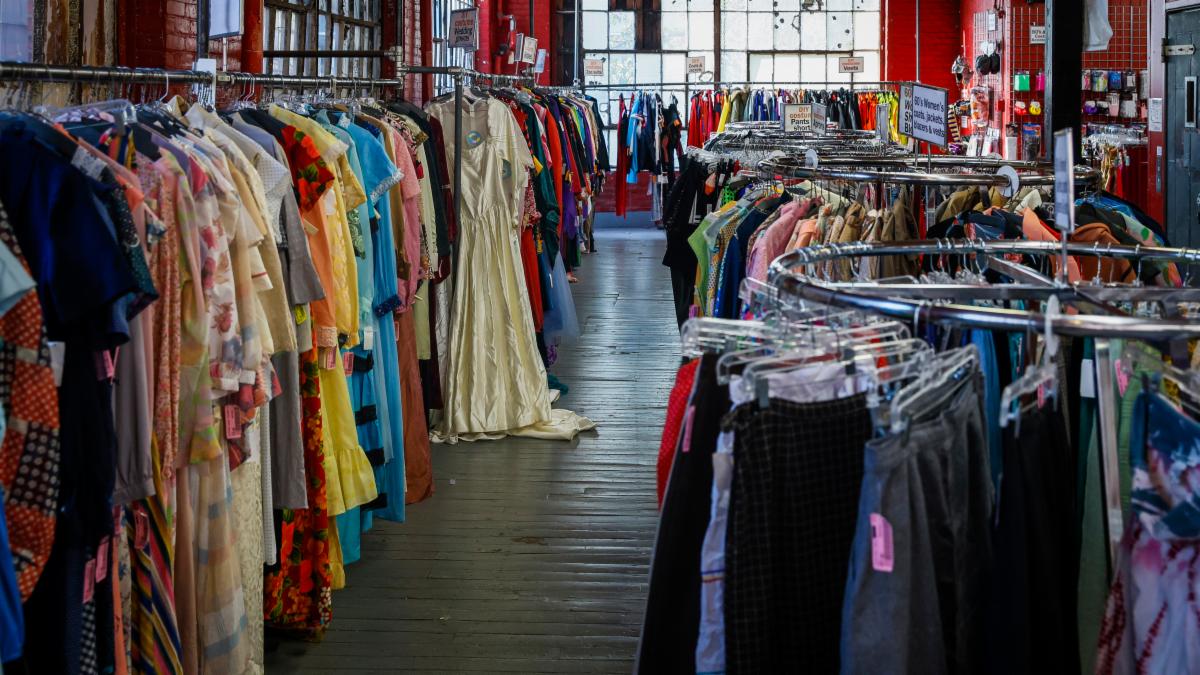
Fashion is a part of all of us. We grow up exploring different styles, finding our favorite looks and discovering trends that connect with our self-expression. When it comes to the fashion industry itself there are two key business models: fast and slow fashion. Fast fashion is a form of textile manufacturing that prioritizes speed and profit over care for the environment, as well as everyone in it. The decisions made under this model are ones that directly harm our ecosystems, through methods such as toxic water waste, microplastic production and excessive energy usage.
Fast fashion has many appeals to a consumer, as it offers trending clothing for a fraction of the cost; yet with cheap clothing development comes lower quality products. Common materials in such products are polyester and nylon, which are not biodegradable, meaning that they do not decompose in nature. As a result, many fast fashion items eventually end up sitting in landfills continuing to damage the ecosystem.
When looking to combat fast fashion it is crucial to look at the entire process. Circularity, the adoption of a closed-loop system where sustainability is incorporated from the development to the disposal or reuse of products, is crucial. Investing in materials that are not only better for the environment during the production process but also are biodegradable or easier to repurpose is an important role that we as consumers can play. Sometimes it can feel as though all impacts that the fashion industry has on the environment are solely up to the companies involved, but that is not the case.
As consumers, there are various habits and resources we can use, including:
- Start by appreciating the clothing you already own by using what is in your closet. This prevents the addition of more waste, as well as decreases the demand for the development of new clothing from manufacturers.
- Participate in second-hand shopping or trading with your family or friends.
- Upcycle clothing that you are not using anymore into pieces that you will love again.
- Shop from slow fashion brands, who adopt environmentally friendly mechanisms.
| |
High Tech High Interns Collaborating with Environmental Services
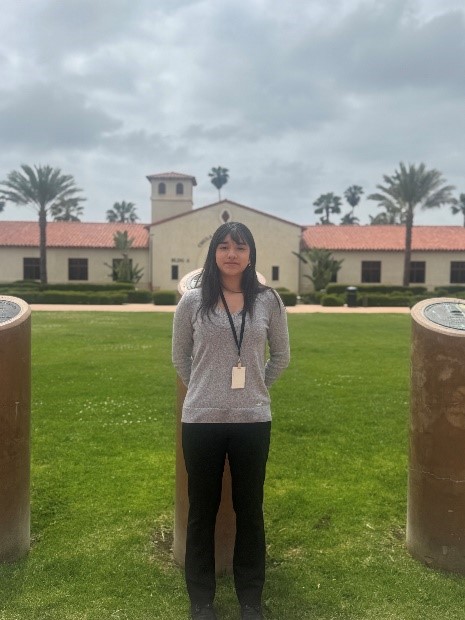
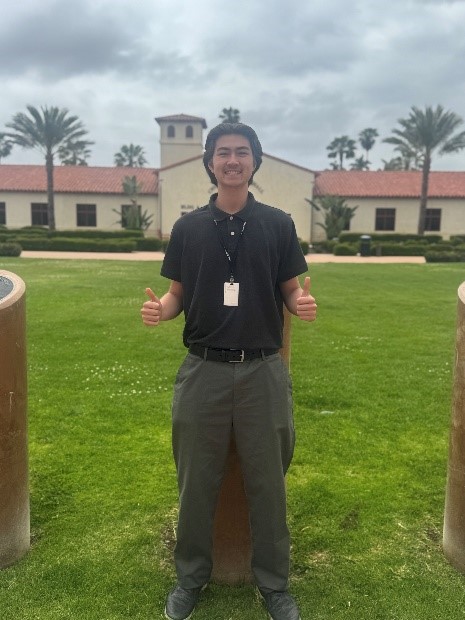
Environmental Services is proud to host two student interns from High Tech High for the month of May. These students will be working on a project that promotes Zero Waste initiatives on the High Tech High Chula Vista Campus. Read more about who they are and what sustainability means to them.
| |
 | | Hi, my name is Charlie Bustamante and I am currently interning for the Office of Sustainability. As a Junior from High Tech High Chula Vista, I am very interested in engaging with the community and finding solutions to social issues. I’ve learned a lot from my school’s projects which encourage collaboration and take an intersectional approach that fosters empathy and understanding for diverse perspectives. The incentive-based resources also inspire motivation and offer unique opportunities. My future plans are being led with the knowledge that I love helping people and I wish to dive more into social work. I’m very interested in social justice and have developed a huge curiosity for the environment and the climate crisis. From my viewpoint, sustainability is all about maintaining balance and using our resources to protect and preserve the environment. I believe that there is a lot we can accomplish if we focus specifically on youth and getting them to participate, increase involvement and become educated on sustainability. It’s important to teach them why it’s important to help the environment and what they can do within their community or at home to contribute to a positive change. As the saying goes, children are our future, so when we show them that they have the power and potential to make a difference, we invest in a healthier environment and a stronger society.
| |
| | | Hello! My name is Jack A. Smart, I'm 17 years old and go to High Tech High Chula Vista. I spend most of my free time playing games, cooking and hanging out with my friends and family. My favorite movie is Django Unchained, my favorite food is Pho noodles and my favorite time is bedtime. I am interested in anything to do with plants, as I want to start a garden and eventually a farm. I hope to go to UC Davis and study soil science to become a soil scientist. I also hope to use my gardening and science knowledge to start a plant-based business in the future. Besides these plans, my main overarching goal in life is to become completely self-sustainable. Sustainability to me is a few things. First, it’s respect for the world and the resources it expends to keep me happy and healthy. Next, its obligation, as I realize this world will far outlive me and it is my responsibility as one of its inhabitants to leave it a better place compared to when I arrived. Finally, it's selflessness, of doing something not because you want to or because it's easy, but because it's the right thing to do for the betterment of not just yourself but of everyone. For me, sustainability is a step in the long trek of becoming a valuable, contributing member of society.
| | Energy Bill Assistance Programs from SDG&E | | |
Managing energy bills can be challenging. But did you know that SDG&E offers several assistance programs to help customers reduce their energy costs and improve energy efficiency?
1. California Alternate Rates for Energy (CARE) Program
The CARE program provides a 30% or more discount on monthly energy bills for eligible households. Eligibility is based on household size and income, or participation in certain public assistance programs. Applying is quick and easy, with no documentation required. Find out if you qualify at sdge.com/CARE.
2. Family Electric Rate Assistance (FERA) Program
FERA offers an 18% discount on electric bills for households with three or more people who exceed CARE income limits but still meet FERA guidelines. This program helps larger families manage their energy expenses more effectively. Learn more at sdge.com/FERA.
3. Energy Savings Assistance (ESA) Program
The ESA program provides no-cost energy-efficient home improvements to income-qualified customers. Services and products may include attic insulation, energy-efficient refrigerators, weatherstripping and more. The program aims to reduce energy use and help lower bills. Find details at sdge.com/ESA.
4. Medical Baseline Allowance
Customers with certain medical conditions may qualify for additional energy at the lowest rates through the Medical Baseline Allowance program. This helps offset the cost of operating medical equipment or maintaining necessary heating and cooling. Learn more at sdge.com/Medical.
5. Payment Arrangements
If you’re having trouble paying your energy bill, you can request an extension to help avoid interruptions to your service. Flexible payment arrangements are also available to help you pay down past due balances. Learn more at sdge.com/PaymentArrangements.
Learn about these programs and more at sdge.com/assistance.
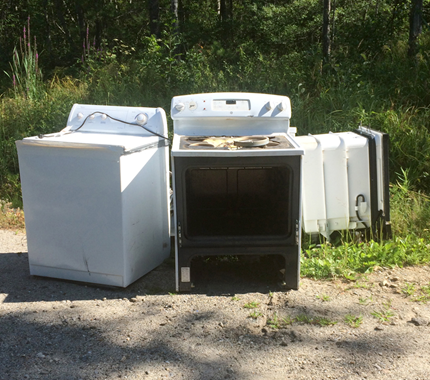
| | Disposing of Furniture, Stoves and Fridges is Easy Through the FREE Bulky-Item Program | | |
On occasion you might see a random sofa, refrigerator or bookcase sitting in front of a house, a street or an alley for a long time, which can detract from the overall appearance and cleanliness of the area.
The cause might be that people opt to drop them off with hopes that “someone” will pick them up, they don’t know how to properly dispose of these bulky items, or they think it will be costly for a special collection. Good news - you can dispose of these large items at your curb and the service is available at no additional cost.
The process is easy! Single-family home residents just need to either visit the Republic Services website or call (619) 421-9400 at least 24 hours before your service day (recycling/trash collection). Up to 10 bulky items can be picked up.
Apartment/Condos:
Apartment managers or homeowner association representatives may also schedule FREE collection of bulky items by also visiting the Republic Services website or calling (619) 421-9400. Please contact your complex representative to inquire and remember, this service is also provided at no additional cost.
Bulky items include:
Washers, dryers, refrigerators, lawn furniture, sofas, recliners, chairs, tables, mattresses, grills, flocked and/or plastic holiday trees, bookcases, and kitchen cabinets.
| |
Energy Benchmarking Deadline Extended to June 30 | |
Attention Chula Vista Building Owners! To comply with the City of Chula Vista Building Energy Saving Ordinance, owners of multi-family, commercial and industrial buildings 20,000 square feet and larger must report their energy use, otherwise known as energy benchmarking, annually on the free Energy Star Portfolio Manager platform. Over time, low-performing buildings will need to perform energy audits and address cost-effective building upgrades.
The deadline to report energy use data has been extended to June 30. Visit www.chulavistaca.gov/benchmark for the reporting link and helpful resources.
For additional questions, please email benchmark@chulavistaca.gov or call (619) 691-5134.
| | |
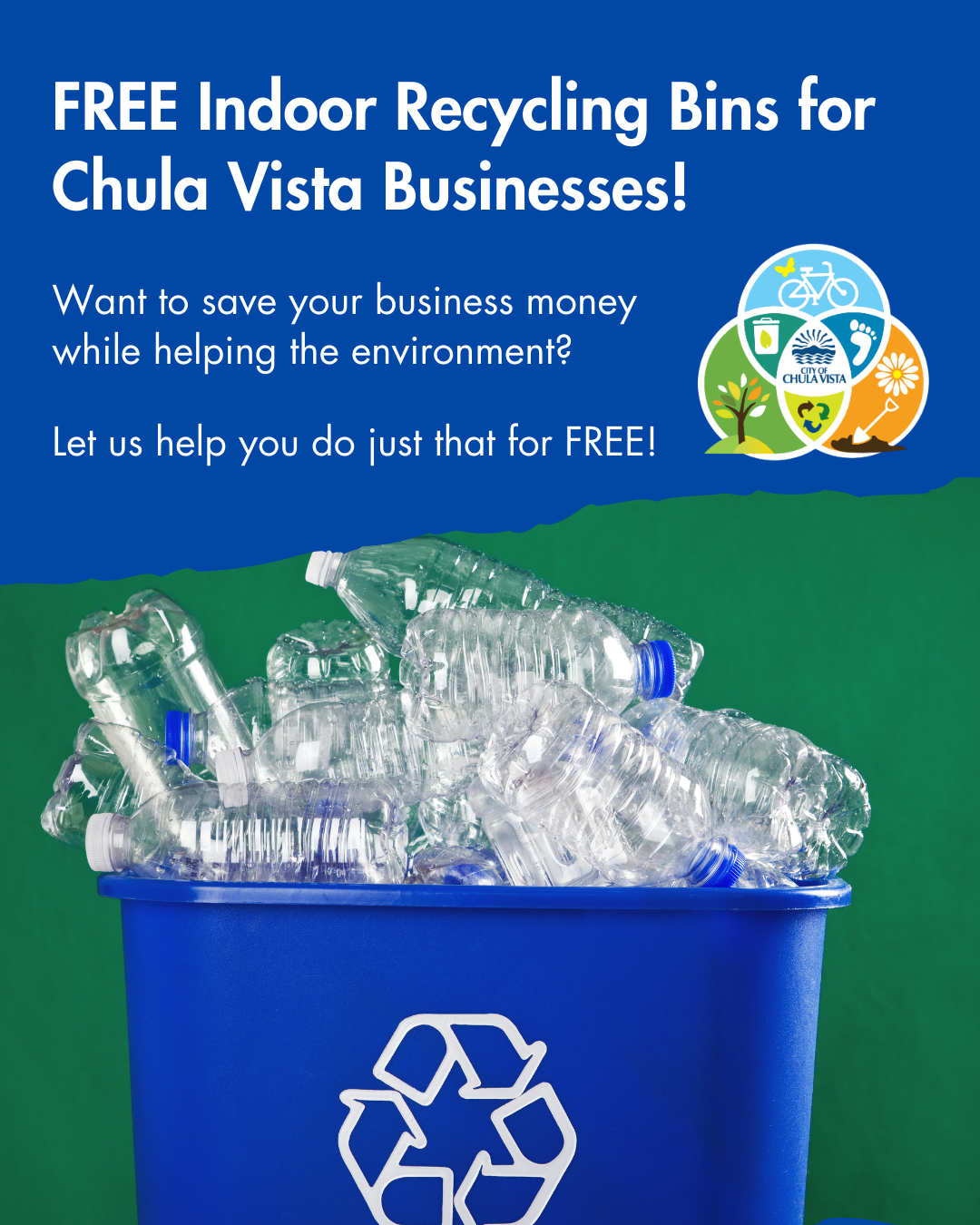
♻️ Chula Vista businesses — get your FREE indoor recycling bins today!
Cut costs, go green, and make an impact 🌱 No fees, no hassle. Just a cleaner future 💚.
Click here to order your containers today! Call us at 619-691-5122 or e-mail environmentalservices@chulavistaca.gov for questions.
| |
State Rebates for Energy Saving Appliances
Sustainable living is a golden state of mind, and every Californian should enjoy the benefits. Golden State Rebates helps by making energy-efficient products and home improvements more affordable and accessible statewide. Golden State instant rebates of up to $900 for efficient heat pump water heaters, $75 for smart thermostats, $90 for room air conditioners are currently available. It’s a simple way to save on solutions that help us all live better and preserve the California we love. To qualify for our instant rebates, you must be a residential customer. You can access the rebate by either downloading a rebate coupon from the Golden State Rebates website to take into the store or, if available, use an in-store coupon. To learn more or apply for rebates, please visit: www.goldenstaterebates.com.
| |
Solana Center Workshop: Food Hacks That Prevent Waste Workshop | | |
On May 14, 2025, from 5:30 PM - 7:00 PM the Solana Center will be hosting a FREE workshop called “Food Hacks That Prevent Waste Workshop” at the Mountain View Community Center (641 S Boundary St. San Diego, CA 92113).
Their knowledgeable speakers will present practical solutions for reducing food waste in your home and discuss how incorporating these practices into your daily life can be a great way to help the environment and save money. You have the power to reduce food waste by making small changes to your daily life and habits.
You’ll also learn:
- Practical and successful methods to prevent food waste in your own kitchen
- How to divert food waste from the landfill
- Tips for buying only what you need, eating what you buy and avoiding throwing away food
- Where and how food is being wasted in the U.S. and around the world
- The social, environmental and economic impacts of food waste
Attendees will also have the chance to win one of two $20 Visa gift cards! To register or learn more about the event visit the Solana Center’s website.
| | Free Household Hazardous Waste Disposal and New Reuse Center | | |
Have you been busy with spring cleaning? Are you looking to declutter some of your old electronics, dead batteries or leftover paint? Do you have unused, new household chemicals that you no longer need? If so, you can bring them to our Household Hazardous Waste facility located at 1800 Maxwell Road, Chula Vista, CA 91911. The facility is open Wednesdays and Saturdays from 9 AM to 1 PM.
If these items are in good shape, we will add them to our reuse center and make them available to other residents. The reuse center allows visitors to reuse these items and do their part to reduce the amount of improperly disposed waste.
If you are interested in acquiring free paint to freshen up portions of your home or to repaint a piece of furniture, please visit our reuse center to view the inventory of available colors and other household chemicals. Inventory is constantly changing, and items are on a first-come, first-served basis.
The reuse center is open to the public on Saturdays from 9:30 a.m. to 12:30 p.m. No appointments are required. You can take up to fifteen (15) gallons of paint and five (5) unrelated items.
For more information visit our Household Hazardous Waste page here. For questions, call 619-691-5122 or e-mail environmentalservices@chulavistaca.gov.
| | Food Waste Has a Surprising Impact on Climate Change | | |
Each year, hundreds of millions of tons of food never make it from the kitchen, grocery shelf or to the table. Instead, they end up in landfills, where rotting lettuce and stale bread emit methane, a greenhouse gas roughly 28 times more powerful than carbon dioxide at trapping heat.
Food waste and climate repercussions
Robert Sanders, an assistant professor of Marketing and Analytics at the University of California San Diego’s Rady School of Management, has spent the last decade examining why so much edible food goes to waste and how policy interventions can bend the curve. In a recent interview, Professor Sanders argued that trimming food waste may be the fastest, most cost‑effective way to curb climate repercussions.
Lawmakers and the public often focus on tailpipes and smokestacks. Sanders points out that the leftovers scraped off dinner plates or the strawberries that spoil in grocery storerooms punch far above their weight. The methane produced as they decompose lingers in the atmosphere for about a decade and delivers an intense burst of warming during that period, making short‑term action on food waste a potent lever for averting near‑term climate tipping points.
“Reducing food waste is pretty much the most actionable measure humanity can take to mitigate greenhouse gas emissions in the short and medium term,” he noted. Yet when Professor Sanders first surveyed academic literature, he found a puzzling gap. Policymakers were proposing rules to standardize expiration date labels, nonprofits were urging composting mandates and states were drafting landfill bans, all based on assumptions that lacked rigorous field evidence. That knowledge vacuum, he said, motivated him to run controlled experiments in real grocery aisles and back‑of‑house storerooms, tracking how shoppers and retailers behave when incentives change.
One headline solution embraced by several U.S. states is the food‑waste landfill ban. In theory, prohibiting retailers from tossing unsold produce or expired milk forces businesses either to donate surplus food, send it to anaerobic digesters or pay composting facilities instead of dumping it. In practice, Sanders’ research, conducted with colleagues at multiple universities, shows uneven results.
“My co-authors and I investigated the efficacy of the first five food-waste bans in the United States, and we found that only one state, Massachusetts, has been successful at diverting food waste away from landfills,” said Professor Sanders. The reason appears twofold: enforcement and infrastructure. Massachusetts imposes clearer, better‑publicized penalties.
Additionally, the state offers businesses a robust network of composting centers willing to accept spoiled goods. Elsewhere, minimal fines and scarce processing facilities make compliance optional. If strict bans are a blunt instrument, Sanders argues that pricing algorithms offer a finer scalpel. Roughly a tenth of all wasted food is chucked by retailers because perishables pass their sell‑by date still sitting on the shelf. Shoppers routinely pay the same sticker price for milk expiring tomorrow as for jugs good for another two weeks, so predictable spoilage is baked into store margins. Sanders’ field studies suggest a market‑based alternative: dynamic markdowns.
| | |
By feeding inventory data, expiration horizons and historical demand into a computer model, a grocery chain can automatically lower prices on soon‑to‑expire yogurt or ground beef several times a day. This nudges bargain‑hunters to snap up aging stock before it goes bad. The benefits compound - less landfill methane, lower operating costs for stores and cheaper staples often fresher and less processed for budget‑conscious customers. “To an economist, it’s actually really weird that grocery stores don’t dynamically price their perishables,” Sanders observed. “Why should you, the consumer, be paying the same price for milk that will expire one week from now as you would for milk expiring three weeks from now? Not only is it unfair, but it’s also inefficient.”
Food waste and the climate change
According to the United Nations, food waste now accounts for up to 10 percent of global greenhouse gas emissions, more than the entire aviation sector. If wasted food were its own nation, it would trail only China and the United States in annual climate pollution.
Momentum is building. Grocery giants in Europe have rolled out dynamic‑discount apps, while startups in the United States pilot real‑time pricing software for deli counters and bakery racks.
Policymakers, however, still debate whether to expand landfill bans or subsidize compost facilities without proof of impact. Professor Sanders believes the fastest progress will come from connecting rigorous field experiments with scalable technology. Only then, he contends, will the world chip away at a problem large enough to rival the emissions of the aviation industry. Until that happens, methane will keep seeping from landfills, one wilted lettuce leaf and one expired gallon of milk at a time. You can take action and make a true difference by learning how you can curb food waste at home or your business, you will find that it is not as difficult as it may appear and once you learn and apply some of the best practices you might even save money.
| | Nature Spotlight: Meet the Fly That Could Help Save the Planet – Black Soldier Fly | | |
Insects have long been used in agricultural practices as a food source but now farmers are exploring the potential of bug waste as a sustainable fertilizer. 33% of the world's soils are currently degraded, diminishing the nutrients necessary for healthy plant growth. Insect dung can play a major role in restoring soil biodiversity and quality.
In May 2024, the US Department of Agriculture (USDA) awarded grants to three projects that seek to harness the black soldier fly's capabilities. This included Chapul Farms, an Oregon-based project development company that's reweaving insects back into American agriculture to eliminate food waste, restore soil health and produce high-quality animal feed. This support of the use of insects in agriculture highlights the growing recognition of black soldier fly potential, for both waste reduction and for enhancing soil health through the production of high-quality domestic fertilizer. But despite the bug's seeming superpowers, the widespread application remains limited.
Black soldier flies can consume nearly any kind of organic waste, from food scraps to agricultural byproducts. Facilities like Chapul Farms utilize their voracious appetite to process large quantities of waste, with the larvae consuming up to four times their own body waste in organic matter every day. This happens in a fraction of the time required for traditional composting, which can take up to 10 months. The larvae's efficiency allows for a rapid turnover of organic material into nutrient-rich dung. The insect can reproduce quickly and grows on dead and decaying material, which means that it can survive on waste.
Chapul Farms also collaborate with neighboring farms to exchange waste for their dung, creating a circular system. It's a mutually beneficial exchange as the farms receive nutrient-rich soil amendment and Chapul receives the fuel for their operation. This is doing something significant for insect populations and helping to repopulate them. This is because insect farming operations create a controlled environment for the bugs to thrive. The dung created from them provides essential nutrients to plants and fosters a more biodiverse soil, which encourages the growth of native plant and insect species, thus supporting the overall ecosystem.
The black soldier fly digestive processes can significantly reduce greenhouse gas emissions.
| | |
The U.S. National Organic Program does not currently include insects as an acceptable soil additive. This makes it a challenge to share this technique with farmers who use organic practices, though teams like Chapul Farms are in conversations with regulators to increase education around it and usher in its inclusion.
Unlike chemical fertilizers, which often deplete soil over time, soldier fly dung promotes biodiversity within the soil by introducing a diverse microbial community. This boosts soil resilience, natural plant defense, improves its ability to retain water and reduces the need for costly synthetic inputs. In sharp contrast, synthetics can wreck soil biodiversity, beneficial bacteria and the soil's natural micro-ecosystem, leaving it dependent on increasingly expensive inputs. They also have intensive fossil-fuel requirements and reduce soil carbon carrying capacity.
The microbes in the dung proliferate over time, rebuilding soil health and this can all contribute to cost savings and be more incentive for farmers, especially at a time when fertilizer prices are sky high, and supply is unreliable. Fertilizer prices more than doubled between 2021 and 2022. The U.S. is the world's third-largest fertilizer importer therefore American farmers felt the brunt of this impact, making this not just a fertilizer issue but also one of food security.
Soil microbes present an exciting frontier for regenerating soil health, yet less than 1% of total microbes in soil have been cultivated. This provides an opportunity to pivot from the reductionist methods of treating soil that perpetuated the soil crisis in the first place, all while bolstering food and agricultural security.
Another benefit is that farmers eventually need less black soldier fly dung to maintain the same levels of soil productivity, as the microbes in soil proliferate over time, rebuilding soil health and resiliency by improving biodiversity. Some farmers who have begun using dung in their fields are already reporting promising results. One of the greatest challenges facing the nascent insect agriculture industry is the tunnel vision around insects for protein production which has overshadowed the benefits in soil health. While protein from black soldier fly is a lucrative and fast-growing market, the dung remains an underutilized resource in insect agriculture.
| |
On Demand Accessible Rides: FREE for 55+ · $2 for Under 55
Need a ride? The Chula Vista Community Shuttle is here for you!
Monday - Friday · 7 AM - 7 PM
Now serving all ages in northwest Chula Vista!
It's Easy:
- Download the CIRCUIT RIDE app.
- Set up your account.
- Share your location and drop a pin where you want to go.
Whether you need to get an appointment, visit family and friends, catch the trolley, or grab lunch or happy hour after work in northwest Chula Vista, leave it to us.
To learn more about this service visit the Chula Vista Community Shuttle website.
| | | | |