2025 Water for Food Global Conference focused on resiliency in water and food security | |
“Anyone working in irrigation has the power to help move the needle on nutrition,” said Claudia Ringer, Ph.D., director of natural resources and resilience at the International Food Policy Research Institute. Her keynote address offered a compelling exploration of the often-overlooked connection between irrigation and nutrition.
Ringler was one of over 100 expert speakers participating in the week-long 2025 Water for Food Global Conference held in Lincoln, Neb. April 28 to May 2, 2025.
More than 350 attendees from 23 different countries came together to tackle the critical challenge of ensuring a resilient future with water and food security for all. Hosted by the Daugherty Water for Food Global Institute at the University of Nebraska, the conference focused on sharing innovative solutions, research, and technologies and addressed the challenge of producing sufficient food while preserving vital water resources. Participants included a diverse range of stakeholders, spanning academia, government agencies, policymaking groups, entrepreneurs, water managers, growers, students, non-profits, non-governmental organizations, and the private sector.
"The conference provided a crucial platform to collaborate and share knowledge on sustainable water management and agricultural practices," said Peter G. McCornick, Ph.D., executive director of the Daugherty Water for Food Global Institute. "The insights and connections forged here will be instrumental in developing effective strategies and continuing our collective work to ensure a food-secure future for generations to come."
Key highlights of the conference included sessions on:
- Cutting-edge research to improve water use efficiency in agriculture
- Case studies showcasing successful implementation of sustainable farming practices
- Supporting, financing and scaling smallholder irrigation
- Drought, water and human health
- Training the next generation of food and water experts
- Framing the conversation surrounding water and food at future, high-level international meetings
- Policy frameworks to promote responsible water management
The conference emphasized the importance of collaboration among various sectors to achieve sustainable solutions. Attendees explored strategies for enhancing agricultural productivity, promoting resilient farming, and safeguarding water resources.
“I loved the variety of viewpoints provided. Farmers, policymakers, and scientists all at the same table. Also, the international perspective was very valuable,” said one attendee.
The 2025 Water for Food Global Conference reinforced the urgency of addressing the interconnected challenges of water and food security. The outcomes of the conference are expected to contribute to the development of actionable solutions and partnerships to achieve a more resilient and sustainable future.
The conference featured speakers from global partnering organizations and companies including the Nature Conservancy, the International Water Management Institute, Catholic Relief Services, Valmont Industries, Bayer CropScience, the Food and Agriculture Organization of the United Nations (FAO), the International Food Policy Research Institute, LI-COR, the United Nations Convention to Combat Desertification (UNCCD), Scoular, the National Drought Mitigation Center, the African Union Commission, and others.
The conference also showcased Nebraska outside of the conference room to the global audience by hosting field tours of local farms, Nebraska Natural Resources Districts, and research facilities, with the help of Nebraska commodity boards. The tours were an opportunity to share Nebraska’s unique water management system and agricultural ecosystem.
All conference sessions were recorded and will be available to view on the institute’s YouTube Channel in the coming months. More information can be found on the conference website
| |
|
Nebraska Water Center publishes spring Water Current newsletter
The Nebraska Water Center, part of DWFI, recently published its Spring 2025 Water Current Newsletter.
The newsletter includes the following topics:
- Great Plains Water Conference - September 18-19, 2025
- Staff updates
- Researchers test carbon dioxide sequestration method: Enhanced rock weathering project
- Wood carbon subsoil amendment for sustainable corn production on sandy irrigated soils
- Nebraska Water Center and USDA-ARS host crop modeling workshop
- Nebraska Master Irrigator program to equip growers to lead irrigation innovation
- Irrigation innovation: Educating the next generation of conservation advocates
- Testing Ag Performance Solutions (TAPS) expands reach
- New NebGuide: In-season nitrogen management for irrigated corn
| |
|
Experts stress importance of irrigation to nutrition, health outcomes
The University of Nebraska–Lincoln’s Heuermann Lecture on April 29 featured Claudia Ringler, Ph.D., director of natural resources and resilience at the International Food Policy Research Institute. Her keynote address offered a compelling exploration of the often-overlooked connection between irrigation and nutrition. The lecture was hosted as part of the week-long 2025 Water for Food Global Conference by the Daugherty Water for Food Global Institute at the University of Nebraska.
“If you have water security, you are more likely to have food security,” Ringler told a full auditorium at Nebraska’s Innovation Campus. “If you are water insecure you are actually consuming fewer food groups and are more likely to be malnourished.” Yet, she explained, traditional nutrition science has largely overlooked how irrigation influences dietary quality and health outcomes.
Ringler emphasized how irrigation supports food security by extending the growing season, improving crop yields, diversifying food production, supporting animal products (eggs, milk, etc.) and enhancing the effectiveness of other agricultural inputs. “[Through irrigation], we are expanding the growing season. We are improving the cropping index. We are diversifying the production mix,” she said. “We improve the benefits of other inputs such as fertilizers or seed technologies.”
Additionally, in many low- and middle-income countries, irrigation systems often serve dual purposes by supporting not only agricultural production, but also household water needs. “And so, water for domestic uses is also important for nutrition,” Ringler said, stressing that, “to maximize the nutrition benefits from irrigation, we have to pay more attention to domestic water.”
“There are a lot of opportunities to improve,” Ringler said. “And I think Nebraska, with its strong irrigation industry, is well-positioned to lead in this space, in finding ways to produce more with less water.” She noted that there is a direct link between research and development investment and food security, and while there has been significant progress, it has also slowed significantly. Many farmers around the world still lack access to the technologies and practices needed to use water efficiently, improve yields, and support better nutrition.
Ringler emphasized that the relationship between irrigation and nutrition is not a straight line, but intentional planning can help close the gap. She introduced four pathways that can help ensure irrigation systems contribute to improved nutrition:
- Promoting crop biodiversity to increase nutrient density in diets
- Raising household incomes through productive agriculture
- Improving water access for hygiene and sanitation
- Supporting women, who are more likely to be household cooks and child caretakers, to be involved in agricultural irrigation and decision-making, which is linked to reduced child undernutrition.
She also highlighted the dual challenges of poor sanitation and malnutrition, which frequently co-occur in water-insecure communities. In this context, irrigation can be a powerful tool to improve both health and agricultural outcomes.
A panel discussion moderated by Jesse Bell, Ph.D., DWFI director of the University of Nebraska Medical Center’s Water, Climate and Health Program, followed Ringler’s talk. During the panel, Abbie Raikes, Ph.D., director of the University of Nebraska Medical Center’s Center for Global Health and Development, noted that food insecurity is not just a global issue. “Here in Nebraska, nearly 50% of families report some level of food insecurity,” she said. Drawing on her experience working in Rwanda, where stunting affects 35–40% of children, Raikes emphasized the importance of learning from innovations abroad and breaking down silos between agriculture and public health. “I’ve worked in public health for a long time,” she said, “and rarely do I see the agricultural community represented. It’s encouraging to see this audience engaged and ready to take on the challenge.”
Brandon Hunnicutt, a fifth-generation Nebraska farmer and chairman of the Nebraska Corn Board, echoed the importance of collaboration and innovation, sharing how farmers in the state are working closely with the University of Nebraska to improve water use efficiency and sustainability.
Ringler concluded with a challenge to all attendees:
“Take one thing from this talk and apply it to your work. Anyone working in irrigation has the power to help move the needle on nutrition.”
Heuermann Lectures are sponsored by the University of Nebraska’s Institute of Agriculture and Natural Resources and funded by a gift from the late B. Keith and Norma Heuermann of Phillips. The Heuermanns have been longtime university supporters, with a strong commitment to the state’s production agriculture, natural resources, rural areas and people.
| |
|
Uganda workshop advances understanding of Irrigation as a Service
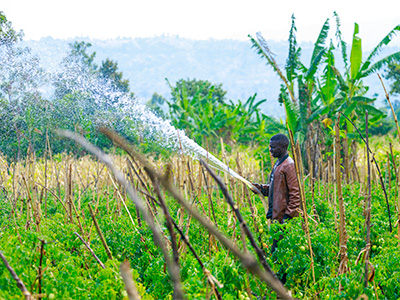
In January 2025, DWFI hosted a five-day workshop in Uganda to enhance understanding of entrepreneurial approaches Irrigation as a Service (IaaS) for smallholder farmers. The event brought together eight commercial irrigation service providers from Africa, Asia, and Europe. The participants represented a wide variety of business models and approaches to supporting smallholder irrigation. Through field visits to IaaS customers and collaborative discussions, participants exchanged expertise and identified key challenges and opportunities for scaling IaaS.
Several key findings emerged from the workshop. The discussion led to an improved understanding of how IaaS transfers risk from farmers to service providers, potentially requiring supplementary risk-management tools such as credit guarantees and rainfall insurance. Participants also emphasized that reliable irrigation for smallholders growing vegetables is the most important value proposition for some customer segments. The group also discussed potential ways to work with value chain and other partners, including opportunities around collected operational data. Alongside these insights, the workshop facilitated peer-to-peer learning, network building, and discussions on business models, financial mechanisms, and technological advancements. These outcomes will directly inform future DWFI research as well as broader initiatives.
| |
|
Irrigation as a Service project team begins field visits
In late 2024, DWFI was awarded a three-year grant from the Gates Foundation. The nearly $3.5-million grant supports a new research project focused on expanding the reach and impact of Irrigation as a Service (IaaS) for small scale farmers.
Irrigation as a Service (IaaS) offers potential solutions by providing agricultural water access without requiring farmers to purchase equipment. The new project investigates critical factors affecting IaaS scalability and sustainability with the goal of informing strategic investments in targeted regions in Sub-Saharan Africa.
Team members on the Gates Foundation project visited Ghana in March 2025 to engage in field visits and meetings. Partners included the International Food Policy Research Institute (IFPRI); International Water Management Institute (IWMI); and other DWFI researchers and contracted consultants.
Activities over the six days included a three-day workshop to understand and integrate project activities, including suitability mapping (led by IWMI) analysis of development outcomes (led by IFPRI); and financial and business analysis (led by DWFI) of IaaS enterprises. Field visits to northern Ghana allowed interaction with these enterprises and their smallholder farmer customers, including a women farmers’ cooperative.
| |
|
Improving Irrigation Management in the Dominican Republic using Geospatial Techniques
A project in the Dominican Republic, involving DWFI, is nearing completion. This project utilized high-resolution satellite imagery to map smallholder irrigated properties and update an existing database from the early 2000s used by Water User Associations to manage water and assess fees. Fieldwork, including boundary confirmation and farmer interviews, has also been conducted to gather further data on water users and irrigation infrastructure.
Accurate property boundaries are critical for effective water governance and policy implementation. By ensuring the correct assignment of water rights and usage, the project supports fair water distribution and helps water management agencies monitor usage and enforce regulations. This work enables the efficient and fair use of water resources in agriculture. Additionally, Water User Associations rely on fees from producers, which are proportional to their irrigated area, making accurate irrigated area measurement essential for the operation and maintenance.
| |
|
Interdisciplinary project aims to improve Nebraska farming
A research team at the University of Nebraska–Lincoln, which includes DWFI Faculty Fellows Yufeng Ge and Saleh Taghvaeian, is developing "CropTwin," a digital twin system using precision and predictive farming techniques. Supported by the USDA, the project aims to create a dynamic virtual replica of a Nebraska farm to simulate crop growth and test irrigation methods. By collecting real-time data from sensors and using deep learning models, CropTwin will provide accurate simulations for smart irrigation management, ultimately saving water and resources.
The researchers plan to deploy CropTwin at the Spidercam field phenotyping site and test its effectiveness on soybean crops. The first year will focus on developing the technology and its integration with existing crop models, while the second year will involve field testing. The team envisions CropTwin expanding to other agricultural solutions like insect control and livestock management, impacting both the technology and agricultural fields, and ultimately affecting everyday people.
| |
|
103 Nebraska faculty receive promotion, tenure honors
We congratulate all DWFI Faculty Fellows who received promotion in tenure honors this semester!
| | |
Uden teaching ecological resilience concepts with Jenga
By Nebraska Today
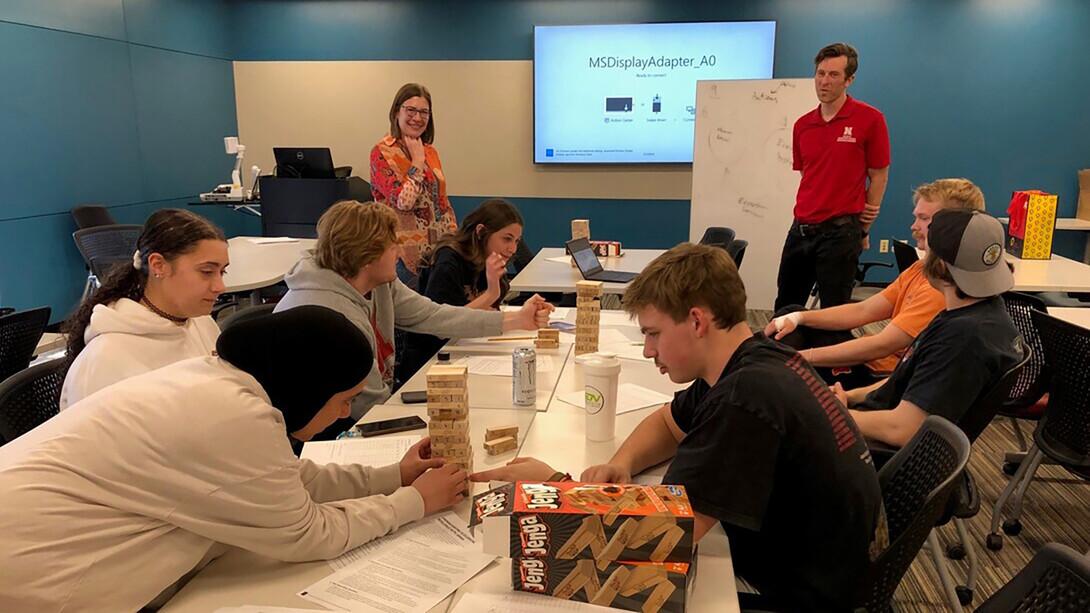
University of Nebraska-Lincoln Assistant Professor and DWFI Faculty Fellow Daniel Uden is using Jenga to teach students about ecosystems and resilience. Originally developed by graduate students, this modified Jenga game simulates an ecosystem, with numbered blocks representing agricultural yields. Players navigate various policy scenarios by removing blocks, learning about the tradeoffs between high yield and system resilience. Uden has adapted the game for both college and high school students, conducting sessions with groups from Lincoln Northeast and Omaha Burke High Schools, aiming to engage them with environmental science and grassland systems concepts. He is also offering to lend numbered Jenga sets to teachers interested in incorporating the activity into their classrooms, hoping to further align with high school curriculum and discuss real-world connections to resilience and ecosystem services.
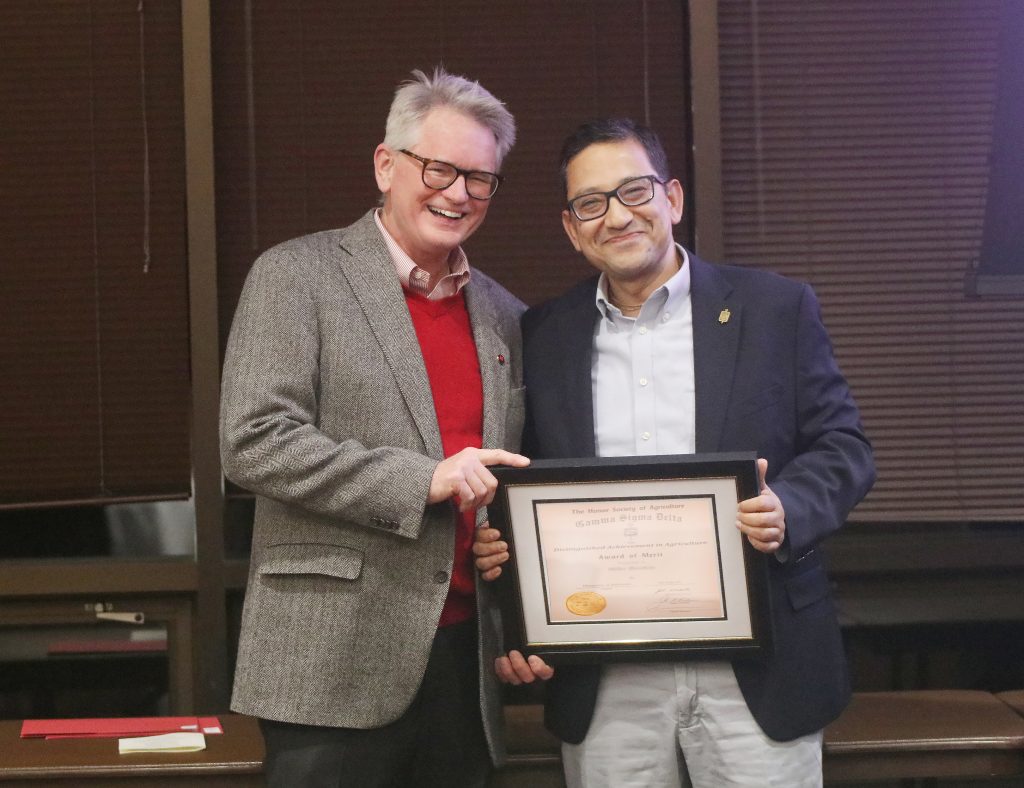
| | Panhandle Research Extension and Education Director John Westra, left, and Bijesh Maharjan, Nebraska Extension Specialist, with his award at the annual Gamma Sigma Delta banquet. Photo by Eric Buck | |
Nebraska Extension Researcher Uses Partnerships and Tools to Create ‘Outstanding Extension Programs’
By PREEC Communications
DWFI Faculty Fellow Bijesh Maharjan of the University of Nebraska-Lincoln Panhandle Research, Extension, and Education Center has received the 2024 Gamma Sigma Delta award for Outstanding Extension Program for his impactful work on soil health and fertility. Maharjan developed a widely recognized program addressing soil fertility issues for various crops in the Panhandle, particularly focusing on optimizing nitrogen application in sugar beets. His research led to a new nitrogen management model that reduces nitrogen use by 20-30%, lowering production costs for growers. Maharjan also secured a significant USDA NRCS grant to test this model across 50 farms. Beyond soil fertility, he's known for his contributions to soil health science, popularizing key terms, contributing to state initiatives, and creating the Nebraska Soil Health School, which has educated over 600 stakeholders on maintaining and rebuilding soil health.
| | |
Fritz elected to National Academy of Sciences
By Nebraska Today
| University of Nebraska-Lincoln professor and DWFI Faculty Fellow Sherilyn Fritz has been elected to the National Academy of Sciences, one of the highest honors for a scientist in the United States. Fritz, a George Holmes Professor in Earth and Atmospheric Sciences and the School of Biological Sciences, joins 120 new members recognized for their outstanding scientific contributions. Her decades-long career spans multiple continents and involves research on international committees. Fritz’s interdisciplinary work at the intersection of geology, biology, and atmospheric sciences, combined with her focus on reconstructing long-term environmental change using diatoms, has led to this prestigious recognition. She credits the supportive environment at the university and the importance of networking for her success. | |
Staff, Fellow and Supported Student Publications | | |
Comparison of salting-out assisted liquid-liquid extraction to polymeric solid phase extraction for liquid chromatography tandem mass spectrometry of neonicotinoids insecticides and metabolites in wastewater: Occurrence and aquatic risk assessment
Cristale, Joyce; Becker, Raquel Wielens; Tornisielo, Valdemar Luiz; Dantas, Renato Falcão; Bartelt-Hunt, Shannon; Onanong, Sathaporn; Snow, Daniel D.
Quantifying the climate change impacts on the magnitude and timing of hydrological extremes in the Baro River Basin, Ethiopia
Kassaye, Shimelash Molla; Tadesse, Tsegaye; Tegegne, Getachew; Hordofa, Aster Tesfaye
Climatological Context of the Severe Rain-on-Snow Flooding Event of March 2019 in Eastern Nebraska
Suriano Z.J.; Davidson S.; Dixon R.D.; Roy T.
Legitimacy in polycentric groundwater governance: Framework conditions identified in Nebraska's Natural Resource Districts
Jedd, Theresa; Sixt, Gregory N.; Schutz, Anthony; Burbach, Mark
Riverine Particulate Carbon, Nitrogen, and Phosphorus Are Decoupled From Land Cover at the Continental Scale
Trost, Benjamin; Shogren, Arial J.; Loveless, Zacharie T.; Manning, David W. P.; Benstead, Jonathan P.
Tillage practices do not affect winter wheat grain yield trend
Aula, Lawrence; Easterly, Amanda C.; Creech, Cody F.
Cooperative Localization of UAVs in Multi-Robot Systems Using Deep Learning-Based Detection
Krishna Rao Muvva, Veera Venkata Ram Murali; Chawla, Yogesh; Joseph, Kunjan Theodore; Pitla, Santosh; Wolf, Marilyn
Legitimacy in polycentric groundwater governance: Framework conditions identified in Nebraska's Natural Resource Districts
Jedd, Theresa; Sixt, Gregory N.; Schutz, Anthony; Burbach, Mark
Innovative governance for sustainable management of Mediterranean coastal aquifers: Evidence from Sustain‐COAST living labs
Ceseracciu, Chiara; Nguyen, Thi Phuoc Lai; Deriu, Romina; Branca, Giampiero; Vozinaki, Anthi-Eirini K.; Karatzas, George P.; Mellah, Thouraya; Akrout, Hanene; Yıldırım, Ümit; Kurt, Mehmet Ali; Jomaa, Seifeddine; Carletti, Alberto
Modelling soil water and its uniformity under linear-move sprinkler irrigation
Zhang, Rui; Qiao, Xin; Zhu, Delan; Wu, Pute; Zhang, Xiaomin
Proximal remote sensing: an essential tool for bridging the gap between high-resolution ecosystem monitoring and global ecology
Pierrat, Zoe Amie; Magney, Troy S.; Richardson, Will P.; Runkle, Benjamin R. K.; Diehl, Jen L.; Yang, Xi; Woodgate, William; Smith, William K.; Johnston, Miriam R.; Ginting, Yohanes R. S.; Koren, Gerbrand; Albert, Loren P.
Groundwater Use in Agriculture in South Asia: The Role of Technology
Balasubramanya, Soumya
| |  | |
Addressing key issues and knowledge gaps in resilience science for agriculture
Sundstrom, Shana M.; Awada, Tala; Bennett, Elena M.; Bestelmeyer, Brandon; Hodbod, Jennifer; Pacheco, Anna; Spiegal, Sheri; Allen, Craig R.
Evapotranspiration Partitioning Using Flux Tower Data in a Semi-Arid Ecosystem
Kar, Kanak Kanti; Haggerty, Ryan; Sharma, Harmandeep; Dwivedi, Dipankar; Roy, Tirthankar
The Brazilian case as a beacon to increase crop production in sub-Saharan Africa
Gasparotto, Leticia G.; Gonçalves, Ivo Z.; Marin, Fábio R.
Lessons about soil health and corn yield after a decade of cover crop and corn residue management
Klopp, Hans W.; Blanco- Canqui, Humberto; Jasa, Paul; Slater, Glen; Ferguson, Richard B.
Environmental health disparities in pediatric cancer: a report from the Fourth Symposium on Childhood Cancer Health Disparities
Hoang, Thanh T.; Herceg, Zdenko; Coulter, Don W.; Smith, Adam; Arora, Manish; Funk, William E.; Haynes, David; Linder, Stephen H.; Nogueira, Leticia M.; Hughes, Amy E.; Williams, Lindsay A.; Schraw, Jeremy M.
Resilient plants, sustainable future
Rhee, Seung Y.; Anstett, Daniel N.; Cahoon, Edgar B.; Covarrubias-Robles, Alejandra A.; Danquah, Eric; Dudareva, Natalia; Ezura, Hiroshi; Gilbert, Kadeem J.; Gutiérrez, Rodrigo A.; Heck, Michelle; Lowry, David B.; Mittler, Ron
Understanding the emerging food, energy, and water nexus (FEW-Nexus) systems in science education
Tabassum, Sumaiya; Dauer, Jenny M.; Scherer, Hannah H.; Sintov, Nicole D.; Wang, Hui-Hui
Coupling Remote Sensing With a Process Model for the Simulation of Rangeland Carbon Dynamics
Xia, Yushu; Sanderman, Jonathan; Watts, Jennifer D.; Machmuller, Megan B.; Mullen, Andrew L.; Rivard, Charlotte; Endsley, Arthur; Hernandez, Haydee; Kimball, John; Ewing, Stephanie A.; Litvak, Marcy; Duman, Tomer
Addressing key issues and knowledge gaps in resilience science for agriculture
Sundstrom, Shana M.; Awada, Tala; Bennett, Elena M.; Bestelmeyer, Brandon; Hodbod, Jennifer; Pacheco, Anna; Spiegal, Sheri; Allen, Craig R.
Coupling Remote Sensing With a Process Model for the Simulation of Rangeland Carbon Dynamics
Xia, Yushu; Sanderman, Jonathan; Watts, Jennifer D.; Machmuller, Megan B.; Mullen, Andrew L.; Rivard, Charlotte; Endsley, Arthur; Hernandez, Haydee; Kimball, John; Ewing, Stephanie A.; Litvak, Marcy; Duman, Tomer
Near-surface remote sensing applications for a robust, climate-smart measurement, monitoring, and information system (MMIS)
Runkle, Benjamin R. K.; Barnes, Mallory; Dannenberg, Matt; Gamon, John A.; Magney, Troy; Pierrat, Zoe; Southwick, Charles D.; Still, Christopher; Woodgate, William
| | |
Memorial Day
May 26
World Environment Day
June 5
WSJ Global Food Forum
Chicago, IL
June 16-17
| | |
Jennah Duncan
Research Lab Manager, Water Sciences Laboratory
Jennah Duncan is the Research Lab Manager at the Water Sciences Laboratory. She started off working in the laboratory as an undergraduate student intern in November of 2022 working for the Know Your Well project. Then moved on to become a full-time technician after graduating with a Bachelor of Science in May of 2023. As a lab technician she mainly focused on running nitrate/nitrate, ammonia, anions on the ion chromatography, cations on the ICP-OES, and metals on the ICP-MS. She further transitioned into the manager position in March of 2025 where she focuses on training students and technicians, assisting clients and researchers, and keeping the lab running smoothly.
Duncan received her B.S. in Forensic Science at the University of Nebraska-Lincoln.
| |
The Daugherty Water for Food Global Institute at the University of Nebraska was founded in 2010 by the Robert B. Daugherty Foundation to address the global challenge of achieving food security with less stress on water resources through improved water management in agricultural and food systems. The institute is committed to ensuring a water and food secure world while maintaining the use of water for other human and environmental needs.
The Nebraska Water Center, established by Congress in 1964, focuses on helping the University of Nebraska become an international leader in water research, teaching, extension and outreach by facilitating programs that will result in UNL becoming a premiere institution in the study of agricultural and domestic water use.
| | | | |