|
Hello USA-NPN,
Here is your monthly update for those participating in the Time to Restore project in New Mexico, Oklahoma, Texas, and Louisiana. If you know others who may be interested in this newsletter, please send it their way! If you were forwarded this message, you can sign up to get on our list here.
| | | Upcoming virtual trainings | | |
Join us for a virtual training May 7th!
Starting this month we'll be hosting monthly virtual training calls. These calls will be a chance to review how to make observations in Nature's Notebook as well as ask your specific questions. The first call will be Wednesday, May 7th at 5:30pm MT / 6:30pm CT and will provide an orientation to the project.
We'll host calls on the first Wednesday of the month through the summer. The May and July calls will provide an orientation to the project and how to participate. The June, August, and September calls will be more of a general check-in with an opportunity for you to ask questions.
| | Plant of the Month: Showy milkweed, Asclepias speciosa | | |
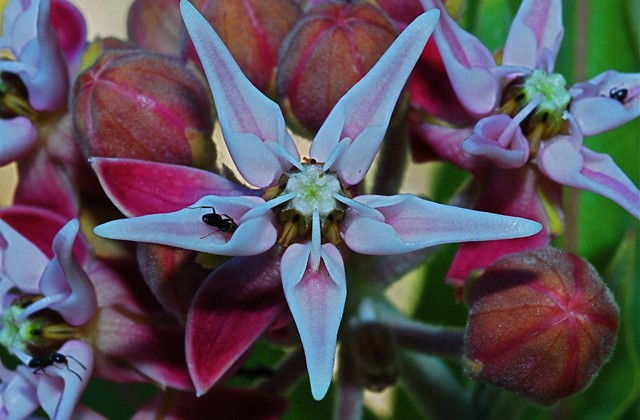
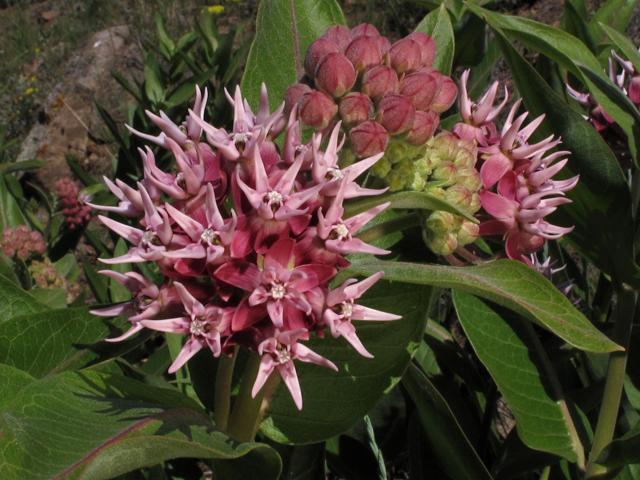
Photo: Terry Glase via Ladybird Johnson Wildflower Center
Each month, we feature one of the plants on the Time to Restore list. Showy milkweed (Asclepias speciosa) is one of our eight regional priority species. This species is found throughout the Western and Central regions of the U.S.
This species has spherical, rose-colored clusters of flowers. Milkweeds are the host plant for monarch butterflies, which only lay their eggs on milkweeds. Milkweed also serve as a host for several other species of butterflies and moths, and many other species drink its nectar.
You can observe this species as a single plant in Nature's Notebook, or, if you have multiple plants growing together that are difficult to differentiate, register the plant as a patch and make your observation considering the patch as a whole. If you have more than one plant or patch, consider monitoring 2-3 individuals at the same site to capture the variation between plants.
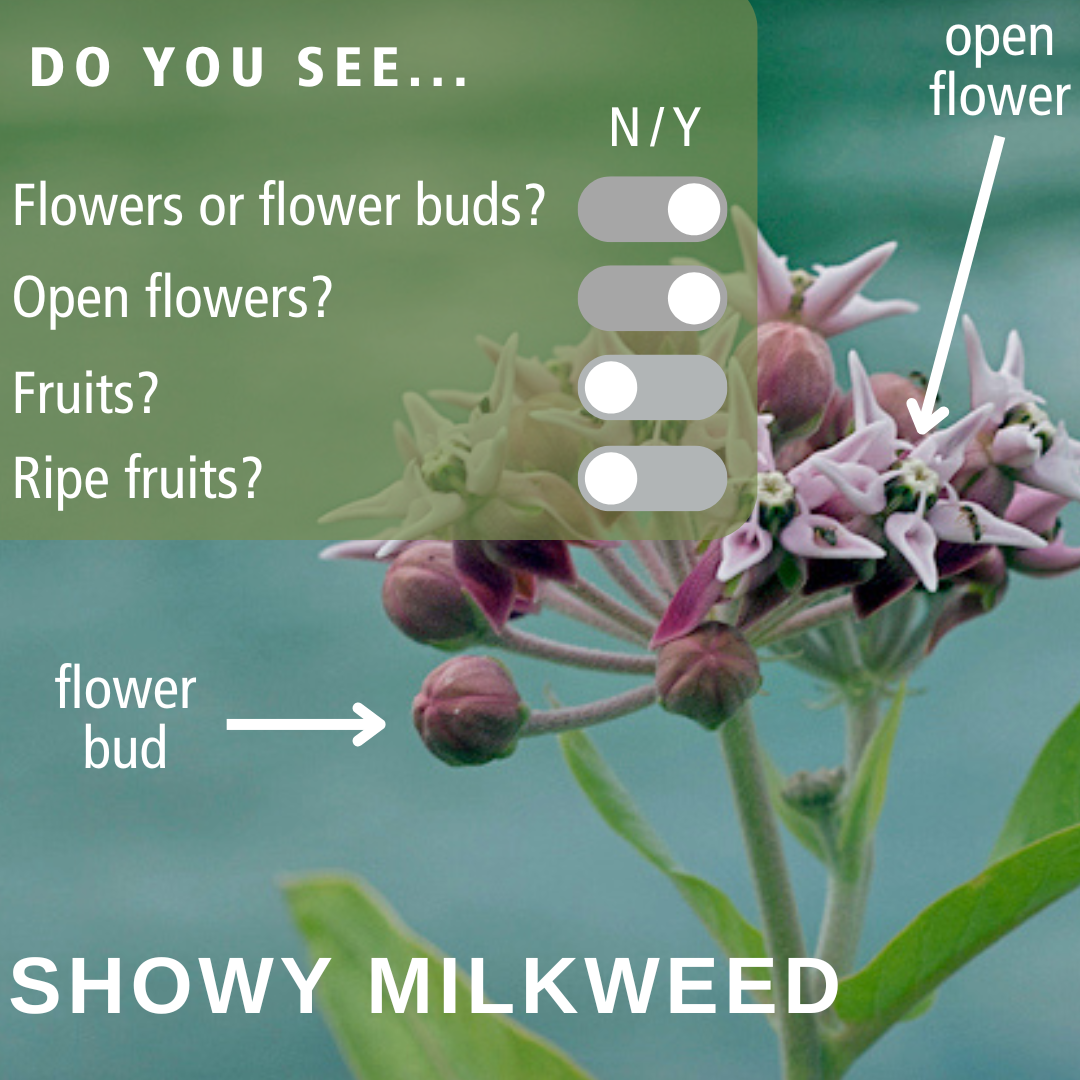
For the plant pictured below, you would report:
Flowers or flower buds - yes
Open flowers - yes
Fruits - no
Ripe fruits - no
| | |
Photo: Terry Glase via Ladybird Johnson Wildflower Center
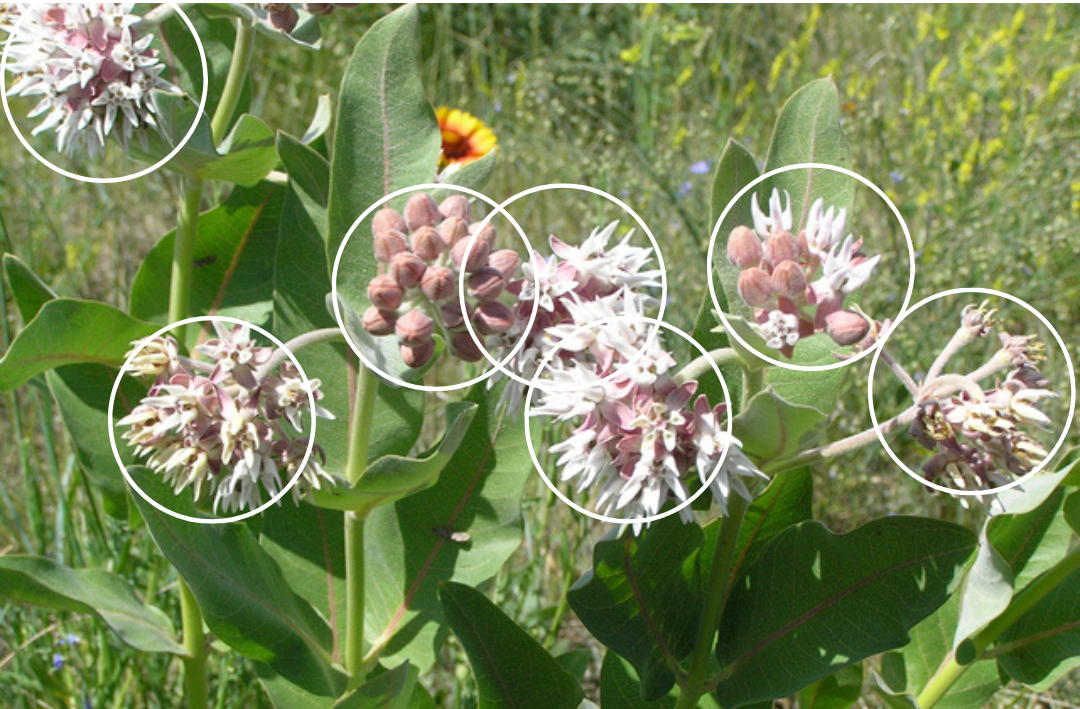
As for the optional intensity questions, remember that for plants where the flowers occur in an inflorescence, you count each inflorescence as one flower. For showy milkweed, flowers occur in an inflorescence. In the photo below, for the question "How many flowers or flower buds?", you would select the bin 3-10, as there are 7 inflorescences in the photo (each circled in white). Optionally, you can also put the exact number of inflorescences in the comment field for your observation.
| | Photo: John Hixson via Ladybird Johnson Wildflower Center | | For the question "What percent of flowers are open?", estimate the percent that are open across all inflorescences. In the photo below inflorescences are either closed or open. Half are closed, half are open. You could put your estimate into either 25-49% or 50-74% depending on whether you felt the open inflorescences had more or less individual flowers than the closed ones. | | |
Photo: Alan Cressler via Ladybird Johnson Wildflower Center
Questions? Reach out to Erin@usanpn.org.
| | |
Time to Restore April Quarterly Call: Data Check In
During the April Time to Restore Quarterly Call we did a deep dive into the data that you all have collected so far. We'll talk about what is going well, and issues with the data, and how to fix those issues.
Watch the recording
| | | |
Monthly Murmuration - Wednesday, June 18th at 11am PT
Monthly Murmurations are webinars that are open to all nature's Notebook observers and Local Phenology Leaders! USA-NPN Director Theresa Crimmins will share results from some recent papers that used Nature's Notebook data. Come find out what scientists are learning from your data!
Register
| | | Training options in your state | | |
Participants in all states are invited to join us for monthly training series on the first Wednesday of the month. The next training will be Wednesday, May 7, 2025 @ 6:30 p.m. CT and will provide an orientation to the Time to Restore project. Register here.
Louisiana
Interested in organizing a training for your group in Louisiana? Reach out to Gina Lloyd to schedule.
New Mexico
Interested in organizing a training for your group in New Mexico? Reach out to Kim Eichhorst to schedule.
Texas
Interested in organizing a training for your group in Texas? Reach out to David Gwin to schedule.
The table below shows the Texas counties that are represented by Master Naturalist and NPSOT chapters that have already approved the project. Let us know if you are already planning on participating in the project but your county is not represented below!
| | | North Texas Counties | Dallas, Denton, Collin, Cooke, Hunt, Kaufman, Montague, Parker, Rockwall, Tarrant, Parker, Wise | | Central Texas Counties | Bell, Hays, Milam, Caldwell | | East Texas Counties | Polk, San Jacinto, Trinity, Tyler | | Southeast Texas Counties | Austin, Brazoria, Brazos, Burleson, Colorado, Fayette, Fort Bend, Galveston, Grimes, Harris, Lee, Leon, Madison, Montgomery, Robertson, Walker, Waller, Washington, Wharton | | Southwest Texas Counties | Uvalde, Medina, Kinney, Bexar | | West Texas Counties | Bailey, Borden, Cochran, Cottle, Crosby, Dawson, Dickens, Floyd, Garza, Hale, Hockley, Kent, King, Lamb, Lubbock, Lynn, Motley, Scurry, Stonewall, Terry, Yoakum | | | | | |
Gina Lloyd
Time to Restore Louisiana Coordinator
ginalloyd113@gmail.com
| | | | |
Kim Eichhorst
Co-Director of the Bosque Ecosystem Monitoring Program (BEMP)
New Mexico contact for Time to Restore
kimde@unm.edu
| | | | |