EconTAI Logo

EconTAI's Quarterly Newsletter

Message from the Faculty Team:


This past quarter, the questions we study moved to the center of the public conversation — in the pages of The Economist and The New York Times, and in scenario-planning workshops we led at Darden and the Peterson Institute that brought policymakers and business leaders face to face with transformative AI futures. What gives up hope is not just the growing attention, but the growing willingness to prepare. We are also delighted to announce new grant support from Coefficient Giving, which will allow us to expand EconTAI's research and outreach in the year ahead. Thank you for reading, engaging, and spreading the word — the challenge ahead is enormous, but so is the community rising to meet it.


Anton Korinek, Basil Halperin & Lee Lockwood

EconTAI Faculty


In the News

Fortunate Joaguin - The Economist

Meet the World's Top AI-pilled Economists

Anton Korinek and Basil Halperin are featured in this Economist piece on the small group of "AI-pilled economists" leading research on AI's economic impact.


Read the full article here

Melanie Lambrick - The New York Times

Everyone Wants to Tax A.I. The Big Disagreement: How?

Lee Lockwood is quoted in this NYT Dealbook piece examining the wave of competing proposals to tax AI companies, and why defining the actual policy gials matters more than the mechanism.


Read the full article here

Maxime Mouysset - The New York Times

Economists Once Dismissed the A.I. Job Threat, but Not Anymore

Anton Korinek is featured in this NYT piece examining a growing shift among economists who once dismissed AI's threat to the labor market but are now increasingly convinced that significant disruption is coming - and that policymakers are unprepared.


Read the full article here

Ben Denzer - The New York Times

Opinion: Silicon Valley Is Bracing for a Permanent Underclass

Work from Anton Korinek and survey results from Basil Halperin are highlighted in this NYT piece examining growing fears among AI insiders that advanced AI could displace workers permanently, leaving millions behind with no clear policy solution in sight.


Read the full article here

Macro Musings

Macroeconomic Policy in an Age of Transformative AI

Basil Halperin joins the Macro Musings podcast with David Beckworth to discuss financial market signals for AI timelines, NGDP targeting as "eclectically-optimal" monetary policy, and the broader fiscal implications of AI-driven growth.


Listen to the full podcast here

Mario Tama - Getty Images

What Is a 'Compute Tax' and Why Is the Idea Gaining Traction?

Anton Korinek contributes to an analysis of the growing mainstream interest in compute taxes as a potential policy response to AI's economic disruption, examining the case for and against taxing AI computation.


Read the full article here

Alexis Pazoumian - The New York Times

A.I. Doesn't Have to Mean Layoffs

Anton Korinek offers perspective on whether businesses can choose to deploy AI to make workers more productive rather than replace them - and whether that window of choice may be narrowing as AI advances rapidly.


Read the full article here


Research and Publications Spotlight

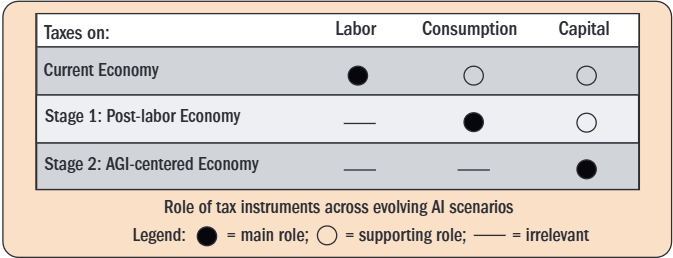
Public Finance in the Age of AI

This research brief is adapted from "Public finance in the age of AI: a primer" by Anton Korinek and Lee M. Lockwood. Prepared by EconTAI at the University of Virginia.

How should governments adapt when transformative AI erodes traditional tax bases like labor income? Korinek and Lockwood's research analyzes how tax systems could evolve across two distinct stages of AI-driven change, offering concrete guidance for policymakers today.

Key Takeaway: As AI transforms the economy, the tax playbook must evolve: consumption taxes become primary in a post-labor economy, while direct taxation of AI capital becomes essential in an AGI-centered economy where autonomous systems bypass human consumption entirely.


Where is AI in GDP Statistics?

Authors: Anton Korinek (PIIE) and Patrick McKelvey (Bank of Canada)

How do you measure an economy growing faster than our statistical tools can track? Korinek and McKelvey examine how AI's extraordinary growth — expanding at over 2,000 percent per year in quality-adjusted terms — is largely invisible in conventional GDP statistics, and propose an "AI GDP" framework to close the gap.

Key Takeaway: National economic statistics were not designed to track AI's unprecedented rate of growth. Statistics agencies should begin developing AI-focused satellite accounts now, before the measurement gap becomes a policy gap.


Events

Interdisciplinary AI Speaker Series Co-hosted with HMI

March 2026

EconTAI organized the interdisciplinary Human and Machine Intelligence seminar series at UVA.

Hudson Golino, a UVA Associate Professor of Psychology, led a discussion on the psychology of artificial minds and construct emergence training.

Gillian Hadfield, a Bloomberg Distinguished Professor of AI Alignment and Governance at Johns Hopkins University, presented work on building AI agents that can participate in democratic life without destabilizing it.


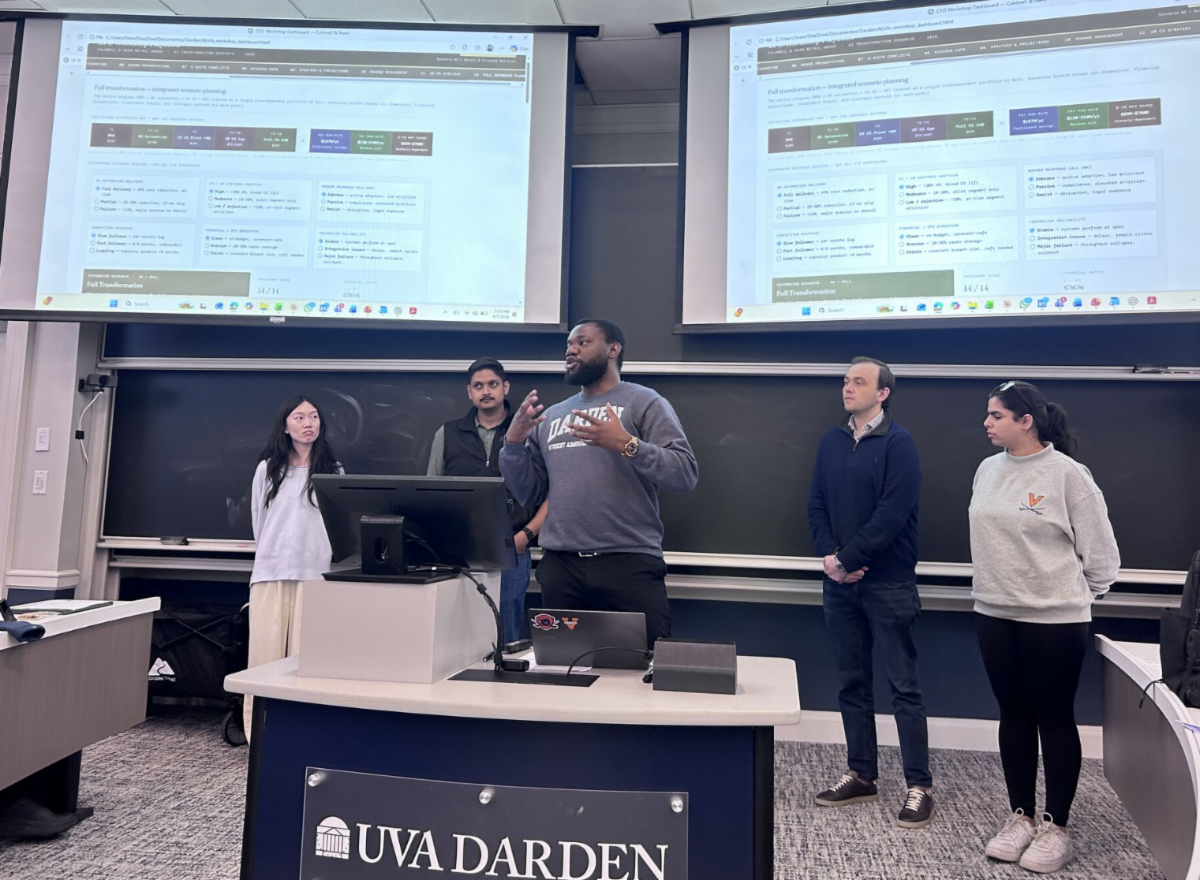
UVA Darden AI Scenario Planning Workshop

April 2026

What happens when AI can perform any cognitive task as well as, and cheaper than, an expert? Darden Professor of Practice Tim Laseter and Anton Korinek led over 40 faculty and students through a half-day scenario planning workshop sponsored by EconTAI, challenging teams to navigate strategic decisions in a near-future AGI economy.

AI and the imminent transformation of work: New dimensions and analyses

April 16, 2026

How will work be affected by artificial intelligence? New PIIE senior fellow Anton Korinek offers a forward-looking perspective, proactively asking whether we're truly preparing for the speed and extent of the transformation of work. The discussion explores the real implications of rapid AI progress for jobs, productivity, inequality, and international diffusion of technology.

Economic Scenarios for Transformative AI Workshop

June 11, 2026

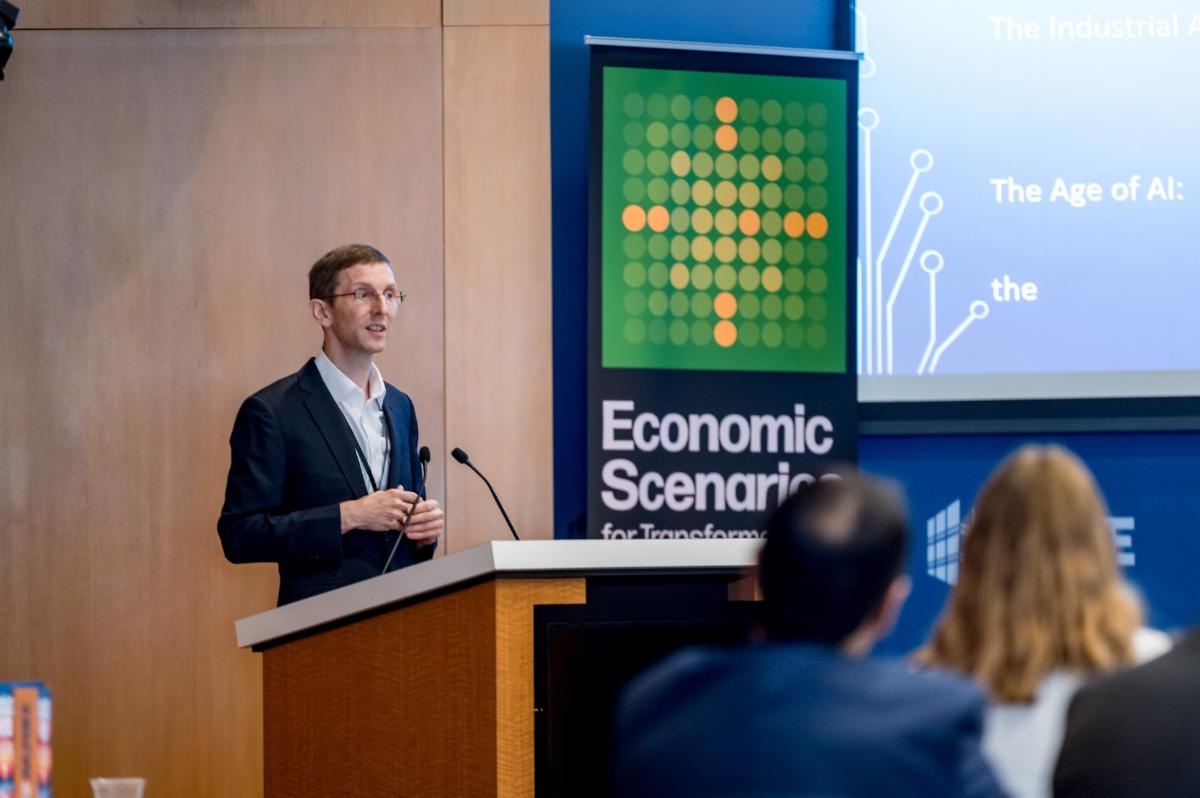
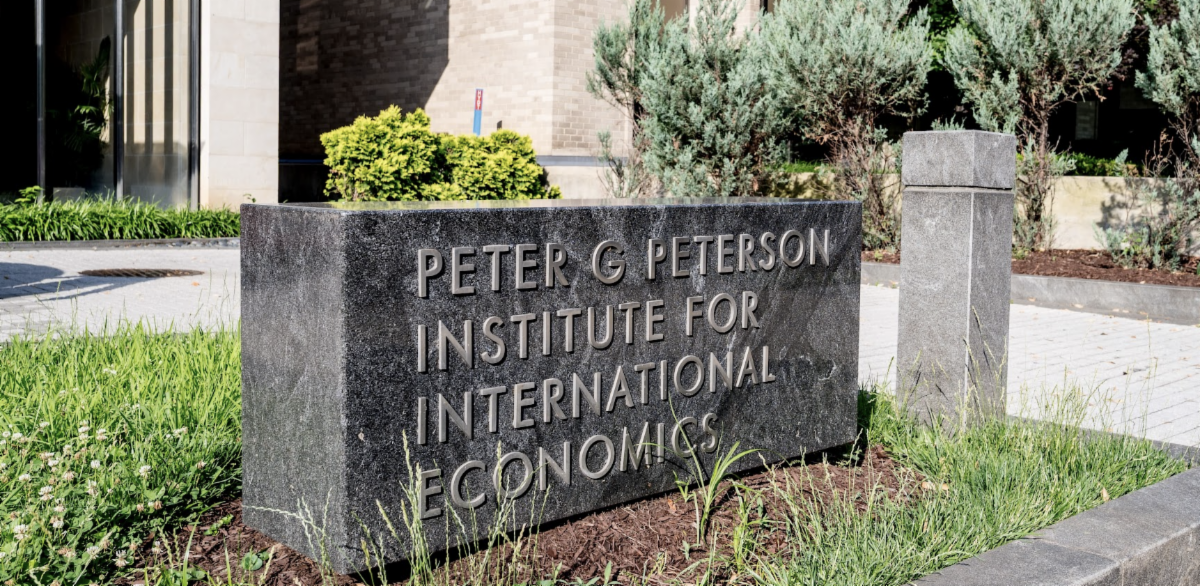
EconTAI co-organized this invitation-only workshop in Washington, D.C., bringing together 40 leading economists, policymakers, and AI researchers to develop and stress-test shared scenarios for how transformative AI could reshape the U.S. economy by 2030. Co-convened with Windfall Trust, the Brookings Center on Regulation and Markets, the Foundation for American Innovation, and the Peterson Institute for International Economics, the session examined realistic policy responses robust across multiple AI futures.


This newsletter shares quarterly updates on our news coverage, research, and activities. Write to us at econtai@virginia.edu to engage. And help us spread the message by forwarding this newsletter to interested readers.

X  LinkedIn  Web