|
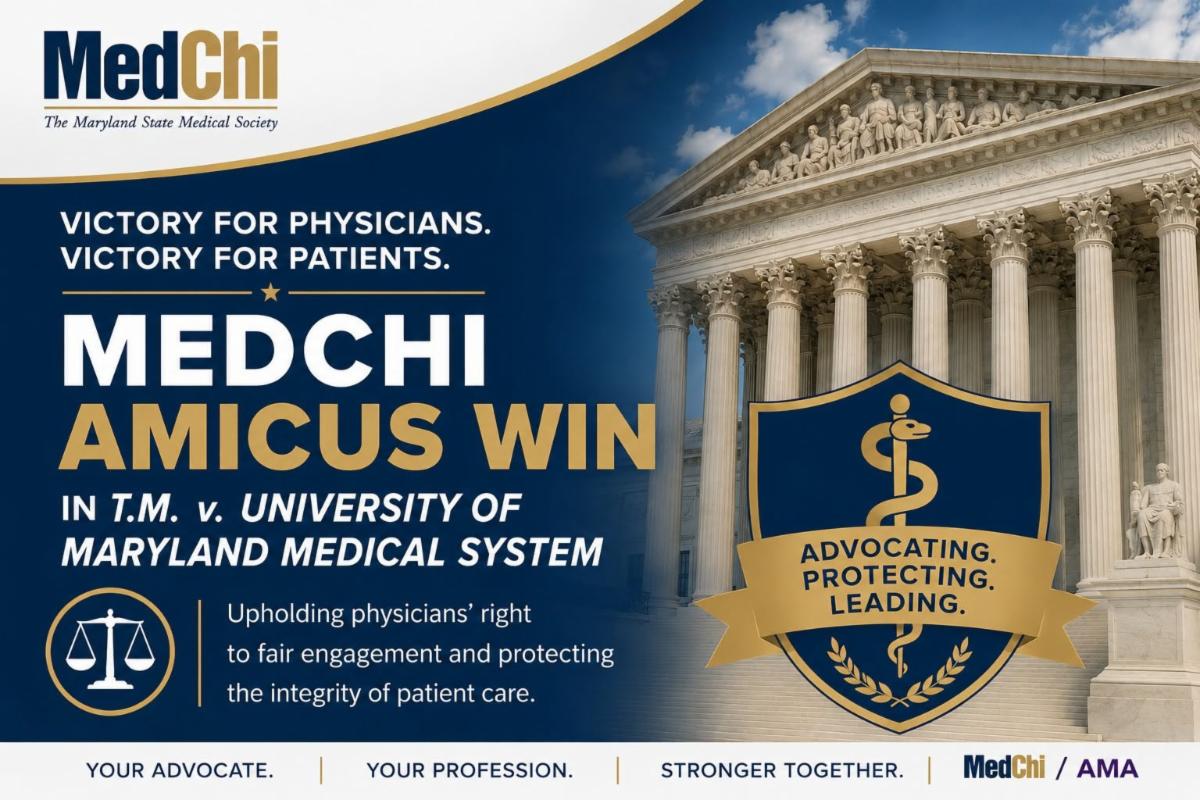
On Thursday, June 18, the U.S. Supreme Court issued an important 5-4 decision in T.M. v. University of Maryland Medical System, affirming a basic but critical principle of our judicial system: litigants should not be permitted to simultaneously challenge the same state-court judgment in federal district court while state appellate proceedings remain ongoing. The Court held that the longstanding Rooker-Feldman doctrine bars such duplicative federal litigation, even when a state-court judgment is still subject to appeal.
While the legal issue before the Court was procedural, the implications for patients, physicians, hospitals, and the integrity of our judicial system are substantial.
The Maryland State Medical Society (MedChi) joined the American Medical Association in filing an amicus brief because healthcare professionals and institutions depend on clear, predictable legal processes. Physicians make difficult decisions every day, often in emergency and behavioral health settings where patient safety, public safety, and individual rights must all be carefully balanced. Those decisions are already subject to extensive review through administrative proceedings, state courts, professional licensing oversight, and established appellate processes.
Allowing parties dissatisfied with a state-court ruling to immediately seek a second review in federal district court before the state process is complete would create confusion, encourage forum shopping, and dramatically increase litigation costs. It could also produce conflicting judicial decisions arising from the same underlying facts. The result would be uncertainty for patients and healthcare professionals alike.
The Supreme Court recognized this concern. Writing for the majority, Justice Sonia Sotomayor concluded that federal district courts cannot serve as alternative appellate tribunals for state-court judgments simply because state appeals remain pending. The decision preserves the proper relationship between state and federal courts and reinforces the principle that litigants must follow established appellate pathways.
MedChi remains committed to advocating for physicians and reducing barriers that contribute to burnout and threaten the delivery of quality healthcare.
To read more about the ruling, click here.
To learn about MedChi's involvement, click here.
Gene M. Ransom III
CEO
MedChi, The Maryland State Medical Society
|