|
We want to bring to your attention critical issues affecting patients across the United States, including those covered by Medicare, Medicare Advantage, Medicaid, and commercial insurers.
The Medicare Final Rule has significantly changed the provision of telehealth services. Starting April 1, 2025, most telehealth services will require patients to be physically present in an office or medical facility located in a rural area. This restriction excludes patients in non-rural areas from accessing telehealth services altogether. Even for those in rural regions, traveling to a designated facility can be extremely difficult, undermining one of telehealth’s primary benefits—providing care from the patient’s home. These changes will impose substantial transportation costs, create burdens for elderly patients who cannot drive, and disrupt the working population that relies on telehealth for accessible care. Currently, approximately 20% of patients depend on telehealth services.
Furthermore, if this rule remains in place, Medicare Advantage, Medicaid, and commercial insurers are expected to adopt similar policies, likely with reduced reimbursements. This will effectively dismantle telehealth services, severely limiting patient access to essential health services.
This issue is crucial for millions of patients across the country, and we hope you will take action to help preserve access to these vital services. We urgently request you to contact CMS and members of Congress (House and Senate).
| |
ONLY THREE DAYS LEFT TO REGISTER! | |
|
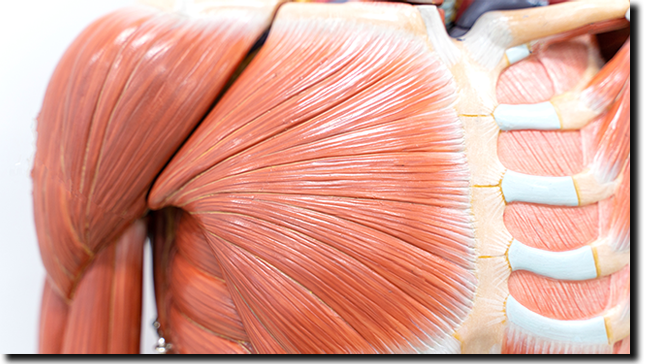
“In rheumatology, the fascia is often the source of pain. There is a lot of manual work to be done on these tissues before considering other treatments such as injections. We certainly make a lot of diagnostic errors by forgetting to take them into account,” said Professor Françoise Laroche, rheumatologist at the Pain Evaluation and Treatment Department of Saint-Antoine University Hospital in Paris, France, while speaking at the recent French Congress of Rheumatology held in Paris.
She emphasized that fascia-related pain is common but is frequently misdiagnosed as other types of musculoskeletal pain.
Laroche and Cornelia Linke, a massage therapist based in Paris, highlighted the importance of recognizing the fascia, which envelops and connects all body structures — muscles, bones, organs, and blood vessels. It forms a continuous network of superficial and deep tissues, providing mechanical and functional support.
Read More
| |
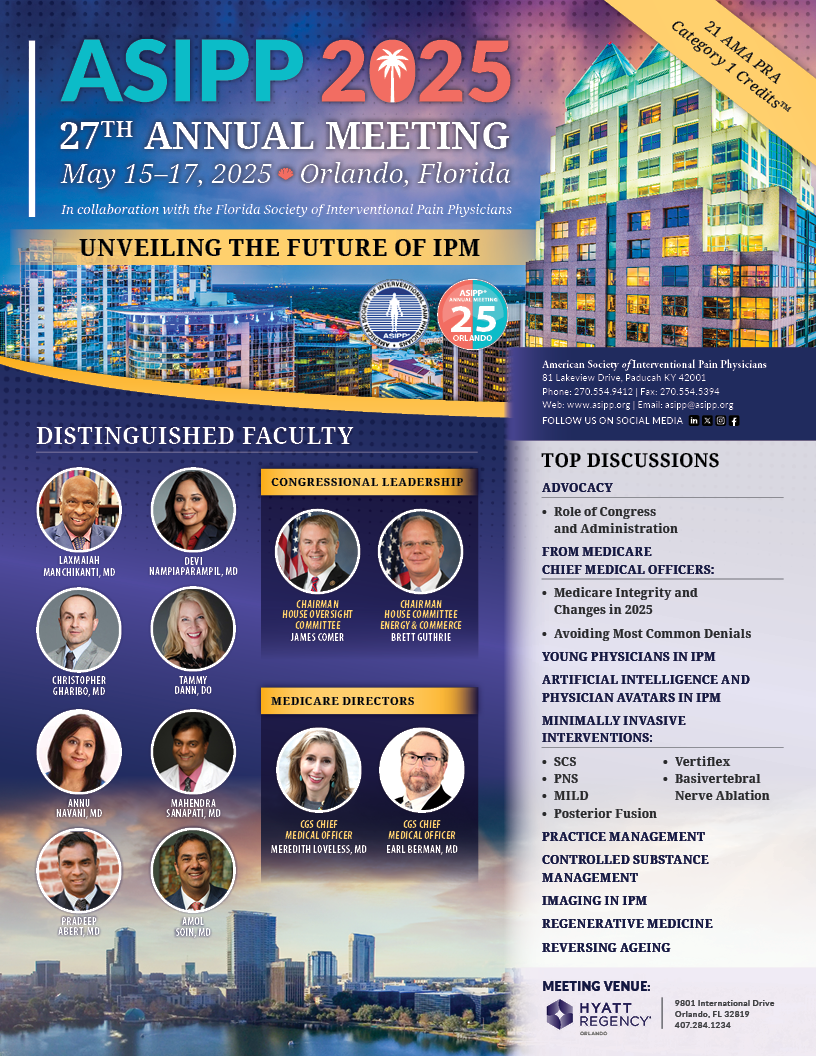
ASIPP's 2025 Annual Meeting
Agenda now available!
We would love it if you would register and join us in Orlando!
| |
Attention Fellows and Residents! | |
|
ASIPP is pleased to announce a scholarship to help fellows and residents participate in the 2025 ASIPP Annual Meeting. Recipients of this scholarship will receive reimbursement for up to three nights stay at the host hotel at the official ASIPP single-occupancy room block rate. This includes room block room rate and tax.
The number of scholarship recipients will be limited so it is important to apply soon!
| |
Abstract submissions are open for
ASIPP's 2025 Annual Meeting!
The abstract submission deadline is March 10, 2025.
Don't miss this opportunity to share your insights
and help shape the future of pain management.
| |
What's needed is an environment "that makes the healthy choice the easy choice"
Much of what people have been taught about making America healthier is wrong, Dan Buettner, the originator of the term "Blue Zones," told members of the Senate Aging Committee Wednesday.
Why are the people in Blue Zones living 10 years longer than Americans? "Because they're avoiding the diseases that shorten Americans' lives and are bankrupting us in many ways," Buettner, of Miami, Florida, said at a hearing on "Optimizing Longevity: From Research to Action."
What are they doing? "Well, none of them are dieting or exercising or running down to Latin America for stem cell treatments," he said. Instead, "every time they go to work or a friend's house or out to eat, it occasions a walk -- they're getting 8,000 to 10,000 steps per day, mindlessly. The cheapest and most accessible foods for them are peasant foods; they're whole grains. They're tubers."
Read More
| |
Probationary employees across FDA received notices that their jobs were being eliminated
The Trump administration's effort to slash the size of the federal workforce reached the FDA this weekend, as recently hired employees who review the safety of food ingredients, medical devices, and other products were fired.
Probationary employees across the FDA received notices Saturday evening that their jobs were being eliminated, according to three FDA staffers who spoke to the Associated Press on condition of anonymity because they were not authorized to speak publicly.
The total number of positions eliminated was not clear Sunday, but the firings appeared to focus on employees in the agency's centers for food, medical devices, and tobacco products -- which includes oversight of electronic cigarettes. It was not clear whether FDA employees who review drugs were exempted.
Read More
| |
|
If medical associations won't take a stand, we must
Former President Barack Obama once said, "elections have consequences." But historically, the consequences tend to be less dramatic than supporters of the winning candidate hoped for -- and less than opponents feared. That's because the American system of government, driven by the principles laid out in the U.S. Constitution, explicitly establishes checks and balances designed to shield us from the domination of extremists of any political stripe.
And for well over 200 years, those principles have held. But since the second inauguration of President Donald Trump, the country is facing an existential crisis of Constitutional fragility across every aspect of government and governing in America.
For doctors and for public and global health, the Trump administration's executive orders and plans are beyond worrisome, as is the confirmation of Robert F. Kennedy, Jr. as HHS secretary. Proposed disruptions or elimination of vital healthcare access for vulnerable populations, massive cuts in critical medical research, and withdrawal from long-standing commitments to global health will affect all of us.
But with major medical organizations standing by rather than leveraging their influence to intervene, many physicians and other healthcare professionals are left wondering, "What can I do?"
Read More
| |
|
New 2025 Dates
Mark your calendars!
March 1, March 29, April 26,
May 31, & June 28
Four (4) hour virtual exam
- ABIPP Path – Combined CCPM/ CSM Exam
For those with subspecialty in Pain Medicine
Two (2) hour virtual exam
- ABIPP Competency Exam in IPM
For those without primary board certification
Two (2) hour virtual exam
- ABIPP Competency Exam in Regenerative Medicine
Two (2) hour virtual exam
- Controlled Substance Management Competency Exam
Two (2) hour virtual exam
- Documentation, Coding, Compliance, Practice Management Competency Exam
Two (2) hour virtual exam
| |
|
They have betrayed the Hippocratic Oath in voting to confirm RFK Jr.
When Senator Bill Cassidy, MD (R-La.) -- a physician, longtime advocate for healthcare policy, and potential swing vote on the Finance Committee -- voted to advance Robert F. Kennedy Jr. as secretary of HHS, he didn't just make a political choice. He made a choice that undermines science, public health, and the very Hippocratic Oath he once swore to uphold.
While Cassidy claims to have taken this decision "very seriously," he must know it is wrong. As a legislator, he understands that the HHS secretary oversees critical health institutions like the CDC, FDA, and CMS. As a doctor, he has firsthand knowledge of how these agencies impact patient care, from ensuring access to safe medications to shaping life-saving public health policies. Entrusting this role to Kennedy -- a man with no qualifications beyond his fame as a purveyor of medical disinformation -- isn't just reckless. It endangers us all.
Kennedy's Dangerous Track Record
Kennedy's record must not be mistaken for misunderstood skepticism. He is one of the most prolific and, seemingly, deliberate spreaders of medical misinformation online.
Read More
| |
- ASIPP Members Only Site Information - | |
-
To log in for the first time you will need to click “forgot password” at the bottom of the login window.
- Check your email and then log in as directed.
-
If you have problems logging into your account, click here.
| |
|
Epidural steroid injections (ESIs) offer limited effectiveness in reducing back pain and disability, an updated review by the American Academy of Neurology (AAN) suggested.
“They may modestly reduce pain in some situations for up to 3 months and may reduce disability for up to 6 months or more. The limited available evidence was insufficient to create practice recommendations,” lead author Carmel Armon, MD, of Loma Linda University School of Medicine in Loma Linda, California, told Medscape Medical News.
The review was published online on February 12 in Neurology.
Read More
| |
|
Experts are talking about a potential small increase in a very rare condition
Public health officials are looking into reports of a small potential uptick in neurologic complications of influenza in children -- particularly a rapidly progressing and dangerous condition called acute necrotizing encephalopathy (ANE).
Adrienne Randolph, MD, MSc, of Boston Children's Hospital, said she reported about 12 potential cases of flu-associated ANE to CDC's National Center for Immunization and Respiratory Diseases (NCIRD) in the past few weeks.
Randolph's position as the leader of the Pediatric Intensive Care Influenza Network gives her particular insight into what's happening with influenza complications in children across the country.
Read More
| |
Upcoming ASIPP State Society Meetings | |
Join the Louisiana Society of
Interventional Pain Physicians (LSIPP)
2025 Annual Meeting is
TOMORROW, February 20
6 pm (CST) at Juban's Restaurant in Baton Rouge, LA
| |
|
Physicians respond to proposed legislation, saying the technology isn't there yet
Artificial intelligence (AI) could be used to prescribe medications to patients -- if a new bill makes its way through Congress.
The proposed legislation, sponsored by Rep. David Schweikert (R-Ariz.), would amend the Federal Food, Drug, and Cosmetic Act to clarify that AI and machine learning technologies can qualify as a practitioner eligible to prescribe drugs if authorized by the state involved and approved by the FDA.
The bill was introduced in the U.S. House of Representatives and referred to the House Committee on Energy and Commerce in January.
Read More
| |
|
Pain Medicine Case Reports (PMCR) and Editor-in-Chief Alaa Abd-Elsayed, MD, PhD would like to invite you to submit case reports and case series to the PMCR journal. Your article will be published free of charge.
Open access journals are freely available online for immediate worldwide open access to the full text of published articles. There is no subscription fee for open access journals. Open access journals are no different from traditional subscription-based journals: they undergo the same peer review and quality control as any other scholarly journal.
Interested in becoming a member of the PMCR Editorial Board?
Editorial board members are asked to review 2-6 manuscripts per year. Please submit your most up-to-date CV to sgold@asipp.org for consideration.
For more information or to submit your articles, click here.
| |
|
Luis Miguel Escano Volquez, MD, Sri Harsha Kanuri, MD, and Roger Haddad, DO
Abstract
BACKGROUND: Infection with COVID-19 has evolved from a novel health crisis into an entity with a myriad of increasingly recognized sequelae. Among these, peripheral neuropathy is often an underrecognized and underdiagnosed complication. Neuropathic pain can be challenging to treat with many cases being refractory to conservative management, often requiring advanced techniques. Neuromodulation has become an important tool for the treatment of the refractory cases.
CASE REPORT: We present a case of a 43-year-old woman with refractory right tibial mononeuropathy secondary to COVID-19 infection who was treated successfully using peripheral nerve stimulation.
CONCLUSIONS: The use of peripheral neuromodulation represents a pivotal strategy for the management of difficult cases. Our case highlights the first use of neuromodulation to treat neuropathic pain secondary to COVID-19 infection. We hope that this case sparks further research on the topic, which could lead to better clarification of this condition and potential expansion of treatment strategies.
KEY WORDS: Neuromodulation, peripheral nerve stimulator, long COVID, tibial neuropathy, neuropathic pain
Read More
| |
RANDOMIZED CONTROLLED TRIAL | |
|
Tarek Mohamed Ashoor, MD, Ahmed Maher Abd ElKader, MSc, Raouf Ramzy Gadalla, MD, Ibrahim Mamdouh Esmat, MD, and Ahmad Mahmoud Hasseb, MD
Abstract
BACKGROUND: Postdural puncture headache (PDPH) is a debilitating, life-altering complication of the administration of obstetric spinal anesthesia (SA). The lack of evidence-based treatment for PDPH necessitates the implementation of new treatment modalities. Mirtazapine is a noradrenergic and specific serotonergic antidepressant that has been used as a prophylactic treatment for chronic tension-type headaches. Few previous studies have assessed the efficacy of sumatriptan in the treatment of PDPH.
OBJECTIVES: The purpose of this study was to assess the hypothesis that an adjunctive therapy that involved adding mirtazapine or sumatriptan to conventional management (CM) would be more effective in reducing the incidence of refractory PDPH after obstetric surgery under SA than would CM alone.
STUDY DESIGN: A prospective randomized study.
SETTING: This study was carried out at Ain-Shams University Maternity Hospital.
METHODS: Two hundred and ten American Society of Anesthesiologists (ASA) physical status II women who complained of PDPH after obstetric SA were randomly allocated to one of 3 groups. Each group consisted of 70 women. The intervention treatment for every group was continued for 3 days, as was the CM of PDPH. Every day at 8 p.m., patients in the mirtazapine group (the M-group) took 30 mg mirtazapine tablet, patients in the sumatriptan group (the S-group) took 50 mg sumatriptan tablet, and patients in the control group (the C-group) took placebo tablets. The primary outcome was the incidence of refractory headache 72 hours after the ingestion of the first dose of the intervention drugs. The incidences of side effects of the study drugs, the hospital length of stay (LOS), and the patient satisfaction score were secondary outcomes.
RESULTS: Patients in the C-group had higher means of headache intensity, lower rates of complete response to medical treatment, more increased incidences of refractory PDPH 72 hours after intervention, and a greater need for epidural blood patches than did patients in either of the intervention groups (P < 0.001), with comparable efficacy between the M- and S-groups (P > 0.05). Incidences of nausea, vomiting, and the need for antiemetics were least frequent in the M-group (P < 0.001). More patients in the C-group had a high prevalence of photophobia and neck stiffness than did patients in the other 2 groups (P < 0.001). Meanwhile, patients in the M- and S-groups had lower hospital LOS and higher patient satisfaction scores (P < 0.001), with no significant differences between the intervention groups (P > 0.05).
LIMITATIONS: This was a single-center study. This study did not determine the optimal dose of mirtazapine.
CONCLUSIONS: Adding either mirtazapine or sumatriptan to the CM of PDPH following obstetric SA was associated with lower means of headache intensities, higher rates of complete response to medical treatment, and decreased incidence of refractory headaches. As an antiemetic drug, mirtazapine was found to be effective, inexpensive, safe, well-tolerated, and capable of being used on an outpatient basis.
KEY WORDS: Obstetric, surgery, spinal anesthesia, postdural puncture headache, conventional, refractory, mirtazapine, sumatriptan
Read More
| |
RANDOMIZED CONTROLLED TRIAL | |
|
Shereen E. Abd Ellatif, MD, Emad Salah Ibrahim, MD, and Heba M. Fathi, MD
Abstract
BACKGROUND: The thoracodorsal artery perforator (TDAP) flap has been developed to improve the postoperative aesthetic and psychological states of patients who receive breast-conserving surgery (BCS); nonetheless, the TDAP flap exacerbates the pain that occurs at 2 surgical sites.
OBJECTIVES: This trial aimed to compare the efficacy of the rhomboid intercostal block (RIB) and the serratus anterior plane block (SAB) as postoperative analgesics for BCS.
STUDY DESIGN: Prospective randomized controlled clinical trial.
SETTING: This clinical trial was conducted at Zagazig University Hospitals.
METHODS: Eighty-four patients scheduled for BCS followed by a TDAP flap were randomly divided into 3 groups (of 28 patients each). Group C received general anesthesia, and groups SAB and RIB received SAB and RIB blocks, respectively, followed by general anesthesia. The cumulative tramadol consumption within 24 hours after the operation was the primary outcome. The postoperative pain score, first-rescue analgesic time, and sensory block coverage were the secondary outcomes.
RESULTS: The 24-hour cumulative tramadol consumption and duration of the first rescue analgesic were significantly lower and longer, respectively, in the RIB group, than in the SAB group or the control group. The VAS score was lower in the RIB group than in the SAB or control group at all measurement times, except at 24 hours postoperatively, and the values among the groups were not significantly different. Dermatomal coverage of the anterior and posterior hemithorax extended from T2-T9 in the RIB group and from T2-T10 in the anterior hemithorax only in the SAB group.
LIMITATIONS: Both block procedures were applied as single shots, and their impact on chronic postoperative pain was not assessed; the observation may therefore be drawn that a continuous local anesthetic (LA) infusion catheter could be used to extend the period of analgesia.
CONCLUSION: Because of its ability to block both the anterior and posterior hemithorax, the RIB, is more efficient than the SAB at controlling acute pain and reducing opioid consumption in patients undergoing BCS followed by TDAP flaps; thus, the RIB can be employed as a potential alternative in these surgeries.
KEY WORDS: Analgesia, breast-conserving surgery, partial mastectomy, regional anesthesia, rhomboid intercostal block, serratus anterior plane block, thoracodorsal artery perforator flap
Read More
| |
|
ASIPP is now in collaboration with Curi Medical Liability Program
Since this malpractice insurance program officially launched in November 2018, ASIPP has signed up hundreds of providers with an average savings of 30%. This is professional liability insurance tailored to our specialty and will stand up for us and defend our practices.
Curi is a full-service advisory firm that serves physicians and their practices. Their valued advice is grounded in your priorities and elevated in your outcomes. They are driven by a deep understanding of your specific circumstances in medicine, business, and life. To read a few important points to keep in mind about the program, including discounts, administrative defense, cyber coverage, aggressive claims handling, and complimentary risk management CME activities, visit our website.
| | |
|
Group Purchasing Organization Offer Better Pricing and Creates Added Value
ASIPP has formed a partnership with Henry Schein and PedsPal, a national GPO that has a successful history of negotiating better prices on medical supplies and creating value-added services for independent physicians. Working with MedAssets, PedsPal provides excellent pricing on products like contrast media that alleviate some of the financial pressures you experience today.
Learn More
| |  |
|
ASIPP, Fedora Healthcare Solutions Partnership
ASIPP offers our members the benefit of a unique revenue cycle management/ billing service.
We have received a tremendous amount of interest in the ASIPP billing and coding program.
Click here to learn more about the negotiated rate for practices and more!
| |
|
Like and follow ASIPP® on Facebook, X, and LinkedIn for the most
up-to-date news related to you, your practice, and your patients!
| | | | |