You still have time to register! | |
ABIPP Certification:
The 31.5 CME credits available through the TOBI Regenerative Medicine Review Course Webinar, Hands-On Cadaver Lab, and 2-Day Symposium meet the certification requirements for the American Board of Interventional Pain Physicians (ABIPP) competency certification in regenerative medicine.
To apply for this certification, please visit abipp.org to submit the necessary documentation.
| | |
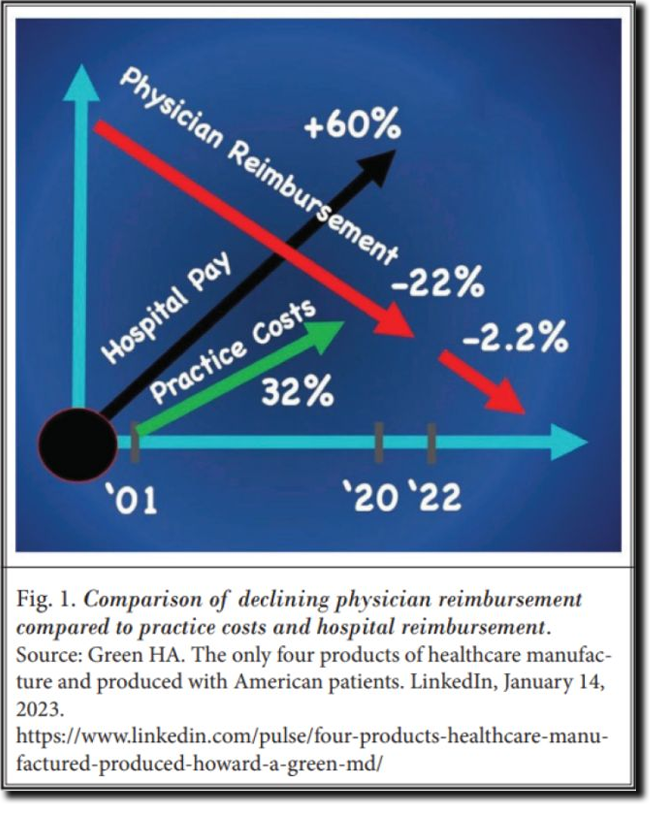
Physician payments have declined significantly due to budget neutrality rules and reimbursement cuts. Since 2001, Medicare payments to physicians have dropped by 33% when adjusted for inflation. These reductions have been compounded by 2% annual sequestration cuts introduced after the Affordable Care Act (ACA), which continues through 2032. Despite their long-term impact, sequestration cuts receive little public attention.
Congress has historically delayed or softened these cuts. However, in 2025, a bill that would have adjusted payment rates was removed from the continuing resolution, resulting in continued reductions. Meanwhile, insurance premiums have risen nearly 400%, highlighting the disparity between healthcare costs and physician compensation.
| | |
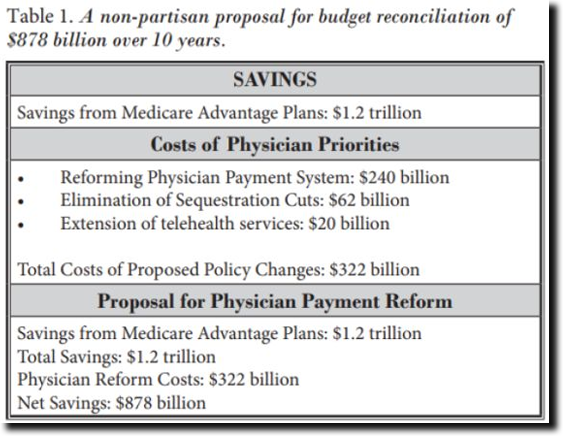
Ironically, while physicians face significant payment cuts, the Centers for Medicare & Medicaid Services (CMS) proposed on January 10, 2025, a 4.3% payment increase for Medicare Advantage plans, totaling $21 billion in 2026 and an estimated $210 billion over the following decade starting in calendar year 2026. This proposal comes amid ongoing concerns about Medicare Advantage overpayments, estimated at nearly $100 billion annually, and additional funding through annual premiums of $198 from all Medicare beneficiaries, amounting to roughly $13 billion per year.
In response, the American Society of Interventional Pain Physicians (ASIPP) submitted a nonpartisan reform proposal advocating for telehealth protections and elimination of sequester cuts - measures that have received strong bipartisan support in Congress.
Both the House of Representatives and the Senate voted to pass a reconciliation bill, nicknamed the “Big Beautiful Bill”, which has been signed into law by the President recently. It proposes an $8.9 billion investment in the Medicare Physician Fee Schedule, with a 2.25% update in 2026.
The proposal does not address the budget neutrality provision, growing practice costs, inflationary pressures, or ongoing sequestration and pay-as-you-go (PAYGO) cuts. It also fails to resolve issues with the Medicare Access and CHIP Reauthorization Act (MACRA), particularly within the Merit-Based Incentive Payment System (MIPS).
On November 1, 2024, CMS finalized a 2.8% cut to physician payments, an estimated $20 billion, while also eliminating telehealth services. These cuts continue to threaten physician sustainability and patient access to care.
Click here to read the full Pain Physician journal article.
| | |
Protecting patients from bad news in the digital age
"I hid her MyChart radiology report on purpose." I was shocked to hear the neurologist (Dr. A) tell me this after our patient had left the exam room.
Dr. A is universally admired by my medical school class for both his teaching and his ability to connect deeply with patients; the waiting list to join him for weekly clinic runs a semester long. I was ecstatic to learn from him. When I heard him say these words, I became even more intrigued than I was already.
Our patient had come for an evaluation after experiencing non-focal neurological symptoms for several months. She had a family history of multiple sclerosis (MS) and wanted to be evaluated for it; as part of the diagnostic process, she had undergone an MRI a few weeks earlier. The purpose of this appointment was to review that study and discuss a plan moving forward. She was understandably nervous in the clinic -- her rapid speech and jittery feet made that clear.
Click here to read the full article.
| | JOIN or RENEW your ASIPP Membership for the best registration rates. | | |
Patients arriving at appointments with researched information is not new, but artificial intelligence (AI) tools such as ChatGPT are changing the dynamics.
Their confident presentation can leave physicians feeling that their expertise is challenged. Kumara Raja Sundar, MD, a family medicine physician at Kaiser Permanente Burien Medical Center in Burien, Washington, highlighted this trend in a recent article published in JAMA.
A patient visited Sundar’s clinic reporting dizziness and described her symptoms with unusual precision: “It’s not vertigo, but more like a presyncope feeling.” She then suggested that the tilt table test might be useful for diagnosis.
Click here to read the full article.
| |
AHA/ACC recommendations also switch to the PREVENT risk calculator
| | |
A Medscape report has revealed notable discrepancies between global physicians regarding their personal health, mental and physical well-being, burnout, and efforts to achieve and maintain balance in such a demanding profession.
French clinicians were most likely (88%) and German clinicians (45%) least likely to report that their own health and wellness was “a priority” or “important.” French doctors were also most likely (64%) to report feeling neither depressed nor burned out, well ahead of Canada (55%) and other European countries (Spain, 37%; Germany, 52%). In contrast, more than half of doctors in Argentina (64%) and Brazil (54%) said they were depressed, burned out, or both.
The findings were published in the Medscape International Physician Mental Health & Well-Being Report 2025.
Click here to read the full article.
| | |
Mark your calendars!
August 30, September 27, October 25,
November 15, & December 13
Four (4) hour virtual exam
- ABIPP Path – Combined CCPM/ CSM Exam
For those with subspecialty in Pain Medicine
Two (2) hour virtual exam
- ABIPP Competency Exam in IPM
For those without primary board certification
Two (2) hour virtual exam
- ABIPP Competency Exam in Regenerative Medicine
Two (2) hour virtual exam
- Controlled Substance Management Competency Exam
Two (2) hour virtual exam
- Documentation, Coding, Compliance, Practice Management Competency Exam
Two (2) hour virtual exam
| | |
On a frigid November night in 2018, Michelle Sullivan came home from dinner with friends, took the dog out, and suddenly felt something off.
“I walked outside, and I could feel my heart go into an odd rhythm,” says Sullivan, an osteopath from southern Illinois whose husband, Bill, is an emergency physician.
A shower failed to relax her, and Sullivan suggested an EKG. “This is what happens when you’ve got two doctors living together,” she laughs. “I said, ‘I don’t think I have time for an EKG. Something’s really wrong.’”
Click here to read the full article.
| | | |
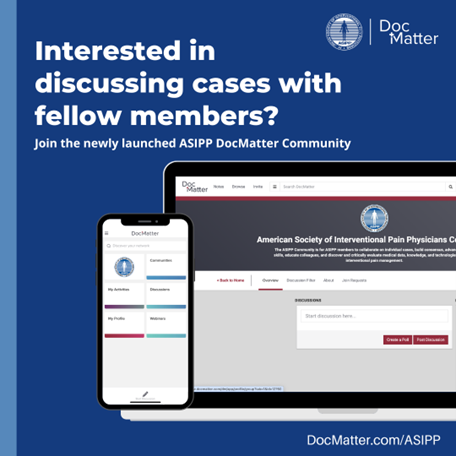
We're excited to let you know that the new ASIPP Community, hosted by DocMatter, is now live!
The ASIPP Community on DocMatter will serve as a place for members to collaborate around clinical and research topics to advance the care of their interventional pain patients.
Click here to be a part of the conversation!
| | |
Pain Medicine Case Reports (PMCR) and Editor-in-Chief Alaa Abd-Elsayed, MD, PhD would like to invite you to submit case reports and case series to the PMCR journal. Your article will be published free of charge.
Open access journals are freely available online for immediate worldwide open access to the full text of published articles. There is no subscription fee for open access journals. Open access journals are no different from traditional subscription-based journals: they undergo the same peer review and quality control as any other scholarly journal.
Interested in becoming a member of the PMCR Editorial Board?
Editorial board members are asked to review 2-6 manuscripts per year. Please submit your most up-to-date CV to sgold@asipp.org for consideration.
For more information or to submit your articles, click here.
| | |
We are excited to announce that Pain Medicine Case Reports (PMCR) journal (eISSN 2768-5152) has been accepted for inclusion in MEDLINE and PubMed, the prestigious bibliographic database of the U.S. National Library of Medicine. PMCR, a companion publication to the prestigious Pain Physician journal by ASIPP, joins its counterpart in achieving indexing in both MEDLINE and PubMed, marking ASIPP’s dual presence in these renowned databases.
The inclusion of PMCR journal in MEDLINE signifies a higher level of selectivity, as MEDLINE consists of the top 5,200 biomedical journals. This indexing also means that articles from PMCR will be searchable using NLM Medical Subject Headings (MeSH terms) and other metadata.
The selection for MEDLINE follows a rigorous evaluation process by reviewers from the Literature Selection Technical Review Committee (LSTRC). According to their criteria, the scientific quality of a journal’s content is the primary factor considered for indexing.
We extend our congratulations to the Pain Medicine Case Reports Editor-in-Chief, Deputy Editor-in-Chief, Journal Team, and Editorial Board for this achievement, which underscores the significance and excellence of this esteemed journal.
| | | | |
Prospective Case Series Evaluating the Efficacy of Radiofrequency Ablation With Stryker Venom Technology in the Treatment of Lumbar Facet Joint Pain
Emily A. Panteli, MCh, and Aaron K. Calodney, MD
| |
A Case of Transverse Myelitis With an Intrathecal Pump: A Case Report
Jimmy Wen, BA, Shannon Dwyer, BA, Burhaan Syed, BS, Sugamjot Badhan, BS, Ramy Khalil, BS, and Foad Elahi, MD
| | | | |
|
Yuye Zhang, MD, Yingzi Zhang, MD, Xingyu You, MD, Xueli Qiu, MD, Wenxiang Tang, MD, Yufei Zhang, MD, and Fanguo Lin, MD
| |
Applying a Preoperative Planning Method Based on 3D Artificial Intelligence-generated Lumbar Models in Transforaminal Puncture: A Phantoms Study
Zhihai Su, MD, Chengjie Huang, MD, Zhifei Cui, MD, Yunfei Wang, MD, Wencong Zhang, PhD, Lei Zhao, PhD, Shumao Pang, PhD, Naiwen Zhang, MD, Libin Liang, PhD, Zhen Yuan, PhD, Qianjin Feng, PhD, Xiang Liu, MD, Tao Chen, MD, and Hai Lu, PhD
| | | | |
|
ASIPP is in collaboration with Curi Medical Liability Program
Since this malpractice insurance program officially launched in November 2018, ASIPP has signed up hundreds of providers with an average savings of 30%. This is professional liability insurance tailored to our specialty and will stand up for us and defend our practices.
Curi is a full-service advisory firm that serves physicians and their practices. Their valued advice is grounded in your priorities and elevated in your outcomes. They are driven by a deep understanding of your specific circumstances in medicine, business, and life. To read a few important points to keep in mind about the program, including discounts, administrative defense, cyber coverage, aggressive claims handling, and complimentary risk management CME activities, visit our website.
| | |
IMPORTANT UPDATE
SPR is happy to announce an important update regarding Humana Medicare Advantage. As of May 1, Humana is now recognizing SPRINT as a PNS therapy. Previously, SPRINT was categorized as PNT (Percutaneous Nerve Stimulation), which allowed denials on the grounds that the therapy fell outside the NCD.
Additional details are as follows:
Payer: Humana Medicare Advantage (click here to view policy)
Policy Title: Peripheral Nerve Stimulators
Policy changes: SPRINT no longer misclassified as PNT and is now appropriately classified as PNS. Humana is applying the Noridian Medicare LCD criteria to ALL PNS devices – Including SPRINT PNS!
Effective Date: 5/1/2025
Click here to view a PDF of the official policy update.
| | |
|
Group Purchasing Organization Offer Better Pricing and Creates Added Value
ASIPP has formed a partnership with Henry Schein and PedsPal, a national GPO that has a successful history of negotiating better prices on medical supplies and creating value-added services for independent physicians. Working with MedAssets, PedsPal provides excellent pricing on products like contrast media that alleviate some of the financial pressures you experience today.
Learn More
For updated information concerning tariffs on products, click here.
| |  |
|
ASIPP, Fedora Healthcare Solutions Partnership
ASIPP offers our members the benefit of a unique revenue cycle management/ billing service.
We have received a tremendous amount of interest in the ASIPP billing and coding program.
Click here to learn more about the negotiated rate for practices and more!
| | |
Like and Follow ASIPP® on Facebook, X, LinkedIn,
and YouTube for the most up-to-date news
related to you, your practice, and your patients!
| | | | |