|
As reported last week, there was a cyberattack on UnitedHealth Group’s subsidiary Change Healthcare. Change Healthcare started experiencing major problems Feb. 21 cutting providers off from payer reimbursements.
Due to lobbying from various groups including ASIPP, temporary loans for all providers including physicians have been arranged. If you recall, this was limited to only hospitals in the beginning.
On Saturday, March 9, 2024, CMS issued this statement announcing that in addition to considering applications for accelerated payments for Medicare Part A providers, applications for advanced payments for Part B suppliers will also be considered. Click here to see the statement.
CMS issued a Fact Sheet with additional details on eligibility requirements, certification terms, and payment amounts. Click here for the Fact Sheet.
All MACs will provide public information on how to submit a request for a Medicare accelerated or advanced payment on their website starting March 9, 2024.
CMS is also urging Medicaid Managed Care Plans and Medicare Advantage Plans to offer similar emergency payment loans to cope with Change Healthcare cyberattack.
In addition to the CMS program of accelerated payments, United Health Group's loan program administered through Optum Financial Services offers financial assistance to providers whose payer payments are processed through Changes EDI. The loan amount is based on average prior claims volume and how much the provider’s payment distributions have been affected. No interest or fees will be charged, but the funds must be repaid.
Overall, while this may help physicians who were excluded in the beginning, it may not be sufficient. Many practices are seeing that a mere fraction of the daily deposits are being given in the form of loans.
If you have any questions, contact your MAC, as well as Optum, your representative for United Health Group or Optum for assistance. Click here to contact your MAC.
| |
Join the AMA or Renew your Membership Today!
As of now, ASIPP has two positions available in the House of Delegates and all of the other memberships where they are available, even for the other societies within AMA. The American Medical Association (AMA) requires all societies to requalify for membership in the AMA House of Delegates (HOD) every five years. To keep and hopefully increase ASIPP's membership in these committees, we have to keep at a minimum 20% AMA membership, otherwise, ASIPP will lose the AMA membership with all the available advantages.
We encourage you to join or renew your membership in the AMA. Joining the AMA will further strengthen our specialty’s representation at the national level through the AMA House of Delegates, the AMA’s policymaking body, and strengthen our ability to meet the challenges in health care today with thoughtful, well-organized responses.
As a member of the AMA, you become part of the organization that unites physicians nationwide to tackle the major issues we all face: 47 million uninsured Americans, looming Medicare payment cuts, and the need for medical liability reform. Membership also gives you access to a broad range of practice management resources and award-winning publications such as the Journal of the American Medical Association, AMNews, AMA Morning Rounds, and the Archives journals.
Please take this opportunity to support the critical activities of ASIPP by joining the AMA today. To join or renew the AMA, we encourage you to visit www.ama-assn.org or call (800) 262-3211.
| |
U.S. Congress Finally Reduced the Cut by Half 1.68% from 3.37% Effective March 9, 2024
In a federal budget deal struck to avoid a government shutdown, the House of Representatives has voted to reduce about half (1.68%) of the 2024 3.37% across-the-board physician pay cut that took effect in January. The Senate is expected to vote soon, and the President is expected to sign which will be effective March 9.
This essentially means Congress has again failed to stop in its entirety a pay cut that threatens Medicare patients’ access to high-quality physician care.
The cut continues to persist over 2% of sequester cuts totaling 3.68%, on top of 4% from last year’s physician pay reduction. Unfortunately, in contrast to prior years, this payment rate is not retroactive.
This was achieved due to enormous effort by all organizations, including ASIPP, with widespread support to block the 3.37% Medicare cuts for physician services permanently.
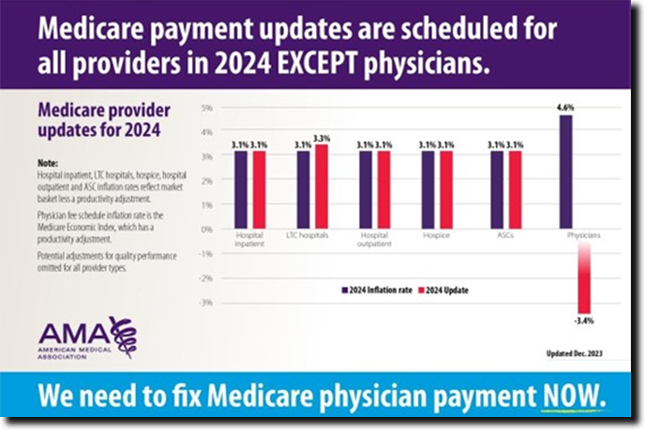
Our conversations with members of Congress show that they are looking at ways to create a permanent fix for these issues. We need to continue to place pressure on Congress for a permanent fix. The graph below shows 2024 Medicare payment updates before the 50% reduction of the cut as projected by AMA. The only change would be 1.68%, instead of 3.4%.
|  | |
|
The continued failure of Congress to commit to wholesale reforms that might actually fix our broken Medicare payment system is an insult to physicians, hobbles the financial viability of independent practices, and further erodes the health care safety net for tens of millions of Americans—with seniors and those in underserved communities most at risk.
While Congress did not outright ignore the urgent cries from physicians to reverse the planned 3.37% Medicare payment reduction that went into effect on Jan. 1, the 1.68% fix included in the 2024 appropriations package this week—reducing our cuts by half—is woefully inadequate and continues to put physician practices in a financial squeeze when they can least afford it. Medicare physician payment rates have plummeted by about 30% since 2001, adjusted for inflation, jeopardizing the long-term viability of our health care system.
The impact of sustained, year-over-year Medicare payment cuts will become noticeable first in rural and underserved areas and with small, independent physician practices. Physician practices will continue to scale back the number of Medicare patients they serve; many will stop seeing them permanently. My own parents faced this exact situation with their long-time primary care physician. Sadly, such situations often catch families off guard, leading to frantic searches for a replacement and delays in essential care.
Read More
| |
|
Virtual
April 27, May 25, June 29, & July 27
Click here for the complete list of upcoming exams.
ABIPP Part I; ABIPP Path - Combined DCCPM/CSM virtual exam;
ABIPP Competency Exam in IPM; ABIPP Competency Exam in Regenerative Medicine;
CSM Competency Exam; DCCPM Competency Exam
In Person
October 18, 2024
ABIPP Part II - Practical Examination
Lab Venue: MERI, 44 S. Cleveland Street, Memphis, TN 38104
| |
|
Change Healthcare, which suffered a ransomware attack last month cutting providers off from payer reimbursements, is offering doctors a temporary loan program to tide them over until the UnitedHealth Group (UHG) technology company's systems can be fixed.
The financial lifeline comes as hospitals and medical practices struggle to maintain cash flows, check insurance eligibility, and get life-saving treatments and prescriptions approved for patients.
"Claims are not going out, claims are not being processed, claims are not being paid," said Graig Straus, DNP, APRN, CEN, president of Rockland Urgent Care in West Haverstraw, New York. He told Medscape Medical News his practice is pulling from reserve funds to cover the delayed insurance reimbursements, but he will consider applying for the temporary loan if necessary.
Read More
| |
|
If current trends continue, patients are in big trouble
Declining reimbursements to surgeons under Medicare and private insurance for total joint replacement procedures are creating an untenable situation, researchers warned.
Already, according to a study presented here at the American Academy of Orthopaedic Surgeons' (AAOS) annual meeting, hourly rates for early-career orthopedic surgeons performing hip replacements are about the same as for dentists and travel nurses. And the same group projected that Medicare payments to physicians for hip replacement surgeries would drop below $11 per hour if the current downward-accelerating trend continues.
That bodes poorly for older Americans, as demand for joint replacement procedures has been projected to surpass 1.5 million annually by 2030, compared with about 1 million prior to the COVID-19 pandemic. It's hard to imagine surgeons agreeing to keep working, let alone join the profession, at pay rates below those currently earned by Taco Bell cashiers. Something has to give.
Read More
| |
|
Excellent opportunities for Residents & Fellows
at ASIPP's 2024 Annual Meeting:
-
Resident & Fellow Scholarship — Limited to 100!
- Abstract Session (April 4, 3:30–5:30pm) and Podium Presentation for Best Abstracts during General Session (April 5, 3:30–4:15pm)
- Half-Day Session dedicated to Young Physicians in Interventional Pain Management
| |
|
Conversations between primary care physicians and older patients often "challenging"
Older people with chronic pain expressed views about opioid use that often sharply differed from those of primary care doctors, an interview-based study indicated.
When asked about the risks associated with long-term opioid use, patients were mainly concerned about becoming addicted, whereas physicians were more worried about acute adverse events such as falling, according to Timothy S. Anderson, MD, MAS, of the University of Pittsburgh, and colleagues.
And while doctors in the study generally agreed that tapering opioid doses is often warranted, both they and the patients said conversations about "deprescribing" were difficult and often unsuccessful, the researchers reported in JAMA Network Open.
There were substantial areas of agreement, however, between patients and the physicians: Regarding opioids as a treatment of last resort is OK, the goal of pain therapy is to improve patients' comfort and functional ability, and trust is paramount in the patient-doctor relationship.
Read More
| |
|
Nation's premier psychiatric association calls proliferation of ketamine clinics the "wild west"
The proliferation of ketamine clinics in the U.S. has veered far off course from the recommendations of the nation's premier psychiatric association when it comes to using the anesthetic to treat mood disorders, experts say.
In 2017, the American Psychiatric Association (APA) issued a consensus statement on the use of ketamine in treating mood disorders, published in JAMA Psychiatry.
But the ketamine clinics cropping up across the U.S. don't appear to follow that guidance, Smita Das, MD, PhD, MPH, of Stanford University and a spokesperson for the APA, told MedPage Today.
"[Intravenous] ketamine is being offered in smaller clinics off-label and there isn't a practice guideline from the American Psychiatric Association that's recommending ketamine for use in the way that it's being used," Das said, noting that these clinics -- which tend not to involve psychiatric or mental health professionals -- often tout ketamine as a "miracle treatment."
Read More
| |
ASIPP State Society Meetings | |
|
Medicare a Big Contributor to the Broken Health Payment System, Senators Told
Use of "hybrid" payment model urged
Who is to blame for America's broken healthcare payment system? Witnesses and lawmakers mostly pointed fingers at Medicare during last week's Senate Budget Committee hearing on how primary care improves healthcare efficiency.
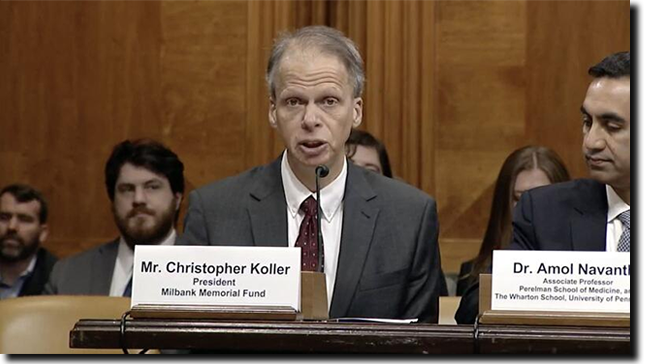
"Medicare's fee schedule has created this unbalanced delivery system and primary care crisis," said Christopher Koller, president of the Milbank Memorial Fund, in New York City. "How much and how it pays is not delivering value for the Medicare program or its beneficiaries. Medicare is the benchmark for all other payers, so this inefficiency is rippled through our entire healthcare system."
Concerns About the RUC
Koller especially faulted the RVS [Relative Value Scale] Update Committee -- known as the RUC -- a group of primary care and specialty physicians appointed by the American Medical Association that makes recommendations to Medicare regarding how much to reimburse for various Current Procedural Terminology (CPT) codes. He noted that a 2021 report from the National Academies of Science, Engineering, and Medicine, written by a committee on which Koller served, found that 90% of the RUC's recommendations are accepted by the Centers for Medicare & Medicaid Services.
Read More
| |
|
Federal agencies invite public comments
Government officials announced a joint investigation into the role of private equity and "corporate profiteering" in healthcare during an online workshop hosted by the Federal Trade Commission (FTC) on Tuesday.
The goal of the public inquiry is to collect information to guide agencies' understanding of the impact of private equity acquisitions in healthcare so they can better leverage enforcement tools to address issues, said FTC Chair Lina Khan.
"Given recent trends, we are concerned that transactions may generate profits for those firms at the expense of patients' health, workers' safety, and affordable health care for patients and taxpayers," wrote the Department of Justice, Department of Health and Human Services, and FTC in their joint request for information.
Private equity often operates on a model of taking a large stake in a platform company, investing in boosting its footprint and revenue, cutting costs, and ultimately selling the company to generate returns for investors. These firms can have money come from a range of sources.
Read More
| |
- ASIPP Members Only Site Information - | |
-
To log in for the first time you will need to click “forgot password” at the bottom of the login window.
- Check your email and then log in as directed.
-
If you have problems logging into your account, click here.
| |
Pain Medicine Case Reports (PMCR) and Editor-in-Chief Alaa Abd-Elsayed, MD, PhD would like to invite you to submit case reports and case series to the PMCR journal. Your article will be published free of charge.
Open access journals are freely available online for immediate worldwide open access to the full text of published articles. There is no subscription fee for open access journals. Open access journals are no different from traditional subscription-based journals: they undergo the same peer-review and quality control as any other scholarly journal.
Interested in becoming a member of the PMCR Editorial Board?
Editorial board members are asked to review 2-6 manuscripts per year. Please submit your most up-to-date CV to sgold@asipp.org for consideration.
For more information or to submit your articles, click here.
| |
|
Tolga Suvar, MD, Stephen Music, DO, Matthew Tan, MD, and Neal Mehta, MD
Abstract
BACKGROUND: Pain is a common symptom associated with cancer and can greatly compromise quality of life, motivation, and further treatments. Intrathecal pump (ITP) offers improved pain scores and clinical outcomes, while reducing the adverse effects of systemic analgesics.
CASE REPORT: A 29-year-old woman with neurofibromatosis type 1 had a malignant peripheral nerve sheath tumor in her right thigh surgically resected. However, one month later, metastatic lesions were found throughout her body. Despite chemotherapy, the disease spread and pain became severe resulting in multiple hospitalizations and halting treatment. Multimodal analgesia was pursued, including regional anesthesia, but she was unable to tolerate the adverse effects of systemic opioids. For long-term analgesia, ITP was pursued, which significantly improved her pain control and quality of life.
CONCLUSIONS: In advanced stages of cancer, we highlight the significant benefits ITP offers with improved quality of life and reduced medication side-effect profiles vs systemic analgesics.
KEY WORDS: Intrathecal pump, regional anesthesia, palliative care, cancer, chronic pain, opioids
Read More
| |
|
Laxmaiah Manchikanti, MD, Emilija Knezevic, Nebojsa Nick Knezevic, MD, PhD, Mahendra R. Sanapati, MD, Alan D. Kaye, MD, PhD, Salahadin Abdi, MD, PhD, Amol Soin, MD, and Joshua A. Hirsch, MD
Abstract
BACKGROUND: Chronic axial spinal pain is one of the major causes of disability. Literature shows that spending on low back and neck pain and musculoskeletal disorders continues to escalate, not only with disability, but also with increasing costs, accounting for the highest amount of various disease categories. Based on the current literature utilizing controlled diagnostic blocks, facet joints, nerve root dura, and sacroiliac joints have been shown as potential sources of spinal pain. Therapeutic facet joint interventional modalities of axial spinal pain include radiofrequency neurotomy, therapeutic facet joint nerve blocks, and therapeutic intraarticular injections.
OBJECTIVE: The objective of this systematic review and meta-analysis is to evaluate the effectiveness of facet joint nerve blocks as a therapeutic modality in managing chronic axial spinal pain of facet joint origin.
STUDY DESIGN: A systematic review and meta-analysis of randomized controlled trials (RCTs) and observational studies utilizing the Preferred Reporting Items for Systematic Reviews and Meta-Analyses (PRISMA) checklist.
METHODS: The available literature on facet joint nerve blocks in axial spinal pain was reviewed. The quality assessment criteria utilized were the Cochrane review criteria to assess risk of bias, the Interventional Pain Management Techniques – Quality Appraisal of Reliability and Risk of Bias Assessment (IPM-QRB) for randomized therapeutic trials, and the Interventional Pain Management Techniques – Quality Appraisal of Reliability and Risk of Bias Assessment for Nonrandomized Studies (IPM-QRBNR) for nonrandomized studies. The evidence was graded according to Grading of Recommendations, Assessment, Development, and Evaluation (GRADE) assessment criteria. The level of evidence was based on best evidence synthesis with modified grading of qualitative evidence from Level I to Level V.
A comprehensive literature search of multiple databases from 1966 to July 2023, including manual searches of the bibliography of known review articles was performed. Quality assessment of the included studies and best evidence synthesis were incorporated into qualitative and quantitative evidence synthesis.
OUTCOME MEASURES: The primary outcome measure was the proportion of patients with significant relief and functional improvement of greater than 50% of at least 3 months. Duration of relief was categorized as short-term (less than 6 months) and long-term (greater than 6 months).
RESULTS: This assessment identified 8 high-quality and one moderate quality RCTs and 8 high quality and 4 moderate quality non-randomized studies with application of spinal facet joint nerve blocks as therapeutic modalities. However, based on the Grading of Recommendations, Assessment, Development and Evaluations (GRADE) assessment, only 3 of the 21 studies showed high levels of evidence and clinical applicability, with 11 studies showing moderate levels of GRADE evidence and clinical applicability.
LIMITATIONS: Despite the availability of multiple studies, the paucity of literature is considered as the major drawback. Based on Grading of Recommendations, Assessment Development, and Evaluations (GRADE) assessment, only 3 of the 21 studies showed high levels of evidence and clinical applicability.
CONCLUSION: Based on the present systematic review and meta-analysis with 9 RCTs and 12 non-randomized studies, the evidence is Level II with moderate to strong recommendation for therapeutic facet joint nerve blocks in managing spinal facet joint pain.
KEY WORDS: Facet joint pain, facet joint nerve blocks, radiofrequency neurotomy, diagnostic facet joint nerve blocks, therapeutic facet joint nerve blocks, randomized controlled trials, meta-analysis, observational studies
Read More
| |
Cytokine Expression in Cancer Survivors Suffering From Chronic Pain: A Systematic Review
Amber De Groote, Thijs Vande Vyvere, PhD, Wiebren Tjalma, MD, PhD, Wim Vanden Berghe, PhD, Samir Kumar-Singh, PhD, An De Groef, PhD, and Mira Meeus, PhD
Abstract
BACKGROUND: Chronic cancer-related pain remains underdiagnosed and undertreated, although it affects 40% of cancer survivors. Recent insights suggest that cytokine signaling between immune, neuro, and glial cells contributes to chronic pain.
OBJECTIVES: This study systematically reviewed cytokine levels and their relation to chronic cancer-related pain and, additionally, investigated differences in cytokine levels between cancer survivors with and without chronic pain.
STUDY DESIGN: Systematic review.
METHODS: This systematic review was conducted and reported following the Preferred Reporting Items for Systematic Reviews and Meta-Analysis guidelines (PRISMA). The study conducted a systematic literature search in the databases PubMed, Web of Science, and Embase for articles examining cytokine levels and pain experience at a time point of a minimum of 3 months post-cancer diagnosis. Pain experience was categorized into a total pain score, pain intensity, and pain interference. The risk of bias was assessed using the Newcastle Ottawa Scale.
RESULTS: Eight articles were included, investigating 6 cancer types and 30 cytokines. Moderate evidence was found for pro-inflammatory cytokine IL-6 to be correlated with pain intensity, of which higher levels are observed in cancer survivors experiencing chronic pain compared to pain-free survivors. Moderate evidence was found for TNF-alpha to be not correlated with any pain experience, which is similar for anti-inflammatory cytokines IL-8 and IL-10 with pain intensity. For the remaining 26 cytokines and pain outcomes, only limited evidence was found for an association or alteration.
LIMITATIONS: The number of included studies was small. Overall, studies showed a moderate risk of bias, except one indicated a high risk of bias.
CONCLUSION: More standardized post-cancer treatment studies are warranted to confirm these results and explore associations and alterations of other cytokines. Nonetheless, moderate evidence suggests that elevated levels of IL-6, in contrast with TNF-alpha levels, are correlated with pain intensity in cancer survivors experiencing chronic pain compared to pain-free survivors.
KEY WORDS: Cytokines, interleukin, chronic cancer-related pain, chronic pain, persistent pain, cancer pain, IL-6, TNF-alpha
Read More
| |
|
ASIPP is now in collaboration with Curi Medical Liability Program
| |
|
Since this malpractice insurance program officially launched in November 2018, ASIPP has signed up hundreds of providers with an average savings of 30%. This is professional liability insurance tailored to our specialty and will stand up for us and defend our practices.
Curi is a full-service advisory firm that serves physicians and their practices. Their valued advice is grounded in your priorities and elevated in your outcomes. They are driven by a deep understanding of your specific circumstances in medicine, business, and life. To read a few important points to keep in mind about the program, including discounts, administrative defense, cyber coverage, aggressive claims handling, and complimentary risk management CME activities, visit our website.
| | |
|
Group Purchasing Organization Offer Better Pricing and Creates Added Value
ASIPP has formed a partnership with Henry Schein and PedsPal, a national GPO that has a successful history of negotiating better prices on medical supplies and creating value-added services for independent physicians. Working with MedAssets, PedsPal provides excellent pricing on products like contrast media that alleviate some of the financial pressures you experience today.
Learn More
| |  |
|
ASIPP, Fedora Billing,
and Revenue Cycle Management Partnership
ASIPP is now offering our members the benefit of a unique revenue cycle management/ billing service.
We have received a tremendous amount of interest in the ASIPP® billing and coding program.
Click here to learn more about the negotiated rate for practices and more!
| |
|
Like and follow ASIPP® on Facebook, X, and LinkedIn for the most
up-to-date news related to you, your practice, and your patients!
| | | | |