|
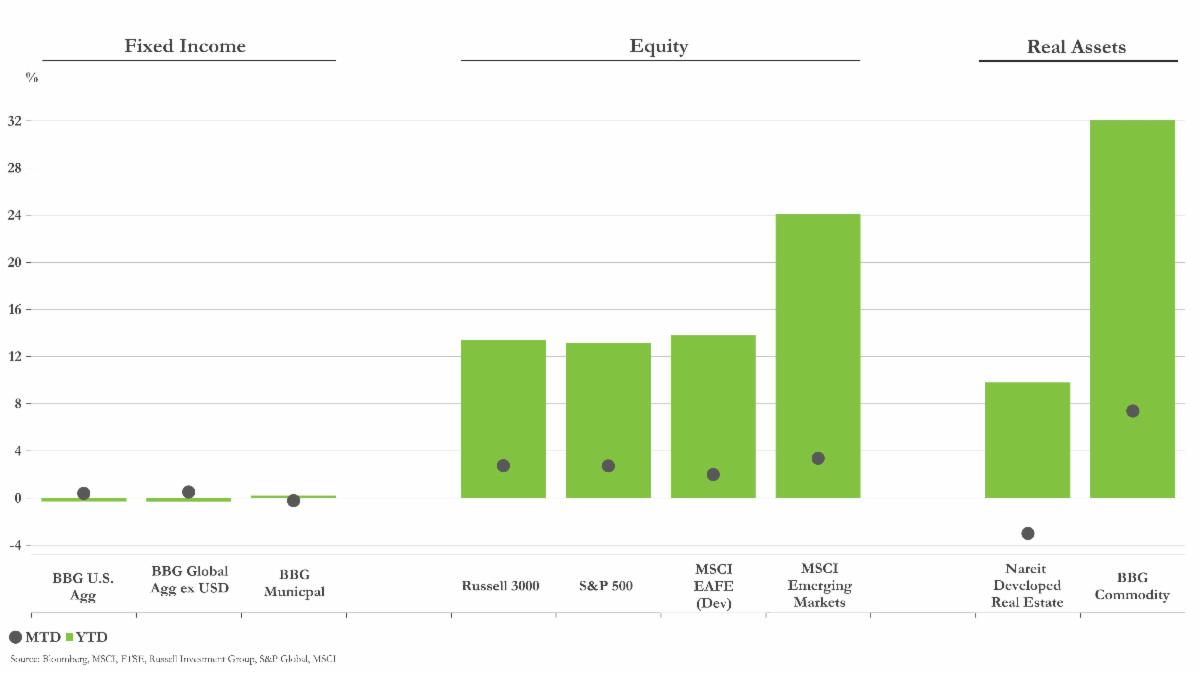
BBG U.S. Agg
Bloomberg U.S. Aggregate Bond Index
The Bloomberg U.S. Aggregate Bond Index is a broad-based flagship benchmark that measures the investment grade, U.S. dollar-denominated, fixed-rate taxable bond market. The index includes Treasuries, government-related and corporate securities, MBS (agency fixed-rate pass-throughs), ABS, and CMBS (agency and non-agency).
BBG Global Agg ex USD
Bloomberg Global Aggregate Index
The Bloomberg Global Aggregate Index is a flagship measure of global investment grade debt from twenty-four local currency markets. This multi-currency benchmark includes Treasury, government-related, corporate, and securitized fixed-rate bonds from both developed and emerging markets issuers.
BBG Municipal
Bloomberg Municipal Bond Index
The Bloomberg Municipal Bond Index covers the U.S. dollar-denominated long-term tax-exempt bond market. The index has four main sectors: state and local general obligation bonds, revenue bonds, insured bonds, and pre-refunded bonds.
Russell 3000
Russell 3000 Index
The Russell 3000 Index measures the performance of the largest 3,000 U.S. companies representing approximately 98% of the investable U.S. equity market. It is constructed to provide a comprehensive, unbiased, and stable barometer of the broad market and is completely reconstituted annually to ensure new and growing equities are included.
Russell 2000
Russell 2000 Index
The Russell 2000 Index measures the performance of the small-cap segment of the U.S. equity universe. It is a subset of the Russell 3000 Index repre-senting approximately 10% of the total market capitalization of that index. It includes approximately 2,000 of the smallest securities based on a combi-nation of their market cap and current index membership.
S&P 500
S&P 500 Index
The S&P 500 Index is a market capitalization-weighted index of 500 widely held stocks often used as a proxy for the stock market. It measures the movement of the largest issues. Standard and Poor’s chooses the member companies for the 500 based on market size, liquidity, and industry group representation. Included are the stocks of eleven different sectors.
MSCI EAFE (Dev)
MSCI EAFE Index
The MSCI EAFE Index (Europe, Australasia, Far East) captures large- and mid-cap representation across developed markets countries around the world, excluding the U.S. and Canada. The index covers approximately 85% of the free float-adjusted market capitalization in each country.
MSCI Emerging Markets
MSCI Emerging Markets Index
The MSCI Emerging Markets Index captures large- and mid-cap representation across emerging markets countries across the world. The index covers approximately 85% of the free float-adjusted market capitalization in each country.
HFRI Fund Weighted Composite
HFRI Fund Weighted Composite Index
The HFRI Fund Weighted Composite Index is a global, equal-weighted index of single-manager funds that report to HFR Database. Constituent funds report monthly net of all fees performance in US Dollar and have a minimum of $50 Million under management or $10 Million under management and a twelve (12) month track record of active performance. The HFRI Fund Weighted Composite Index does not include Funds of Hedge Funds.
Nareit Developed Real Estate
FTSE EPRA/NAREIT Developed Index
The FTSE EPRA/NAREIT Developed Index is designed to track the performance of listed real estate companies and REITS worldwide. Index constituents are free float-adjusted, subject to liquidity, size, and revenue screening for inclusion.
BBG Commodity
Bloomberg Commodity Index
The Bloomberg Commodity Index reflects commodity futures price movements and is calculated on an excess return basis. The index rebalances annually weighted 2/3 by trading volume and 1/3 by world production, and weight-caps are applied at the commodity, sector, and group level for diversification. The roll period typically occurs from the 6th-10th business day based on the roll schedule.
Consumer Confidence Index
Conference Board Consumer Confidence Index
The Consumer Confidence Index is a measure based on a survey administered by The Conference Board that reflects prevailing business conditions and likely developments for the months ahead. This monthly report details consumer attitude, buying intentions, vacation plans, and consumer expectations for inflation, stock prices, and interest rates.
U.S. Dollar Index (DXY)
U.S. Dollar Index (DXY)
The U.S. Dollar Index (DXY) is an index of the value of the United States dollar relative to a basket of foreign currencies, often referred to as a basket of U.S. trade partners' currencies. The Index goes up when the U.S. dollar gains "strength" (value) when compared to other currencies.
DJIA
Dow Jones Industrial Average
The Dow Jones Industrial Average (DJIA), commonly known as “The Dow”, is a price-weighted measure of 30 U.S. blue-chip companies. The index covers all industries except transportation and utilities.
ISM Manufacturing Index
ISM Manufacturing Index
The ISM Manufacturing Index, also known as the purchasing managers’ index (PMI), is a monthly indicator of U.S. economic activity based on a survey of executives covering all North American Industry Classification System’s businesses in the manufacturing sector.
ISM Non-Manufacturing Index
ISM Non-Manufacturing Index
The ISM Non-Manufacturing Index is a monthly indicator of U.S. economic activity based on a survey of executives covering all North American Industry Classification System’s businesses in the services (or non-manufacturing) sector.
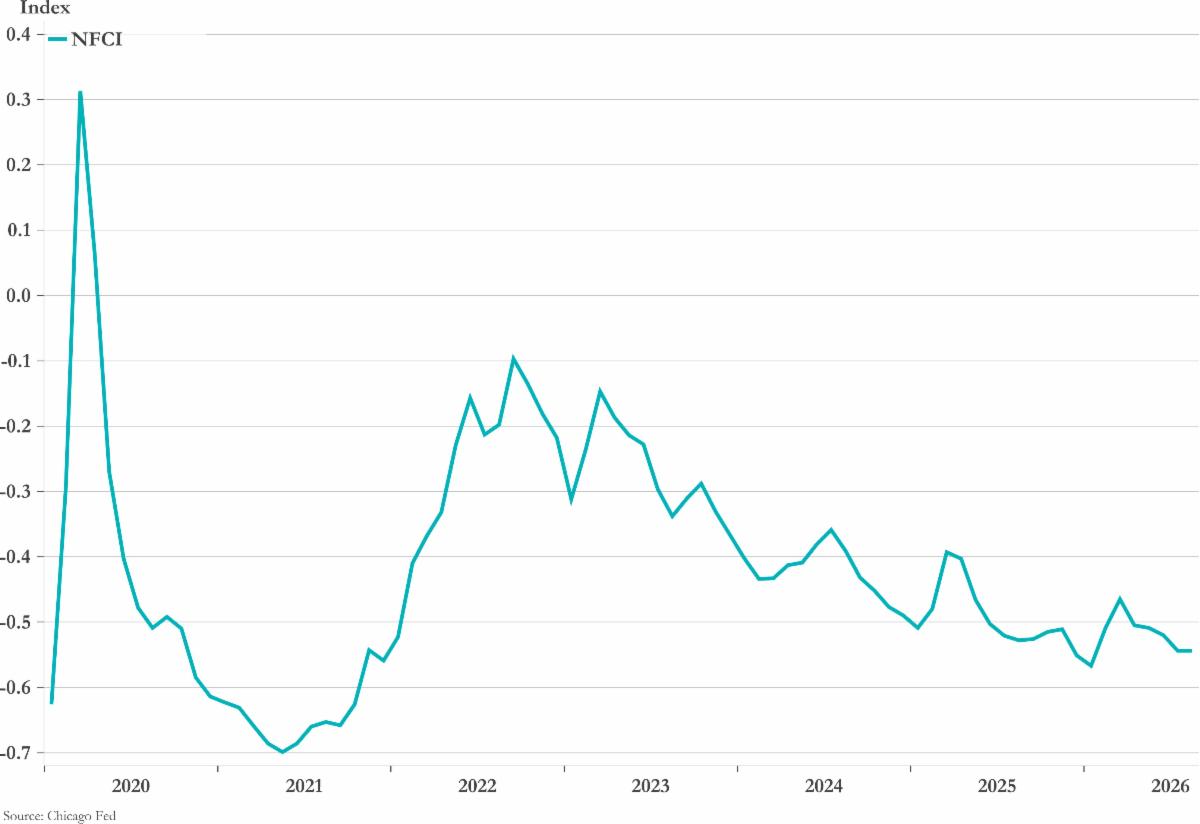
NFCI
Federal Reserve Bank of Chicago National Financial Conditions Index (NFCI)
The National Financial Conditions Index (NFCI) is a weekly report that measures U.S. financial health across money markets, debt and equity markets, and traditional or shadow banking systems. Created by the Federal Reserve Bank of Chicago, it combines 105 different market indicators into a single score.
MOVE Index
Merrill Lynch Option Volatility Estimate Index
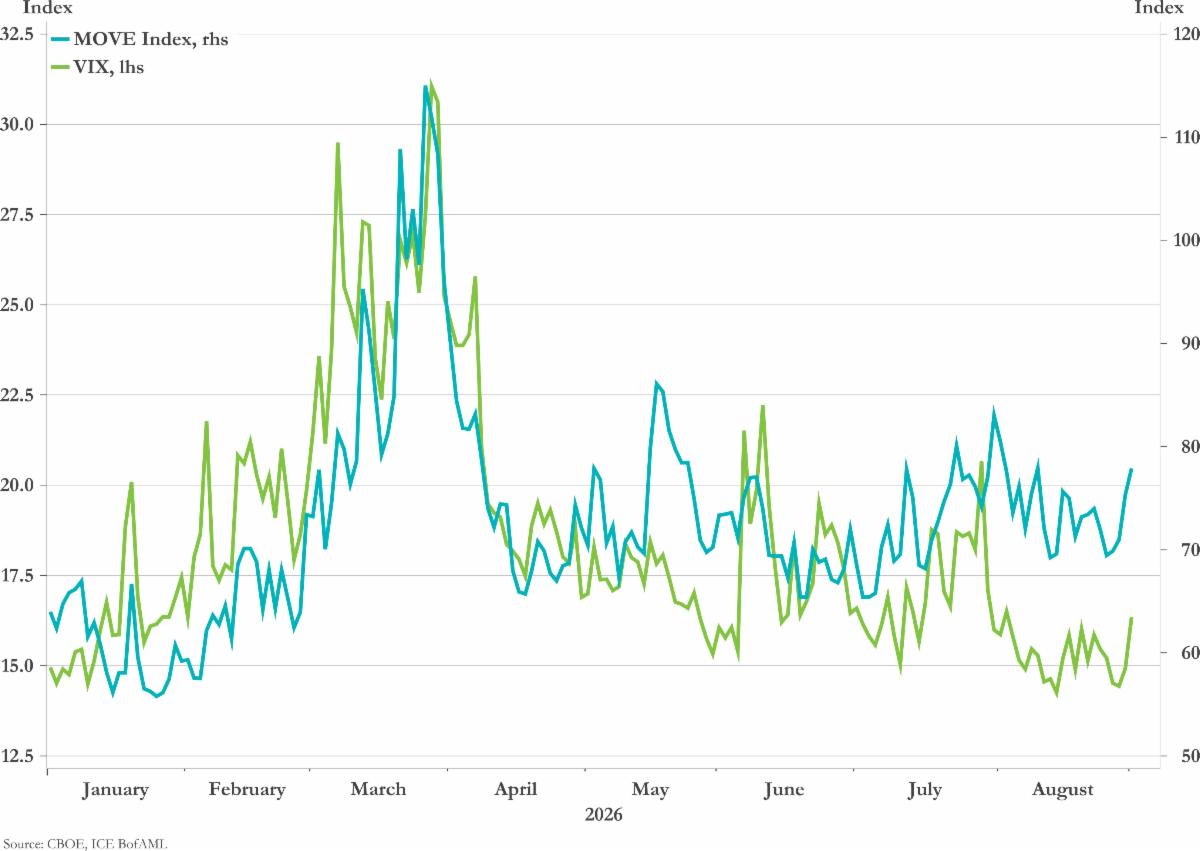
The MOVE Index measures expected volatility in the U.S. Treasury market. Higher readings indicate greater uncertainty about the future path of interest rates, inflation, and Federal Reserve policy; lower readings indicate a more stable bond market.
VIX
CBOE Volatility Index
A measure of expected volatility in the S&P 500 over the next 30 days, often referred to as the stock market's "fear gauge." Higher readings indicate greater investor uncertainty and expected market volatility.
|