First Quarter 2026 - Investment Newsletter

KEY TAKEAWAYS

>>  Geopolitical risks re‑entered the spotlight in early 2026 with U.S. military intervention in Venezuela and U.S.–Iran tensions escalated, disrupting energy markets and resurfacing inflation concerns. Oil prices and volatility spiked amid fears of supply disruptions through the Strait of Hormuz, though intermittent signs of potential de‑escalation have so far helped limit broader economic spillovers. With negotiations ongoing and outcomes uncertain, the risk of renewed escalation remains elevated.

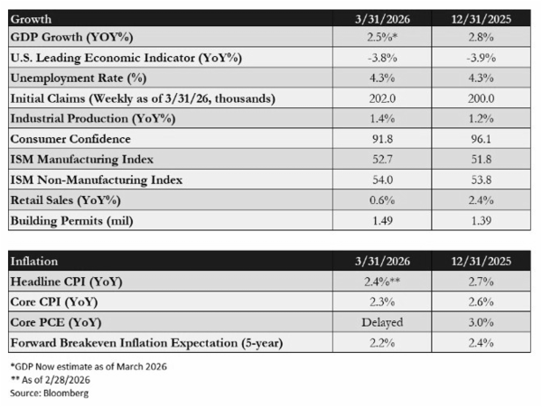
>> Despite elevated headline risk, the U.S. economy has continued to hold up. Growth has moderated but remains supported by consumer spending and business investment, while recent labor market data suggest conditions are easing gradually rather than weakening outright.

>> Inflation trends remain uneven. Easing pressures across services and housing had supported expectations for policy easing, but renewed energy price volatility has complicated the outlook and reinforced a more cautious, data‑dependent Federal Reserve stance.

>> U.S. equity markets posted modestly negative returns during the quarter amid heightened geopolitical uncertainty and elevated valuations. Weakness in mega‑cap technology held back index-level performance, even as market leadership broadened across smaller companies and non‑mega‑cap segments.

  • International equities also ended the quarter in negative territory but remained ahead of U.S. markets, building on the relative outperformance from 2025. Both developed and emerging markets modestly led U.S. equities, supported by broader market participation and more attractive starting valuations, though global uncertainty continued to weigh on returns.


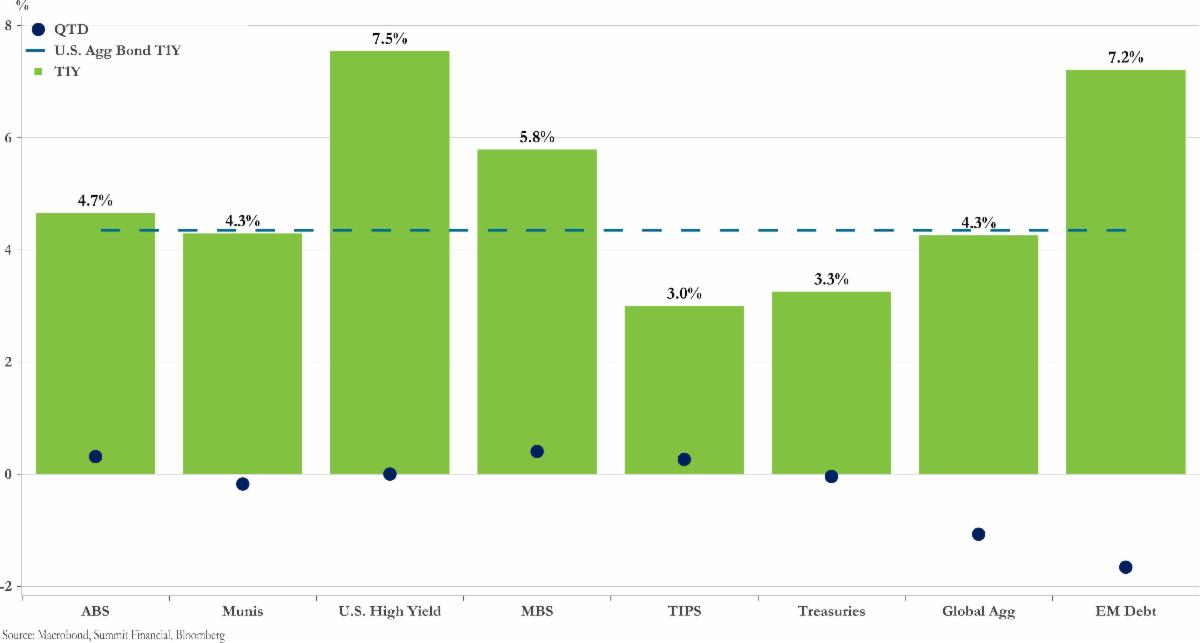
  • Fixed income assets produced muted returns so far in 2026, ranging from flat to modest declines depending on market segment. Rate volatility resurfaced following the outbreak of the U.S.-Iranian conflict and renewed inflationary concerns. Despite results, higher quality fixed income presents reasonable starting yields and continues to serve as an important ballast amidst future volatility.


  • Municipals delivered modest but stabilizing returns over the first quarter supported by intact credit fundamentals, steady reinvestment demand, and improving technicals despite intermittent rate volatility. A steeper municipal yield curve, historically attractive tax‑equivalent yields, and strong state and local balance sheets position the asset class favorably, particularly for investors able to lean into duration and active security selection.


  • Private credit had its share of headlines extending from isolated defaults in 2025 to concerns around future viability for software and related businesses with the advancement of AI capabilities. Manager portfolio fundamentals remain resilient and despite sensationalized headlines, the outlook for the asset class is still constructive with a competitive yield premium over the broadly syndicated loan market.


  • The environment for privates outside of credit is constructive but nuanced. Private real estate, which faced similar media scrutiny to private credit during 2021/22, is coming out of trough valuations and has a constructive outlook going forward. Private infrastructure is also a bright spot, benefiting from stabilizing valuations, steepening yield curves, and long‑term structural demand (digital infrastructure, energy transition). Private equity activity is increasing, although still suppressed relative to historical levels, while secondary markets remain attractive and robust.


  • After a benign back half of 2025 for investors, 2026 has delivered no shortage of surprises within just the first few months. Change is one of the few constants, and amid heightened geopolitical volatility, evolving tariff dynamics, and the accelerating implications of AI disruption, maintaining discipline has become paramount. This reinforces the importance of core principles including diversification, prudent rebalancing, robust risk controls, and ensuring portfolios remain aligned with long-term strategic asset allocations.

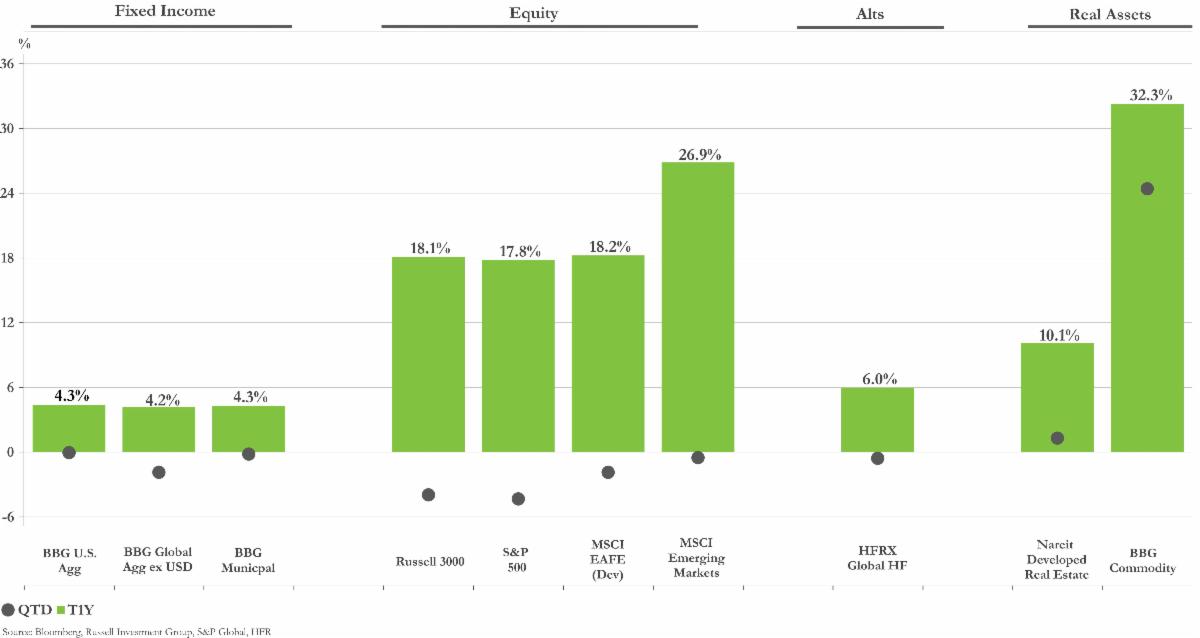
Asset Class Performance as of 3/31/2026

ECONOMY

As the first quarter of 2026 came to a close, the U.S. economy continued to hold up better than many expected, though signs of cooling have become more visible. Growth remains supported by consumer spending, business investment, and ongoing capital deployment into technology and digital infrastructure. Beneath the headline data, however, momentum has become increasingly uneven across sectors and income groups, reinforcing the K‑shaped dynamic that has defined much of the post‑pandemic expansion.


Manufacturing continues to face more headwinds than much of the broader economy. Demand has been cautious, input costs remain elevated, and supply chains continue to adjust following several years of disruption. Factory output and new orders have struggled to gain consistent traction, as higher financing costs and uncertain end demand have weighed on capital spending.


Tariff‑related pressures and energy price volatility have further complicated conditions for import‑reliant and energy‑intensive industries. While there are early signs of stabilization, manufacturing activity continues to lag the services and technology‑oriented parts of the economy, suggesting it will remain a modest drag on growth in the near term.


The labor market has cooled, but conditions have not deteriorated to the point of becoming a key concern for policymakers. March payroll growth rebounded from a weak February, though gains were concentrated in a narrow set of sectors, particularly health care. The unemployment rate edged lower, but largely due to a decline in labor force participation rather than a broad acceleration in hiring. Wage growth has continued to slow, reaching its lowest pace since 2021, which helps relieve inflation pressure but also reflects softer labor demand. Taken together, the data points to a labor market moving toward a slower and more balanced footing, supportive of growth but unlikely to prompt near‑term policy urgency.


Financial conditions have remained accommodative despite periodic volatility. Equity markets entered the year with elevated valuations, while fixed income markets have grappled with renewed uncertainty around the interest rate path. Fiscal policy continues to provide modest support through targeted spending and infrastructure investment, even as rising deficits remain a longer‑term consideration. Consumer confidence remains uneven, with higher‑income households benefiting from asset‑driven wealth effects, while affordability pressures persist for lower‑income consumers.


The U.S. dollar has also played an important role in shaping the economic backdrop. After weakening meaningfully in 2025, the dollar traded in a more range‑bound fashion during the first quarter. Slower relative growth, large fiscal deficits, and narrowing interest rate differentials have limited upside, while the dollar’s reserve currency status and periodic safe‑haven demand have provided support amid geopolitical uncertainty. Movement in the dollar remains important for inflation, trade competitiveness, and returns on international assets, and will continue to reflect differences in monetary policy paths across global economies.


Overall, the economic backdrop entering the second quarter of 2026 remains constructive but not without crosscurrents. Growth is intact, inflation risks have not fully faded, and policy uncertainty persists. While these factors warrant attention, supportive fundamentals and easing financial conditions suggest the economy remains positioned for continued expansion, albeit at a more measured pace.

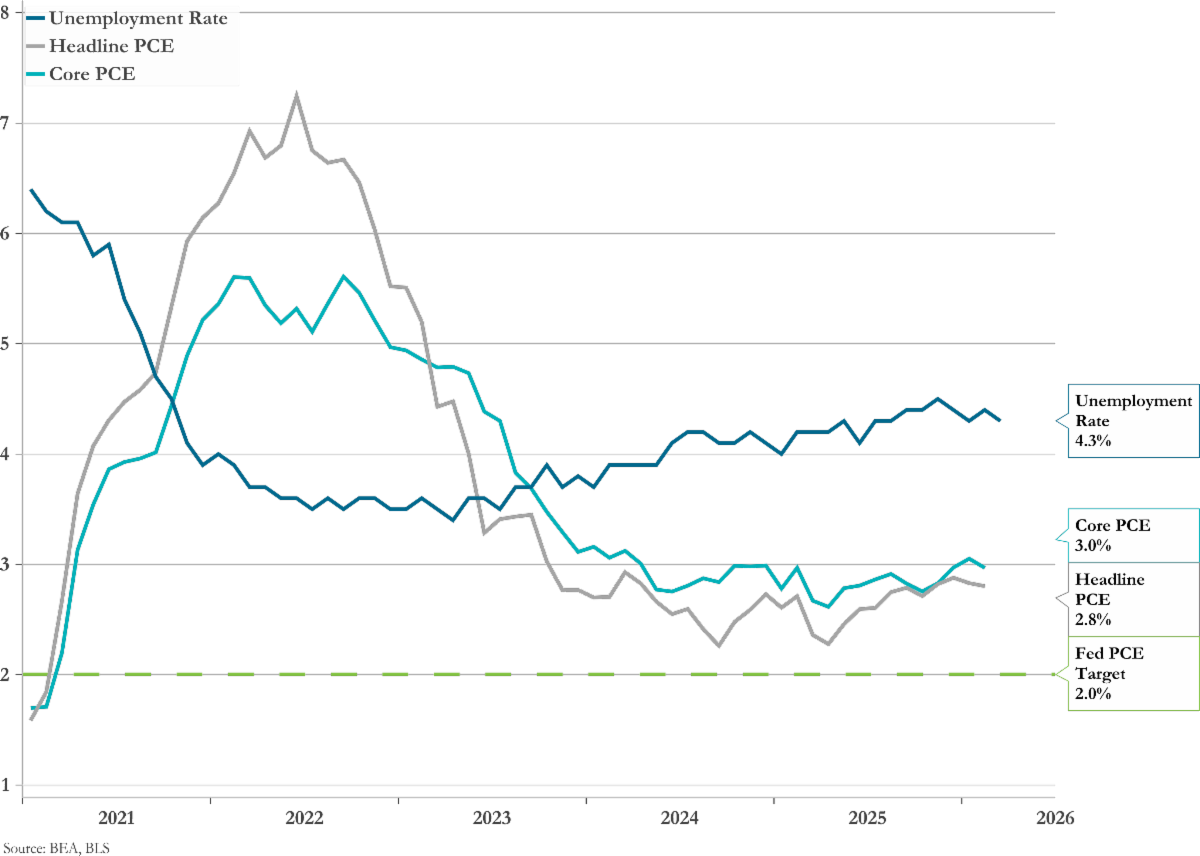
Inflation and Policy Implications


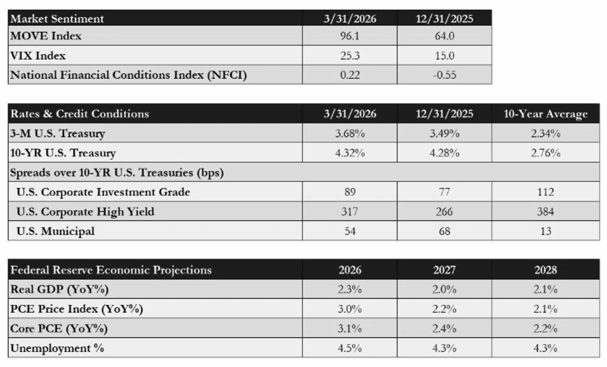
  • Inflation dynamics remain mixed, as moderating core inflation, particularly in services and housing, supported expectations for policy easing entering the year, but renewed energy market volatility tied to the war in Iran has reintroduced upside risks.


  • Sustained increases in energy prices could feed through to transportation, goods, and services costs, slowing progress toward the Fed’s inflation target and reinforcing a more cautious and data‑dependent approach to potential interest rate cuts in 2026.


  •  Moderate inflation can benefit commodities, energy infrastructure, and companies with pricing power, while a significant spike would likely pressure long‑duration assets, rate‑sensitive sectors such as housing and utilities, and lower‑income consumers who are already facing affordability challenges.


Unemployment and PCE Inflation

MARKETS

Equities Markets


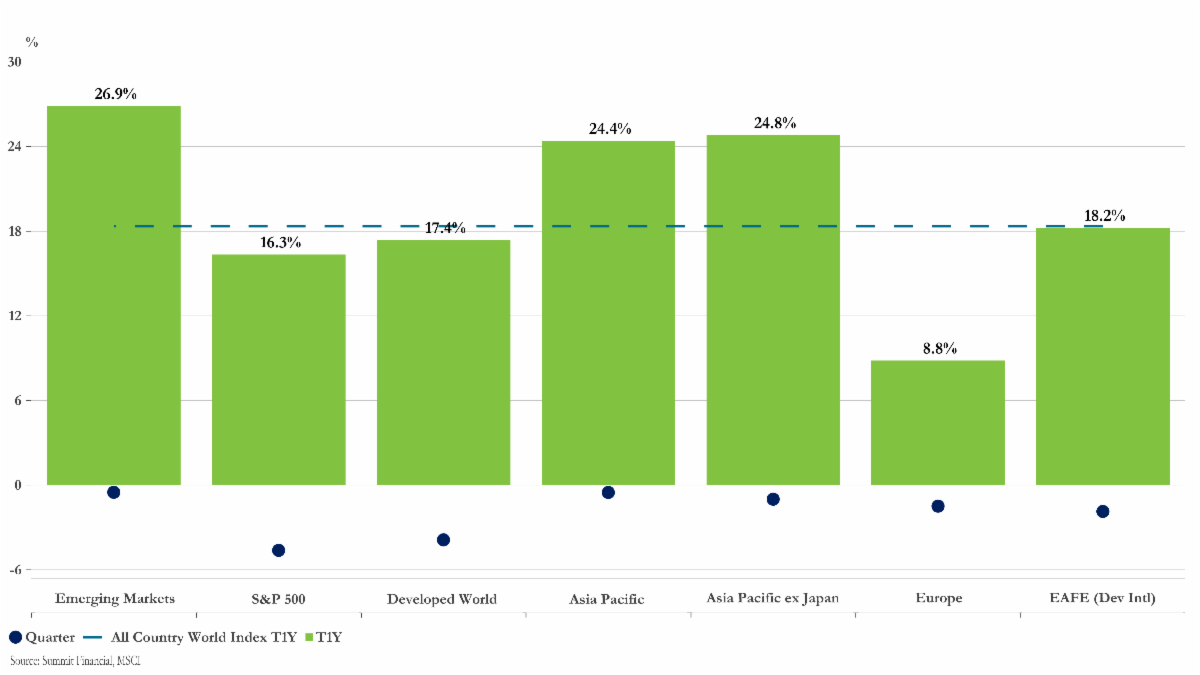
Global equity markets began 2026 with heightened volatility and mixed performance, marking a sharp contrast to the strong gains recorded last year. During the first quarter, U.S. equities declined meaningfully, while international markets proved relatively more resilient. The S&P 500 fell approximately 4.5%, snapping a streak of quarterly advances, as surging oil prices, rising interest rates, and escalating geopolitical tensions weighed on investor sentiment. As a result, U.S. stocks underperformed global peers throughout the quarter.


International markets fared better by comparison. The MSCI EAFE Index declined roughly 1%, while the MSCI Emerging Markets Index was broadly flat, returning approximately -0.2%. Within the U.S., performance was uneven across major indices. The Dow Jones Industrial Average fell 3.8%, and the Nasdaq declined 7%, marking the first notable quarterly pullback since early 2022, following initial gains in January. Toward the end of March, equities staged a modest rebound, supported by optimism surrounding a potential ceasefire in the Middle East.


Among developed international markets, Europe posted modest declines, the U.K. recorded gains, and Japan delivered solid performance, supported by domestic stimulus measures and a weaker yen. Emerging markets were largely flat, as strength among commodity‑exporting countries helped offset weakness in energy‑importing Asian economies.


Overall, the first quarter of 2026 represented a clear shift from the steady market advance seen in 2025, underscoring how quickly market conditions can change. Rising geopolitical tensions pushed oil prices higher, inflation concerns resurfaced, and volatility in the technology sector weighed on U.S. equities. Despite these challenges, diversified portfolios demonstrated greater resilience, with international exposure and value‑oriented investments helping to mitigate market pressure. As uncertainties around energy prices, Federal Reserve policy, and global developments persist, the second quarter begins with a continued focus on risk management and portfolio balance. The experience of Q1 reinforces the importance of diversification and maintaining a long‑term investment perspective amid periods of elevated market volatility.


Global Equity Market Performance

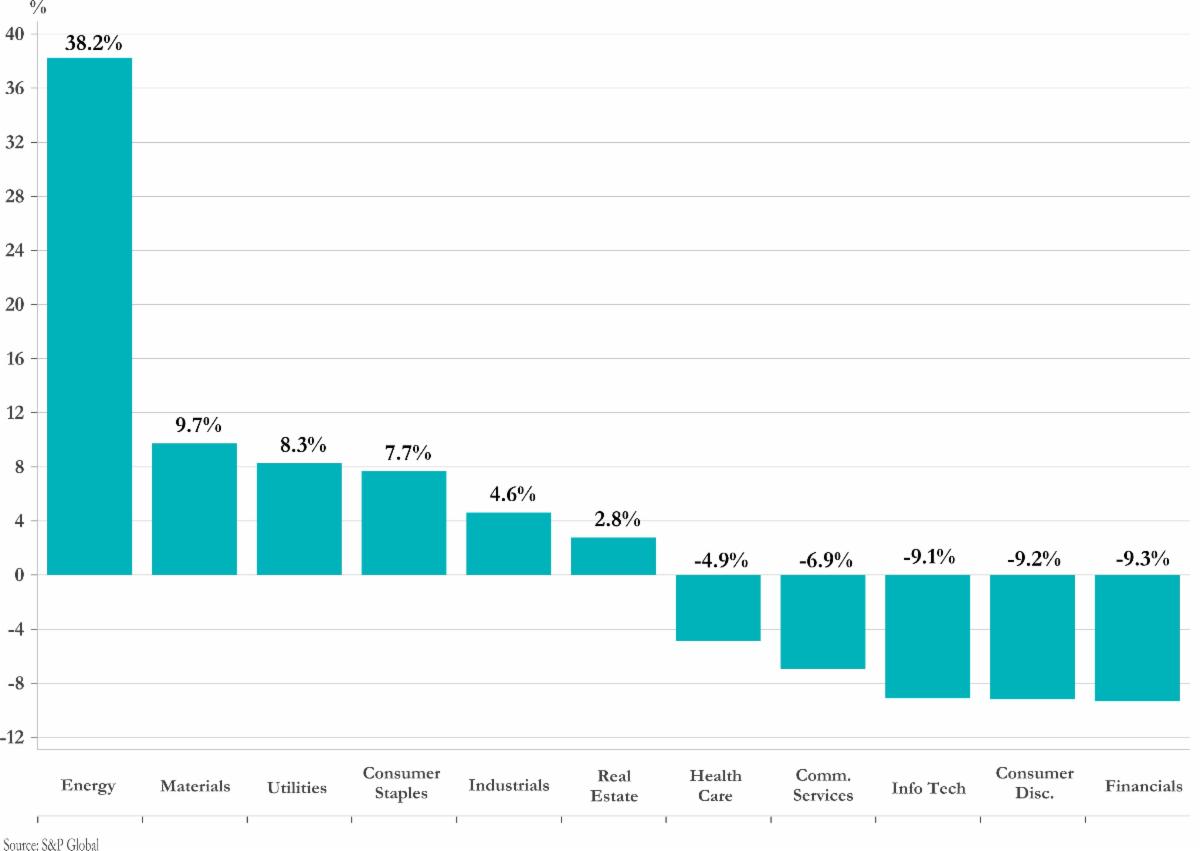
U.S. Equity Market Sector Leadership Rotation


  • Q1 2026 saw a clear rotation away from growth and mega-cap technology stocks toward energy, materials, utilities, and other defensive sectors, signaling a meaningful change in market leadership.


  • Energy significantly outperformed amid rising oil prices and geopolitical developments, while most growth-oriented sectors declined; information technology, consumer discretionary and financials all dropped more than 9%, reflecting heightened volatility.


  • Growing concerns that AI‑driven disruption could have outsized and uneven effects across industries prompted investors to broaden exposure, favoring diversification, defensives, and value‑oriented opportunities beyond technology.


S&P 500 Sector Returns - Q1 2026

Fixed Income Markets


U.S. fixed income delivered muted returns in the first quarter as geopolitical tensions weighed on sentiment. The conflict in the Middle East pushed oil prices higher, raising concerns that inflation may remain elevated and delaying expectations for interest rate cuts. The Fed left rates unchanged at a target range of 3.50-3.75%, and maintained expectations for just one rate cut in 2026, while revising inflation forecasts higher. Treasury yields drifted higher through March as markets reassessed the inflation outlook, and we saw a modest flight to quality. Treasuries and investment‑grade corporates outperformed high yield and global bonds, while TIPS generated positive returns given their inflation‑hedge structure.


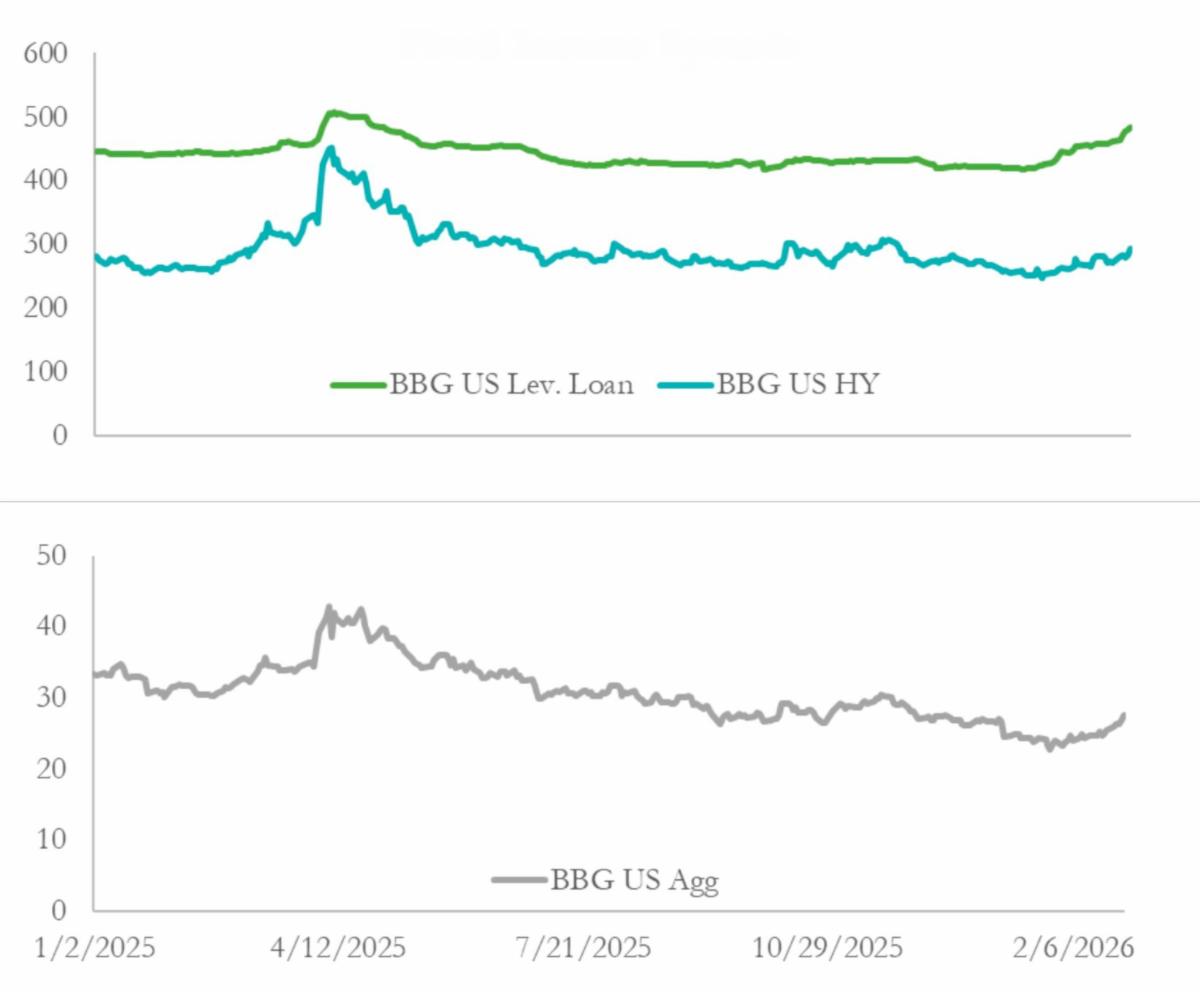
Credit spreads widened modestly during the quarter but remain below levels reached last April. Corporate fundamentals continue to look healthy, supported by solid earnings and expectations for positive EPS growth in 2026. The U.S. yield curve remains upward sloping, signaling stable underlying economic conditions. One area of relative weakness has been leveraged loans, where spreads widened more materially amid concerns around AI‑related disruption in software and high- profile credit issues within the consumer sector.


Municipal bond returns were relatively stable early in the quarter but declined sharply in March as geopolitical developments fueled inflation fear and pushed yields higher. Heavy new issuance added technical pressure, with supply in early 2026 tracking ahead of last year’s record pace. The combination of higher Treasury yields and heavier supply contributed to weaker performance.


Looking ahead to the second quarter, the key focus will be whether tensions in the Middle East can be resolved quickly. A prolonged conflict would keep oil prices elevated and reinforce a higher inflation outlook, increasing the likelihood of a no-cut scenario in 2026. This would impact business sentiment and could lead to a broader risk-off tone across bonds.


Fixed Income Sector Performance

Spreads Widened in 1Q26


  • Investment‑grade spreads widened by 4 bps, while high yield and leveraged loan spreads widened 52 bps and 69 bps, respectively, over the quarter.


  • Investment‑grade spreads moved off multi‑year tights, reflecting a gradual normalization from previously and unusually compressed levels.


  • Spread widening was broad‑based across credit markets, though leveraged loans experienced the largest move, driven by loan‑specific concerns including AI‑related pressure on software business models and several high‑profile consumer‑sector defaults.


  • Despite wider spreads, credit fundamentals remained generally stable, with corporate balance sheets and interest‑coverage ratios still supportive.


Fixed Income Spreads

REAL ASSETS


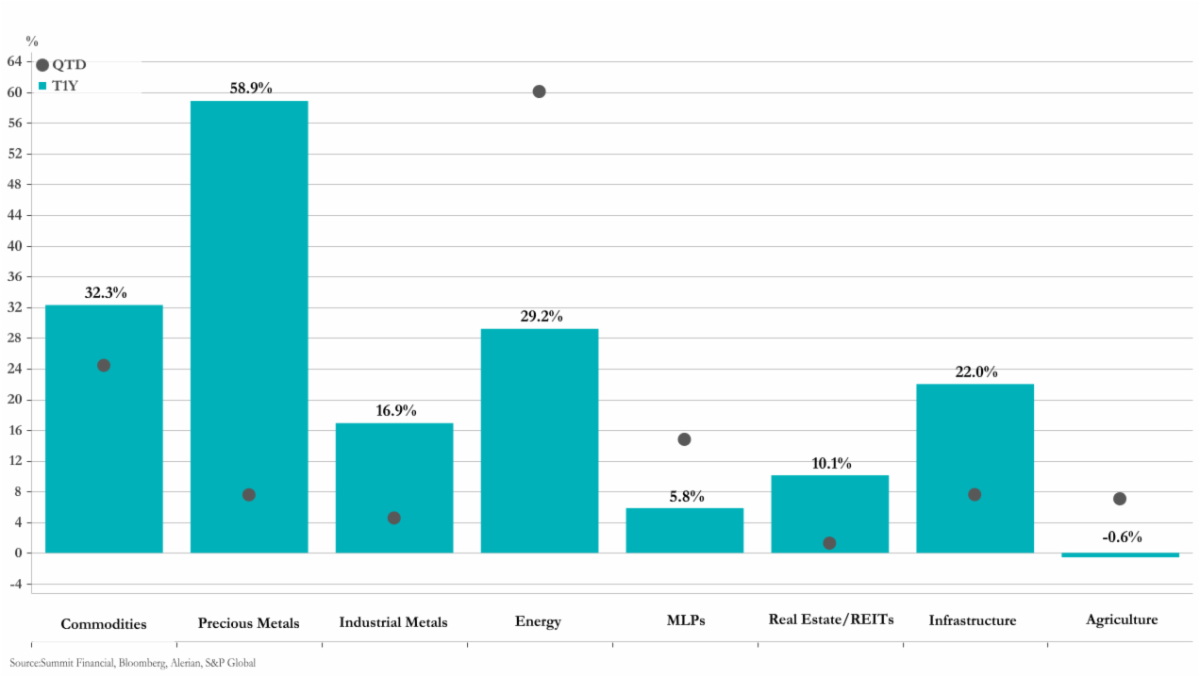
Public real assets delivered a strong start to the year, with positive returns across all major segments and energy leading performance. The Bloomberg Energy Subindex rose sharply during the first quarter as oil prices climbed to roughly $105 per barrel, reflecting tightening supply conditions and elevated geopolitical risk. Energy markets remained sensitive to developments in global production and trade, with policy responses and inventory management remaining in focus as volatility persisted.


Commodities also posted a robust first quarter, supported by broad‑based demand and tightening inventories across several key raw materials. While performance varied by subsector, overall gains reflected continued interest in real assets as a source of diversification amid shifting macroeconomic conditions. Disruptions to global trade flows and supply chains remained an important driver of price movements, contributing to heightened volatility across commodity markets.


Precious metals advanced during the quarter, supported by geopolitical uncertainty and continued central bank demand, though gains moderated toward quarter‑end following a March pullback. Industrial metals also moved higher, reflecting demand tied to electrification, infrastructure investment, and clean‑energy‑related supply chains. Price movements across metals were shaped by a combination of structural demand trends and near‑term supply dynamics.


Within public real estate, performance weakened late in the quarter as interest‑rate volatility weighed on valuations, reducing quarterly gains. Higher financing costs and margin pressure continued to influence investor sentiment and sector performance. In contrast, public infrastructure delivered solid returns, supported by steady demand for essential services and continued growth in digital infrastructure assets such as data centers, which remained a key source of resilience within the real assets landscape.


Real Assets Performance

Heightened Volatility in Oil Markets


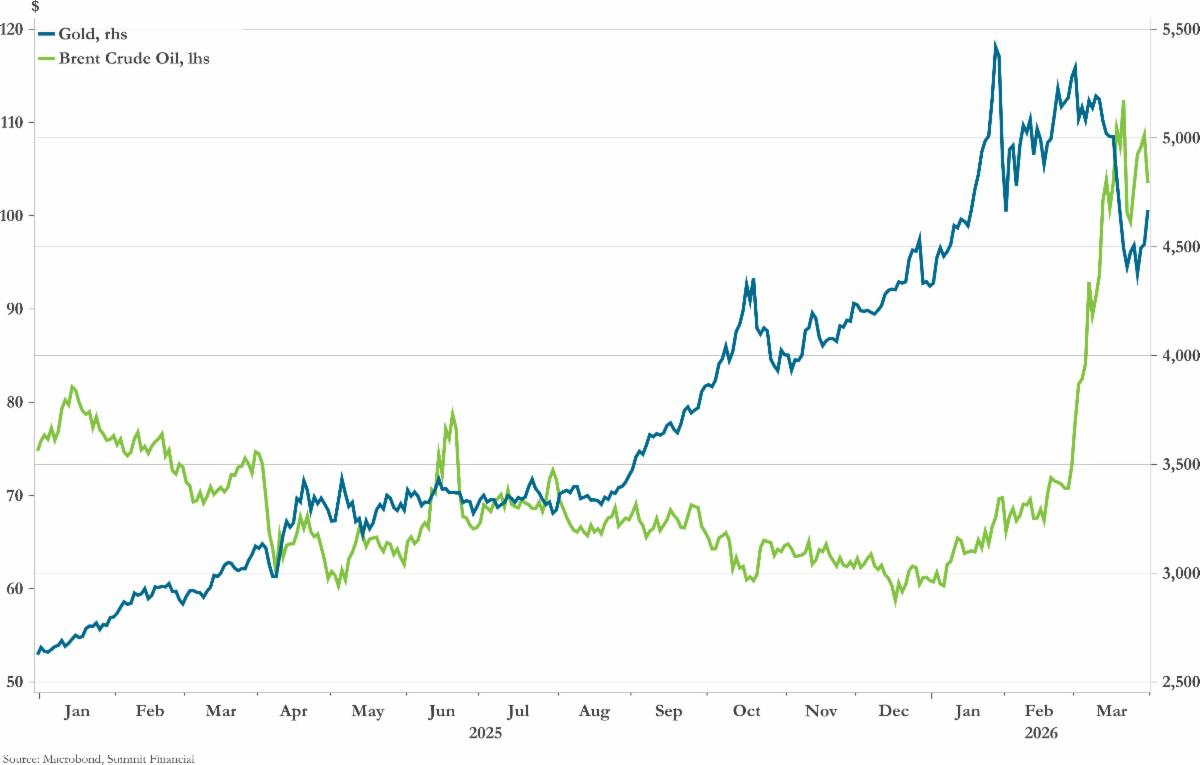
  • Brent crude recorded one of its strongest quarterly gains in decades, as oil markets shifted rapidly from surplus conditions toward tighter supply.


  • Escalating geopolitical tensions, including conflict involving Iran and disruptions in the Strait of Hormuz, a critical transit route for global oil flows, drove a sharp repricing of energy risk.


  • Energy markets grew increasingly volatile, with headline‑driven trading, rising tanker rates, and renewed attention on strategic reserves highlighting the fragility of global energy supply chains and shipping logistics.


  • The shift toward tighter energy supply conditions reinforced broader macro concerns around inflation, growth sensitivity, and the transmission of geopolitical risk across global markets.


Gold & Brent Crude Oil Prices

ALTERNATIVES


Geopolitics once again became a key market driver in early 2026, with ripple effects felt across private markets. The late February outbreak of war in Iran, alongside broader instability in the Middle East, pushed energy prices higher and contributed to bouts of market volatility. These developments slowed activity in certain areas and reinforced the importance of discipline, particularly around underwriting standards and liquidity management. As is often the case, periods of stress have helped differentiate asset quality and manager skill rather than altering the long‑term case for private markets.


Private equity entered 2026 on firmer footing after an extended period of subdued activity. Lower interest rates and improved credit availability helped narrow valuation gaps and supported a gradual pickup in deal activity that began late last year. Portfolio company fundamentals have remained solid, with technology adoption and AI‑driven efficiency continuing to support growth, particularly across technology and healthcare. That said, elevated valuations and a sizable backlog of investments have kept deployment measured, and exits and fundraising remain below the highs of 2021 and 2022. Looking ahead, conditions appear supportive for continued improvement through 2026, though competition for high‑quality assets remains.


Private credit continued to draw strong investor interest, supported by attractive yields and generally stable portfolio fundamentals. Demand remained robust following a strong 2025, particularly through semi‑liquid structures, while first‑lien loan yields stayed compelling relative to public markets. Defaults have remained contained, and interest coverage has benefited from easing rates. At the same time, several high‑profile credit events and heightened media attention brought renewed focus to liquidity terms and fund structures. While these developments warrant monitoring, recent challenges appear isolated rather than systemic, and the outlook for well‑diversified, conservatively underwritten strategies remains constructive.


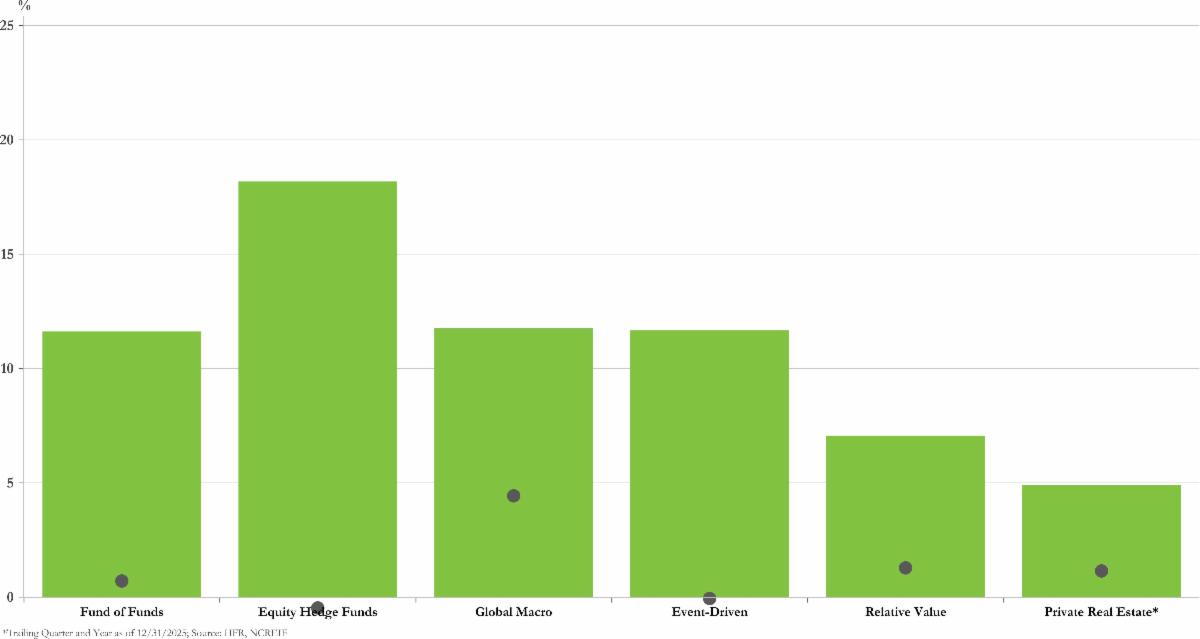
Private real estate continued to show a more nuanced and uneven backdrop. The sector appears to be working through prior valuation pressure, with pricing beginning to stabilize and fund net asset values improving from recent lows. Performance remains highly differentiated by property type and geography, with industrial and multifamily assets generally holding up better amid steady demand and constrained supply, while office assets remain challenged in select markets as leasing activity and capital flows stay subdued. Elevated financing costs have tempered transaction activity, reinforcing the importance of selectivity and asset quality.


Private infrastructure remained a relative bright spot, supported by durable, long‑term demand tied to digital infrastructure, electrification, and the global energy transition. Stable cash‑flow profiles and inflation‑linked revenue characteristics continued to underpin investor interest, even as elevated valuations and evolving regulatory frameworks necessitate disciplined underwriting. While near‑term deal activity has moderated, long‑term fundamentals remain supportive given persistent capital needs and policy alignment across key infrastructure segments.


Hedge funds delivered solid results amid a volatile start to the year, extending the favorable backdrop seen in 2025. Sharp market moves driven by geopolitical developments and shifting interest rate expectations created opportunities, particularly for macro and trading‑oriented strategies, while select long‑short equity managers benefited from increased dispersion. Looking ahead, performance differences across strategies are likely to widen, reinforcing the value of diversification and thoughtful manager selection.


Across private markets, maintaining a long‑term perspective remains essential. Periods of volatility and uncertainty are a normal part of market cycles, particularly for asset classes with longer investment horizons. While short‑term disruptions can test sentiment, they also reinforce the importance of partnering with experienced managers that demonstrate disciplined underwriting and repeatable value creation. Over time, this focus should support more consistent outcomes across market environments.


Alternatives Performance

DISCLAIMER

Compliance Code: 8868658.1


This commentary was authored by the investment team at Summit Financial, LLC., an SEC Registered Investment Adviser (“Summit”), headquartered at 4 Campus Drive, Parsippany, NJ 07054, Tel. 973-285-3600. It is provided for your information and guidance and is not intended as specific advice and does not constitute an offer to sell securities. Summit is an investment adviser and offers asset management and financial planning services. Indices are unmanaged and cannot be invested into directly.


Data in this newsletter is obtained from sources which we, and our suppliers believe to be reliable, but we do not warrant or guarantee the timeliness or accuracy of this information. Consult your financial professional before making any investment decision. Past performance is no guarantee of future results. Diversification/asset allocation does not ensure a profit or guarantee against a loss. Economic and market forecasts presented herein reflect our judgment as of the date of this presentation and are subject to change without notice. Any forecasts are subject to high levels of uncertainty that may affect actual performance. Accordingly, forecasts should be viewed as merely representative of a broad range of possible outcomes. Forecasts are estimated, based on assumptions, and are subject to significant revision and may change materially as economic and market conditions change. Forecasts do not take into account the specific investment objectives, restrictions, tax and financial situation or other needs of any specific client.


DEFINITIONS & DESCRIPTIONS

CBOE Volatility Index (VIX)

The CBOE Volatility Index (VIX) reflects the market’s real-time expectation of 30-day forward-looking volatility. It is created by the Chicago Board of Options Exchange (CBOE).


National Financial Condi- tions Index (NFCI)

The Chicago Fed’s National Financial Conditions Index (NFCI) provides a comprehensive weekly update on U.S. financial conditions in money markets, debt and equity markets, and the traditional and “shadow” banking systems


Consumer Confidence Index

The Consumer Confidence Index is a measure based on a survey administered by The Conference Board that reflects prevailing business conditions and likely developments for the months ahead. This monthly report details consumer attitude, buying intentions, vacation plans, and consumer expectations for inflation, stock prices, and interest rates.


Consumer Price Index

The Consumer Price Index (CPI) is a measure of the average change over time in the prices paid by urban consumers for a market basket of consumer goods and services.


Core Inflation

Core Inflation is a measure of economic inflation that excludes food and energy


Headline Inflation

Headline Inflation is a measure of the total economic inflation that includes food and energy prices


ISM Manufacturing Index

The ISM Manufacturing Index, also known as the purchasing managers’ index (PMI), is a monthly indicator of U.S. economic activity based on a survey of executives covering all North American Industry Classification System’s businesses in the manufacturing sector.


ISM Non-Manufacturing Index

The ISM Non-Manufacturing Index is a monthly indicator of U.S. economic activity based on a survey of executives covering all North American Industry Classification System’s businesses in the services (or non-manufacturing) sector.


Leading economic indicators (LEI)

Leading economic indicators (LEI) are statistics that precede economic events. They predict the next phase of the business cycle.


Merrill Lynch Option Vola- tility Estimate Index (MOVE Index)

The MOVE index, or Merrill Lynch Option Volatility Estimate Index, is a gauge of interest rate volatility in the U.S. Treasury market. It is calculated from options prices, which reflect the collective expectations of market participants about future volatility. The index measures the implied volatility of U.S. Treasury options across various maturities


OECD Composite leading indicators (CLIs)

The OECD Composite leading indicators (CLIs), designed to anticipate turning points in economic activity relative to trend

Personal Consumption Expenditures Price Index


(PCE)

Personal Consumption Expenditures Price Index (PCE) is a measure of the prices that people living in the United States, or those buying on their behalf, pay for goods and services. The PCE price index is known for capturing inflation (or deflation) across a wide range of consumer expenses and reflecting changes in consumer behavior


The Federal Funds Rate

The Federal Funds Rate is the target interest rate range at which commercial banks borrow and lend their excess reserves to each other overnight, which is set by the Federal Open Market Committee (FOMC)


Treasury Bill (T-Bill)

A Treasury Bill (T-Bill) is a short-term U.S. government debt obligation backed by the Treasury Department with a maturity of one year or less;


U-3 unemployment rate

The U-3 unemployment rate is the most commonly reported rate in the United States, representing the number of unemployed people actively seeking a job


United States Industrial

Production

United States Industrial production refers to the output of industrial establishments and covers sectors such as mining, manufacturing, electricity, gas and steam and air-conditioning.

This indicator is measured in an index based on a reference period that expresses change in the volume of production output;


Consumer Sentiment

Consumer Sentiment is represented by The University of Michigan Consumer Sentiment Index which rates the relative level of current and future economic conditions.


Building Permits

Building Permits measures the change in the number of new building permits issued by the government. Building permits are a key indicator of demand in the housing market.


Retail Sales

Retail sales are an economic metric that tracks consumer demand for finished goods. This figure is a very important data set as it is a key monthly market-moving event. Retail sales are reported each month by the U.S. Census Bureau and indicate the direction of the economy.


Industrial Production

Industrial production refers to the output of industrial establishments and covers sectors such as mining, manufacturing, electricity, gas and steam and air-conditioning. This indicator is measured in an index based on a reference period that expresses change in the volume of production output.


Initial Claims

Initial claims refers to the government report on the number of workers applying for unemployment benefits for the first time following job loss.


Bloomberg U.S. Leveraged Loan Index

The Bloomberg U.S. Leveraged Loan Index measures the performance of USD denominated, high-yield, floating-rate, institutional leveraged loan market.


U.S. Agg

Bloomberg U.S. Aggregate Bond Index

The Bloomberg U.S. Aggregate Bond Index is a broad-based flagship benchmark that measures the investment grade, U.S. dollar-denominated, fixed-rate taxable bond market. The index includes Treasuries, government-related and corporate securities, MBS (agency fixed-rate pass-throughs), ABS, and CMBS (agency and non-agency).


Global Agg ex USD

Bloomberg Global Aggre- gate Index

The Bloomberg Global Aggregate Index is a flagship measure of global investment grade debt from twenty-four local currency markets. This multi-currency benchmark includes Treasury, government-related, corporate, and securitized fixed-rate bonds from both developed and emerging markets issuers.

Municipal


Bloomberg Municipal Bond Index

The Bloomberg Municipal Bond Index covers the U.S. dollar-denominated long-term tax-exempt bond market. The index has four main sectors: state and local general obligation bonds, revenue bonds, insured bonds, and pre-refunded bonds.


Russell 3000

Russell 3000 Index

The Russell 3000 Index measures the performance of the largest 3,000 U.S. companies representing approximately 98% of the investable U.S. equity market. It

is constructed to provide a comprehensive, unbiased, and stable barometer of the broad market and is completely reconstituted annually to ensure new and

growing equities are included.


S&P 500

S&P 500 Index

The S&P 500 Index is a market capitalization-weighted index of 500 widely held stocks often used as a proxy for the stock market. It measures the movement of the largest issues. Standard and Poor’s chooses the member companies for the 500 based on market size, liquidity, and industry group representation. In-

cluded are the stocks of eleven different sectors.


MSCI EAFE (Dev)

MSCI EAFE Index

The MSCI EAFE Index (Europe, Australasia, Far East) captures large- and mid-cap representation across developed markets countries around the world, excluding the U.S. and Canada. The index covers approximately 85% of the free float-adjusted market capitalization in each country.


MSCI Emerging Markets

MSCI Emerging Markets Index

The MSCI Emerging Markets Index captures large- and mid-cap representation across emerging markets countries across the world. The index covers approxi- mately 85% of the free float-adjusted market capitalization in each country.


HFRI FoF Comp.

HFRI Fund of Funds Composite Index

The HFRI Fund of Funds Composite Index is an equally weighted hedge fund of funds benchmark composed of global constituent funds. The underlying constituents are typically diversified among multiple managers and styles to provide a comprehensive representation of the hedge fund of funds investment

space.


Nareit Developed Real Estate

FTSE EPRA/NAREIT

Developed Index

The FTSE EPRA/NAREIT Developed Index is designed to track the performance of listed real estate companies and REITS worldwide. Index constituents are free float-adjusted, subject to liquidity, size, and revenue screening for inclusion.


BBG Commodity

Bloomberg Commodity Index

The Bloomberg Commodity Index reflects commodity futures price movements and is calculated on an excess return basis. The index rebalances annually weighted 2/3 by trading volume and 1/3 by world production, and weight-caps are applied at the commodity, sector, and group level for diversification. The roll period typically occurs from the 6th-10th business day based on the roll schedule.


Developed World

MSCI World Index

The MSCI World Index captures large- and mid-cap representation across developed markets countries. The index covers approximately 85% of the free float- adjusted market capitalization in each country.


Asia Pacific

 MSCI AC Asia Pacific Index

The MSCI AC Asia Pacific Index captures large and mid cap representation across 5 Developed Markets countries and 8 Emerging Markets countries in the Asia Pacific region. With 1,537 constituents, the index covers approximately 85% of the free float-adjusted market capitalization in each country.


Asia Pacific ex Japan

MSCI AC Asia Pac ex. Japan

The MSCI AC Asia Pacific ex Japan Index captures large and mid cap representation across 4 of 5 Developed Markets countries (excluding Japan) and 9 Emerging Markets countries in the Asia Pacific region. With 1,312 constituents, the index covers approximately 85% of the free float-adjusted market capitalization in each country.


Europe

MSCI Europe Index

The MSCI Europe Index captures large- and mid-cap representation across developed markets countries in Europe. The index covers approximately 85% of the free float-adjusted market capitalization across the European developed markets equity universe.


Comm. Services

S&P 500 Communication Services

The S&P 500® Communication Services comprises those companies included in the S&P 500 that are classified as members of the GICS® communication services sector.


Info Tech

S&P 500 Information Technology

The S&P 500® Information Technology comprises those companies included in the S&P 500 that are classified as members of the GICS® information technology sector.


Consumer Disc.

S&P 500 Consumer Discretionary

The S&P 500® Consumer Discretionary comprises those companies included in the S&P 500 that are classified as members of the GICS® Consumer Discretionary sector.


Industrials

S&P 500 Industrials

The S&P 500® Industrials comprises those companies included in the S&P 500 that are classified as members of the GICS® industrials sector.


Materials

S&P 500 Materials

The S&P 500® Materials comprises those companies included in the S&P 500 that are classified as members of the GICS® materials sector.


Energy

S&P 500 Energy

The S&P 500® Energy comprises those companies included in the S&P 500 that are classified as members of the GICS® energy sector.


Real Estate

S&P 500 Real Estate

The S&P 500® Real Estate comprises those companies included in the S&P 500 that are classified as members of the GICS® Real Estate sector.


Financials

S&P 500 Financials

The S&P 500® Financials comprises those companies included in the S&P 500 that are classified as members of the GICS® financials sector.


Consumer Staples

S&P 500 Consumer Staples

The S&P 500® Consumer Staples comprises those companies included in the S&P 500 that are classified as members of the GICS® consumer staples sector.


Health Care

S&P 500 Health Care

The S&P 500® Health Care comprises those companies included in the S&P 500 that are classified as members of the GICS® health care sector.


Utilities

S&P 500 Utilities

The S&P 500® Utilities comprises those companies included in the S&P 500 that are classified as members of the GICS® utilities sector.


ABS

Bloomberg US Asset- Backed Securities Index

The Bloomberg US ABS Index is a broad-based flagship benchmark that measures the investment grade, US dollar-denominated, fixed-rate taxable bond market. The index only includes ABS securities.


U.S. High Yield

Bloomberg U.S. Corporate High-Yield Index

The Bloomberg U.S. Corporate High-Yield Index measures the U.S. dollar-denominated, high yield, fixed-rate corporate bond market. Securities are classified as high yield if the middle rating of Moody’s, Fitch, and S&P is Ba1/BB+/BB+ or below. Bonds from issuers with an emerging markets country of risk, based

on Barclays EM country definition, are excluded.


MBS

Bloomberg U.S. Mortgage- Backed Securities Index

The Bloomberg Mortgage-Backed Securities Index tracks fixed-rate agency mortgage-backed pass-through securities guaranteed by Ginnie Mae (GNMA), Fannie Mae (FNMA), and Freddie Mac (FHLMC). The index is constructed by grouping individual TBA-deliverable MBS pools into aggregates or generics

based on program, coupon, and vintage.


TIPS

Bloomberg U.S. Treasury Inflation Notes 1-10 Year Index

The Bloomberg U.S. Treasury Inflation Notes 1-10 Year Index measures the performance of the U.S. Treasury Inflation-Protected Securities (TIPS) market with less than 10 years to maturity. TIPS are inflation-protected bonds (IPBs) that are issued by the U.S. Treasury. Their face value is pegged to the CPI and adjusted in step with changes in the rate of inflation.


Treasuries

Bloomberg U.S. Treasury Index

The Bloomberg U.S. Treasury Index measures U.S. dollar-denominated, fixed-rate, nominal debt issued by the U.S. Treasury. Treasury bills are excluded by the maturity constraint but are part of a separate Short Treasury Index. STRIPS are excluded from the index because their inclusion would result in double- counting.


EM Debt

Bloomberg Emerging Markets Tradeable Debt

Index: Total Return

This index measures the performance of emerging market debt on a total return basis


Precious Metals

Bloomberg Precious Metals Subindex

Formerly known as Dow Jones-UBS Precious Metals Subindex (DJUBSPR), the index is a commodity group subindex of the Bloomberg CI. It is composed of futures contracts on gold and silver. It reflects the return of underlying commodity futures price movements only and is quoted in USD.


Industrial Metals

Bloomberg Industrial Metals Subindex

Formerly known as Dow Jones-UBS Industrial Metals Subindex (DJUBSIN), the index is composed of futures contracts on aluminum, copper, nickel and zinc. It reflects the return of underlying commodity futures price movements only. It is quoted in USD.


Energy

Bloomberg Energy Subin- dex

Formerly known as Dow Jones-UBS Energy Subindex (DJUBSEN), the index is a commodity group subindex of the Bloomberg CI. It is composed of futures contracts on crude oil, heating oil, unleaded gasoline and natural gas. It reflects the return of underlying commodity futures price movements only and is quoted in USD.


MLPs

Alerian MLP Index

The Alerian MLP Index is a float-adjusted, capitalization-weighted index whose constituents earn most of their cash flow from midstream activities involving energy commodities. It tracks energy infrastructure Master Limited Partnerships (MLPs).


Real Estate/REITs

FTSE EPRA/NAREIT

Developed Index

The FTSE EPRA/NAREIT Developed Index is designed to track the performance of listed real estate companies and REITS worldwide. Index constituents are free float-adjusted, subject to liquidity, size, and revenue screening for inclusion.


Infrastructure

S&P Global Infrastructure Index

The S&P Global Infrastructure Index is designed to track 75 companies from around the world chosen to represent the listed infrastructure industry while maintaining liquidity and tradability. To create diversified exposure, the index includes three distinct infrastructure clusters: energy, transportation, and utilities.


Agriculture

Bloomberg Agriculture Subindex

Formerly known as Dow Jones-UBS Agriculture Subindex (DJUBSAG), the index is a commodity group subindex of the Bloomberg CI. It is composed of futures contracts on coffee, corn, cotton, soybeans, soybean oil, soybean meal, sugar and wheat. It reflects the return of underlying commodity futures price movements only and is quoted in USD.


Fund of Funds

HFRI Fund of Funds

Composite Index

The HFRI Fund of Funds Composite Index is an equally weighted hedge fund of funds benchmark composed of global constituent funds. The underlying constituents are typically diversified among multiple managers and styles to provide a comprehensive representation of the hedge fund of funds investment space.


Equity Hedge Funds


HFRI Equity Hedge Index

The HFRI Equity Hedge Index is an equally weighted hedge fund benchmark composed of investment managers who maintain both long and short positions, primarily in equity and equity derivative securities. Equity hedge managers typically maintain at least 50% exposure to, and may in some cases be entirely invested in, equities, both long and short.


Global Macro

HFRI Macro Index

The HFRI Macro Index is an equally weighted hedge fund benchmark composed of investment managers that trade a broad range of strategies in which the investment process is predicated on movements in underlying economic variables and the impact these have on equity, fixed income, hard currency, and commodity markets. Managers employ a variety of techniques, both discretionary and systematic analysis, combinations of top-down and bottom-up theses, quanti-

tative and fundamental approaches, and long- and short-term holding periods.


Event-Driven

HFRI Event-Driven Index

The HFRI Event-Driven Index is an equally weighted hedge fund benchmark composed of investment managers who maintain positions in companies currently or prospectively involved in corporate transactions of a wide variety including but not limited to mergers, restructurings, financial distress, tender offers, shareholder buybacks, debt exchanges, security issuance or other capital structure adjustments. Event-driven exposure includes a combination of sensitivities to

equity markets, credit markets, and idiosyncratic, company-specific developments.


Relative Value

HFRI Relative Value Index

The HFRI Relative Value Index is an equally weighted hedge fund benchmark composed of investment managers who maintain positions in which the investment thesis is predicated on the realization of a valuation discrepancy in the relationship between multiple securities. Managers employ a variety of fundamental and quantitative techniques to establish investment theses, and security types can range broadly across equity, fixed income, derivative, or other security types.


Private Real Estate

NCREIF Property Index

The NCREIF Property Index is a quarterly, unleveraged composite total return for private commercial real estate properties held for investment purposes only. Constituents include operating apartment, hotel, industrial, office, and retail properties.


U.S. Large Cap

Russell 1000 Index

The Russell 1000 Index measures the performance of the large-cap segment of the U.S. equity universe. It is a subset of the Russell 3000 Index representing approximately 90% of the total market capitalization of that index. It includes approximately 1,000 of the largest securities based on a combination of their market cap and current index membership.


U.S. Mid Cap

Russell Midcap Index

The Russell Midcap Index measures the performance of the mid-cap segment of the U.S. equity universe. The Russell Midcap Index is a subset of the Russell 1000 Index. It includes approximately 800 of the smallest securities based on a combination of their market cap and current index membership. The Russell Midcap Index represents approximately 31% of the total market capitalization of the Russell 1000 companies.


U.S. Small Cap

Russell 2000 Index

The Russell 2000 Index measures the performance of the small-cap segment of the U.S. equity universe. It is a subset of the Russell 3000 Index representing approximately 10% of the total market capitalization of that index. It includes approximately 2,000 of the smallest securities based on a combination of their

market cap and current index membership.


U.S. Core

Russell 1000 Index

The Russell 1000 Index measures the performance of the large-cap segment of the U.S. equity universe. It is a subset of the Russell 3000 Index representing approximately 90% of the total market capitalization of that index. It includes approximately 1,000 of the largest securities based on a combination of their market cap and current index membership.


U.S. Value

Russell 1000 Value Index

The Russell 1000 Value Index measures the performance of the large-cap value segment of the U.S. equity universe. It includes those Russell 1000 companies with lower price-to-book ratios and lower forecasted growth values.


U.S. Growth

Russell 1000 Growth Index

The Russell 1000 Growth Index measures the performance of the large-cap growth segment of the U.S. equity universe. It includes those Russell 1000 companies with higher price-to-book ratios and higher forecasted growth values.


International Large Cap

MSCI All Country World ex. U.S. Index

The MSCI All Country World ex U.S. Index captures large- and mid-cap representation across developed and emerging markets countries, excluding the U.S. The index covers approximately 85% of the global equity opportunity set outside the U.S.


International Mid Cap

MSCI All Country World ex. U.S. Mid Cap Index

The MSCI ACWI ex USA Mid Cap Index captures mid cap representation across 22 Developed Markets (DM) and 24 Emerging Markets (EM) countries*. With 1,208 constituents, the index covers approximately 15% of the free float-adjusted market capitalization in each country.


International Small Cap

MSCI All Country World ex. U.S. Small Cap Index

The MSCI ACWI ex USA Small Cap Index captures small cap representation across 22 of 23 Developed Markets (DM) countries (excluding the US) and 24 Emerging Markets (EM) countries*. With 4,263 constituents, the index covers approximately 14% of the global equity opportunity set outside the US.


International Core

MSCI All Country World

ex. U.S. Index

The MSCI All Country World ex U.S. Index captures large- and mid-cap representation across developed and emerging markets countries, excluding the U.S.

The index covers approximately 85% of the global equity opportunity set outside the U.S.


International Value

MSCI All Country World ex. U.S. Value Index

The MSCI ACWI ex USA Value Index captures large and mid cap securities exhibiting overall value style characteristics across 22 Developed and 24 Emerging Markets countries*. The value investment style characteristics for index construction are defined using three variables: book value to price, 12-month forward earnings to price and dividend yield.


International Growth

MSCI All Country World ex. U.S. Growth Index

The MSCI ACWI ex USA Growth Index captures large and mid cap securities exhibiting overall growth style characteristics across 22 Developed Markets (DM) countries and 24 Emerging Markets (EM) countries*. The growth investment style characteristics for index construction are defined using five variables: long-term forward EPS growth rate, short-term forward EPS growth rate, current internal growth rate and long-term historical EPS growth trend and long-

term historical sales per share growth trend.


QUESTIONS?

Our Wealth Management team is ready to answer your questions and help you prepare for your future with a suite of planning solutions focused on you.

View as Webpage


LinkedIn

6135 Memorial Drive Suite 103, Dublin, OH 43017 | 614.380.3800