May 2026 - Investment Newsletter

KEY TAKEAWAYS

>>  The Iran war dominated geopolitics in May, with a largely nominal ceasefire and Strait of Hormuz restrictions disrupting about 20% of global oil flows. Brent crude spiked above $111 before falling nearly 15% on tentative but unresolved U.S.–Iran deal optimism, reigniting inflation concerns and market volatility.

>>  Q1 2026 U.S. real GDP growth was revised down from 2.0% to 1.60%, confirming a modest expansion driven by strong business investment, particularly in AI and intellectual property, while the Q2 outlook remains clouded by energy-driven inflation, moderating consumer spending, and a growing divergence between resilient manufacturing activity and softer services demand.

>>  The Federal Reserve has kept policy rates on hold at 3.50%–3.75% following its April meeting, as persistent inflation and macro uncertainty continue to cloud the outlook; under newly appointed Chair Kevin Warsh, officials have emphasized a flexible, data-dependent approach, with market expectations for eventual rate cuts pushed further out and a growing willingness among some policymakers to consider additional hikes if inflation remains elevated.

>>  The labor market remained resilient through May despite ongoing macroeconomic headwinds. Initial jobless claims edged higher to 215,000 from 210,000 the prior week, but the four-week moving average stayed near historic lows, reflecting a continued low-layoffs, low-hiring environment even as hiring momentum shows early signs of moderation.

  • Consumer confidence weakened further in May, with the University of Michigan Consumer Sentiment Index falling to a new record low of 44.8, revised down from a preliminary reading of 48.2 and marking a third consecutive monthly decline, as higher gasoline prices, rising inflation expectations, and broader cost pressures weighed on household sentiment and spending behavior.


  • Growth outside the U.S. remained more constrained, with Europe facing greater sensitivity to elevated energy prices and geopolitical risks; the European Central Bank has highlighted increased uncertainty around inflation and growth but has not definitively committed to additional rate hikes, instead signaling a data-dependent policy path, reinforcing global policy divergence.


  • The U.S. dollar strengthened over the course of the month, supported by shifting rate expectations, persistent inflation, and safe-haven demand amid geopolitical uncertainty, contributing to tighter global financial conditions and influencing cross-border equity and capital flow dynamics.


  • U.S. equities extended April’s rally with a more moderate gain, as the S&P 500 posted its ninth straight weekly advance to new highs to close the month, supported by strong earnings, continued AI‑driven technology leadership, and outperformance from healthcare and defense stocks, with signs of gradually improving market breadth.


  • International equities generally advanced, led by strong emerging market performance, while Europe lagged due to higher energy dependence, currency pressures, and a more cautious growth backdrop, reinforcing the regional divergence seen earlier in the year.


  • Treasury yields were volatile, with the 10-year reaching a 15-month high of 4.60% and the 30-year breaching 5% amid inflation concerns and increased term premium, before pulling back late in the month as oil prices softened, resulting in a modest steepening bias while overall rate levels remained elevated versus April.


  • Fixed income markets remained under pressure amid elevated yields and rising rate uncertainty, although a late-month pullback in oil prices provided some relief. Credit and high-yield markets were relatively resilient, supported by solid corporate fundamentals, even as rate volatility and higher yields continued to pressure longer-duration assets.


  • May highlighted a complex and evolving backdrop, characterized by resilient corporate earnings and labor markets alongside weakening consumer sentiment, persistent inflation pressures, shifting rate expectations, a stronger U.S. dollar, and unresolved geopolitical risks. In this environment, a disciplined, diversified, long-term investment approach, anchored in strategic objectives rather than short-term reactions to headlines, remains the most effective framework for navigating uncertainty.

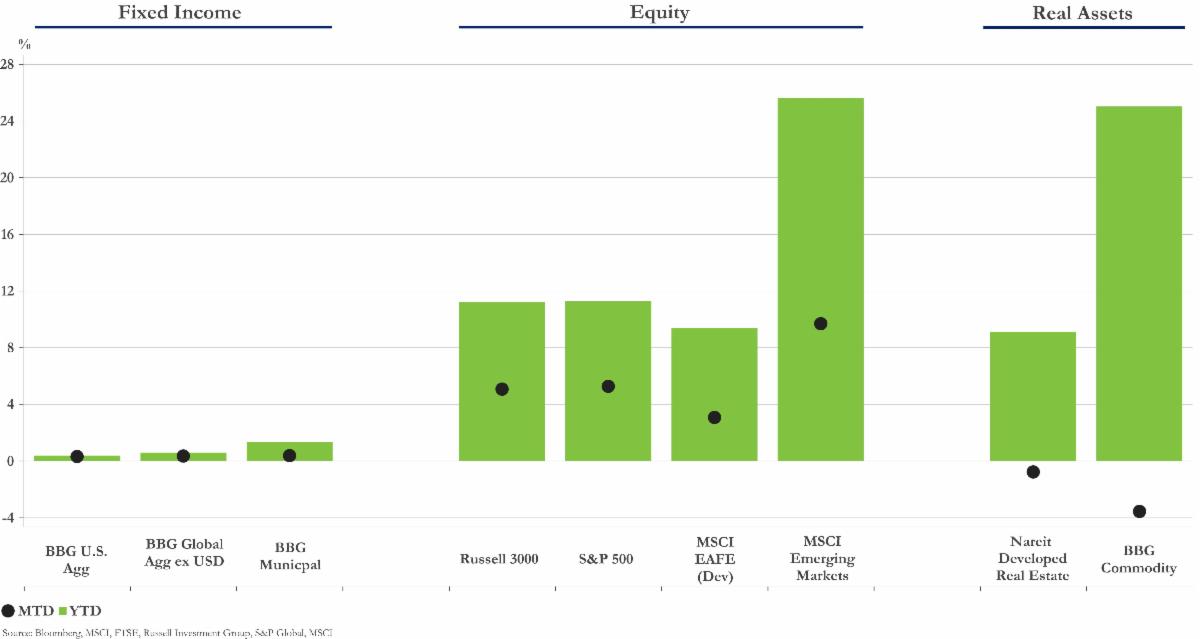
Asset Class Performance as of 5/31/2026

ECONOMY

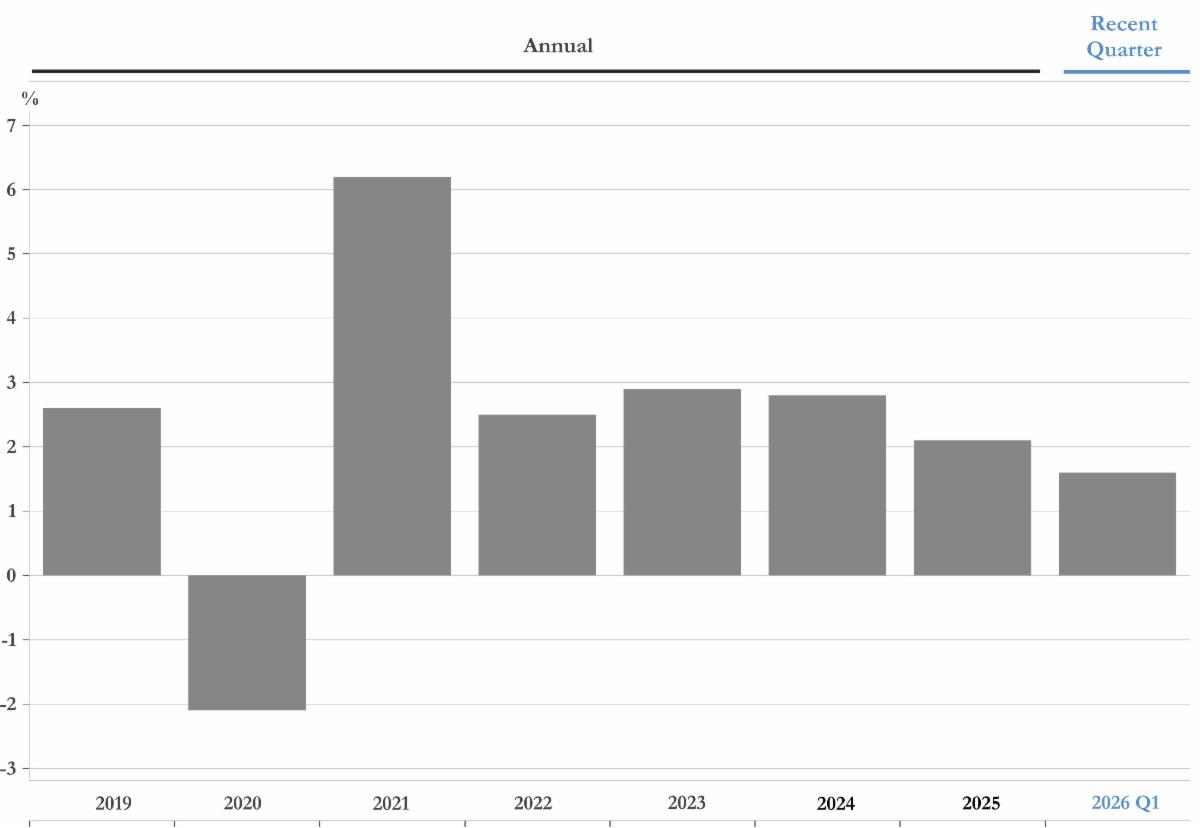
Solid U.S. Real GDP Growth in Q1


  • U.S. real GDP grew 2.6% year-over-year in Q1 2026, while annualized quarter-over-quarter growth was revised down to 1.6% from 2.0%, reflecting softer services consumption and weaker contributions from investment and inventories, partly linked to Middle East conflict disruptions.


  • Consumer spending slowed to 1.4% in Q1, but still improved sequentially from 0.5% in Q4, highlighting a more moderate but still positive contribution to overall growth amid rising inflation and declining sentiment.


  • Near-term growth expectations remained highly uncertain, with Fed nowcasting models diverging between roughly 1% and 4%, as markets await additional clarity from upcoming labor market and ISM data to assess the trajectory of Q2 growth and the implications for monetary policy.

U.S. GDP Growth

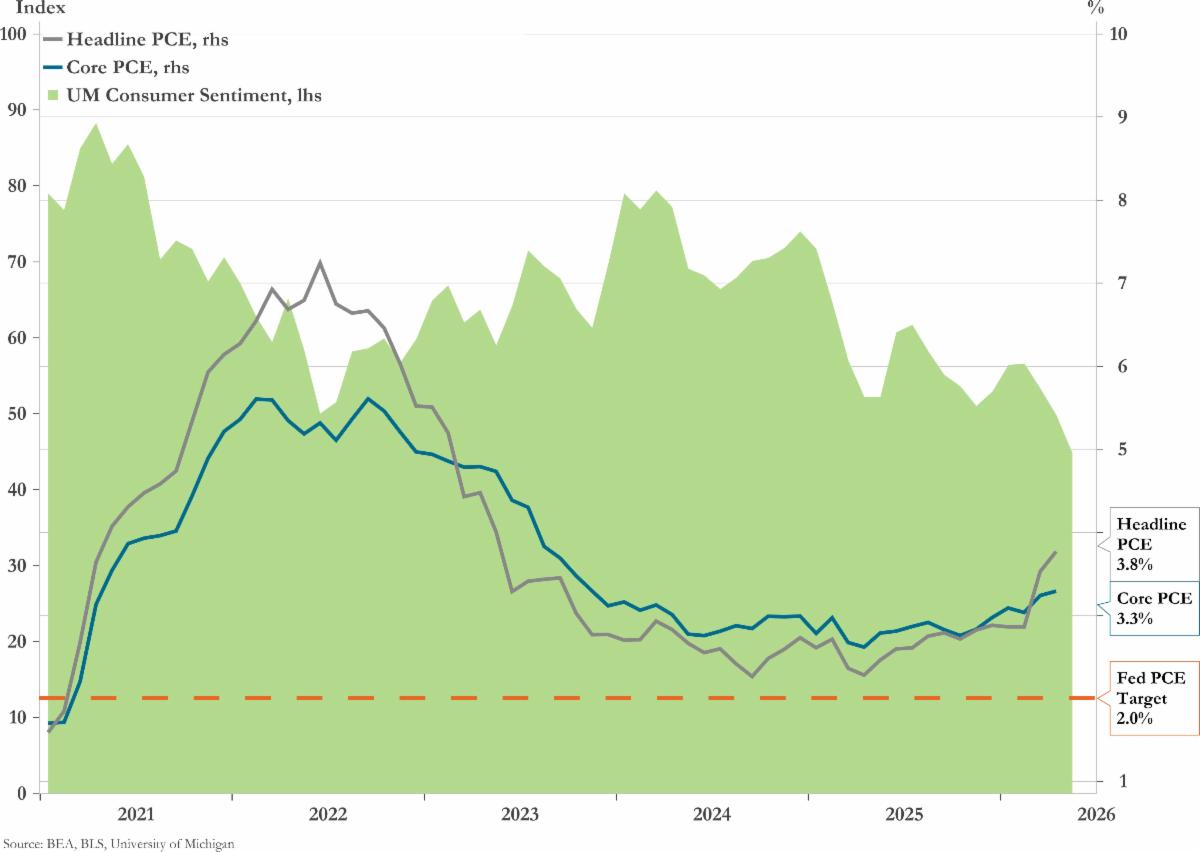
Consumer Confidence Weakens Further


  • Consumer confidence deteriorated in May, with the University of Michigan Sentiment Index falling to a record low of 44.8, marking a third straight decline and signaling increasing strain on household finances.


  • The decline was driven by rising gasoline prices tied to Strait of Hormuz disruptions, alongside elevated inflation expectations and broader cost pressures across essential goods and services.


  • Forward-looking sentiment weakened, with consumers increasingly concerned inflation will persist beyond energy and continue to erode purchasing power.


  • The divergence between resilient economic data and declining confidence points to a more cautious spending backdrop, reinforcing downside risks to consumption in the months ahead.


U.S. Consumer Sentiment and PCE Inflation

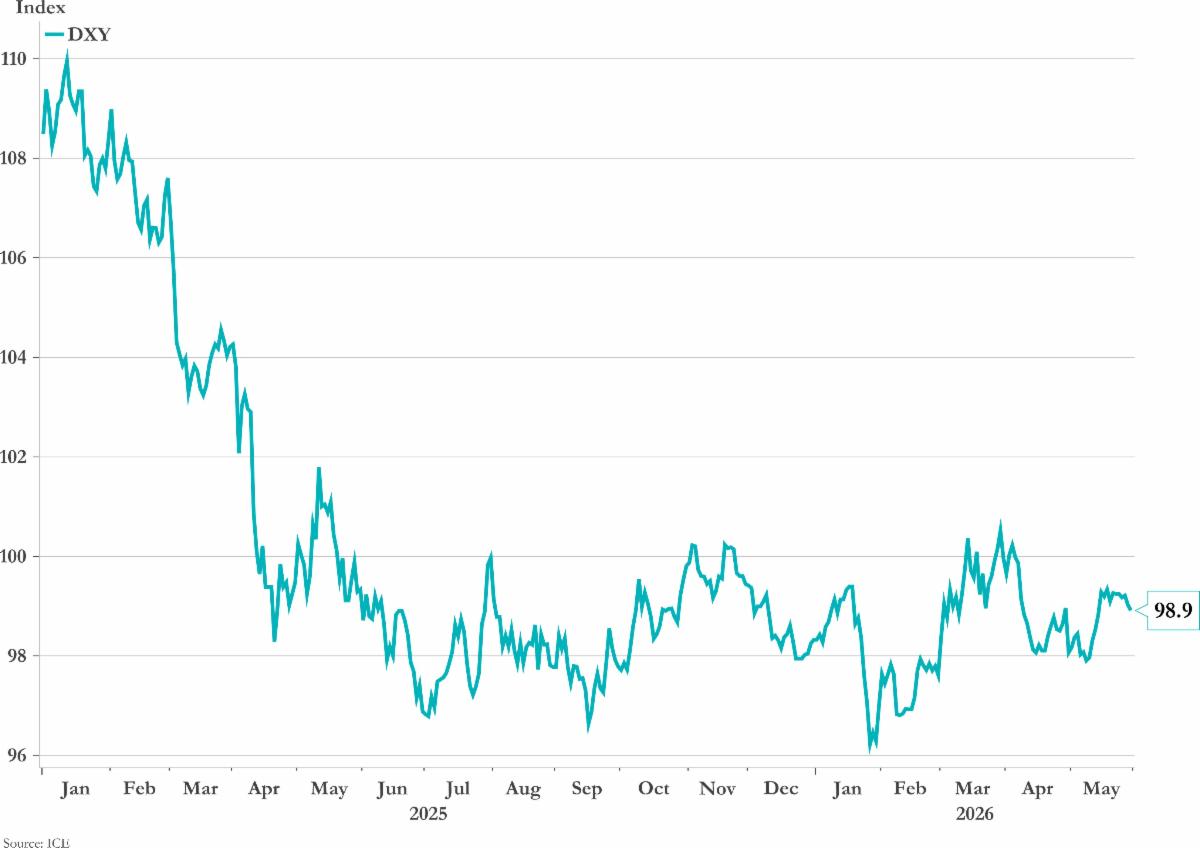
USD Bounces Back


  • The U.S. dollar strengthened modestly in May, with DXY rising 0.8% as shifting rate expectations and Fed repricing drove a mid-month advance and reversed earlier weakness.


  • Inflation surprises and more hawkish policy signals triggered a repricing toward a higher-for-longer rate environment, reinforcing dollar strength and contributing to its strongest weekly gain since March.


  • Persistent geopolitical uncertainty and elevated oil prices provided some safe-haven support, keeping the dollar near cycle highs and reinforcing a supportive backdrop as expectations for delayed rate cuts remain in place.


U.S. Dollar Index (DXY)

MARKETS

Equities Rallied in May


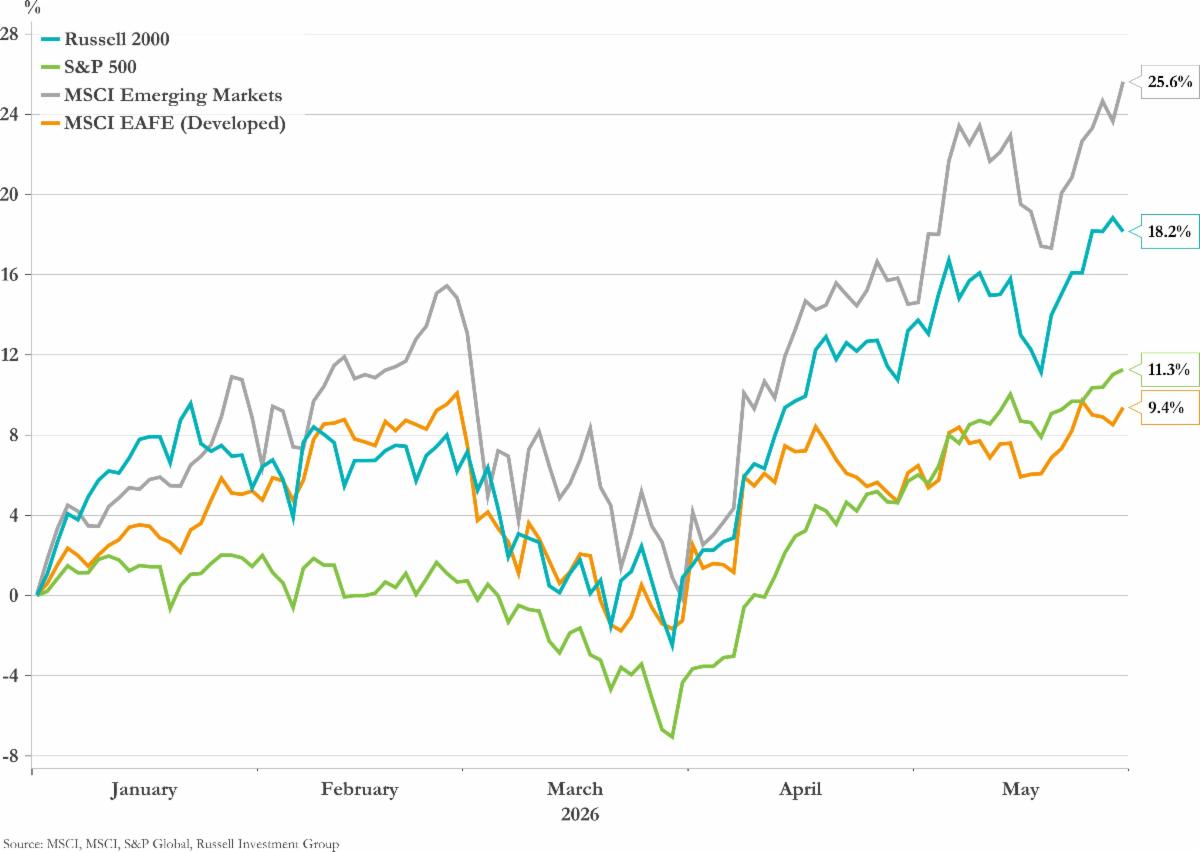
  • U.S. equity markets advanced in May, with major indices reaching new highs as the Nasdaq and S&P 500 delivered strong monthly gains, supported by continued earnings strength and sustained technology leadership.


  • AI-driven earnings momentum remained the primary driver of performance, with technology leading gains across sectors, while energy lagged amid oil price volatility tied to ongoing U.S.–Iran ceasefire negotiations.


  • Market breadth improved during the month, with small caps also advancing, while global performance remained uneven, as Asia and emerging markets outperformed and Europe lagged due to weaker growth dynamics and higher energy sensitivity.

Major Index Performance - Total Return

Fixed Income Market Stress


  • Treasury yields moved sharply higher during May, driven by persistent inflation, fiscal concerns, and geopolitical risk, with the 10-year approaching ~4.7% and the 30-year rising above 5.1% mid-month before retracing modestly.


  • A bear-steepening dynamic emerged as term premium and supply concerns pressured the long end of the curve, with the 10Y–2Y spread widening meaningfully.


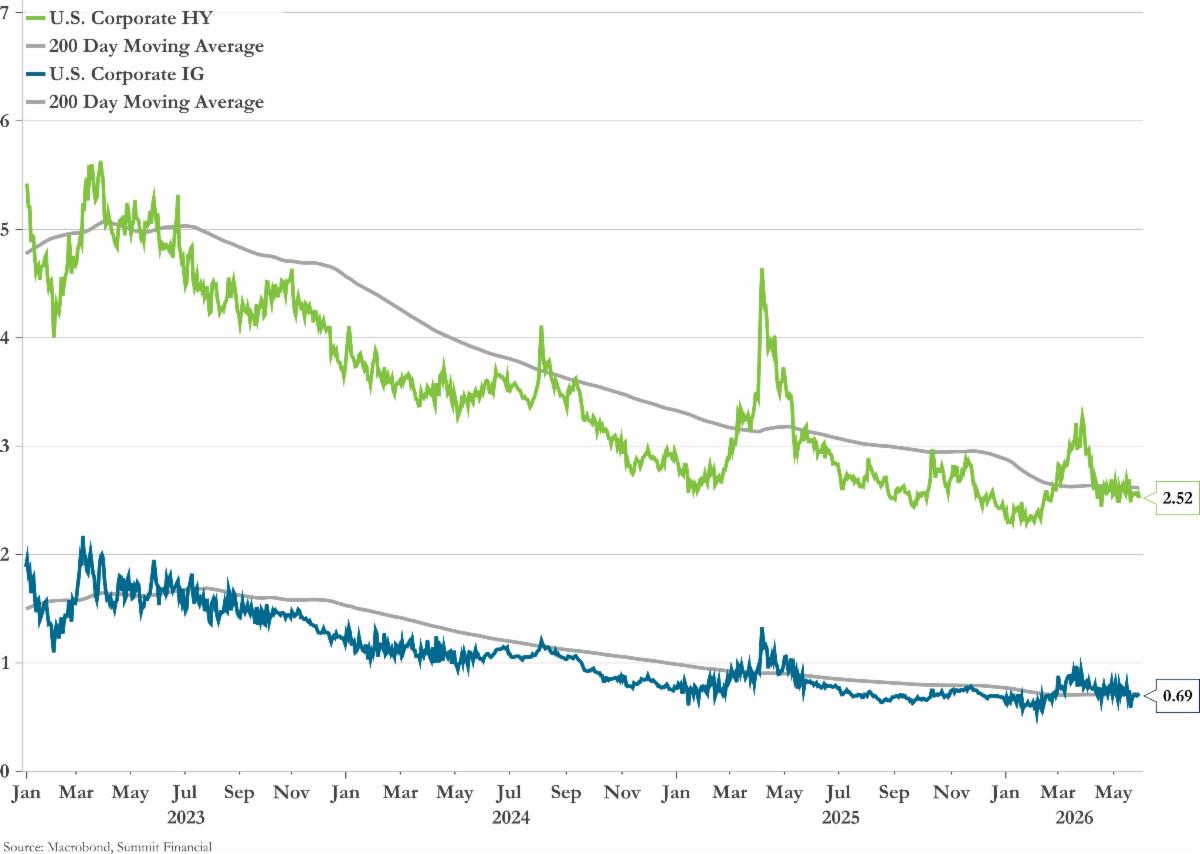
  • Credit markets remained relatively resilient despite higher rates, with investment-grade and high-yield spreads holding broadly stable, supported by solid corporate fundamentals and continued demand for income.


  • High yield performance masked underlying rate volatility, highlighting that market pressure remained concentrated in sovereign duration rather than credit risk.


Credit Spreads

Commodities Remain Volatile


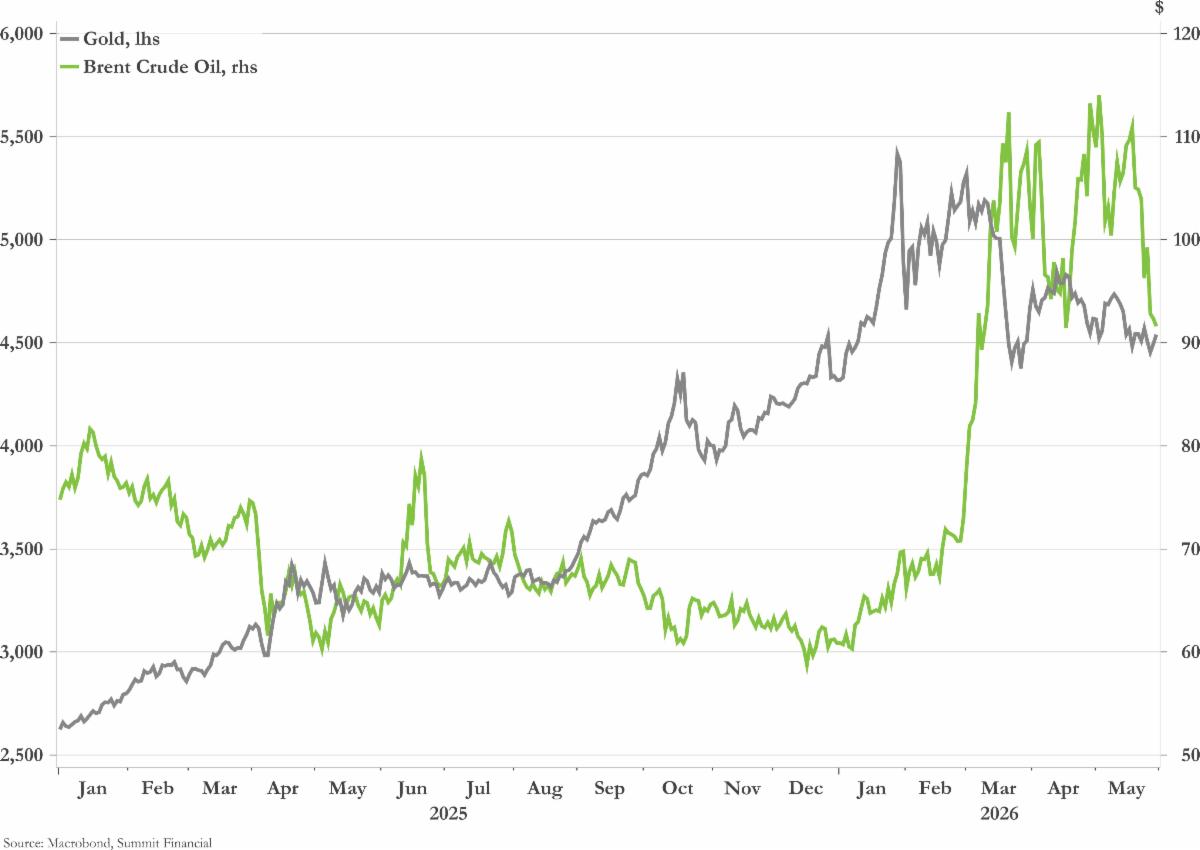
  • Commodity markets remained highly volatile in May, driven by the U.S.–Iran conflict and disruptions in the Strait of Hormuz, which created sharp swings in energy prices while supporting select non-energy commodities.


  • Oil prices spiked early on supply disruption fears before declining as ceasefire optimism, demand concerns, and alternative supply routes reduced geopolitical risk premia.


  • Precious metals experienced notable intra-month volatility but finished broadly unchanged, while wheat declined modestly amid softer demand and ample global supply.


  • Industrial metals were more resilient, with copper rising on strong demand tied to data-center build-outs and broader electrification trends.

Gold & Brent Crude Oil - Spot Prices

DISCLAIMER

Compliance Code: 8958308.1


This commentary was authored by the investment team at Summit Financial, LLC., an SEC Registered Investment Adviser (“Summit”), headquartered at 4 Campus Drive, Parsippany, NJ 07054, Tel. 973-285-3600. It is provided for your information and guidance and is not intended as specific advice and does not constitute an offer to sell securities. Summit is an investment adviser and offers asset management and financial planning services. Indices are unmanaged and cannot be invested into directly.


Data in this newsletter is obtained from sources which we, and our suppliers believe to be reliable, but we do not warrant or guarantee the timeliness or accuracy of this information. Consult your financial professional before making any investment decision. Past performance is no guarantee of future results.


Diversification/asset allocation does not ensure a profit or guarantee against a loss. Economic and market forecasts presented herein reflect our judgment as of the date of this presentation and are subject to change without notice. Any forecasts are subject to high levels of uncertainty that may affect actual performance. Accordingly, forecasts should be viewed as merely representative of a broad range of possible outcomes. Forecasts are estimated, based on assumptions, and are subject to significant revision and may change materially as economic and market conditions change. Forecasts do not take into account the specific investment objectives, restrictions, tax and financial situation or other needs of any specific client.

DEFINITIONS & DESCRIPTIONS


BBG U.S. Agg

Bloomberg U.S. Aggregate Bond Index

The Bloomberg U.S. Aggregate Bond Index is a broad-based flagship benchmark that measures the investment grade, U.S. dollar-denominated, fixed-rate taxable bond market. The index includes Treasuries, government-related and corporate securities, MBS (agency fixed-rate pass-throughs), ABS, and CMBS (agency and non-agency).


BBG Global Agg ex USD

Bloomberg Global Aggregate Index

The Bloomberg Global Aggregate Index is a flagship measure of global investment grade debt from twenty-four local currency markets. This multi-currency benchmark includes Treasury, government-related, corporate, and securitized fixed-rate bonds from both developed and emerging markets issuers.


BBG Municipal

Bloomberg Municipal Bond Index

The Bloomberg Municipal Bond Index covers the U.S. dollar-denominated long-term tax-exempt bond market. The index has four main sectors: state and local general obligation bonds, revenue bonds, insured bonds, and pre-refunded bonds.


Russell 3000

Russell 3000 Index

The Russell 3000 Index measures the performance of the largest 3,000 U.S. companies representing approximately 98% of the investable U.S. equity market. It is constructed to provide a comprehensive, unbiased, and stable barometer of the broad market and is completely reconstituted annually to ensure new and growing equities are included.


Russell 2000

Russell 2000 Index

The Russell 2000 Index measures the performance of the small-cap segment of the U.S. equity universe. It is a subset of the Russell 3000 Index repre-senting approximately 10% of the total market capitalization of that index. It includes approximately 2,000 of the smallest securities based on a combi-nation of their market cap and current index membership.


S&P 500

S&P 500 Index

The S&P 500 Index is a market capitalization-weighted index of 500 widely held stocks often used as a proxy for the stock market. It measures the movement of the largest issues. Standard and Poor’s chooses the member companies for the 500 based on market size, liquidity, and industry group representation. Included are the stocks of eleven different sectors.


MSCI EAFE (Dev)

MSCI EAFE Index

The MSCI EAFE Index (Europe, Australasia, Far East) captures large- and mid-cap representation across developed markets countries around the world, excluding the U.S. and Canada. The index covers approximately 85% of the free float-adjusted market capitalization in each country.


MSCI Emerging Markets

MSCI Emerging Markets Index

The MSCI Emerging Markets Index captures large- and mid-cap representation across emerging markets countries across the world. The index covers approximately 85% of the free float-adjusted market capitalization in each country.


HFRX Global HF

HFRX Global Hedge Fund Index

The HFRX Global Hedge Fund Index is comprised of funds representing the overall hedge fund universe. Constituent funds include but are not limited to convertible arbitrage, distressed securities, equity hedge, equity market neutral, event-driven, macro, merger arbitrage, and relative value arbitrage. The underlying strategies are asset-weighted based on the distribution of assets in the hedge fund industry.


Nareit Developed Real Estate

FTSE EPRA/NAREIT Developed Index

The FTSE EPRA/NAREIT Developed Index is designed to track the performance of listed real estate companies and REITS worldwide. Index constituents are free float-adjusted, subject to liquidity, size, and revenue screening for inclusion.


BBG Commodity

 Bloomberg Commodity Index

he Bloomberg Commodity Index reflects commodity futures price movements and is calculated on an excess return basis. The index rebalances annually weighted 2/3 by trading volume and 1/3 by world production, and weight-caps are applied at the commodity, sector, and group level for diversification. The roll period typically occurs from the 6th-10th business day based on the roll schedule.


Consumer Confidence Index

Conference Board Consumer Confidence Index

The Consumer Confidence Index is a measure based on a survey administered by The Conference Board that reflects prevailing business conditions and likely developments for the months ahead. This monthly report details consumer attitude, buying intentions, vacation plans, and consumer expectations for inflation, stock prices, and interest rates.


U.S. Dollar Index (DXY)

 U.S. Dollar Index (DXY)

The U.S. Dollar Index (DXY) is an index of the value of the United States dollar relative to a basket of foreign currencies, often referred to as a basket of U.S. trade partners' currencies. The Index goes up when the U.S. dollar gains "strength" (value) when compared to other currencies.


DJIA

Dow Jones Industrial Average

The Dow Jones Industrial Average (DJIA), commonly known as “The Dow”, is a price-weighted measure of 30 U.S. blue-chip companies. The index covers all industries except transportation and utilities.


ISM Manufacturing Index

ISM Manufacturing Index

The ISM Manufacturing Index, also known as the purchasing managers’ index (PMI), is a monthly indicator of U.S. economic activity based on a survey of executives covering all North American Industry Classification System’s businesses in the manufacturing sector.


ISM Non-Manufacturing Index

ISM Non-Manufacturing Index

The ISM Non-Manufacturing Index is a monthly indicator of U.S. economic activity based on a survey of executives covering all North American Industry Classification System’s businesses in the services (or non-manufacturing) sector.


QUESTIONS?

Our Wealth Management team is ready to answer your questions and help you prepare for your future with a suite of planning solutions focused on you.

View as Webpage


LinkedIn

6135 Memorial Drive Suite 103, Dublin, OH 43017 | 614.380.3800