|
Upcoming Events
Social Parent young kids meet-up
Thursday, July 31, 3:30 - 5pm
Greeley House Courtyard - Free registration
Castles of New Castle House Tour
Sunday, October 5 - Save the Date
| | Meet Mia Michelson-Bartlett, Our New Executive Director | | We are excited to welcome Mia Michelson-Bartlett as the recently appointed Executive Director of the New Castle Historical Society. She brings a wealth of experience in visitor engagement and cultural programming to her new role. She most recently served as the Assistant Director at the Armour-Stiner Octagon House in Irvington, NY. Prior to that, she was instrumental in leading educational and community events at iconic New York City landmarks, including the Cathedral of St. John the Divine and the High Line. Her diverse experience in fostering public connection to historic and cultural sites promises an exciting new chapter for the New Castle Historical Society. | | From left to right: Executive Director Mia Michelson-Bartlett, President Clinton Smith, Vice President Barbara Romeo | | |
What excites you most about stepping into the role of Executive Director at the New Castle Historical Society, and what do you see as your immediate priorities?
I'm thrilled to be part of an organization that has such a rich history and an enthusiastic community around it. The board and the staff who have come before me established a really strong foundation, and there's so much potential for growth. 2026 marks the 60th anniversary of the founding of NCHS and the 250th anniversary of the Declaration of Independence, so one of my immediate priorities is to make sure we are ready to mark those milestones thoughtfully and in collaboration with the New Castle community. It's going to mean establishing partnerships and thinking about what these anniversaries mean for us collectively.
Local historical societies play a vital role in preserving and sharing a community's unique story. How do you envision the New Castle Historical Society engaging with the New Castle community to make local history relevant and accessible to everyone?
We have to actively reach out to the community -- we can't just wait for them to seek us out. Creating digital resources, partnering with other local organizations, and truly becoming part of the everyday life of New Castle will put us front and center in people's minds. History feels relevant and accessible when it's visible. The more visible we can be in the community, the more relevant and accessible local history will feel for everyone. It's an exciting opportunity to be able to shape the way NCHS tackles this challenge in the coming years.
| Parade celebrating Chappaqua's bicentennial on September 6, 1930 | |
Many historical societies face challenges related to funding, volunteer engagement, and adapting to new technologies. What strategies do you plan to implement to ensure the long-term sustainability and continued growth of the New Castle Historical Society?
I think that all of these relate to one another. Today's technology can allow us to share our collection and our stories far beyond the limits of the Horace Greeley House and even New Castle. The work that we're currently doing to digitize our collection is a powerful start, and we're simultaneously working toward making this information more accessible via our website and other digital channels. As already noted, visibility is key! People want to see what they're supporting, either with their time or their dollars. My hope is that as we employ new technologies to help advance the work that NCHS has been doing for nearly 60 years, more people will feel compelled and able to be part of that work, and we'll see that reflected in volunteer hours and funding channels. The more resources we have -- both human and financial -- the more impact we can have.
If the New Castle Historical Society had a mascot, what do you think it should be and why?
A kangaroo. Thanks to a recent email inquiry, I now know that a couple rogue kangaroos caused quite a stir in Chappaqua in August of 1927. The town arranged hunting parties and exerted a lot of effort to track them down, but it took months to finally catch them. According to the New Castle Tribune in April 1928, "All around the Nation, the words kangaroo and Chappaqua became analogous," so I can't think of a better mascot. I guess we'll have to add the anniversary of the Chappaqua kangaroos to the calendar!
When you're not busy preserving history, what's your favorite way to relax?
When I have the time, I love to go hiking and camping - anything that gets me outside. In my day to day, I spend a lot of time knitting, cooking, and throwing pottery. I guess I find relaxation in doing things!
| | Social Parent Meet-Up: Thursday, July 31 | | |
Join us at the Horace Greeley House on Thursday, July 31, 3:30 - 5:00 pm for a garden meet-up for young kids and their parents!
We are teaming up with Social Parent to transform our courtyard into a play space with bubbles, sidewalk chalk, a water table, and more under a shady canopy. Social Parent organizes gatherings and events for local expecting and young families. They also host private WhatsApp groups for new parents based on your baby or toddler's year of birth. Reach out to learn more!
REGISTER HERE for this free event and to learn more about Social Parent.
| | New Collections Assistants Accelerate Digitization Drive | | |
It’s been a busy few months as we’ve welcomed our new Collections Assistants, Diane Myers (left) and Sheli Thomases (right), who have been doing a fantastic job inventorying, photographing, and digitizing the collection. From uncovering hidden gems to meticulously documenting them in our collections database, CatalogIt, their hard work is bringing the collection to life in exciting new ways!
A big thank you as well to our two Horace Greeley High School Capstone students, Philip Childs and Ethan Vargas, who spent three weeks with us developing engaging research and activities for our younger audiences — your creativity and enthusiasm made a real impact.
And finally, a heartfelt thank you to Kari Weis for all her time and contributions during her time with us — we wish her all the best as she moves on to exciting new pastures!
| |
Historic Places of New Castle
The Railroad Station That Almost Wasn't
by Gray Williams, Town Historian
| | By the turn of the 20th century, the village of Chappaqua had outgrown its railroad station (figure 1). The 30-year-old station building could no longer serve its users properly, particularly the increasing number of passengers, and its site on North Greeley Avenue, hemmed in by local businesses, was too small to accommodate a larger replacement. There was a growing feeling in the community that a new station was needed on a new and larger site. | | |
In the summer of 1901, Gabrielle Greeley Clendenin and her husband the Reverend Dr. Frank M. Clendenin generously offered a site on part of the farm that Gabrielle had inherited from her father, Horace Greeley. A committee spearheaded by local estate owners (known as “hilltoppers”) such as George D. MacKay, Hugh Douglas, and Frank M. Valentine circulated a petition to the railroad in support of the proposal. By the end of July, they had gathered several hundred signatures – a strong showing of community sentiment.1
But that support was not universal. Several local business proprietors were vehemently opposed to moving the station from the village center, fearing that it would cost them their customers. One of the most determined of these critics was Wilbur Hyatt, who was the owner of a livery stable directly across the street, and whose family operated the nearby hotel, with its popular bar room. He complained of the new site to a reporter, “It’s no place, no place at all. It’s clear away from the heart of the village. What do they want to poke it off there for? Here’s the hotel and the livery stable and Seigle’s [sic] store and the castor factory. Here’s everything and here’s where the station should be.”2
On July 30, Hyatt and his colleagues submitted a petition of their own to the railroad.3 Over the next two weeks, the railroad placed further conditions upon accepting the Clendenins’ proposal, including a commitment of some $4,000 from the town for drainage and other site preparation. At a public meeting on August 13 to discuss this expense, someone suggested that Dr. Clendenin had “mercenary motives for offering the site.” Dr. Clendenin, who was present, “rose and left the meeting without a word.” The next morning, he went alone to the railroad offices in New York City. He personally pledged the required $4,000 and demanded an immediate decision concerning the property offer. The railroad yielded, and construction of the station would begin almost immediately.4
On August 15, the Clendenins issued a gracious public statement in the local newspaper:
We ask through your paper to thank our friends and neighbors who have taken so public spirited an interest in moving the Station to larger and better surroundings. Until we became convinced it was the desire of the large majority of the people of Chappaqua, we made no effort to have our offer of land accepted by the New York Central.
When we found that the greater number desired this change, and feeling deeply it was for the welfare of all who live in or about Chappaqua, as well as to our own interest, we concluded not only to give the land but also to provide all expenses required by the Railroad to move the station, so that there would be no burden placed on anyone, especially on those who so generously came forward to help.
We have arranged to give to the town a broad macadam roadway to the station and to dedicate to the people of Chappaqua a Park in front of this station, asking that they beautify and improve it in the way they deem best.
With a substantial stone station and its appropriate surroundings of park and fields and hills we believe Chappaqua will move forward to a new era of enterprise and prosperity that will benefit all who live here, whether they have been for or against this undertaking, and our town becomes the beautiful and prosperous place it ought to be.5
In the late winter of 1902, when construction of the station was almost complete, a group of local malcontents, mainly from the Mt. Kisco part of town, almost succeeded in derailing at least part of the project. They had enough votes in an incomplete quorum of the town board to refuse the Clendenins’ offer of the access road and the park.6 Fortunately, the full board, not long after, reversed this ill-considered decision.
| | |
By the beginning of summer, the new station was ready for occupancy. On June 14, it was formally dedicated, with great ceremony. Charles W. Page, who was not only the owner of the largest store in town but also an expert photographer, took this picture of the festivities from the limestone crag just south of the site (figure 2).
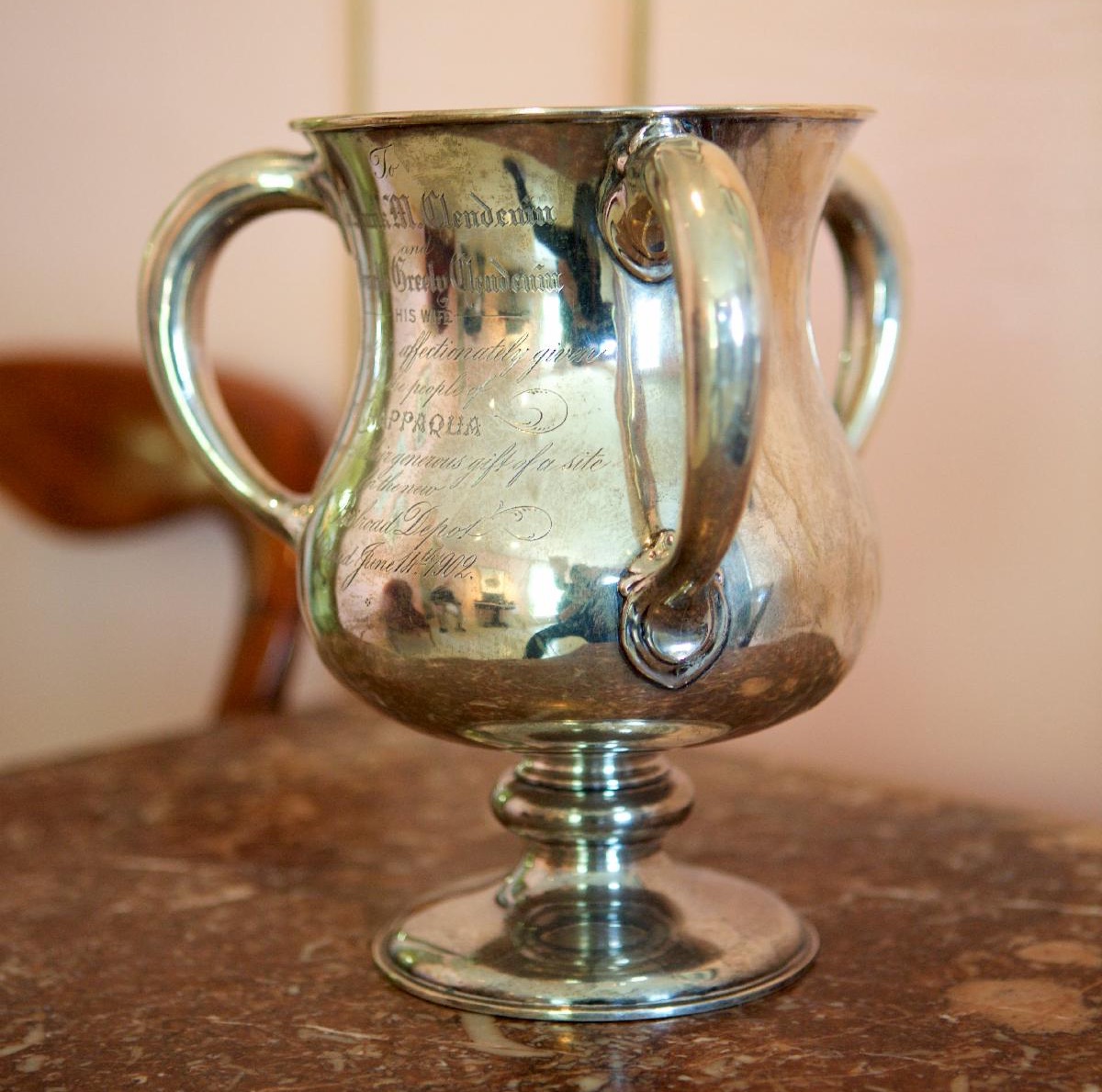
In gratitude to the Clendenins, the town presented them with a large engraved silver cup. It is now in the possession of the historical society and on display at the Horace Greeley House (figure 3). It was, and is, very impressive, but with one minor flaw: The engraver of the inscription misspelled Gabrielle’s maiden name “Greely.” At the time, nobody may have noticed. At least nobody complained.
| | |
1 “Chappaqua All Torn Up,” New York Sun, July 28, 1901.
2 Idem.
3 Letter from Charles Haines, Attorney for the Petitioners, to W.J. Wilgus, Chief Engineer, New York City and Harlem Railroad, July 30, 1901. Copy in the archives of the New Castle Historical Society.
4 “New Station for Chappaqua,” New York Sun, August 15, 1901.
5 The Item, August 15, 1901.
6 “Chappaqua in a Quandary,” New York Times, February 14, 1902.
| |
| |
Museum Shop
For the perfect gift, check out our Museum Store collection of locally inspired products.
| | | | | | |